

The DOI matches its Crossref record; 252 of the 252 references it cites were found in a registry or an index.
Putting CRISPR-Cas system in action: a golden window for efficient and precise genome editing for crop improvement
Open accessAbstract
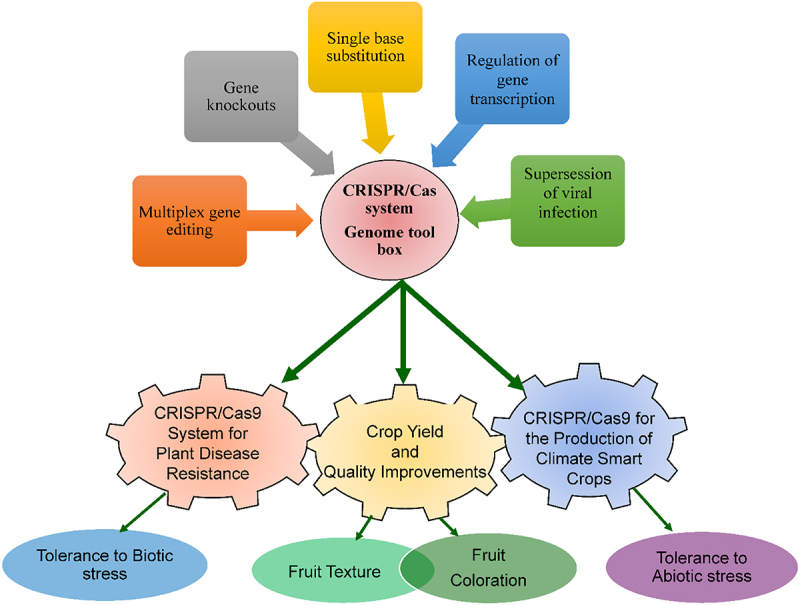
The daunting task of feeding an ever-growing population is an immense challenge for the contemporary scientific community, especially in view of the rapidly changing climate throughout the world. Amidst these threatening crises, we witness rapid development in genome editing (GE) technologies, revolutionizing the field of applied genomics and molecular breeding. Various GE tools have been developed during the last two decades, but the CRISPR/Cas system has most recently made a significant impact on crop improvement. The major breakthroughs of this versatile toolbox are genomic modifications like single base-substitutions, multiplex GE, gene regulation, screening mutagenesis, and enhancing the breeding of wild crop plants. Previously, this toolbox was used to modify genes related to significant traits such as biotic/abiotic resistance/tolerance, post-harvest traits, nutritional regulation, and to address self-incompatibility analysis-related challenges. In the present review, we have demonstrated the functional dynamics of CRISPR-based GE and its applicability in targeting genes to accomplish novel editing of crops. The compiled knowledge will provide a solid foundation for highlighting the primary source for applying CRISPR/Cas as a toolbox for enhancing crops, to achieve food and nutritional security.
Overview
The claims and statistics of this paper haven’t been checked yet.
Run the check — free, no account needed. It reads the open-access text and checks the sources it cites.
Integrity signals
Registry
Cites
Statistics
Figures
Verification
Claims the paper makes
The claims and statistics of this paper haven’t been checked yet.
Run the check — free, no account needed. It reads the open-access text and checks the sources it cites.
Claims other papers make about this one
Each is checked against this paper’s own text: does it say what the citing paper says it does?
The check wasn’t confident either way, so it gives no verdict — never disputed.
In the citing paper
“These HMs in diverse soils may be emitted from coal mines, petrochemical spillages, metal disposals, industrial areas, animal manures, atmospheric depositions, and sewage-sludge treatment plants (Adeyemi, 2021; Oladoye et al., 2021; Tariq et al., 2023).”
From Plant hyperaccumulators: a state-of-the-art review on mechanism of heavy metal transport and sequestration (2025) · cites this paper as Tariq et al., 2023
Experimental — accuracy not yet measured
Self-check
Percentages, sums and reported differences re-computed from the paper’s own numbers.
The self-check needs the paper’s full text.
Citations
Cites
A Programmable Dual-RNA–Guided DNA Endonuclease in Adaptive Bacterial Immunity
Jinek, M., Chylinski, K., Fonfara, I., Hauer, M., Doudna, J. A., & Charpentier, E. (2012) · Science · doi:10.1126/science.1225829 · Cited by 17,116
Multiplex Genome Engineering Using CRISPR/Cas Systems
Cong, L., Ran, F. A., Cox, D., Lin, S., Barretto, R., Habib, N., Hsu, P. D., Wu, X., Jiang, W., Marraffini, L. A., et al. (2013) · Science · doi:10.1126/science.1231143 · Cited by 15,339
RNA-Guided Human Genome Engineering via Cas9
Mali, P., Yang, L., Esvelt, K. M., Aach, J., Guell, M., DiCarlo, J. E., Norville, J. E., & Church, G. M. (2013) · Science · doi:10.1126/science.1232033 · Cited by 9,210
Genome-scale CRISPR-Cas9 knockout screening in human cells
Shalem, O., Sanjana, N. E., Hartenian, E., Shi, X., Scott, D. A., Mikkelsen, T. S., Heckl, D., Ebert, B. L., Root, D. E., Doench, J. G., et al. (2014) · Science · doi:10.1126/science.1247005 · Cited by 5,234
Search-and-replace genome editing without double-strand breaks or donor DNA
Anzalone, A. V., Randolph, P. B., Davis, J. R., Sousa, A. A., Koblan, L. W., Levy, J. M., Chen, P. J., Wilson, C., Newby, G. A., Raguram, A., et al. (2019) · Nature · doi:10.1038/s41586-019-1711-4 · Cited by 4,767
Cpf1 Is a Single RNA-Guided Endonuclease of a Class 2 CRISPR-Cas System
Zetsche, B., Gootenberg, J. S., Abudayyeh, O. O., Slaymaker, I. M., Makarova, K. S., Essletzbichler, P., Volz, S. E., Joung, J., van der Oost, J., Regev, A., et al. (2015) · Cell · doi:10.1016/j.cell.2015.09.038 · Cited by 4,761
CRISPR-Cas12a target binding unleashes indiscriminate single-stranded DNase activity
Chen, J. S., Ma, E., Harrington, L. B., Da Costa, M., Tian, X., Palefsky, J. M., & Doudna, J. A. (2018) · Science · doi:10.1126/science.aar6245 · Cited by 4,507
Programmable base editing of A•T to G•C in genomic DNA without DNA cleavage
Gaudelli, N. M., Komor, A. C., Rees, H. A., Packer, M. S., Badran, A. H., Bryson, D. I., & Liu, D. R. (2017) · Nature · doi:10.1038/nature24644 · Cited by 4,184
High-Frequency off-Target Mutagenesis Induced by CRISPR-Cas Nucleases in Human Cells
Fu, Y., Foden, J. A., Khayter, C., Maeder, M. L., Reyon, D., Joung, J. K., & Sander, J. D. (2013) · Nature Biotechnology · doi:10.1038/nbt.2623 · Cited by 3,292
Gasiunas, G., Barrangou, R., Horvath, P., & Siksnys, V. (2012) · Proceedings of the National Academy of Sciences · doi:10.1073/pnas.1208507109 · Cited by 2,769
Research works printed but not linked: 1
- Kumar A. Application, Regulation, Ethical Concerns and Governance of Genome-Editing Technologies: an Overview. Asian Biotechnology & Development Review. 2019;21.
Cited by
Sorted by citations
Trehalose: A sugar molecule involved in temperature stress management in plants
Raza, A., Bhardwaj, S., Rahman, M. A., García‐Caparrós, P., Habib, M., Saeed, F., Charagh, S., Foyer, C. H., Siddique, K. H. M., & Varshney, R. K. (2023) · The Crop Journal · doi:10.1016/j.cj.2023.09.010 · Cited by 120
Self-citationAli, S., Mir, R. A., Haque, M. A., Danishuddin, Almalki, M. A., Alfredan, M., Khalifa, A. Y. Z., Mahmoudi, H., Shahid, M., Tyagi, A., et al. (2025) · Frontiers in Plant Science · doi:10.3389/fpls.2025.1565635 · Cited by 114
Self-citationNano‐enabled stress‐smart agriculture: Can nanotechnology deliver drought and salinity‐smart crops?
Raza, A., Charagh, S., Salehi, H., Abbas, S., Saeed, F., Poinern, G. E. J., Siddique, K. H. M., & Varshney, R. K. (2023) · Journal of Sustainable Agriculture and Environment · doi:10.1002/sae2.12061 · Cited by 104
Self-citationBhat, B. A., Rather, M. A., Bilal, T., Nazir, R., Qadir, R. U., & Mir, R. A. (2025) · Frontiers in Plant Science · doi:10.3389/fpls.2025.1631378 · Cited by 68
“These HMs in diverse soils may be emitted from coal mines, petrochemical spillages, metal disposals, industrial areas, animal manures, atmospheric depositions, and sewage-sludge treatment plants (Adeyemi, 2021; Oladoye et al., 2021; Tariq et al., 2023).”
Self-citationTemperature‐smart plants: A new horizon with omics‐driven plant breeding
Raza, A., Bashir, S., Khare, T. R., Karikari, B., Copeland, R. G. R., Jamla, M., Abbas, S., Charagh, S., Nayak, S. N., Djalović, I. G., et al. (2024) · Physiologia Plantarum · doi:10.1111/ppl.14188 · Cited by 59
Self-citation
Metadata
- Authors
- Tariq, A., Mushtaq, M., Yaqoob, H., Bhat, B. A., Zargar, S. M., Raza, A., Ali, S., Charagh, S., Mubarik, M. S., Zaman, Q. U., Prasad, P. V., & Mir, R. A.
- Affiliations
- Baba Ghulam Shah Badshah University (IN)
- Shoolini University (IN)
- Cluster University Srinagar (IN)
- Sher-e-Kashmir University of Agricultural Sciences and Technology of Kashmir (IN)
- Fujian Agriculture and Forestry University (CN)
- Yeungnam University (KR)
- Chinese Academy of Agricultural Sciences (CN)
- University of Narowal (PK)
- Hainan University (CN)
- Kansas State University (US)
- Central University of Kashmir (IN)
- Corresponding author
- Zargar, Sajad Majeed
- Raza, Ali
- Mir, Rakeeb Ahmad
- ORCID
- Venue
- GM Crops & Food
- Publisher
- Informa UK Limited
- Published
- 2023-06-08
- Volume
- 14
- Issue
- 1
- Pages
- 1-27
- ISSN
- 2164-5698 (ISSN-L)
- 2164-5701
- PMC
- PMC10251801
- OpenAlex
- W4379769205
- Cited by
- 45
- References
- 252
- Citations by year
- 2026: 12 · 2025: 18 · 2024: 10 · 2023: 5
- FWCI
- 1.19
- Type
- journal article
- Language
- en
- Open access
- gold
- doi.org
- Licence
- Locations
- GM crops & food (publishedVersion, cc-by)
- PubMed Central (publishedVersion, cc-by)
- PubMed (publishedVersion)
- DOAJ (DOAJ: Directory of Open Access Journals) (submittedVersion, cc-by-sa)
- Funders
- no external funding
- Topics
- Life Sciences › Biochemistry, Genetics and Molecular Biology › Molecular Biology › CRISPR and Genetic Engineering
- Life Sciences › Agricultural and Biological Sciences › Plant Science › Genetically Modified Organisms Research
- Life Sciences › Agricultural and Biological Sciences › Plant Science › Plant Genetic and Mutation Studies
- Keywords
- CRISPR/Cas genome editing, crop improvement, plant breeding, single base substitution, multiplex genome editing, gene expression regulation, mutagenesis screening, nutritional properties, self-incompatibility, food security
- MeSH terms
- Plant Breeding, Gene Editing, Crops, Agricultural, Genome, Plant, Plants, Genetically Modified, CRISPR-Cas Systems
About these checks
Registry, retraction, Cites and statistics results are computed, not judged, with one exception: a printed reference that no index lists is read once by a model before it counts as a citation error. Claims are extracted by a model and kept only when their quote appears verbatim in the text; each cited source is then checked, with a model’s help, for whether it says what the claim relies on. Those verdicts can be wrong — read the claim’s quote and the cited source before relying on one.
Statistics and arithmetic are recomputed, not judged.
Confidence bands are shown only for fields calibrated on our annotated test set. None is calibrated yet, so no band is shown.
What counts as a claim ›How we measure confidence ›How we check this ›
Are you an author, or do you see a problem with this page? Request a review
