

The DOI matches its Crossref record; 3 of the 3 references it cites were found in a registry or an index.
SARS-CoV-2 Omicron variant shows less efficient replication and fusion activity when compared with Delta variant in TMPRSS2-expressed cells
Open accessAbstract
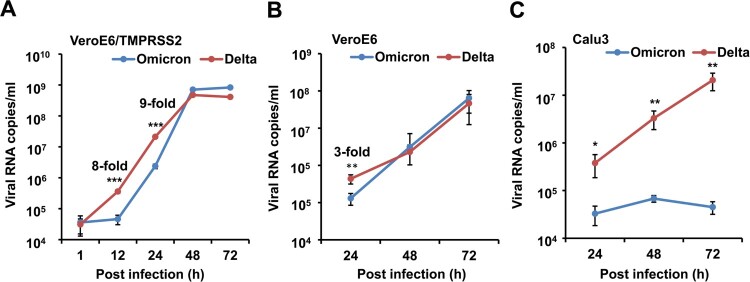
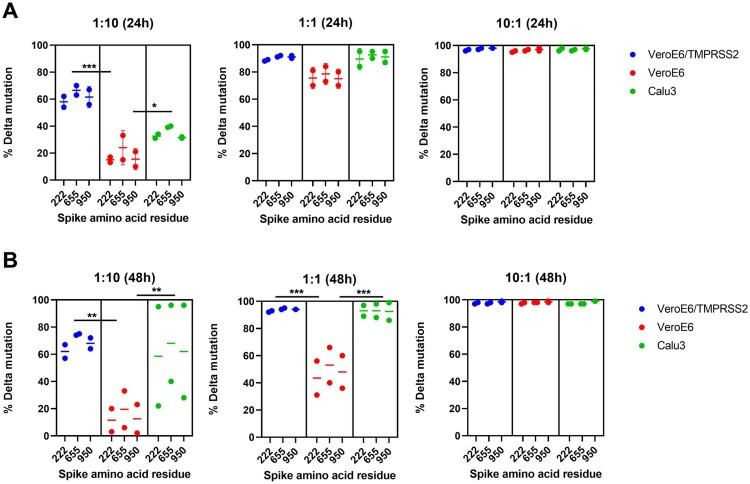
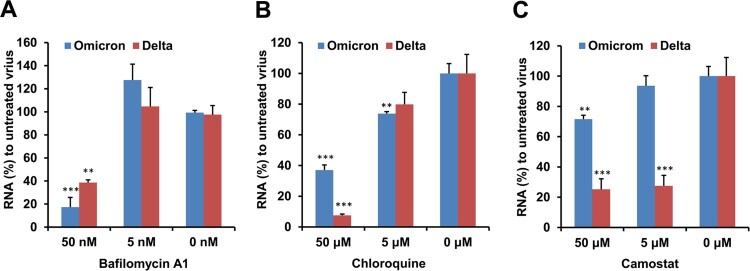
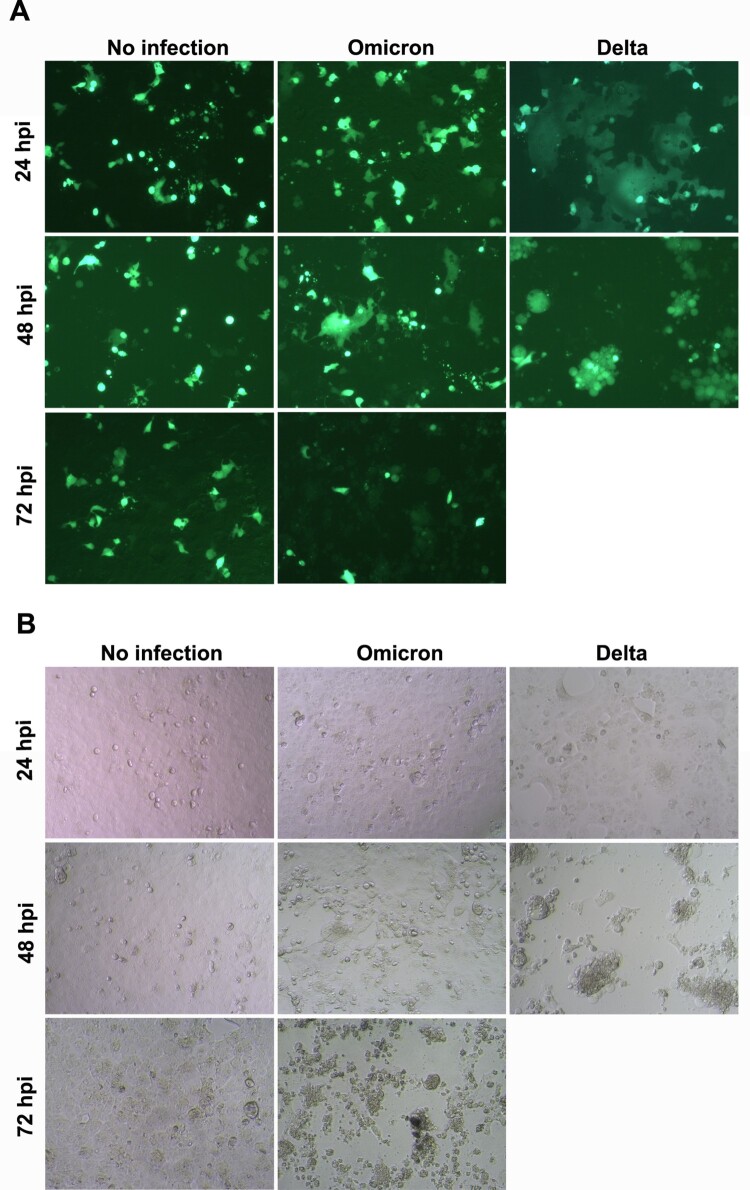
The novel SARS-CoV-2 Omicron variant (B.1.1.529), first found in early November 2021, has sparked considerable global concern and it has >50 mutations, many of which are known to affect transmissibility or cause immune escape. In this study, we sought to investigate the virological characteristics of the Omicron variant and compared it with the Delta variant which has dominated the world since mid-2021. Omicron variant replicated more slowly than the Delta variant in transmembrane serine protease 2 (TMPRSS2)-overexpressing VeroE6 (VeroE6/TMPRSS2) cells. Notably, the Delta variant replicated well in Calu3 cell line which has robust TMPRSS2 expression, while the Omicron variant replicated poorly in this cell line. Competition assay showed that Delta variant outcompeted Omicron variant in VeroE6/TMPRSS2 and Calu3 cells. To confirm the difference in entry pathway between the Omicron and Delta variants, we assessed the antiviral effect of bafilomycin A1, chloroquine (inhibiting endocytic pathway), and camostat (inhibiting TMPRSS2 pathway). Camostat potently inhibited the Delta variant but not the Omicron variant, while bafilomycin A1 and chloroquine could inhibit both Omicron and Delta variants. Moreover, the Omicron variant also showed weaker cell-cell fusion activity when compared with Delta variant in VeroE6/TMPRSS2 cells. Collectively, our results suggest that Omicron variant infection is not enhanced by TMPRSS2 but is largely mediated via the endocytic pathway. The difference in entry pathway between Omicron and Delta variants may have an implication on the clinical manifestations or disease severity.
Overview
The claims and statistics of this paper haven’t been checked yet.
Run the check — free, no account needed. It reads the open-access text and checks the sources it cites.
Integrity signals
Registry
Cites
Statistics
Figures
Verification
Claims the paper makes
The claims and statistics of this paper haven’t been checked yet.
Run the check — free, no account needed. It reads the open-access text and checks the sources it cites.
Claims other papers make about this one
Each is checked against this paper’s own text: does it say what the citing paper says it does?
The cited source says what the claim attributes to it.
In the citing paper
“suggesting entry selectivity of variants is associated with clinical manifestation [67].”
From Insights of Endocytosis Signaling in Health and Disease (2023) · cites this paper as [67]
The cited source says what the claim attributes to it.
In the citing paper
“Current evidence suggests that pharmacological inhibition of endocytic pathways potentially regressed replication of novel SARS-CoV-2 lineage B.1.1.529 (Omicron variant) in VeroE6/TMPRSS2 cell, suggesting entry selectivity of variants is associated with clinical manifestation [67].”
From Insights of Endocytosis Signaling in Health and Disease (2023) · cites this paper as [67]
Self-check
Percentages, sums and reported differences re-computed from the paper’s own numbers.
The self-check needs the paper’s full text.
Citations
Cites
Letko, M., Marzi, A., & Munster, V. (2020) · Nature Microbiology · doi:10.1038/s41564-020-0688-y · Cited by 3,109
HCA Lung Biological Network, Sungnak, W., Huang, N., Bécavin, C., Berg, M., Queen, R., Litvinukova, M., Talavera-López, C., Maatz, H., Reichart, D., et al. (2020) · Nature Medicine · doi:10.1038/s41591-020-0868-6 · Cited by 2,501
Increased risk of SARS-CoV-2 reinfection associated with emergence of Omicron in South Africa
Pulliam, J. R. C., van Schalkwyk, C., Govender, N., Gottberg, A. V., Cohen, C., Groome, M. J., Dushoff, J., Mlisana, K., & Moultrie, H. (2021) · doi:10.1101/2021.11.11.21266068 · Cited by 1,037
Research works printed but not linked: 23
- 10.1016/S1473-3099(20)30196-1 · DOI
- 10.1016/S0140-6736(20)30154-9 · DOI
- 10.1016/j.cell.2021.02.053 · DOI
- 10.1038/s41467-020-20457-w · DOI
- 10.1038/s41586-021-03925-1 · DOI
- 10.1016/j.cell.2020.02.052 · DOI · Paper page
- 10.1038/s41467-021-21825-w · DOI
- 10.1038/s42003-021-02640-x · DOI
- 10.1093/cid/ciaa1275 · DOI · Paper page
- 10.1016/j.ebiom.2021.103544 · DOI
- 10.1093/cid/ciab656 · DOI
- 10.1101/2021.11.11.21266068:2021.11.11.21266068 · DOI
- 10.1016/S0140-6736(21)02758-6 · DOI
- 10.1016/j.lanwpc.2021.100360 · DOI
- 10.1016/j.ebiom.2021.103643 · DOI
- 10.1038/s41580-021-00418-x · DOI · Paper page
- 10.1038/s41586-021-04266-9 · DOI
- 10.1038/s41564-021-00908-w · DOI
- 10.1016/j.celrep.2021.109825 · DOI
- 10.1126/science.abl9463 · DOI
- 10.1038/s41586-021-03491-6 · DOI
- 10.1371/journal.ppat.1009820 · DOI
- 10.1038/s41586-020-2575-3 · DOI
Cited by
Sorted by citations
Items 301–337 of 337
Vu, M. N., Alvarado, R. E., Morris, D. R., Lokugamage, K. G., Zhou, Y., Morgan, A. L., Ahearn, Y. P., Hazell, N. C., Estes, L. K., McLeland, A. M., et al. (2026) · Nature Communications · doi:10.1038/s41467-026-76680-4 · Cited by 21
“These differences in plaque size and stock titers are consistent with observations of most Omicron strains 30 – 33 .”
Serial cycle threshold to assess the infectious potential of SARS-CoV-2: A systematic review
Rosca, E., Oke, J., Jefferson, T., Brassey, J., Onakpoya, I., Plüddemann, A., Gandini, S., Maltoni, S., Evans, D., Conly, J., et al. (2026) · Epidemiology and Infection · doi:10.1017/s0950268826101484
“Between 2020 and 2023, different SARS-CoV-2 strains circulated, some of which, like Omicron, were more difficult to culture [29].”
IFITM3 deficiency drives SARS-CoV-2 adaptation while preserving variant-specific traits
Denz, P. J., Speaks, S., McFadden, M. I., Cable, J. M., Al-Adhami, A., Papa, J. L., Rayner, R. E., Rao, P. R., Leumi, S., Roettger, J. E., et al. (2026) · Nature Communications · doi:10.1038/s41467-026-68485-2
“Notably, Omicron relies more heavily on endosomal entry than previous variants 37,38,40 – 43 , which may render it more sensitive to IFITM3-mediated restriction 9,32,37,44 , though this hypothesis hasnot been de fi nitivelytested in vivosince animalmodels havebeenlimiting.”
K5 polysaccharides inhibit SARS-CoV-2 infection by preventing spike-proteolytic priming
Milanesi, M., Urbinati, C., Zimmermann, L., Oreste, P., Zani, A., Caruso, A., Caccuri, F., Laketa, V., Chlanda, P., Wade, R. C., et al. (2026) · npj Viruses · doi:10.1038/s44298-025-00163-4
“In contrast, the Omicron variants are less dependent on TMPRSS2 cleavage and utilize an endocytic pathway 43,44 where both S1/S2 and S2 ’ cleavage can be carried out by endosome-associated proteases 45,46 .”
What Has SARS-CoV-2 Taught Us About Evolution?
Liu, Y. (2025) · Cureus · doi:10.7759/cureus.94502 · Cited by 1
Sun, F., Yuan, Y., Chen, H., Fang, Z., Shi, Y., Jiang, H., & Zhou, J. (2025) · World Journal of Microbiology & Biotechnology · doi:10.1007/s11274-025-04602-5
“…and a specific V-ATPase inhibitor since the 1980 s (Bowman et al. 1988 ; Shacka et al. 2006; Yamamoto et al. 1998), while exhibit - ing significant pharmacological activities such as anti-tumor (Yoo et al. 2024), antiviral (Zhao et al. 2022 ), and immu - nomodulatory effects (Yu et al. 2021 ).”
Self-citationPhilip, A. M., Uddin, S. M. N., Islam, Z., Kolatkar, P. R., & Biswas, K. H. (2025) · International Journal of Molecular Sciences · doi:10.3390/ijms262010216 · Cited by 1
“Similarly, Zhao et al. (2022) observed that while fusion activity of the Omicron variant in TMPRSS2-expressing cells is reduced compared to the Delta variant, it is nonetheless detectable, suggesting that the variant does not completely abandon TMPRSS2-dependent entry [57].”
Reis, L., & Saad, M. (2025) · Cadernos de Saúde Pública · doi:10.1590/0102-311xen112724
“Omicron infection is less involved with the lower respiratory tract and has a lower probability of hospitalization 36,37,38 .”
Mazzarella, M. C., Cristiano, S., Rea, D., Mazzarella, N., Addeo, M., Iannelli, S., Falco, G., Brancaccio, M., & Angrisano, T. (2025) · Frontiers in Molecular Biosciences · doi:10.3389/fmolb.2025.1536953
Hwang, J., Choi, S., Kim, B. K., Son, S., Yoon, J.-H., Kim, K. W., Park, W., Choo, H., Kim, S., Kim, S., et al. (2025) · Journal of Nanobiotechnology · doi:10.1186/s12951-025-03100-y
Correlation between Androgentic Alopecia and SARS-CoV-2 Omicron variant infection in China.
Lv, S.-Y., Zou, X., Wang, L., Xu, Y.-L., Huang, C., Zhong, S., Lin, W., Xie, Y., Fang, H.-J., Du, M., et al. (2024) · Journal of Investigative Dermatology · doi:10.1016/j.jid.2024.11.013
Grisard, H. B. D. S., Schörner, M., Barazzetti, F., Wachter, J., Benetti, V., Martínez, R., Venturi, C., Fongaro, G., Bazzo, M., & Wagner, G. (2024) · Microorganisms · doi:10.3390/microorganisms12112312
Analysis of KIR and HLA polymorphism in Chinese individuals with COVID-19
Tao, S., You, X., Norman, P. J., Kichula, K., Dong, L., Chen, N.-Y., He, J., Zhang, W., & Zhu, F.-M. (2024) · HLA · doi:10.1111/tan.15715
“In the process of continuous self-replication, it is prone to frequently mutate, producing many variant strains, including Delta variant with strong virulence, and Omicron variant with strong transmission but relatively weaker virulence [4, 5].”
In vitro comparison of viral replication and cytopathology induced by SARS-CoV-2 variants
Phadke, K. S., Higdon, N. B. A., & Bellaire, B. (2024) · Access Microbiology · doi:10.1099/acmi.0.000716.v3
“4), compared to Calu3 cells where Omicron has shown to have less viral particle release than Delta at 2 days post-infection [23–25].”
BackgroundResultInfluentialThe impact of COVID-19 pandemic on seasonal influenza virus
Pandey, A., Pandey, P., Das, S., Agarwal, P., Pandey, A. K., & Gupta, R. (2024) · IP International Journal of Medical Microbiology and Tropical Diseases · doi:10.18231/j.ijmmtd.2024.023
Singh, J., Anantharaj, A., Kumar, P., Pandey, R., Pandey, A. K., & Medigeshi, G. (2024) · Journal of Interferon and Cytokine Research · doi:10.1089/jir.2024.0016
“Many reports have shown that the replication of Omicron variants in an IFN-de fi cient cell line (VeroE6) is comparable with the Delta variant, but the same is severely attenuated in IFN-competent cells (Bojkova et al., 2022b; Shuai et al., 2023; Zhao et al., 2022).”
Khiabani, K. S., Neisi, N., Raiesian, S., Sina, H., & Amirzade-Iranaq, M. H. (2023) · Jundishapur Journal of Microbiology · doi:10.5812/jjm-139773
“However, the transmission process is complex, and mechanisms other than increased viral load, such as altered cell tropism, might contribute to the rapid spread of the Omicron variant (26, 27).”
BackgroundDutta, M., & Voth, G. A. (2023) · bioRxiv (Cold Spring Harbor Laboratory) · doi:10.1101/2023.10.19.563184 · Cited by 1
“Moreover, Omicron exhibits lower replication and fusion activity than Delta in TMPRSS2-expressed cells( 31 ).”
BackgroundThe Omicron Strain of the SARS-CoV-2 Coronavirus and Its Variants
Sсherbak, S. G., Vologzhanin, D. A., Golota, A., Sarana, A., & Makarenko, S. (2023) · Journal of Clinical Practice · doi:10.17816/clinpract322036
The TMPRSS2 non-protease domains regulating SARS-CoV-2 Spike in mediated virus entry
Strobelt, R., Adler, J., & Shaul, Y. (2023) · bioRxiv · doi:10.1101/2023.10.01.560357
Have clinical studies on COVID-19 matured?
Ito, I. (2023) · Respiratory Investigation · doi:10.1016/j.resinv.2023.08.010
Stewart, R., Yan, K., Ellis, S. A., Bishop, C., Dumenil, T. D., Tang, B., Nguyen, W., Larcher, T., Parry, R. H., Sng, J. D. J., et al. (2022) · bioRxiv (Cold Spring Harbor Laboratory) · doi:10.1101/2022.12.22.521696 · Cited by 3
“Such furin cleavage site deletions were not seen in BA.1 or BA.5 sequences from brains of K18-hACE2 mice, likely because omicron viruses can already effectively use the endosomal pathway (Meng et al., 2022; Qu et al., 2023; Zhao et al., 2022).”
BackgroundResultA Systemic Review on Omicron Variant of SARS-CoV-2
Pappuswamy, M., Chaudhary, A., & Shitut, A. (2023) · Biomedical & Pharmacology Journal · doi:10.13005/bpj/2648
Vasconcelos, M. W., de Barros, F. D., Pilonetto, J. C., Rosa, S. G. B., Gonçalves, S., Kuhn, B. C., Leite, D. C. D. A., Perseguini, J. M., Gabiatti, N., Wendt, S. N., et al. (2023) · Journal of Medical Virology · doi:10.1002/jmv.28882
T Cell Immune Responses against SARS-CoV-2 in the With Corona Era
Oh, J.-E. (2022) · Journal of Experimental & Biomedical Sciences/Biomedical Science Letters · doi:10.15616/bsl.2022.28.4.211
Haupert, S., Shi, X., Chen, C., Fritsche, L. G., & Mukherjee, B. (2022) · medRxiv · doi:10.1101/2022.07.07.22277394
“Temporal variation in symptomatology may be because different variants attack different parts of the body.(44)”
AbdelMassih, A., Sedky, A., Shalaby, A., Shalaby, A.-F., Yasser, A., Mohyeldin, A., Amin, B., Saleheen, B., Osman, D., Samuel, E., et al. (2022) · Bulletin of the National Research Centre · doi:10.1186/s42269-022-00879-w
Sanhueza, C. B., Kehr, J. C., Carrillo, C. C., Venegas, H. L., Catalan, Y. G., & Gutiérrez, K. A. A. (2022) · Revista del Instituto de Salud Pública de Chile · doi:10.34052/rispch.v6i1.149
Karbalaei, M., & Keikha, M. (2022) · World Journal of Meta-Analysis · doi:10.13105/wjma.v10.i3.177
Jakarta COVID-19 Forecast with Bayesian PIRD Multiwave Model
Chandra, C., & Abdullah, S. (2022) · ASEAN Journal of Science and Engineering · doi:10.17509/ajse.v3i3.47248
Evolution of nasal and olfactory infection characteristics of SARS-CoV-2 variants
Chen, M.-F., Pekosz, A., Villano, J., Shen, W., Zhou, R.-F., Kulaga, H., Li, Z.-X., Beck, S., Witwer, K., Mankowski, J. L., et al. (2022) · bioRxiv · doi:10.1101/2022.04.12.487379
Omicron Variant: Secrets Behind the Great Escape Artist
Sutanto, H., & Santoso, D. (2022) · doi:10.20944/preprints202202.0224.v1
“As a consequence, the cell entry of Omicron variant was largely mediated through the endocytic pathway (24, 25).”
BackgroundSARS-CoV-2 pandemic: on its way to becoming an endemic disease?
Mattiuzzi, C., Henry, B., & Lippi, G. (2022) · doi:10.21203/rs.3.rs-1262987/v1
“, angiotensin converting enzyme 2; ACE2) [15], while more prevalently infecting and more efficiently replicating in the upper respiratory tract [16-17], thus having attenuated pulmonary and systemic virulence.”
BackgroundChang, C.-W., Parsi, K., Somasundaran, M., Vanderleeden, E., Cruz, J., Cousineau, A., Liu, P., Li, Q., Wang, Y., Maehr, R., et al. (2022) · bioRxiv · doi:10.1101/2021.12.31.474593
“Our results strongly suggested that the Omicron spike protein induced relatively poor cell fusion similar to recent reports in 293ACE2 and VeroE6TMPRSS2 cells (Meng et al., 2021; Zhao et al., 2021).”
ResultVariants of Coronavirus and Cardiovascular Diseases
Dara, M., Saffar, M., Dianatpour, M., Tanideh, N., Azarpira, N., & Talebzadeh, M. (2022) · Frontiers in Medical Case Reports · doi:10.47746/fmcr.2022.3602
Metadata
- Authors
- Zhao, H., Lu, L., Peng, Z., Chen, L.-L., Meng, X., Zhang, C., Ip, J. D., Chan, W.-M., Chu, A. W.-H., Chan, K.-H., Jin, D.-Y., Chen, H., Yuen, K.-Y., & To, K. K.-W.
- Affiliations
- University of Hong Kong (HK)
- Queen Mary Hospital (CN)
- Corresponding author
- Zhao, Hanjun
- To, Kelvin Kai-Wang
- ORCID
- Venue
- Emerging Microbes & Infections
- Publisher
- Informa UK Limited
- Published
- 2022-01-19
- Volume
- 11
- Issue
- 1
- Pages
- 277-283
- ISSN
- 2222-1751 (ISSN-L)
- PMC
- PMC8774049
- OpenAlex
- W4200625712
- Cited by
- 413
- References
- 25
- Citations by year
- 2026: 12 · 2025: 29 · 2024: 68 · 2023: 104 · 2022: 197
- FWCI
- 29.38
- Type
- journal article
- Language
- en
- Open access
- gold
- doi.org
- Licence
- Locations
- Emerging Microbes & Infections (publishedVersion, cc-by)
- PubMed Central (publishedVersion, cc-by)
- PubMed (publishedVersion)
- DOAJ (DOAJ: Directory of Open Access Journals) (submittedVersion, cc-by-sa)
- Funders
- Theme-Based Research Scheme (T11-709/21-N)
- Topics
- Health Sciences › Medicine › Infectious Diseases › SARS-CoV-2 and COVID-19 Research
- Health Sciences › Medicine › Infectious Diseases › COVID-19 Clinical Research Studies
- Physical Sciences › Mathematics › Modeling and Simulation › COVID-19 epidemiological studies
- Keywords
- Omicron variant, Delta variant, viral entry pathways, TMPRSS2, endocytic pathway, viral replication, cell-cell fusion, camostat, bafilomycin A1, chloroquine, competition assay
- MeSH terms
- Whole Genome Sequencing, COVID-19, SARS-CoV-2, Animals, Carcinoma, Non-Small-Cell Lung, Chlorocebus aethiops, Chloroquine, Endocytosis, Esters, Guanidines, Humans, Lung Neoplasms, Recombinant Proteins, Serine Endopeptidases, Vero Cells, Virus Cultivation, Virus Replication, Macrolides, Cell Line, Tumor, Virus Internalization, Immune Evasion
About these checks
Registry, retraction, Cites and statistics results are computed, not judged, with one exception: a printed reference that no index lists is read once by a model before it counts as a citation error. Claims are extracted by a model and kept only when their quote appears verbatim in the text; each cited source is then checked, with a model’s help, for whether it says what the claim relies on. Those verdicts can be wrong — read the claim’s quote and the cited source before relying on one.
Statistics and arithmetic are recomputed, not judged.
Confidence bands are shown only for fields calibrated on our annotated test set. None is calibrated yet, so no band is shown.
What counts as a claim ›How we measure confidence ›How we check this ›
Are you an author, or do you see a problem with this page? Request a review
