

Regulated splicing of the fibronectin EDA exon is essential for proper skin wound healing and normal lifespan
Open accessThe DOI matches its Crossref record; 60 of the 60 references it cites were found in a registry or an index.
Abstract
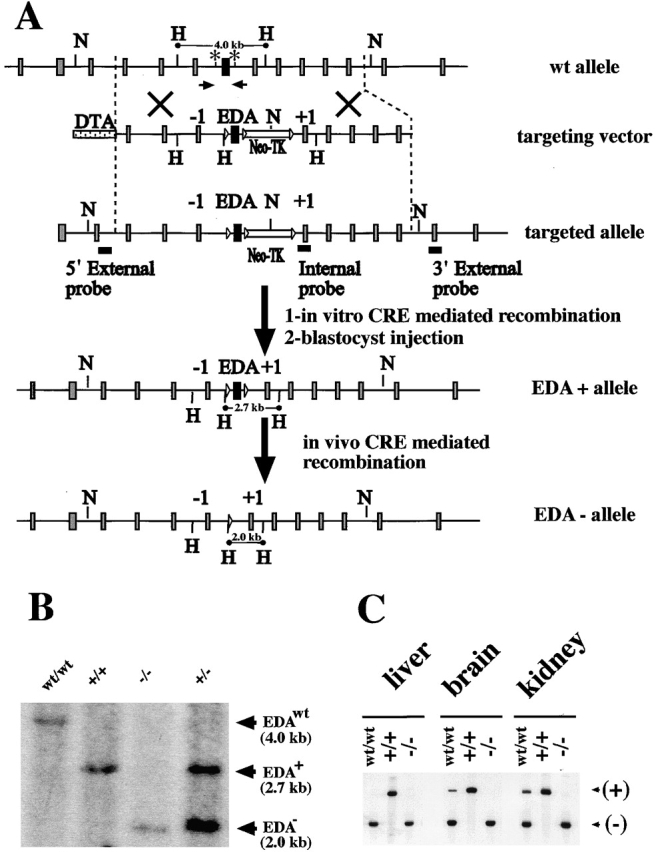
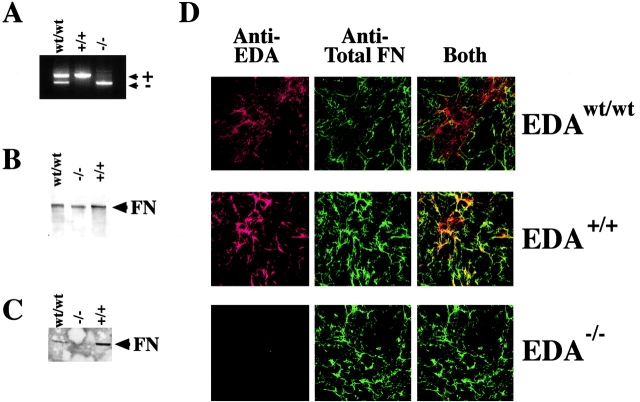
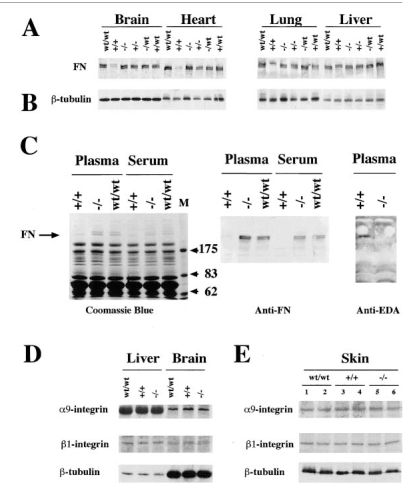
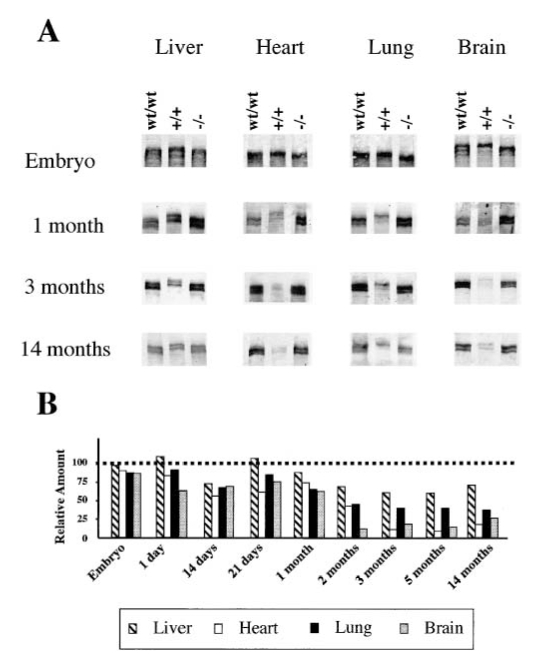
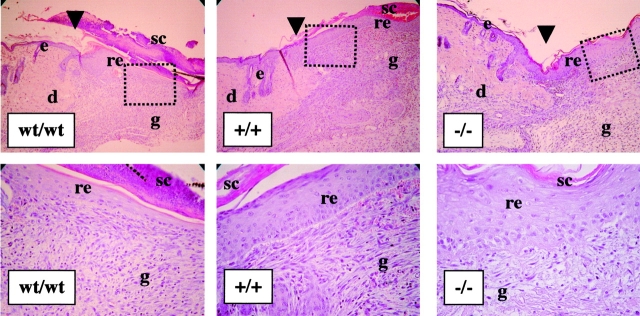
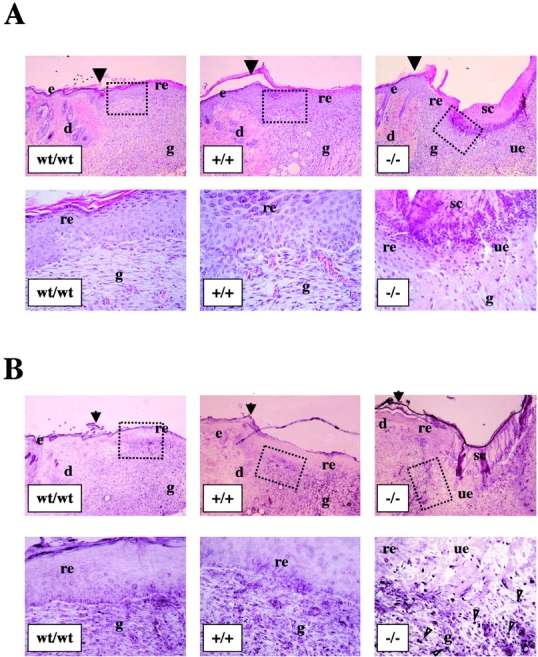
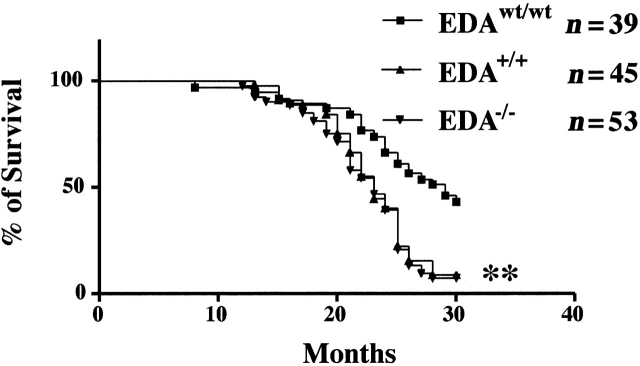
Fibronectins (FNs) are multifunctional high molecular weight glycoproteins present in the blood plasma and in the ECMs of tissues. The FN primary transcript undergoes alternative splicing in three regions generating up to 20 main different variants in humans. However, the precise role of the FN isoforms is poorly understood. One of the alternatively spliced exons is the extra domain A (EDA) or extra type III homology that is regulated spatially and temporally during development and aging. To study its in vivo function, we generated mice devoid of EDA exon-regulated splicing. Constitutive exon inclusion was obtained by optimizing the splice sites, whereas complete exclusion was obtained after in vivo CRE-loxP-mediated deletion of the exon. Homozygous mouse strains with complete exclusion or inclusion of the EDA exon were viable and developed normally, indicating that the alternative splicing at the EDA exon is not necessary during embryonic development. Conversely, mice without the EDA exon in the FN protein displayed abnormal skin wound healing, whereas mice having constitutive inclusion of the EDA exon showed a major decrease in the FN levels in all tissues. Moreover, both mutant mouse strains have a significantly shorter lifespan than the control mice, suggesting that EDA splicing regulation is necessary for efficient long-term maintenance of biological functions.
Overview
The claims and statistics of this paper haven’t been checked yet.
Free: it reads the open-access text and checks the first 5 claims that cite a source we can check. Create a free account to check every claim.
Integrity signals
Registry
Cites
Statistics
Figures
Verification
Claims the paper makes
The claims and statistics of this paper haven’t been checked yet.
Free: it reads the open-access text and checks the first 5 claims that cite a source we can check. Create a free account to check every claim.
Claims other papers make about this one
Each is checked against this paper’s own text: does it say what the citing paper says it does?
The cited source says what the claim attributes to it.
In the citing paper
“Mammalian fibronectin consists of various isoforms, created through alternative splicing (Muro et al., 2003).”
From Notch signaling functions in lymphatic valve formation (2014) · cites this paper as Muro et al., 2003
Self-check
Percentages, sums and reported differences re-computed from the paper’s own numbers.
The self-check needs the paper’s full text.
Citations
Cites
Single-step method of RNA isolation by acid guanidinium thiocyanate-phenol-chloroform extraction
Chomczynski, P., & Sacchi, N. (1987) · Analytical Biochemistry · doi:10.1016/0003-2697(87)90021-2 · Cited by 46,426 · cited 1×
“Total cellular RNA from various tissues was prepared by the guanidinium thiocyanate method (Chomczynski and Sacchi, 1987), quantitated by measuring absorbance at 260 and 280 nm, and RNA integrity was confirmed by running the samples on 1% agarose formaldehyde gels.”
MethodHow Matrix Metalloproteinases Regulate Cell Behavior
Sternlicht, M. D., & Werb, Z. (2001) · Annual Review of Cell and Developmental Biology · doi:10.1146/annurev.cellbio.17.1.463 · Cited by 3,959 · cited 1×
“In an attempt to determine alterations in the FN-degradative mechanisms, we performed gelatin zymography and observed no variations in plasma and other tissues (brain and heart) in the levels of matrix metalloproteinases (MMPs), enzymes known to degrade FN (Sternlicht and Werb, 2001).”
MethodDefects in mesoderm, neural tube and vascular development in mouse embryos lacking fibronectin
George, E. L., Georges-Labouesse, E. N., Patel-King, R. S., Rayburn, H., & Hynes, R. O. (1993) · Development · doi:10.1242/dev.119.4.1079 · Cited by 1,305
The Extra Domain A of Fibronectin Activates Toll-like Receptor 4
Okamura, Y., Watari, M., Jerud, E. S., Young, D. W., Ishizaka, S. T., Rose, J., Chow, J. C., & Strauss, J. F. (2001) · Journal of Biological Chemistry · doi:10.1074/jbc.m100099200 · Cited by 1,216 · cited 2×
“…(Peters et al., 1990); secretion (Wang et al., 1991); cell adhesion (Xia and Culp, 1995); cell differentiation (Jarnagin et al., 1994); tissue injury and inflammation (Satoi et al., 1999; Okamura et al., 2001); and cell cycle progression and mitogenic signal transduction (Manabe et al., 1999).”
BackgroundConditional control of gene expression in the mouse
Lewandoski, M. (2001) · Nature Reviews Genetics · doi:10.1038/35093537 · Cited by 781 · cited 1×
“A similar phenomenon has recently been observed in other genes (Lewandoski, 2001).”
Distinct functions of the two isoforms of dopamine D2 receptors
Usiello, A., Baik, J.-H., Rougé-Pont, F., Picetti, R., Dierich, A., LeMeur, M., Piazza, P. V., & Borrelli, E. (2000) · Nature · doi:10.1038/35041572 · Cited by 717 · cited 3×
“…of alternatively spliced exons in different protein systems such as 6 integrin, -aminobutyrate receptor, dopamine D2 receptor, FN, Pax6, and Stat3 (Gimond et al., 1998; Homanics et al., 1999; Usiello et al., 2000; Wang et al., 2000; Fukuda et al., 2002; Singh et al., 2002; Yoo et al., 2002).”
BackgroundThree different fibronectin mRNAs arise by alternative splicing within the coding region
Schwarzbauer, J. E., Tamkun, J. W., Lemischka, I. R., & Hynes, R. O. (1983) · Cell · doi:10.1016/0092-8674(83)90175-7 · Cited by 706 · cited 2×
“The IIICS region undergoes a more complex pattern of splicing which is species dependent (Schwarzbauer et al., 1983).”
BackgroundClark, R. A. F., Lanigan, J. M., DellaPelle, P., Manseau, E., Dvorak, H. F., & Colvin, R. B. (1982) · Journal of Investigative Dermatology · doi:10.1111/1523-1747.ep12500075 · Cited by 695 · cited 2×
“Previous studies have also shown that FN appears in the provisional matrix beneath the migrating epidermis coordinating with the FN-receptor expression on migrating epidermal cells ( Clark et al., 1982, 1983; Grinnell, 1984).”
ResultHelgason, C. D., Damen, J. E., Rosten, P., Grewal, R., Sorensen, P., Chappel, S. M., Borowski, A., Jirik, F., Krystal, G., & Humphries, R. K. (1998) · Genes & Development · doi:10.1101/gad.12.11.1610 · Cited by 556 · cited 2×
“…have a shorter lifespan It has been shown that deficiency of SH2-containing inositol-5-phosphatase, lysosomal acid lipase, and DNA topoisomerase III had no consequences in embryonic development, but shortens the lifespan of the animals (Helgason et al., 1998; Du et al., 2001; Kwan and Wang, 2001).”
BackgroundReappearance of an embryonic pattern of fibronectin splicing during wound healing in the adult rat.
Ffrench-Constant, C., Van de Water, L., Dvorak, H. F., & Hynes, R. O. (1989) · The Journal of cell biology · doi:10.1083/jcb.109.2.903 · Cited by 486 · cited 8×
“Expression of cFN by the cells found at the base and edges of the wound just beneath the epidermis was observed, and the presence of cFN preceded the migration of epithelial cells that eventually covered the wound (ffrench-Constant et al., 1989).”
BackgroundInfluential
Research works printed but not linked: 1
- Hynes, R.O. 1990. Fibronectins. Springer-Verlag New York Inc., New York. 544 pp.
Cited by
Items 301–323 of 323
Tarpląstelinis matriksas ir jo vaidmuo sergant astma
Janulaitytė, I., Januškevičius, A., & Malakauskas, K. (2017) · Pulmonology and allergology · doi:10.37499/pia.229
Shihan, M. H. (2020) · Library, Museums and Press - UDSpace (University of Delaware) · doi:10.58088/yph1-we42 · Cited by 1
A critique. B. F. Skinner's behaviorism.
Dunning, R. (1972) · PubMed
Anti-Aging Medicine LiteratureWatch
(2003) · Rejuvenation Research · doi:10.1089/109454503322733117
Pihlajaniemi, T. A., & Heljäsvaara, R. (2019) · Faculty Opinions – Post-Publication Peer Review of the Biomedical Literature · doi:10.3410/f.726121845.793560503
Tucker, R. P. (2016) · Springer eBooks · doi:10.1007/978-1-4614-6438-9_101621-1
Allen, J. L. (2022) · The Research Repository @ WVU (West Virginia University) · doi:10.33915/etd.11622
Cutaneous Response to Injury and Wound Healing
O’Toole, E. A. (2024) · Wiley eBooks · doi:10.1002/9781119709268.rook011 · Cited by 1
Deciphering the role of oncofetal fibronectin isoforms in matrix assembly and cellular function
Efthymiou, G. (2019) · theses.fr (ABES) · doi:10.70675/d886eea3z6c61z4428zab63z85d84dc6ab46 · Cited by 1
Potential relevance of periostin in psoriasis
Flink, L. B. (2024) · SZTE Repository of Dissertations (University of Szeged) · doi:10.14232/phd.11972
Lemańska-Perek, A., Krzyżanowska‐Gołąb, D., Wysoczański, G., Barteczko-Grajek, B., Goździk, W., & Adamik, B. (2024) · Scientific Reports · doi:10.1038/s41598-024-80765-9
“The concentration of EDA-FN increases rapidly in response to the activation of inflammation in both infectious and non-infectious diseases 13,20,21 .”
Regulación post-transcripcional de la expresión génica por señales extracelulares
Kappelmacher, M. B. (2007)
Mavlyutov, T. A., Myrah, J. J., Chauhan, A. K., Liu, Y., & McDowell, C. M. (2022) · Figshare · doi:10.6084/m9.figshare.19898878
Self-citationFranco‐Valls, H., Tusquets-Uxó, E., Sala, L., Val, M., Peña, R., Iaconcig, A., Villarino, Á., Jiménez-Arriola, M., Massó, P., Trincado, J. L., et al. (2024) · Figshare · doi:10.6084/m9.figshare.26639965
Self-citationMa, X., Wang, E., Puviindran, V., Su, Z., Liu, X., Shimada, E., Yan, C., Liu, Y., Li, Z., Nadesan, P., et al. (2026) · Nature Communications · doi:10.1038/s41467-026-69449-2 · Cited by 2
“129-Fn1 tm2Feb mice 49 , which lack the EDA splice variant of fi bronectin (Eda Fn -/- ), and their wild-type littermates (Eda Fn +/+ ).”
Yan, Z., Shi, Z., Wang, Y., & Yin, H. (2026) · Clinical Cosmetic and Investigational Dermatology · doi:10.2147/ccid.s576669
“22 Moreover, FN1 has been reported to participate in T cell–mediated immune regulation 23 and to play a critical role in cutaneous wound healing and tissue repair, 24 suggesting a potential function in coordinating local immune responses with tissue homeostasis.”
Implication du syndécan-1 dans la migration des kératinocytes
Montmasson, M. (2018) · theses.fr (ABES) · doi:10.70675/1ebeb559za258z40a5z8fe6z502f3f0fe0db
Laigle, C. (2024) · theses.fr (ABES) · doi:10.70675/fbf71a50z8b1ez410azaf20z23eda138692a
Emerging Matritherapies in Lung Fibrosis and Cancer
Staab-Weijnitz, C. A., Kandhari, K., Herrera, J., Hansen, K., Redente, E. F., & Roman, J. (2026) · Biology of extracellular matrix · doi:10.1007/978-3-032-22618-1_6
Tempel, L., Schrepper, A., Berndt, A., Schulze, P. C., Franz, M., & Grün, K. (2026) · Histochemistry and Cell Biology · doi:10.1007/s00418-026-02516-3
“…reports describing ED-A + Fn as a disease-associated Fn variant reactivated in pathological conditions characterized by tissue injury, chronic inflammation, and remodeling (White and Muro 2011; White et al. 2008; Shinde et al. 2015; Serini et al. 1998; Okamura et al. 2001; Muro et al. 2003).”
Transcript Isoform Remodeling in Human Skin Wound HealingPreprint
Xu, N., Luo, L., Bian, X., Pulh, P., Peng, S., Liu, X., Li, D., Sommar, P., Niu, G., Geara, J., et al. (2026) · Research Square · doi:10.21203/rs.3.rs-11209387/v1
Myocardial infarct healing : rupture and remodeling
van den Borne, S. W. M. (2009) · Research Publications (Maastricht University) · doi:10.26481/dis.20090417sb
Metadata
- Authors
- Muro, A. F., Chauhan, A. K., Gajovic, S., Iaconcig, A., Porro, F., Stanta, G., & Baralle, F. E.
- Affiliations
- 1International Centre for Genetic Engineering and Biotechnology, 34012 Trieste, Italy
- International Centre for Genetic Engineering and Biotechnology (IT)
- 2Croatian Institute for Brain Research, School of Medicine, University of Zagreb, 10000 Zagreb, Croatia
- University of Trieste (IT)
- Venue
- The Journal of Cell Biology
- Publisher
- Rockefeller University Press
- Published
- 2003-07-07
- Volume
- 162
- Issue
- 1
- Pages
- 149-160
- ISSN
- 0021-9525 (ISSN-L)
- 1540-8140
- PMC
- PMC2172721
- OpenAlex
- W2112541119
- Cited by
- 319
- References
- 59
- Citations by year
- 2026: 6 · 2025: 6 · 2024: 14 · 2023: 11 · 2022: 13 · 2021: 12 · 2020: 21 · 2019: 13 · 2018: 18 · 2017: 13 · 2016: 19 · 2015: 14 · 2014: 16 · 2013: 12 · 2012: 19
- FWCI
- 4.02
- Type
- journal article
- Language
- en
- Open access
- bronze
- doi.org
- Locations
- The Journal of Cell Biology (publishedVersion)
- Europe PMC (PubMed Central) (publishedVersion, cc-by-nc-sa)
- PubMed Central (publishedVersion, cc-by-nc-sa)
- PubMed (publishedVersion)
- Funders
- Institute of Genetics
- Topics
- Life Sciences › Biochemistry, Genetics and Molecular Biology › Molecular Biology › RNA Research and Splicing
- Health Sciences › Medicine › Immunology and Allergy › Cell Adhesion Molecules Research
- Health Sciences › Medicine › Surgery › Wound Healing and Treatments
- Keywords
- fibronectin, alternative splicing, skin wound healing, lifespan, fibronectin isoforms, extracellular matrix
- MeSH terms
- Aging, Animals, Cells, Cultured, Exons, Fetus, Fibroblasts, Fibronectins, Male, Mice, Inbred C57BL, Mutation, RNA, Messenger, Skin, Wound Healing, Down-Regulation, Survival Rate, Gene Deletion, Alternative Splicing, Protein Structure, Tertiary, Mice, Knockout, Gene Expression Regulation, Developmental, Protein Isoforms, Mice
About these checks
Registry, retraction, Cites and statistics results are computed, not judged, with one exception: a printed reference that no index lists is read once by a model before it counts as a citation error. Claims are extracted by a model and kept only when their quote appears verbatim in the text; each cited source is then checked, with a model’s help, for whether it says what the claim relies on. Those verdicts can be wrong — read the claim’s quote and the cited source before relying on one.
Statistics and arithmetic are recomputed, not judged.
Confidence bands are shown only for fields calibrated on our annotated test set. None is calibrated yet, so no band is shown.
What counts as a claim ›How we measure confidence ›How we check this ›
Are you an author, or do you see a problem with this page? Request a review
Data sources
Bibliographic data: Semantic Scholar, OpenAlex, Crossref.
Contains information from the Semantic Scholar Academic Graph Datasets, made available under the ODC Attribution License (ODC-BY 1.0).
Semantic Scholar’s data is described in: Kinney, R., et al. (2023). The Semantic Scholar Open Data Platform. arXiv:2301.10140.
