

Myotubes differentiate optimally on substrates with tissue-like stiffness
Open accessThe DOI matches its Crossref record; 58 of the 58 references it cites were found in a registry or an index.
Abstract
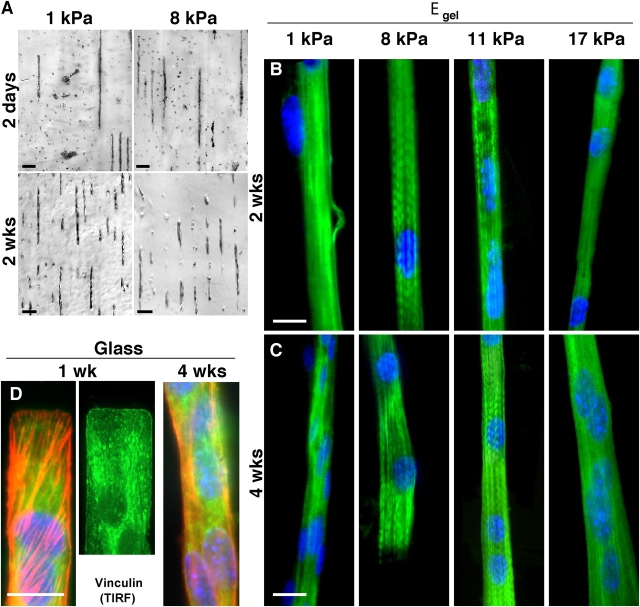
Contractile myocytes provide a test of the hypothesis that cells sense their mechanical as well as molecular microenvironment, altering expression, organization, and/or morphology accordingly. Here, myoblasts were cultured on collagen strips attached to glass or polymer gels of varied elasticity. Subsequent fusion into myotubes occurs independent of substrate flexibility. However, myosin/actin striations emerge later only on gels with stiffness typical of normal muscle (passive Young's modulus, E ∼12 kPa). On glass and much softer or stiffer gels, including gels emulating stiff dystrophic muscle, cells do not striate. In addition, myotubes grown on top of a compliant bottom layer of glass-attached myotubes (but not softer fibroblasts) will striate, whereas the bottom cells will only assemble stress fibers and vinculin-rich adhesions. Unlike sarcomere formation, adhesion strength increases monotonically versus substrate stiffness with strongest adhesion on glass. These findings have major implications for in vivo introduction of stem cells into diseased or damaged striated muscle of altered mechanical composition.
Overview
The claims and statistics of this paper haven’t been checked yet.
Free: it reads the open-access text and checks the first 5 claims that cite a source we can check. Create a free account to check every claim.
Integrity signals
Registry
Cites
Statistics
Figures




Verification
Claims the paper makes
The claims and statistics of this paper haven’t been checked yet.
Free: it reads the open-access text and checks the first 5 claims that cite a source we can check. Create a free account to check every claim.
Claims other papers make about this one
Each is checked against this paper’s own text: does it say what the citing paper says it does?
The source backs part of the claim, not all of it — or backs it for a different population, condition or comparison.
In the citing paper
“Additionally, the stiffness of the cellular environment or niche is an additional mechanical signal that influences for example the differentiation of mesenchymal stem cells into muscle and other cell types (34, 35).”
From The Hippo signal transduction network for exercise physiologists (2016) · cites this paper as [34]
Experimental — accuracy not yet measuredThe cited source says what the claim attributes to it.
In the citing paper
“In studies using biomimetic niches, substrates with an elastic stiffness of young adult skeletal muscle (∼12 kPa Young's modulus, the characteristic elastic rigidity of a material), which is five orders of magnitude softer than traditonal tissue culture plastic), promote MuSC self-renewal29,31 and myoblast differentiation94,95 (Fig. 4).”
From The central role of muscle stem cells in regenerative failure with aging (2015) · cites this paper as [94]
Self-check
Percentages, sums and reported differences re-computed from the paper’s own numbers.
The self-check needs the paper’s full text.
Citations
Cites
Calcium's Role in Mechanotransduction during Muscle Development
Benavides Damm, T., & Egli, M. (2014) · Cellular Physiology and Biochemistry · doi:10.1159/000356667 · Cited by 14,502
Biomechanics. Mechanical Properties of Living Tissues
Fung, Y. C., & Skalak, R. (1982) · Journal of Applied Mechanics · doi:10.1115/1.3162171 · Cited by 6,025
Cell Movement Is Guided by the Rigidity of the Substrate
Lo, C.-M., Wang, H.-B., Dembo, M., & Wang, Y.-L. (2000) · Biophysical Journal · doi:10.1016/s0006-3495(00)76279-5 · Cited by 3,289 · cited 3×
“FAK regulation could also occur by calciumdependent mechanisms (Lo et al., 2000) or stretch-activation (Nakamura et al.”
BackgroundCell locomotion and focal adhesions are regulated by substrate flexibility
Pelham, R. J., & Wang, Y.-L. (1997) · Proceedings of the National Academy of Sciences · doi:10.1073/pnas.94.25.13661 · Cited by 3,027 · cited 7×
“The reason is unclear, but physical aspects of the microenvironment, especially mechanical compliance of matrix (Pelham and Wang, 1997) and perhaps adjacent cells, are becoming increasingly linked to gene expression and protein organization.”
BackgroundInfluentialTaking Cell-Matrix Adhesions to the Third Dimension
Cukierman, E., Pankov, R., Stevens, D. R., & Yamada, K. M. (2001) · Science · doi:10.1126/science.1064829 · Cited by 3,027 · cited 1×
“…adhesion (Choquest et al., 1997; Beningo et al., 2001), posttranslational modification (Pelham and Wang, 1997; Beningo et al., 2001), protein expression (Cukierman et al., 2001), cytoskeletal organization (Cukierman et al., 2001; Engler et al., 2004a), and even cell viability (Wang et al., 2000).”
BackgroundCells lying on a bed of microneedles: An approach to isolate mechanical force
Tan, J. L., Tien, J., Pirone, D. M., Gray, D. S., Bhadriraju, K., & Chen, C. S. (2003) · Proceedings of the National Academy of Sciences · doi:10.1073/pnas.0235407100 · Cited by 1,962 · cited 2×
“The mechanism of coalignment is understood, from theory (Bischofs and Schwartz, 2003), to involve a propagation of cell-induced substrate contractions (Pelham and Wang, 1997; Wang et al., 2001; Tan et al., 2003 ).”
BackgroundSilicone Rubber Substrata: A New Wrinkle in the Study of Cell Locomotion
Harris, A. K., Wild, P., & Stopak, D. (1980) · Science · doi:10.1126/science.6987736 · Cited by 1,348 · cited 1×
“Analogous to the wrinkling of films by cells (Harris et al., 1980; Oliver et al., 1995), cells generate traction forces on collagen-coated polyacrylamide (PA) gel substrates.”
BackgroundExtracellular Matrix Rigidity Causes Strengthening of Integrin–Cytoskeleton Linkages
Choquet, D., Felsenfeld, D. P., & Sheetz, M. P. (1997) · Cell · doi:10.1016/s0092-8674(00)81856-5 · Cited by 1,245 · cited 1×
“Such signals feed back into cell tension (Wang et al., 2002), cell adhesion ( Choquest et al., 1997; Beningo et al., 2001), posttranslational modification (Pelham and Wang, 1997; Beningo et al., 2001), protein expression (Cukierman et al., 2001), cytoskeletal organization (Cukierman et al., 2001; Engler et al., 2004a)…”
BackgroundDetermination of Elastic Moduli of Thin Layers of Soft Material Using the Atomic Force Microscope
Dimitriadis, E. K., Horkay, F., Maresca, J., Kachar, B., & Chadwick, R. S. (2002) · Biophysical Journal · doi:10.1016/s0006-3495(02)75620-8 · Cited by 1,230 · cited 2×
“Mechanics of gels The elastic modulus of various gels was determined by AFM as well as macroscopic methods (Dimitriadis et al., 2002; Engler et al., 2004a).”
MethodSubstrate Compliance versus Ligand Density in Cell on Gel Responses
Engler, A., Bacakova, L., Newman, C., Hategan, A., Griffin, M., & Discher, D. (2004) · Biophysical Journal · doi:10.1016/s0006-3495(04)74140-5 · Cited by 1,141 · cited 16×
“In the absence of stiff ECM resistance, however, assembly and phosphorylation of adhesion proteins are inhibited (Pelham and Wang, 1997), and thus F-actin assembly is reduced (Engler et al., 2004a).”
BackgroundMethodInfluentialSelf-citationRotsch, C., & Radmacher, M. (2000) · Biophysical Journal · doi:10.1016/s0006-3495(00)76614-8 · Cited by 971 · cited 1×
“Fibroblasts (FC7) are much softer than C2C12 cells with an AFM-determined elasticity of EFibroblast 2–5 kPa (Wu et al., 1998; Bushell et al., 1999; Rotsch and Radmacher, 2000; Mahaffy et al., 2004).”
BackgroundThe mdx mouse diaphragm reproduces the degenerative changes of Duchenne muscular dystrophy
Stedman, H. H., Sweeney, H. L., Shrager, J. B., Maguire, H. C., Panettieri, R. A., Petrof, B., Narusawa, M., Leferovich, J. M., Sladky, J. T., & Kelly, A. M. (1991) · Nature · doi:10.1038/352536a0 · Cited by 926 · cited 3×
“Moreover, our finding that Emdx from excised EDL muscle is significantly greater than EMuscle is consistent with past findings on diaphragm (Stedman et al., 1991) that suggested fibrotic stiffening mechanisms.”
BackgroundResultInfluentialSelf-citationShake, J. G., Gruber, P. J., Baumgartner, W. A., Senechal, G., Meyers, J., Redmond, J. M., Pittenger, M. F., & Martin, B. J. (2002) · The Annals of Thoracic Surgery · doi:10.1016/s0003-4975(02)03517-8 · Cited by 901 · cited 2×
“On the other hand, injection of stem cells into an ever-stiffening infarct zone of the heart resulted in the cells beginning to express myocyte markers, but stopping differentiation short of myofibrillogenesis, highly analogous to our cells on a stiff matrix (Shake et al., 2002).”
BackgroundBeningo, K. A., Dembo, M., Kaverina, I., Small, J. V., & Wang, Y.-L. (2001) · The Journal of Cell Biology · doi:10.1083/jcb.153.4.881 · Cited by 750 · cited 8×
“This is consistent with stress fiber assembly in cells on very stiff gels and in cell types ranging from fibroblasts (Beningo et al., 2001) to SMCs (Gaudet et al.”
BackgroundInfluentialMechanical behavior in living cells consistent with the tensegrity model
Wang, N., Naruse, K., Stamenović, D., Fredberg, J. J., Mijailovich, S. M., Tolić-Nørrelykke, I. M., Polte, T., Mannix, R., & Ingber, D. E. (2001) · Proceedings of the National Academy of Sciences · doi:10.1073/pnas.141199598 · Cited by 741 · cited 1×
“The mechanism of coalignment is understood, from theory (Bischofs and Schwartz, 2003), to involve a propagation of cell-induced substrate contractions (Pelham and Wang, 1997; Wang et al., 2001; Tan et al., 2003).”
BackgroundCell prestress. I. Stiffness and prestress are closely associated in adherent contractile cells
Wang, N., Tolić-Nørrelykke, I. M., Chen, J., Mijailovich, S. M., Butler, J. P., Fredberg, J. J., & Stamenović, D. (2002) · American Journal of Physiology-Cell Physiology · doi:10.1152/ajpcell.00269.2001 · Cited by 669 · cited 4×
“Such signals feed back into cell tension (Wang et al., 2002), cell adhesion (Choquest et al., 1997; Beningo et al., 2001), posttranslational modification (Pelham and Wang, 1997; Beningo et al., 2001), protein expression (Cukierman et al., 2001), cytoskeletal organization (Cukierman et al., 2001;…”
BackgroundInfluentialSubstrate flexibility regulates growth and apoptosis of normal but not transformed cells
Wang, H.-B., Dembo, M., & Wang, Y.-L. (2000) · American Journal of Physiology-Cell Physiology · doi:10.1152/ajpcell.2000.279.5.c1345 · Cited by 655 · cited 2×
“, 2004a), and even cell viability (Wang et al., 2000).”
BackgroundSkeletal muscle repair by adult human mesenchymal stem cells from synovial membrane
De Bari, C., Dell'Accio, F., Vandenabeele, F., Vermeesch, J. R., Raymackers, J.-M., & Luyten, F. P. (2003) · The Journal of Cell Biology · doi:10.1083/jcb.200212064 · Cited by 643 · cited 1×
“…to attempts to introduce stem cells into dystrophic skeletal muscle or infarcted regions of myocar- on January 27, 2005 w w w .jcb.org D ow nloaded from Differentiation optimum in substrate compliance | Engler et al. 885 dium (Mueller et al., 2002; De Bari et al., 2003; Kobinger et al., 2003).”
BackgroundMeasuring the Elastic Properties of Thin Polymer Films with the Atomic Force Microscope
Domke, J., & Radmacher, M. (1998) · Langmuir · doi:10.1021/la9713006 · Cited by 636 · cited 2×
“Force-indentation profiles were obtained at 10 locations of each muscle section, and each profile was fit up to a 2- m tip deflection with a Hertz cone model (Domke and Radmacher, 1998; Rotsch et al., 1999) to determine the elastic modulus.”
BackgroundMethodFluorescence correlation spectroscopy with single-molecule sensitivity on cell and model membranes
Schwille, P., Korlach, J., & Webb, W. W. (1999) · Cytometry · doi:10.1002/(sici)1097-0320(19990701)36:3<176::aid-cyto5>3.0.co;2-f · Cited by 487
Mahaffy, R. E., Park, S., Gerde, E., Käs, J., & Shih, C. K. (2004) · Biophysical Journal · doi:10.1016/s0006-3495(04)74245-9 · Cited by 460 · cited 1×
“Fibroblasts (FC7) are much softer than C2C12 cells with an AFM-determined elasticity of EFibroblast 2–5 kPa (Wu et al., 1998; Bushell et al., 1999; Rotsch and Radmacher, 2000; Mahaffy et al., 2004).”
BackgroundRotsch, C., Jacobson, K., & Radmacher, M. (1999) · Proceedings of the National Academy of Sciences · doi:10.1073/pnas.96.3.921 · Cited by 437 · cited 4×
“Force-indentation profiles were obtained at 10 locations of each muscle section, and each profile was fit up to a 2- m tip deflection with a Hertz cone model (Domke and Radmacher, 1998; Rotsch et al., 1999) to determine the elastic modulus.”
BackgroundMethodInfluentialEngler, A. J., Richert, L., Wong, J. Y., Picart, C., & Discher, D. E. (2004) · Surface Science · doi:10.1016/j.susc.2004.06.179 · Cited by 370 · cited 12×
“, 2004a), near the elasticity of the SMC-rich arterial media, Emedia 5–8 kPa (Engler et al., 2004b).”
BackgroundMethodInfluentialSelf-citationApparent elastic modulus and hysteresis of skeletal muscle cells throughout differentiation
Collinsworth, A. M., Zhang, S., Kraus, W. E., & Truskey, G. A. (2002) · American Journal of Physiology-Cell Physiology · doi:10.1152/ajpcell.00502.2001 · Cited by 361 · cited 8×
“The passive elasticity of adherent muscle cells appears set by their contractility (Wang et al., 2002) because inhibition of myosin activity (with BDM) can soften myotubes up to 10-fold in 30 min (Collinsworth et al., 2002).”
BackgroundResultInfluentialCELLULAR AND MOLECULAR MECHANISMS OF PULMONARY VASCULAR REMODELING
Stenmark, K. R., & Mecham, R. P. (1997) · Annual Review of Physiology · doi:10.1146/annurev.physiol.59.1.89 · Cited by 353 · cited 1×
“These findings have major implications for in vivo introduction of stem cells into diseased or damaged striated muscle of altered mechanical composition.”
BackgroundZyxin and cCRP: two interactive LIM domain proteins associated with the cytoskeleton.
Sadler, I., Crawford, A. W., Michelsen, J. W., & Beckerle, M. C. (1992) · The Journal of cell biology · doi:10.1083/jcb.119.6.1573 · Cited by 348
Wu, H. W., Kuhn, T., & Moy, V. T. (1998) · Scanning · doi:10.1002/sca.1998.4950200504 · Cited by 334 · cited 1×
“Fibroblasts (FC7) are much softer than C2C12 cells with an AFM-determined elasticity of EFibroblast 2–5 kPa (Wu et al., 1998; Bushell et al., 1999; Rotsch and Radmacher, 2000; Mahaffy et al., 2004).”
BackgroundCell organization in soft media due to active mechanosensing
Bischofs, I. B., & Schwarz, U. S. (2003) · Proceedings of the National Academy of Sciences · doi:10.1073/pnas.1233544100 · Cited by 304 · cited 1×
“The mechanism of coalignment is understood, from theory (Bischofs and Schwartz, 2003), to involve a propagation of cell-induced substrate contractions (Pelham and Wang, 1997; Wang et al.”
BackgroundFilamin 2 (FLN2): A Muscle-specific Sarcoglycan Interacting Protein
Thompson, T. G., Chan, Y.-M., Hack, A. A., Brosius, M., Rajala, M., Lidov, H. G. W., McNally, E. M., Watkins, S., & Kunkel, L. M. (2000) · The Journal of Cell Biology · doi:10.1083/jcb.148.1.115 · Cited by 294 · cited 1×
“The difference may reflect compensatory mechanisms in vivo such as an 10-fold overexpression of filamin C at the sarcolemma in fully differentiated dystrophic muscle compared with normal sarcolemma (Thompson et al., 2000).”
BackgroundMechanical function of dystrophin in muscle cells.
Pasternak, C., Wong, S., & Elson, E. L. (1995) · The Journal of cell biology · doi:10.1083/jcb.128.3.355 · Cited by 292 · cited 2×
“Elson and coworkers (Pasternak et al., 1995) used a glass microprobe (Rp 1 m) to “poke” myotubes grown from C57-derived satellite cells and reported an average indentation force f 12.3 0.04 nN per 1 m; assuming a Hertz indentation model for an incompressible solid, this early method of myotube…”
MethodInfluentialPhase behavior of two-dimensional hard rod fluids
Bates, M. A., & Frenkel, D. (2000) · The Journal of Chemical Physics · doi:10.1063/1.481637 · Cited by 254 · cited 1×
“2) between the reference and incident cell (Bates and Frenkel, 2000), was used to assess the spontaneous alignment of unpatterned cells.”
MethodInfluence of Type I Collagen Surface Density on Fibroblast Spreading, Motility, and Contractility
Gaudet, C., Marganski, W. A., Kim, S., Brown, C. T., Gunderia, V., Dembo, M., & Wong, J. Y. (2003) · Biophysical Journal · doi:10.1016/s0006-3495(03)74752-3 · Cited by 221 · cited 4×
“This is consistent with stress fiber assembly in cells on very stiff gels and in cell types ranging from fibroblasts (Beningo et al., 2001) to SMCs ( Gaudet et al., 2003; Engler et al., 2004a).”
BackgroundInfluentialTraction forces in locomoting cells
Oliver, T., Jacobson, K., & Dembo, M. (1995) · Cell Motility · doi:10.1002/cm.970310306 · Cited by 208 · cited 1×
“Analogous to the wrinkling of films by cells (Harris et al., 1980; Oliver et al., 1995), cells generate traction forces on collagen-coated polyacrylamide (PA) gel substrates.”
BackgroundMunevar, S., Wang, Y.-L., & Dembo, M. (2004) · Journal of Cell Science · doi:10.1242/jcs.00795 · Cited by 160 · cited 4×
“Recent work with gadolinium, a calcium channel inhibitor, has suggested that calcium entry through the plasma membrane strongly influences cell tractions, making calcium a key second messenger in substrate sensing (Munevar et al., 2004).”
BackgroundInfluentialContractile Skeletal Muscle Tissue-Engineered on an Acellular Scaffold
Borschel, G. H., Dennis, R. G., & Kuzon, W. M. (2004) · Plastic & Reconstructive Surgery · doi:10.1097/01.prs.0000101064.62289.2f · Cited by 154 · cited 1×
“Recent efforts with muscle tissue constructs for implantation probably fit the latter description (Borschel et al., 2004).”
BackgroundMyofibrillogenesis in Skeletal Muscle Cells
Sanger, J. W., Chowrashi, P. K., Shaner, N. C., Spalthoff, S., Wang, J., Freeman, N. L., & Sanger, J. M. (2002) · Clinical Orthopaedics and Related Research · doi:10.1097/00003086-200210001-00018 · Cited by 140 · cited 1×
“In a nascent myotube, -actinin rich “Z-bodies” assemble with F-actin and nonmuscle myosin II in crosslinked premyofibrils (McKeena et al., 1986; Sanger et al., 2002).”
BackgroundIntegrin-mediated Muscle Cell Spreading
Disatnik, M., & Rando, T. A. (1999) · Journal of Biological Chemistry · doi:10.1074/jbc.274.45.32486 · Cited by 122 · cited 1×
“Integrin ligation activates PKC in muscle cells as do phorbol esters, with FAK activation downstream of these contributing to cell spreading and survival (Disatnik and Rando, 1999).”
BackgroundChew, C. S., Chen, X., Parente, J. A., Tarrer, S., Okamoto, C. T., & Qin, H.-Y. (2002) · Journal of Cell Science · doi:10.1242/jcs.00174 · Cited by 117 · cited 1×
“N-RAP might become phosphorylated, dissociating it from actin (Chew et al., 2002) and thus limiting premyofibril nucleation.”
BackgroundMicropatterned Surfaces to Engineer Focal Adhesions for Analysis of Cell Adhesion Strengthening
Gallant, N. D., Capadona, J. R., Frazier, A. B., Collard, D. M., & García, A. J. (2002) · Langmuir · doi:10.1021/la025554p · Cited by 113 · cited 1×
“As individual myotubes are peeled, molecular adhesions break and limit the rate of peeling along the length of the myotubes (Gallant et al., 2002; Griffin et al., 2004).”
BackgroundMuscle‐derived stem cells: Potential for muscle regeneration
Huard, J., Cao, B., & Qu‐Petersen, Z. (2003) · Birth Defects Research Part C Embryo Today Reviews · doi:10.1002/bdrc.10020 · Cited by 100 · cited 1×
“Indeed, stem cells injected into fibrotic, dystrophic skeletal muscle have been shown to differentiate into connective tissue rather than muscle (Huard et al., 2003), which could be a function of mechanical signaling as well as well-accepted cytokine signaling to the cells.”
BackgroundImaging and force-distance analysis of human fibroblasts in vitro by atomic force microscopy
Bushell, G. R., Cahill, C., Clarke, F. M., Gibson, C. T., Myhra, S., & Watson, G. S. (1999) · Cytometry · doi:10.1002/(sici)1097-0320(19990701)36:3<254::aid-cyto16>3.0.co;2-4 · Cited by 66 · cited 1×
“Fibroblasts (FC7) are much softer than C2C12 cells with an AFM-determined elasticity of EFibroblast 2–5 kPa (Wu et al., 1998; Bushell et al., 1999; Rotsch and Radmacher, 2000; Mahaffy et al., 2004).”
BackgroundCorrection of the Dystrophic Phenotype by In Vivo Targeting of Muscle Progenitor Cells
Kobinger, G., Louboutin, J., Barton, E. R., Sweeney, H. L., & Wilson, J. M. (2003) · Human Gene Therapy · doi:10.1089/104303403769211655 · Cited by 64 · cited 2×
“…to attempts to introduce stem cells into dystrophic skeletal muscle or infarcted regions of myocar- on January 27, 2005 w w w .jcb.org D ow nloaded from Differentiation optimum in substrate compliance | Engler et al. 885 dium (Mueller et al., 2002; De Bari et al., 2003; Kobinger et al., 2003).”
BackgroundSelf-citationLu, S., Carroll, S. L., Herrera, A. H., Ozanne, B. W., & Horowits, R. (2003) · Journal of Cell Science · doi:10.1242/jcs.00425 · Cited by 60 · cited 2×
“N-RAP also binds � -actinin and filamin ( Lu et al., 2003 ) and is thought to form a membrane-bound scaffold for nucleating actin filament growth (Carroll et al., 2004).”
BackgroundSkeletal muscle LIM protein 1 (SLIM1/FHL1) induces α5β1-integrin-dependent myocyte elongation
McGrath, M. J., Mitchell, C. A., Coghill, I. D., Robinson, P. A., & Brown, S. (2003) · American Journal of Physiology-Cell Physiology · doi:10.1152/ajpcell.00207.2003 · Cited by 58 · cited 1×
“Another LIM domain protein, skeletal muscle LIM protein 1 (or SLIM1), is known to induce myoblast elongation by a 5 1 integrin-dependent mechanism (McGrath et al., 2003).”
BackgroundPortiér, G. L., Benders, A. A. G. M., Oosterhof, A., Veerkamp, J. H., & Kuppevelt, T. H. V. (1999) · In Vitro Cellular & Developmental Biology - Animal · doi:10.1007/s11626-999-0030-8 · Cited by 57 · cited 2×
“1‐2 d after plating on various substrates detailed below, cell media was switched to differentiation media, containing DME with 10% horse serum, 1% rat brain extract ( Portier et al., 1999 ), and antibiotics.”
MethodPatterning, Prestress, and Peeling Dynamics of Myocytes
Griffin, M. A., Engler, A. J., Barber, T. A., Healy, K. E., Sweeney, H. L., & Discher, D. E. (2004) · Biophysical Journal · doi:10.1016/s0006-3495(04)74195-8 · Cited by 56 · cited 9×
“8, A and B) that is well-suited to elucidating adhesion along the length of single cells (Griffin et al., 2004).”
BackgroundMethodInfluentialSelf-citationLin, Z. X., Eshleman, J. R., Gründ, C., Fischman, D. A., Masaki, T., Franke, W. W., & Holtzer, H. (1989) · The Journal of Cell Biology · doi:10.1083/jcb.108.3.1079 · Cited by 55 · cited 1×
“Such a pathway might be stimulated by phorbol esters, which have long been known to cause sarcomere disassembly without loss of vinculin- and talin-rich focal adhesions (Lin et al., 1989).”
BackgroundStretch-activated cation channels in skeletal muscle myotubes from sarcoglycan-deficient hamsters
Nakamura, T. Y., Iwata, Y., Sampaolesi, M., Hanada, H., Saito, N., Artman, M., Coetzee, W. A., & Shigekawa, M. (2001) · American Journal of Physiology-Cell Physiology · doi:10.1152/ajpcell.2001.281.2.c690 · Cited by 55 · cited 2×
“FAK regulation could also occur by calciumdependent mechanisms (Lo et al., 2000) or stretch-activation (Nakamura et al., 2001; Munevar et al., 2004) that should also be sensitive to substrate stiffness (Wang et al., 2002).”
BackgroundSmooth muscle phenotypic modulation: Role in atherogenesis
CAMPBELL, G. R., & Chamley-Campbell, J. H. (1981) · Medical Hypotheses · doi:10.1016/0306-9877(81)90084-0 · Cited by 53 · cited 1×
“altered and perhaps softened (Campbell and Chamley-Campbell, 1981; Glukhova and Koteliansky, 1995; Stenmark and Mecham, 1997).”
Glukhova, M. A., & Koteliansky, V. (1995) · Elsevier eBooks · doi:10.1016/b978-012632310-8/50004-8 · Cited by 53 · cited 2×
“These findings have major implications for in vivo introduction of stem cells into diseased or damaged striated muscle of altered mechanical composition.”
BackgroundMcKenna, N. M., Johnson, C. S., & Wang, Y. L. (1986) · The Journal of Cell Biology · doi:10.1083/jcb.103.6.2163 · Cited by 50 · cited 1×
“In a nascent myotube, -actinin rich “Z-bodies” assemble with F-actin and nonmuscle myosin II in crosslinked premyofibrils (McKeena et al., 1986; Sanger et al., 2002).”
BackgroundMueller, G. M., O’Day, T., Watchko, J. F., & Ontell, M. (2002) · Human Gene Therapy · doi:10.1089/104303402753812485 · Cited by 45 · cited 2×
“…to attempts to introduce stem cells into dystrophic skeletal muscle or infarcted regions of myocar- on January 27, 2005 w w w .jcb.org D ow nloaded from Differentiation optimum in substrate compliance | Engler et al. 885 dium (Mueller et al., 2002; De Bari et al., 2003; Kobinger et al., 2003).”
BackgroundSkeletal muscle myosin cross‐bridge cycling is necessary for myofibrillogenesis
Ramachandran, I., Terry, M., & Ferrari, M. B. (2003) · Cell Motility and the Cytoskeleton · doi:10.1002/cm.10113 · Cited by 42 · cited 1×
“…including BDM (and BTS, a skeletal muscle myosin inhibitor), clearly block late stage myofibril bundling and so f clearly stimulates myo- on January 27, 2005 w w w .jcb.org D ow nloaded from 884 The Journal of Cell Biology | Volume 166, Number 6, 2004 fibrillogenesis (Ramachandran et al., 2003).”
BackgroundTerai, M., Komiyama, M., & Shimada, Y. (1989) · Cell Motility and the Cytoskeleton · doi:10.1002/cm.970120402 · Cited by 40 · cited 1×
“Premyofibrils occur along the sides and at the ends of the myotube, spanning vinculin-rich adhesive contacts with the substrate (Terai et al., 1989).”
BackgroundMOHIDDIN, S. A., Lu, S., Cardoso, J. L. S., Carroll, S. L., Jha, S., Horowits, R., & Fananapazir, L. (2003) · Cell Motility and the Cytoskeleton · doi:10.1002/cm.10123 · Cited by 39 · cited 1×
“Due to N-RAP’s large size ( 100 kD), it is believed to orient parallel to the membrane in order to mediate force transmission (Mohiddin et al., 2003).”
BackgroundN-RAP scaffolds I-Z-I assembly during myofibrillogenesis in cultured chick cardiomyocytes
Carroll, S. L., Lu, S., Herrera, A. H., & Horowits, R. (2003) · Journal of Cell Science · doi:10.1242/jcs.00847 · Cited by 33 · cited 2×
“, 2003) and is thought to form a membrane-bound scaffold for nucleating actin filament growth (Carroll et al., 2004).”
BackgroundTORGAN, C. E., Burge, S., Collinsworth, A. M., Truskey, G. A., & Kraus, W. E. (2000) · Medical & Biological Engineering & Computing · doi:10.1007/bf02345757 · Cited by 29 · cited 2×
“Poor adhesion, generating only a small adhesion force, is consistent with reports of reduced mechanical loading inducing decreased myogenic expression (Torgan et al., 2000) and with other cell types grown on soft gels (Pelham and Wang, 1997; Beningo et al.”
BackgroundResultCarroll, S. L., Herrera, A. H., & Horowits, R. (2001) · Journal of Cell Science · doi:10.1242/jcs.114.23.4229 · Cited by 22
Research works printed but not linked: 1
- 2004, Surf. Sci., In press
Cited by
Matrix elasticity directs stem cell lineage specification
Engler, A. J., Sen, S., Sweeney, H. L., & Discher, D. E. (2006) · Cell · doi:10.1016/j.cell.2006.06.044 · Cited by 13,915
“Such a wide variation in matrix stiffness for differentiated cells is known to influence focal-adhesion structure and the cytoskeleton (Bershadsky et al., 2003; Cukierman et al., 2001; Discher et al., 2005; Engler et al., 2004a; Lo et al., 2000; Pelham and Wang, 1997).”
BackgroundMethodResultInfluentialSelf-citationTissue Cells Feel and Respond to the Stiffness of Their Substrate
Discher, D. E., Janmey, P., & Wang, Y.-L. (2005) · Science · doi:10.1126/science.1116995 · Cited by 6,382
Self-citationTensional homeostasis and the malignant phenotype
Paszek, M. J., Zahir, N., Johnson, K. R., Lakins, J. N., Rozenberg, G. I., Gefen, A., Reinhart-King, C. A., Margulies, S. S., Dembo, M., Boettiger, D., et al. (2005) · Cancer Cell · doi:10.1016/j.ccr.2005.08.010 · Cited by 3,941
“*p % 0.05; **p % 0.01; ***p % 0.001. with the role shown for matrix compliance in smooth muscle cell differentiation (Engler et al., 2004) and extend those findings to incorporate the effect of matrix stiffness on multicellular epithelial tissue morphogenesis.”
BackgroundInfluentialThe control of human mesenchymal cell differentiation using nanoscale symmetry and disorder
Dalby, M. J., Gadegaard, N., Tare, R., Andar, A., Riehle, M. O., Herzyk, P., Wilkinson, C. D. W., & Oreffo, R. O. C. (2007) · Nature Materials · doi:10.1038/nmat2013 · Cited by 2,416
Local force and geometry sensing regulate cell functions
Vogel, V., & Sheetz, M. (2006) · Nature Reviews Molecular Cell Biology · doi:10.1038/nrm1890 · Cited by 2,328
“The response of cells to substrate rigidity in cell culture is cell-specific and seems to be correlated with the rigidity of the native environment of the cell, which can vary significantly between different tissue”
Background
Metadata
- Authors
- Engler, A. J., Griffin, M. A., Sen, S., Bönnemann, C. G., Sweeney, H. L., & Discher, D. E.
- Affiliations
- University of Pennsylvania (US)
- 2Pennsylvania Muscle Institute, University of Pennsylvania, Philadelphia, PA 19104
- Venue
- The Journal of Cell Biology
- Publisher
- Rockefeller University Press
- Published
- 2004-09-13
- Volume
- 166
- Issue
- 6
- Pages
- 877-887
- ISSN
- 0021-9525 (ISSN-L)
- 1540-8140
- PMC
- PMC2172122
- OpenAlex
- W2167243609
- Cited by
- 1,743
- References
- 57
- Citations by year
- 2026: 47 · 2025: 54 · 2024: 63 · 2023: 49 · 2022: 71 · 2021: 84 · 2020: 87 · 2019: 77 · 2018: 86 · 2017: 119 · 2016: 90 · 2015: 88 · 2014: 92 · 2013: 115 · 2012: 128
- FWCI
- 14.63
- Type
- journal article
- Language
- en
- Open access
- green
- www.ncbi.nlm.nih.gov
- Licence
- cc-by-nc-sa
- Locations
- The Journal of Cell Biology (publishedVersion)
- PubMed Central (publishedVersion, cc-by-nc-sa)
- PubMed (publishedVersion)
- ScholarlyCommons (University of Pennsylvania) (submittedVersion)
- eScholarship (California Digital Library) (submittedVersion)
- Topics
- Life Sciences › Biochemistry, Genetics and Molecular Biology › Cell Biology › Cellular Mechanics and Interactions
- Life Sciences › Biochemistry, Genetics and Molecular Biology › Molecular Biology › Muscle Physiology and Disorders
- Health Sciences › Medicine › Surgery › Tissue Engineering and Regenerative Medicine
- Keywords
- myotube differentiation, substrate stiffness, mechanotransduction, myoblast fusion, sarcomere formation, cell adhesion, stress fibers, vinculin, dystrophic muscle, collagen substrate, polymer gels, stem cell transplantation, muscle regeneration
- MeSH terms
- Polyacrylamides, Acrylic Resins, Animals, Cell Adhesion, Cell Differentiation, Cell Line, Cells, Cultured, Elasticity, Fibroblasts, Gels, Mice, Inbred C3H, Mice, Mutant Strains, Models, Biological, Substrate Specificity, Muscle, Skeletal, Muscle Fibers, Skeletal, Microscopy, Atomic Force, Fluorescent Antibody Technique, Direct, Mice
About these checks
Registry, retraction, Cites and statistics results are computed, not judged, with one exception: a printed reference that no index lists is read once by a model before it counts as a citation error. Claims are extracted by a model and kept only when their quote appears verbatim in the text; each cited source is then checked, with a model’s help, for whether it says what the claim relies on. Those verdicts can be wrong — read the claim’s quote and the cited source before relying on one.
Statistics and arithmetic are recomputed, not judged.
Confidence bands are shown only for fields calibrated on our annotated test set. None is calibrated yet, so no band is shown.
What counts as a claim ›How we measure confidence ›How we check this ›
Are you an author, or do you see a problem with this page? Request a review
Data sources
Bibliographic data: Semantic Scholar, OpenAlex, Crossref.
Contains information from the Semantic Scholar Academic Graph Datasets, made available under the ODC Attribution License (ODC-BY 1.0).
Semantic Scholar’s data is described in: Kinney, R., et al. (2023). The Semantic Scholar Open Data Platform. arXiv:2301.10140.
