

Myotubes differentiate optimally on substrates with tissue-like stiffness
Open accessThe DOI matches its Crossref record; 58 of the 58 references it cites were found in a registry or an index.
Abstract
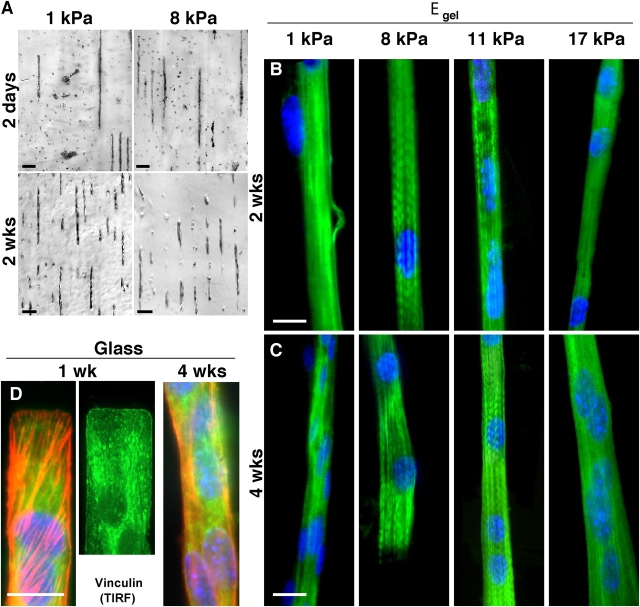
Contractile myocytes provide a test of the hypothesis that cells sense their mechanical as well as molecular microenvironment, altering expression, organization, and/or morphology accordingly. Here, myoblasts were cultured on collagen strips attached to glass or polymer gels of varied elasticity. Subsequent fusion into myotubes occurs independent of substrate flexibility. However, myosin/actin striations emerge later only on gels with stiffness typical of normal muscle (passive Young's modulus, E ∼12 kPa). On glass and much softer or stiffer gels, including gels emulating stiff dystrophic muscle, cells do not striate. In addition, myotubes grown on top of a compliant bottom layer of glass-attached myotubes (but not softer fibroblasts) will striate, whereas the bottom cells will only assemble stress fibers and vinculin-rich adhesions. Unlike sarcomere formation, adhesion strength increases monotonically versus substrate stiffness with strongest adhesion on glass. These findings have major implications for in vivo introduction of stem cells into diseased or damaged striated muscle of altered mechanical composition.
Overview
The claims and statistics of this paper haven’t been checked yet.
Free: it reads the open-access text and checks the first 5 claims that cite a source we can check. Create a free account to check every claim.
Integrity signals
Registry
Cites
Statistics
Figures




Verification
Claims the paper makes
The claims and statistics of this paper haven’t been checked yet.
Free: it reads the open-access text and checks the first 5 claims that cite a source we can check. Create a free account to check every claim.
Claims other papers make about this one
Each is checked against this paper’s own text: does it say what the citing paper says it does?
The source backs part of the claim, not all of it — or backs it for a different population, condition or comparison.
In the citing paper
“Additionally, the stiffness of the cellular environment or niche is an additional mechanical signal that influences for example the differentiation of mesenchymal stem cells into muscle and other cell types (34, 35).”
From The Hippo signal transduction network for exercise physiologists (2016) · cites this paper as [34]
Experimental — accuracy not yet measuredThe cited source says what the claim attributes to it.
In the citing paper
“In studies using biomimetic niches, substrates with an elastic stiffness of young adult skeletal muscle (∼12 kPa Young's modulus, the characteristic elastic rigidity of a material), which is five orders of magnitude softer than traditonal tissue culture plastic), promote MuSC self-renewal29,31 and myoblast differentiation94,95 (Fig. 4).”
From The central role of muscle stem cells in regenerative failure with aging (2015) · cites this paper as [94]
Self-check
Percentages, sums and reported differences re-computed from the paper’s own numbers.
The self-check needs the paper’s full text.
Citations
Cites
Calcium's Role in Mechanotransduction during Muscle Development
Benavides Damm, T., & Egli, M. (2014) · Cellular Physiology and Biochemistry · doi:10.1159/000356667 · Cited by 14,502
Biomechanics. Mechanical Properties of Living Tissues
Fung, Y. C., & Skalak, R. (1982) · Journal of Applied Mechanics · doi:10.1115/1.3162171 · Cited by 6,025
Cell Movement Is Guided by the Rigidity of the Substrate
Lo, C.-M., Wang, H.-B., Dembo, M., & Wang, Y.-L. (2000) · Biophysical Journal · doi:10.1016/s0006-3495(00)76279-5 · Cited by 3,289 · cited 3×
“FAK regulation could also occur by calciumdependent mechanisms (Lo et al., 2000) or stretch-activation (Nakamura et al.”
BackgroundCell locomotion and focal adhesions are regulated by substrate flexibility
Pelham, R. J., & Wang, Y.-L. (1997) · Proceedings of the National Academy of Sciences · doi:10.1073/pnas.94.25.13661 · Cited by 3,027 · cited 7×
“The reason is unclear, but physical aspects of the microenvironment, especially mechanical compliance of matrix (Pelham and Wang, 1997) and perhaps adjacent cells, are becoming increasingly linked to gene expression and protein organization.”
BackgroundInfluentialTaking Cell-Matrix Adhesions to the Third Dimension
Cukierman, E., Pankov, R., Stevens, D. R., & Yamada, K. M. (2001) · Science · doi:10.1126/science.1064829 · Cited by 3,027 · cited 1×
“…adhesion (Choquest et al., 1997; Beningo et al., 2001), posttranslational modification (Pelham and Wang, 1997; Beningo et al., 2001), protein expression (Cukierman et al., 2001), cytoskeletal organization (Cukierman et al., 2001; Engler et al., 2004a), and even cell viability (Wang et al., 2000).”
BackgroundCells lying on a bed of microneedles: An approach to isolate mechanical force
Tan, J. L., Tien, J., Pirone, D. M., Gray, D. S., Bhadriraju, K., & Chen, C. S. (2003) · Proceedings of the National Academy of Sciences · doi:10.1073/pnas.0235407100 · Cited by 1,962 · cited 2×
“The mechanism of coalignment is understood, from theory (Bischofs and Schwartz, 2003), to involve a propagation of cell-induced substrate contractions (Pelham and Wang, 1997; Wang et al., 2001; Tan et al., 2003 ).”
BackgroundSilicone Rubber Substrata: A New Wrinkle in the Study of Cell Locomotion
Harris, A. K., Wild, P., & Stopak, D. (1980) · Science · doi:10.1126/science.6987736 · Cited by 1,348 · cited 1×
“Analogous to the wrinkling of films by cells (Harris et al., 1980; Oliver et al., 1995), cells generate traction forces on collagen-coated polyacrylamide (PA) gel substrates.”
BackgroundExtracellular Matrix Rigidity Causes Strengthening of Integrin–Cytoskeleton Linkages
Choquet, D., Felsenfeld, D. P., & Sheetz, M. P. (1997) · Cell · doi:10.1016/s0092-8674(00)81856-5 · Cited by 1,245 · cited 1×
“Such signals feed back into cell tension (Wang et al., 2002), cell adhesion ( Choquest et al., 1997; Beningo et al., 2001), posttranslational modification (Pelham and Wang, 1997; Beningo et al., 2001), protein expression (Cukierman et al., 2001), cytoskeletal organization (Cukierman et al., 2001; Engler et al., 2004a)…”
BackgroundDetermination of Elastic Moduli of Thin Layers of Soft Material Using the Atomic Force Microscope
Dimitriadis, E. K., Horkay, F., Maresca, J., Kachar, B., & Chadwick, R. S. (2002) · Biophysical Journal · doi:10.1016/s0006-3495(02)75620-8 · Cited by 1,230 · cited 2×
“Mechanics of gels The elastic modulus of various gels was determined by AFM as well as macroscopic methods (Dimitriadis et al., 2002; Engler et al., 2004a).”
MethodSubstrate Compliance versus Ligand Density in Cell on Gel Responses
Engler, A., Bacakova, L., Newman, C., Hategan, A., Griffin, M., & Discher, D. (2004) · Biophysical Journal · doi:10.1016/s0006-3495(04)74140-5 · Cited by 1,141 · cited 16×
“In the absence of stiff ECM resistance, however, assembly and phosphorylation of adhesion proteins are inhibited (Pelham and Wang, 1997), and thus F-actin assembly is reduced (Engler et al., 2004a).”
BackgroundMethodInfluentialSelf-citation
Research works printed but not linked: 1
- 2004, Surf. Sci., In press
Cited by
Matrix elasticity directs stem cell lineage specification
Engler, A. J., Sen, S., Sweeney, H. L., & Discher, D. E. (2006) · Cell · doi:10.1016/j.cell.2006.06.044 · Cited by 13,915
“Such a wide variation in matrix stiffness for differentiated cells is known to influence focal-adhesion structure and the cytoskeleton (Bershadsky et al., 2003; Cukierman et al., 2001; Discher et al., 2005; Engler et al., 2004a; Lo et al., 2000; Pelham and Wang, 1997).”
BackgroundMethodResultInfluentialSelf-citationTissue Cells Feel and Respond to the Stiffness of Their Substrate
Discher, D. E., Janmey, P., & Wang, Y.-L. (2005) · Science · doi:10.1126/science.1116995 · Cited by 6,382
Self-citationTensional homeostasis and the malignant phenotype
Paszek, M. J., Zahir, N., Johnson, K. R., Lakins, J. N., Rozenberg, G. I., Gefen, A., Reinhart-King, C. A., Margulies, S. S., Dembo, M., Boettiger, D., et al. (2005) · Cancer Cell · doi:10.1016/j.ccr.2005.08.010 · Cited by 3,941
“*p % 0.05; **p % 0.01; ***p % 0.001. with the role shown for matrix compliance in smooth muscle cell differentiation (Engler et al., 2004) and extend those findings to incorporate the effect of matrix stiffness on multicellular epithelial tissue morphogenesis.”
BackgroundInfluentialThe control of human mesenchymal cell differentiation using nanoscale symmetry and disorder
Dalby, M. J., Gadegaard, N., Tare, R., Andar, A., Riehle, M. O., Herzyk, P., Wilkinson, C. D. W., & Oreffo, R. O. C. (2007) · Nature Materials · doi:10.1038/nmat2013 · Cited by 2,416
Local force and geometry sensing regulate cell functions
Vogel, V., & Sheetz, M. (2006) · Nature Reviews Molecular Cell Biology · doi:10.1038/nrm1890 · Cited by 2,328
“The response of cells to substrate rigidity in cell culture is cell-specific and seems to be correlated with the rigidity of the native environment of the cell, which can vary significantly between different tissue”
BackgroundSatellite Cells and the Muscle Stem Cell Niche
Yin, H., Price, F., & Rudnicki, M. A. (2013) · Physiological Reviews · doi:10.1152/physrev.00043.2011 · Cited by 2,166
“Resting healthy skeletal muscles and cultured myotubes possess a similar elastic stiffness (elastic modulus 12 kPa) (106, 152), whereas aged (184, 444) and dystrophic (152) skeletal muscles are apparently stiffer (elastic modulus 418 kPa).”
BackgroundNuclear Lamin-A Scales with Tissue Stiffness and Enhances Matrix-Directed Differentiation
Swift, J., Ivanovska, I. L., Buxboim, A., Harada, T., Dingal, P. C. D. P., Pinter, J., Pajerowski, J. D., Spinler, K. R., Shin, J.-W., Tewari, M., et al. (2013) · Science · doi:10.1126/science.1240104 · Cited by 1,991
Self-citationA tense situation: forcing tumour progression
Butcher, D. T., Alliston, T., & Weaver, V. M. (2009) · Nature Reviews Cancer · doi:10.1038/nrc2544 · Cited by 1,940
Control of Stem Cell Fate by Physical Interactions with the Extracellular Matrix
Guilak, F., Cohen, D. M., Estes, B. T., Gimble, J. M., Liedtke, W., & Chen, C. S. (2009) · Cell Stem Cell · doi:10.1016/j.stem.2009.06.016 · Cited by 1,850
“While the fusion of myoblasts into myotubes was found to be independent of substrate stiffness, the development of actin/ myosin striations occurred only on gels that had properties similar to those of normal muscle (Engler et al., 2004).”
Modeling Tissue Morphogenesis and Cancer in 3D
Yamada, K. M., & Cukierman, E. (2007) · Cell · doi:10.1016/j.cell.2007.08.006 · Cited by 1,751
“One approach could be to intercalate stem cells into damaged tissue, but the local environment may not sustain normal biological function if it is pathological (for example, if it is fibrotic; Engler et al., 2004).”
Photodegradable Hydrogels for Dynamic Tuning of Physical and Chemical Properties
Kloxin, A. M., Kasko, A. M., Salinas, C. N., & Anseth, K. S. (2009) · Science · doi:10.1126/science.1169494 · Cited by 1,748
Complexity in biomaterials for tissue engineering
Place, E. S., Evans, N. D., & Stevens, M. M. (2009) · Nature Materials · doi:10.1038/nmat2441 · Cited by 1,728
“A recent study in mice has revealed that stem cells injected into heart muscle post-infarction went on to mineralize, possibly because the stiffer mechanical environment of the scar tissue was not conducive to myogenic differentiatio”
BackgroundCellular mechanotransduction: putting all the pieces together again
Ingber, D. E. (2006) · The FASEB Journal · doi:10.1096/fj.05-5424rev · Cited by 1,627
“In fact, cells seem to be tuned mechanically (compliance-matched) so that they preferentially differentiate on ECMs that have a mechanical stiffness similar to that of their natural tissues (140, 141).”
BackgroundPhysical approaches to biomaterial design
Mitragotri, S., & Lahann, J. (2009) · Nature Materials · doi:10.1038/nmat2344 · Cited by 1,445
Cao, H., Duan, L., Zhang, Y., Cao, J., & Zhang, K. (2021) · Signal Transduction and Targeted Therapy · doi:10.1038/s41392-021-00830-x · Cited by 1,274
Structures, mechanical properties and applications of silk fibroin materials
Koh, L.-D., Cheng, Y., Teng, C.-P., Khin, Y.-W., Loh, X.-J., Tee, S.-Y., Low, M., Ye, E., Yu, H.-D., Zhang, Y.-W., et al. (2015) · Progress in Polymer Science · doi:10.1016/j.progpolymsci.2015.02.001 · Cited by 1,241
Substrate Modulus Directs Neural Stem Cell Behavior
Saha, K., Keung, A. J., Irwin, E. F., Li, Y., Little, L., Schaffer, D. V., & Healy, K. E. (2008) · Biophysical Journal · doi:10.1529/biophysj.108.132217 · Cited by 1,092
“Furthermore, native brain tissue is soft (elastic moduli, E9 500 Pa) (16,17) compared with muscle (E9 10(4) Pa) (13,18), connective tissue (E9 10(4) Pa) (18), skin (E9 10(4)–10(5) Pa) (18,19), and bone (E9 10(9)–10(10) Pa) (18,19).”
BackgroundPreparation of Hydrogel Substrates with Tunable Mechanical Properties
Tse, J. R., & Engler, A. J. (2010) · Current Protocols in Cell Biology · doi:10.1002/0471143030.cb1016s47 · Cited by 1,070
Self-citationThe role of matrix stiffness in regulating cell behavior†
Wells, R. G. (2008) · Hepatology · doi:10.1002/hep.22193 · Cited by 1,059
Fibroblast Adaptation and Stiffness Matching to Soft Elastic Substrates
Solon, J., Levental, I., Sengupta, K., Georges, P. C., & Janmey, P. A. (2007) · Biophysical Journal · doi:10.1529/biophysj.106.101386 · Cited by 1,027
“Similarly, differentiation of myoblasts into myotubes occurs only on substrate compliances mimicking those of differentiated muscle (;10 kPa) (15).”
BackgroundTransduction of mechanical and cytoskeletal cues by YAP and TAZ
Halder, G., Dupont, S., & Piccolo, S. (2012) · Nature Reviews Molecular Cell Biology · doi:10.1038/nrm3416 · Cited by 985
Cellular Mechanotransduction: From Tension to Function
Martino, F., Perestrelo, A. R., Vinarský, V., Pagliari, S., & Forte, G. (2018) · Frontiers in Physiology · doi:10.3389/fphys.2018.00824 · Cited by 971
Basement Membranes: Cell Scaffoldings and Signaling Platforms
Yurchenco, P. D. (2011) · Cold Spring Harbor Perspectives in Biology · doi:10.1101/cshperspect.a004911 · Cited by 959
“Using this approach, the organization of actin and myosin in C2C12 myotubes to create striated myofibrils was found to depend on substrate stiffness in which an intermediate gel viscosity was optimal for differentiation (Engler et al. 2004).”
Engineering Hydrogels as Extracellular Matrix Mimics
Geckil, H., Xu, F., Zhang, X., Moon, S., & Demirci, U. (2010) · Nanomedicine · doi:10.2217/nnm.10.12 · Cited by 944
Surface engineering approaches to micropattern surfaces for cell-based assays
Falconnet, D., Csucs, G., Michelle Grandin, H., & Textor, M. (2006) · Biomaterials · doi:10.1016/j.biomaterials.2005.12.024 · Cited by 944
“Upon contact with the surface (similar to mFLP) the ink is transferred to the substrate [12,118].”
BackgroundSoft biological materials and their impact on cell function
Levental, I., Georges, P. C., & Janmey, P. A. (2007) · Soft Matter · doi:10.1039/b610522j · Cited by 905
Nanofabrication by electron beam lithography and its applications: A review
Chen, Y. (2015) · Microelectronic Engineering · doi:10.1016/j.mee.2015.02.042 · Cited by 863
Engler, A. J., Carag-Krieger, C., Johnson, C. P., Raab, M., Tang, H.-Y., Speicher, D. W., Sanger, J. W., Sanger, J. M., & Discher, D. E. (2008) · Journal of Cell Science · doi:10.1242/jcs.029678 · Cited by 865
“The observation that matricellular composition and mechanics can direct cell function is not specific to heart (see Engler et al., 2004b; Paszek et al., 2005; Yeung et al., 2005).”
BackgroundMethodInfluentialSelf-citationCell–extracellular matrix mechanotransduction in 3D
Saraswathibhatla, A., Indana, D., & Chaudhuri, O. (2023) · Nature Reviews Molecular Cell Biology · doi:10.1038/s41580-023-00583-1 · Cited by 814
Mechanotransduction in development: a growing role for contractility
Wozniak, M. A., & Chen, C. S. (2009) · Nature Reviews Molecular Cell Biology · doi:10.1038/nrm2592 · Cited by 818
“In direct contrast to traditional culture on plastic, many cell types maintain a more differentiated phenotype when cultured on less stiff substrates, as these are more reflective of the stiffness of their in vivo tissue environmen”
BackgroundGenetic and cell biological analysis of integrin outside-in signaling
Legate, K. R., Wickström, S. A., & Fässler, R. (2009) · Genes & Development · doi:10.1101/gad.1758709 · Cited by 802
“2006), and myotubes differentiate into striated muscle only on substrates approximating the stiffness of muscle (Engler et al. 2004).”
BackgroundIntrinsic extracellular matrix properties regulate stem cell differentiation
Reilly, G. C., & Engler, A. J. (2010) · Journal of Biomechanics · doi:10.1016/j.jbiomech.2009.09.009 · Cited by 780
“2A (Engler et al., 2006; Rowlands et al., 2008)); they cannot fuse together as normal muscle cells do in culture (Collinsworth et al., 2002; Engler et al., 2004a).”
BackgroundSelf-citationThe actin cytoskeleton and actin-based motility
Svitkina, T. (2018) · Cold Spring Harbor Perspectives in Biology · doi:10.1101/cshperspect.a018267 · Cited by 761
“…culture have exaggerated stress fibers and focal adhesions, as compared with cells moving in vivo (Wong et al. 1983; Geraldo et al. 2012), in three-dimensional culture (Kubow et al. 2013), or on soft surfaces with physiologically relevant stiffness (Pelham and Wang 1997; Engler et al. 2004).”
BackgroundDecellularization Strategies for Regenerative Medicine: From Processing Techniques to Applications
Gilpin, A., & Yang, Y. (2017) · BioMed Research International · doi:10.1155/2017/9831534 · Cited by 742
Micropatterning as a tool to decipher cell morphogenesis and functions
Théry, M. (2010) · Journal of Cell Science · doi:10.1242/jcs.075150 · Cited by 730
“Here it was shown that substrate stiffness of around 10 kPa, which mimics muscle tissue stiffness, favours myotube differentiation and the formation of striated muscles (Engler et al., 2004).”
BackgroundGeorges, P. C., Miller, W. J., Meaney, D. F., Sawyer, E. S., & Janmey, P. A. (2006) · Biophysical Journal · doi:10.1529/biophysj.105.073114 · Cited by 724
“The enhanced protrusion of neurites on soft gels together with the increase in branching probability (7) suggests that, despite the similarities between the neuronal growth cone and the lamellapodium of other cell types, the actin-dependent contraction of neurons may not be the motor that drives neurites forward.”
BackgroundDesigning degradable hydrogels for orthogonal control of cell microenvironments
Kharkar, P. M., Kiick, K. L., & Kloxin, A. M. (2013) · Chem. Soc. Rev. · doi:10.1039/c3cs60040h · Cited by 717
Focal adhesion size controls tension-dependent recruitment of α-smooth muscle actin to stress fibers
Goffin, J. M., Pittet, P., Csucs, G., Lussi, J. W., Meister, J.-J., & Hinz, B. (2006) · The Journal of Cell Biology · doi:10.1083/jcb.200506179 · Cited by 712
Stiffening hydrogels to probe short- and long-term cellular responses to dynamic mechanics
Guvendiren, M., & Burdick, J. A. (2012) · Nature Communications · doi:10.1038/ncomms1792 · Cited by 707
The myofibroblast: Paradigm for a mechanically active cell
Hinz, B. (2010) · Journal of Biomechanics · doi:10.1016/j.jbiomech.2009.09.020 · Cited by 698
“…and differentiation of cancer cells (Paszek et al., 2005), mesenchymal stem cells (Engler et al., 2006), neurons (Georges et al., 2006), myotubes (Engler et al., 2004), cardiomyocytes (Engler et al., 2008) and fibroblasts (Goffin et al., 2006), with the list of substrate-responsive cell types…”
BackgroundMesenchymal stem cell injection after myocardial infarction improves myocardial compliance
Berry, M. F., Engler, A. J., Woo, Y. J., Pirolli, T. J., Bish, L. T., Jayasankar, V., Morine, K. J., Gardner, T. J., Discher, D. E., & Sweeney, H. L. (2006) · American Journal of Physiology-Heart and Circulatory Physiology · doi:10.1152/ajpheart.01017.2005 · Cited by 690
Self-citationThe effect of substrate stiffness on adult neural stem cell behavior
Leipzig, N. D., & Shoichet, M. S. (2009) · Biomaterials · doi:10.1016/j.biomaterials.2009.09.002 · Cited by 686
“Although the molecular pathways are yet to be characterized, it has been specifically shown that anchorage dependent cells are responsive to the mechanical properties of their matrix [10] [11] [12] [13] [14] [15] [16] [17] [18] [19] [20].”
BackgroundFibrin gels and their clinical and bioengineering applications
Janmey, P. A., Winer, J. P., & Weisel, J. W. (2009) · Journal of The Royal Society Interface · doi:10.1098/rsif.2008.0327 · Cited by 680
Banerjee, A., Arha, M., Choudhary, S., Ashton, R. S., Bhatia, S. R., Schaffer, D. V., & Kane, R. S. (2009) · Biomaterials · doi:10.1016/j.biomaterials.2009.05.050 · Cited by 673
“…concentrated on the influence of biochemical cues on stem cell behavior, it has become increasingly clear that the mechanical properties of the microenvironment also influence the behavior of a wide variety of cells including stem cells [4] [5] [6] [7] [8] [9] [10] [11] [12] [13] [14] [15] [16].”
The extracellular matrix and transforming growth factor-β1: Tale of a strained relationship
Hinz, B. (2015) · Matrix Biology · doi:10.1016/j.matbio.2015.05.006 · Cited by 608
Li, Y., Xiao, Y., & Liu, C. (2017) · Chemical Reviews · doi:10.1021/acs.chemrev.6b00654 · Cited by 598
Tissue–electronics interfaces: from implantable devices to engineered tissues
Feiner, R., & Dvir, T. (2017) · Nature Reviews Materials · doi:10.1038/natrevmats.2017.76 · Cited by 595
Increased stiffness of the rat liver precedes matrix deposition: implications for fibrosis
Georges, P. C., Hui, J.-J., Gombos, Z., McCormick, M. E., Wang, A. Y., Uemura, M., Mick, R., Janmey, P. A., Furth, E. E., & Wells, R. G. (2007) · American Journal of Physiology-Gastrointestinal and Liver Physiology · doi:10.1152/ajpgi.00032.2007 · Cited by 577
Chowdhury, F., Na, S., Li, D., Poh, Y.-C., Tanaka, T. S., Wang, F., & Wang, N. (2010) · Nature Materials · doi:10.1038/nmat2563 · Cited by 575
“These results are consistent with a previous report that cell–substrate stiffness matching is crucial for normal cell function”
ResultPalchesko, R. N., Zhang, L., Sun, Y., & Feinberg, A. W. (2012) · PLoS ONE · doi:10.1371/journal.pone.0051499 · Cited by 559
“It is probable that the decreased myotube length and clustering behavior on the soft PDMS are coupled responses to substrate mechanics that have their basis in altered cytoskeletal structure, as previous studies have shown this type of mechanosensitivity in the cytoskeleton of C2C12 myotubes [51].”
BackgroundResultInfluentialEvidence of a large-scale mechanosensing mechanism for cellular adaptation to substrate stiffness
Trichet, L., Le Digabel, J., Hawkins, R. J., Vedula, S. R. K., Gupta, M., Ribrault, C., Hersen, P., Voituriez, R., & Ladoux, B. (2012) · Proceedings of the National Academy of Sciences · doi:10.1073/pnas.1117810109 · Cited by 537
Biohybrid actuators for robotics: A review of devices actuated by living cells
Ricotti, L., Trimmer, B., Feinberg, A. W., Raman, R., Parker, K. K., Bashir, R., Sitti, M., Martel, S., Dario, P., & Menciassi, A. (2017) · Science Robotics · doi:10.1126/scirobotics.aaq0495 · Cited by 527
Screening out irrelevant cell-based models of disease
Horvath, P., Aulner, N., Bickle, M., Davies, A. M., Nery, E. D., Ebner, D., Montoya, M. C., Östling, P., Pietiäinen, V., Price, L. S., et al. (2016) · Nature Reviews Drug Discovery · doi:10.1038/nrd.2016.175 · Cited by 525
Cell type-specific response to growth on soft materials
Georges, P. C., & Janmey, P. A. (2005) · Journal of Applied Physiology · doi:10.1152/japplphysiol.01121.2004 · Cited by 496
Tensegrity, cellular biophysics, and the mechanics of living systems
Ingber, D. E., Wang, N., & Stamenović, D. (2014) · Reports on Progress in Physics · doi:10.1088/0034-4885/77/4/046603 · Cited by 485
“…responses are critical for control of cell proliferation and apoptosis (Numaguchi et al 2002), gene expression (Chen et al 2001), differentiation (Engler et al 2004, 2006, Chowdhury et al 2010), and spreading of the cell (Zhang et al 2008, Chowdhury et al 2010) and endoplasmic reticulum…”
BackgroundResultA hydrogel derived from decellularized dermal extracellular matrix
Wolf, M. T., Daly, K. A., Brennan-Pierce, E. P., Johnson, S. A., Carruthers, C. A., D'Amore, A., Nagarkar, S. P., Velankar, S. S., & Badylak, S. F. (2012) · Biomaterials · doi:10.1016/j.biomaterials.2012.06.051 · Cited by 482
Stem cell migration and mechanotransduction on linear stiffness gradient hydrogels
Hadden, W. J., Young, J. L., Holle, A. W., McFetridge, M. L., Kim, D. Y., Wijesinghe, P., Taylor-Weiner, H., Wen, J. H., Lee, A. R., Bieback, K., et al. (2017) · Proceedings of the National Academy of Sciences · doi:10.1073/pnas.1618239114 · Cited by 479
“When mimicking the stiffness of neural (∼1 kPa), muscle (∼12 kPa), and bone (∼30 kPa) tissues (15, 16), substrate stiffness can induce differentiation toward those specific tissue types.”
BackgroundSelf-citationCellulose Biomaterials for Tissue Engineering
Hickey, R. J., & Pelling, A. E. (2019) · Frontiers in Bioengineering and Biotechnology · doi:10.3389/fbioe.2019.00045 · Cited by 469
The Tension Mounts: Mechanics Meets Morphogenesis and Malignancy
Paszek, M. J., & Weaver, V. M. (2004) · Journal of Mammary Gland Biology and Neoplasia · doi:10.1007/s10911-004-1404-x · Cited by 467
“We and others also found that substrate stiffness can dramatically influence tissue-specific differentiation (( 105 ); See Fig. 2) and even regulate stem cell fate (106), likely through modulation of cell-ECM adhesion organization (Paszek et al., Submitted).”
BackgroundTopological defects control collective dynamics in neural progenitor cell cultures
Kawaguchi, K., Kageyama, R., & Sano, M. (2017) · Nature · doi:10.1038/nature22321 · Cited by 450
Substrate Rigidity Regulates the Formation and Maintenance of Tissues
Guo, W.-H., Frey, M. T., Burnham, N. A., & Wang, Y.-L. (2006) · Biophysical Journal · doi:10.1529/biophysj.105.070144 · Cited by 453
“A similar result was recently reported by using a micropipette peeling method (25).”
BackgroundMethodResultSubstrate Stiffness Affects the Functional Maturation of Neonatal Rat Ventricular Myocytes
Jacot, J. G., McCulloch, A. D., & Omens, J. H. (2008) · Biophysical Journal · doi:10.1529/biophysj.107.124545 · Cited by 448
“Recent in vitro studies have shown that alterations in the elastic modulus of the substrate affects proliferation rates of vascular smooth muscle cells (6), cell association and tissue formation (7), differentiation of myoblasts into striated myotubes (8,9), and differentiation of mesenchymal stem cells into myocytes…”
BackgroundMECHANOTRANSDUCTION INVOLVING MULTIMODULAR PROTEINS: Converting Force into Biochemical Signals
Vogel, V. (2006) · Annual Review of Biophysics and Biomolecular Structure · doi:10.1146/annurev.biophys.35.040405.102013 · Cited by 446
Age-related vascular stiffening: causes and consequences
Kohn, J. C., Lampi, M. C., & Reinhart-King, C. A. (2015) · Frontiers in Genetics · doi:10.3389/fgene.2015.00112 · Cited by 440
“The healthy human intima has been reported to have an elastic modulus of 34.4 kPa and is considered a compliant material, with an elastic modulus similar to adipose tissue and lower than muscle (Lundkvist et al., 1996; Engler et al., 2004; Patel et al., 2005).”
BackgroundInfluentialTuning Supramolecular Rigidity of Peptide Fibers through Molecular Structure
Pashuck, E. T., Cui, H., & Stupp, S. I. (2010) · Journal of the American Chemical Society · doi:10.1021/ja908560n · Cited by 439
The central role of muscle stem cells in regenerative failure with aging
Blau, H. M., Cosgrove, B. D., & Ho, A. T. V. (2015) · Nature Medicine · doi:10.1038/nm.3918 · Cited by 437
Gallant, N. D., Michael, K. E., & García, A. J. (2005) · Molecular Biology of the Cell · doi:10.1091/mbc.e05-02-0170 · Cited by 437
“…is increasingly evident that mechanotransduction between cells and their environment regulates gene expression and cell fate (Wozniak et al., 2003; Engler et al., 2004; McBeath et al., 2004; Mammoto et al., 2004; Polte et al., 2004); therefore, it is essential to have direct measurements of…”
BackgroundCsapo, R., Gumpenberger, M., & Wessner, B. (2020) · Frontiers in Physiology · doi:10.3389/fphys.2020.00253 · Cited by 429
Controlled Growth Factor Delivery for Tissue Engineering
Tayalia, P., & Mooney, D. J. (2009) · Advanced Materials · doi:10.1002/adma.200900241 · Cited by 430
Janmey, P. A., Fletcher, D. A., & Reinhart-King, C. A. (2020) · Physiological Reviews · doi:10.1152/physrev.00013.2019 · Cited by 422
Hinz, B. (2016) · Experimental Eye Research · doi:10.1016/j.exer.2015.07.009 · Cited by 424
McKinnon, D. D., Domaille, D. W., Cha, J. N., & Anseth, K. S. (2014) · Advanced Materials · doi:10.1002/adma.201303680 · Cited by 414
Microengineered Platforms for Cell Mechanobiology
Kim, D.-H., Wong, P. K., Park, J., Levchenko, A., & Sun, Y. (2009) · Annual Review of Biomedical Engineering · doi:10.1146/annurev-bioeng-061008-124915 · Cited by 411
“For instance, myotubes differentiate optimally on gels with stiffness comparable to that of normal muscle (217).”
BackgroundIn situ elasticity modulation with dynamic substrates to direct cell phenotype
Kloxin, A. M., Benton, J. A., & Anseth, K. S. (2010) · Biomaterials · doi:10.1016/j.biomaterials.2009.09.025 · Cited by 408
“Researchers have used discrete poly(acrylamide)-, poly(ethylene glycol) (PEG)-, or poly(dimethyl siloxane)-based gels with different moduli to explore cellular processes such as myotube differentiation [10], embryonic cardiomyocyte beating [11], and neuronal cell process extension [12]; smooth muscle cell (SMC) prolif…”
BackgroundREHFELDT, F., ENGLER, A., ECKHARDT, A., AHMED, F., & DISCHER, D. (2007) · Advanced Drug Delivery Reviews · doi:10.1016/j.addr.2007.08.007 · Cited by 405
“Both of these values agree with our measurements for the passive elasticity of EDL muscle from normal mice with E≈12±4kPa [33] and the elasticity of 1-week old C2C12 cells E≈12–15kPa [34].”
BackgroundResultSelf-citationThe consensus mechanics of cultured mammalian cells
Hoffman, B. D., Massiera, G., Van Citters, K. M., & Crocker, J. C. (2006) · Proceedings of the National Academy of Sciences · doi:10.1073/pnas.0510348103 · Cited by 403
Buxboim, A., Ivanovska, I. L., & Discher, D. E. (2010) · Journal of Cell Science · doi:10.1242/jcs.041186 · Cited by 399
“Gels of varying thickness, H, were made at the same time with the same polyacrylamide gel solutions to maintain a constant E of tissue-like (~1 kPa) elasticities, and the gels were all indented by ~1-2 m at forces that bend the cantilever in the nano-Newton (nN) range (Engler et al., 2004c).”
BackgroundMethodInfluentialSelf-citationMechanosensitive mechanisms in transcriptional regulation
Mammoto, A., Mammoto, T., & Ingber, D. E. (2012) · Journal of Cell Science · doi:10.1242/jcs.093005 · Cited by 393
Elastic Modulus Determination of Normal and Glaucomatous Human Trabecular Meshwork
Last, J. A., Pan, T., Ding, Y., Reilly, C. M., Keller, K., Acott, T. S., Fautsch, M. P., Murphy, C. J., & Russell, P. (2011) · Investigative Opthalmology & Visual Science · doi:10.1167/iovs.10-6342 · Cited by 386
The effect of matrix stiffness on mesenchymal stem cell differentiation in a 3D thixotropic gel
Pek, Y. S., Wan, A. C. A., & Ying, J. Y. (2010) · Biomaterials · doi:10.1016/j.biomaterials.2009.09.057 · Cited by 384
“This observation is in agreement with the understanding that cells on soft gels become less contractile [28], with reduced adhesion strength [29] and a5 integrin downregulation [30], and thus the absence of additional focal adhesions due to RGD would not greatly affect cell proliferation.”
ResultChitosan based biocomposite scaffolds for bone tissue engineering
Saravanan, S., Leena, R. S., & Selvamurugan, N. (2016) · International Journal of Biological Macromolecules · doi:10.1016/j.ijbiomac.2016.01.112 · Cited by 384
Wang, L., Wu, Y., Guo, B., & Ma, P. X. (2015) · ACS Nano · doi:10.1021/acsnano.5b03644 · Cited by 381
Winer, J. P., Janmey, P. A., McCormick, M. E., & Funaki, M. (2009) · Tissue Engineering Part A · doi:10.1089/ten.tea.2007.0388 · Cited by 374
“For instance, neurons exhibit more neurite branching on gels mimicking the stiffness of brain tissue, and myotubes exhibit striation only on gels whose compliance is comparable with that of muscle tissue.(14,15) Fibroblasts adopt a round shape on a soft matrix, and stress fibers are apparent only when they are plated…”
BackgroundInfluence of substrate stiffness on the phenotype of heart cells
Bhana, B., Iyer, R. K., Chen, W. L. K., Zhao, R., Sider, K. L., Likhitpanichkul, M., Simmons, C. A., & Radisic, M. (2010) · Biotechnology and Bioengineering · doi:10.1002/bit.22647 · Cited by 373
Fry, C. S., Kirby, T. J., Kosmac, K., McCarthy, J. J., & Peterson, C. A. (2017) · Cell stem cell · doi:10.1016/j.stem.2016.09.010 · Cited by 372
“, 1991), which negatively affects satellite cell behavior (Engler et al., 2004).”
Bioinspired Nanocomposite Hydrogels with Highly Ordered Structures
Zhao, Z., Fang, R., Rong, Q., & Liu, M. (2017) · Advanced Materials · doi:10.1002/adma.201703045 · Cited by 368
Optimal matrix rigidity for stress-fibre polarization in stem cells
Zemel, A., Rehfeldt, F., Brown, A. E. X., Discher, D. E., & Safran, S. A. (2010) · Nature Physics · doi:10.1038/nphys1613 · Cited by 363
“Experiments show that the spreading area and the force exerted by cells increase with the matrix rigidity [4,6,16,25].”
BackgroundSelf-citationFreeman, F. E., & Kelly, D. J. (2017) · Scientific Reports · doi:10.1038/s41598-017-17286-1 · Cited by 362
Schwarz, U. S., & Safran, S. A. (2013) · Reviews of Modern Physics · doi:10.1103/revmodphys.85.1327 · Cited by 361
“In particular, it was found that skeletal muscle cells differentiate optimally on substrates with rigidities of 11 kPa (Engler et al., 2004b) and that stem-cell fate strongly depends on substrate rigidity (Engler et al., 2006).”
BackgroundMethodInfluentialWeigelin, B., Bakker, G.-J., & Friedl, P. (2012) · IntraVital · doi:10.4161/intv.21223 · Cited by 357
Hydrogels with time-dependent material properties enhance cardiomyocyte differentiation in vitro
Young, J. L., & Engler, A. J. (2011) · Biomaterials · doi:10.1016/j.biomaterials.2010.10.020 · Cited by 358
“Images were analyzed using Image J to determine striation length by drawing a calibrated line through a fibril and dividing by the number of striations, and myofibril alignment by examining ellipse fits of fibrils and calculating the deviation of fibrils from long cell axis using an orientation correlation function (O…”
MethodInfluentialSelf-citationHow deeply cells feel: methods for thin gels
Buxboim, A., Rajagopal, K., Brown, A. E. X., & Discher, D. E. (2010) · Journal of Physics: Condensed Matter · doi:10.1088/0953-8984/22/19/194116 · Cited by 355
Self-citationPeyton, S. R., Raub, C. B., Keschrumrus, V. P., & Putnam, A. J. (2006) · Biomaterials · doi:10.1016/j.biomaterials.2006.05.012 · Cited by 357
Hepatic stellate cells require a stiff environment for myofibroblastic differentiation
Olsen, A. L., Bloomer, S. A., Chan, E. P., Gaça, M. D. A., Georges, P. C., Sackey, B., Uemura, M., Janmey, P. A., & Wells, R. G. (2011) · American Journal of Physiology-Gastrointestinal and Liver Physiology · doi:10.1152/ajpgi.00412.2010 · Cited by 355
“There is no change in the density of matrix coatings on gels of different stiffnesses (8, 9, 29); coatings are uniform and indistinguishable on hard and soft gel surfaces (6, 43).”
Mechanical control of tissue morphogenesis during embryological development
Ingber, D. E. (2006) · The International Journal of Developmental Biology · doi:10.1387/ijdb.052044di · Cited by 354
“…between different lineages (e.g., bone versus fat) through ECMdependent changes of cell shape (McBeath et al., 2004) and that cells are tuned mechanically so that they preferentially differentiate on ECM with a mechanical stiffness similar to that of their natural tissue (Engler et al., 2004).”
Scaffolding Biomaterials for 3D Cultivated Meat: Prospects and Challenges
Bomkamp, C., Skaalure, S. C., Fernando, G. F., Ben‐Arye, T., Swartz, E. W., & Specht, E. A. (2022) · Advanced Science · doi:10.1002/advs.202102908 · Cited by 349
Viscoelastic hydrogels for 3D cell culture
Chaudhuri, O. (2017) · Biomaterials Science · doi:10.1039/c7bm00261k · Cited by 353
Single and collective cell migration: the mechanics of adhesions
De Pascalis, C., & Etienne-Manneville, S. (2017) · Molecular Biology of the Cell · doi:10.1091/mbc.e17-03-0134 · Cited by 351
“Cardiac myocytes need a specific stiff ness to become actively beating cells, and muscle cells need mus clelike stiffness to form myotubes; excessive stiffness will impede correct myofibril development and may lead to sclerosis and scars (Engler et al., 2004, 2008).”
BackgroundBiocompatible Materials for Continuous Glucose Monitoring Devices
Nichols, S. P., Koh, A., Storm, W. L., Shin, J. H., & Schoenfisch, M. H. (2013) · Chemical Reviews · doi:10.1021/cr300387j · Cited by 347
Possibilities for an in vitro meat production system
Datar, I., & Betti, M. (2010) · Innovative Food Science & Emerging Technologies · doi:10.1016/j.ifset.2009.10.007 · Cited by 345
“A scaffold that closely mimics the in vivo situation is best; myotubes differentiate optimally on scaffold with a tissue-like stiffness (Engler et al., 2004).”
Background
Metadata
- Authors
- Engler, A. J., Griffin, M. A., Sen, S., Bönnemann, C. G., Sweeney, H. L., & Discher, D. E.
- Affiliations
- University of Pennsylvania (US)
- 2Pennsylvania Muscle Institute, University of Pennsylvania, Philadelphia, PA 19104
- Venue
- The Journal of Cell Biology
- Publisher
- Rockefeller University Press
- Published
- 2004-09-13
- Volume
- 166
- Issue
- 6
- Pages
- 877-887
- ISSN
- 0021-9525 (ISSN-L)
- 1540-8140
- PMC
- PMC2172122
- OpenAlex
- W2167243609
- Cited by
- 1,743
- References
- 57
- Citations by year
- 2026: 47 · 2025: 54 · 2024: 63 · 2023: 49 · 2022: 71 · 2021: 84 · 2020: 87 · 2019: 77 · 2018: 86 · 2017: 119 · 2016: 90 · 2015: 88 · 2014: 92 · 2013: 115 · 2012: 128
- FWCI
- 14.63
- Type
- journal article
- Language
- en
- Open access
- green
- www.ncbi.nlm.nih.gov
- Licence
- cc-by-nc-sa
- Locations
- The Journal of Cell Biology (publishedVersion)
- PubMed Central (publishedVersion, cc-by-nc-sa)
- PubMed (publishedVersion)
- ScholarlyCommons (University of Pennsylvania) (submittedVersion)
- eScholarship (California Digital Library) (submittedVersion)
- Topics
- Life Sciences › Biochemistry, Genetics and Molecular Biology › Cell Biology › Cellular Mechanics and Interactions
- Life Sciences › Biochemistry, Genetics and Molecular Biology › Molecular Biology › Muscle Physiology and Disorders
- Health Sciences › Medicine › Surgery › Tissue Engineering and Regenerative Medicine
- Keywords
- myotube differentiation, substrate stiffness, mechanotransduction, myoblast fusion, sarcomere formation, cell adhesion, stress fibers, vinculin, dystrophic muscle, collagen substrate, polymer gels, stem cell transplantation, muscle regeneration
- MeSH terms
- Polyacrylamides, Acrylic Resins, Animals, Cell Adhesion, Cell Differentiation, Cell Line, Cells, Cultured, Elasticity, Fibroblasts, Gels, Mice, Inbred C3H, Mice, Mutant Strains, Models, Biological, Substrate Specificity, Muscle, Skeletal, Muscle Fibers, Skeletal, Microscopy, Atomic Force, Fluorescent Antibody Technique, Direct, Mice
About these checks
Registry, retraction, Cites and statistics results are computed, not judged, with one exception: a printed reference that no index lists is read once by a model before it counts as a citation error. Claims are extracted by a model and kept only when their quote appears verbatim in the text; each cited source is then checked, with a model’s help, for whether it says what the claim relies on. Those verdicts can be wrong — read the claim’s quote and the cited source before relying on one.
Statistics and arithmetic are recomputed, not judged.
Confidence bands are shown only for fields calibrated on our annotated test set. None is calibrated yet, so no band is shown.
What counts as a claim ›How we measure confidence ›How we check this ›
Are you an author, or do you see a problem with this page? Request a review
Data sources
Bibliographic data: Semantic Scholar, OpenAlex, Crossref.
Contains information from the Semantic Scholar Academic Graph Datasets, made available under the ODC Attribution License (ODC-BY 1.0).
Semantic Scholar’s data is described in: Kinney, R., et al. (2023). The Semantic Scholar Open Data Platform. arXiv:2301.10140.
