

The DOI matches its Crossref record; 23 of the 23 references it cites were found in a registry or an index.
ATM regulates ATR chromatin loading in response to DNA double-strand breaks
Open accessAbstract
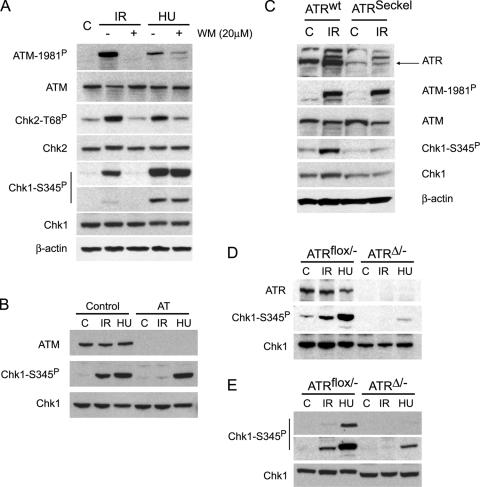
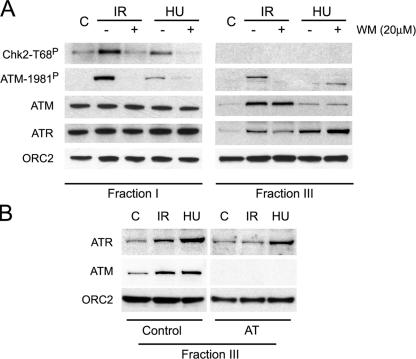
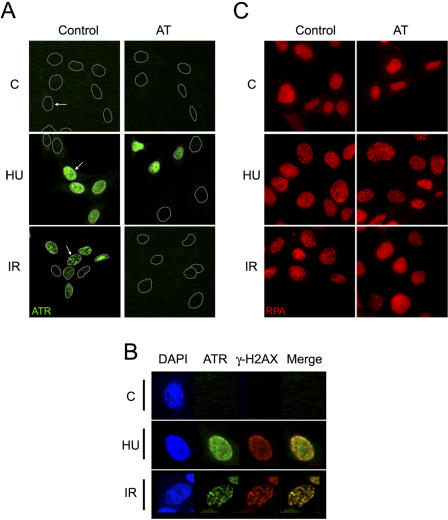
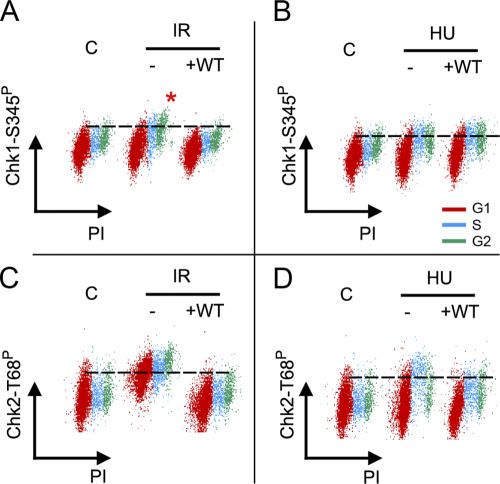
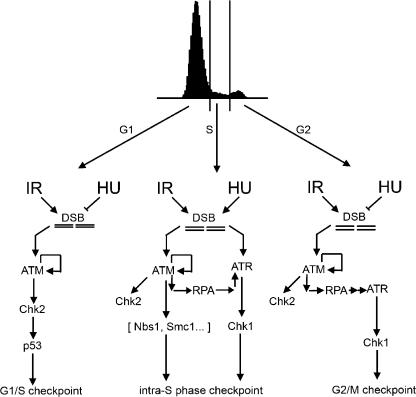
DNA double-strand breaks (DSBs) are among the most deleterious lesions that can challenge genomic integrity. Concomitant to the repair of the breaks, a rapid signaling cascade must be coordinated at the lesion site that leads to the activation of cell cycle checkpoints and/or apoptosis. In this context, ataxia telangiectasia mutated (ATM) and ATM and Rad-3–related (ATR) protein kinases are the earliest signaling molecules that are known to initiate the transduction cascade at damage sites. The current model places ATM and ATR in separate molecular routes that orchestrate distinct pathways of the checkpoint responses. Whereas ATM signals DSBs arising from ionizing radiation (IR) through a Chk2-dependent pathway, ATR is activated in a variety of replication-linked DSBs and leads to activation of the checkpoints in a Chk1 kinase–dependent manner. However, activation of the G2/M checkpoint in response to IR escapes this accepted paradigm because it is dependent on both ATM and ATR but independent of Chk2. Our data provides an explanation for this observation and places ATM activity upstream of ATR recruitment to IR-damaged chromatin. These data provide experimental evidence of an active cross talk between ATM and ATR signaling pathways in response to DNA damage.
Overview
The claims and statistics of this paper haven’t been checked yet.
Run the check — free, no account needed. It reads the open-access text and checks the sources it cites.
Integrity signals
Registry
Cites
Statistics
Figures
Verification
Claims the paper makes
The claims and statistics of this paper haven’t been checked yet.
Run the check — free, no account needed. It reads the open-access text and checks the sources it cites.
Claims other papers make about this one
Each is checked against this paper’s own text: does it say what the citing paper says it does?
In the citing paper
“ATM is essential for the recruitment of ATR to IR-damaged chromatin and Chk1 phosphorylation at Serine 345 [139].”
From Functional interplay between ATM/ATR-mediated DNA damage response and DNA repair pathways in oxidative stress (2014) · cites this paper as [139]
Self-check
Percentages, sums and reported differences re-computed from the paper’s own numbers.
The self-check needs the paper’s full text.
Citations
Cites
DNA damage activates ATM through intermolecular autophosphorylation and dimer dissociation
Bakkenist, C. J., & Kastan, M. B. (2003) · Nature · doi:10.1038/nature01368 · Cited by 3,466
Cell-cycle checkpoints and cancer
Kastan, M. B., & Bartek, J. (2004) · Nature · doi:10.1038/nature03097 · Cited by 2,836
DNA damage response as a candidate anti-cancer barrier in early human tumorigenesis
Bartkova, J., Hořejší, Z., Koed, K., Krämer, A., Tort, F., Zieger, K., Guldberg, P., Sehested, M., Nesland, J. M., Lukas, C., et al. (2005) · Nature · doi:10.1038/nature03482 · Cited by 2,688
Cell Cycle Checkpoints: Preventing an Identity Crisis
Elledge, S. J. (1996) · Science · doi:10.1126/science.274.5293.1664 · Cited by 2,050
Activation of the DNA damage checkpoint and genomic instability in human precancerous lesions
Gorgoulis, V. G., Vassiliou, L.-V. F., Karakaidos, P., Zacharatos, P., Kotsinas, A., Liloglou, T., Venere, M., DiTullio, R. A., Kastrinakis, N. G., Levy, B., et al. (2005) · Nature · doi:10.1038/nature03485 · Cited by 2,009
Cell cycle checkpoint signaling through the ATM and ATR kinases
Abraham, R. T. (2001) · Genes & Development · doi:10.1101/gad.914401 · Cited by 1,966
Liu, Q., Guntuku, S., Cui, X.-S., Matsuoka, S., Cortez, D., Tamai, K., Luo, G., Carattini-Rivera, S., DeMayo, F., Bradley, A., et al. (2000) · Genes & Development · doi:10.1101/gad.14.12.1448 · Cited by 1,625
ATM- and cell cycle-dependent regulation of ATR in response to DNA double-strand breaks
Jazayeri, A., Falck, J., Lukas, C., Bartek, J., Smith, G. C. M., Lukas, J., & Jackson, S. P. (2006) · Nature Cell Biology · doi:10.1038/ncb1337 · Cited by 1,064
ATR and ATRIP: Partners in Checkpoint Signaling
Cortez, D., Guntuku, S., Qin, J., & Elledge, S. J. (2001) · Science · doi:10.1126/science.1065521 · Cited by 985
O'Driscoll, M., Ruiz-Perez, V. L., Woods, C. G., Jeggo, P. A., & Goodship, J. A. (2003) · Nature Genetics · doi:10.1038/ng1129 · Cited by 794
Research works printed but not linked: 3
- 1998, Cancer Res., 58, 4375
- 2004, Methods Mol. Biol., 263, 67
- 2005, Nat. Cell Biol., 8, 37
Cited by
Sorted by citations
Items 201–231 of 231
Sankunny, M. (2013) · D-Scholarship@Pitt (University of Pittsburgh)
Replication fork stability in mammalian cells
Elvers, I. (2011) · KTH Publication Database DiVA (KTH Royal Institute of Technology)
Regulation of DNA Double Strand Break Response
Chen, C. (2014) · DukeSpace (Duke University)
Hashash, N. (2009) · OpenGrey (Institut de l'Information Scientifique et Technique)
Damasceno, J. D. (2013) · Digital Library of Theses and Dissertations (Universidade de São Paulo) · doi:10.11606/t.17.2013.tde-04042013-114550
Linking Human RecQ Helicases to DNA Damage Response and Aging
Cheng, W., Ahn, B., & Bohr, V. A. (2009) · Springer eBooks · doi:10.1007/978-90-481-2561-6_15
ATM Mediated Signaling Defends the Integrity of the Genome
Lavin, M. F., Gatei, M. H., Chen, P., Kijas, A. W., & Kozlov, S. (2010) · Elsevier eBooks · doi:10.1016/b978-0-12-374145-5.00263-1 · Cited by 1
Diaz, J. (2015) · Scholarly Commons (University of Pennsylvania)
Interplay between ATM and ATR for the regulation of cellular responses to DNA damage
Fan, X. (2010) · DuEPublico (University of Duisburg-Essen)
McAndrew, C. W., Gastwirt, R. F., & Donoghue, D. J. (2008) · Wiley eBooks · doi:10.1002/9780470048672.wecb057
The control of centrosome duplication after genotoxic stress
Inanç, B. (2011) · Arrow@dit (Dublin Institute of Technology) · doi:10.13025/18014
Regal, J. A. (2015) · Deep Blue (University of Michigan)
Cell Cycle Responses to Hyperthermia
Furusawa, Y. (2016) · Springer eBooks · doi:10.1007/978-981-10-0719-4_6
Lees, J. A. (2008) · Elsevier eBooks · doi:10.1016/b978-0-443-06694-8.50007-5
Neumann, J. (2012) · heiDOK (Heidelberg University) · doi:10.11588/heidok.00013237
ATR Inhibitors as Potent Modulators of DNA End Resection CapacityPreprint
Dibitetto, D., Sims, J. R., Ascenção, C. F. R., Feng, K., Freire, R., & Smolka, M. B. (2020) · bioRxiv (Cold Spring Harbor Laboratory) · doi:10.1101/2020.01.13.905059
Zou, L. (2019) · Faculty Opinions – Post-Publication Peer Review of the Biomedical Literature · doi:10.3410/f.734992733.793556649
Muñoz, P. A. M. (2019) · Digital Library of Theses and Dissertations (Universidade de São Paulo) · doi:10.11606/t.42.2019.tde-13032023-180307
Links between the DNA damage response and immune response in cancer
Malysa, A., Song, J. J., Bepler, G., & Zhang, X. M. (2024) · Elsevier eBooks · doi:10.1016/b978-0-443-13827-0.00014-7
Responses to DNA damage within Arabidopsis stem cell niches
Fulcher, N. (2010) · UEA Digital Repository (University of East Anglia)
Accidental Cytogenetic and Molecular Biodosimetry in Radiation Emergency
Abdelaziz, R. F., & Belyakov, O. V. (2026) · Springer eBooks · doi:10.1007/978-3-032-10159-4_29
Li, L., Tian, Q., Dai, D., Dai, Y., Yang, Q., & Wu, X. (2026) · Discover Oncology · doi:10.1007/s12672-026-04835-2
A nonsense mutation in the DNA repair factor Hebo causes mild bone marrow failure and microcephaly
Zhang, S. (2016) · theses.fr (ABES) · doi:10.70675/378524f1ze627z4e3dzbcf5z15f09d7cce33
Ferdousi, L. V. (2014) · theses.fr (ABES) · doi:10.70675/9d73199ez7949z4602zadcfz6763e4bdd1b0
The interaction of CtIP with DNA damage response proteins
Abramowiçz, I. (2010) · University of Birmingham Institutional Research Archive (University of Birmingham)
Radiation Induced DNA Damage Checkpoints
Eriksson, D., Riklund, K., Johansson, L. F., & Stigbrand, T. I. (2008) · Springer eBooks · doi:10.1007/978-1-4020-8696-0_14
Metadata
- Authors
- Cuadrado, M., Martinez-Pastor, B., Murga, M., Toledo, L. I., Gutierrez-Martinez, P., Lopez, E., & Fernandez-Capetillo, O.
- Affiliations
- Spanish National Cancer Research Centre (ES)
- Genomic Instability Group, Spanish National Cancer Center, Madrid 28029, Spain
- Venue
- The Journal of Experimental Medicine
- Publisher
- Rockefeller University Press
- Published
- 2006-02-06
- Volume
- 203
- Issue
- 2
- Pages
- 297-303
- ISSN
- 0022-1007 (ISSN-L)
- 1540-9538
- PMC
- PMC2118201
- OpenAlex
- W2149468013
- Cited by
- 232
- References
- 23
- Citations by year
- 2026: 2 · 2025: 3 · 2024: 6 · 2023: 6 · 2022: 3 · 2021: 6 · 2020: 8 · 2019: 17 · 2018: 5 · 2017: 8 · 2016: 12 · 2015: 9 · 2014: 16 · 2013: 9 · 2012: 17
- FWCI
- 9.78
- Type
- journal article
- Language
- en
- Open access
- green
- europepmc.org
- Licence
- cc-by-nc-sa
- Locations
- The Journal of Experimental Medicine (publishedVersion)
- Europe PMC (PubMed Central) (publishedVersion, cc-by-nc-sa)
- PubMed Central (publishedVersion, cc-by-nc-sa)
- PubMed (publishedVersion)
- Topics
- Life Sciences › Biochemistry, Genetics and Molecular Biology › Molecular Biology › DNA Repair Mechanisms
- Health Sciences › Medicine › Radiology, Nuclear Medicine and Imaging › Effects of Radiation Exposure
- Life Sciences › Biochemistry, Genetics and Molecular Biology › Molecular Biology › Genomics and Chromatin Dynamics
- Keywords
- ATM kinase, ATR kinase, DNA double-strand breaks, chromatin loading, ionizing radiation, G2/M checkpoint, Chk2, Chk1, DNA damage signaling, DNA repair
- MeSH terms
- Checkpoint Kinase 1, Ataxia Telangiectasia, Cell Cycle, Cell Line, Transformed, Chromatin, DNA Damage, DNA Replication, DNA-Binding Proteins, Flow Cytometry, Gamma Rays, Humans, Phosphorylation, Protein Kinases, Signal Transduction, Protein Serine-Threonine Kinases, Cell Cycle Proteins, Chromosome Breakage, Tumor Suppressor Proteins, Cell Line, Tumor, Ataxia Telangiectasia Mutated Proteins, Checkpoint Kinase 2
About these checks
Registry, retraction, Cites and statistics results are computed, not judged, with one exception: a printed reference that no index lists is read once by a model before it counts as a citation error. Claims are extracted by a model and kept only when their quote appears verbatim in the text; each cited source is then checked, with a model’s help, for whether it says what the claim relies on. Those verdicts can be wrong — read the claim’s quote and the cited source before relying on one.
Statistics and arithmetic are recomputed, not judged.
Confidence bands are shown only for fields calibrated on our annotated test set. None is calibrated yet, so no band is shown.
What counts as a claim ›How we measure confidence ›How we check this ›
Are you an author, or do you see a problem with this page? Request a review
