

The DOI matches its Crossref record; 92 of the 92 references it cites were found in a registry or an index.
Microglia in Alzheimer's disease at single-cell level. Are there common patterns in humans and mice?
Open accessAbstract
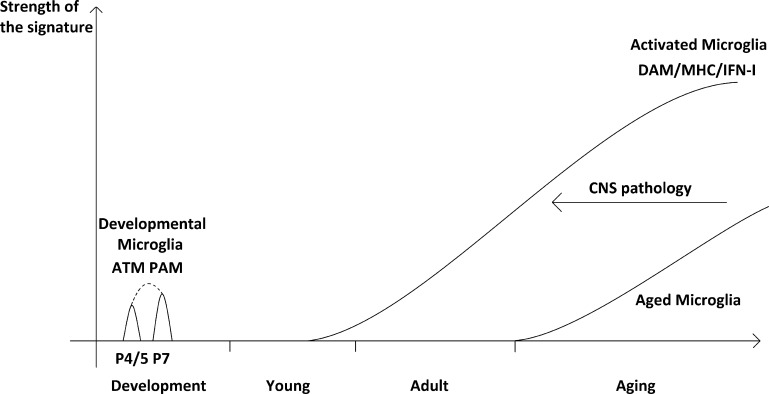
Alzheimer’s disease (AD) is characterized by extracellular aggregates of amyloid β peptides, intraneuronal tau aggregates, and neuronal death. This pathology triggers activation of microglia. Because variants of genes expressed in microglia correlate with AD risk, microglial response to pathology plausibly impacts disease course. In mouse AD models, single-cell RNA sequencing (scRNA-seq) analyses delineated this response as progressive conversion of homeostatic microglia into disease-associated microglia (DAM); additional reactive microglial populations have been reported in other models of neurodegeneration and neuroinflammation. We review all of these microglial signatures, highlighting four fundamental patterns: DAM, IFN–microglia, MHC-II microglia, and proliferating microglia. We propose that all reported microglia populations are either just one or a combination, depending on the clustering strategy applied and the disease model. We further review single-nucleus RNA sequencing (snRNA-seq) data from human AD specimens and discuss reasons for parallels and discrepancies between human and mouse transcriptional profiles. Finally, we outline future directions for delineating the microglial impact in AD pathogenesis.
Overview
The claims and statistics of this paper haven’t been checked yet.
Run the check — free, no account needed. It reads the open-access text and checks the sources it cites.
Integrity signals
Registry
Cites
Statistics
Figures
Verification
Claims the paper makes
The claims and statistics of this paper haven’t been checked yet.
Run the check — free, no account needed. It reads the open-access text and checks the sources it cites.
Claims other papers make about this one
Each is checked against this paper’s own text: does it say what the citing paper says it does?
The source backs part of the claim, not all of it — or backs it for a different population, condition or comparison.
In the citing paper
“Many disease-associated microglial programs are spatially enriched around plaques, which suggests that microglial state transitions are not only disease-stage-dependent but also anatomically localized.”
From Lymphoid-like Suppressive Microglia in Alzheimer’s Disease: A New Neuroimmune Regulatory Axis? (2026) · cites this paper as [46]
Experimental — accuracy not yet measuredThe source backs part of the claim, not all of it — or backs it for a different population, condition or comparison.
In the citing paper
“They can express molecules associated with antigen presentation, including MHC class II–related genes and co-stimulatory ligands such as CD80 or CD86, especially under inflammatory conditions.”
From Lymphoid-like Suppressive Microglia in Alzheimer’s Disease: A New Neuroimmune Regulatory Axis? (2026) · cites this paper as [46]
Experimental — accuracy not yet measuredThe cited source says what the claim attributes to it.
In the citing paper
“Single-cell and single-nucleus studies have repeatedly identified Alzheimer ’s-associated microglial states enriched for immune activation, antigen-presentation genes, lipid-processing pathways, and inflammatory mediators.”
From Lymphoid-like Suppressive Microglia in Alzheimer’s Disease: A New Neuroimmune Regulatory Axis? (2026) · cites this paper as [46]
The cited source says what the claim attributes to it.
In the citing paper
“Instead, microglia in Alzheimer’s disease appear to acquire hybrid programs: they remain tissue-resident myeloid cells, but they can express genes normally associated with professional antigen presentation, immune communication, and inflammatory coordination.”
From Lymphoid-like Suppressive Microglia in Alzheimer’s Disease: A New Neuroimmune Regulatory Axis? (2026) · cites this paper as [46]
The cited source says what the claim attributes to it.
In the citing paper
“This microglial subset is characterized by reduced expression of homeostatic genes (e.g., Tmem119, P2ry12, Cx3cr1) and increased expression of inflammatory genes (e.g., Clec7a, Apoe, Trem2) including Ch25h (Chen and Colonna, 2021).”
From Cholesterol 25-hydroxylase mediates neuroinflammation and neurodegeneration in a mouse model of tauopathy (2024) · cites this paper as Chen and Colonna, 2021
The check wasn’t confident either way, so it gives no verdict — never disputed.
In the citing paper
“The recent finding therefore suggests that at least some plaque-associated microglia may borrow elements of lymphoid signaling logic rather than merely presenting antigen to lymphocytes [44,45,46].”
From Lymphoid-like Suppressive Microglia in Alzheimer’s Disease: A New Neuroimmune Regulatory Axis? (2026) · cites this paper as [46]
Experimental — accuracy not yet measured
Self-check
Percentages, sums and reported differences re-computed from the paper’s own numbers.
The self-check needs the paper’s full text.
Citations
Cites
A Unique Microglia Type Associated with Restricting Development of Alzheimer’s Disease
Keren-Shaul, H., Spinrad, A., Weiner, A., Matcovitch-Natan, O., Dvir-Szternfeld, R., Ulland, T. K., David, E., Baruch, K., Lara-Astaiso, D., Toth, B., et al. (2017) · Cell · doi:10.1016/j.cell.2017.05.018 · Cited by 5,493
Self-citationFate Mapping Analysis Reveals That Adult Microglia Derive from Primitive Macrophages
Ginhoux, F., Greter, M., Leboeuf, M., Nandi, S., See, P., Gokhan, S., Mehler, M. F., Conway, S. J., Ng, L. G., Stanley, E. R., et al. (2010) · Science · doi:10.1126/science.1194637 · Cited by 5,175
Alzheimer Disease: An Update on Pathobiology and Treatment Strategies
Long, J. M., & Holtzman, D. M. (2019) · Cell · doi:10.1016/j.cell.2019.09.001 · Cited by 3,204
Krasemann, S., Madore, C., Cialic, R., Baufeld, C., Calcagno, N., El Fatimy, R., Beckers, L., O’Loughlin, E., Xu, Y., Fanek, Z., et al. (2017) · Immunity · doi:10.1016/j.immuni.2017.08.008 · Cited by 2,979
Alzheimer Disease Genetics Consortium (ADGC), Kunkle, B. W., The European Alzheimer’s Disease Initiative (EADI), Cohorts for Heart and Aging Research in Genomic Epidemiology Consortium (CHARGE), Genetic and Environmental Risk in AD/Defining Genetic, P. A. E. R. F. A. D. C. (., Grenier-Boley, B., Sims, R., Bis, J. C., Damotte, V., Naj, A. C., et al. (2019) · Nature Genetics · doi:10.1038/s41588-019-0358-2 · Cited by 2,946
Self-citationSingle-cell transcriptomic analysis of Alzheimer’s disease
Mathys, H., Davila-Velderrain, J., Peng, Z., Gao, F., Mohammadi, S., Young, J. Z., Menon, M., He, L., Abdurrob, F., Jiang, X., et al. (2019) · Nature · doi:10.1038/s41586-019-1195-2 · Cited by 2,568
Identification of a unique TGF-β–dependent molecular and functional signature in microglia
Butovsky, O., Jedrychowski, M. P., Moore, C. S., Cialic, R., Lanser, A. J., Gabriely, G., Koeglsperger, T., Dake, B., Wu, P. M., Doykan, C. E., et al. (2014) · Nature Neuroscience · doi:10.1038/nn.3599 · Cited by 2,543
Hammond, T. R., Dufort, C., Dissing-Olesen, L., Giera, S., Young, A., Wysoker, A., Walker, A. J., Segel, M., Nemesh, J., Saunders, A., et al. (2018) · doi:10.1101/406140 · Cited by 2,225
Tau-mediated neurodegeneration in Alzheimer’s disease and related disorders
Ballatore, C., Lee, V. M.-Y., & Trojanowski, J. Q. (2007) · Nature Reviews Neuroscience · doi:10.1038/nrn2194 · Cited by 2,174
Microglia and macrophages in brain homeostasis and disease
Li, Q., & Barres, B. A. (2018) · Nature Reviews Immunology · doi:10.1038/nri.2017.125 · Cited by 1,999
Cited by
Sorted by citations
Microglia states and nomenclature: A field at its crossroads
Paolicelli, R. C., Sierra, A., Stevens, B., Tremblay, M.-E., Aguzzi, A., Ajami, B., Amit, I., Audinat, E., Bechmann, I., Bennett, M., et al. (2022) · Neuron · doi:10.1016/j.neuron.2022.10.020 · Cited by 1,973
Self-citationTissue-specific macrophages: how they develop and choreograph tissue biology
Mass, E., Nimmerjahn, F., Kierdorf, K., & Schlitzer, A. (2023) · Nature Reviews Immunology · doi:10.1038/s41577-023-00848-y · Cited by 621
Applications of multi‐omics analysis in human diseases
Chen, C., Wang, J., Pan, D., Wang, X., Xu, Y., Yan, J., Wang, L., Yang, X., Yang, M., & Liu, G. (2023) · MedComm · doi:10.1002/mco2.315 · Cited by 545
TREM2 drives microglia response to amyloid-β via SYK-dependent and -independent pathways
Wang, S., Sudan, R., Peng, V., Zhou, Y., Du, S., Yuede, C. M., Lei, T., Hou, J., Cai, Z., Cella, M., et al. (2022) · Cell · doi:10.1016/j.cell.2022.09.033 · Cited by 471
Self-citationMou, Y., Du, Y., Zhou, L., Yue, J., Hu, X., Liu, Y., Chen, S., Lin, X., Zhang, G., Xiao, H., et al. (2022) · Frontiers in Immunology · doi:10.3389/fimmu.2022.796288 · Cited by 432
Metadata
- Authors
- Chen, Y., & Colonna, M.
- Affiliations
- Washington University in St. Louis (US)
- Corresponding author
- Colonna, Marco
- Venue
- Journal of Experimental Medicine
- Publisher
- Rockefeller University Press
- Published
- 2021-07-22
- Volume
- 218
- Issue
- 9
- ISSN
- 0022-1007 (ISSN-L)
- 1540-9538
- PMC
- PMC8302448
- OpenAlex
- W3185694768
- Cited by
- 339
- References
- 92
- Citations by year
- 2026: 65 · 2025: 60 · 2024: 85 · 2023: 75 · 2022: 47 · 2021: 6
- FWCI
- 6.23
- Type
- journal article
- Language
- en
- Open access
- hybrid
- doi.org
- Licence
- Locations
- The Journal of Experimental Medicine (publishedVersion, cc-by-nc-sa)
- PubMed Central (publishedVersion, cc-by-nc-sa)
- PubMed (publishedVersion)
- Digital Commons@Becker (Washington University School of Medicine) (submittedVersion, cc-by-nc-sa)
- Funders
- National Institutes of Health (RF1 AG051485, R21 AG059176, RF1 AG059082)
- Topics
- Life Sciences › Neuroscience › Neurology › Neuroinflammation and Neurodegeneration Mechanisms
- Life Sciences › Neuroscience › Cellular and Molecular Neuroscience › Alzheimer's disease research and treatments
- Life Sciences › Biochemistry, Genetics and Molecular Biology › Molecular Biology › Single-cell and spatial transcriptomics
- Keywords
- Alzheimer's disease, microglia, disease-associated microglia, microglial activation, single-cell RNA sequencing, single-nucleus RNA sequencing, microglial proliferation, neuroinflammation, amyloid-beta, tau pathology
- MeSH terms
- Aging, Alzheimer Disease, Animals, Histocompatibility Antigens Class II, Disease Models, Animal, Humans, Interferon Type I, Neurons, Gene Expression, Microglia, Mice, Single-Cell Analysis
About these checks
Registry, retraction, Cites and statistics results are computed, not judged, with one exception: a printed reference that no index lists is read once by a model before it counts as a citation error. Claims are extracted by a model and kept only when their quote appears verbatim in the text; each cited source is then checked, with a model’s help, for whether it says what the claim relies on. Those verdicts can be wrong — read the claim’s quote and the cited source before relying on one.
Statistics and arithmetic are recomputed, not judged.
Confidence bands are shown only for fields calibrated on our annotated test set. None is calibrated yet, so no band is shown.
What counts as a claim ›How we measure confidence ›How we check this ›
Are you an author, or do you see a problem with this page? Request a review
