

Quantum gravity from causal dynamical triangulations: a review
Open accessThe DOI matches its Crossref record; 107 of the 108 references it cites were found in a registry or an index.
Abstract
This topical review gives a comprehensive overview and assessment of recent results in causal dynamical triangulations, a modern formulation of lattice gravity, whose aim is to obtain a theory of quantum gravity nonperturbatively from a scaling limit of the lattice-regularized theory. In this manifestly diffeomorphism-invariant approach one has direct, computational access to a Planckian spacetime regime, which is explored with the help of invariant quantum observables. During the last few years, there have been numerous new and important developments and insights concerning the theory’s phase structure, the roles of time, causality, diffeomorphisms and global topology, the application of renormalization group methods and new observables. We will focus on these new results, primarily in four spacetime dimensions, and discuss some of their geometric and physical implications.
Overview
The claims and statistics of this paper haven’t been checked yet.
Free: it reads the open-access text and checks the first 5 claims that cite a source we can check. Create a free account to check every claim.
Integrity signals
Registry
Cites
Statistics
Figures
Verification
Claims the paper makes
The claims and statistics of this paper haven’t been checked yet.
Free: it reads the open-access text and checks the first 5 claims that cite a source we can check. Create a free account to check every claim.
Claims other papers make about this one
Each is checked against this paper’s own text: does it say what the citing paper says it does?
The cited source says what the claim attributes to it.
In the citing paper
“Over the past decades, mounting evidence for asymptotic safety has been obtained both via the lattice Monte Carlo simulations of dynamical triangulations [24,25] and via the semi-analytical methods of the functional renormalization group (FRG) [26].”
From Charting GLOBs in asymptotically safe gravity (2026) · cites this paper as [24]
Self-check
Percentages, sums and reported differences re-computed from the paper’s own numbers.
The self-check needs the paper’s full text.
Citations
Cites
Wilson, K. G. (1974) · Physical Review D · doi:10.1103/physrevd.10.2445 · Cited by 4,507 · cited 1×
“Although realized in a different way, it can be thought of as the gravitational counterpart of the exact gauge invariance of Wilson’s timehonoured lattice formulation of QCD [108], which is also preserved, despite the lattice discretization.”
BackgroundQuantum gravity at a Lifshitz point
Hořava, P. (2009) · Physical Review D · doi:10.1103/physrevd.79.084008 · Cited by 2,666 · cited 2×
“hat this is just a lattice artefact and has no implications for the continuum limit. Firstly, although the situation resembles supercially the preferred foliation present in Horava-Lifshitz gravity [60], which is associated with a breaking of full dieomorphism invariance to an invariance under foliation-preserving die…”
BackgroundGeneral relativity without coordinates
Regge, T. (1961) · Il Nuovo Cimento · doi:10.1007/bf02733251 · Cited by 1,477 · cited 5×
“– The starting point for encoding the geometric degrees of freedom of gravity in a regularized way is Regge’s proposal to describe “general relativity without coordinates” [35], where curved spacetimes are approximated by piecewise flat, simplicial manifolds, and a discrete analogue of the Einstein equations is derive…”
BackgroundMethodInfluentialMontvay, I., & Münster, G. (1994) · Cambridge University Press eBooks · doi:10.1017/cbo9780511470783 · Cited by 1,197
Heat kernel expansion: user's manual
Vassilevich, D. V. (2003) · Physics Reports · doi:10.1016/j.physrep.2003.09.002 · Cited by 1,016 · cited 1×
“where a0 = Vg and the remaining an are integrated curvature invariants of order n [96].”
BackgroundSpectral Dimension of the Universe in Quantum Gravity at a Lifshitz Point
Hořava, P. (2009) · Physical Review Letters · doi:10.1103/physrevlett.102.161301 · Cited by 782 · cited 1×
“The initial conjecture of such a relation was based mainly on the observed (spectral) dimensional reduction at short distances [10, 66] and the presence of a foliation in both formulations.”
BackgroundRicci curvature of Markov chains on metric spaces
Ollivier, Y. (2009) · Journal of Functional Analysis · doi:10.1016/j.jfa.2008.11.001 · Cited by 712 · cited 1×
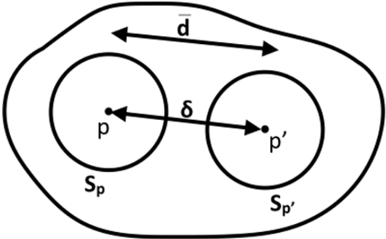
“The key idea, inspired by a classical characterization of curvature on smooth D-dimensional Riemannian spaces and later generalized to general metric spaces [102], is to compare the distance d̄ of two (D−1)-spheres with the distance δ between their centres (see Fig.”
BackgroundThe Spectral Dimension of the Universe is Scale Dependent
Ambjørn, J., Jurkiewicz, J., & Loll, R. (2005) · Physical Review Letters · doi:10.1103/physrevlett.95.171301 · Cited by 518
Self-citationEmergence of a 4D World from Causal Quantum Gravity
Ambjørn, J., Jurkiewicz, J., & Loll, R. (2004) · Physical Review Letters · doi:10.1103/physrevlett.93.131301 · Cited by 447
Self-citationAmbjørn, J., Jurkiewicz, J., & Loll, R. (2005) · Physical Review D · doi:10.1103/physrevd.72.064014 · Cited by 422 · cited 2×
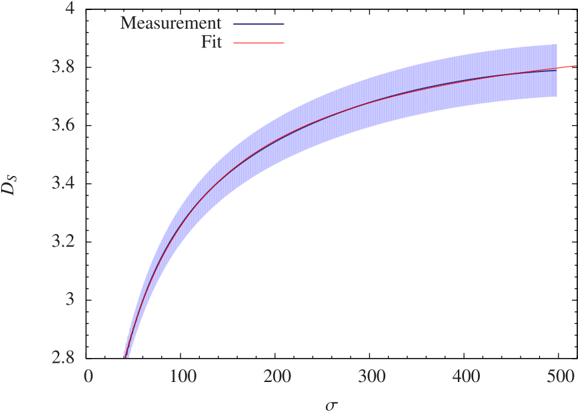
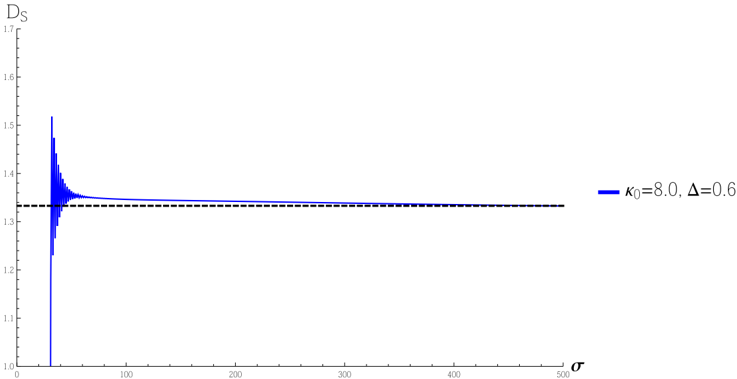
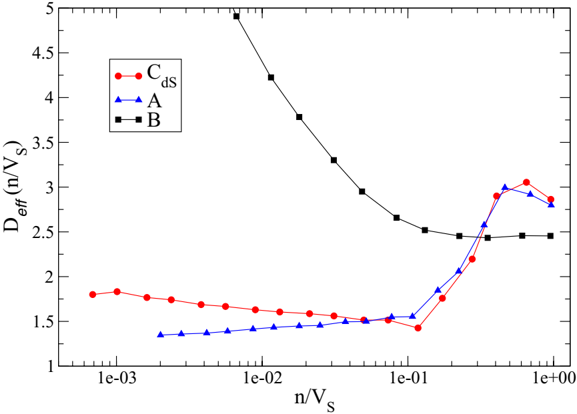
“short distances, which are dominated by lattice artefacts, the spectral dimension determined in this way is D e ˇ1:5 in phase CdS, in agreement with earlier measurements using the return probability [11,97]. As illustrated by Fig. 19, the same approximately constant value is found in phase A, whereas in phase Bone nds…”
BackgroundResultSelf-citationNon-perturbative Lorentzian quantum gravity, causality and topology change
Ambjørn, J., & Loll, R. (1998) · Nuclear Physics B · doi:10.1016/s0550-3213(98)00692-0 · Cited by 388 · cited 3×
“nction ZCDT can be evaluated analytically, which led to the rst explicit demonstration that Lorentzian and Euclidean nonperturbative gravitational path integrals in general yield inequivalent results [5,29]. The same seems to be true in the physically relevant case of gravity in four dimensions, where the presence of…”
BackgroundSelf-citationNonperturbative quantum gravity
Ambjørn, J., Görlich, A., Jurkiewicz, J., & Loll, R. (2012) · Physics Reports · doi:10.1016/j.physrep.2012.03.007 · Cited by 383 · cited 10×
“There are no specific technical difficulties in implementing this in dynamically triangulated quantum gravity, where gravitymatter models have been studied extensively in Euclidean-signature DT (see, for example, [2,17]).”
BackgroundMethodInfluentialSelf-citationAn Introduction to Covariant Quantum Gravity and Asymptotic Safety
Percacci, R. (2017) · 100 Years of General Relativity · doi:10.1142/10369 · Cited by 327 · cited 1×
“A partial exception are functional renormalization group techniques in an asymptotic safety scenario [21, 22], although also this ansatz relies crucially on numerical methods.”
MethodDynamically triangulating Lorentzian quantum gravity
Ambjørn, J., Jurkiewicz, J., & Loll, R. (2001) · Nuclear Physics B · doi:10.1016/s0550-3213(01)00297-8 · Cited by 312 · cited 5×
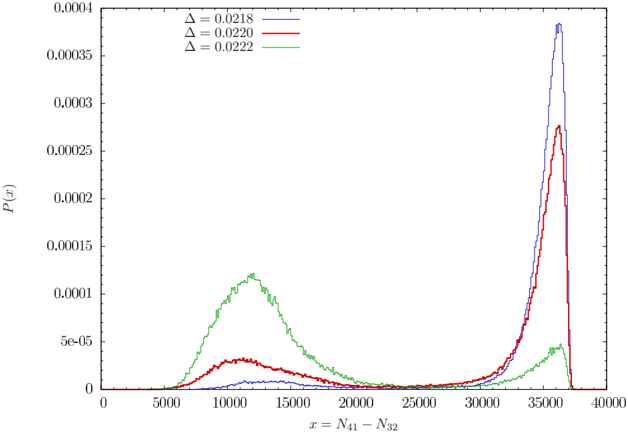
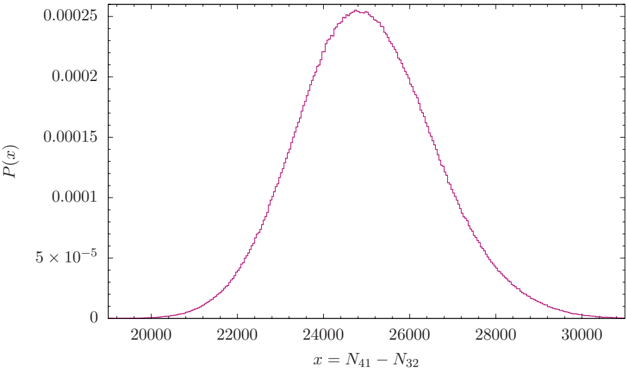
“ility distribution P(x) of the order parameter x= N41 N32 close to the critical point cˇ0:0220 on the B-Ctransition line has only a single peak. Wick rotation possesses a well-dened transfer matrix M[6,7,17]. Its matrix elements describe the amplitude of going from one three-geometry T3 (a spatial three-dimensional si…”
BackgroundInfluentialSelf-citationMultiloop correlators for two-dimensional quantum gravity
Ambjørn, J., Jurkiewicz, J., & Makeenko, Y. M. (1990) · Physics Letters B · doi:10.1016/0370-2693(90)90790-d · Cited by 306 · cited 1×
“vables. The fact that the DT approach can reproduce the results of a dieomorphism-invariant continuum quantum eld theory is well documented in the case of Liouville quantum gravity in two dimensions [52,53]. 5 Causal structure, Wick rotation, time and all that As highlighted in the introduction, the main motivation be…”
ResultThe asymptotic safety scenario in quantum gravity: an introduction
Niedermaier, M. (2007) · Classical and Quantum Gravity · doi:10.1088/0264-9381/24/18/r01 · Cited by 264
LOOP EQUATIONS AND NON-PERTURBATIVE EFFECTS IN TWO-DIMENSIONAL QUANTUM GRAVITY
DAVID, F. (1990) · Modern Physics Letters A · doi:10.1142/s0217732390001141 · Cited by 245
Quantum Geometry: A Statistical Field Theory Approach
Ambjørn, J., Durhuus, B., & Jonsson, T. (1997) · Cambridge University Press eBooks · doi:10.1017/cbo9780511524417 · Cited by 238
Discrete Approaches to Quantum Gravity in Four Dimensions
Loll, R. (1998) · Living Reviews in Relativity · doi:10.12942/lrr-1998-13 · Cited by 232
Self-citationRoček, M., & Williams, R. M. (1981) · Physics Letters B · doi:10.1016/0370-2693(81)90848-0 · Cited by 216 · cited 2×
“The main aim of the present article is to review the major new developments 1“Euclidean spacetimes” have a Riemannian, positive-definite metric, instead of the physical, Lorentzian signature, and are used in the gravitational path integrals of Dynamical Triangulations (DT), the Euclidean precursor of CDT [1,2], and of…”
MethodFour-dimensional simplicial quantum gravity
Ambjørn, J., & Jurkiewicz, J. (1992) · Physics Letters B · doi:10.1016/0370-2693(92)90709-d · Cited by 205 · cited 1×
““Euclidean spacetimes” have a Riemannian, positive-definite metric, instead of the physical, Lorentzian signature, and are used in the gravitational path integrals of Dynamical Triangulations (DT), the Euclidean precursor of CDT [1,2], and of Quantum Regge Calculus [3, 4].”
MethodNonperturbative Lorentzian Path Integral for Gravity
Ambjørn, J., Jurkiewicz, J., & Loll, R. (2000) · Physical Review Letters · doi:10.1103/physrevlett.85.924 · Cited by 194 · cited 4×
“the piecewise at spacetime congurations in the \sum over histories", eq. (1), to unique piecewise at Riemannian spaces, while transforming the sum itself into a sum over real Boltzmann weights [6,7,17]. It turns out that in two spacetime dimensions the analytically continued, real partition function ZCDT can be e…”
BackgroundInfluentialSelf-citationQuantum Gravity and the Functional Renormalization Group: The Road towards Asymptotic Safety
Reuter, M., & Saueressig, F. (2018) · doi:10.1017/9781316227596 · Cited by 179
Planckian Birth of a Quantum de Sitter Universe
Ambjørn, J., Görlich, A., Jurkiewicz, J., & Loll, R. (2008) · Physical Review Letters · doi:10.1103/physrevlett.100.091304 · Cited by 172 · cited 6×
“Its first proposition is to extract what the authors call an “absolute lattice spacing” from measuring the quantum fluctuations around de Sitter space, as introduced in [13, 14].”
BackgroundInfluentialSelf-citationRenormalization of Hořava gravity
Barvinsky, A. O., Blas, D., Herrero-Valea, M., Sibiryakov, S. M., & Steinwachs, C. F. (2016) · Physical review. D/Physical review. D. · doi:10.1103/physrevd.93.064022 · Cited by 171
Nonperturbative quantum de Sitter universe
Ambjørn, J., Görlich, A., Jurkiewicz, J., & Loll, R. (2008) · Physical Review D · doi:10.1103/physrevd.78.063544 · Cited by 159 · cited 6×
“The next important finding came in 2007, when it was shown that the expectation value of the global shape of the dynamically generated universe behaves like the shape of a classical de Sitter universe [13, 14].”
BackgroundInfluentialSelf-citationObservational challenges for the standard FLRW model
Buchert, T., Coley, A. A., Kleinert, H. M., Roukema, B. F., & Wiltshire, D. L. (2016) · International Journal of Modern Physics D · doi:10.1142/s021827181630007x · Cited by 146 · cited 1×
“36 The so-called averaging problem of cosmology refers to the difficulty of quantifying the effect of inhomogeneities on smaller scales on the dynamics of the universe on larger scales, beyond a linear regime, see [111, 112] for recent reviews.”
BackgroundQuantum gravity on the lattice
Hamber, H. W. (2009) · General Relativity and Gravitation · doi:10.1007/s10714-009-0769-y · Cited by 145 · cited 2×
“The main aim of the present article is to review the major new developments 1“Euclidean spacetimes” have a Riemannian, positive-definite metric, instead of the physical, Lorentzian signature, and are used in the gravitational path integrals of Dynamical Triangulations (DT), the Euclidean precursor of CDT [1,2], and of…”
MethodCDT meets Hořava–Lifshitz gravity
Ambjørn, J., Görlich, A., Jordan, S., Jurkiewicz, J., & Loll, R. (2010) · Physics Letters B · doi:10.1016/j.physletb.2010.05.054 · Cited by 137 · cited 3×
“This confirms that the double-peak structure at the B-C transition first reported in [69] in no way contradicts the conclusion of [15, 16] that this phase transition is of second order.”
MethodResultSelf-citationSpringer Handbook of Spacetime
Ashtekar, A., & Petkov, V. (2014) · Springer handbooks · doi:10.1007/978-3-642-41992-8 · Cited by 135
Spectral geometry as a probe of quantum spacetime
Benedetti, D., & Henson, J. (2009) · Physical Review D · doi:10.1103/physrevd.80.124036 · Cited by 134 · cited 4×
“6), in phases CdS and A [97, 98], the suggestion to investigate the function DS(σ) on all scales, generalising a corresponding study of CDT in three dimensions [69], and a comprehensive analysis of the spectral properties of three-dimensional spatial slices in four-dimensional CDT quantum gravity [50].”
BackgroundInfluentialDimension and dimensional reduction in quantum gravity
Carlip, S. (2017) · Classical and Quantum Gravity · doi:10.1088/1361-6382/aa8535 · Cited by 130 · cited 3×
“However, plenty of evidence has been put forward in the meantime [12], supporting the conjecture that short-scale dimensional reduction is a general feature of quantum gravity, and not related to the existence or otherwise of a foliation.”
BackgroundSemiclassical universe from first principles
Ambjørn, J., Jurkiewicz, J., & Loll, R. (2005) · Physics Letters B · doi:10.1016/j.physletb.2004.12.067 · Cited by 120 · cited 2×
“They demonstrated the emergence of an extended fourdimensional universe with semiclassical features on large scales in one of the phases of CDT quantum gravity [8,9], something not seen previously (and since) in models of this type.”
BackgroundSelf-citationSecond-Order Phase Transition in Causal Dynamical Triangulations
Ambjørn, J., Jordan, S., Jurkiewicz, J., & Loll, R. (2011) · Physical Review Letters · doi:10.1103/physrevlett.107.211303 · Cited by 120 · cited 5×
“This confirms that the double-peak structure at the B-C transition first reported in [69] in no way contradicts the conclusion of [15, 16] that this phase transition is of second order.”
BackgroundMethodResultInfluentialSelf-citationNonperturbative 3D Lorentzian quantum gravity
Ambjørn, J., Jurkiewicz, J., & Loll, R. (2001) · Physical Review D · doi:10.1103/physrevd.64.044011 · Cited by 116 · cited 1×
“Just like standard CDT in three dimensions [64], the system exhibits a phase transition as a function of k, with a physical, ‘de Sitter-like’ phase at low vertex density N0/N3 for k < kcrit ≈ 0.”
Self-citationA proper-time cure for the conformal sickness in quantum gravity
Dasgupta, A., & Loll, R. (2001) · Nuclear Physics B · doi:10.1016/s0550-3213(01)00227-9 · Cited by 115 · cited 2×
“congurations prevents the system from developing a conformal divergence, but that for increasing 0 the negative kinetic term of the conformal mode in the bare action will eventually become dominant [54,78]. While the A-Ctransition is thus associated with a clear signal in the eective Lagrangian for the spatial volume,…”
BackgroundSelf-citationFractal space-times under the microscope: a renormalization group view on Monte Carlo data
Reuter, M., & Saueressig, F. (2011) · Journal of High Energy Physics · doi:10.1007/jhep12(2011)012 · Cited by 106 · cited 1×
“p methods in a setting with asymptotic safety, which are usually formulated in terms of the (gauge-xed) spacetime metric g(x). This has already happened for two observables: the spectral dimension [24,25] and the so-called volume prole, dened as the (expectation value of the) volume of space as a function of cosmologi…”
MethodSecond- and first-order phase transitions in causal dynamical triangulations
Ambjørn, J., Jordan, S., Jurkiewicz, J., & Loll, R. (2012) · Physical review. D. Particles, fields, gravitation, and cosmology/Physical review. D. Particles and fields · doi:10.1103/physrevd.85.124044 · Cited by 102 · cited 5×
“This confirms that the double-peak structure at the B-C transition first reported in [69] in no way contradicts the conclusion of [15, 16] that this phase transition is of second order.”
BackgroundMethodResultInfluentialSelf-citationQuantum Gravity via Causal Dynamical Triangulations
Ambjørn, J., Görlich, A., Jurkiewicz, J., & Loll, R. (2014) · Springer handbooks · doi:10.1007/978-3-642-41992-8_34 · Cited by 97
Self-citationR2phase diagram of quantum Einstein gravity and its spectral dimension
Rechenberger, S., & Saueressig, F. (2012) · Physical Review D · doi:10.1103/physrevd.86.024018 · Cited by 95 · cited 1×
“This has already happened for two observables: the spectral dimension [24, 25] and the so-called volume profile, defined as the (expectation value Class.”
BackgroundThe semiclassical limit of causal dynamical triangulations
Ambjørn, J., Görlich, A., Jurkiewicz, J., Loll, R., Gizbert-Studnicki, J., & Trześniewski, T. (2011) · Nuclear Physics B · doi:10.1016/j.nuclphysb.2011.03.019 · Cited by 88 · cited 2×
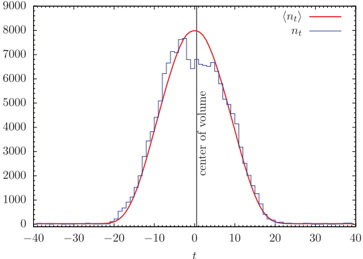
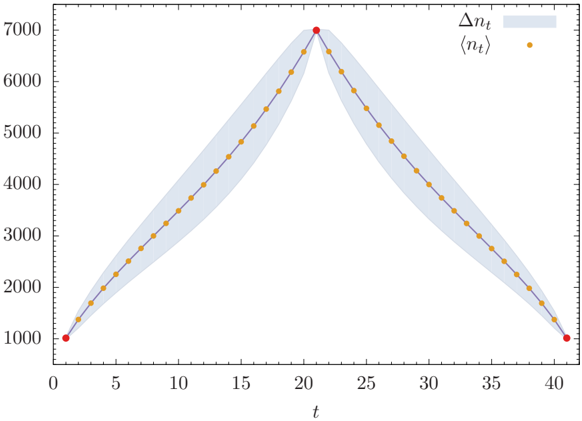
“One recognizes the functional form of Leff from the effective action for the three-volume reconstructed from the covariance matrix of spatial volume fluctuations around the semiclassical expectation value 〈nt〉 in the full CDT simulations [13, 14, 81].”
BackgroundSelf-citationQuantizing Hořava-Lifshitz gravity via causal dynamical triangulations
Anderson, C., Carlip, S. J., Cooperman, J. H., Hořava, P., Kommu, R. K., & Zulkowski, P. R. (2012) · Physical review. D. Particles, fields, gravitation, and cosmology/Physical review. D. Particles and fields · doi:10.1103/physrevd.85.044027 · Cited by 86 · cited 1×
“Secondly, the action used in CDT quantum gravity is just the standard Einstein action, although one could in principle try to implement an explicitly noncovariant action of Hořava-Lifshitz type, as has been done in three dimensions [61].”
Method2d CDT is 2d Hořava–Lifshitz quantum gravity
Ambjørn, J., Glaser, L., Sato, Y., & Watabiki, Y. (2013) · Physics Letters B · doi:10.1016/j.physletb.2013.04.006 · Cited by 76
Discrete Lorentzian quantum gravity
Loll, R. (2001) · Nuclear Physics B - Proceedings Supplements · doi:10.1016/s0920-5632(01)00957-4 · Cited by 75 · cited 1×
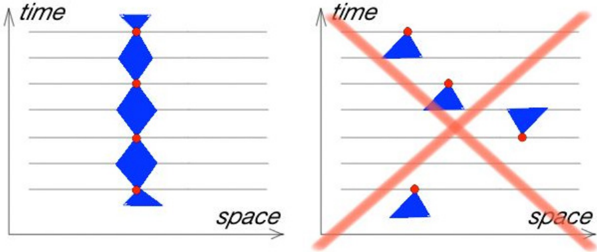
“ranchings are by denition disallowed in CDT, but they are generically present in DT, no matter what notion of time one superimposes on the Euclidean triangulations (for illustration, see for example [57,58]). Although such violations of the causal structure are not allowed in the classical theory, there is no a priori…”
BackgroundSelf-citationRenormalization group flow in CDT
Jan Ambjørn, A., Görlich, A., Jurkiewicz, J., Kreienbuehl, A., & Loll, R. (2014) · Classical and Quantum Gravity · doi:10.1088/0264-9381/31/16/165003 · Cited by 75 · cited 8×
“However, a proof of principle has been given in [85] that these difficulties can be overcome in CDT quantum gravity.”
BackgroundMethodInfluentialSelf-citationNew perspective on matter coupling in 2D quantum gravity
Ambjørn, J., Anagnostopoulos, K. N., & Loll, R. (1999) · Physical Review D · doi:10.1103/physrevd.60.104035 · Cited by 73
Self-citationThe emergence of spacetime or quantum gravity on your desktop
Loll, R. (2008) · Classical and Quantum Gravity · doi:10.1088/0264-9381/25/11/114006 · Cited by 62
Self-citationCausal Dynamical Triangulations without preferred foliation
Jordan, S., & Loll, R. (2013) · Physics Letters B · doi:10.1016/j.physletb.2013.06.007 · Cited by 59 · cited 1×
“The formulation introduced in [62] achieves this by allowing for additional simplicial building blocks without enlarging the set of allowed edge lengths, which are still given in terms of the relations (4).”
BackgroundSelf-citationQuantum Gravity: the art of building spacetime
Ambjørn, J., Jurkiewicz, J., & Loll, R. (2009) · Cambridge University Press eBooks · doi:10.1017/cbo9780511575549.022 · Cited by 58
Self-citationTowards Reconstructing the Quantum Effective Action of Gravity
Knorr, B., & Saueressig, F. (2018) · Physical Review Letters · doi:10.1103/physrevlett.121.161304 · Cited by 57 · cited 1×
“This has already happened for two observables: the spectral dimension [24, 25] and the so-called volume profile, defined as the (expectation value of the) volume of space as a function of cosmological time [26].”
BackgroundDimension and Dimensional Reduction in Quantum Gravity
Carlip, S. J. (2019) · Universe · doi:10.3390/universe5030083 · Cited by 56
Evidence for asymptotic safety from dimensional reduction in causal dynamical triangulations
Coumbe, D. N., & Jurkiewicz, J. (2015) · Journal of High Energy Physics · doi:10.1007/jhep03(2015)151 · Cited by 52 · cited 7×
“Some evidence for this is the fact that the fitted curves for the spectral dimension functions corresponding to different phase space points do not match particularly well, even after a best rescaling of σ (figure 3 in [97]).”
BackgroundInfluentialEuclidean and Lorentzian quantum gravity—lessons from two dimensions
Ambjørn, J., Loll, R., Nielsen, J. L., & Rolf, J. (1999) · Chaos, Solitons & Fractals · doi:10.1016/s0960-0779(98)00197-0 · Cited by 52 · cited 1×
“nction ZCDT can be evaluated analytically, which led to the rst explicit demonstration that Lorentzian and Euclidean nonperturbative gravitational path integrals in general yield inequivalent results [5,29]. The same seems to be true in the physically relevant case of gravity in four dimensions, where the presence of…”
BackgroundSelf-citationIntroducing quantum Ricci curvature
Klitgaard, N., & Loll, R. (2018) · Physical review. D/Physical review. D. · doi:10.1103/physrevd.97.046008 · Cited by 52 · cited 3×
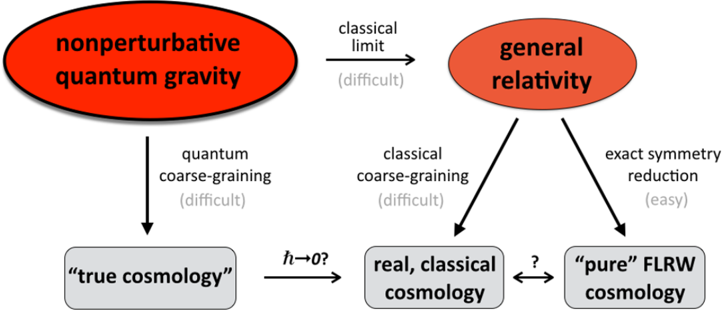
“uot; scale factors and their dynamics are related requires further research. Another interesting question is to what extent quantum coarse-graining, especially for a quantity like the Ricci curvature [100], can shed light on the little-understood coarse-graining properties of the classical Einstein or Friedmann equati…”
BackgroundInfluentialSelf-citationCharacteristics of the new phase in CDT
Ambjørn, J., Gizbert-Studnicki, J., Görlich, A., Jurkiewicz, J., Klitgaard, N., & Loll, R. (2017) · The European Physical Journal C · doi:10.1140/epjc/s10052-017-4710-3 · Cited by 51 · cited 5×
“A more recent study of the B-C transition [68] has confirmed its second-order status, and somewhat surprisingly found that the (potentially misleading) double peak in histograms simply disappears when N41 instead of N4 is kept fixed (see Figs.”
BackgroundInfluentialSelf-citationThe cosmological time function
Andersson, L., Galloway, G. J., & Howard, R. (1998) · Classical and Quantum Gravity · doi:10.1088/0264-9381/15/2/006 · Cited by 50 · cited 1×
“e with de Sitter behaviour { it measures the geodesic distance to the beginning of the universe, reminiscent of the dieomorphism-invariant notion of cosmological time in classical general relativity [59]. Whether or not the label tcan be related to some physical notion of time in a suitable continuum limit cannot be d…”
BackgroundShaken, but not stirred—Potts model coupled to quantum gravity
Ambjørn, J., Anagnostopoulos, K. N., Loll, R., & Pushkina, I. (2008) · Nuclear Physics B · doi:10.1016/j.nuclphysb.2008.08.030 · Cited by 50
Self-citationSpectral dimension of quantum geometries
Calcagni, G., Oriti, D., & Thürigen, J. (2014) · Classical and Quantum Gravity · doi:10.1088/0264-9381/31/13/135014 · Cited by 50 · cited 1×
“see [94] for examples of discretization effects on some regular lattices”
Background2D quantum gravity in the proper-time gauge
Nakayama, R. (1994) · Physics Letters B · doi:10.1016/0370-2693(94)90023-x · Cited by 46 · cited 1×
“As has been known for a long time, also ordinary two-dimensional gravity in proper-time gauge leads to equivalent results [68].”
ResultEuclidian 4d quantum gravity with a non-trivial measure term
Jan Ambjørn, A., Glaser, L., Görlich, A., & Jurkiewicz, J. (2013) · Journal of High Energy Physics · doi:10.1007/jhep10(2013)100 · Cited by 46 · cited 2×
“Despite renewed efforts [41, 55, 56], there is still no evidence of higher-order phase transitions or semiclassical behaviour à la CDT in the latter.”
BackgroundThe effective action in 4-dim CDT. The transfer matrix approach
Ambjørn, J., Gizbert-Studnicki, J., Görlich, A., & Jurkiewicz, J. (2014) · Journal of High Energy Physics · doi:10.1007/jhep06(2014)034 · Cited by 45 · cited 5×
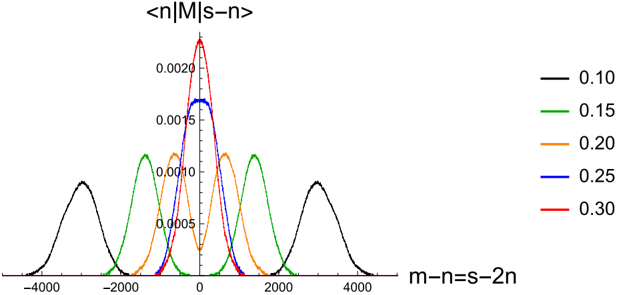
“In a follow-up investigation [84] the matrix elements (14) were extracted from measurements of a periodically identified two-slice system with ttot = 2.”
BackgroundMethodInfluentialCausal dynamical triangulations and the quest for quantum gravity
Ambjørn, J., Jurkiewicz, J., & Loll, R. (2012) · Cambridge University Press eBooks · doi:10.1017/cbo9780511920998.013 · Cited by 45
Self-citationExploring Euclidean dynamical triangulations with a non-trivial measure term
Coumbe, D. N., & Laiho, J. (2015) · Journal of High Energy Physics · doi:10.1007/jhep04(2015)028 · Cited by 44 · cited 1×
“ion of the CDT path integral and associated observables by Monte Carlo simulations, and thus an explicit comparison with corresponding DT results for Euclidean quantum gravity. Despite renewed eorts [41,55,56], there is still no evidence of higher-order phase transitions or semiclassical behaviour a la CDT in the latt…”
Crossing thec=1barrier in 2D Lorentzian quantum gravity
Ambjørn, J., Anagnostopoulos, K., & Loll, R. (2000) · Physical Review D · doi:10.1103/physrevd.61.044010 · Cited by 43 · cited 1×
“Systems of CDT geometry and matter were investigated in the early days of CDT, and were centred on questions specific to two dimensions, like the existence of a c = 1 barrier in CDT [36, 37] and whether matter critical exponents coincide with those on flat two-dimensional lattices [38, 39].”
BackgroundSelf-citationSingular vertices and the triangulation space of the D-sphere
Catterall, S. M., Þorleifsson, G., Kogut, J. B., & Renken, R. L. (1996) · Nuclear Physics B · doi:10.1016/0550-3213(96)00130-7 · Cited by 43
New higher-order transition in causal dynamical triangulations
Ambjørn, J., Coumbe, D., Gizbert-Studnicki, J., Görlich, A., & Jurkiewicz, J. (2017) · Physical review. D/Physical review. D. · doi:10.1103/physrevd.95.124029 · Cited by 43 · cited 4×
“arlo time, normalized by the autocorrelation time. Notable for the simulations near the transition is a severe critical slowing-down, associated with very long autocorrelation times, as documented in [71,80]. 19the slice closest to the maximum of the volume prole n tof a given conguration, or some variant involving th…”
BackgroundResultInfluential4d simplicial quantum gravity interacting with gauge matter fields
Bilke, S., Burda, Z., Krzywicki, A., Petersson, B., Tabaczek, J., & Thorleifsson, G. (1998) · Physics Letters B · doi:10.1016/s0370-2693(97)01409-3 · Cited by 42 · cited 1×
“sidering matter coupling in four-dimensional Euclidean DT quantum gravity in the 1990s was the hope to find a continuous phase transition and an associated continuum theory after all [40], a hope that up to now has not been realized.”
BackgroundGeometry of the quantum universe
Ambjørn, J., Görlich, A., Jurkiewicz, J., & Loll, R. (2010) · Physics Letters B · doi:10.1016/j.physletb.2010.05.062 · Cited by 42 · cited 1×
“The fractal and largely nonclassical geometric nature of the slices of constant proper time has been exhibited previously [11,95].”
BackgroundSelf-citationImplementing quantum Ricci curvature
Klitgaard, N., & Loll, R. (2018) · Physical review. D/Physical review. D. · doi:10.1103/physrevd.97.106017 · Cited by 42 · cited 2×
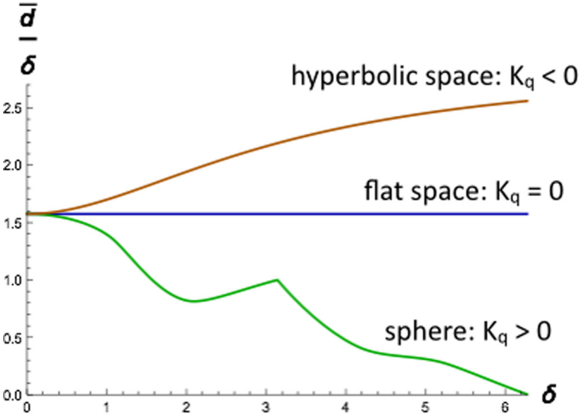
“omputed analytically (c.f. Fig. 22). A rst indication of the robustness of the quantum Ricci curvature comes from evaluating it on the ensemble of Euclidean dynamical triangulations in two dimensions [101], which is known to have a highly nonclassical and fractal geometry. The measured expectation value of its curvatu…”
BackgroundSelf-citationSignature change of the metric in CDT quantum gravity?
Ambjørn, J., Coumbe, D. N., Gizbert-Studnicki, J., & Jurkiewicz, J. (2015) · Journal of High Energy Physics · doi:10.1007/jhep08(2015)033 · Cited by 41 · cited 5×
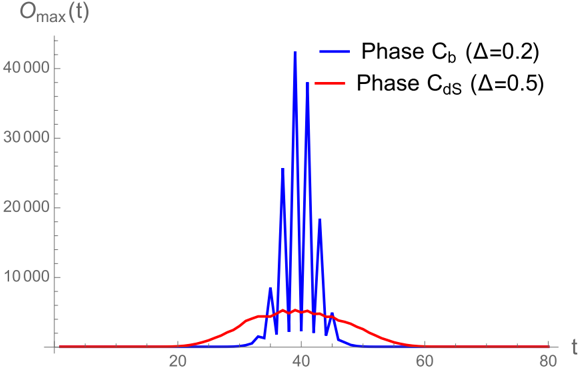
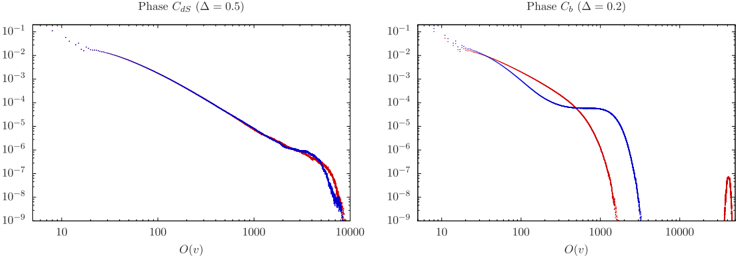
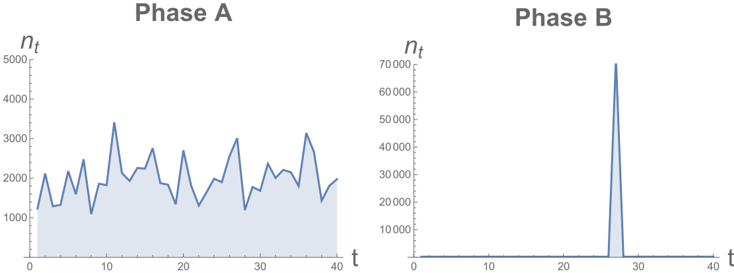
“inside phases A, Band Cis not sensitive to the Cb-CdS phase transition. The likely explanation is the nature of the bifurcation phase, whose distinguishing feature is a particular localized structure [67,68] that does not aect the overall shape of the universe, at least not near the transition to the de Sitter phase.…”
BackgroundMethodInfluentialCDT---an Entropic Theory of Quantum GravityPreprint
Ambjørn, J., Goerlich, A., Jurkiewicz, J., & Loll, R. (2010) · arXiv (Cornell University) · doi:10.48550/arxiv.1007.2560 · Cited by 41 · cited 1×
“This is consistent with the idea that inside phase C the entropy of the microscopic configurations prevents the system from developing a conformal divergence, but that for increasing κ0 the negative kinetic term of the conformal mode in the bare action will eventually become dominant [54, 85].”
BackgroundSelf-citationDe Sitter universe from causal dynamical triangulations without preferred foliation
Jordan, S., & Loll, R. (2013) · Physical review. D. Particles, fields, gravitation, and cosmology/Physical review. D. Particles and fields · doi:10.1103/physrevd.88.044055 · Cited by 40 · cited 1×
“a time variable with individual simplices and subsequently to dene the notion of a spatial slice of constant time, is an average version of \link distance to the poles" of the three-sphere (see [63,64] for details). Volume proles as a function of this intrinsic time twere analyzed throughout phase space for k<…”
BackgroundSelf-citationImpact of topology in causal dynamical triangulations quantum gravity
Ambjørn, J., Drogosz, Z., Gizbert-Studnicki, J., Görlich, A., Jurkiewicz, J., & Nèmeth, D. (2016) · Physical review. D/Physical review. D. · doi:10.1103/physrevd.94.044010 · Cited by 40 · cited 5×
“1 2[80k;240k] and the time extension in the range ttot 2[10;200]) resulted in an eective action of 32 the form Se = X t 1 (nt nt+1)2 nt+ nt+1 + n t + nt ; (21) with ˇ26:3, =1:16 0:02 and >0 [82].22 Comparing this with the eective Lagrangian (15) obtained for the spherical case, the kinetic term is identical, includ…”
BackgroundInfluentialSector models—A toolkit for teaching general relativity: I. Curved spaces and spacetimes
Zahn, C., & Kraus, U. (2014) · European Journal of Physics · doi:10.1088/0143-0807/35/5/055020 · Cited by 39 · cited 1×
“The pedagogical value of explaining curvature in terms of piecewise flat triangulations is illustrated nicely in [51].”
BackgroundSpacetime condensation in (2+1)-dimensional CDT from a Hořava–Lifshitz minisuperspace model
Benedetti, D., & Henson, J. (2015) · Classical and Quantum Gravity · doi:10.1088/0264-9381/32/21/215007 · Cited by 33 · cited 1×
“The same applies to conclusions on the relationship between Hořava–Lifshitz and CDT quantum gravity drawn from so-called balls-in-boxes models [73, 74], which are conjectured effective models of the scale factor [75].”
BackgroundThe transfer matrix in four-dimensional CDT
Ambjørn, J., Gizbert-Studnicki, J., Görlich, A., & Jurkiewicz, J. (2012) · Journal of High Energy Physics · doi:10.1007/jhep09(2012)017 · Cited by 33 · cited 4×
“In [72], transfer matrix elements 〈nt+1|M |nt〉 were obtained from combining measurements of various probability distributions of pairs (n1, n2) of three-volumes, for (cyclically identified) total times in the range ttot ∈ [2, 6], at (κ0,∆) = (2.”
BackgroundMethodResultInfluentialInhomogeneous cosmology and backreaction: Current status and future prospects
Bolejko, K., & Korzyński, M. (2017) · International Journal of Modern Physics D · doi:10.1142/s0218271817300117 · Cited by 32
Four-dimensional CDT with toroidal topology
Ambjørn, J., Gizbert-Studnicki, J., Görlich, A., Grosvenor, K. T., & Jurkiewicz, J. (2017) · Nuclear Physics B · doi:10.1016/j.nuclphysb.2017.06.026 · Cited by 31 · cited 4×
“The shape of the volume profile 〈nt〉 of figure 13 can be matched qualitatively well by classical solutions derived for the continuum analogue of the action (21) [90].”
BackgroundMethodResultInfluentialExploring the new phase transition of CDT
Coumbe, D., Gizbert-Studnicki, J., & Jurkiewicz, J. (2016) · Journal of High Energy Physics · doi:10.1007/jhep02(2016)144 · Cited by 29 · cited 5×
“Notable for the simulations near the transition is a severe critical slowing-down, associated with very long autocorrelation times, as documented in [79, 87].”
BackgroundMethodInfluentialSearching for a continuum limit in causal dynamical triangulation quantum gravity
Ambjørn, J., Coumbe, D., Gizbert-Studnicki, J., & Jurkiewicz, J. (2016) · Physical review. D/Physical review. D. · doi:10.1103/physrevd.93.104032 · Cited by 29 · cited 1×
“s. { The systematic and theoretical uncertainties 43 just described make it dicult to judge whether the qualitative increase in the lattice spacing for growing coupling 0 (at xed =0 :6) observed in [91,92] is a genuine physical eect, which would imply that these simulations probe closer into the Planckian regime. A re…”
BackgroundThe phase structure of causal dynamical triangulations with toroidal spatial topology
Ambjørn, J., Gizbert-Studnicki, J., Görlich, A., Jurkiewicz, J., & Németh, D. (2018) · Journal of High Energy Physics · doi:10.1007/jhep06(2018)111 · Cited by 29 · cited 4×
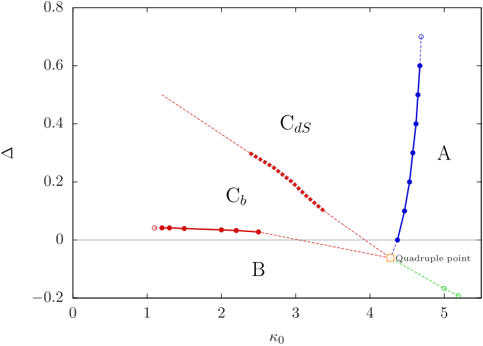
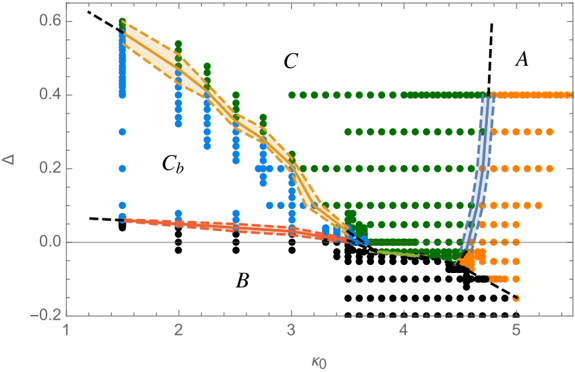
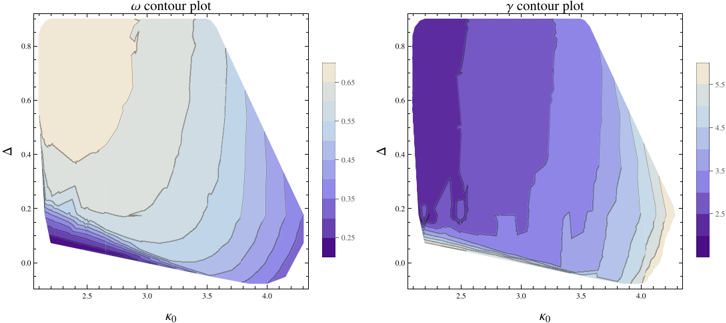
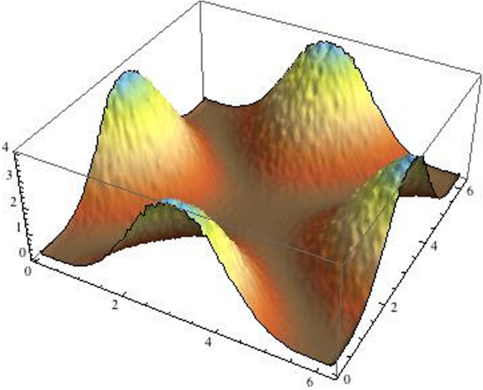
“with dierent colours associated to the four dierent phases. The phase denoted Cis the analogue of the de Sitter phase for spherical slices. Dashed black lines indicate extrapolations. [Figure from [84].] coordination number (˘60k) forming on every second spatial slice. In addition, extensive measurements of both the o…”
BackgroundMethodInfluentialA validation of causal dynamical triangulations
Kommu, R. K. (2012) · Classical and Quantum Gravity · doi:10.1088/0264-9381/29/10/105003 · Cited by 28
Non-Abelian Stokes theorems in the Yang-Mills and gravity theories
Diakonov, D. I., & Petrov, V. Y. (2001) · Journal of Experimental and Theoretical Physics · doi:10.1134/1.1385630 · Cited by 26 · cited 1×
“where the 4 comes from the trace of the unit matrix in the defining representation of SO(4) (see, for example, [104]).”
BackgroundSpectrum of the Laplace-Beltrami operator and the phase structure of causal dynamical triangulations
Clemente, G., & D’Elia, M. (2018) · Physical review. D/Physical review. D. · doi:10.1103/physrevd.97.124022 · Cited by 23 · cited 4×
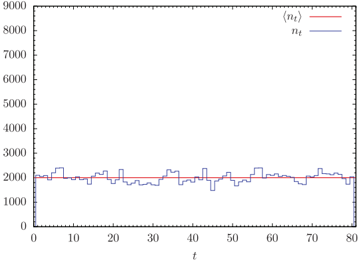
“ces at (0;)=(5 :0;0:6) in phase A, (2:2; 0:2) in phase B and (2:2;0:6) in phase CdS, measured for ttot=80, spacetime volume N41 =80k(phases Aand CdS) and N41 =16k(phase B), and in small bins of n=VS [50]. In the kinematical limit n=VS!1 the eective dimensions are close to 3, primarily determined by the discrete lattic…”
BackgroundMethodInfluentialPseudo-topological transitions in 2D gravity models coupled to massless scalar fields
Ambjørn, J., Görlich, A., Jurkiewicz, J., & Zhang, H.-G. (2012) · Nuclear Physics B · doi:10.1016/j.nuclphysb.2012.05.024 · Cited by 21 · cited 1×
“Systems of CDT geometry and matter were investigated in the early days of CDT, and were centred on questions specific to two dimensions, like the existence of a c= 1 barrier in CDT [36, 37] and whether matter critical exponents coincide with those on flat two-dimensional lattices [38,39].”
BackgroundLocally causal dynamical triangulations in two dimensions
Loll, R., & Ruijl, B. (2015) · Physical review. D. Particles, fields, gravitation, and cosmology/Physical review. D. Particles and fields · doi:10.1103/physrevd.92.084002 · Cited by 19 · cited 1×
“Perhaps more feasible, although less relevant physically, is the analytic solution of CDT without preferred slicing in two dimensions, to establish its equivalence or otherwise with standard CDT, which so far has not been achieved (see [66] for some numerical hints).”
BackgroundSelf-citationEuclidean Dynamical Triangulation revisited: is the phase transition really 1st order?
Rindlisbacher, T., & de Forcrand, P. (2015) · Journal of High Energy Physics · doi:10.1007/jhep05(2015)138 · Cited by 18
On a renormalization group scheme for causal dynamical triangulations
Cooperman, J. H. (2016) · General Relativity and Gravitation · doi:10.1007/s10714-016-2027-4 · Cited by 17 · cited 3×
“Reference [82] provides an explicit construction of an initial configuration of this kind, which is needed as a starting point for the Monte Carlo simulations.”
BackgroundInfluentialGlaser, L., & Loll, R. (2017) · Comptes Rendus Physique · doi:10.1016/j.crhy.2017.04.002 · Cited by 17 · cited 1×
“Readers interested in further considerations on the relation between CDT and cosmology should consult [104], which also compares the robustness of the classical FLRW paradigm with the fact that in candidate theories of nonperturbative quantum gravity the emergence of a scale factor exhibiting FLRW behaviour is definit…”
BackgroundSelf-citationTesting the holographic principle using lattice simulations
Jha, R. G., Catterall, S. M., Schaich, D., & Wiseman, T. (2018) · EPJ Web of Conferences · doi:10.1051/epjconf/201817508004 · Cited by 17
Wilson loops in nonperturbative quantum gravity
Ambjørn, J., Görlich, A., Jurkiewicz, J., & Loll, R. (2015) · Physical review. D. Particles, fields, gravitation, and cosmology/Physical review. D. Particles and fields · doi:10.1103/physrevd.92.024013 · Cited by 15 · cited 5×
“6), for ttot=80 and N4 =20k and loops of winding number 1 with respect to the compactified time direction [43].”
BackgroundMethodInfluentialSelf-citationCoupling a point-like mass to quantum gravity with causal dynamical triangulations
Khavkine, I., Loll, R., & Reska, P. M. (2010) · Classical and Quantum Gravity · doi:10.1088/0264-9381/27/18/185025 · Cited by 15 · cited 1×
“On the conceptual side, as illustrated by studies of CDT coupled to a single massive particle [42, 43], there are subtleties in relating Euclidean and Lorentzian results, which still need to be understood better.”
MethodSelf-citationScale-dependent homogeneity measures for causal dynamical triangulations
Cooperman, J. H. (2014) · Physical review. D. Particles, fields, gravitation, and cosmology/Physical review. D. Particles and fields · doi:10.1103/physrevd.90.124053 · Cited by 13 · cited 1×
“1) and the variance of the normalized volume of geodesic balls of radius r for a given triangulation T as measures for the homogeneity of the geometry of T [113].”
BackgroundCapturing the phase diagram of (2 + 1)-dimensional CDT using a balls-in-boxes model
Benedetti, D., & Ryan, J. P. (2017) · Classical and Quantum Gravity · doi:10.1088/1361-6382/aa6b5d · Cited by 12 · cited 1×
“The same applies to conclusions on the relationship between Hořava–Lifshitz and CDT quantum gravity drawn from so-called balls-in-boxes models [73, 74], which are conjectured effective models of the scale factor [75].”
BackgroundSingular vertices in the strong coupling phase of four-dimensional simplicial gravity
Hotta, T., Izubuchi, T., & Nishimura, J. (1996) · Nuclear Physics B - Proceedings Supplements · doi:10.1016/0920-5632(96)00132-6 · Cited by 11
Causal set generator and action computer
Cunningham, W. J., & Krioukov, D. (2018) · Computer Physics Communications · doi:10.1016/j.cpc.2018.06.008 · Cited by 11 · cited 1×
“In recent years, Markov chain Monte Carlo and other computer algorithms have gradually been making inroads, beyond lattice QCD and lattice gravity, into other quantum gravity approaches and more generally theoretical high-energy physics beyond the standard model (see [44–46] for some recent examples), and their apprec…”
BackgroundRunning scales in causal dynamical triangulations
Clemente, G., D’Elia, M., & Ferraro, A. (2019) · Physical review. D/Physical review. D. · doi:10.1103/physrevd.99.114506 · Cited by 11
Quantum widening of a causal dynamical triangulations universe
Bogacz, L., Burda, Z., & Waclaw, B. (2012) · Physical review. D. Particles, fields, gravitation, and cosmology/Physical review. D. Particles and fields · doi:10.1103/physrevd.86.104015 · Cited by 10
Recent results in CDT quantum gravity
Ambjørn, J., Coumbe, D., Gizbert-Studnicki, J., & Jurkiewicz, J. (2017) · The Ninth Marcel Grossmann Meeting · doi:10.1142/9789813226609_0516 · Cited by 10 · cited 1×
“and large sband interpreting the result as 26 an eective Lagrangian like (15), one nds for suciently large spatial volumes an \eective" kinetic term with a negative sign, which the authors of [67,79] suggest to interpret as a scale-dependent eective signature change of the metric. Since the total volume is just o…”
BackgroundIntroduction to Causal Dynamical Triangulations
Görlich, A. (2012) · Lecture notes in physics · doi:10.1007/978-3-642-33036-0_5 · Cited by 7 · cited 1×
“Since the details of how the CDT path integral over triangulations is set up have been covered in [17] and other previous reviews and overviews (see, for example, [30–34]), we will confine ourselves to a summary of the essentials, while highlighting some issues which are of special importance.”
BackgroundMarkov Chain Monte Carlo for DummiesPreprint
Hanada, M. (2018) · arXiv (Cornell University) · doi:10.48550/arxiv.1808.08490 · Cited by 7
Quantum spacetime, from a practitioner's point of view
Jan Ambjørn, A., Jordan, S., Jurkiewicz, J., & Loll, R. (2013) · AIP conference proceedings · doi:10.1063/1.4791726 · Cited by 6 · cited 1×
“not near the transition to the de Sitter phase. A similar observation holds for the order parameters that were used to locate the previously known transition lines A-Cand B-Cand determine their order [15,16,64,69,70]. Although they can also be used for the Cb-CdS transition, the corresponding signals are much weaker t…”
MethodSelf-citationThe transfer matrix in four dimensional causal dynamical triangulations
Ambjørn, J., Gizbert-Studnicki, J., Görlich, A., Jurkiewicz, J., & Loll, R. (2013) · AIP conference proceedings · doi:10.1063/1.4791727 · Cited by 5
Self-citationGeometric flux formula for the gravitational Wilson loop
Klitgaard, N., Loll, R., Reitz, M., & Toriumi, R. (2020) · Classical and Quantum Gravity · doi:10.1088/1361-6382/abb874 · Cited by 5
Self-citationCAUSAL DYNAMICAL TRIANGULATIONS AND THE SEARCH FOR A THEORY OF QUANTUM GRAVITY
Jan Ambjørn, A., GüRLICH, A., Jurkiewicz, J., & Loll, R. (2015) · The Ninth Marcel Grossmann Meeting · doi:10.1142/9789814623995_0008 · Cited by 4
Self-citationComments on "Searching for a continuum limit in CDT quantum gravity"Preprint
Cooperman, J. H. (2016) · arXiv (Cornell University) · doi:10.48550/arxiv.1604.01798 · Cited by 4 · cited 1×
“4 above (see also [99] for related comments)29.”
BackgroundProjectable Hořava Gravity in 2+1 Dimensions: Phases and Flows
Grosvenor, K. T. (2018) · Journal of Physics Conference Series · doi:10.1088/1742-6596/952/1/012015 · Cited by 1
Research works printed but not linked: 8
- 20. Ellis G, Murugan J and Weltman A (ed) 2012 Foundations of Space and Time (Cambridge: Cambridge University Press)
- 22. Reuter M and Saueressig F 2019 Quantum Gravity and the Functional Renormalization Group (Cambridge: Cambridge University Press)
- 28. David F 1995 Simplicial quantum gravity and random lattices Gravitation and Quantizations. Proc. Les Houches Summer School 1992 ed J Zinn-Justin and B Julia (Amsterdam: Elsevier)
- 63. Jordan S 2013 Globally and locally causal dynamical triangulations PhD Thesis Radboud University Nijmegen
- 82. Class. Quantum Grav. 37 (2020) 013002 Topical Review
- 83. Gizbert-Studnicki J 2014 The effective action in four-dimensional CDT PhD Thesis Jagiellonian University Krakow
- 105. Görlich A 2010 Causal dynamical triangulations in four dimensions PhD Thesis Jagiellonian University Krakow
- 113. Class. Quantum Grav. 37 (2020) 013002 Topical Review
Cited by
Barceló, C., Liberati, S., & Visser, M. (2005) · Living Reviews in Relativity · doi:10.12942/lrr-2005-12 · Cited by 1,163
Quantum gravity phenomenology at the dawn of the multi-messenger era—A review
Addazi, A., Alvarez-Muniz, J., Alves Batista, R., Amelino-Camelia, G., Antonelli, V., Arzano, M., Asorey, M., Atteia, J.-L., Bahamonde, S., Bajardi, F., et al. (2022) · Progress in Particle and Nuclear Physics · doi:10.1016/j.ppnp.2022.103948 · Cited by 440
A short review of loop quantum gravity
Ashtekar, A., & Bianchi, E. (2021) · Reports on Progress in Physics · doi:10.1088/1361-6633/abed91 · Cited by 294
Critical Reflections on Asymptotically Safe Gravity
Bonanno, A., Eichhorn, A., Gies, H., Pawlowski, J. M., Percacci, R., Reuter, M., Saueressig, F., & Vacca, G. P. (2020) · Frontiers in Physics · doi:10.3389/fphy.2020.00269 · Cited by 238
Boguñá, M., Bonamassa, I., De Domenico, M., Havlin, S., Krioukov, D., & Serrano, M. Á. (2021) · Nature Reviews Physics · doi:10.1038/s42254-020-00264-4 · Cited by 213
Metadata
- Authors
- Loll, R.
- Affiliations
- Radboud University Nijmegen (NL)
- Corresponding author
- Loll, R
- ORCID
- Loll, R
- Venue
- Classical and Quantum Gravity
- Publisher
- IOP Publishing
- Published
- 2019-12-06
- Volume
- 37
- Issue
- 1
- Pages
- 013002
- ISSN
- 0264-9381 (ISSN-L)
- 1361-6382
- OpenAlex
- W2988499113
- Cited by
- 359
- References
- 103
- Citations by year
- 2026: 26 · 2025: 52 · 2024: 58 · 2023: 62 · 2022: 51 · 2021: 67 · 2020: 41 · 2019: 2
- FWCI
- 18.63
- Type
- journal article
- Language
- en
- Open access
- hybrid
- doi.org
- Licence
- cc-by
- publishingsupport.iopscience.iop.org/iop-standard/v1 (vor)
- iopscience.iop.org/info/page/text-and-data-mining (tdm)
- Locations
- Classical and Quantum Gravity (publishedVersion, cc-by)
- arXiv (Cornell University) (submittedVersion)
- Radboud Repository (Radboud University) (submittedVersion)
- arXiv (Cornell University)
- Funders
- Government of Canada
- Institut Périmètre de physique théorique
- Topics
- Physical Sciences › Physics and Astronomy › Nuclear and High Energy Physics › Noncommutative and Quantum Gravity Theories
- Physical Sciences › Physics and Astronomy › Astronomy and Astrophysics › Relativity and Gravitational Theory
- Physical Sciences › Physics and Astronomy › Nuclear and High Energy Physics › Black Holes and Theoretical Physics
- Keywords
- causal dynamical triangulations, quantum gravity, lattice gravity, non-perturbative quantum gravity, Planck scale, diffeomorphism invariance, phase structure, causality, global topology, renormalization group, quantum observables, four-dimensional spacetime
About these checks
Registry, retraction, Cites and statistics results are computed, not judged, with one exception: a printed reference that no index lists is read once by a model before it counts as a citation error. Claims are extracted by a model and kept only when their quote appears verbatim in the text; each cited source is then checked, with a model’s help, for whether it says what the claim relies on. Those verdicts can be wrong — read the claim’s quote and the cited source before relying on one.
Statistics and arithmetic are recomputed, not judged.
Confidence bands are shown only for fields calibrated on our annotated test set. None is calibrated yet, so no band is shown.
What counts as a claim ›How we measure confidence ›How we check this ›
Are you an author, or do you see a problem with this page? Request a review
Data sources
Bibliographic data: Semantic Scholar, OpenAlex, Crossref.
Contains information from the Semantic Scholar Academic Graph Datasets, made available under the ODC Attribution License (ODC-BY 1.0).
Semantic Scholar’s data is described in: Kinney, R., et al. (2023). The Semantic Scholar Open Data Platform. arXiv:2301.10140.
