

An experiment for the direct determination of the g-factor of a single proton in a Penning trap
Open accessThe DOI matches its Crossref record; 52 of the 52 references it cites were found in a registry or an index.
Abstract
A new apparatus has been designed that aims at a direct precision measurement of the g -factor of a single isolated proton or antiproton in a Penning trap. We present a thorough discussion on the trap design and a method for the experimental trap optimization using a single stored proton. A first attempt at the g -factor determination has been made in a section of the trap with a magnetic bottle. The Larmor frequency of the proton has been measured with a relative uncertainty of 1.8 × 10 −6 and the magnetic moment has been determined with a relative uncertainty of 8.9 × 10 −6 . A g -factor of 5.585 696(50) has been obtained, which is in excellent agreement with previous measurements and predictions. Future experiments shall drive the spin-flip transition in a section of the trap with a homogeneous magnetic field. This has the potential to improve the precision of the measured g -factor of the proton and the antiproton by several orders of magnitude.
Overview
The claims and statistics of this paper haven’t been checked yet.
Free: it reads the open-access text and checks the first 5 claims that cite a source we can check. Create a free account to check every claim.
Integrity signals
Registry
Cites
Statistics
Figures


Verification
Claims the paper makes
The claims and statistics of this paper haven’t been checked yet.
Free: it reads the open-access text and checks the first 5 claims that cite a source we can check. Create a free account to check every claim.
Self-check
Percentages, sums and reported differences re-computed from the paper’s own numbers.
The self-check needs the paper’s full text.
Citations
Cites
(2020) · Electromagnetic Processes · doi:10.2307/j.ctv131bv37.5 · Cited by 21,966
Geonium theory: Physics of a single electron or ion in a Penning trap
Brown, L. S., & Gabrielse, G. (1986) · Reviews of Modern Physics · doi:10.1103/revmodphys.58.233 · Cited by 1,367 · cited 7×
“4), as demonstrated in [25].”
BackgroundMethodResultInfluentialThe Nuclear Induction Experiment
Bloch, F., Hansen, W. W., & Packard, M. (1946) · Physical Review · doi:10.1103/physrev.70.474 · Cited by 1,192
New measurement of the electron magnetic moment and the fine structure constant
Hanneke, D., Fogwell, S., & Gabrielse, G. (2008) · Physical Review Letters · doi:10.1103/physrevlett.100.120801 · Cited by 1,138
High-accuracy mass spectrometry with stored ions
Blaum, K. (2006) · Physics Reports · doi:10.1016/j.physrep.2005.10.011 · Cited by 860 · cited 1×
“Furthermore, Penning traps are crucial in the field of high-accuracy mass spectrometry [5–8].”
BackgroundSelf-citationRecent trends in the determination of nuclear masses
Lunney, D., Pearson, J. M., & Thibault, C. (2003) · Reviews of Modern Physics · doi:10.1103/revmodphys.75.1021 · Cited by 759
New high-precision comparison of electron and positron g factors
Van Dyck, R. S., Schwinberg, P. B., & Dehmelt, H. G. (1987) · Physical Review Letters · doi:10.1103/physrevlett.59.26 · Cited by 659
Principles of the stored ion calorimeter
Wineland, D. J., & Dehmelt, H. G. (1975) · Journal of Applied Physics · doi:10.1063/1.321602 · Cited by 328
Open-endcap Penning traps for high precision experiments
Gabrielse, G., Haarsma, L., & Rolston, S. L. (1989) · International Journal of Mass Spectrometry and Ion Processes · doi:10.1016/0168-1176(89)85027-x · Cited by 288 · cited 3×
“By means of a proper choice of the trap geometry and tuning ratio, C4 and C6 can be eliminated simultaneously, thus providing compensation of the potential in the lowest order [34, 35].”
BackgroundThousandfold improvement in the measured antiproton mass
Gabrielse, G., Fei, X., Orozco, L., Tjoelker, R., Haas, J., Kalinowsky, H., Trainor, T., & Kells, W. (1990) · Physical Review Letters · doi:10.1103/physrevlett.65.1317 · Cited by 275 · cited 1×
“When cooled down to cryogenic temperatures a vacuum pressure below 10−14 mbar can be achieved due to cryopumping [26, 27], which allows for storage times of the order of months.”
BackgroundCPTand Lorentz tests in Penning traps
Bluhm, R., Kostelecký, V. A., & Russell, N. (1998) · Physical Review D · doi:10.1103/physrevd.57.3932 · Cited by 245
Precision spectroscopy of a charged particle in an imperfect Penning trap
Brown, L. S., & Gabrielse, G. (1982) · Physical Review A · doi:10.1103/physreva.25.2423 · Cited by 231 · cited 3×
“Eventually, the free cyclotron frequency is calculated using the ‘invariance theorem’ ω2 c = ω2 + +ω 2 − +ω2 z [22].”
MethodInfluential�ber die magnetische Ablenkung von Wasserstoffmolek�len und das magnetische Moment des Protons. I
Frisch, R., & Stern, O. (1933) · Zeitschrift f�r Physik · doi:10.1007/bf01330773 · Cited by 186
Mode coupling in a Penning trap:π pulses and a classical avoided crossing
Cornell, E. A., Weisskoff, R. M., Boyce, K. R., & Pritchard, D. E. (1990) · Physical Review A · doi:10.1103/physreva.41.312 · Cited by 181
g Factor of Hydrogenlike Si13+28
(2011) · Physical Review Letters · doi:10.1103/physrevlett.107.023002 · Cited by 176
Self-citationBolometric technique for the RF spectroscopy of stored ions
Dehmelt, H. G., & Walls, F. L. (1968) · Physical Review Letters · doi:10.1103/physrevlett.21.127 · Cited by 165
Double Penning trap technique for precise g factor determinations in highly charged ions
Häffner, H., Beier, T., Djekić, S., Hermanspahn, N., Kluge, H.-J., Quint, W., Stahl, S., Verdú, J., Valenzuela, T., & Werth, G. (2003) · The European Physical Journal D · doi:10.1140/epjd/e2003-00012-2 · Cited by 132
Self-citationMagnetic Moment of the Proton in Bohr Magnetons
Winkler, P. F., Kleppner, D., Myint, T., & Walther, F. G. (1972) · Physical Review A · doi:10.1103/physreva.5.83 · Cited by 130 · cited 3×
“585 696(50), in agreement with the value obtained in [10] and with the most recent value obtained in [46] by using the technique developed by us and described in this paper.”
BackgroundMethodResultPenning traps as a versatile tool for precise experiments in fundamental physics
Blaum, K., Novikov, Y. N., & Werth, G. (2010) · Contemporary Physics · doi:10.1080/00107510903387652 · Cited by 124 · cited 1×
“Furthermore, Penning traps are crucial in the field of high-accuracy mass spectrometry [5–8].”
BackgroundSelf-citationRepp, J., Böhm, C., López-Urrutia, J. R. C., Dörr, A., Eliseev, S., George, S., Goncharov, M., Novikov, Y. N., Roux, C., Sturm, S., et al. (2012) · Applied Physics B · doi:10.1007/s00340-011-4823-6 · Cited by 117 · cited 1×
“Also high-accuracy mass measurements [15, 16] can directly benefit from the acquired knowledge.”
BackgroundSelf-citationContinuous Stern-Gerlach effect: Principle and idealized apparatus
Dehmelt, H. (1986) · Proceedings of the National Academy of Sciences · doi:10.1073/pnas.83.8.2291 · Cited by 115
Observation of the continuous Stern-Gerlach effect on an electron bound in an atomic Ion
Hermanspahn, N., Häffner, H., Kluge, H.-J., Quint, W., Stahl, S., Verdú, J., & Werth, G. (2000) · Physical Review Letters · doi:10.1103/physrevlett.84.427 · Cited by 113 · cited 1×
“Although this evaluation does not make use of the Boltzmann convoluted line shape of the cyclotron frequency, which actually describes the cyclotron resonance [27, 41, 42] (see also section 6.”
BackgroundSelf-citationMacroscopic variations of surface potentials of conductors
Camp, J. B., Darling, T. W., & Brown, R. E. (1991) · Journal of Applied Physics · doi:10.1063/1.347601 · Cited by 100 · cited 2×
“certain areas, thus resulting in a non-uniform variation of the work function due to the presence of different materials on the surfaces [36].”
BackgroundPenning traps as a versatile tool for precise experiments in fundamental physics
Blaum, K., Novikov, Y., & Werth, G. (2010) · Max Planck Digital Library · Cited by 90
Self-citationObservation of spin flips with a single trapped proton
Ulmer, S., Rodegheri, C. C., Blaum, K., Kracke, H., Mooser, A., Quint, W., & Walz, J. (2011) · Physical Review Letters · doi:10.1103/physrevlett.106.253001 · Cited by 89
Self-citationTank circuit model applied to particles in a Penning trap
Feng, X., Charlton, M., Holzscheiter, M., Lewis, R. A., & Yamazaki, Y. (1996) · Journal of Applied Physics · doi:10.1063/1.360947 · Cited by 87 · cited 1×
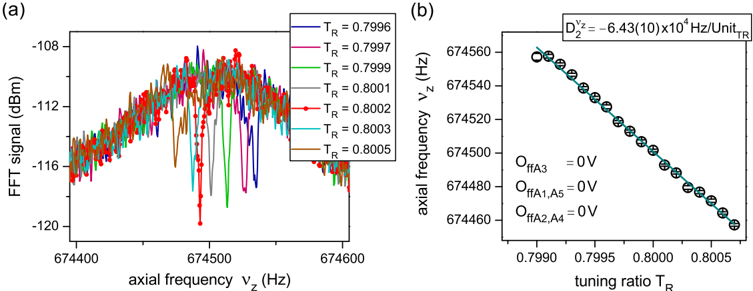
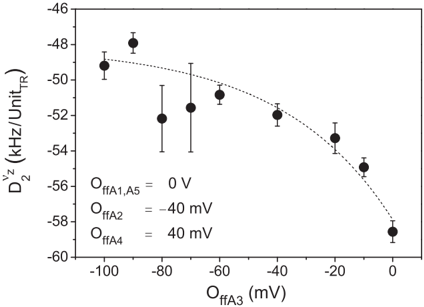
“This is determined by the narrowest dip with the largest depth, which indicates the most harmonic potential (C4 = 0) [19, 40]10 .”
BackgroundNew measurement of the proton-electron mass ratio
Dyck, R. S. V., Moore, F. L., Farnham, D. L., & Schwinberg, P. B. (1985) · International Journal of Mass Spectrometry and Ion Processes · doi:10.1016/0168-1176(85)80006-9 · Cited by 86
Feedback Cooling of a One-Electron Oscillator
D’Urso, B., Odom, B., & Gabrielse, G. (2003) · Physical Review Letters · doi:10.1103/physrevlett.90.043001 · Cited by 82 · cited 2×
“The implementation of active feedback to reduce the particle temperature [43, 44] allowed the measurement of a narrower Larmor frequency resonance than in [17].”
BackgroundMethodRedshaw, M., McDaniel, J., & Myers, E. G. (2008) · Physical Review Letters · doi:10.1103/physrevlett.100.093002 · Cited by 71 · cited 1×
“Also high-accuracy mass measurements [15, 16] can directly benefit from the acquired knowledge.”
BackgroundThe Euroschool Lectures on Physics with Exotic Beams, Vol. I
Al-Khalili, J., & Roeckl, E. (2004) · Lecture notes in physics · doi:10.1007/b98790 · Cited by 69
Experimental g factor of hydrogenlike silicon-28
Schabinger, B., Sturm, S., Wagner, A., Alonso, J., Quint, W., Werth, G., & Blaum, K. (2012) · The European Physical Journal D · doi:10.1140/epjd/e2012-20610-y · Cited by 59
Self-citationRemeasurement of the magnetic moment of the antiproton
Kreissl, A., Hancock, A. D., Koch, H., K�hler, T., Poth, H., Raich, U., Rohmann, D., Wolf, A., Tauscher, L., Nilsson, A., et al. (1988) · The European Physical Journal C · doi:10.1007/bf01549714 · Cited by 58
The quality factor of a superconducting rf resonator in a magnetic field
Ulmer, S., Kracke, H., Blaum, K., Kreim, S., Mooser, A., Quint, W., Rodegheri, C. C., & Walz, J. (2009) · Review of Scientific Instruments · doi:10.1063/1.3271537 · Cited by 56 · cited 1×
“969 MHz, with Rp = 380 k and Q = 1250 [30, 31].”
Self-citationDirect Measurement of the Proton Magnetic Moment
DiSciacca, J., & Gabrielse, G. (2012) · Physical Review Letters · doi:10.1103/physrevlett.108.153001 · Cited by 56
Gabrielse, G. (1984) · Physical Review A · doi:10.1103/physreva.29.462 · Cited by 54 · cited 3×
“By means of a proper choice of the trap geometry and tuning ratio, C4 and C6 can be eliminated simultaneously, thus providing compensation of the potential in the lowest order [34, 35].”
BackgroundAntiproton magnetic moment determined from the HFS of p¯He+
Pask, T., Barna, D., Dax, A., Hayano, R. S., Hori, M., Horváth, D., Friedreich, S., Juhász, B., Massiczek, O., Ono, N., et al. (2009) · Physics Letters B · doi:10.1016/j.physletb.2009.05.038 · Cited by 50 · cited 1×
“The advantage is that no theoretical corrections due to atomic binding need to be considered as in the case of [10], and most importantly, the measurement can be carried out in the same way with the antiproton, whose g-factor is currently known to be only 10−3 [12].”
BackgroundTemperature measurement of a single ion in a Penning trap
Djekic, S., Alonso, J., Kluge, H.-J., Quint, W., Stahl, S., Valenzuela, T., Verd�, J., Vogel, M., & Werth, G. (2004) · The European Physical Journal D · doi:10.1140/epjd/e2004-00168-1 · Cited by 40 · cited 1×
“For the determination of the temperature of the axial mode of the proton, we make use of the concept of sideband coupling [20, 25, 45, 46].”
MethodSelf-citationCollington, D. J., Dellis, A. N., Sanders, J. H., & Turberfield, K. C. (1955) · Physical Review · doi:10.1103/physrev.99.1622 · Cited by 33
Direct Measurement of the Free Cyclotron Frequency of a Single Particle in a Penning Trap
Ulmer, S., Blaum, K., Kracke, H., Mooser, A. H., Quint, W., Rodegheri, C. C., & Walz, J. (2011) · Physical Review Letters · doi:10.1103/physrevlett.107.103002 · Cited by 33 · cited 2×
“The same principle is used to measure the radial frequencies in the precision trap by coupling the radial modes to the axial mode as discussed in [21].”
BackgroundMethodSelf-citationFirst Observation of Spin Flips with a single Proton stored in a cryogenic Penning trap
Ulmer, S. (2011) · heiDOK (Heidelberg University) · doi:10.11588/heidok.00012306 · Cited by 32
Self-citationBollen, G. (2004) · Lecture notes in physics · doi:10.1007/978-3-540-44490-9_6 · Cited by 31
Kretzschmar, M. (1999) · AIP conference proceedings · doi:10.1063/1.57446 · Cited by 27 · cited 2×
“585 696(50), in agreement with the value obtained in [10] and with the most recent value obtained in [46] by using the technique developed by us and described in this paper.”
MethodResultVerdú, J., Kreim, S., Blaum, K., Kracke, H., Quint, W., Ulmer, S., & Walz, J. (2008) · New Journal of Physics · doi:10.1088/1367-2630/10/10/103009 · Cited by 22 · cited 2×
“With the former design of the analysis trap [32], 1TR = −1.”
MethodSelf-citationContinuous Stern–Gerlach effect and the magnetic moment of the antiproton
Quint, W., Alonso, J., Djekić, S., Kluge, H.-J., Stahl, S., Valenzuela, T., Verdú, J., Vogel, M., & Werth, G. (2004) · Nuclear Instruments and Methods in Physics Research Section B: Beam Interactions with Materials and Atoms · doi:10.1016/j.nimb.2003.08.008 · Cited by 22
Self-citationSelf-excited mono-ion oscillator
Dehmelt, H., Nagourney, W., & Sandberg, J. (1986) · Proceedings of the National Academy of Sciences · doi:10.1073/pnas.83.16.5761 · Cited by 20 · cited 2×
“The implementation of active feedback to reduce the particle temperature [43, 44] allowed the measurement of a narrower Larmor frequency resonance than in [17].”
BackgroundMethodBakalov, D., & Widmann, E. (2007) · Physical Review A · doi:10.1103/physreva.76.012512 · Cited by 17
High-accuracy Penning trap mass measurements with stored and cooled exotic ions
Blaum, K., Nagy, S., & Werth, G. (2009) · Max Planck Digital Library · Cited by 12
Self-citationPenning Trap Measurement of the Magnetic Moment of the Antiproton
Verdú, J. (2005) · AIP Conference Proceedings · doi:10.1063/1.2130176 · Cited by 11 · cited 1×
“With our Penning-trap setup, we aim to achieve a relative uncertainty of 10−9 or better for the g-factor of a single (anti)proton [9].”
MethodTrap-assisted precision spectroscopy of highly charged ions
Vogel, M., & Quint, W. (2009) · Journal of Physics B Atomic Molecular and Optical Physics · doi:10.1088/0953-4075/42/15/154016 · Cited by 11
Self-citationDevelopments for the direct determination of the g-factor of a single proton in a Penning trap
Rodegheri, C. C., Blaum, K., Kracke, H., Kreim, S., Mooser, A. H., Mrozik, C., Quint, W., Ulmer, S., & Walz, J. (2009) · Hyperfine Interactions · doi:10.1007/s10751-009-0035-4 · Cited by 10 · cited 1×
“We intend to determine the g-factor directly, based on the non-destructive measurement of two frequencies of a single proton in a Penning trap [11].”
MethodSelf-citationPrecision measurements with non-laser-cooled trapped ions
Karr, J. (2009) · Journal of Physics B Atomic Molecular and Optical Physics · doi:10.1088/0953-4075/42/15/154018 · Cited by 8
Direct observation of a single proton in a Penning trap
Kreim, S. (2009) · Gutenberg Open Science · doi:10.25358/openscience-4524 · Cited by 4
Self-citation
Research works printed but not linked: 4
- [27]27. Hermanspahn N H 1999 Das magnetische Moment des gebundenen Elektrons in wasserstoffartigem Kohlenstoff (C 5+ ) Dissertation Johannes Gutenberg-Universität Mainz
- [33]33. Bozorth R M 1993 Ferromagnetism (New York: Wiley-IEEE Press)
- [38]38. Verdú J 2003 Ultrapräzise Messung des elektronischen g-Faktors in wasserstoffähnlichem Sauerstoff Dissertation Johannes Gutenberg-Universität Mainz
- [39]39. Rodegheri C C 2012 Speicherung und Kühlung eines einzelnen Protons in einer Penning-Falle zur Bestimmung seines g-Faktors Dissertation Johannes Gutenberg-Universität Mainz (in preparation)
Cited by
CODATA recommended values of the fundamental physical constants: 2014
Mohr, P. J., Newell, D. B., & Taylor, B. N. (2016) · Reviews of Modern Physics · doi:10.1103/revmodphys.88.035009 · Cited by 920
CODATA Recommended Values of the Fundamental Physical Constants: 2014
Mohr, P. J., Newell, D. B., & Taylor, B. N. (2016) · Journal of Physical and Chemical Reference Data · doi:10.1063/1.4954402 · Cited by 252
Double-trap measurement of the proton magnetic moment at 0.3 parts per billion precision
Schneider, G. L., Mooser, A. H., Bohman, M., Schön, N., Harrington, J. A., Higuchi, T., Nagahama, H., Sellner, S., Smorra, C., Blaum, K., et al. (2017) · Science · doi:10.1126/science.aan0207 · Cited by 158
Self-citationOne-Particle Measurement of the Antiproton Magnetic Moment
DiSciacca, J., Marshall, M., Marable, K., Gabrielse, G., Ettenauer, S., Tardiff, E., Kalra, R., Fitzakerley, D. W., George, M. C., Hessels, E. A., et al. (2013) · Physical Review Letters · doi:10.1103/physrevlett.110.130801 · Cited by 90
BASE – The Baryon Antibaryon Symmetry Experiment
Smorra, C., Blaum, K., Bojtar, L., Borchert, M., Franke, K. A., Higuchi, T., Leefer, N., Nagahama, H., Matsuda, Y., Mooser, A., et al. (2015) · The European Physical Journal Special Topics · doi:10.1140/epjst/e2015-02607-4 · Cited by 82
Self-citation
Metadata
- Authors
- Rodegheri, C. C., Blaum, K., Kracke, H., Kreim, S., Mooser, A., Quint, W., Ulmer, S., & Walz, J.
- Affiliations
- Johannes Gutenberg University Mainz (DE)
- Heidelberg University (DE)
- GSI Helmholtz Centre for Heavy Ion Research (DE)
- Max Planck Institute for Nuclear Physics (DE)
- Corresponding author
- Rodegheri, C C
- Venue
- New Journal of Physics
- Publisher
- IOP Publishing
- Published
- 2012-06-12
- Volume
- 14
- Issue
- 6
- Pages
- 063011
- ISSN
- 1367-2630 (ISSN-L)
- OpenAlex
- W2096697046
- Semantic Scholar
- dfb6b3f07470f191e7cd1bfa5bf2233a007dcce8
- Cited by
- 37
- References
- 51
- Citations by year
- 2024: 2 · 2022: 1 · 2021: 2 · 2020: 1 · 2019: 4 · 2018: 2 · 2017: 2 · 2016: 2 · 2015: 4 · 2014: 7 · 2013: 8 · 2012: 2
- FWCI
- 3.48
- Type
- journal article
- Language
- en
- Open access
- gold
- doi.org
- Licence
- cc-by
- Locations
- New Journal of Physics (publishedVersion, cc-by)
- MPG.PuRe (Max Planck Society) (submittedVersion)
- Funders
- European Commission
- Deutsche Forschungsgemeinschaft
- Bundesministerium für Bildung und Forschung
- Max-Planck-Gesellschaft
- Topics
- Physical Sciences › Physics and Astronomy › Atomic and Molecular Physics, and Optics › Atomic and Molecular Physics
- Physical Sciences › Physics and Astronomy › Atomic and Molecular Physics, and Optics › Atomic and Subatomic Physics Research
- Physical Sciences › Physics and Astronomy › Nuclear and High Energy Physics › Particle physics theoretical and experimental studies
- Keywords
- proton g-factor, Penning trap, antiprotons, magnetic moment, Larmor frequency, magnetic bottle, spin-flip transitions, uniform magnetic field
About these checks
Registry, retraction, Cites and statistics results are computed, not judged, with one exception: a printed reference that no index lists is read once by a model before it counts as a citation error. Claims are extracted by a model and kept only when their quote appears verbatim in the text; each cited source is then checked, with a model’s help, for whether it says what the claim relies on. Those verdicts can be wrong — read the claim’s quote and the cited source before relying on one.
Statistics and arithmetic are recomputed, not judged.
Confidence bands are shown only for fields calibrated on our annotated test set. None is calibrated yet, so no band is shown.
What counts as a claim ›How we measure confidence ›How we check this ›
Are you an author, or do you see a problem with this page? Request a review
Data sources
Bibliographic data: Semantic Scholar, OpenAlex, Crossref.
Contains information from the Semantic Scholar Academic Graph Datasets, made available under the ODC Attribution License (ODC-BY 1.0).
Semantic Scholar’s data is described in: Kinney, R., et al. (2023). The Semantic Scholar Open Data Platform. arXiv:2301.10140.
