

Application of fermionic marginal constraints to hybrid quantum algorithms
Open accessThe DOI matches its Crossref record; 108 of the 109 references it cites were found in a registry or an index.
Abstract
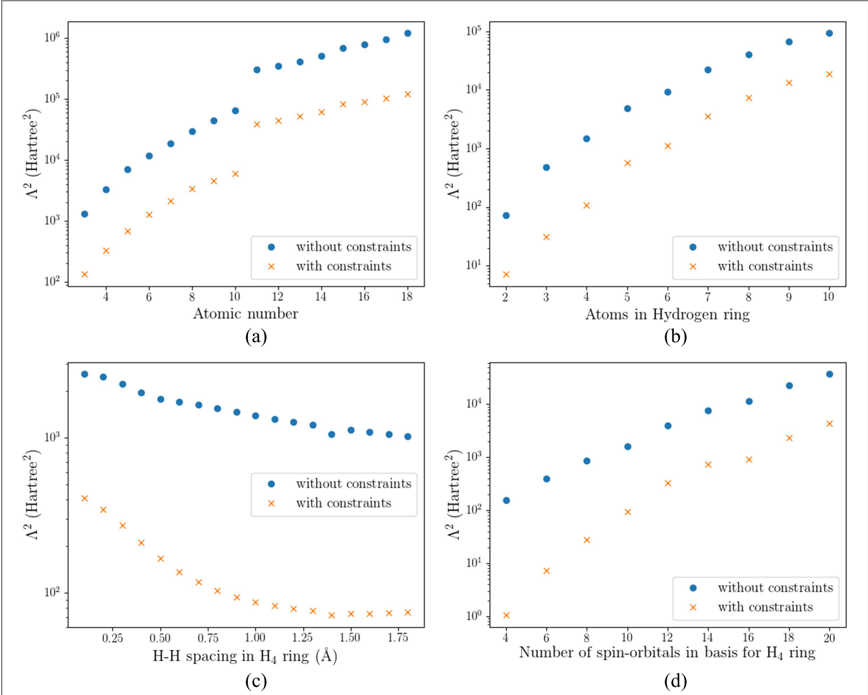
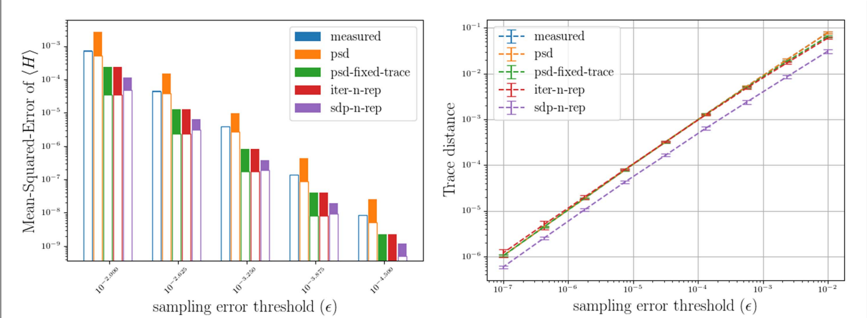
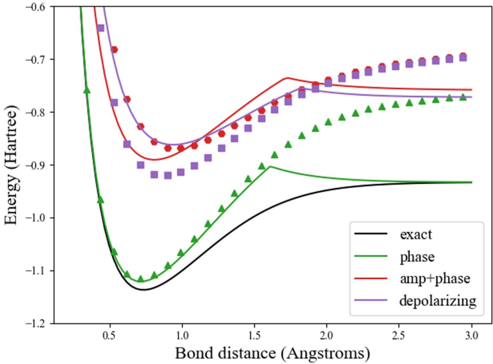
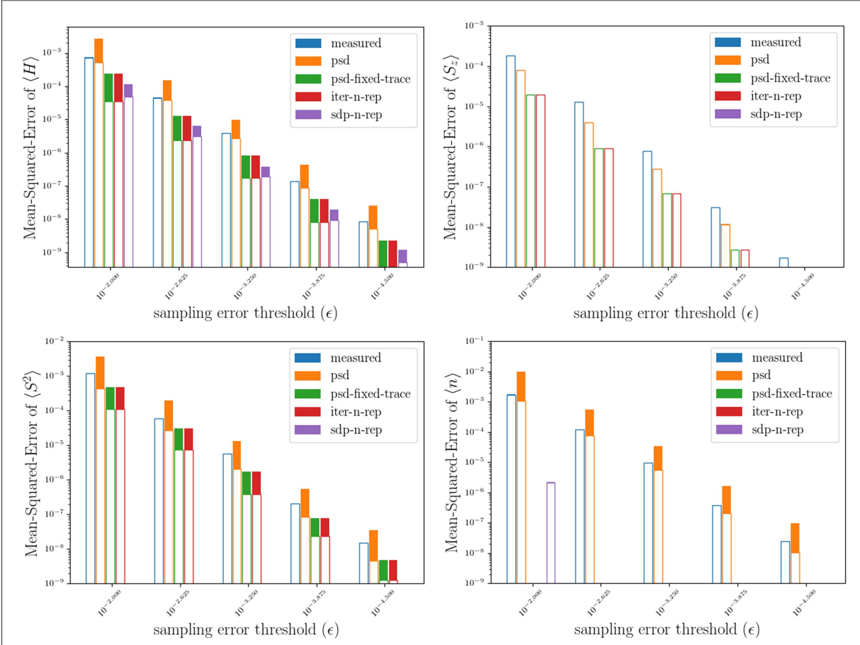
Many quantum algorithms, including recently proposed hybrid classical/quantum algorithms, make use of restricted tomography of the quantum state that measures the reduced density matrices, or marginals, of the full state. The most straightforward approach to this algorithmic step estimates each component of the marginal independently without making use of the algebraic and geometric structure of the marginals. Within the field of quantum chemistry, this structure is termed the fermionic n -representability conditions, and is supported by a vast amount of literature on both theoretical and practical results related to their approximations. In this work, we introduce these conditions in the language of quantum computation, and utilize them to develop several techniques to accelerate and improve practical applications for quantum chemistry on quantum computers. As a general result, we demonstrate how these marginals concentrate to diagonal quantities when measured on random quantum states. We also show that one can use fermionic n -representability conditions to reduce the total number of measurements required by more than an order of magnitude for medium sized systems in chemistry. As a practical demonstration, we simulate an efficient restoration of the physicality of energy curves for the dilation of a four qubit diatomic hydrogen system in the presence of three distinct one qubit error channels, providing evidence these techniques are useful for pre-fault tolerant quantum chemistry experiments.
Overview
The claims and statistics of this paper haven’t been checked yet.
Free: it reads the open-access text and checks the first 5 claims that cite a source we can check. Create a free account to check every claim.
Integrity signals
Registry
Cites
Statistics
Figures

Verification
Claims the paper makes
The claims and statistics of this paper haven’t been checked yet.
Free: it reads the open-access text and checks the first 5 claims that cite a source we can check. Create a free account to check every claim.
Claims other papers make about this one
Each is checked against this paper’s own text: does it say what the citing paper says it does?
The source backs part of the claim, not all of it — or backs it for a different population, condition or comparison.
In the citing paper
“The Hamiltonian of molecular hydrogen in the minimal basis mapped to a four-qubit system, using the Bravyi-Kitaev transformation, takes the following form 181,366 :”
From Quantum Chemistry in the Age of Quantum Computing (2019) · cites this paper as [366]
Experimental — accuracy not yet measuredThe source backs part of the claim, not all of it — or backs it for a different population, condition or comparison.
In the citing paper
“In the context of quantum chemistry, research has focused on the analog simulation of molecules by mapping the electronic structure problem to a Hamiltonian of spins with additional coupling terms 366 , although proposals exist for simulating chemical reactions 367-369 and protein folding simulations 370,371 .”
From Quantum Chemistry in the Age of Quantum Computing (2019) · cites this paper as [366]
Experimental — accuracy not yet measuredThe check wasn’t confident either way, so it gives no verdict — never disputed.
In the citing paper
“This effect was first conjectured theoretically [220] and later seen experimentally in superconducting qubits [48], where errors after the variational procedure were reduced in some cases by over an order of magnitude.”
From Variational quantum algorithms (2021) · cites this paper as [220]
Experimental — accuracy not yet measured
Self-check
Percentages, sums and reported differences re-computed from the paper’s own numbers.
The self-check needs the paper’s full text.
Citations
Cites
A variational eigenvalue solver on a photonic quantum processor
Peruzzo, A., McClean, J., Shadbolt, P., Yung, M.-H., Zhou, X.-Q., Love, P. J., Aspuru-Guzik, A., & O’Brien, J. L. (2014) · Nature Communications · doi:10.1038/ncomms5213 · Cited by 4,552
Self-citationAn efficient internally contracted multiconfiguration–reference configuration interaction method
Werner, H.-J., & Knowles, P. J. (1988) · The Journal of Chemical Physics · doi:10.1063/1.455556 · Cited by 3,899
Andersson, K., Malmqvist, P.-Å., & Roos, B. O. (1992) · The Journal of Chemical Physics · doi:10.1063/1.462209 · Cited by 3,877
Second-order perturbation theory with a CASSCF reference function
Andersson, K., Malmqvist, P. A., Roos, B. O., Sadlej, A. J., & Wolinski, K. (1990) · The Journal of Physical Chemistry · doi:10.1021/j100377a012 · Cited by 3,331
Lloyd, S. (1996) · Science · doi:10.1126/science.273.5278.1073 · Cited by 3,088
Hardware-efficient variational quantum eigensolver for small molecules and quantum magnets
Kandala, A., Mezzacapo, A., Temme, K., Takita, M., Brink, M., Chow, J. M., & Gambetta, J. M. (2017) · Nature · doi:10.1038/nature23879 · Cited by 2,982
The theory of variational hybrid quantum-classical algorithms
McClean, J. R., Romero, J., Babbush, R., & Aspuru-Guzik, A. (2016) · New Journal of Physics · doi:10.1088/1367-2630/18/2/023023 · Cited by 2,227
Self-citationIntroduction of n-electron valence states for multireference perturbation theory
Angeli, C., Cimiraglia, R., Evangelisti, S., Leininger, T., & Malrieu, J.-P. (2001) · The Journal of Chemical Physics · doi:10.1063/1.1361246 · Cited by 1,951
A Quantum Approximate Optimization Algorithm
Farhi, E., Goldstone, J., & Gutmann, S. (2014) · arXiv · doi:10.48550/arxiv.1411.4028 · Cited by 1,789
Structure of Fermion Density Matrices
Coleman, A. J. (1963) · Reviews of Modern Physics · doi:10.1103/revmodphys.35.668 · Cited by 1,506
Simulated Quantum Computation of Molecular Energies
Aspuru-Guzik, A., Dutoi, A. D., Love, P. J., & Head-Gordon, M. (2005) · Science · doi:10.1126/science.1113479 · Cited by 1,418
Parrish, R. M., Burns, L. A., Smith, D. G. A., Simmonett, A. C., DePrince, A. E., Hohenstein, E. G., Bozkaya, U., Sokolov, A. Y., Di Remigio, R., Richard, R. M., et al. (2017) · Journal of Chemical Theory and Computation · doi:10.1021/acs.jctc.7b00174 · Cited by 1,249
Angeli, C., Cimiraglia, R., & Malrieu, J.-P. (2002) · The Journal of Chemical Physics · doi:10.1063/1.1515317 · Cited by 1,225
Characterizing quantum supremacy in near-term devices
Boixo, S., Isakov, S. V., Smelyanskiy, V. N., Babbush, R., Ding, N., Jiang, Z., Bremner, M. J., Martinis, J. M., & Neven, H. (2018) · Nature Physics · doi:10.1038/s41567-018-0124-x · Cited by 1,175
Self-citationScalable Quantum Simulation of Molecular Energies
O’Malley, P. J. J., Babbush, R., Kivlichan, I. D., Romero, J., McClean, J. R., Barends, R., Kelly, J., Roushan, P., Tranter, A., Ding, N., et al. (2016) · Physical Review X · doi:10.1103/physrevx.6.031007 · Cited by 1,059
Self-citationComputing the nearest correlation matrix--a problem from finance
Higham, N. J. (2002) · IMA Journal of Numerical Analysis · doi:10.1093/imanum/22.3.329 · Cited by 886
Ray, U., & Das, S. (2011) · Scientific Reports · doi:10.1038/srep00001 · Cited by 884
Celani, P., & Werner, H.-J. (2000) · The Journal of Chemical Physics · doi:10.1063/1.481132 · Cited by 877
Quantum Algorithm Providing Exponential Speed Increase for Finding Eigenvalues and Eigenvectors
Abrams, D. S., & Lloyd, S. (1999) · Physical Review Letters · doi:10.1103/physrevlett.83.5162 · Cited by 817
Towards quantum chemistry on a quantum computer
Lanyon, B. P., Whitfield, J. D., Gillett, G. G., Goggin, M. E., Almeida, M. P., Kassal, I., Biamonte, J. D., Mohseni, M., Powell, B. J., Barbieri, M., et al. (2010) · Nature Chemistry · doi:10.1038/nchem.483 · Cited by 796
A nonlinear programming algorithm for solving semidefinite programs via low-rank factorization
Burer, S., & Monteiro, R. D. C. (2003) · Mathematical Programming · doi:10.1007/s10107-002-0352-8 · Cited by 770
Simulation of Many-Body Fermi Systems on a Universal Quantum Computer
Abrams, D. S., & Lloyd, S. (1997) · Physical Review Letters · doi:10.1103/physrevlett.79.2586 · Cited by 745
Elucidating reaction mechanisms on quantum computers
Reiher, M., Wiebe, N., Svore, K. M., Wecker, D., & Troyer, M. (2017) · Proceedings of the National Academy of Sciences · doi:10.1073/pnas.1619152114 · Cited by 745
Multireference Møller—Plesset method
Hirao, K. (1992) · Chemical Physics Letters · doi:10.1016/0009-2614(92)85354-d · Cited by 717
Progress towards practical quantum variational algorithms
Wecker, D., Hastings, M. B., & Troyer, M. (2015) · Physical Review A · doi:10.1103/physreva.92.042303 · Cited by 716
Computing a nearest symmetric positive semidefinite matrix
Higham, N. J. (1988) · Linear Algebra and its Applications · doi:10.1016/0024-3795(88)90223-6 · Cited by 698
Efficient quantum state tomography
Cramer, M., Plenio, M. B., Flammia, S. T., Somma, R., Gross, D., Bartlett, S. D., Landon-Cardinal, O., Poulin, D., & Liu, Y.-K. (2010) · Nature Communications · doi:10.1038/ncomms1147 · Cited by 666
The Bravyi-Kitaev transformation for quantum computation of electronic structure
Seeley, J. T., Richard, M. J., & Love, P. J. (2012) · The Journal of Chemical Physics · doi:10.1063/1.4768229 · Cited by 585
Nobel Lecture: Quantum chemical models
Pople, J. A. (1999) · Reviews of Modern Physics · doi:10.1103/revmodphys.71.1267 · Cited by 527
Hybrid quantum-classical hierarchy for mitigation of decoherence and determination of excited states
McClean, J. R., Kimchi-Schwartz, M. E., Carter, J., & de Jong, W. A. (2017) · Physical Review A · doi:10.1103/physreva.95.042308 · Cited by 516
Self-citationColeman, A. J., & Yukalov, V. I. (2000) · Lecture Notes in Chemistry · doi:10.1007/978-3-642-58304-9 · Cited by 479
Reduction of the N-Particle Variational Problem
Garrod, C., & Percus, J. K. (1964) · Journal of Mathematical Physics · doi:10.1063/1.1704098 · Cited by 477
Simulation of electronic structure Hamiltonians using quantum computers
Whitfield, J. D., Biamonte, J., & Aspuru-Guzik, A. (2011) · Molecular Physics · doi:10.1080/00268976.2011.552441 · Cited by 472
Computation of Molecular Spectra on a Quantum Processor with an Error-Resilient Algorithm
Colless, J. I., Ramasesh, V. V., Dahlen, D., Blok, M. S., Kimchi-Schwartz, M. E., McClean, J. R., Carter, J., de Jong, W. A., & Siddiqi, I. (2018) · Physical Review X · doi:10.1103/physrevx.8.011021 · Cited by 460
Self-citationQuantum Simulation of Electronic Structure with Linear Depth and Connectivity
Kivlichan, I. D., McClean, J., Wiebe, N., Gidney, C., Aspuru-Guzik, A., Chan, G. K.-L., & Babbush, R. (2018) · Physical Review Letters · doi:10.1103/physrevlett.120.110501 · Cited by 431
Self-citationThe self-consistent electron pairs method for multiconfiguration reference state functions
Werner, H.-J., & Reinsch, E.-A. (1982) · The Journal of Chemical Physics · doi:10.1063/1.443357 · Cited by 426
Polynomial-time quantum algorithm for the simulation of chemical dynamics
Kassal, I., Jordan, S. P., Love, P. J., Mohseni, M., & Aspuru-Guzik, A. (2008) · Proceedings of the National Academy of Sciences · doi:10.1073/pnas.0808245105 · Cited by 385
Simulating physical phenomena by quantum networks
Somma, R., Ortiz, G., Gubernatis, J. E., Knill, E., & Laflamme, R. (2002) · Physical Review A · doi:10.1103/physreva.65.042323 · Cited by 365
Quantum algorithms for fermionic simulations
Ortiz, G., Gubernatis, J. E., Knill, E., & Laflamme, R. (2001) · Physical Review A · doi:10.1103/physreva.64.022319 · Cited by 347
Local Minima and Convergence in Low-Rank Semidefinite Programming
Burer, S., & Monteiro, R. D. C. (2005) · Mathematical Programming · doi:10.1007/s10107-004-0564-1 · Cited by 347
Low-Depth Quantum Simulation of Materials
Babbush, R., Wiebe, N., McClean, J., McClain, J., Neven, H., & Chan, G. K.-L. (2018) · Physical Review X · doi:10.1103/physrevx.8.011044 · Cited by 335
Self-citationGate-count estimates for performing quantum chemistry on small quantum computers
Wecker, D., Bauer, B., Clark, B. K., Hastings, M. B., & Troyer, M. (2014) · Physical Review A · doi:10.1103/physreva.90.022305 · Cited by 296
Quantum implementation of the unitary coupled cluster for simulating molecular electronic structure
Shen, Y., Zhang, X., Zhang, S., Zhang, J.-N., Yung, M.-H., & Kim, K. (2017) · Physical Review A · doi:10.1103/physreva.95.020501 · Cited by 295
Nakata, M., Nakatsuji, H., Ehara, M., Fukuda, M., Nakata, K., & Fujisawa, K. (2001) · The Journal of Chemical Physics · doi:10.1063/1.1360199 · Cited by 282
New perspectives in multireference perturbation theory: the n-electron valence state approach
Angeli, C., Pastore, M., & Cimiraglia, R. (2007) · Theoretical Chemistry Accounts · doi:10.1007/s00214-006-0207-0 · Cited by 281
Smolin, J. A., Gambetta, J. M., & Smith, G. (2012) · Physical Review Letters · doi:10.1103/physrevlett.108.070502 · Cited by 276
Present State of Molecular Structure Calculations
Coulson, C. A. (1960) · Reviews of Modern Physics · doi:10.1103/revmodphys.32.170 · Cited by 275
Canonical transformation theory for multireference problems
Yanai, T., & Chan, G. K.-L. (2006) · The Journal of Chemical Physics · doi:10.1063/1.2196410 · Cited by 246
Zhao, Z., Braams, B. J., Fukuda, M., Overton, M. L., & Percus, J. K. (2004) · The Journal of Chemical Physics · doi:10.1063/1.1636721 · Cited by 237
Structure of Fermionic Density Matrices: CompleteN-Representability Conditions
Mazziotti, D. A. (2012) · Physical Review Letters · doi:10.1103/physrevlett.108.263002 · Cited by 222
Many-Electron Densities and Reduced Density Matrices
(2000) · Mathematical and Computational Chemistry · doi:10.1007/978-1-4615-4211-7 · Cited by 219 · cited 1×
“(6) By convention, in the quantum chemistry community the normalization constant for D RDM is typically scaled to ( n p ) [58, 60, 69].”
BackgroundQuantum marginal problem and N-representability
Klyachko, A. A. (2006) · Journal of Physics: Conference Series · doi:10.1088/1742-6596/36/1/014 · Cited by 215
Witnessing eigenstates for quantum simulation of Hamiltonian spectra
Santagati, R., Wang, J., Gentile, A. A., Paesani, S., Wiebe, N., McClean, J. R., Morley-Short, S., Shadbolt, P. J., Bonneau, D., Silverstone, J. W., et al. (2018) · Science Advances · doi:10.1126/sciadv.aap9646 · Cited by 211
Self-citationChemical basis of Trotter-Suzuki errors in quantum chemistry simulation
Babbush, R., McClean, J., Wecker, D., Aspuru-Guzik, A., & Wiebe, N. (2015) · Physical Review A · doi:10.1103/physreva.91.022311 · Cited by 199
Self-citationMapping local Hamiltonians of fermions to local Hamiltonians of spins
Verstraete, F., & Cirac, J. I. (2005) · Journal of Statistical Mechanics: Theory and Experiment · doi:10.1088/1742-5468/2005/09/p09012 · Cited by 196
Adiabatic Quantum Simulation of Quantum Chemistry
Babbush, R., Love, P. J., & Aspuru-Guzik, A. (2014) · Scientific Reports · doi:10.1038/srep06603 · Cited by 191
Self-citationMazziotti, D. A. (2002) · Physical Review A · doi:10.1103/physreva.65.062511 · Cited by 190
Mazziotti, D. A., & Erdahl, R. M. (2001) · Physical Review A · doi:10.1103/physreva.63.042113 · Cited by 187
Erdahl, R. M. (1978) · International Journal of Quantum Chemistry · doi:10.1002/qua.560130603 · Cited by 172
Tapering off qubits to simulate fermionic Hamiltonians
Bravyi, S. B., Gambetta, J., Mezzacapo, A., & Temme, K. (2017) · arXiv (Cornell University) · doi:10.48550/arxiv.1701.08213 · Cited by 162
The Trotter step size required for accurate quantum simulation of quantum chemistry
Poulin, D., Hastings, M. B., Wecker, D., Wiebe, N., Doberty, A. C., & Troyer, M. (2015) · Quantum Information and Computation · doi:10.26421/qic15.5-6-1 · Cited by 159
Large-Scale Semidefinite Programming for Many-Electron Quantum Mechanics
Mazziotti, D. A. (2011) · Physical Review Letters · doi:10.1103/physrevlett.106.083001 · Cited by 153
Quantum Simulation of Helium Hydride Cation in a Solid-State Spin Register
Wang, Y., Dolde, F., Biamonte, J., Babbush, R., Bergholm, V., Yang, S., Jakobi, I., Neumann, P., Aspuru-Guzik, A., Whitfield, J. D., et al. (2015) · ACS Nano · doi:10.1021/acsnano.5b01651 · Cited by 152
Self-citationThe role of model systems in the few‐body reduction of the N‐fermion problem
Percus, J. K. (1978) · International Journal of Quantum Chemistry · doi:10.1002/qua.560130108 · Cited by 147
Faster quantum chemistry simulation on fault-tolerant quantum computers
Cody Jones, N., Whitfield, J. D., McMahon, P. L., Yung, M.-H., Meter, R. V., Aspuru-Guzik, A., & Yamamoto, Y. (2012) · New Journal of Physics · doi:10.1088/1367-2630/14/11/115023 · Cited by 145
Improved techniques for preparing eigenstates of fermionic Hamiltonians
Berry, D. W., Kieferová, M., Scherer, A., Sanders, Y. R., Low, G. H., Wiebe, N., Gidney, C., & Babbush, R. (2018) · npj Quantum Information · doi:10.1038/s41534-018-0071-5 · Cited by 140
Self-citationCanonical transformation theory from extended normal ordering
Yanai, T., & Chan, G. K.-L. (2007) · The Journal of Chemical Physics · doi:10.1063/1.2761870 · Cited by 139
TheBravyi–Kitaev transformation: Properties and applications
Tranter, A., Sofia, S., Seeley, J., Kaicher, M., McClean, J., Babbush, R., Coveney, P. V., Mintert, F., Wilhelm, F., & Love, P. J. (2015) · International Journal of Quantum Chemistry · doi:10.1002/qua.24969 · Cited by 136
Self-citationExponentially more precise quantum simulation of fermions in second quantization
Babbush, R., Berry, D. W., Kivlichan, I. D., Wei, A. Y., Love, P. J., & Aspuru-Guzik, A. (2016) · New Journal of Physics · doi:10.1088/1367-2630/18/3/033032 · Cited by 135
Self-citationImproving quantum algorithms for quantum chemistry
Hastings, M. B., Wecker, D., Bauer, B., & Troyer, M. (2015) · Quantum Information and Computation · doi:10.26421/qic15.1-2-1 · Cited by 128
Exploiting Locality in Quantum Computation for Quantum Chemistry
McClean, J. R., Babbush, R., Love, P. J., & Aspuru-Guzik, A. (2014) · The Journal of Physical Chemistry Letters · doi:10.1021/jz501649m · Cited by 125
Self-citationConsistency of Local Density Matrices Is QMA-Complete
Liu, Y.-K. (2006) · Lecture Notes in Computer Science · doi:10.1007/11830924_40 · Cited by 102
A Boundary Point Method to Solve Semidefinite Programs
Povh, J., Rendl, F., & Wiegele, A. (2006) · Computing · doi:10.1007/s00607-006-0182-2 · Cited by 101
Operator locality in the quantum simulation of fermionic models
Havlíček, V., Troyer, M., & Whitfield, J. D. (2017) · Physical Review A · doi:10.1103/physreva.95.032332 · Cited by 97
A study of cumulant approximations to n-electron valence multireference perturbation theory
Zgid, D., Ghosh, D., Neuscamman, E., & Chan, G. K.-L. (2009) · The Journal of Chemical Physics · doi:10.1063/1.3132922 · Cited by 94
Babbush, R., Berry, D. W., Sanders, Y. R., Kivlichan, I. D., Scherer, A., Wei, A. Y., Love, P. J., & Aspuru-Guzik, A. (2018) · Quantum Science and Technology · doi:10.1088/2058-9565/aa9463 · Cited by 85
Self-citationAdiabatic state preparation study of methylene
Veis, L., & Pittner, J. (2014) · The Journal of Chemical Physics · doi:10.1063/1.4880755 · Cited by 84
Strongly contracted canonical transformation theory
Neuscamman, E., Yanai, T., & Chan, G. K.-L. (2010) · The Journal of Chemical Physics · doi:10.1063/1.3274822 · Cited by 84
Universal perturbative explicitly correlated basis set incompleteness correction
Torheyden, M., & Valeev, E. F. (2009) · The Journal of Chemical Physics · doi:10.1063/1.3254836 · Cited by 80
Pure- N -representability conditions of two-fermion reduced density matrices
Mazziotti, D. A. (2016) · Physical Review A · doi:10.1103/physreva.94.032516 · Cited by 77
Spin and symmetry adaptation of the variational two-electron reduced-density-matrix method
Gidofalvi, G., & Mazziotti, D. A. (2005) · Physical Review A · doi:10.1103/physreva.72.052505 · Cited by 73
Lower bounds for ground states of condensed matter systems
Baumgratz, T., & Plenio, M. B. (2012) · New Journal of Physics · doi:10.1088/1367-2630/14/2/023027 · Cited by 73
Local spin operators for fermion simulations
Whitfield, J. D., Havlíček, V., & Troyer, M. (2016) · Physical Review A · doi:10.1103/physreva.94.030301 · Cited by 73
Quantum-circuit design for efficient simulations of many-body quantum dynamics
Raeisi, S., Wiebe, N., & Sanders, B. C. (2012) · New Journal of Physics · doi:10.1088/1367-2630/14/10/103017 · Cited by 72
Reduced hamiltonian orbitals. III. Unitarily invariant decomposition of hermitian operators
Coleman, A., & Absar, I. (1980) · International Journal of Quantum Chemistry · doi:10.1002/qua.560180513 · Cited by 71
Bounding the costs of quantum simulation of many-body physics in real space
Kivlichan, I. D., Wiebe, N., Babbush, R., & Aspuru-Guzik, A. (2017) · Journal of Physics A: Mathematical and Theoretical · doi:10.1088/1751-8121/aa77b8 · Cited by 63
Self-citationQuantum computing applied to calculations of molecular energies: CH2 benchmark
Veis, L., & Pittner, J. (2010) · The Journal of Chemical Physics · doi:10.1063/1.3503767 · Cited by 60
Reduced density operators and the N‐particle problem
Coleman, A. (1978) · International Journal of Quantum Chemistry · doi:10.1002/qua.560130106 · Cited by 60
Sugisaki, K., Yamamoto, S., Nakazawa, S., Toyota, K., Sato, K., Shiomi, D., & Takui, T. (2016) · The Journal of Physical Chemistry A · doi:10.1021/acs.jpca.6b04932 · Cited by 55
Compatibility between local and multipartite states
Bravyi, S. (2004) · Quantum Information and Computation · doi:10.26421/qic4.1-2 · Cited by 54
Preparation of many-body states for quantum simulation
Ward, N. J., Kassal, I., & Aspuru-Guzik, A. (2009) · The Journal of Chemical Physics · doi:10.1063/1.3115177 · Cited by 54
Moll, N., Fuhrer, A., Staar, P., & Tavernelli, I. (2016) · Journal of Physics A: Mathematical and Theoretical · doi:10.1088/1751-8113/49/29/295301 · Cited by 53
Hammond, J. R., & Mazziotti, D. A. (2005) · Physical Review A · doi:10.1103/physreva.71.062503 · Cited by 44
Alcoba, D. R., & Valdemoro, C. (2005) · International Journal of Quantum Chemistry · doi:10.1002/qua.20487 · Cited by 41
Extraction of electronic excited states from the ground-state two-particle reduced density matrix
Mazziotti, D. A. (2003) · Physical Review A · doi:10.1103/physreva.68.052501 · Cited by 41
Error Sensitivity to Environmental Noise in Quantum Circuits for Chemical State Preparation
Sawaya, N. P. D., Smelyanskiy, M., McClean, J. R., & Aspuru-Guzik, A. (2016) · Journal of Chemical Theory and Computation · doi:10.1021/acs.jctc.6b00220 · Cited by 35
Self-citationKong, L., & Valeev, E. F. (2010) · The Journal of Chemical Physics · doi:10.1063/1.3499600 · Cited by 33
Greenman, L., & Mazziotti, D. A. (2008) · The Journal of Chemical Physics · doi:10.1063/1.2890961 · Cited by 33
Linear and Logarithmic Time Compositions of Quantum Many-Body Operators
Motzoi, F., Kaicher, M. P., & Wilhelm, F. K. (2017) · Physical Review Letters · doi:10.1103/physrevlett.119.160503 · Cited by 29
Lowering qubit requirements for quantum simulations of fermionic systemsPreprint
Steudtner, M., & Wehner, S. (2017) · arXiv (Cornell University) · doi:10.48550/arxiv.1712.07067 · Cited by 29
Foley, J. J., & Mazziotti, D. A. (2012) · Physical Review A · doi:10.1103/physreva.86.012512 · Cited by 28
The convex structure of electrons
Coleman, A. (1977) · International Journal of Quantum Chemistry · doi:10.1002/qua.560110604 · Cited by 27
Hardware-efficient fermionic simulation with a cavity–QED system
Zhu, G., Subaşı, Y., Whitfield, J. D., & Hafezi, M. (2018) · npj Quantum Information · doi:10.1038/s41534-018-0065-3 · Cited by 27
Quantum Algorithms for Quantum Chemistry based on the sparsity of the CI-matrix
Toloui, B., & Love, P. J. (2013) · arXiv (Cornell University) · doi:10.48550/arxiv.1312.2579 · Cited by 20
Communication: Spin-free quantum computational simulations and symmetry adapted states
Whitfield, J. D. (2013) · The Journal of Chemical Physics · doi:10.1063/1.4812566 · Cited by 19
Method for making 2-electron response reduced density matrices approximately N-representable
Lanssens, C., Ayers, P. W., Neck, D. V., Baerdemacker, S. D., Gunst, K., & Bultinck, P. (2018) · The Journal of Chemical Physics · doi:10.1063/1.4994618 · Cited by 18
Fermionic Hamiltonians for quantum simulations: a general reduction schemePreprint
Barkoutsos, P. K., Moll, N., Staar, P., Müeller, P. R., Fuhrer, A., Filipp, S., Troyer, M., & Tavernelli, I. (2017) · arXiv (Cornell University) · doi:10.48550/arxiv.1706.03637 · Cited by 12
Rubin, N. C., & Mazziotti, D. A. (2014) · Theoretical Chemistry Accounts · doi:10.1007/s00214-014-1492-7 · Cited by 11
Self-citationStrong Electron Correlation in Materials from Pair-Interacting Model Hamiltonians
Rubin, N. C., & Mazziotti, D. A. (2015) · The Journal of Physical Chemistry C · doi:10.1021/jp5130266 · Cited by 10
Self-citation
Research works printed but not linked: 8
- Setia K and Whitfield J D 2017 arXiv:1712.00446 · arXiv
- Romero J, Babbush R, McClean J, Hempel C, Love P and Aspuru-Guzik A 2017 arXiv:1701.02691 · arXiv
- Szabo A and Ostlund N S 1996 Modern Quantum Chemistry: Introduction to Advanced Electronic Structure Theory (Mineola, NY: Dover)
- Löwdin P O 1987 Some aspects on the development of the theory of reduced density matrices and the representability problem (Density Matrices and Density Functionals: Proceedings of the A. John Coleman Symposium) ed R Erdahl and V H Smith (Dordrecht: Springer) pp 21-49
- Fosso-Tande J, Nascimento D R and DePrince E III 2016 Mol. Phys. 114 423
- Boixo S, Isakov S V, Smelyanskiy V N, Babbush R, Ding N, Jiang Z, Bremner M J, Martinis J M and Neven H 2016 arXiv:1608.00263 · arXiv
- Milman V D and Schechtman G 2009 Asymptotic Theory of Finite Dimensional Normed Spaces: Isoperimetric Inequalities in Riemannian Manifolds vol 1200 (Berlin: Springer)
- McClean J R et al 2017 arXiv:1710.07629 · arXiv
Cited by
Variational quantum algorithms
Cerezo, M., Arrasmith, A., Babbush, R., Benjamin, S. C., Endo, S., Fujii, K., McClean, J. R., Mitarai, K., Yuan, X., Cincio, L., et al. (2021) · Nature Reviews Physics · doi:10.1038/s42254-021-00348-9 · Cited by 3,385
“Instead, the optimal approach is to give each Pauli operator a number of shots proportional to |ci| √ Var(σi), where Var(σi) is the variance of 〈σi〉 [194].”
BackgroundSelf-citationBarren plateaus in quantum neural network training landscapes
McClean, J. R., Boixo, S., Smelyanskiy, V. N., Babbush, R., & Neven, H. (2018) · Nature Communications · doi:10.1038/s41467-018-07090-4 · Cited by 2,329
Self-citationQuantum computational chemistry
McArdle, S., Endo, S., Aspuru-Guzik, A., Benjamin, S. C., & Yuan, X. (2020) · Reviews of Modern Physics · doi:10.1103/revmodphys.92.015003 · Cited by 1,621
Quantum Chemistry in the Age of Quantum Computing
Cao, Y., Romero, J., Olson, J. P., Degroote, M., Johnson, P. D., Kieferová, M., Kivlichan, I. D., Menke, T., Peropadre, B., Sawaya, N. P. D., et al. (2019) · Chemical Reviews · doi:10.1021/acs.chemrev.8b00803 · Cited by 1,560
Quantum Chemistry in the Age of Quantum Computing
Cao, Y., Romero, J., Olson, J., Degroote, M., Johnson, P., Kieferová, M., Kivlichan, I., Menke, T., Peropadre, B., Sawaya, N., et al. (n.d.) · OPUS - Open Publications of UTS Scholars (University of Technology Sydney) · Cited by 1,265
Metadata
- Authors
- Rubin, N. C., Babbush, R., & McClean, J.
- Affiliations
- Rigetti Computing (United States) (US)
- Google (United States) (US)
- Venue
- New Journal of Physics
- Publisher
- IOP Publishing
- Published
- 2018-05-09
- Volume
- 20
- Issue
- 5
- Pages
- 053020
- ISSN
- 1367-2630 (ISSN-L)
- OpenAlex
- W2782569940
- Semantic Scholar
- e5ce4a74665146206b97ce0de5402e00360422b3
- Cited by
- 152
- References
- 101
- Citations by year
- 2026: 11 · 2025: 24 · 2024: 19 · 2023: 17 · 2022: 18 · 2021: 26 · 2020: 22 · 2019: 9 · 2018: 6
- FWCI
- 8.87
- Type
- journal article
- Language
- en
- Open access
- gold
- doi.org
- Licence
- cc-by
- iopscience.iop.org/info/page/text-and-data-mining (tdm)
- creativecommons.org/licenses/by/3.0/ (vor)
- Locations
- New Journal of Physics (publishedVersion, cc-by)
- arXiv (Cornell University) (submittedVersion)
- DOAJ (DOAJ: Directory of Open Access Journals) (submittedVersion)
- arXiv (Cornell University)
- Topics
- Physical Sciences › Computer Science › Artificial Intelligence › Quantum Computing Algorithms and Architecture
- Physical Sciences › Physics and Astronomy › Atomic and Molecular Physics, and Optics › Quantum many-body systems
- Physical Sciences › Physics and Astronomy › Atomic and Molecular Physics, and Optics › Advanced Chemical Physics Studies
- Keywords
- marginal constraints, hybrid quantum-classical algorithms, reduced density matrix, quantum chemistry on quantum computers, measurement efficiency, random quantum states
About these checks
Registry, retraction, Cites and statistics results are computed, not judged, with one exception: a printed reference that no index lists is read once by a model before it counts as a citation error. Claims are extracted by a model and kept only when their quote appears verbatim in the text; each cited source is then checked, with a model’s help, for whether it says what the claim relies on. Those verdicts can be wrong — read the claim’s quote and the cited source before relying on one.
Statistics and arithmetic are recomputed, not judged.
Confidence bands are shown only for fields calibrated on our annotated test set. None is calibrated yet, so no band is shown.
What counts as a claim ›How we measure confidence ›How we check this ›
Are you an author, or do you see a problem with this page? Request a review
Data sources
Bibliographic data: Semantic Scholar, OpenAlex, Crossref.
Contains information from the Semantic Scholar Academic Graph Datasets, made available under the ODC Attribution License (ODC-BY 1.0).
Semantic Scholar’s data is described in: Kinney, R., et al. (2023). The Semantic Scholar Open Data Platform. arXiv:2301.10140.
