

The contribution of Paris to limit global warming to 2 °C
Open accessThe DOI matches its Crossref record; 31 of the 31 references it cites were found in a registry or an index.
Abstract
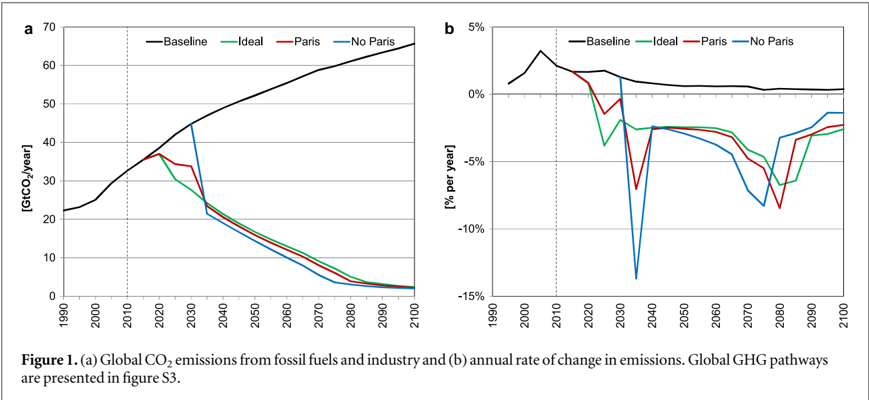
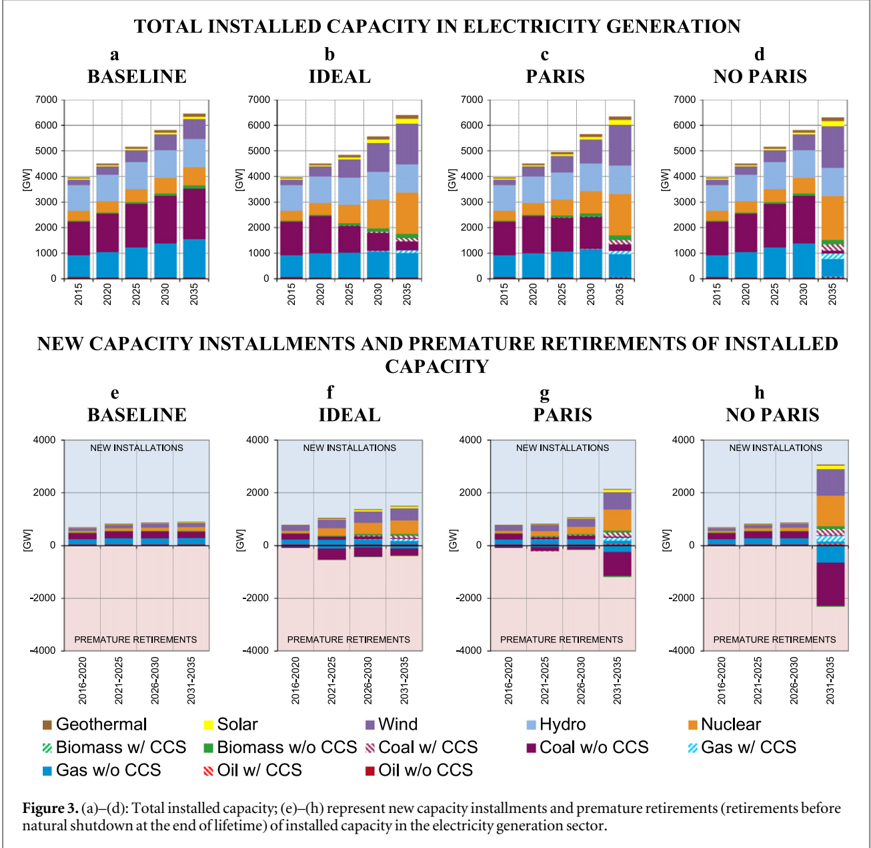
The international community has set a goal to limit global warming to 2 °C. Limiting global warming to 2 °C is a challenging goal and will entail a dramatic transformation of the global energy system, largely complete by 2040. As part of the work toward this goal, countries have been submitting their Intended Nationally Determined Contributions (INDCs) to the United Nations Framework Convention on Climate Change, indicating their emissions reduction commitments through 2025 or 2030, in advance of the 21st Conference of the Parties (COP21) in Paris in December 2015. In this paper, we use the Global Change Assessment Model (GCAM) to analyze the near versus long-term energy and economic-cost implications of these INDCs. The INDCs imply near-term actions that reduce the level of mitigation needed in the post-2030 period, particularly when compared with an alternative path in which nations are unable to undertake emissions mitigation until after 2030. We find that the latter case could require up to 2300 GW of premature retirements of fossil fuel power plants and up to 2900 GW of additional low-carbon power capacity installations within a five-year period of 2031–2035. INDCs have the effect of reducing premature retirements and new-capacity installations after 2030 by 50% and 34%, respectively. However, if presently announced INDCs were strengthened to achieve greater near-term emissions mitigation, the 2031–2035 transformation could be tempered to require 84% fewer premature retirements of power generation capacity and 56% fewer new-capacity additions. Our results suggest that the INDCs delivered for COP21 in Paris will have important contributions in reducing the challenges of achieving the goal of limiting global warming to 2 °C.
Overview
The claims and statistics of this paper haven’t been checked yet.
Free: it reads the open-access text and checks the first 5 claims that cite a source we can check. Create a free account to check every claim.
Integrity signals
Registry
Cites
Statistics
Figures
Verification
Claims the paper makes
The claims and statistics of this paper haven’t been checked yet.
Free: it reads the open-access text and checks the first 5 claims that cite a source we can check. Create a free account to check every claim.
Claims other papers make about this one
Each is checked against this paper’s own text: does it say what the citing paper says it does?
The source backs part of the claim, not all of it — or backs it for a different population, condition or comparison.
In the citing paper
“This challenge is particularly relevant to policy, because limiting emissions in 2030 does not only increase the chances of attaining the 2 °C target, but also reduces the need to rely on unproven, potentially risky or controversial technologies in the future 16,40,59 .”
From Paris Agreement climate proposals need a boost to keep warming well below 2 °C (2016) · cites this paper as [59]
Experimental — accuracy not yet measured
Self-check
Percentages, sums and reported differences re-computed from the paper’s own numbers.
The self-check needs the paper’s full text.
Citations
Cites
The next generation of scenarios for climate change research and assessment
Moss, R. H., Edmonds, J. A., Hibbard, K. A., Manning, M. R., Rose, S. K., van Vuuren, D. P., Carter, T. R., Emori, S., Kainuma, M., Kram, T., et al. (2010) · Nature · doi:10.1038/nature08823 · Cited by 6,467
Self-citationA new scenario framework for climate change research: the concept of shared socioeconomic pathways
O’Neill, B. C., Kriegler, E., Riahi, K., Ebi, K. L., Hallegatte, S., Carter, T. R., Mathur, R., & van Vuuren, D. P. (2014) · Climatic Change · doi:10.1007/s10584-013-0905-2 · Cited by 2,716
RCP4.5: a pathway for stabilization of radiative forcing by 2100
Thomson, A. M., Calvin, K. V., Smith, S. J., Kyle, G. P., Volke, A., Patel, P., Delgado-Arias, S., Bond-Lamberty, B., Wise, M. A., Clarke, L. E., et al. (2011) · Climatic Change · doi:10.1007/s10584-011-0151-4 · Cited by 1,631
Self-citationFuss, S., Canadell, J. G., Peters, G. P., Tavoni, M., Andrew, R. M., Ciais, P., Jackson, R. B., Jones, C. D., Kraxner, F., Nakicenovic, N., et al. (2014) · Nature Climate Change · doi:10.1038/nclimate2392 · Cited by 1,114
Meinshausen, M., Raper, S. C. B., & Wigley, T. M. L. (2011) · Atmospheric Chemistry and Physics · doi:10.5194/acp-11-1417-2011 · Cited by 876
Implications of Limiting CO 2 Concentrations for Land Use and Energy
Wise, M., Calvin, K., Thomson, A., Clarke, L., Bond-Lamberty, B., Sands, R., Smith, S. J., Janetos, A., & Edmonds, J. (2009) · Science · doi:10.1126/science.1168475 · Cited by 875
Self-citationEdenhofer, O. (2015) · Intergovernmental Panel on Climate Change eBooks · Cited by 835
Econometric Models for Probabilistic Choice Among Products
McFadden, D. (1980) · The Journal of Business · doi:10.1086/296093 · Cited by 766
International Energy Agency (2014) · World Energy Outlook · doi:10.1787/weo-2014-en · Cited by 662
Implications for climate and sea level of revised IPCC emissions scenarios
Wigley, T. M. L., & Raper, S. C. B. (1992) · Nature · doi:10.1038/357293a0 · Cited by 630
Research works printed but not linked: 3
- IEA 2014 World Energy Investment Outlook (Paris: International Energy Agency) IPCC 2014 Climate change 2014: synthesis report Contribution of Working Groups I, II and III 2014 to the Fifth Assessment Report of the Intergovernmental Panel on Climate Change ed R K Pachauri and L A Meyer (Geneva: Intergovernmental Panel on Climate Change)
- UNEP 2014 The Emissions Gap Report 2014 (Nairobi: United Nations Environment Programme (UNEP)) UNFCCC 2015 INDCs as Communicated by Parties (www4.unfccc. int/submissions/indc/Submission%20Pages/submissions. aspx) (accessed 30 July 2015)
- Wigley T M 2008 MAGICC/SCENGEN 5.3: User Manual Version 2 (Boulder, CO: National Center for Atmospheric Research)
Cited by
Paris Agreement climate proposals need a boost to keep warming well below 2 °C
Rogelj, J., den Elzen, M., Höhne, N., Fransen, T., Fekete, H., Winkler, H., Schaeffer, R., Sha, F., Riahi, K., & Meinshausen, M. (2016) · Nature · doi:10.1038/nature18307 · Cited by 3,637
Residual fossil CO2 emissions in 1.5–2 °C pathways
Luderer, G., Vrontisi, Z., Bertram, C., Edelenbosch, O. Y., Pietzcker, R. C., Rogelj, J., De Boer, H. S., Drouet, L., Emmerling, J., Fricko, O., et al. (2018) · Nature Climate Change · doi:10.1038/s41558-018-0198-6 · Cited by 575
Self-citationInvesting in Climate, Investing in Growth
OECD (2017) · OECD eBooks · doi:10.1787/9789264273528-en · Cited by 349
(2023) · Climate Change 2022 - Mitigation of Climate Change · doi:10.1017/9781009157926.004 · Cited by 253
Motesharrei, S., Rivas, J., Kalnay, E., Asrar, G. R., Busalacchi, A. J., Cahalan, R. F., Cane, M. A., Colwell, R. R., Feng, K., Franklin, R. S., et al. (2016) · National Science Review · doi:10.1093/nsr/nww081 · Cited by 209
“AsarecentWorldBankassessment[261, p. xvii] states, ‘The data show that dramatic climate changes, heat and weather extremes are already impacting people, damaging crops and coastlinesandputtingfood,water,andenergysecurityatrisk...Thetask…”
InfluentialSelf-citationDiverse carbon dioxide removal approaches could reduce impacts on the energy–water–land system
Fuhrman, J., Bergero, C., Weber, M., Monteith, S., Wang, F. M., Clarens, A. F., Doney, S. C., Shobe, W., & McJeon, H. (2023) · Nature Climate Change · doi:10.1038/s41558-023-01604-9 · Cited by 201
Self-citationInstrument choice and stranded assets in the transition to clean capital
Rozenberg, J., Vogt-Schilb, A., & Hallegatte, S. (2020) · Journal of Environmental Economics and Management · doi:10.1016/j.jeem.2018.10.005 · Cited by 140
“(2015), and Iyer et al. (2015) find that the least-cost pathway toward a 2◦C-compliant economy does involve stranding assets.”
BackgroundRoustai, M., Rayati, M., Sheikhi, A., & Ranjbar, A. (2018) · Sustainable Cities and Society · doi:10.1016/j.scs.2018.01.045 · Cited by 139
Climate policy, stranded assets, and investors’ expectations
Şen, S., & von Schickfus, M.-T. (2019) · Journal of Environmental Economics and Management · doi:10.1016/j.jeem.2019.102277 · Cited by 175
“Also, see Johnson et al., 2015; Rozenberg et al., 2015; Iyer et al., 2015 for the estimates of long-term energy- and economic-costs of the 2◦C goal.”
BackgroundMatthews, H. D., Zickfeld, K., Knutti, R., & Allen, M. R. (2018) · Environmental Research Letters · doi:10.1088/1748-9326/aa98c9 · Cited by 152
“Iyer et al (2015) also emphasized the need for early mitigation action to reduce the economic costs of remaining below 2 ◦C.”
BackgroundHof, A. F., den Elzen, M. G. J., Admiraal, A., Roelfsema, M., Gernaat, D., & van Vuuren, D. P. (2017) · Environmental Science & Policy · doi:10.1016/j.envsci.2017.02.008 · Cited by 152
Ratcheting of climate pledges needed to limit peak global warming
Iyer, G. C., Ou, Y., Edmonds, J., Fawcett, A. A., Hultman, N., MCFARLAND, J. R., Fuhrman, J., WALDHOFF, S. T., & McJeon, H. C. (2022) · Nature Climate Change · doi:10.1038/s41558-022-01508-0 · Cited by 146
Self-citationHighly active catalyst for CO 2 methanation derived from a metal organic framework template
Lippi, R., Howard, S. C., Barrón, H., Easton, C. D., Madsen, I. C., Waddington, L. J., Vogt, C., Hill, M. R., Sumby, C. J., Doonan, C. J., et al. (2017) · Journal of Materials Chemistry A · doi:10.1039/c7ta00958e · Cited by 118
Vogt‐Schilb, A., & Hallegatte, S. (2017) · WIREs Energy and Environment · doi:10.1002/wene.256 · Cited by 112
An integrated assessment of INDCs under Shared Socioeconomic Pathways: an implementation of C3IAM
Wei, Y., Han, R., Liang, Q., Yu, B., Yao, Y.-F., Xue, M., Zhang, K., Liu, L.-J., Peng, J., Yang, P., et al. (2018) · Natural Hazards · doi:10.1007/s11069-018-3297-9 · Cited by 110
“In recent years, a number of studies have examined the implications of the INDCs for future emissions (e.g., Fawcett et al. 2015; Iyer et al. 2015; Damassa 2015; Rogelj et al. 2016; Aldy et al. 2016; Rose et al. 2017).”
BackgroundAl-Sakkari, E. G., Ragab, A., Dagdougui, H., Boffito, D. C., & Amazouz, M. (2024) · The Science of The Total Environment · doi:10.1016/j.scitotenv.2024.170085 · Cited by 121
Will international emissions trading help achieve the objectives of the Paris Agreement?
Fujimori, S., Kubota, I., Dai, H., Takahashi, K., Hasegawa, T., Liu, J.-Y., Hijioka, Y., Masui, T., & Takimi, M. (2016) · Environmental Research Letters · doi:10.1088/1748-9326/11/10/104001 · Cited by 94
Energy system changes in 1.5 °C, well below 2 °C and 2 °C scenarios
Gambhir, A., Rogelj, J., Luderer, G., Few, S., & Napp, T. (2018) · Energy Strategy Reviews · doi:10.1016/j.esr.2018.12.006 · Cited by 102
Vrontisi, Z., Luderer, G., Saveyn, B., Keramidas, K., Lara, A. R., Baumstark, L., Bertram, C., de Boer, H. S., Drouet, L., Fragkiadakis, K., et al. (2018) · Environmental Research Letters · doi:10.1088/1748-9326/aab53e · Cited by 79
“A multi-model analysis can provide some insight into the level of uncertainty of cost estimations (Iyer et al 2015).”
BackgroundMethodSampedro, J., Smith, S. J., Arto, I., González‐Eguino, M., Markandya, A., Mulvaney, K. M., Pizarro-Irizar, C., & Dingenen, R. V. (2020) · Environment International · doi:10.1016/j.envint.2020.105513 · Cited by 91
Divestment prevails over the green paradox when anticipating strong future climate policies
Bauer, N., McGlade, C., Hilaire, J., & Ekins, P. (2018) · Nature Climate Change · doi:10.1038/s41558-017-0053-1 · Cited by 86
“This model rests on a number of simplifying assumptions: (1) there is a single non-renewable resource with a given quantity and zero extraction costs; (2) the resource owners choose an extraction path to maximize their net welfare subject to a given market interest rate; (3) profits can be invested into financial asse…”
BackgroundSystematic map of the literature on carbon lock-in induced by long-lived capital
Fisch-Romito, V., Guivarch, C., Creutzig, F., Minx, J. C., & Callaghan, M. (2021) · Environmental Research Letters · doi:10.1088/1748-9326/aba660 · Cited by 97
Stranded asset implications of the Paris Agreement in Latin America and the Caribbean
Binsted, M. T., Iyer, G. C., Edmonds, J., Vogt‐Schilb, A., Argüello, R., Cadena, Á., Delgado, R., Feijoo, F., Lucena, A. F. P., McJeon, H. C., et al. (2020) · Environmental Research Letters · doi:10.1088/1748-9326/ab506d · Cited by 91
Self-citationEarly retirement of power plants in climate mitigation scenarios
Fofrich, R., Tong, D., Calvin, K., de Boer, H. S., Emmerling, J., Fricko, O., Fujimori, S., Luderer, G., Rogelj, J., & Davis, S. J. (2020) · Environmental Research Letters · doi:10.1088/1748-9326/ab96d3 · Cited by 84
Self-citationQuantifying the regional stranded asset risks from new coal plants under 1.5 °C
Edwards, M. R., Cui, R. Y., Bindl, M., Hultman, N., Mathur, K., McJeon, H. C., Iyer, G. C., Song, J., & Zhao, A. (2022) · Environmental Research Letters · doi:10.1088/1748-9326/ac4ec2 · Cited by 78
“These risks only increasewith delayed climate action [19] and specifically with continued expansion of fossil fuel infrastructure [22].”
BackgroundSelf-citationThe Paris Agreement and next steps in limiting global warming
Rose, S. K., Richels, R., Blanford, G. J., & Rutherford, T. F. (2017) · Climatic Change · doi:10.1007/s10584-017-1935-y · Cited by 82
“A number of analyses have evaluated the implications of the NDCs for emissions (e.g., Jacoby and Chen 2014; Reilly et al. 2015; UNEP 2015; Fawcett et al. 2015; Iyer et al. 2015; Rogelj et al. 2016).”
BackgroundImplications of the Paris agreement for the ocean
Magnan, A., Colombier, M., Billé, R., Joos, F., Hoegh‐Guldberg, O., Pörtner, H., Waisman, H., Spencer, T., & Gattuso, J. (2016) · Nature Climate Change · doi:10.1038/nclimate3038 · Cited by 62
Implication of Paris Agreement in the context of long-term climate mitigation goals
Fujimori, S., Su, X., Liu, J.-Y., Hasegawa, T., Takahashi, K., Masui, T., & Takimi, M. (2016) · SpringerPlus · doi:10.1186/s40064-016-3235-9 · Cited by 49
“There have already been several assessments related to INDCs published either in scientific papers, websites, or reports (Meinshausen et al. 2015; Fawcett et al. 2015; Gokul et al. 2015; International Energy Agency 2015; Climate Action Tracker 2015; Lomborg 2015; Benveniste et al. 2015; Kitous and Keramidas 2015; Hof…”
Bio-energy and CO2 emission reductions: an integrated land-use and energy sector perspective
Bauer, N., Klein, D., Humpenöder, F., Kriegler, E., Luderer, G., Popp, A., & Strefler, J. (2020) · Climatic Change · doi:10.1007/s10584-020-02895-z · Cited by 55
Zheng, J., Duan, H., Zhou, S., Wang, S., Gao, J., Jiang, K., & Gao, S. (2021) · Energy Economics · doi:10.1016/j.eneco.2021.105355 · Cited by 49
US energy system transitions under cumulative emissions budgets
Feijoo, F., Iyer, G. C., Binsted, M. T., & Edmonds, J. (2020) · Climatic Change · doi:10.1007/s10584-020-02670-0 · Cited by 46
Self-citationPotential impacts of China's climate policies on energy security
Duan, H., & Wang, S. (2018) · Environmental Impact Assessment Review · doi:10.1016/j.eiar.2018.04.007 · Cited by 42
Dioha, M. O., & Kumar, A. (2020) · Energy Policy · doi:10.1016/j.enpol.2020.111703 · Cited by 49
Machine learning-assisted selection of adsorption-based carbon dioxide capture materials
Al-Sakkari, E. G., Ragab, A., So, T. M. Y., Shokrollahi, M., Dagdougui, H., Navarri, P., Elkamel, A., & Amazouz, M. (2023) · Journal of environmental chemical engineering · doi:10.1016/j.jece.2023.110732 · Cited by 46
Renewable energy achievements in CO2 mitigation in Thailand's NDCs
Chunark, P., Limmeechokchai, B., Fujimori, S., & Masui, T. (2017) · Renewable Energy · doi:10.1016/j.renene.2017.08.017 · Cited by 49
Wan, L., Wang, C., & Cai, W. (2016) · Applied Energy · doi:10.1016/j.apenergy.2016.10.013 · Cited by 36
Fragkos, P. F., & Kouvaritakis, N. (2018) · Energy · doi:10.1016/j.energy.2018.07.030 · Cited by 52
Chilean pathways for mid-century carbon neutrality under high renewable potential
Arriet, A., Flores, F., Matamala, Y., & Feijoo, F. (2022) · Journal of Cleaner Production · doi:10.1016/j.jclepro.2022.134483 · Cited by 32
González-Mahecha, E., Lecuyer, O., Hallack, M., Bazilian, M., & Vogt‐Schilb, A. (2019) · Environmental Research Letters · doi:10.1088/1748-9326/ab5476 · Cited by 28
“All countries in the region have presented nationally determined contributions (NDC) that include emission reductions in the power sector as part of their contribution to the Paris Agreement (World Bank 2019).”
BackgroundInfluentialLow-End Probabilistic Sea-Level Projections
Cozannet, G. L., Thiéblemont, R., Rohmer, J., Idier, D., Manceau, J., & Quique, R. (2019) · Water · doi:10.3390/w11071507 · Cited by 31
The future evolution of global natural gas trade
Yarlagadda, B., Iyer, G. C., Binsted, M. T., Patel, P., Wise, M., & McLeod, J. (2024) · iScience · doi:10.1016/j.isci.2024.108902 · Cited by 33
Self-citationda Silva, S. R. S., Miralles‐Wilhelm, F. R., Muñoz-Castillo, R., Clarke, L., Braun, C. J., Delgado, A., Edmonds, J., Hejazi, M. I., Horing, J., Horowitz, R., et al. (2019) · PLoS ONE · doi:10.1371/journal.pone.0215013 · Cited by 34
“Previous studies have assessed NDCs largely from the point of view of their collective contribution to limit global warming [13, 14], in terms of their implications on the energy sector [15] or on mitigation costs [16, 17].”
BackgroundSelf-citationWild, T., Khan, Z., Zhao, M., Suriano, M., Bereslawski, J. L., Roberts, P., Casado, J., Novillo, M. G., Clarke, L., Hejazi, M. I., et al. (2021) · Earth s Future · doi:10.1029/2020ef001970 · Cited by 31
“Despite the Paris Climate Accord's temperature goal, current global GHG reduction pledges from individual countries, including Argentina's, are collectively inconsistent with limiting warming to 2°C (Iyer et al., 2015).”
BackgroundSelf-citationKöhler, P. (2016) · Environmental Research Letters · doi:10.1088/1748-9326/11/12/124016 · Cited by 20
Baridó, D. P. D. L., Avila, N. I., & Kammen, D. M. (2019) · Energy Research & Social Science · doi:10.1016/j.erss.2019.101343 · Cited by 33
Pradhan, S., Shobe, W., Fuhrman, J., McJeon, H. C., Binsted, M. T., Doney, S. C., & Clarens, A. F. (2021) · Frontiers in Climate · doi:10.3389/fclim.2021.660787 · Cited by 28
Self-citationYu, S., Evans, M., Kyle, P. G., Vu, L., Tan, Q., Gupta, A., & Patel, P. (2018) · Environmental Research Letters · doi:10.1088/1748-9326/aaad84 · Cited by 23
Self-citationThe global carbon budget and the Paris agreement
Alcaraz, O., Buenestado, P., Escribano, B., Carbonell, B. S., Turon, A., & Xercavins, J. (2019) · International Journal of Climate Change Strategies and Management · doi:10.1108/ijccsm-06-2017-0127 · Cited by 27
“This is a very worrying fact, confirmed by the reports on the aggregate effect of INDCs that, a posteriori, have attempted to assess the CB that these INDCs imply (Iyer et al., 2015; Peters et al., 2015; UNEP, 2015; UNFCCC, 2015b, 2016c).”
BackgroundCommitted Emissions of the U.S. Power Sector, 2000–2018
Shearer, C., Tong, D., Fofrich, R., & Davis, S. J. (2020) · AGU Advances · doi:10.1029/2020av000162 · Cited by 22
“This analysis reflects similar studies finding that existing infrastructure is already incompatible with the Paris climate agreement and that strengthening NDCs can help prevent early retirement of fossil fuel infrastructure (Binsted et al., 2020; Iyer et al., 2015).”
ResultIntegrated energy-water-land nexus planning in the Colorado River Basin (Argentina)
Wild, T., Khan, Z., Clarke, L., Hejazi, M. I., Bereslawski, J. L., Suriano, M., Roberts, P., Casado, J., Miralles‐Wilhelm, F. R., Novillo, M. G., et al. (2021) · Regional Environmental Change · doi:10.1007/s10113-021-01775-1 · Cited by 25
Self-citationPathway comparison of limiting global warming to 2°C
Wei, Y., Liu, L.-J., Liang, Q., Yu, B., Liu, L.-C., Yao, Y.-F., Zhang, K., Wang, C., Han, R., Kang, J.-N., et al. (2021) · Energy and Climate Change · doi:10.1016/j.egycc.2021.100063 · Cited by 29
Quantifying the reductions in mortality from air-pollution by cancelling new coal power plants
Sampedro, J., Cui, R. Y., McJeon, H. C., Smith, S. J., Hultman, N., He, L., Sen, A., Dingenen, R. V., & Cazcarro, I. (2020) · Energy and Climate Change · doi:10.1016/j.egycc.2020.100023 · Cited by 19
Self-citationOu, Y., Binsted, M. T., Iyer, G. C., Patel, P., & Wise, M. (2021) · Energy Strategy Reviews · doi:10.1016/j.esr.2021.100739 · Cited by 19
Self-citationApostoli, A. J. (2016) · Journal of Earth Science & Climatic Change · doi:10.4172/2157-7617.1000362 · Cited by 16
“Countries participating in COP21 have been submitting their Intended Nationally Determined Contributions (INDCs) which specifies their emission reduction commitments through 2025 or 2030 [26].”
BackgroundTemporal and spatial distribution of global mitigation cost: INDCs and equity
Liu, J., Fujimori, S., & Masui, T. (2016) · Environmental Research Letters · doi:10.1088/1748-9326/11/11/114004 · Cited by 18
Adun, H. H., Ampah, J. D., Bamisile, O., Hu, Y., & Staffell, I. (2023) · Energy Sustainable Development/Energy for sustainable development · doi:10.1016/j.esd.2023.101338 · Cited by 14
Lüning, S., & Vahrenholt, F. (2017) · Frontiers in Earth Science · doi:10.3389/feart.2017.00104 · Cited by 15
“Limiting global warming to 2C is a challenging goal and according to Iyer et al. (2015) entails a dramatic transformation of the global energy system, that needs to be largely complete by 2040.”
BackgroundMalik, A., Chaturvedi, V., Sandhani, M., Das, P., Arora, C., Singh, N., Cui, R. Y., Iyer, G. C., & Zhao, A. (2024) · Environmental Research Letters · doi:10.1088/1748-9326/ad64ec · Cited by 12
“Poor policy integration could have negative consequences in the form of higher costs to society and increased risk of stranded assets (Hood 2013, Iyer et al 2015, Binsted et al 2020).”
Self-citationGonzález-Mahecha, E., Lecuyer, O., Hallack, M., Bazilian, M., & Vogt‐Schilb, A. (2019) · doi:10.18235/0001827 · Cited by 9
Large Ensemble Exploration of Global Energy Transitions Under National Emissions Pledges
Wessel, J., Iyer, G. C., Wild, T., Ou, Y., McJeon, H. C., & Lamontagne, J. (2024) · Earth s Future · doi:10.1029/2024ef004754 · Cited by 9
Self-citationThe challenge of the Paris Agreement to contain climate change
Grigoroudis, E., Kanellos, F. D., Kouikoglou, V. S., & Phillis, Y. A. (2018) · Intelligent Automation & Soft Computing · doi:10.1080/10798587.2017.1292716 · Cited by 8
HOW CARBON MARKET COOPERATION CHANGES THE ENERGY SYSTEMS IN NORTHEAST ASIA
BAEK, M., Chai, Q., & Kim, S. (2020) · Climate Change Economics · doi:10.1142/s2010007820500104 · Cited by 5
IMPLICATION OF PARIS AGREEMENT IN THE CONTEXT OF LONG-TERM CLIMATE MITIGATION TARGET
Fujimori, S., Hasegawa, T., Takahashi, K., Masui, T., & Takimi, M. (2016) · Journal of Japan Society of Civil Engineers Ser G (Environmental Research) · doi:10.2208/jscejer.72.i_223 · Cited by 5
Miralles‐Wilhelm, F. R., & Castillo, R. M. (2018) · doi:10.18235/0001179 · Cited by 8
Wang, Y., Zhang, Y., Wang, K., Liu, J., & Pan, X. (2026) · Energy Policy · doi:10.1016/j.enpol.2026.115132 · Cited by 6
Changes in Research Trends and Topics on Carbon Neutrality Before and After the 2016 Paris Agreement
Hwang, I., Jung, W., & Cho, K. (2025) · IEEE Access · doi:10.1109/access.2025.3583438 · Cited by 5
“The rationale for segmenting the research period around the Paris Agreement stems from its role as a pivotal moment in global environmental policy, wherein countries made formal commitments to emission reductions through their nationally determined contributions [77], [78], [79].”
Simulated response of the climate of eastern Africa to stratospheric aerosol intervention
Misiani, H., Endris, H. S., Opijah, F. J., Ouma, J. O., Barasa, B. N., Tye, M. R., & MacMartin, D. G. (2025) · Frontiers in Climate · doi:10.3389/fclim.2025.1522235 · Cited by 5
Govindasamy, G., & Balaji, P. K. J. (2025) · Journal of Material Cycles and Waste Management · doi:10.1007/s10163-025-02231-6 · Cited by 6
Temporal and Spatial Distribution of Global Mitigation Cost: INDCs and Equity
Liu, J., Fujimori, S., & Masui, T. (2017) · Springer eBooks · doi:10.1007/978-981-10-3869-3_4 · Cited by 4
Akpan, J. S., & Olanrewaju, O. A. (2024) · Atmosphere · doi:10.3390/atmos15020227 · Cited by 6
Asian INDC Assessments: The Case of Thailand
Limmeechokchai, B., Chunark, P., Fujimori, S., & Masui, T. (2017) · Springer eBooks · doi:10.1007/978-981-10-3869-3_10 · Cited by 4
Iyer, G. C., Clarke, L., Edmonds, J., & Hultman, N. (2016) · Energy Policy · doi:10.1016/j.enpol.2016.08.017 · Cited by 3
Self-citationAlloisio, I., Borghesi, S., & Nicolli, F. (2020) · Economia Politica · doi:10.1007/s40888-020-00193-6 · Cited by 4
The Effectiveness of the International Emissions Trading under the Paris Agreement
Fujimori, S., Kubota, I., Dai, H., Takahashi, K., Hasegawa, T., Liu, J., Hijioka, Y., Masui, T., & Takimi, M. (2017) · Springer eBooks · doi:10.1007/978-981-10-3869-3_5 · Cited by 3
Green Finance and Economic Growth: Empirical Evidence from Panel Data Using CCEMG and PCSE Methods
Ceviz, A. Y. (2025) · Uluslararası Ekonomi Siyaset İnsan ve Toplum Bilimleri Dergisi · doi:10.59445/ijephss.1710694 · Cited by 2
Global Energy System Transitions
Edmonds, J., Fujimori, S., Iyer, G. C., McJeon, H. C., O’Rourke, P., Pedersen, J. S. T., van Vuuren, D. P., & Yu, S. (2024) · Review of Environmental Economics and Policy · doi:10.1086/728206 · Cited by 2
“…the mitigation cost (Bosetti et al. 2009; Jakob et al. 2012; Luderer et al. 2013), how variations in the quality of governance affect those choices (Iyer et al. 2015a), and how perceptions of risk and the time horizons might in fl u-ence investment planning (Bosetti and Victor 2011) These studies…”
BackgroundSelf-citationGovindasamy, G., Sharma, R., & Subramanian, S. (2022) · IOP Conference Series Earth and Environmental Science · doi:10.1088/1755-1315/1042/1/012007 · Cited by 2
Govindasamy, G., Sharma, R., & Subramanian, S. (2022) · BULLETIN OF CHEMICAL REACTION ENGINEERING AND CATALYSIS · doi:10.9767/bcrec.17.4.15781.768-777 · Cited by 3
“To address this twin issues of energy security and mitigation of global warming, energy transition from fossil to renewable energy is the urgent need [2].”
BackgroundIdentification of metabolites involved in heat stress response in different tomato genotypes
Paupière, M. J. (2017) · doi:10.18174/413346 · Cited by 3
TSUTSUI, T., Nishiura, O., Fujimori, S., & Oshiro, K. (2025) · Global Environmental Change Advances · doi:10.1016/j.gecadv.2025.100022 · Cited by 3
Ciaschini, C., & Salvati, L. (2026) · Sustainable development goals series · doi:10.1007/978-3-032-12559-0_6 · Cited by 1
Global INDCs Gap, Dilemma and Innovative Path of Carbon Sink Increase
Hu, H., Fang, W., Luo, T., & Jin, G. (2022) · Environmental science and engineering · doi:10.1007/978-981-19-1704-2_7 · Cited by 1
Hutajulu, D. S., Revina, T., & Dermawan, M. D. (2023) · IOP Conference Series Earth and Environmental Science · doi:10.1088/1755-1315/1199/1/012018 · Cited by 1
Performance Analysis of H-Type Vertical Axis Wind Turbine by Using Novelty Numerical Simulink Method
Radhiva, M., Abdillah, M. H., Putra, G. D. K., Wajdi, M. R., Wulandari, P., Caesarendra, W., Lubis, A. H., & Syahriar, A. (2024) · Lecture notes in electrical engineering · doi:10.1007/978-981-99-6749-0_14 · Cited by 1
Implications of the Paris Agreement in the Context of Long-Term Climate Mitigation Goals
Fujimori, S., Su, X., Liu, J., Hasegawa, T., Takahashi, K., Masui, T., & Takimi, M. (2017) · Springer eBooks · doi:10.1007/978-981-10-3869-3_2 · Cited by 3
Design of IOT-Based Framework for Evaluation of Energy Efficiency in Power Transformers
Plienis, M., Deveikis, T., Jonaitis, A., & Gudžius, S. (2023) · Energies · doi:10.3390/en16114358 · Cited by 1
“Europe is currently setting ambitious targets for reducing CO2 emissions in the world so that global average temperatures do not rise by more than 2 degrees by the end of the 21st century [1].”
BackgroundTransparency crucial to Paris climate scenarios—Response
Ou, Y., Iyer, G. C., Edmonds, J., Fawcett, A. A., Hultman, N., McFarland, J., WALDHOFF, S. T., Gidden, M., & McJeon, H. C. (2022) · Science · doi:10.1126/science.abn9667 · Cited by 1
Self-citationEFFECTIVENESS OF EMISSIONS TRADING UNDER THE UPDATED NATIONAL EMISSIONS TARGETS BY 2030
TSUTSUI, T., Nishiura, O., Fujimori, S., & Oshiro, K. (2022) · Journal of Japan Society of Civil Engineers Ser G (Environmental Research) · doi:10.2208/jscejer.78.5_i_405
Ceviz, A. Y. (2025) · DergiPark (Istanbul University)
Cheraghi, Y., & Bratvold, R. B. (2026) · Decision Analysis · doi:10.1287/deca.2025.0335
Metadata
- Authors
- Iyer, G. C., Edmonds, J. A., Fawcett, A. A., Hultman, N. E., Alsalam, J., Asrar, G. R., Calvin, K. V., Clarke, L. E., Creason, J., Jeong, M., Kyle, P., McFarland, J., Mundra, A., Patel, P., Shi, W., & McJeon, H. C.
- Affiliations
- Joint Global Change Research Institute (US)
- Environmental Protection Agency (US)
- University of Maryland, College Park (US)
- Corresponding author
- McJeon, Haewon C
- ORCID
- Venue
- Environmental Research Letters
- Publisher
- IOP Publishing
- Published
- 2015-11-24
- Volume
- 10
- Issue
- 12
- Pages
- 125002
- ISSN
- 1748-9326 (ISSN-L)
- OpenAlex
- W2172866072
- Semantic Scholar
- 2ad0aac808a1fabe919606daca6e9a44988296ce
- Cited by
- 90
- References
- 31
- Citations by year
- 2026: 3 · 2025: 6 · 2024: 7 · 2023: 6 · 2022: 8 · 2021: 6 · 2020: 10 · 2019: 8 · 2018: 12 · 2017: 13 · 2016: 11
- FWCI
- 28.98
- Type
- journal article
- Language
- en
- Open access
- gold
- doi.org
- Licence
- cc-by
- iopscience.iop.org/info/page/text-and-data-mining (tdm)
- creativecommons.org/licenses/by/3.0/ (vor)
- Locations
- Environmental Research Letters (publishedVersion, cc-by)
- DOAJ (DOAJ: Directory of Open Access Journals) (submittedVersion)
- Funders
- Environmental Protection Agency (DW –8992406301)
- William and Flora Hewlett Foundation
- Topics
- Social Sciences › Economics, Econometrics and Finance › Economics and Econometrics › Climate Change Policy and Economics
- Physical Sciences › Environmental Science › Global and Planetary Change › Climate Change and Geoengineering
- Physical Sciences › Environmental Science › Global and Planetary Change › Sustainability and Climate Change Governance
- Keywords
- 2°C target, Intended Nationally Determined Contributions, COP21 Paris Agreement, emission reduction, energy system transformation, early retirement, GCAM, climate policy
About these checks
Registry, retraction, Cites and statistics results are computed, not judged, with one exception: a printed reference that no index lists is read once by a model before it counts as a citation error. Claims are extracted by a model and kept only when their quote appears verbatim in the text; each cited source is then checked, with a model’s help, for whether it says what the claim relies on. Those verdicts can be wrong — read the claim’s quote and the cited source before relying on one.
Statistics and arithmetic are recomputed, not judged.
Confidence bands are shown only for fields calibrated on our annotated test set. None is calibrated yet, so no band is shown.
What counts as a claim ›How we measure confidence ›How we check this ›
Are you an author, or do you see a problem with this page? Request a review
Data sources
Bibliographic data: Semantic Scholar, OpenAlex, Crossref.
Contains information from the Semantic Scholar Academic Graph Datasets, made available under the ODC Attribution License (ODC-BY 1.0).
Semantic Scholar’s data is described in: Kinney, R., et al. (2023). The Semantic Scholar Open Data Platform. arXiv:2301.10140.
