

Global scale climate–crop yield relationships and the impacts of recent warming
Open accessThe DOI matches its Crossref record; 16 of the 16 references it cites were found in a registry or an index.
Abstract
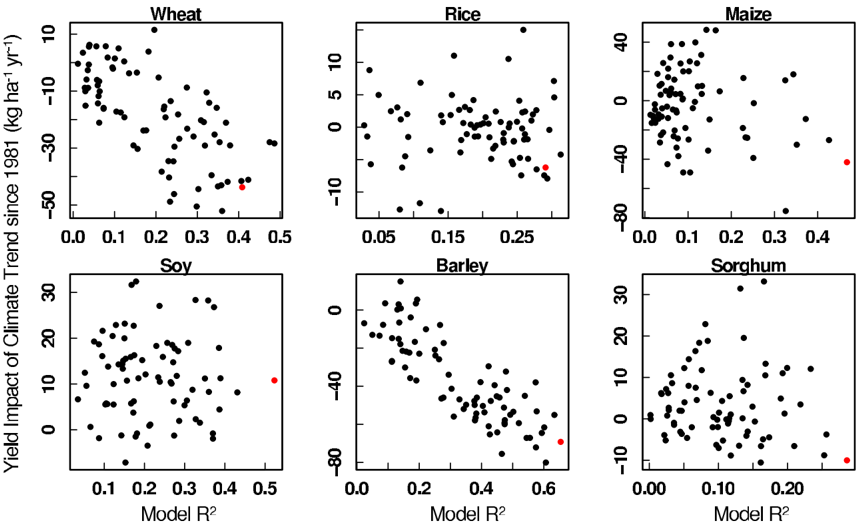
Changes in the global production of major crops are important drivers of food prices, food security and land use decisions. Average global yields for these commodities are determined by the performance of crops in millions of fields distributed across a range of management, soil and climate regimes. Despite the complexity of global food supply, here we show that simple measures of growing season temperatures and precipitation—spatial averages based on the locations of each crop—explain ∼30% or more of year-to-year variations in global average yields for the world's six most widely grown crops. For wheat, maize and barley, there is a clearly negative response of global yields to increased temperatures. Based on these sensitivities and observed climate trends, we estimate that warming since 1981 has resulted in annual combined losses of these three crops representing roughly 40 Mt or $5 billion per year, as of 2002. While these impacts are small relative to the technological yield gains over the same period, the results demonstrate already occurring negative impacts of climate trends on crop yields at the global scale.
Overview
The claims and statistics of this paper haven’t been checked yet.
Free: it reads the open-access text and checks the first 5 claims that cite a source we can check. Create a free account to check every claim.
Integrity signals
Registry
Cites
Statistics
Figures
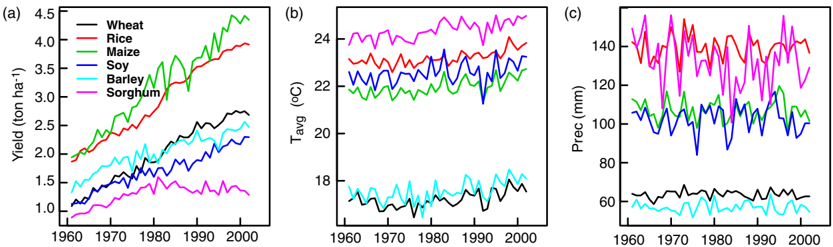
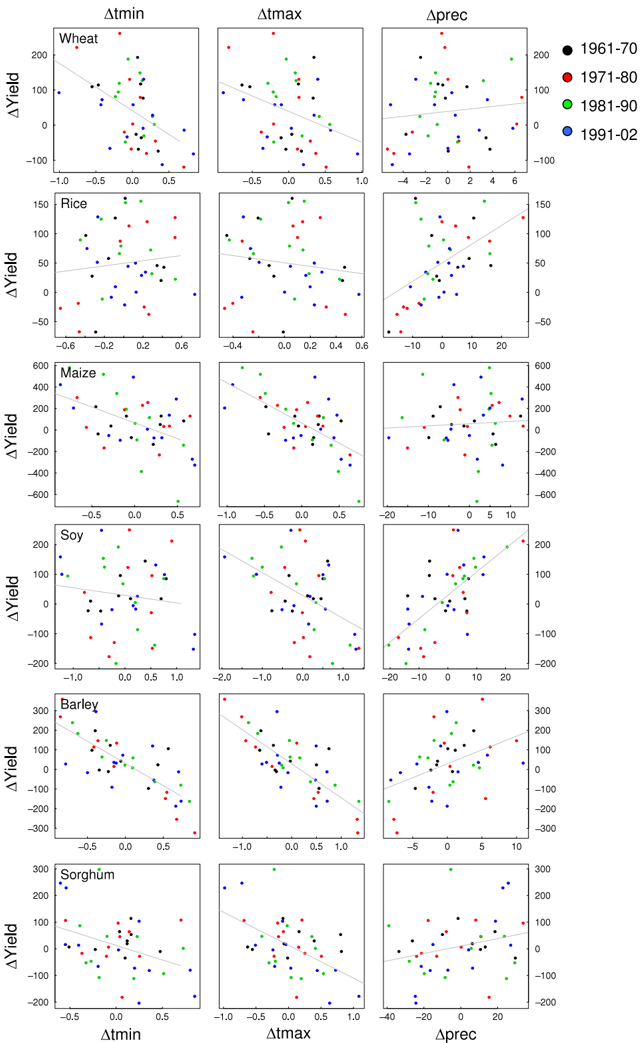
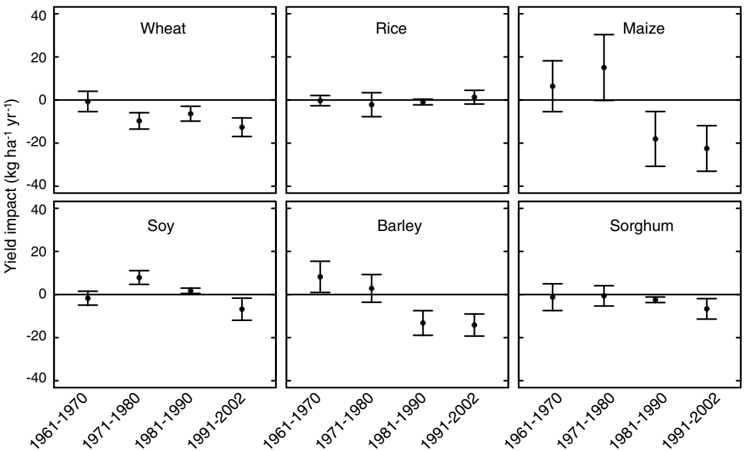
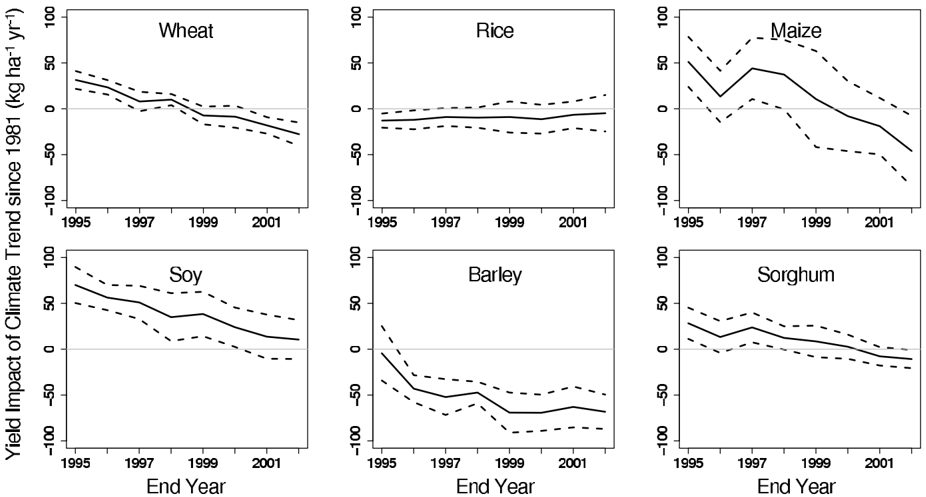
Verification
Claims the paper makes
The claims and statistics of this paper haven’t been checked yet.
Free: it reads the open-access text and checks the first 5 claims that cite a source we can check. Create a free account to check every claim.
Claims other papers make about this one
Each is checked against this paper’s own text: does it say what the citing paper says it does?
The source backs part of the claim, not all of it — or backs it for a different population, condition or comparison.
In the citing paper
“Given the documented long-term trends in [CO2] and temperature, it is likely we are already dealing with their early effects on crop productivity in many of our crop improvement programs (Lobell and Field 2007; Chapman et al. 2012; Lobell et al. 2013, 2015; Hammer et al. 2014, 2020; Zheng et al. 2016; Snowdon et al. 2020).”
From Tackling G × E × M interactions to close on-farm yield-gaps: creating novel pathways for crop improvement by predicting contributions of genetics and management to crop productivity (2021) · cites this paper as Lobell and Field 2007
Experimental — accuracy not yet measuredThe source backs part of the claim, not all of it — or backs it for a different population, condition or comparison.
In the citing paper
“Similarly, it was reported that yield in maize decreased by 8.3% with every 1 °C rise in temperature from the optimum growth temperature [55].”
From Impact of Climate Change on Crops Adaptation and Strategies to Tackle Its Outcome: A Review (2019) · cites this paper as [55]
Experimental — accuracy not yet measuredThe check wasn’t confident either way, so it gives no verdict — never disputed.
In the citing paper
“Despite extraordinary global expenditures on wildfire suppression in MCRs, most inter-annual variability in burned areas in MCRs in recent decades is still explained by fire weather (figure 1).”
From Wildfire management in Mediterranean-type regions: paradigm change needed (2020) · cites this paper as [29]
Experimental — accuracy not yet measured
Self-check
Percentages, sums and reported differences re-computed from the paper’s own numbers.
The self-check needs the paper’s full text.
Citations
Cites
Mitchell, T. D., & Jones, P. D. (2005) · International Journal of Climatology · doi:10.1002/joc.1181 · Cited by 3,822
Potential impact of climate change on world food supply
Rosenzweig, C., & Parry, M. L. (1994) · Nature · doi:10.1038/367133a0 · Cited by 1,891
Food for Thought: Lower-Than-Expected Crop Yield Stimulation with Rising CO 2 Concentrations
Long, S. P., Ainsworth, E. A., Leakey, A. D. B., Nösberger, J., & Ort, D. R. (2006) · Science · doi:10.1126/science.1114722 · Cited by 1,500 · cited 2×
“The impact of warming was likely offset to some extent by fertilization effects of increased CO2 levels, although the magnitude of these effects are uncertain and the subject of much debate [23–25].”
BackgroundSocio-economic and climate change impacts on agriculture: an integrated assessment, 1990–2080
Fischer, G., Shah, M., N. Tubiello, F., & van Velhuizen, H. (2005) · Philosophical Transactions of the Royal Society B: Biological Sciences · doi:10.1098/rstb.2005.1744 · Cited by 1,040 · cited 3×
“The inferred temperature sensitivities were negative for all crops (figure 2; table 1), in agreement with several previous assessments [2–5].”
BackgroundResultInfluentialInsulin Staining of ES Cell Progeny from Insulin Uptake
Rajagopal, J., Anderson, W. J., Kume, S., Martinez, O. I., & Melton, D. A. (2003) · Science · doi:10.1126/science.1077838 · Cited by 931
Geographic distribution of major crops across the world
Leff, B., Ramankutty, N., & Foley, J. A. (2004) · Global Biogeochemical Cycles · doi:10.1029/2003gb002108 · Cited by 735
Climate change, global food supply and risk of hunger
Parry, M., Rosenzweig, C., & Livermore, M. (2005) · Philosophical Transactions of the Royal Society B: Biological Sciences · doi:10.1098/rstb.2005.1751 · Cited by 458
Increased Australian wheat yield due to recent climate trends
Nicholls, N. (1997) · Nature · doi:10.1038/387484a0 · Cited by 318
Crop response to elevated CO2 and world food supply
Tubiello, F. N., Amthor, J. S., Boote, K. J., Donatelli, M., Easterling, W., Fischer, G., Gifford, R. M., Howden, M., Reilly, J., & Rosenzweig, C. (2007) · European Journal of Agronomy · doi:10.1016/j.eja.2006.10.002 · Cited by 314
Analysis of wheat yield and climatic trends in Mexico
Lobell, D. B., Ortiz-Monasterio, J. I., Asner, G. P., Matson, P. A., Naylor, R. L., & Falcon, W. P. (2005) · Field Crops Research · doi:10.1016/j.fcr.2005.01.007 · Cited by 276
Self-citation
Research works printed but not linked: 6
- [9] USDA1994 Major world crop areas and climatic profiles (revised) Agricultural Handbook No. 664 (Washington, DC: United States Department of Agriculture) -
- [13] Lobell D B, Field C B, Cahill K N and Bonfils C 2006 Impacts of future climate change on California perennial crop yields: model projections with climate and crop uncertainties Agric. Meteorol. 141 208-18 -
- [15] Reilly J et al 1996 Agriculture in a changing climate: impacts and adaptations Impacts, Adaptations and Mitigation of climate Change, Contribution of Working Group II to the 2nd Assessment Report of the IPCC ed R T Watson, MCZinyowera and R H Moss (London: Cambridge University Press) p 878 -
- [16] Hansen L 1991 Farmer response to changes in climate: the case of corn production J. Agric. Econ. Res. 43 18-25 -
- [19] Stone P 2001 The effects of heat stress on cereal yield and quality Crop Responses and Adaptations to Temperature Stress ed A S Basra (Binghamton, NY: Food Products Press) p 302 -
- [21] Hansen J, Ruedy R, Sato M and Lo K 2006 Global Temperature Trends: 2005 Summation (New York: NASA Goddard Institute for Space Studies) -
Cited by
Items 101–200 of 244
Mudanças do clima e agropecuária: impactos, mitigação e adaptação. Desafios e oportunidades
Assad, E. D., & Assad, M. L. L. (2024) · Estudos Avançados · doi:10.1590/s0103-4014.202438112.015 · Cited by 44
The MAHB, the Culture Gap, and Some Really Inconvenient Truths
Ehrlich, P. R. (2010) · PLoS Biology · doi:10.1371/journal.pbio.1000330 · Cited by 21
“and rising temperatures threaten the food supply of 1.6 billion people”
BackgroundInfluentialThe Effect of Weather Conditions on Fertilizer Applications: A Spatial Dynamic Panel Data Analysis
Billé, A. G., & Rogna, M. (2021) · Journal of the Royal Statistical Society Series A (Statistics in Society) · doi:10.1111/rssa.12709 · Cited by 22
Improved Index Insurance Design and Yield Estimation Using a Dynamic Factor Forecasting Approach
Li, H., Porth, L., Tan, K. S., & Zhu, W. (2018) · Insurance Mathematics and Economics · doi:10.1016/j.insmatheco.2020.11.003 · Cited by 29
Barnhart, M. H., Masalia, R. R., Mosley, L. J., & Burke, J. M. (2022) · PLoS ONE · doi:10.1371/journal.pone.0275462 · Cited by 30
Hendrawan, V. S. A., Kim, W., & Komori, D. (2023) · Anthropocene · doi:10.1016/j.ancene.2023.100389 · Cited by 23
Impacts of regional climate change on barley yield and its geographical variation in South Korea
Ko, J., Ng, C. T., Jeong, S., Kim, J., Lee, B., & Kim, H.-Y. (2019) · International Agrophysics · doi:10.31545/intagr/104398 · Cited by 26
“While considerable efforts have been made to enumerate global crop productions, especially considering the changing climate (Lobell and Field 2007; Rosenzweig et al., 2014), it might be unmanageable at present to measure the collective impact of climate change on global agricultural productivity (Gornall et al.”
BackgroundTemperature and precipitation are adversely affecting wheat yield in India
Madhukar, A., Kumar, V., & Dashora, K. (2022) · Journal of Water and Climate Change · doi:10.2166/wcc.2022.443 · Cited by 21
Ferjani, A., Mann, S., & Zimmermann, A. (2018) · British Food Journal · doi:10.1108/bfj-12-2017-0709 · Cited by 17
(2024) · Trends in Biotechnology and Plant Sciences · doi:10.62460/tbps/2023.010 · Cited by 33
Observed heatwaves characteristics and variability over Saudi Arabia
Syed, F. S., Al‐Azemi, M. A., Zamreeq, A. O., Islam, M. N., & Ghulam, A. (2024) · Meteorology and Atmospheric Physics · doi:10.1007/s00703-024-01010-6 · Cited by 21
Impacts du changement climatique sur la croissance et le développement du blé en France
Gate, P., Blondlot, A., Gouache, D., Deudon, O., & Vignier, L. (2008) · Oléagineux Corps gras Lipides · doi:10.1051/ocl.2008.0221 · Cited by 15
“Ces constats sont convergents avec des travaux menés à l’échelle mondiale [8].”
Kim, H., & Ahn, Y. (2009) · HortScience · doi:10.21273/hortsci.44.3.866 · Cited by 14
Peltonen‐Sainio, P., Jauhiainen, L., Niemi, J. K., Hakala, K., & Sipiläinen, T. (2013) · Agricultural and Food Science · doi:10.23986/afsci.8153 · Cited by 14
Bayesian Inference of Baseline Fertility and Treatment Effects via a Crop Yield-Fertility Model
Chen, H., Yamagishi, J., & Kishino, H. (2014) · PLoS ONE · doi:10.1371/journal.pone.0112785 · Cited by 14
“The impact of climate change may damage crop yields on a global scale [48,49] and lead to decreases in crop production [50].”
BackgroundHussain, I., Ashraf, M. A., Rasheed, R., Iqbal, M., Ibrahim, M., & Ashraf, S. (2016) · International Agrophysics · doi:10.1515/intag-2016-0023 · Cited by 14
Risk spillover between climate variables and the agricultural commodity market in East Africa
Mubenga-Tshitaka, J.-L., Mwamba, J. W. M., Dikgang, J., & Gelo, D. K. (2023) · Climate Risk Management · doi:10.1016/j.crm.2023.100561 · Cited by 16
Watt, C., Zhou, G., & Li, C. (2020) · Frontiers in Plant Science · doi:10.3389/fpls.2020.01273 · Cited by 14
Batho, P., Shaban, N., & Mwakaje, A. G. (2019) · Archives of Agriculture and Environmental Science · doi:10.26832/24566632.2019.040208 · Cited by 13
“For instance, the models are calibrated for individual sites and are assumed to be accurate to simulate crop responses over that particular site (Lobell and Field, 2007).”
BackgroundDelamare, J., Brunel‐Muguet, S., Morvan‐Bertrand, A., Cantat, O., Firmin, S., Trinsoutrot‐Gattin, I., Franc, L. L., & Personeni, E. (2023) · Environmental and Experimental Botany · doi:10.1016/j.envexpbot.2023.105318 · Cited by 16
Observed Relationships between Maize Yield and Climate in Sri Lanka
Karunaratne, A. S., & Wheeler, T. (2014) · Agronomy Journal · doi:10.2134/agronj14.0043 · Cited by 12
The new challenge – sustainable production in a changing environment
Gregory, P. J., & Nortcliff, S. (2013) · Wiley eBooks · doi:10.1002/9781118337295.ch13 · Cited by 14
The evolution of the evidence base for observed impacts of climate change
Hansen, G. (2015) · Current Opinion in Environmental Sustainability · doi:10.1016/j.cosust.2015.05.005 · Cited by 12
Fekad, M., & Bekalu, Y. (2020) · EPRA International Journal of Research & Development (IJRD) · doi:10.36713/epra4142 · Cited by 11
Mérot, P., Corgne, S., Delahaye, D., Desnos, P., Dubreuil, V., Gascuel, C., Giteau, J.-L., Joannon, A., Quénol, H., & Narcy, J.-B. (2014) · Cahiers Agricultures · doi:10.1684/agr.2014.0694 · Cited by 16
Self‐Adaptive Multi‐Objective Climate Policies Align Mitigation and Adaptation Strategies
Carlino, A., Tavoni, M., & Castelletti, A. F. (2022) · Earth s Future · doi:10.1029/2022ef002767 · Cited by 10
“This methodology reveals the strong interconnections between climate trends or shocks and social and economic 17 indicators, both at the sectoral and aggregated level [7, 8, 9, 10, 11, 12, 13, 14].”
BackgroundCrop models for assessing impact and adaptation options under climate change
Singh, P. (2023) · Journal of Agrometeorology · doi:10.54386/jam.v25i1.1969 · Cited by 22
Cavigelli, M. A., Nash, P. R., Gollany, H. T., Rasmann, C., Polumsky, R. W., Le, A. N., & Conklin, A. E. (2018) · Journal of Environmental Quality · doi:10.2134/jeq2017.07.0291 · Cited by 13
“) yields at a global scale, technological yield gains over the same time period resulted in net yield increases of ~40 to 50% (Lobell and Field, 2007).”
BackgroundInfluentialEmpirical Prediction of Short‐Term Annual Global Temperature Variability
Brown, P. T., & Caldeira, K. (2020) · Earth and Space Science · doi:10.1029/2020ea001116 · Cited by 10
“Such variability has also been linked to variation in societal phenomena including agricultural output (David & Christopher, 2007), gross domestic product growth (Burke et al., 2015), monetary inflation (Cashin et al., 2017), energy demand (Deschênes & Greenstone, 2011), human mortality (Deschênes…”
BackgroundArbeláez, J. A. V., Giraldo, A. S., Castaño‐Villa, G. J., Espinosa, L. F. V., Salazar-Gutiérrez, M., & Vargas, G. (2021) · PLoS ONE · doi:10.1371/journal.pone.0244694 · Cited by 11
“Since the early 80’s, tons of different crops have been lost annually due to global warming [1, 2].”
BackgroundHuang, S., Gali, K. K., Lachagari, V. B. R., Chakravartty, N., Bueckert, R. A., Tar’an, B., & Warkentin, T. D. (2021) · PLoS ONE · doi:10.1371/journal.pone.0251167 · Cited by 9
“The evidence of the rising temperature causing lowered grain production was reported in the three major crops, maize, wheat, and rice [2].”
BackgroundAmerican agricultural commodities in a changing climate
Burkhead, T. R., & Klink, V. P. (2018) · AIMS Agriculture and Food · doi:10.3934/agrfood.2018.4.406 · Cited by 8
Kim, S., Eom, J., Zhang, Y., & WALDHOFF, S. T. (2025) · PLoS ONE · doi:10.1371/journal.pone.0313748 · Cited by 10
Rathore, L. S., Kumar, M., McNider, R. T., Magliocca, N. R., & Ellenburg, W. L. (2024) · Journal of Agriculture and Food Research · doi:10.1016/j.jafr.2024.101373 · Cited by 12
Aryal, M., Regmi, P., Thapa, R., Pande, K., & Pant, K. (2018) · Journal of Agriculture and Environment · doi:10.3126/aej.v17i0.19862 · Cited by 7
“…models are useful to predict crop yield changes due to changes in climate variables, based on historical data on crop yield and climate variables, is common (Poudel and Kotani, 2012; Joshi et al., 2011; Lobell and Burke, 2010; Kim and Pang, 2009; McCarlet al., 2008 and Lobell and Field, 2007).”
BackgroundInfluentialCook, B. I., Anderson, W., Slinski, K. M., Shukla, S., & McNally, A. L. (2023) · Journal of Hydrometeorology · doi:10.1175/jhm-d-23-0098.1 · Cited by 13
Agricultural Practices and Climate Resilience: Case Study in Vietnam
Tuan, H. D. (2024) · International Journal of Climatic Studies · doi:10.47604/ijcs.2476 · Cited by 6
“For instance, a study by Lobell and Field (2007) found that in the United States, the adoption of heat-tolerant varieties of maize has contributed to maintaining stable crop yields despite rising temperatures.”
BackgroundZhang, Y., WALDHOFF, S. T., Wise, M., Edmonds, J., & Patel, P. (2023) · PLoS ONE · doi:10.1371/journal.pone.0291577 · Cited by 9
Wheat yield vulnerability: relation to rainfall and suggestions for adaptation
Tafoughalti, K., Faleh, E. M. E., Moujahid, Y., & Ouargaga, F. (2018) · Journal of Degraded and Mining Lands Management · doi:10.15243/jdmlm.2018.053.1251 · Cited by 6
“Risks to agricultural production due to climate variations have been reported through various studies (Lobell and Field, 2007; Requier-Desjardins, 2008; Pala et al., 2011; Karrou, 2014).”
BackgroundVagh, Y. (2012) · International Journal of Information and Education Technology · doi:10.7763/ijiet.2012.v2.116 · Cited by 7
Climate Change Impacts and Adaptations in the Countries of the Former Soviet Union
Kirilenko, A., & Dronin, N. M. (2011) · Wiley eBooks · doi:10.1002/9780470960929.ch8 · Cited by 9
Thiede, B. C., Robinson, A., & Gray, C. (2022) · doi:10.31235/osf.io/hxv35 · Cited by 6
Wong, A. C. S., van Oosterom, E. J., Godwin, I. D., & Borrell, A. K. (2023) · AoB Plants · doi:10.1093/aobpla/plad040 · Cited by 5
“Although there are some positive impacts of climate change such as CO2 fertilization (Long et al. 2006), the negative impacts dominate (Lobell and Field 2007; Lobell and Gourdji 2012; Guan et al. 2017; Zhao et al. 2017).”
Mensah-Brako, B., & Kotei, R. (2019) · Journal of Agriculture and Environmental Sciences · doi:10.15640/jaes.v8n2a9 · Cited by 5
“Globally, climate variability accounts for about a third of observed crop yield variability (Lobell and Field, 2007;Ray et al., 2015).”
Backgroundde Almeida, L. M. M., Corlouer, E., Laperche, A., Nési, N., Mollier, A., & Brunel‐Muguet, S. (2022) · European Journal of Agronomy · doi:10.1016/j.eja.2022.126622 · Cited by 6
Analysing Climate Change Manifestations Through People's Perception in Kashmir Valley, India.
Parrey, H. A., Shah, S. A., & Bhat, M. S. (2024) · Journal Of Advanced Zoology · doi:10.53555/jaz.v45i2.3847 · Cited by 5
A Theoretical Framework for Assessing the Impact of Climate Change on Crop Yields
Ojumu, O., Ojumu, M. F., & Joonas, K. (2020) · AIMS International Journal of Management · doi:10.26573/2020.14.2.1 · Cited by 5
Climate Variability Implications for Maize Yield Food Security and Rural Poverty in TanzaniaPreprint
Lugendo, P., Tadesse, T., Wortman, C. J., & Neale, C. M. U. (2018) · SSRN Electronic Journal · doi:10.2139/ssrn.3233487 · Cited by 6
The Impact of Climate Change on Food Insecurity in The Southern African Development Community
Mavodyo, E. (2023) · Journal of Developing Economies · doi:10.20473/jde.v8i1.43534 · Cited by 5
“According to Lobell and Field (2007), regions in the mid-to high latitudes may not experience the yield declines expected in tropical regions, which are anticipated to be the most severely impacted by climate change, experiencing suffering due to significant agricultural production losses.”
BackgroundMagugu, J. W., Feng, S., Huang, Q., Zhang, Y., & West, G. H. (2018) · Journal of Water and Land Development · doi:10.2478/jwld-2018-0029 · Cited by 4
(2021) · Middle East Journal of Agriculture Research · doi:10.36632/mejar/2021.10.3.59 · Cited by 6
Cropping Systems Diversification as an Approach to Enhancing Crop ProductivityPreprint
Nasiro, K. (2023) · Preprints.org · doi:10.20944/preprints202312.2115.v1 · Cited by 4
A Bayesian framework to unravel food, groundwater, and climate linkages: A case study from Louisiana
Singh, N. K., Bhattacharya, R., & Borrok, D. M. (2020) · PLoS ONE · doi:10.1371/journal.pone.0236757 · Cited by 3
Crop Yield Prediction Using Machine Learning
Gagan, M., Reddy, G. N., A, K. S., & Kiran., K. (2022) · International Journal for Research in Applied Science and Engineering Technology · doi:10.22214/ijraset.2022.43191 · Cited by 3
EFFECT OF CLIMATE CHANGE ON CROP PRODUCTION IN INDIA
Nayak, P., & Solanki, H. (2022) · International Association of Biologicals and Computational Digest · doi:10.56588/iabcd.v1i2.52 · Cited by 5
“With a 1°C increase in average temperatures, yields of the major food and cash crop species can decrease by 5 to 10 percent (Lobell and Field, 2007; Hatfield et al., 2009).”
BackgroundOtieno, E. O., Gweyi-Onyango, J. P., & Oduor, N. O. (2022) · Springer eBooks · doi:10.1007/978-3-030-93262-6_2 · Cited by 4
Polymorphism of floral type gene Cly1 and its association with thermal stress in barley
Zou, M., Zhou, G., Angessa, T. T., Zhang, X., & Li, C. (2018) · PLoS ONE · doi:10.1371/journal.pone.0193390 · Cited by 3
Fan, Y. (2016) · eDiss (Georg-August-Universität Göttingen) · doi:10.53846/goediss-5674 · Cited by 3
Spatiotemporal variation and scenario projections of heat wave during 1961–2100 in the Loess Plateau
Si, W., Wu, Z., Du, Z., Liang, H., Lei, T., & Sun, B. (2024) · Theoretical and Applied Climatology · doi:10.1007/s00704-024-04990-y · Cited by 2
“…extreme temperature events, heat wave (HW) has severe and irreversible impacts on ecosystems (Bastos et al. 2014; Yao et al. 2020), human health (McMichael and Lindgren 2011; Yang et al. 2019), agriculture (Lobell and Field 2007), and many other sectors (King and Harrington 2018; Chen et al. 2023).”
Farhadi, M., Bannayan, M., Fallah, M. H., & Jahan, M. (2024) · Discover Life · doi:10.1007/s11084-024-09651-8 · Cited by 3
“Despite major developments in cropping systems and technologies, management of all climate variables could affect the yield is often inefficient where simple indicators of growing season temperatures and precipitation explain 30% of variations in global average yields [34].”
InfluentialPrediction of Climate Change Effects on Plantain Yield in Ondo State, Nigeria
Yahaya, O., Atanda, E. O., Rodiya, A. A., & Okafor, M. C. (2019) · Agriculture and Food Sciences Research · doi:10.20448/journal.512.2019.61.57.65 · Cited by 2
“Pearson’s correlation coefficient was used to measure the strength of the association between crop yield and climatic variability [16].”
BackgroundMethodThe influence of the degree of climate continentality on the productivity of agricultural production
Molchanova, N. P., Letuchy, A. V., Morozova, S. V., Kondakov, K. S., & Shcherbakova, N. A. (2022) · IOP Conference Series Earth and Environmental Science · doi:10.1088/1755-1315/1010/1/012156 · Cited by 2
“3 We point out that the authors of the above articles for climate assessments used the ranks of minimum and maximum air temperatures [3], as well as various indicators of heat and moisture supply [4-5].”
BackgroundResultMensah-Brako, B., Nyatuame, M., Yakanu, P. N., Samuel, A. K., & Oppong, P. K. (2021) · International Journal of Sustainable Development Research · doi:10.11648/j.ijsdr.20210704.14 · Cited by 2
Kanchai, T., Srisodaphol, W., Pongsart, T., & Klongdee, W. (2024) · Journal of risk and financial management · doi:10.3390/jrfm17030107 · Cited by 2
Bridging evidence gaps in attributing loss and damage, and measures to minimize impacts
Engdaw, M. M., Mayanja, B., Rose, S., Loboguerrero, A. M., & Ghosh, A. (2024) · PLOS Climate · doi:10.1371/journal.pclm.0000477 · Cited by 4
Exploring the Climate Change Impact on Major Food Crops of Bangladesh - A Time Series Analysis
Rabbi, M. M. H., & Tabassum, N. H. (2020) · International Journal of Sustainable Agricultural Research · doi:10.18488/journal.70.2020.74.287.303 · Cited by 2
“Lobell and Field (2007) showed the measure of harvesting season temperature and precipitation spatial average based on the location of crops for the period 1961 to 2002.”
BackgroundMedina-García, G., Zegbe, J. A., Corral, J. A. R., Flores, J. I. C., & Rodríguez-Moreno, V. M. (2021) · Revista Bio Ciencias · doi:10.15741/revbio.08.e1007 · Cited by 2
Relationship between Climatic Variables and Finger Millet Yield in Syangja, Central Nepal
Luitel, D. R., Siwakoti, M., & Jha, P. K. (2018) · Journal of Forest and Livelihood · doi:10.3126/jfl.v16i2.56561 · Cited by 2
“There have been several studies with respect to effect of climate change on crop yield at global, regional and even national levels (Parry et al. 2004; Lobell and Field 2007; Lobell et al. 2007; Kim and Pang 2009; Lobell et al.2005; Carew et al. 2009; Bhatta et al. 2014).”
BackgroundAzene, Y., Liyew, S. Y., & Wassie, T. K. (2023) · Asian Journal of Research in Crop Science · doi:10.9734/ajrcs/2023/v8i4217 · Cited by 2
A library of climate adaptation measures in agriculture and their economic assessment
Leo, S. D., Villani, G., Fonzo, A. D., Giuca, S., Gaito, M., Volta, A., Vecchi, A., Tomei, F., Pratizzoli, W., & Bonati, G. (2023) · RIVISTA DI ECONOMIA AGRARIA · doi:10.36253/rea-13995 · Cited by 2
A review on abiotic stress resistance in maize: effect, resistance mechanism and management
Burhan, Z. (2024) · Cornous Biology · doi:10.37446/corbio/ra/2.1.2024.36-44 · Cited by 4
“Furthermore, high temperatures may cause drought condition due to the falling water content in soil, in addition to other broad-scale climatic changes that influence the patterns of rainfall (Lobell & Field, 2007; Challinor et al., 2010).”
BackgroundClimate change, rice production, and migration in Vietnamese households
Baronchelli, A., & Ricciuti, R. (2018) · WIDER Working Paper Series · doi:10.35188/unu-wider/2018/528-2 · Cited by 4
“The aggregate world effect in the period 1961-2002, as estimated by Lobell and Field (2007), is negative but close to zero, given the different impact across countries.4 Extending the dataset until 2008, Lobell et al. (2011) claim that global warming slightly reduces rice yield in Viet Nam.”
BackgroundCan Directed Innovation Mitigate Climate Damage? Evidence from US AgriculturePreprint
Moscona, J., & Sastry, K. (2020) · SSRN Electronic Journal · doi:10.2139/ssrn.3744951 · Cited by 2
Borona, M., Mbow, C., Ouédraogo, I., & Coe, R. (2015) · doi:10.5716/wp15273.pdf · Cited by 2
Effect of Climate Change and Research on Crop Yield GrowthPreprint
Fei, C. J., & McCarl, B. A. (2022) · SSRN Electronic Journal · doi:10.2139/ssrn.4066780 · Cited by 2
Onyekwelu, I., & Sharda, V. (2023) · SSRN Electronic Journal · doi:10.2139/ssrn.4514428 · Cited by 2
Reghunath, A., Surendran, A., & Ramasubbu, R. (2024) · Research Square · doi:10.21203/rs.3.rs-5308465/v1 · Cited by 2
Effects of climate change on grain yield in a major grain producing area of China
Huang, X., Cao, Y., Cui, M., & Li, Q. (2025) · Scientia Agricola · doi:10.1590/1678-992x-2023-0140 · Cited by 1
Estimation of the correlation between temperature and precipitation in Bafra Plain using Copula
Sözen, Ç., Sağlam, F., Sözen, M., & Zorlu, K. (2025) · Theoretical and Applied Climatology · doi:10.1007/s00704-025-05640-7 · Cited by 1
“These two fundamental climatic variables wield a substantial impact on agricultural output (Lobell and Field 2007) as well as various hydrological and meteorological phenomena (Dupuis 2007; Chen et al. 2013).”
Agro-Climatic Environment Heterogeneity and Productivity Convergence
Walheer, B. (2024) · Journal of Quantitative Economics · doi:10.1007/s40953-024-00411-z · Cited by 1
“Several recent works have incorporated output-specific technology heterogeneity in their economic or econometric modelling (Lobell and Field 2007; Schlenker and Roberts 2008; Seo and Mendelsohn 2008; Vollrath 2011; Eberhardt and Teal 2013; Qi et al. 2015; Asante et al. 2017).”
Zhong, Z., Fu, J., Li, J., Du, W., Zhu, M., Xue, W., Zhong, X., & Qu, J. (2025) · Plant Stress · doi:10.1016/j.stress.2025.100897 · Cited by 1
Estimating the Effect of Climatic Variables and Crop Area on Maize Yield in Ghana
Acquah, H. D.-G. (2012) · Journal of Social and Development Sciences · doi:10.22610/jsds.v3i9.715 · Cited by 1
“Similarly, in a study conducted on maize at the world level from the period 1961 - 2002, Lobell & Field (2007) found that maize yields decreased by 17% with a 1oC rise in growing season temperature.”
BackgroundFarmers' Perspectives on Autonomous and Planned Climate Change Adaptations: A Nepalese Case Study
Khanal, U. (2018) · Queensland University of Technology · doi:10.5204/thesis.eprints.120363 · Cited by 3
Structural Transformation, Agriculture, Climate and the EnvironmentPreprint
Barrett, C. B., Ortiz‐Bobea, A., & Pham, T. (2021) · SSRN Electronic Journal · doi:10.2139/ssrn.3933252 · Cited by 5
Climate change risks to push one-third of global food production outside Safe Climatic SpacePreprint
Kummu, M., Heino, M., Taka, M., Varis, O., & Viviroli, D. (2021) · EarthArXiv (California Digital Library) · doi:10.31223/x5mk7h · Cited by 1
Drought Characteristics and its Multifaceted Implications in the Karnali River Basin of NepalPreprint
Dahal, P., Shakya, A., Panthi, J., Kirat, N. H., Gajurel, S., POKHREL, Y. N., Pradhananga, D., Pokharel, B., Pradhanang, S. M., Shrestha, M. L., et al. (2022) · Research Square · doi:10.21203/rs.3.rs-2188896/v1 · Cited by 1
Food Policy in a Warming WorldPreprint
Hsiao, A., Moscona, J., & Sastry, K. (2024) · Social Science Research Network · doi:10.2139/ssrn.4859391 · Cited by 9
“A large literature quantifies the impacts of extreme heat on agricultural production (see, e.g., Lobell and Field (2007), Schlenker and Roberts (2009), Lobell, Schlenker, and Costa-Roberts (2011)).”
Bendel, D., Gayler, S., Weber, T. K. D., Mequanint-Rettie, F., & Streck, T. (2025) · SSRN Electronic Journal · doi:10.2139/ssrn.5399345 · Cited by 1
Climate Change, Agriculture and Food Security in Sahel
Yobom, O. (2020) · theses.fr (ABES) · doi:10.70675/ede7a7bazd3ddz4576za231zada58ebcf3d1 · Cited by 7
Sun, Z., & Liu, Z. (2017) · International Conference on Sustainable Development (ICSD) · doi:10.2991/icsd-16.2017.94
“The result was similar with some previous researches [10, 12].”
BackgroundResultGarba, N. A., Abdullahi, S., & Usman, K. (2017) · Greener Journal of Science Engineering and Technological Research · doi:10.15580/gjsetr.2017.3.060117069
“These changes will have serious implication on the global production of dedicated bioenergy crops for biofuels causing declines in energy supply due to low feedstock yields [22].”
BackgroundThree Essays on Food Demand, Land Use Intensity, and Food Crop Portfolio Choice under Weather Risk
Khanal, A. R. (2015) · doi:10.31390/gradschool_dissertations.3520
“Weather and climatic variability is one of the important factors affecting agricultural production and land allocation (Lobell and Field, 2007; Stige et al. 2006; Tao et al. 2008).”
BackgroundGautam, S. (2018) · MOspace Institutional Repository (University of Missouri) · doi:10.32469/10355/70702
Bhatti, S., Hassan, S., Mushtaq, K., Bashir, K., & Javed, K. (2020) · Big Data In Agriculture · doi:10.26480/bda.01.2020.01.04
“…of climate change on agriculture production is an empirical issue, and the extant literature, in general, concludes that climatic changes are affecting agricultural production negatively (Adams et al., 1988; Cline and William, 1996; Parry et al., 2004; Lobell and Field, 2007; Cabas et al., 2010).”
Climate change risks to push one-third of global food production outside Safe Climatic SpacePreprint
Kummu, M., Heino, M., Taka, M., Varis, O., & Viviroli, D. (2021) · doi:10.31223/x53k7v
COMPARISON OF AGRONOMICAL PERFORMANCE OF SERBIAN WHEAT CULTIVARS AND NILs WITH DIFFERENT PPD ALLELES
Kondić‐Špika, A., Trkulja, D., Mikić, S., & Brbaklić, L. (2021) · doi:10.46793/sbt26.025ks
An Empirical Investigation of a Framework for Assessing the Impact of Climate Change on Crop Yields
Joonas, K., Ojumu, M. F., & Ojumu, O. (2020) · AIMS International Journal of Management · doi:10.26573/2020.14.3.1
Complex Systems Modelling of UK Winter Wheat YieldPreprint
Pearson, S., Hall, R., Hl, W., Ma, Y., Fang, S., & Hanna, E. (2022) · SSRN Electronic Journal · doi:10.2139/ssrn.4065291
Metadata
- Authors
- Lobell, D. B., & Field, C. B.
- Affiliations
- Lawrence Livermore National Laboratory (US)
- Carnegie Institution for Science (US)
- Venue
- Environmental Research Letters
- Publisher
- IOP Publishing
- Published
- 2007-03
- Volume
- 2
- Issue
- 1
- Pages
- 014002
- ISSN
- 1748-9326 (ISSN-L)
- OpenAlex
- W113286128
- Semantic Scholar
- cab0ee490222d55d4392f0489f6d1785bf463aab
- Cited by
- 205
- References
- 16
- Citations by year
- 2026: 13 · 2025: 10 · 2024: 20 · 2023: 23 · 2022: 21 · 2021: 17 · 2020: 16 · 2019: 10 · 2018: 16 · 2017: 8 · 2016: 13 · 2015: 9 · 2014: 10 · 2013: 5 · 2012: 5
- FWCI
- 2.36
- Type
- journal article
- Language
- en
- Open access
- gold
- doi.org
- Licence
- cc-by
- Locations
- Environmental Research Letters (publishedVersion, cc-by)
- Lincoln (University of Nebraska) (submittedVersion)
- Funders
- U.S. Department of Energy (W-7405, -7405-ENG-48, W‐7405‐ENG‐48)
- Carnegie Institution of Washington
- Lawrence Livermore National Laboratory (W-7405-ENG 48, -7405-Eng-48)
- Topics
- Life Sciences › Agricultural and Biological Sciences › Agronomy and Crop Science › Climate change impacts on agriculture
- Physical Sciences › Environmental Science › Global and Planetary Change › Climate variability and models
- Physical Sciences › Environmental Science › Ecology › Remote Sensing in Agriculture
- Keywords
- growing season temperature, precipitation, wheat, maize, barley, yield loss, food security, climate change impacts
About these checks
Registry, retraction, Cites and statistics results are computed, not judged, with one exception: a printed reference that no index lists is read once by a model before it counts as a citation error. Claims are extracted by a model and kept only when their quote appears verbatim in the text; each cited source is then checked, with a model’s help, for whether it says what the claim relies on. Those verdicts can be wrong — read the claim’s quote and the cited source before relying on one.
Statistics and arithmetic are recomputed, not judged.
Confidence bands are shown only for fields calibrated on our annotated test set. None is calibrated yet, so no band is shown.
What counts as a claim ›How we measure confidence ›How we check this ›
Are you an author, or do you see a problem with this page? Request a review
Data sources
Bibliographic data: Semantic Scholar, OpenAlex, Crossref.
Contains information from the Semantic Scholar Academic Graph Datasets, made available under the ODC Attribution License (ODC-BY 1.0).
Semantic Scholar’s data is described in: Kinney, R., et al. (2023). The Semantic Scholar Open Data Platform. arXiv:2301.10140.
