

Global scale climate–crop yield relationships and the impacts of recent warming
Open accessThe DOI matches its Crossref record; 16 of the 16 references it cites were found in a registry or an index.
Abstract
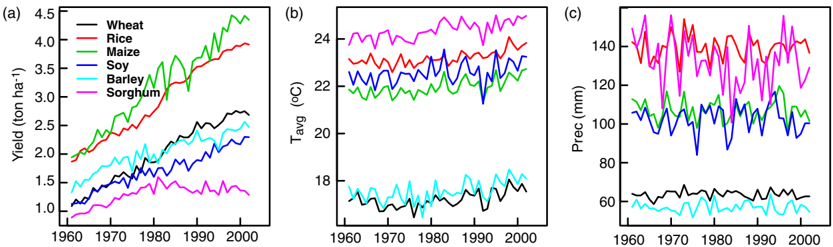
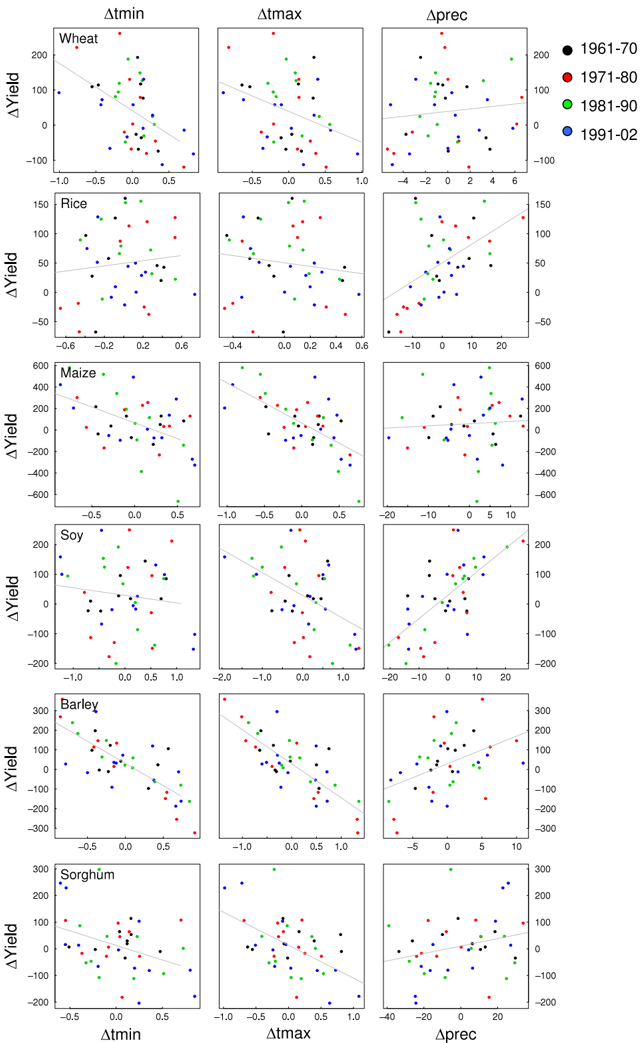
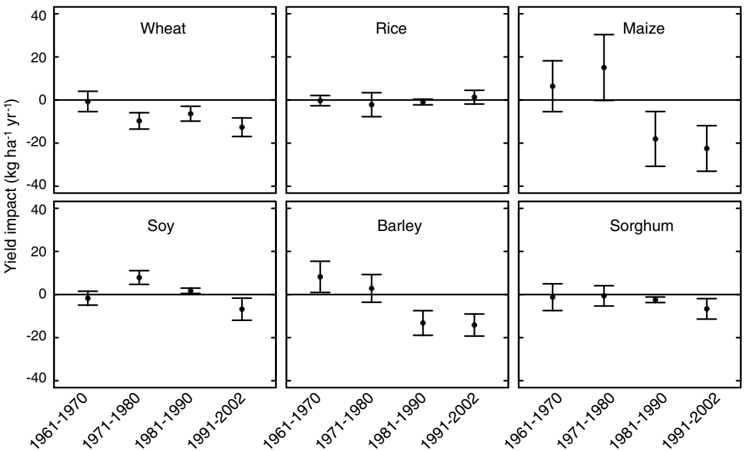
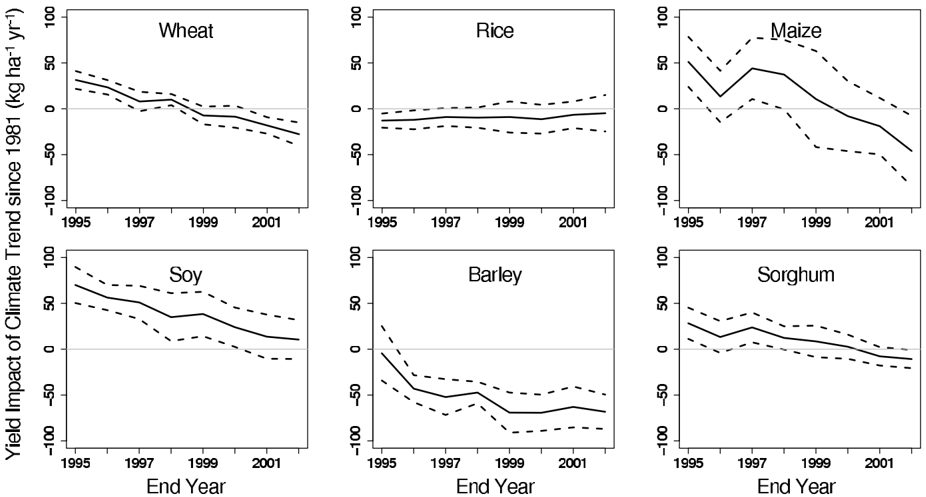
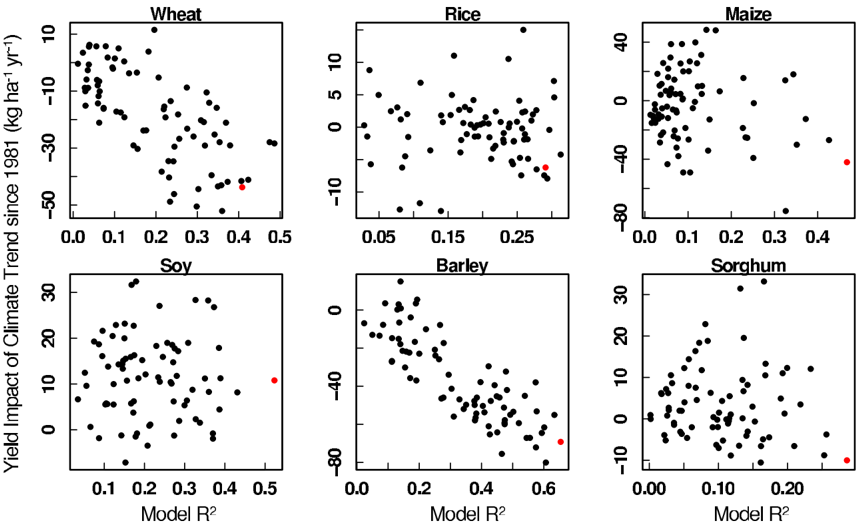
Changes in the global production of major crops are important drivers of food prices, food security and land use decisions. Average global yields for these commodities are determined by the performance of crops in millions of fields distributed across a range of management, soil and climate regimes. Despite the complexity of global food supply, here we show that simple measures of growing season temperatures and precipitation—spatial averages based on the locations of each crop—explain ∼30% or more of year-to-year variations in global average yields for the world's six most widely grown crops. For wheat, maize and barley, there is a clearly negative response of global yields to increased temperatures. Based on these sensitivities and observed climate trends, we estimate that warming since 1981 has resulted in annual combined losses of these three crops representing roughly 40 Mt or $5 billion per year, as of 2002. While these impacts are small relative to the technological yield gains over the same period, the results demonstrate already occurring negative impacts of climate trends on crop yields at the global scale.
Overview
The claims and statistics of this paper haven’t been checked yet.
Free: it reads the open-access text and checks the first 5 claims that cite a source we can check. Create a free account to check every claim.
Integrity signals
Registry
Cites
Statistics
Figures
Verification
Claims the paper makes
The claims and statistics of this paper haven’t been checked yet.
Free: it reads the open-access text and checks the first 5 claims that cite a source we can check. Create a free account to check every claim.
Claims other papers make about this one
Each is checked against this paper’s own text: does it say what the citing paper says it does?
The source backs part of the claim, not all of it — or backs it for a different population, condition or comparison.
In the citing paper
“Given the documented long-term trends in [CO2] and temperature, it is likely we are already dealing with their early effects on crop productivity in many of our crop improvement programs (Lobell and Field 2007; Chapman et al. 2012; Lobell et al. 2013, 2015; Hammer et al. 2014, 2020; Zheng et al. 2016; Snowdon et al. 2020).”
From Tackling G × E × M interactions to close on-farm yield-gaps: creating novel pathways for crop improvement by predicting contributions of genetics and management to crop productivity (2021) · cites this paper as Lobell and Field 2007
Experimental — accuracy not yet measuredThe source backs part of the claim, not all of it — or backs it for a different population, condition or comparison.
In the citing paper
“Similarly, it was reported that yield in maize decreased by 8.3% with every 1 °C rise in temperature from the optimum growth temperature [55].”
From Impact of Climate Change on Crops Adaptation and Strategies to Tackle Its Outcome: A Review (2019) · cites this paper as [55]
Experimental — accuracy not yet measuredThe check wasn’t confident either way, so it gives no verdict — never disputed.
In the citing paper
“Despite extraordinary global expenditures on wildfire suppression in MCRs, most inter-annual variability in burned areas in MCRs in recent decades is still explained by fire weather (figure 1).”
From Wildfire management in Mediterranean-type regions: paradigm change needed (2020) · cites this paper as [29]
Experimental — accuracy not yet measured
Self-check
Percentages, sums and reported differences re-computed from the paper’s own numbers.
The self-check needs the paper’s full text.
Citations
Cites
Mitchell, T. D., & Jones, P. D. (2005) · International Journal of Climatology · doi:10.1002/joc.1181 · Cited by 3,822
Potential impact of climate change on world food supply
Rosenzweig, C., & Parry, M. L. (1994) · Nature · doi:10.1038/367133a0 · Cited by 1,891
Food for Thought: Lower-Than-Expected Crop Yield Stimulation with Rising CO 2 Concentrations
Long, S. P., Ainsworth, E. A., Leakey, A. D. B., Nösberger, J., & Ort, D. R. (2006) · Science · doi:10.1126/science.1114722 · Cited by 1,500 · cited 2×
“The impact of warming was likely offset to some extent by fertilization effects of increased CO2 levels, although the magnitude of these effects are uncertain and the subject of much debate [23–25].”
BackgroundSocio-economic and climate change impacts on agriculture: an integrated assessment, 1990–2080
Fischer, G., Shah, M., N. Tubiello, F., & van Velhuizen, H. (2005) · Philosophical Transactions of the Royal Society B: Biological Sciences · doi:10.1098/rstb.2005.1744 · Cited by 1,040 · cited 3×
“The inferred temperature sensitivities were negative for all crops (figure 2; table 1), in agreement with several previous assessments [2–5].”
BackgroundResultInfluentialInsulin Staining of ES Cell Progeny from Insulin Uptake
Rajagopal, J., Anderson, W. J., Kume, S., Martinez, O. I., & Melton, D. A. (2003) · Science · doi:10.1126/science.1077838 · Cited by 931
Geographic distribution of major crops across the world
Leff, B., Ramankutty, N., & Foley, J. A. (2004) · Global Biogeochemical Cycles · doi:10.1029/2003gb002108 · Cited by 735
Climate change, global food supply and risk of hunger
Parry, M., Rosenzweig, C., & Livermore, M. (2005) · Philosophical Transactions of the Royal Society B: Biological Sciences · doi:10.1098/rstb.2005.1751 · Cited by 458
Increased Australian wheat yield due to recent climate trends
Nicholls, N. (1997) · Nature · doi:10.1038/387484a0 · Cited by 318
Crop response to elevated CO2 and world food supply
Tubiello, F. N., Amthor, J. S., Boote, K. J., Donatelli, M., Easterling, W., Fischer, G., Gifford, R. M., Howden, M., Reilly, J., & Rosenzweig, C. (2007) · European Journal of Agronomy · doi:10.1016/j.eja.2006.10.002 · Cited by 314
Analysis of wheat yield and climatic trends in Mexico
Lobell, D. B., Ortiz-Monasterio, J. I., Asner, G. P., Matson, P. A., Naylor, R. L., & Falcon, W. P. (2005) · Field Crops Research · doi:10.1016/j.fcr.2005.01.007 · Cited by 276
Self-citationLong, S. P., Ainsworth, E. A., Leakey, A. D. B., & Morgan, P. B. (2005) · Philosophical Transactions of the Royal Society B: Biological Sciences · doi:10.1098/rstb.2005.1749 · Cited by 272
A Multidecadal Trend of Earlier Corn Planting in the Central USA
Kucharik, C. J. (2006) · Agronomy Journal · doi:10.2134/agronj2006.0156 · Cited by 199
Adaptation: Sensitivity to Natural Variability, Agent Assumptions and Dynamic Climate Changes
Schneider, S. H., Easterling, W. E., & Mearns, L. O. (2000) · Climatic Change · doi:10.1023/a:1005657421149 · Cited by 184
A Biophysical Model of Corn Yield: Integrating Climatic and Social Determinants
Kaufmann, R. K., & Snell, S. E. (1997) · American Journal of Agricultural Economics · doi:10.2307/1243952 · Cited by 172
Reilly, J. M. (1999) · The World Bank Research Observer · doi:10.1093/wbro/14.2.295 · Cited by 42
Climate Change Impacts for the Conterminous USA: An Integrated Assessment Summary
Edmonds, J., & Rosenberg, N. J. (2005) · Climatic Change · doi:10.1007/s10584-005-3613-8 · Cited by 26
Research works printed but not linked: 6
- [9] USDA1994 Major world crop areas and climatic profiles (revised) Agricultural Handbook No. 664 (Washington, DC: United States Department of Agriculture) -
- [13] Lobell D B, Field C B, Cahill K N and Bonfils C 2006 Impacts of future climate change on California perennial crop yields: model projections with climate and crop uncertainties Agric. Meteorol. 141 208-18 -
- [15] Reilly J et al 1996 Agriculture in a changing climate: impacts and adaptations Impacts, Adaptations and Mitigation of climate Change, Contribution of Working Group II to the 2nd Assessment Report of the IPCC ed R T Watson, MCZinyowera and R H Moss (London: Cambridge University Press) p 878 -
- [16] Hansen L 1991 Farmer response to changes in climate: the case of corn production J. Agric. Econ. Res. 43 18-25 -
- [19] Stone P 2001 The effects of heat stress on cereal yield and quality Crop Responses and Adaptations to Temperature Stress ed A S Basra (Binghamton, NY: Food Products Press) p 302 -
- [21] Hansen J, Ruedy R, Sato M and Lo K 2006 Global Temperature Trends: 2005 Summation (New York: NASA Goddard Institute for Space Studies) -
Cited by
Global food demand and the sustainable intensification of agriculture
Tilman, D., Balzer, C., Hill, J., & Befort, B. L. (2011) · Proceedings of the National Academy of Sciences · doi:10.1073/pnas.1116437108 · Cited by 7,692
Influence of extreme weather disasters on global crop production
Lesk, C., Rowhani, P., & Ramankutty, N. (2016) · Nature · doi:10.1038/nature16467 · Cited by 3,883
Temperature increase reduces global yields of major crops in four independent estimates
Zhao, C., Liu, B., Piao, S., Wang, X., Lobell, D. B., Huang, Y., Huang, M., Yao, Y., Bassu, S., Ciais, P., et al. (2017) · Proceedings of the National Academy of Sciences · doi:10.1073/pnas.1701762114 · Cited by 3,311
Self-citationA review of the global climate change impacts, adaptation, and sustainable mitigation measures
Abbass, K., Qasim, M. Z., Song, H., Murshed, M., Mahmood, H., & Younis, I. (2022) · Environmental Science and Pollution Research · doi:10.1007/s11356-022-19718-6 · Cited by 2,359
“Lobell and field (2007) claimed that from 1962 to 2002, wheat crop output had condensed significantly due to rising temperatures.”
BackgroundPhysiological, Biochemical, and Molecular Mechanisms of Heat Stress Tolerance in Plants
Hasanuzzaman, M., Nahar, K., Alam, M., Roychowdhury, R., & Fujita, M. (2013) · International Journal of Molecular Sciences · doi:10.3390/ijms14059643 · Cited by 2,313
“Plants, in particular, as sessile organisms, cannot move to more favorable environments; consequently, plant growth and developmental processes are substantially affected, often lethally, by high temperature (HT) stress [2,3].”
Background
Metadata
- Authors
- Lobell, D. B., & Field, C. B.
- Affiliations
- Lawrence Livermore National Laboratory (US)
- Carnegie Institution for Science (US)
- Venue
- Environmental Research Letters
- Publisher
- IOP Publishing
- Published
- 2007-03
- Volume
- 2
- Issue
- 1
- Pages
- 014002
- ISSN
- 1748-9326 (ISSN-L)
- OpenAlex
- W113286128
- Cited by
- 205
- References
- 16
- Citations by year
- 2026: 13 · 2025: 10 · 2024: 20 · 2023: 23 · 2022: 21 · 2021: 17 · 2020: 16 · 2019: 10 · 2018: 16 · 2017: 8 · 2016: 13 · 2015: 9 · 2014: 10 · 2013: 5 · 2012: 5
- FWCI
- 2.36
- Type
- journal article
- Language
- en
- Open access
- gold
- doi.org
- Licence
- cc-by
- Locations
- Environmental Research Letters (publishedVersion, cc-by)
- Lincoln (University of Nebraska) (submittedVersion)
- Funders
- U.S. Department of Energy (W-7405, -7405-ENG-48, W‐7405‐ENG‐48)
- Carnegie Institution of Washington
- Lawrence Livermore National Laboratory (W-7405-ENG 48, -7405-Eng-48)
- Topics
- Life Sciences › Agricultural and Biological Sciences › Agronomy and Crop Science › Climate change impacts on agriculture
- Physical Sciences › Environmental Science › Global and Planetary Change › Climate variability and models
- Physical Sciences › Environmental Science › Ecology › Remote Sensing in Agriculture
- Keywords
- growing season temperature, precipitation, wheat, maize, barley, yield loss, food security, climate change impacts
About these checks
Registry, retraction, Cites and statistics results are computed, not judged, with one exception: a printed reference that no index lists is read once by a model before it counts as a citation error. Claims are extracted by a model and kept only when their quote appears verbatim in the text; each cited source is then checked, with a model’s help, for whether it says what the claim relies on. Those verdicts can be wrong — read the claim’s quote and the cited source before relying on one.
Statistics and arithmetic are recomputed, not judged.
Confidence bands are shown only for fields calibrated on our annotated test set. None is calibrated yet, so no band is shown.
What counts as a claim ›How we measure confidence ›How we check this ›
Are you an author, or do you see a problem with this page? Request a review
Data sources
Bibliographic data: Semantic Scholar, OpenAlex, Crossref.
Contains information from the Semantic Scholar Academic Graph Datasets, made available under the ODC Attribution License (ODC-BY 1.0).
Semantic Scholar’s data is described in: Kinney, R., et al. (2023). The Semantic Scholar Open Data Platform. arXiv:2301.10140.
