

Global scale climate–crop yield relationships and the impacts of recent warming
Open accessThe DOI matches its Crossref record; 16 of the 16 references it cites were found in a registry or an index.
Abstract
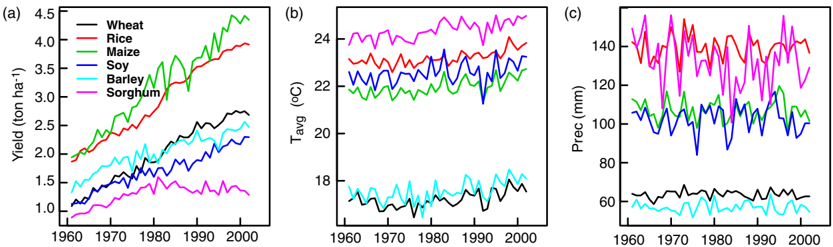
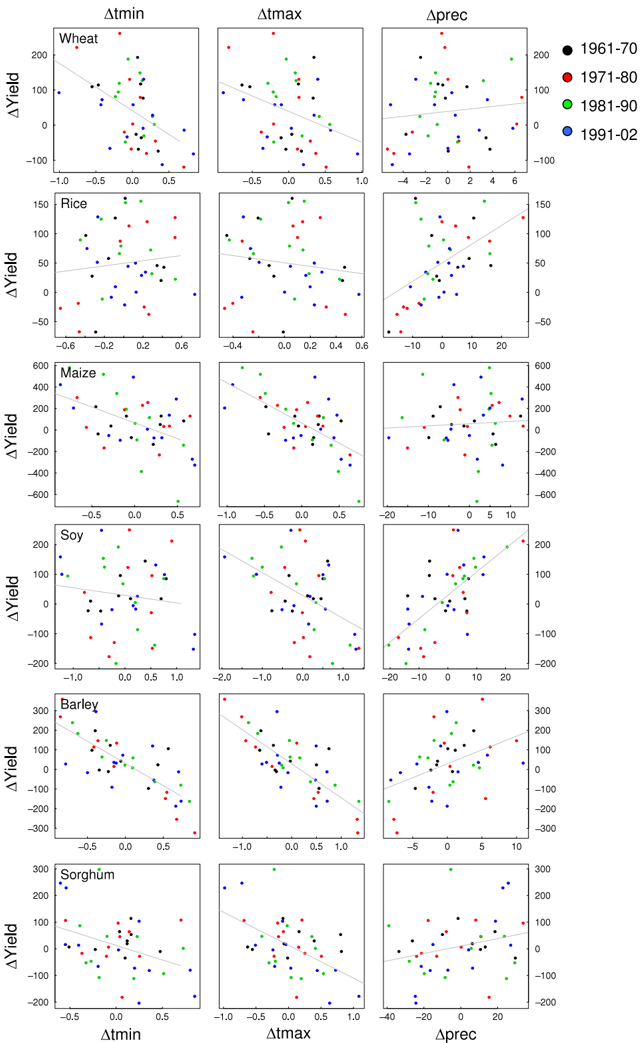
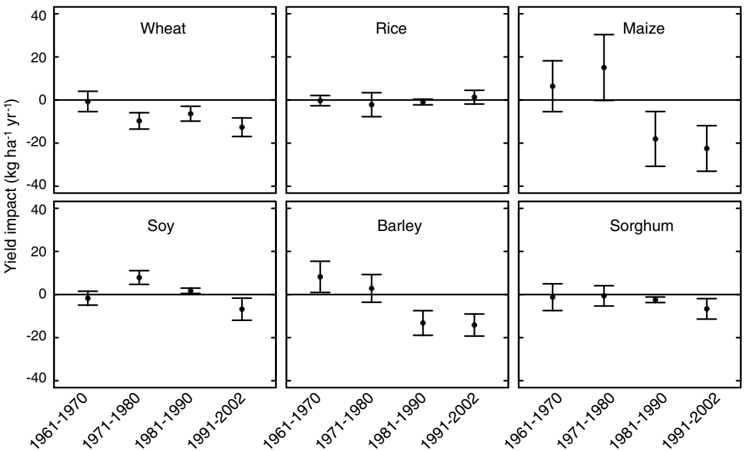
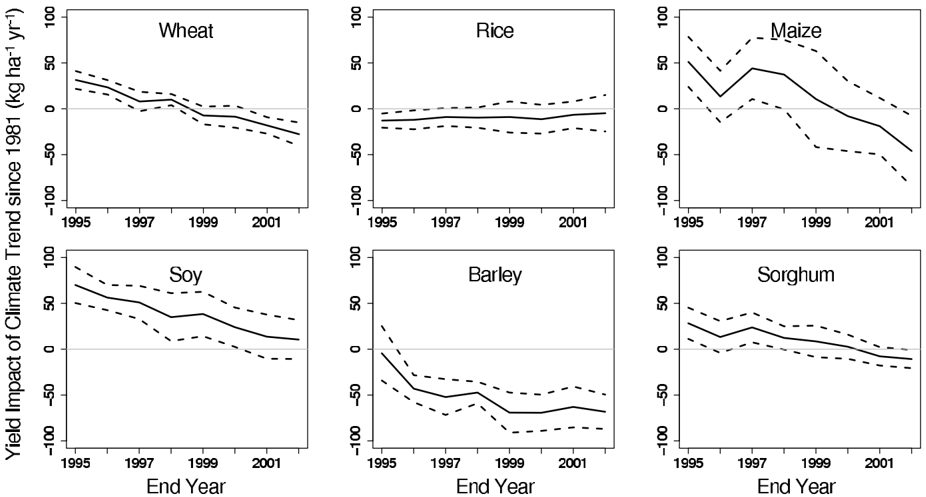
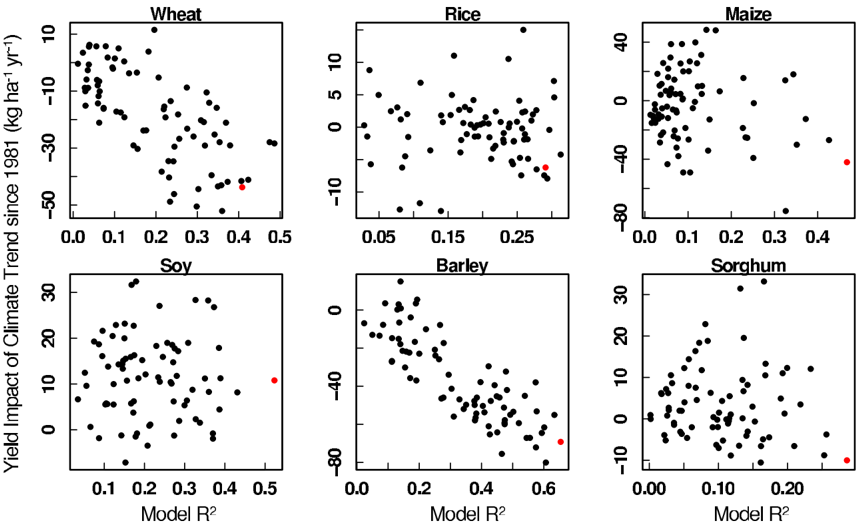
Changes in the global production of major crops are important drivers of food prices, food security and land use decisions. Average global yields for these commodities are determined by the performance of crops in millions of fields distributed across a range of management, soil and climate regimes. Despite the complexity of global food supply, here we show that simple measures of growing season temperatures and precipitation—spatial averages based on the locations of each crop—explain ∼30% or more of year-to-year variations in global average yields for the world's six most widely grown crops. For wheat, maize and barley, there is a clearly negative response of global yields to increased temperatures. Based on these sensitivities and observed climate trends, we estimate that warming since 1981 has resulted in annual combined losses of these three crops representing roughly 40 Mt or $5 billion per year, as of 2002. While these impacts are small relative to the technological yield gains over the same period, the results demonstrate already occurring negative impacts of climate trends on crop yields at the global scale.
Overview
The claims and statistics of this paper haven’t been checked yet.
Free: it reads the open-access text and checks the first 5 claims that cite a source we can check. Create a free account to check every claim.
Integrity signals
Registry
Cites
Statistics
Figures
Verification
Claims the paper makes
The claims and statistics of this paper haven’t been checked yet.
Free: it reads the open-access text and checks the first 5 claims that cite a source we can check. Create a free account to check every claim.
Claims other papers make about this one
Each is checked against this paper’s own text: does it say what the citing paper says it does?
The source backs part of the claim, not all of it — or backs it for a different population, condition or comparison.
In the citing paper
“Given the documented long-term trends in [CO2] and temperature, it is likely we are already dealing with their early effects on crop productivity in many of our crop improvement programs (Lobell and Field 2007; Chapman et al. 2012; Lobell et al. 2013, 2015; Hammer et al. 2014, 2020; Zheng et al. 2016; Snowdon et al. 2020).”
From Tackling G × E × M interactions to close on-farm yield-gaps: creating novel pathways for crop improvement by predicting contributions of genetics and management to crop productivity (2021) · cites this paper as Lobell and Field 2007
Experimental — accuracy not yet measuredThe source backs part of the claim, not all of it — or backs it for a different population, condition or comparison.
In the citing paper
“Similarly, it was reported that yield in maize decreased by 8.3% with every 1 °C rise in temperature from the optimum growth temperature [55].”
From Impact of Climate Change on Crops Adaptation and Strategies to Tackle Its Outcome: A Review (2019) · cites this paper as [55]
Experimental — accuracy not yet measuredThe check wasn’t confident either way, so it gives no verdict — never disputed.
In the citing paper
“Despite extraordinary global expenditures on wildfire suppression in MCRs, most inter-annual variability in burned areas in MCRs in recent decades is still explained by fire weather (figure 1).”
From Wildfire management in Mediterranean-type regions: paradigm change needed (2020) · cites this paper as [29]
Experimental — accuracy not yet measured
Self-check
Percentages, sums and reported differences re-computed from the paper’s own numbers.
The self-check needs the paper’s full text.
Citations
Cites
Mitchell, T. D., & Jones, P. D. (2005) · International Journal of Climatology · doi:10.1002/joc.1181 · Cited by 3,822
Potential impact of climate change on world food supply
Rosenzweig, C., & Parry, M. L. (1994) · Nature · doi:10.1038/367133a0 · Cited by 1,891
Food for Thought: Lower-Than-Expected Crop Yield Stimulation with Rising CO 2 Concentrations
Long, S. P., Ainsworth, E. A., Leakey, A. D. B., Nösberger, J., & Ort, D. R. (2006) · Science · doi:10.1126/science.1114722 · Cited by 1,500 · cited 2×
“The impact of warming was likely offset to some extent by fertilization effects of increased CO2 levels, although the magnitude of these effects are uncertain and the subject of much debate [23–25].”
BackgroundSocio-economic and climate change impacts on agriculture: an integrated assessment, 1990–2080
Fischer, G., Shah, M., N. Tubiello, F., & van Velhuizen, H. (2005) · Philosophical Transactions of the Royal Society B: Biological Sciences · doi:10.1098/rstb.2005.1744 · Cited by 1,040 · cited 3×
“The inferred temperature sensitivities were negative for all crops (figure 2; table 1), in agreement with several previous assessments [2–5].”
BackgroundResultInfluentialInsulin Staining of ES Cell Progeny from Insulin Uptake
Rajagopal, J., Anderson, W. J., Kume, S., Martinez, O. I., & Melton, D. A. (2003) · Science · doi:10.1126/science.1077838 · Cited by 931
Geographic distribution of major crops across the world
Leff, B., Ramankutty, N., & Foley, J. A. (2004) · Global Biogeochemical Cycles · doi:10.1029/2003gb002108 · Cited by 735
Climate change, global food supply and risk of hunger
Parry, M., Rosenzweig, C., & Livermore, M. (2005) · Philosophical Transactions of the Royal Society B: Biological Sciences · doi:10.1098/rstb.2005.1751 · Cited by 458
Increased Australian wheat yield due to recent climate trends
Nicholls, N. (1997) · Nature · doi:10.1038/387484a0 · Cited by 318
Crop response to elevated CO2 and world food supply
Tubiello, F. N., Amthor, J. S., Boote, K. J., Donatelli, M., Easterling, W., Fischer, G., Gifford, R. M., Howden, M., Reilly, J., & Rosenzweig, C. (2007) · European Journal of Agronomy · doi:10.1016/j.eja.2006.10.002 · Cited by 314
Analysis of wheat yield and climatic trends in Mexico
Lobell, D. B., Ortiz-Monasterio, J. I., Asner, G. P., Matson, P. A., Naylor, R. L., & Falcon, W. P. (2005) · Field Crops Research · doi:10.1016/j.fcr.2005.01.007 · Cited by 276
Self-citation
Research works printed but not linked: 6
- [9] USDA1994 Major world crop areas and climatic profiles (revised) Agricultural Handbook No. 664 (Washington, DC: United States Department of Agriculture) -
- [13] Lobell D B, Field C B, Cahill K N and Bonfils C 2006 Impacts of future climate change on California perennial crop yields: model projections with climate and crop uncertainties Agric. Meteorol. 141 208-18 -
- [15] Reilly J et al 1996 Agriculture in a changing climate: impacts and adaptations Impacts, Adaptations and Mitigation of climate Change, Contribution of Working Group II to the 2nd Assessment Report of the IPCC ed R T Watson, MCZinyowera and R H Moss (London: Cambridge University Press) p 878 -
- [16] Hansen L 1991 Farmer response to changes in climate: the case of corn production J. Agric. Econ. Res. 43 18-25 -
- [19] Stone P 2001 The effects of heat stress on cereal yield and quality Crop Responses and Adaptations to Temperature Stress ed A S Basra (Binghamton, NY: Food Products Press) p 302 -
- [21] Hansen J, Ruedy R, Sato M and Lo K 2006 Global Temperature Trends: 2005 Summation (New York: NASA Goddard Institute for Space Studies) -
Cited by
Global food demand and the sustainable intensification of agriculture
Tilman, D., Balzer, C., Hill, J., & Befort, B. L. (2011) · Proceedings of the National Academy of Sciences · doi:10.1073/pnas.1116437108 · Cited by 7,692
Influence of extreme weather disasters on global crop production
Lesk, C., Rowhani, P., & Ramankutty, N. (2016) · Nature · doi:10.1038/nature16467 · Cited by 3,883
Temperature increase reduces global yields of major crops in four independent estimates
Zhao, C., Liu, B., Piao, S., Wang, X., Lobell, D. B., Huang, Y., Huang, M., Yao, Y., Bassu, S., Ciais, P., et al. (2017) · Proceedings of the National Academy of Sciences · doi:10.1073/pnas.1701762114 · Cited by 3,311
Self-citationA review of the global climate change impacts, adaptation, and sustainable mitigation measures
Abbass, K., Qasim, M. Z., Song, H., Murshed, M., Mahmood, H., & Younis, I. (2022) · Environmental Science and Pollution Research · doi:10.1007/s11356-022-19718-6 · Cited by 2,359
“Lobell and field (2007) claimed that from 1962 to 2002, wheat crop output had condensed significantly due to rising temperatures.”
BackgroundA meta-analysis of crop yield under climate change and adaptation
Challinor, A. J., Watson, J., Lobell, D. B., Howden, S. M., Smith, D. R., & Chhetri, N. (2014) · Nature Climate Change · doi:10.1038/nclimate2153 · Cited by 2,333
Self-citationPhysiological, Biochemical, and Molecular Mechanisms of Heat Stress Tolerance in Plants
Hasanuzzaman, M., Nahar, K., Alam, M., Roychowdhury, R., & Fujita, M. (2013) · International Journal of Molecular Sciences · doi:10.3390/ijms14059643 · Cited by 2,313
“Plants, in particular, as sessile organisms, cannot move to more favorable environments; consequently, plant growth and developmental processes are substantially affected, often lethally, by high temperature (HT) stress [2,3].”
BackgroundEcological intensification: harnessing ecosystem services for food security
Bommarco, R., Kleijn, D., & Potts, S. G. (2013) · Trends in Ecology & Evolution · doi:10.1016/j.tree.2012.10.012 · Cited by 1,862
Impact of Climate Change on Crops Adaptation and Strategies to Tackle Its Outcome: A Review
Raza, A., Razzaq, A., Mehmood, S. S., Zou, X., Zhang, X., Lv, Y., & Xu, J. (2019) · Plants · doi:10.3390/plants8020034 · Cited by 1,762
“3% with every 1 ◦C rise in temperature from the optimum growth temperature [55].”
BackgroundAgroecology and the design of climate change-resilient farming systems
Altieri, M. A., Nicholls, C. I., Henao, A., & Lana, M. A. (2015) · Agronomy for Sustainable Development · doi:10.1007/s13593-015-0285-2 · Cited by 1,472
Social and economic impacts of climate
Carleton, T. A., & Hsiang, S. M. (2016) · Science · doi:10.1126/science.aad9837 · Cited by 1,348
Vulnerability of national economies to the impacts of climate change on fisheries
Allison, E. H., Perry, A. L., Badjeck, M., Neil Adger, W., Brown, K., Conway, D., Halls, A. S., Pilling, G. M., Reynolds, J. D., Andrew, N. L., et al. (2009) · Fish and Fisheries · doi:10.1111/j.1467-2979.2008.00310.x · Cited by 1,259
Food, livestock production, energy, climate change, and health
McMichael, A. J., Powles, J. W., Butler, C. D., & Uauy, R. (2007) · The Lancet · doi:10.1016/s0140-6736(07)61256-2 · Cited by 1,226
Impacts and adaptation of European crop production systems to climate change
Olesen, J. E., Trnka, M., Kersebaum, K. C., Skjelvåg, A. O., Seguin, B., Peltonen-Sainio, P., Rossi, F., Kozyra, J., & Micale, F. (2011) · European Journal of Agronomy · doi:10.1016/j.eja.2010.11.003 · Cited by 1,215
“There are also clear indications that increasing temperatures are causing grain yield reductions globally (Lobell and Field, 2007).”
BackgroundThe critical role of extreme heat for maize production in the United States
Lobell, D. B., Hammer, G. L., McLean, G., Messina, C., Roberts, M. J., & Schlenker, W. (2013) · Nature Climate Change · doi:10.1038/nclimate1832 · Cited by 1,026
Self-citationThe role of biochar and biochar-compost in improving soil quality and crop performance: a review
Agegnehu, G., Srivastava, A. K., & Bird, M. I. (2017) · Applied Soil Ecology · doi:10.1016/j.apsoil.2017.06.008 · Cited by 928
Leng, G., & Hall, J. (2019) · Science of The Total Environment · doi:10.1016/j.scitotenv.2018.10.434 · Cited by 729
Wildfire management in Mediterranean-type regions: paradigm change needed
Moreira, F., Ascoli, D., Safford, H., Adams, M. A., Moreno, J. M., Pereira, J. M. C., Catry, F. X., Armesto, J., Bond, W., González, M. E., et al. (2020) · Environmental Research Letters · doi:10.1088/1748-9326/ab541e · Cited by 561
Global climate change, war, and population decline in recent human history
Zhang, D. D., Brecke, P., Lee, H. F., He, Y.-Q., & Zhang, J. (2007) · Proceedings of the National Academy of Sciences · doi:10.1073/pnas.0703073104 · Cited by 540
Effect of warming temperatures on US wheat yields
Tack, J., Barkley, A., & Nalley, L. L. (2015) · Proceedings of the National Academy of Sciences · doi:10.1073/pnas.1415181112 · Cited by 472
Can a collapse of global civilization be avoided?
Ehrlich, P. R., & Ehrlich, A. H. (2013) · Proceedings of the Royal Society B: Biological Sciences · doi:10.1098/rspb.2012.2845 · Cited by 445
Matiu, M., Ankerst, D. P., & Menzel, A. (2017) · PLOS ONE · doi:10.1371/journal.pone.0178339 · Cited by 295
Climate Change, Agriculture, and Poverty
Hertel, T. W., & Rosch, S. D. (2010) · Applied Economic Perspectives and Policy · doi:10.1093/aepp/ppq016 · Cited by 284
Djanaguiraman, M., Narayanan, S., Erdayani, E., & Prasad, P. V. V. (2020) · BMC Plant Biology · doi:10.1186/s12870-020-02479-0 · Cited by 286
How do we improve crop production in a warming world?
Ainsworth, E. A., & Ort, D. R. (2010) · Plant Physiology · doi:10.1104/pp.110.161349 · Cited by 278
Global patterns in the sensitivity of burned area to fire-weather: implications for climate change
Bedia, J., Herrera, S., Gutiérrez, J. M., Benali, A., Brands, S., Mota, B., & Moreno, J. M. (2015) · Agricultural and Forest Meteorology · doi:10.1016/j.agrformet.2015.09.002 · Cited by 276
Synchronous failure: the emerging causal architecture of global crisis
Homer-Dixon, T., Walker, B., Biggs, R., Crépin, A.-S., Folke, C., Lambin, E. F., Peterson, G. D., Rockström, J., Scheffer, M., Steffen, W., et al. (2015) · Ecology and Society · doi:10.5751/es-07681-200306 · Cited by 244
“…climate change has begun to affect food output by increasing, in particular, the frequency and severity of extreme weather events such as drought (Lobell and Field 2007); this impact is expected to become much more pronounced in coming decades, requiring ever-larger investments in new…”
BackgroundMotesharrei, S., Rivas, J., Kalnay, E., Asrar, G. R., Busalacchi, A. J., Cahalan, R. F., Cane, M. A., Colwell, R. R., Feng, K., Franklin, R. S., et al. (2016) · National Science Review · doi:10.1093/nsr/nww081 · Cited by 209
Raihan, A. (2023) · Journal of Environmental Science and Economics · doi:10.56556/jescae.v2i3.587 · Cited by 203
“Warming temperatures, according to Lobell and Field (2007), considerably reduced wheat crop output from 1962 to 2002.”
BackgroundInsights from past millennia into climatic impacts on human health and survival
McMichael, A. J. (2012) · Proceedings of the National Academy of Sciences · doi:10.1073/pnas.1120177109 · Cited by 201
RNA Interference (RNAi) Induced Gene Silencing: A Promising Approach of Hi-Tech Plant Breeding
Younis, A., Siddique, M. I., Kim, C.-K., & Lim, K.-B. (2014) · International Journal of Biological Sciences · doi:10.7150/ijbs.10452 · Cited by 188
“In addition, climate alteration has aggravated the regularity and harshness of several abiotic stresses, principally elevated temperature and drought, with considerable reductions in yield of main cereals like maize, wheat and barley [51].”
BackgroundNegative impacts of climate change on cereal yields: statistical evidence from France
Gammans, M., Mérel, P., & Ortiz-Bobea, A. (2017) · Environmental Research Letters · doi:10.1088/1748-9326/aa6b0c · Cited by 185
Renzaho, A. M. N., Kamara, J. K., & Toole, M. (2017) · Renewable and Sustainable Energy Reviews · doi:10.1016/j.rser.2017.04.072 · Cited by 182
Climate Change: Implications for the Yield of Edible Rice
Zhao, X., & Fitzgerald, M. (2013) · PLoS ONE · doi:10.1371/journal.pone.0066218 · Cited by 177
“In addition, it has been shown that a discrepancy exists between estimates of the effects of warmer temperatures on crop yields based on field conditions, versus those derived from modeling and experiments conducted under controlled conditions [14].”
Rhizosphere microbiome manipulation for sustainable crop production
Mahmud, K., Missaoui, A., Lee, K., Ghimire, B., Presley, H. W., & Makaju, S. (2021) · Current Plant Biology · doi:10.1016/j.cpb.2021.100210 · Cited by 173
Gadedjisso-Tossou, A., Adjegan, K. I., & Kablan, A. K. M. (2021) · Sci · doi:10.3390/sci3010017 · Cited by 168
Effects of Climate Change on the Yield and Cropping Area of Major Food Crops: A Case of Bangladesh
Amin, M., Zhang, J., & Yang, M. (2015) · Sustainability · doi:10.3390/su7010898 · Cited by 161
“The major difference was that the growing season is different by crop, which is the most useful time for determining the impacts of climate change on the yield and cropping area of crops [40–42].”
BackgroundCMIP5 Models Predict Rapid and Deep Soil Warming Over the 21st Century
Soong, J. L., Phillips, C. L., Ledna, C. M., Koven, C. D., & Torn, M. S. (2020) · Journal of Geophysical Research Biogeosciences · doi:10.1029/2019jg005266 · Cited by 167
“Warmer atmospheric temperatures have been shown to reduce some crop yields and are predicted to negatively affect global yields of key staple crops grown mainly in Mollisol regions, such as wheat, maize, and barley (Hatfield et al., 2011; Lobell & Field, 2007; Zhao et al., 2017).”
BackgroundThe impact of drought on the productivity of two rainfed crops in Spain
Peña‐Gallardo, M., Vicente-Serrano, S. M., Domínguez‐Castro, F., & Beguería, S. (2019) · Natural hazards and earth system sciences · doi:10.5194/nhess-19-1215-2019 · Cited by 153
“Mechanization and innovation in agriculture have increased in the last century, resulting in a trend of increased yields (Lobell and Field, 2007), which is also evident in data for Spain.”
BackgroundInfluentialCooper, M., Voss-Fels, K. P., Messina, C. D., Tang, T., & Hammer, G. L. (2021) · Theoretical and Applied Genetics · doi:10.1007/s00122-021-03812-3 · Cited by 119
“Given the documented long-term trends in [CO2] and temperature, it is likely we are already dealing with their early effects on crop productivity in many of our crop improvement programs (Lobell and Field 2007; Chapman et al. 2012; Lobell et al. 2013, 2015; Hammer et al. 2014, 2020; Zheng et al. 2016; Snowdon et al. 2…”
BackgroundZhong, S., Liu, J., Jin, H., Lin, L., Li, Q., Chen, Y., Yuan, Y., Wang, Z., Huang, H., Qi, Y., et al. (2013) · Proceedings of the National Academy of Sciences · doi:10.1073/pnas.1219655110 · Cited by 136
“G warming has greatly affected plant growth and development and poses a serious threat to the global food supply (1, 2), highlighted by a discovery estimating that global warming caused an ∼10% reduction in rice yield for every 1-°C temperature increase (3).”
BackgroundFraser, E., Simelton, E., Termansen, M., Gosling, S. N., & South, A. (2012) · Agricultural and Forest Meteorology · doi:10.1016/j.agrformet.2012.04.008 · Cited by 147
Bechtold, U., Penfold, C. A., Jenkins, D. J., Legaie, R., Moore, J. D., Lawson, T., Matthews, J. S. A., Vialet‐Chabrand, S., Baxter, L. A., Subramaniam, S., et al. (2016) · The Plant Cell · doi:10.1105/tpc.15.00910 · Cited by 149
“Reducedwater availability leads to drought stress, which is a major constraint on the physiology, growth, development, and productivity of plants (Boyer, 1970, 1982; Lobell and Field, 2007; Roberts and Schlenker, 2009; Skirycz et al., 2010; Lobell et al., 2011; Verelst et al., 2013).”
BackgroundHealth risks, present and future, from global climate change
McMichael, T., Montgomery, H., & Costello, A. M. D. L. (2012) · BMJ · doi:10.1136/bmj.e1359 · Cited by 134
Climate change and potential impacts on agriculture in Bhutan: a discussion of pertinent issues
Chhogyel, N., & Kumar, L. (2018) · Agriculture & Food Security · doi:10.1186/s40066-018-0229-6 · Cited by 118
Impacts of climate change on agro-climatic suitability of major food crops in Ghana
Chemura, A., Schauberger, B., & Gornott, C. (2020) · PLoS ONE · doi:10.1371/journal.pone.0229881 · Cited by 139
Ecosystem services, targets, and indicators for the conservation and sustainable use of biodiversity
Perrings, C., Naeem, S., Ahrestani, F. S., Bunker, D. E., Burkill, P., Canziani, G., Elmqvist, T., Fuhrman, J. A., Jaksic, F. M., Kawabata, Z., et al. (2011) · Frontiers in Ecology and the Environment · doi:10.1890/100212 · Cited by 113
Berardy, A., & Chester, M. V. (2017) · Environmental Research Letters · doi:10.1088/1748-9326/aa5e6d · Cited by 110
Wu, X., Vuichard, N., Ciais, P., Viovy, N., de Noblet-Ducoudré, N., Wang, X., Magliulo, V., Wattenbach, M., Vitale, L., Di Tommasi, P., et al. (2016) · Geoscientific Model Development · doi:10.5194/gmd-9-857-2016 · Cited by 104
Fishman, J., Creilson, J. K., Parker, P. A., Ainsworth, E. A., Vining, G. G., Szarka, J. L., Booker, F. L., & Xu, X. (2010) · Atmospheric Environment · doi:10.1016/j.atmosenv.2010.01.015 · Cited by 105
“…variables include both physical parameters, such as precipitation, temperature and solar insolation, and also management practices, including variations in the way crops are cultivated, fertilized and irrigated, and which specific cultivars are used (Lobell and Asner, 2003; Lobell and Field, 2007).”
BackgroundClimate Change and Maize Yield in Iowa
Xu, H., Twine, T. E., & Girvetz, E. (2016) · PLOS ONE · doi:10.1371/journal.pone.0156083 · Cited by 100
“Statistical crop yield models are useful for relating changes in reported yield values to actual climate, and observed yield variability includes variables not typically simulated within models such as pests and disease [14].”
BackgroundInfluentialIntegration of Renewable Energy into Present and Future Energy Systems
Sims, R., Mercado, P., Krewitt, W., Bhuyan, G., Flynn, D., Holttinen, H., Jannuzzi, G., Khennas, S., Liu, Y., Nilsson, L. J., et al. (2011) · Renewable Energy Sources and Climate Change Mitigation · doi:10.1017/cbo9781139151153.012 · Cited by 98
Climate change, rice crops, and violence
Caruso, R., Petrarca, I., & Ricciuti, R. (2016) · Journal of Peace Research · doi:10.1177/0022343315616061 · Cited by 95
Quantifying Temperature Effects on Cotton Reproductive Efficiency and Fiber Quality
Lokhande, S. B., & Reddy, K. R. (2014) · Agronomy Journal · doi:10.2134/agronj13.0531 · Cited by 111
Assessing Weather-Yield Relationships in Rice at Local Scale Using Data Mining Approaches
Delerce, S., Dorado, H., Grillon, A., Rebolledo, M. C., Prager, S. D., Patiño, V. H., Garcés-Varón, G., & Jimenez, D. R. (2016) · PLoS ONE · doi:10.1371/journal.pone.0161620 · Cited by 109
“Studies on climate-yield relationships that use observational data often aggregate the data using either geographical or administrative boundaries [2,81].”
BackgroundMukherjee, A., Singh, B. K., & Verma, J. P. (2020) · Microbiological Research · doi:10.1016/j.micres.2020.126469 · Cited by 90
Controlled Warming Effects on Wheat Growth and Yield: Field Measurements and Modeling
Grant, R. F., Kimball, B. A., Conley, M. M., White, J. W., Wall, G. W., & Ottman, M. J. (2011) · Agronomy Journal · doi:10.2134/agronj2011.0158 · Cited by 94
Fang, S., Cammarano, D., Zhou, G., Tan, K., & Ren, S. (2015) · European Journal of Agronomy · doi:10.1016/j.eja.2014.12.012 · Cited by 85
Climate variability and educational attainment: Evidence from rural Ethiopia
Randell, H., & Gray, C. (2016) · Global Environmental Change · doi:10.1016/j.gloenvcha.2016.09.006 · Cited by 81
Spatial analysis of the sensitivity of wheat yields to temperature in India
RAO, B. B., Chowdary, P. S. B., Sandeep, V. M., Pramod, V. P., & Rao, V. U. M. (2014) · Agricultural and Forest Meteorology · doi:10.1016/j.agrformet.2014.09.023 · Cited by 82
Estimated impacts of emission reductions on wheat and maize crops
Tebaldi, C., & Lobell, D. (2018) · Climatic Change · doi:10.1007/s10584-015-1537-5 · Cited by 68
Self-citationA novel method for quantitatively evaluating agricultural vulnerability to climate change
Dong, Z., Pan, Z., An, P., Wang, L., Zhang, J., He, D., Han, H., & Pan, X. (2014) · Ecological Indicators · doi:10.1016/j.ecolind.2014.07.032 · Cited by 78
Yengoh, G. T., Armah, F. A., Onumah, E. E., & Odoi, J. O. (2010) · Journal of Agricultural Science · doi:10.5539/jas.v2n3p3 · Cited by 66
Are we approaching a water ceiling to maize yields in the United States?
DeLucia, E. H., Chen, S., Guan, K., Peng, B., Li, Y., Gomez‐Casanovas, N., Kantola, I. B., Bernacchi, C. J., Huang, Y., Long, S. P., et al. (2019) · Ecosphere · doi:10.1002/ecs2.2773 · Cited by 62
Is Yield Increase Sufficient to Achieve Food Security in China?
Wei, X., Zhang, Z., Shi, P., Pin, W., Chen, Y., Song, X. P., & Tao, F. (2015) · PLoS ONE · doi:10.1371/journal.pone.0116430 · Cited by 67
Post-Heading Heat Stress in Rice of South China during 1981-2010
Shi, P., Tang, L. R., Wang, L., Sun, T., Liu, L., Cao, W., & Zhu, Y. P. (2015) · PLoS ONE · doi:10.1371/journal.pone.0130642 · Cited by 62
“The year-to-year variation of climatic and grain yield data were both derived from the first-difference method which was commonly used to estimate the effects of climate change on crop grain yield [31, 34].”
BackgroundMethodTHE IMPACT OF CLIMATE CHANGE ON RICE YIELD IN BANGLADESH: A TIME SERIES ANALYSIS
Uddin, A. C. I., & Abul, E. K. M. (2015) · Russian Journal of Agricultural and Socio-Economic Sciences · doi:10.18551/rjoas.2015-04.02 · Cited by 75
Risk transfer policies and climate-induced immobility among smallholder farmers
Choquette-Levy, N., Wildemeersch, M., Oppenheimer, M., & Levin, S. A. (2021) · Nature Climate Change · doi:10.1038/s41558-021-01205-4 · Cited by 62
Ahmad, M. S. A., Imtiaz, M., Nawaz, M. S., Mubeen, F., & Imran, A. (2022) · Frontiers in Plant Science · doi:10.3389/fpls.2022.794782 · Cited by 68
“, 2001) causing a yield reduction of 19 million tons (Lobell and Field, 2007) while USDA (United States Department of Agriculture) reported ≈5.”
BackgroundSuckall, N., Fraser, E., & Forster, P. (2017) · Climate and Development · doi:10.1080/17565529.2016.1149441 · Cited by 52
“Over time, if predictions are correct, agricultural yields may fall by up to 30% (Lobell & Field, 2007; Parry, Rosenzweig, Iglesias, Livermore, & Fischer, 2004).”
BackgroundGWAS analysis in spring barley (Hordeum vulgare L.) for morphological traits exposed to drought
Jabbari, M., Fakheri, B. A., Aghnoum, R., Nezhad, N. M., & Ataei, R. (2018) · PLoS ONE · doi:10.1371/journal.pone.0204952 · Cited by 51
High temperature injury and auxin biosynthesis in microsporogenesis
Higashitani, A. (2013) · Frontiers in Plant Science · doi:10.3389/fpls.2013.00047 · Cited by 69
Li, X., Liu, N., You, L., Ke, X., Liu, H., Huang, M., & Waddington, S. R. (2016) · PLoS ONE · doi:10.1371/journal.pone.0159061 · Cited by 57
Wang, F., Cheruy, F., & Dufresne, J. (2016) · Geoscientific model development · doi:10.5194/gmd-9-363-2016 · Cited by 52
“…it can modulate the results of impact studies related to the societal and eco-system impacts of the heat waves, which are due both to the maximum temperature and the amplitude of the nocturnal cooling (e.g., crop and pest development prediction, photosynthetic rates) (Lobell and Field, 2007).”
BackgroundEnvironmental performance of agroforestry systems in the Cerrado biome, Brazil
Martinelli, G. D. C., Schlindwein, M. M., Padovan, M. P., Vogel, E., & Ruviaro, C. F. (2019) · World Development · doi:10.1016/j.worlddev.2019.06.003 · Cited by 63
Increase in Population Exposure Due to Dry and Wet Extremes in India Under a Warming Climate
Kumar, R., & Mishra, V. (2020) · Earth's Future · doi:10.1029/2020ef001731 · Cited by 43
“Floods and droughts are the two hydroclimatic extremes that pose tremendous pressure on human society affecting crop production (Lesk et al., 2016; Lobell & Field, 2007; Peng et al., 2004), water availability (Barnett et al., 2005; Immerzeel et al., 2010; Piao et al., 2010; Schewe et al., 2014),…”
BackgroundRamachandran, A., Dhanya, P., Jaganathan, R., RajaLakshmi, D., & Palanivelu, K. (2017) · PLoS ONE · doi:10.1371/journal.pone.0180706 · Cited by 45
Impacts of a nuclear war in South Asia on rice production in Mainland China
Xia, L., & Robock, A. (2013) · Climatic Change · doi:10.1007/s10584-012-0475-8 · Cited by 42
“There have been extensive studies on climate change impacts on food production by analyzing historical records (e.g., Lobell et al. 2008; Lobell and Field 2007; Lobell et al. 2011; Tao et al. 2008; Tao et al. 2006; Peng et al. 2004) and using dynamic crop models (e.g., Rosenzweig and Parry 1994;…”
BackgroundImpacts of a nuclear war in South Asia on soybean and maize production in the Midwest United States
Özdoğan, M., Robock, A., & Kucharik, C. J. (2013) · Climatic Change · doi:10.1007/s10584-012-0518-1 · Cited by 41
“Thus changes to the length of the period will affect production (Kucharik 2006; Lobell and Field 2007; Sacks and Kucharik 2011).”
BackgroundBryan, B. A., Huai, J., Connor, J., Gao, L., King, D., Kandulu, J., & Zhao, G. (2015) · PLoS ONE · doi:10.1371/journal.pone.0117600 · Cited by 44
Lamarque, L. J., Delzon, S., Toups, H. S., Gravel, A., Corso, D., Badel, É., Burlett, R., Charrier, G., Cochard, H., Jansen, S., et al. (2020) · Plant Cell & Environment · doi:10.1111/pce.13703 · Cited by 43
“Water deficit represents the single most limiting factor of crop yield (Lobell & Field, 2007), thus breeding programmes have understandably searched to lower plant transpiration and improve crop water use efficiency (WUE), especially under rainfed or deficit irrigation conditions.”
BackgroundAkpoti, K., Groen, T. A., Dossou‐Yovo, E. R., Kabo-bah, A. T., & Zwart, S. J. (2022) · Agricultural Systems · doi:10.1016/j.agsy.2022.103429 · Cited by 48
Potential for surprising heat and drought events in wheat-producing regions of USA and China
de Perez, E. C., Ganapathi, H., Masukwedza, G. I. T., Griffin, T. S., & Kelder, T. (2023) · npj Climate and Atmospheric Science · doi:10.1038/s41612-023-00361-y · Cited by 50
“However, physiological models demonstrate that wheat plants are sensitive to temperature in several critical growth phases 7 .”
Deteriorating weed control and variable weather portends greater soybean yield losses in the future
Landau, C. A., Hager, A. G., & Williams, M. (2022) · The Science of The Total Environment · doi:10.1016/j.scitotenv.2022.154764 · Cited by 43
Zhang, N., Qu, Y., Song, Z., Chen, Y., & Jiang, J. (2022) · PLoS ONE · doi:10.1371/journal.pone.0262289 · Cited by 35
Possible factors determining global-scale patterns of crop yield sensitivity to drought
Hendrawan, V. S. A., Komori, D., & Kim, W. (2023) · PLoS ONE · doi:10.1371/journal.pone.0281287 · Cited by 42
Bu, L., Chen, X., Li, S., Liu, J., Zhu, L., Luo, S., Hill, R. L., & Zhao, Y. (2014) · Agricultural Water Management · doi:10.1016/j.agwat.2014.09.010 · Cited by 31
AgriLOVE: Agriculture, land-use and technical change in an evolutionary, agent-based model
Coronese, M., Occelli, M., Lamperti, F., & Roventini, A. (2023) · Ecological Economics · doi:10.1016/j.ecolecon.2023.107756 · Cited by 40
Limited potential of irrigation to prevent potato yield losses in Germany under climate change
Egerer, S., Puente, A. F., Peichl, M., Rakovec, O., Samaniego, L., & Schneider, U. A. (2023) · Agricultural Systems · doi:10.1016/j.agsy.2023.103633 · Cited by 36
The effect of climate change on crop yield anomaly in Europe
Schmidt, M., & Felsche, E. (2023) · Climate Resilience and Sustainability · doi:10.1002/cli2.61 · Cited by 40
Geographic Variation of Rice Yield Response to Past Climate Change in China
Yang, J., Xiong, W., Yang, X., Cao, Y., & Ling-zhi, F. (2014) · Journal of Integrative Agriculture · doi:10.1016/s2095-3119(14)60803-0 · Cited by 28
Awoye, H., Pollinger, F., Agbossou, E. K., & Paeth, H. (2016) · Agricultural and Forest Meteorology · doi:10.1016/j.agrformet.2016.12.010 · Cited by 29
Response of root traits to plastic film mulch and its effects on yield
Li, Y., Yang, J. B., Shi, Z., Pan, W., Liao, Y., Li, T., & Qin, X. (2021) · Soil and Tillage Research · doi:10.1016/j.still.2020.104930 · Cited by 28
Marmai, N., Villoria, M. F., & Guerzoni, M. (2022) · PLoS ONE · doi:10.1371/journal.pone.0261839 · Cited by 29
“The staple crops of interest are wheat, rice, maize, soybeans, barley, and sorghum which constitute the six most commonly cultivated crops worldwide [6].”
BackgroundTHE EFFECTS OF CLIMATIC VARIABLES AND CROP AREA ON MAIZE YIELD AND VARIABILITY IN GHANA
Acquah, H. D.-G., & Kyei, C. K. (2012) · Russian Journal of Agricultural and Socio-Economic Sciences · doi:10.18551/rjoas.2012-10.02 · Cited by 25
Shi, Z., Shan, N., Xu, L., Yang, X., Gao, J., Guo, H., Zhang, X., Song, A., & Dong, L. (2016) · International Journal of Climatology · doi:10.1002/joc.4635 · Cited by 25
“Higher DTR, therefore, is conducive to the accumulation of biomass (Lobell, 2007; Yu et al., 2014).”
BackgroundAfful, D. B. (2016) · Suid-Afrikaanse tydskrif vir landbouvoorligting/South African journal of agricultural extension · doi:10.17159/2413-3221/2016/v44n2a387 · Cited by 28
Impact of Climate Change on Agriculture: A Review
Verma, S. K., Singh, A., Pradhan, S. S., & Kushuwaha, M. (2024) · International Journal of Environment and Climate Change · doi:10.9734/ijecc/2024/v14i34069 · Cited by 28
Impact of Climate Change on Integrated Pest Management Strategies
Gvozdenac, S., Dedić, B., Mikić, S., Ovuka, J. S., & Miladinović, D. (2022) · Wiley eBooks · doi:10.1002/9781119789789.ch14 · Cited by 32
Agricultural Meteorology and Climatology
Lalić, B., Eitzinger, J., Marta, A. D., Orlandini, S., Sremac, A. F., & Pacher, B. (2018) · Manuali. Scienze tecnologiche · doi:10.36253/978-88-6453-795-5 · Cited by 28
Agriculture and food security challenge of climate change: a dynamic analysis for policy selection
Ahmed, F., Al‐Amin, A. Q., Mohamad, Z. F., & Chenayah, S. (2016) · Scientia Agricola · doi:10.1590/0103-9016-2015-0141 · Cited by 24
“…a number of recognized studies in the literature on the matter, including Lobell et al. (2011), Rowhani et al. (2011), Georgescu et al. (2011), Ahmed et al. (2011), Burke et al. (2010), Hertel et al. (2010), Bonfils et al. (2008), Lobell and Field (2007), Cahill et al. (2007) and Parry (2007).”
Background
Metadata
- Authors
- Lobell, D. B., & Field, C. B.
- Affiliations
- Lawrence Livermore National Laboratory (US)
- Carnegie Institution for Science (US)
- Venue
- Environmental Research Letters
- Publisher
- IOP Publishing
- Published
- 2007-03
- Volume
- 2
- Issue
- 1
- Pages
- 014002
- ISSN
- 1748-9326 (ISSN-L)
- OpenAlex
- W113286128
- Semantic Scholar
- cab0ee490222d55d4392f0489f6d1785bf463aab
- Cited by
- 205
- References
- 16
- Citations by year
- 2026: 13 · 2025: 10 · 2024: 20 · 2023: 23 · 2022: 21 · 2021: 17 · 2020: 16 · 2019: 10 · 2018: 16 · 2017: 8 · 2016: 13 · 2015: 9 · 2014: 10 · 2013: 5 · 2012: 5
- FWCI
- 2.36
- Type
- journal article
- Language
- en
- Open access
- gold
- doi.org
- Licence
- cc-by
- Locations
- Environmental Research Letters (publishedVersion, cc-by)
- Lincoln (University of Nebraska) (submittedVersion)
- Funders
- U.S. Department of Energy (W-7405, -7405-ENG-48, W‐7405‐ENG‐48)
- Carnegie Institution of Washington
- Lawrence Livermore National Laboratory (W-7405-ENG 48, -7405-Eng-48)
- Topics
- Life Sciences › Agricultural and Biological Sciences › Agronomy and Crop Science › Climate change impacts on agriculture
- Physical Sciences › Environmental Science › Global and Planetary Change › Climate variability and models
- Physical Sciences › Environmental Science › Ecology › Remote Sensing in Agriculture
- Keywords
- growing season temperature, precipitation, wheat, maize, barley, yield loss, food security, climate change impacts
About these checks
Registry, retraction, Cites and statistics results are computed, not judged, with one exception: a printed reference that no index lists is read once by a model before it counts as a citation error. Claims are extracted by a model and kept only when their quote appears verbatim in the text; each cited source is then checked, with a model’s help, for whether it says what the claim relies on. Those verdicts can be wrong — read the claim’s quote and the cited source before relying on one.
Statistics and arithmetic are recomputed, not judged.
Confidence bands are shown only for fields calibrated on our annotated test set. None is calibrated yet, so no band is shown.
What counts as a claim ›How we measure confidence ›How we check this ›
Are you an author, or do you see a problem with this page? Request a review
Data sources
Bibliographic data: Semantic Scholar, OpenAlex, Crossref.
Contains information from the Semantic Scholar Academic Graph Datasets, made available under the ODC Attribution License (ODC-BY 1.0).
Semantic Scholar’s data is described in: Kinney, R., et al. (2023). The Semantic Scholar Open Data Platform. arXiv:2301.10140.
