

Implications of incorporating air-quality co-benefits into climate change policymaking
Open accessThe DOI matches its Crossref record; 73 of the 74 references it cites were found in a registry or an index.
Abstract
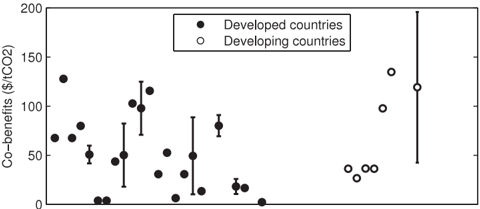
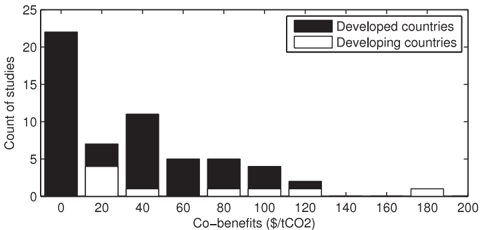
We present an analysis of the barriers and opportunities for incorporating air quality co-benefits into climate policy assessments. It is well known that many strategies for reducing greenhouse gas emissions also decrease emissions of health-damaging air pollutants and precursor species, including particulate matter, nitrogen oxides, and sulfur dioxide. In a survey of previous studies we found a range of estimates for the air quality co-benefits of climate change mitigation of $2 - 196/tCO 2 with a mean of $49/tCO 2 , and the highest co-benefits found in developing countries. These values, although of a similar order of magnitude to abatement cost estimates, are only rarely included in integrated assessments of climate policy. Full inclusion of these co-benefits would have pervasive implications for climate policy in areas including: optimal policy stringency, overall costs, distributional effects, robustness to discount rates, incentives for international cooperation, and the value of adaptation, forests, and climate engineering relative to mitigation. Under-valuation results in part from uncertainty in climatic damages, valuation inconsistency, and institutional barriers. Because policy debates are framed in terms of cost minimization, policy makers are unlikely to fully value air quality co-benefits unless they can be compared on an equivalent basis with the benefits of avoided climatic damages. While air quality co-benefits have been prominently portrayed as a hedge against uncertainty in the benefits of climate change abatement, this assessment finds that full inclusion of co-benefits depends on —rather than substitutes for—better valuation of climate damages.
Overview
The claims and statistics of this paper haven’t been checked yet.
Free: it reads the open-access text and checks the first 5 claims that cite a source we can check. Create a free account to check every claim.
Integrity signals
Registry
Cites
Statistics
Figures
Verification
Claims the paper makes
The claims and statistics of this paper haven’t been checked yet.
Free: it reads the open-access text and checks the first 5 claims that cite a source we can check. Create a free account to check every claim.
Claims other papers make about this one
Each is checked against this paper’s own text: does it say what the citing paper says it does?
The cited source says what the claim attributes to it.
In the citing paper
“mitigation efforts can reduce pollution 11,12”
From Co-benefits of addressing climate change can motivate action around the world (2016) · cites this paper as [11]
The cited source says what the claim attributes to it.
In the citing paper
“Commonly cited co-benefits addressing Dysfunction (for example, pollution, disease 11,12,15,16 ) were actually the weakest motivators of action overall.”
From Co-benefits of addressing climate change can motivate action around the world (2016) · cites this paper as [11]
Self-check
Percentages, sums and reported differences re-computed from the paper’s own numbers.
The self-check needs the paper’s full text.
Citations
Cites
(2007) · London School of Economics and Political Science Research Online (London School of Economics and Political Science) · Cited by 9,690
Slovic, P. (1987) · Science · doi:10.1126/science.3563507 · Cited by 9,271 · cited 2×
“I UK Stern 2005/PAGE2002d 2200 Yes Yes Yes Yes No J US C.B.O. (2009)e 2019 No No No — — K US EIA NEMS (2008)f 2030 Yes No No — — L US EPA ADAGE (2008)g 2050 Yes No No — — M US EPA IGEM (2008)g 2050 Yes No No — —”
BackgroundThe Economics of Climate Change: The Stern Review
Stern, N. (2007) · doi:10.1017/cbo9780511817434 · Cited by 8,371
The "Stern Review" on the Economics of Climate Change
Nordhaus, W. (2006) · National Bureau of Economic Research · doi:10.3386/w12741 · Cited by 2,774
A tale of two market failures: Technology and environmental policy
Jaffe, A. B., Newell, R. G., & Stavins, R. N. (2005) · Ecological Economics · doi:10.1016/j.ecolecon.2004.12.027 · Cited by 1,683
Albedo enhancement by stratospheric sulfur injections: a contribution to resolve a policy dilemma?
Crutzen, P. J. (2006) · Climatic Change · doi:10.1007/s10584-006-9101-y · Cited by 1,541 · cited 1×
“Indeed, some solar radiation modification schemes have the potential to reduce air quality (Crutzen 2006, Victor 2008), and even those with no adverse affect must take into account the opportunity cost of missed air quality improvements.”
BackgroundThe Economic Effects of Climate Change
Tol, R. S. J. (2009) · Journal of Economic Perspectives · doi:10.1257/jep.23.2.29 · Cited by 1,251
A question of balance: weighing the options on global warming policies
(2008) · Choice Reviews Online · doi:10.5860/choice.46-1603 · Cited by 1,239
A Question of Balance: Weighing the Options on Global Warming Policies
Nordhaus, W. (2008) · Yale University Press eBooks · doi:10.2307/j.ctt1npzkh · Cited by 1,081
Lifting the taboo on adaptation
Pielke, R., Prins, G., Rayner, S., & Sarewitz, D. (2007) · Nature · doi:10.1038/445597a · Cited by 557 · cited 1×
“The observed under-prioritization of adaptation and climate engineering relative to mitigation (Pielke et al 2007) may be partially attributable to concern over the loss of AQ co-benefits, even if not explicitly expressed.”
Background
Research works printed but not linked: 18
- Amann M et al 2009 Potentials and Costs for Greenhouse Gas Mitigation in Annex 1 Countries: Initial Results (Laxenburg: International Institute for Applied Systems Analysis)
- Barker T 1993 Secondary Benefits of Greenhouse Gas Abatement: The Effects of a UK Carbon/Energy Tax on Air Pollution (Cambridge: Department of Applied Economics, University of Cambridge)
- Caton R, 2000, Clearing the Air: A Preliminary Analysis of Air Quality Co-Benefits from Reduced Greenhouse Gas Emissions in Canada
- Caton R and Constable S 2000 Clearing the Air: A Preliminary Analysis of Air Quality Co-Benefits from Reduced Greenhouse Gas Emissions in Canada The David Suzuki Foundation CBO 2009 Congressional Budget Office Cost Estimate of H.R. 2454, American Clean Energy and Security Act of 2009 (Washington DC: Congressional Budget Office)
- DECC 2008 Climate Change Act 2008 Impact Assessment (London: UK Department of Energy and Climate Change)
- Dowlatabadi H, 1993, Estimating the Ancillary Benefits of Selected Carbon Dioxide Mitigation Strategies: Electicity Sector
- Dowlatabadi H, Tschang F and Siegel S 1993 Estimating the Ancillary Benefits of Selected Carbon Dioxide Mitigation Strategies: Electicity Sector Climate Change Division, US Environmental Protection Agency EIA 2008 Energy Market and Economic Impacts of S.1766, the Low Carbon Economy Act of 2007 (Washington DC: Energy Information Administration)
- 1997, Regulatory Impact Analysis for the Particulate Matter and Ozone National Ambient Air Quality Standards and Proposed Regional Haze Rule
- 2008, EPA’s Economic Analysis of the Low Carbon Economy Act of 2007 (S.1766)
- Goulder L 1993 Economy-Wide Emissions Impacts of Alternative Energy Tax Proposals Climate Change Division, US Environmental Protection Agency
- Han H 2001 Analysis of the Environmental Benefits of Reductions in Greenhouse Gas Emissions (Seoul: Korean Environmental Institute)
- Holmes R, 1993, Ancillary Benefits of Mitigating Climate Change: Selected Actions from the Climate Change Action Plan
- Holmes R, Keinath D and Sussman F 1993 Ancillary Benefits of Mitigating Climate Change: Selected Actions from the Climate Change Action Plan Climate Change Division, US Environmental Protection Agency IPCC 2007 Climate change 2007: Mitigation. Contribution of Working group III to the 4th Assessment Report of the Intergovernmental Panel on Climate Change (Cambridge: Cambridge University Press)
- Johnson M 2001 'Hidden Health Benefits of Greenhouse Gas Mitigation' offers nothing to policy-makers (eLetter response) Science www.sciencemag.org/cgi/eletters/293/5533/1257
- Mccubbin D, 1999, Co-Control Benefits of Greenhouse Gas Control Policies
- Nemet G, 2010, Clim. Change
- Pearce D W, 1992, The Secondary Benefits of Greenhouse Gas Control
- Rowe R, 1995, The New York State Externalities Cost Study
Cited by
Items 101–200 of 430
Implications of climate change mitigation for sustainable development
Jakob, M., & Steckel, J. C. (2016) · Environmental Research Letters · doi:10.1088/1748-9326/11/10/104010 · Cited by 84
Winners and losers: the distributional impacts of a carbon tax in Brazil
Moz-Christofoletti, M. A., & Pereda, P. C. (2021) · Ecological Economics · doi:10.1016/j.ecolecon.2021.106945 · Cited by 81
POLICY INSIGHTS FROM THE EMF 32 STUDY ON U.S. CARBON TAX SCENARIOS
BARRON, A. R., FAWCETT, A. A., HAFSTEAD, M. A. C., MCFARLAND, J. R., & MORRIS, A. C. (2018) · Climate Change Economics · doi:10.1142/s2010007818400031 · Cited by 70
“Studies of CO2 abatement policies often estimate substantial health benefits from consequent reductions in SO2 and NOx, frequently of magnitude similar to the near-term costs of the policy (Nemet et al., 2010; Burtraw and Palmer, 2013; West et al., 2013; Thompson et al., 2014; Buonocore et al., 2016).”
BackgroundThe Political Economy of Health Co-Benefits: Embedding Health in the Climate Change Agenda
Workman, A., Blashki, G., Bowen, K. J., Karoly, D. J., & Wiseman, J. (2018) · International Journal of Environmental Research and Public Health · doi:10.3390/ijerph15040674 · Cited by 60
“However, there is recognition that co-benefits have not gained commensurate political traction in a majority of Parties to the UNFCCC [12,13,18,48,49].”
BackgroundInfluentialDeploying Renewables in Southeast Asia: Trends and potentials
Ölz, S., & Beerepoot, M. (2010) · IEA energy papers · doi:10.1787/5kmd4xs1jtmr-en · Cited by 68
Sustainable policy—key considerations for air quality and climate change
Melamed, M. L., Schmale, J., & von Schneidemesser, E. (2016) · Current Opinion in Environmental Sustainability · doi:10.1016/j.cosust.2016.12.003 · Cited by 82
Wei, X., Tong, Q., Magill, I., Vithayasrichareon, P., & Betz, R. (2020) · Energy Economics · doi:10.1016/j.eneco.2020.104917 · Cited by 72
Building equity in: strategies for integrating equity into modelling for a 1.5°C world
Sonja, K., & Harald, W. (2018) · Philosophical Transactions of the Royal Society A: Mathematical, Physical and Engineering Sciences · doi:10.1098/rsta.2016.0461 · Cited by 46
“Co-benefits are often used to motivate action [38,39] and could change aggregate cost-benefit analyses [40] but are experienced unevenly.”
BackgroundBistline, J. E., Hodson, E., Rossmann, C. G., Creason, J., Murray, B., & Barron, A. R. (2018) · Energy Economics · doi:10.1016/j.eneco.2018.04.012 · Cited by 65
“The health benefits of reductions in SO2 and NOx are often substantial, with the short-term health benefits often similar in magnitude to, or greater than, the near-term abatement costs (e.g., Woollacott, 2018; Buonocore et al., 2016; Thompson et al., 2014; West et al., 2013; Nemet et al., 2010).”
BackgroundYu, Z., Geng, Y., Dai, H., Wu, R., Liu, Z., Tian, X., & Bleischwitz, R. (2018) · Journal of Cleaner Production · doi:10.1016/j.jclepro.2018.05.006 · Cited by 68
Dolšak, N., Adolph, C., & Prakash, A. (2020) · Public Administration · doi:10.1111/padm.12657 · Cited by 74
“A mitigation-focused tax directs new revenues to mitigation projects such as mass transit and renewable energy that create local co-benefits (Nemet, Holloway, and Meier, 2010; West, Smith, Silva, Naik, Zhang, Adelman, Fry, Anenberg, Horowitz, and Lamarque, 2013; Bain,Milfont, Kashima, Bilewicz,…”
BackgroundPurohit, P., Höglund-Isaksson, L., Dulac, J., Shah, N., Wei, M., Rafaj, P., & Schöpp, W. (2020) · Atmospheric chemistry and physics · doi:10.5194/acp-20-11305-2020 · Cited by 68
Cost-Effectiveness of Greenhouse Gas Mitigation Measures for Agriculture: A Literature Review
MacLeod, M. J., Eory, V., Gruère, G., & Lankoski, J. (2015) · OECD food, agriculture and fisheries working papers · doi:10.1787/5jrvvkq900vj-en · Cited by 64
Key dimensions of cities’ engagement in the transition to climate neutrality
Salvia, M., Pietrapertosa, F., D’Alonzo, V., Maestosi, P. C., Simões, S. G., & Reckien, D. (2023) · Journal of Environmental Management · doi:10.1016/j.jenvman.2023.118519 · Cited by 63
Climate Change Communication: A Provocative Inquiry into Motives, Meanings, and Means
Johnson, B. B. (2011) · Risk Analysis · doi:10.1111/j.1539-6924.2011.01731.x · Cited by 69
“mated costs of reducing greenhouse gas emissions, and would be highest in developing countries.(72) Yet these benefits have been little mentioned in CCC, al-”
BackgroundHasanbeigi, A., Lobscheid, A. B., Lu, H., Price, L., & Dai, Y. (2013) · The Science of The Total Environment · doi:10.1016/j.scitotenv.2013.04.031 · Cited by 61
Ward, D. S., & Mahowald, N. M. (2014) · Environmental Research Letters · doi:10.1088/1748-9326/9/7/074008 · Cited by 67
“By including aerosols in our analysis we give climate credit to nations that emit high levels of aerosols and may do so at the expense of local air quality (Nemet et al 2010).”
BackgroundRegional co-control plan for local air pollutants and CO 2 reduction: Method and practice
Zeng, A., Mao, X., Hu, T., Xing, Y., Gao, Y., Zhou, J. T., & Qian, Y. T. (2016) · Journal of Cleaner Production · doi:10.1016/j.jclepro.2016.10.037 · Cited by 61
Health co-benefits of climate mitigation in urban areas
Jack, D. W., & Kinney, P. L. (2010) · Current Opinion in Environmental Sustainability · doi:10.1016/j.cosust.2010.06.007 · Cited by 72
“[8 ].”
BackgroundInfluentialManaging future air quality in megacities: Co-benefit assessment for Delhi
Bhanarkar, A. D., Purohit, P., Rafaj, P., Amann, M. C., Bertok, I., Cofała, J., Rao, P. S., Vardhan, B. H., Kiesewetter, G., Sander, R., et al. (2018) · Atmospheric Environment · doi:10.1016/j.atmosenv.2018.05.026 · Cited by 61
Dual high‐stake emerging technologies: a review of the climate engineering research literature
Linnér, B., & Wibeck, V. (2015) · Wiley Interdisciplinary Reviews Climate Change · doi:10.1002/wcc.333 · Cited by 63
Abel, D. W., Holloway, T., Harkey, M. K., Rrushaj, A., Brinkman, G., Duran, P. L., Janssen, M., & Denholm, P. L. (2017) · Atmospheric Environment · doi:10.1016/j.atmosenv.2017.11.049 · Cited by 58
Self-citationLee, T., & de Meene, S. J. V. (2013) · Journal of Cleaner Production · doi:10.1016/j.jclepro.2013.04.047 · Cited by 56
Environmental education and the health professions: framing climate change as a health issue
Adlong, W., & Dietsch, E. (2014) · Environmental Education Research · doi:10.1080/13504622.2014.930727 · Cited by 61
“For example, health benefits of improvements in air quality are well studied, more immediate and less subject to modelling uncertainty than climate effects (Nemet, Holloway, and Meier 2010).”
BackgroundLi, X., Qiao, Y., & Shi, L. (2016) · Journal of Cleaner Production · doi:10.1016/j.jclepro.2016.03.015 · Cited by 56
Stuhlmacher, M., Patnaik, S., Streletskiy, D. A., & Taylor, K. (2019) · Journal of Environmental Management · doi:10.1016/j.jenvman.2019.109352 · Cited by 58
Sources of atmospheric pollution: a bibliometric analysis
Li, Y., Wang, Y., Rui, X., Li, Y., Li, Y., Wang, H., Zuo, J., & Tong, Y. (2017) · Scientometrics · doi:10.1007/s11192-017-2421-z · Cited by 58
“Moreover, GHG emission relate strategies also reduced emissions of air pollutants and their precursors (Nemet et al. 2010).”
BackgroundHealth and environmental co-benefits and conflicts of actions to meet UK carbon targets
Smith, A. C., Holland, M., Korkeala, O., Warmington, J., Forster, D., ApSimon, H. M., Oxley, T., Dickens, R., & Smith, S. M. (2015) · Climate Policy · doi:10.1080/14693062.2014.980212 · Cited by 64
Méndez, M. (2015) · Local Environment · doi:10.1080/13549839.2015.1038227 · Cited by 59
“In a survey of 37 worldwide peer-reviewed studies, Nemet et al. (2010) found a mean co-benefit of $49/ton of carbon dioxide avoided.”
BackgroundHow will air quality effects on human health, crops and ecosystems change in the future?
von Schneidemesser, E., Driscoll, C. T., Rieder, H. E., & Schiferl, L. D. (2020) · Philosophical Transactions of the Royal Society A Mathematical Physical and Engineering Sciences · doi:10.1098/rsta.2019.0330 · Cited by 56
The Economics of 1.5°C Climate Change
Dietz, S., Bowen, A., Doda, B., Gambhir, A., & Warren, R. (2018) · Annual Review of Environment and Resources · doi:10.1146/annurev-environ-102017-025817 · Cited by 65
Cao, C., Cui, X., Cai, W., Wang, C., Lu, X., Zhang, N., Shen, S., Bai, Y., & Deng, Z. (2019) · Applied Energy · doi:10.1016/j.apenergy.2019.113498 · Cited by 56
Jennings, N., Fecht, D., & De Matteis, S. (2020) · The Lancet Planetary Health · doi:10.1016/s2542-5196(20)30167-4 · Cited by 52
Lawler, J. J., Spencer, B., Olden, J. D., Kim, S.-H., Lowe, C., Bolton, S. M., Beamon, B. M., Thompson, L., & Voss, J. G. (2013) · Elsevier eBooks · doi:10.1016/b978-0-12-384703-4.00436-6 · Cited by 55
A comparison of carbon allocation schemes: On the equity-efficiency tradeoff
Pan, X., Teng, F., & Wang, G. (2014) · Energy · doi:10.1016/j.energy.2014.05.109 · Cited by 52
How Stimulating Is a Green Stimulus? The Economic Attributes of Green Fiscal Spending
O’Callaghan, B., Yau, N., & Hepburn, C. J. (2022) · Annual Review of Environment and Resources · doi:10.1146/annurev-environ-112420-020640 · Cited by 65
“appeal compared to other investments—examining only the impacts on GDP understates benefits of green investment spanning health (21–23), the environment (24,25), economic stability (26– 28), among others (see 29).”
BackgroundAir quality co-benefits of subnational carbon policies
Thompson, T. M., Rausch, S., Saari, R. K., & Selin, N. E. (2016) · Journal of the Air & Waste Management Association · doi:10.1080/10962247.2016.1192071 · Cited by 53
“Regional results fall within the range of $2–196/tCO2 from published literature as reported by Nemet et al. (2010).”
BackgroundResultInfluentialAir quality and climate benefits of long-distance electricity transmission in China
Peng, W., Yuan, J., Zhao, Y., Lin, M., Zhang, Q., Victor, D. G., & Mauzerall, D. L. (2017) · Environmental Research Letters · doi:10.1088/1748-9326/aa67ba · Cited by 52
Saari, R. K., Mei, Y., Monier, E., & Garcia–Menendez, F. (2019) · Environmental Science & Technology · doi:10.1021/acs.est.8b05094 · Cited by 52
Taxation of Emissions of Greenhouse Gases
Baranzini, A., & Carattini, S. (2014) · Springer eBooks · doi:10.1007/978-94-007-5784-4_90 · Cited by 59
Cost‐Benefit Analysis for Optimization of Risk Protection Under Budget Constraints
Špačková, O., & Straub, D. (2015) · Risk Analysis · doi:10.1111/risa.12310 · Cited by 58
“(9) CBA is also applied to assess the effect of policies and regulations, for example, on terrorist prevention measures in aviation,(10,11) on retrofitting of buildings to reduce the impact of earthquakes,(12) on air pollution(13,14) or on testing and use of pharmaceutics.”
BackgroundThe design of optimal climate policy with air pollution co-benefits
Muller, N. Z. (2012) · Resource and Energy Economics · doi:10.1016/j.reseneeco.2012.07.002 · Cited by 53
Air Quality-Related Health Benefits of Energy Efficiency in the United States
Abel, D. W., Holloway, T., Martínez-Santos, J., Harkey, M. K., Tao, M., Kubes, C., & Hayes, S. (2019) · Environmental Science & Technology · doi:10.1021/acs.est.8b06417 · Cited by 48
Self-citationUnderhill, L. J., Milando, C. W., Levy, J. I., Dols, W. S., Lee, S. K., & Fabian, M. P. (2019) · Building and Environment · doi:10.1016/j.buildenv.2019.106507 · Cited by 55
Mitigation Policies for the Paris Agreement: An Assessment for G20 Countries
Parry, I. W. H., Mylonas, V., & Vernon, N. (2018) · IMF Working Paper · doi:10.2139/ssrn.3257359 · Cited by 50
Balbus, J. M., Greenblatt, J. B., Chari, R., Millstein, D. E., & Ebi, K. L. (2014) · Climatic Change · doi:10.1007/s10584-014-1262-5 · Cited by 44
“date, co-benefits studies have had limited usefulness in policy decision-making because of variability in methods used, health outcomes assessed, the limited number of sectors evaluated, and uncertainty regarding climate change-related damages (Bell et al. 2008; Nemet et al. 2010; Jack and Kinney 2010; Groosman et al.…”
BackgroundMethodMrkajić, V., Vukelić, D., & Mihajlov, A. (2015) · Renewable and Sustainable Energy Reviews · doi:10.1016/j.rser.2015.04.100 · Cited by 53
Air quality and climate – synergies and trade-offs
von Schneidemesser, E., & Monks, P. S. (2013) · Environmental Science Processes & Impacts · doi:10.1039/c3em00178d · Cited by 48
A systematic assessment of city-level climate change mitigation and air quality improvement in China
Zhang, L., Wu, P., Niu, M., Zheng, Y., Wang, J., Dong, G., Zhang, Z., Xie, Z., Du, M., Jiang, H., et al. (2022) · The Science of The Total Environment · doi:10.1016/j.scitotenv.2022.156274 · Cited by 44
Co-benefit comparison of carbon tax, sulfur tax and nitrogen tax: The case of China
Jiang, H.-D., Liu, L.-J., & Deng, H.-M. (2021) · Sustainable Production and Consumption · doi:10.1016/j.spc.2021.10.017 · Cited by 44
Tackling climate change: what is the impact on air pollution?
Williams, M. L. (2012) · Carbon Management · doi:10.4155/cmt.12.49 · Cited by 50
Kim, M. J., & Hall, C. M. (2022) · Journal of Hospitality and Tourism Management · doi:10.1016/j.jhtm.2022.08.007 · Cited by 41
Torres, A. B., MacMillan, D. C., Skutsch, M., & Lovett, J. C. (2014) · Ecological Economics · doi:10.1016/j.ecolecon.2014.11.008 · Cited by 40
“The magnitude of co-benefits may be even higher than mitigation costs and climate benefits (Pearce, 1992, 2000; Nemet et al., 2010; Glenk and Colombo, 2011).”
BackgroundTonmoy, F., Cooke, S., Armstrong, F., & Rissik, D. (2020) · Environmental Science & Policy · doi:10.1016/j.envsci.2020.03.005 · Cited by 39
Ščasný, M., Massetti, E., Melichar, J., & Carrara, S. (2015) · Environmental and Resource Economics · doi:10.1007/s10640-015-9969-y · Cited by 49
“6 to e78 (Dessus and O’Connor 1999) and e148 (Aunan et al. 2000) per tonne of reduced CO2 emissions.4 A review of 48 peer-reviewed studies by Nemet et al. (2010) provides the range of air quality co-benefits from climate change mitigation ofe1.”
An Analysis of Costs and Health Co-Benefits for a U.S. Power Plant Carbon Standard
Buonocore, J. J., Lambert, K. F., Burtraw, D., Sekar, S., & Driscoll, C. T. (2016) · PLoS ONE · doi:10.1371/journal.pone.0156308 · Cited by 46
Robust incentives and the design of a climate change governance regime
Nemet, G. F. (2010) · Energy Policy · doi:10.1016/j.enpol.2010.07.052 · Cited by 39
Self-citationShen, J., Chen, X., Li, H., Cui, X., Zhang, S., Bu, C., An, K., Wang, C., & Cai, W. (2023) · Environmental Science & Technology · doi:10.1021/acs.est.2c08450 · Cited by 39
An evolutionary modeling approach for designing a contractual REDD+ payment scheme
Sheng, J., Wu, Y., Zhang, M., & Miao, Z. (2017) · Ecological Indicators · doi:10.1016/j.ecolind.2017.04.010 · Cited by 38
The economics of health and climate change: key evidence for decision making
Hutton, G. (2011) · Globalization and Health · doi:10.1186/1744-8603-7-18 · Cited by 38
Rashidi, K., Stadelmann, M., & Patt, A. (2017) · Sustainable Cities and Society · doi:10.1016/j.scs.2017.06.003 · Cited by 41
“In China and the US, as the studies show, the costs associated with the reduction of carbon emissions in transportation sector will be offset by the increase in health benefits (Aunan et al., 2004; Dong et al., 2015; Nemet et al., 2010; Thompson et al., 2014).”
BackgroundAjibade, I. M., & Adams, E. A. (2019) · Climate and Development · doi:10.1080/17565529.2019.1580557 · Cited by 44
Sim, S., Jeong, S., Park, H., Park, C., Kwak, K., Lee, S., Kim, C. H., Lee, S., Chang, J. S., Kang, H., et al. (2020) · Atmospheric Pollution Research · doi:10.1016/j.apr.2020.08.009 · Cited by 40
Two Birds, One Stone? Local Pollution Regulation and Greenhouse Gas Emissions
Brunel, C., & Johnson, E. P. (2016) · Energy Economics · doi:10.1016/j.eneco.2018.10.011 · Cited by 38
Cai, B., Bo, X., Zhang, L., Boyce, J. K., Zhang, Y., & Yu, L. (2016) · Global Environmental Change · doi:10.1016/j.gloenvcha.2016.05.013 · Cited by 39
Using “Local Climate Zones” to Detect Urban Heat Island on Two Small Cities in Alabama
Chieppa, J., Bush, A., & Mitra, C. (2018) · Earth Interactions · doi:10.1175/ei-d-17-0020.1 · Cited by 40
Quantifying the emissions and air quality co-benefits of lower-carbon electricity production
Plachinski, S. D., Holloway, T., Meier, P. J., Nemet, G. F., Rrushaj, A., Oberman, J., Duran, P. L., & Voigt, C. L. (2014) · Atmospheric Environment · doi:10.1016/j.atmosenv.2014.03.028 · Cited by 39
Self-citationMurata, A., Liang, J., Eto, R., Tokimatsu, K., Okajima, K., & Uchiyama, Y. (2015) · Renewable Energy · doi:10.1016/j.renene.2015.09.046 · Cited by 36
Air Passengers’ Preferences for Aviation Voluntary Carbon Offsetting: A Co-benefits Perspective
Zhang, B., Ritchie, B. W., Mair, J., & Driml, S. (2021) · Journal of Travel Research · doi:10.1177/00472875211030340 · Cited by 35
“In addition, the air quality co-benefit is also believed to give rise to further social and economic co-benefits in terms of reducing the costs of pollution control and pollution-related diseases (Nemet, Holloway, and Meier 2010).”
BackgroundReduce growth rate of light-duty vehicle travel to meet 2050 global climate goals
Sager, J., Apte, J. S., Lemoine, D. M., & Kammen, D. M. (2011) · Environmental Research Letters · doi:10.1088/1748-9326/6/2/024018 · Cited by 39
Zhang, S., Worrell, E., & Crijns-Graus, W. H. J. (2015) · Energy · doi:10.1016/j.energy.2015.10.088 · Cited by 35
“The co-bene fi ts in developing countries would be higher than developed countries, based on a survey of 37 studies [49].”
BackgroundSources of emission reductions: Market and policy-stringency effects
Hille, E., & Shahbaz, M. Q. (2018) · Energy Economics · doi:10.1016/j.eneco.2018.11.006 · Cited by 37
Co-benefits of global and regional greenhouse gas mitigation for US air quality in 2050
Zhang, Y., Bowden, J. H., Adelman, Z. E., Naïk, V., Horowitz, L. W., Smith, S. J., & West, J. J. (2016) · Atmospheric chemistry and physics · doi:10.5194/acp-16-9533-2016 · Cited by 37
“When monetized, the global average marginal co-benefits of avoided mortality were $50–380/tCO2, higher than the 10 previous estimates (Nemet et al., 2010).”
InfluentialMitigation Policies for the Paris Agreement: An Assessment for G20 Countries
Parry, I. W. H., Mylonas, V., & Vernon, N. (2021) · Journal of the Association of Environmental and Resource Economists · doi:10.1086/713147 · Cited by 38
“Nemet et al. (2010) and West et al. (2013) also estimate reductions in air pollution deaths from carbon pricing, though they are not compared with efficiency costs and they do not consider other domestic externalities (e.g., from road vehicles).”
BackgroundHow Much Carbon Pricing is in Countries’ Own Interests? The Critical Role of Co-Benefits
Parry, I. W. H., Veung, C., & Heine, D. (2014) · IMF Working Paper · doi:10.5089/9781498358279.001 · Cited by 80
Does the EU emissions trading system help reduce PM2.5 damage? A research based on PSM-DID method
Wan, L., Wang, S., Zang, J., Zheng, Q., & Fang, W. (2021) · Environmental Science and Pollution Research · doi:10.1007/s11356-021-17640-x · Cited by 34
“In addition, scholars have also confirmed that greenhouse gas reduction strategies can improve air pollution and bring public health benefits (Haines et al. 2009; Nemet et al. 2010; Groosman et al. 2011).”
BackgroundDesigning Fiscal Policy to Address the External Costs of Energy
Parry, I. W. H. (2015) · International Review of Environmental and Resource Economics · doi:10.1561/101.00000065 · Cited by 34
“Parry, Veung and Heine (2014) estimate (using data discussed below) that co-benefits warrant CO2 taxes averaging $57.5 per ton across the top-twenty CO2-emitting countries, before any charge is levied for climate damages (see also Nemet et al. 2010).”
BackgroundInfluentialCollaborative Governance Mechanism of Climate Change and Air Pollution: Evidence from China
Wang, B., Wang, Y., & Zhao, Y. (2021) · Sustainability · doi:10.3390/su13126785 · Cited by 34
“The co-benefits of developing countries are the highest [22].”
BackgroundImpacts of Potential CO2-Reduction Policies on Air Quality in the United States
Trail, M. A., Tsimpidi, A. P., Liu, P., Tsigaridis, K., Hu, Y., Rudokas, J. R., Miller, P. J., Nenes, A., & Russell, A. G. (2015) · Environmental Science & Technology · doi:10.1021/acs.est.5b00473 · Cited by 33
The case for integrated air quality and climate change policies
Thambiran, T., & Diab, R. D. (2011) · Environmental Science & Policy · doi:10.1016/j.envsci.2011.08.002 · Cited by 32
“Work by authors such as Nemet et al. (2010) suggest whilst a co-benefits approach to achieving GHG emission reductions may help developing countries overcome international collective action problems, it may also act to complicate the implementation of an international climate agreement.”
BackgroundMaking climate instruments work for sustainable transport in developing countries
Bakker, S., & Huizenga, C. (2010) · Natural Resources Forum · doi:10.1111/j.1477-8947.2010.01315.x · Cited by 31
“for air quality, reduced congestion, energy security and social equality (e.g. ADB and CAI-Asia, 2010; CCAP, 2010; Nemet et al., 2010), the transport sector is likely to benefit from such an approach.”
BackgroundKammerer, M., Wagner, P. M., Gronow, A., Ylä‐Anttila, T., Fisher, D. R., & Sun‐Jin, Y. (2021) · Policy Studies Journal · doi:10.1111/psj.12422 · Cited by 33
PM2.5 co-benefits of climate change legislation part 1: California’s AB 32
Zapata, C. B., Muller, N. Z., & Kleeman, M. J. (2012) · Climatic Change · doi:10.1007/s10584-012-0545-y · Cited by 32
“Previous studies suggest that air quality benefits associated with climate change mitigation policies may be appreciable (Nemet et al. 2010).”
BackgroundReaping the Economic Benefits of Decarbonization for China
Teng, F., & Jotzo, F. (2014) · China & World Economy · doi:10.1111/j.1749-124x.2014.12083.x · Cited by 32
“A review of studies on monetized air quality benefit (Nemet et al., 2010) found a range between US$27 and US$196 per ton CO2 avoided for developing countries.”
Smith, K. R., Balakrishnan, K., Butler, C. D., Chafe, Z. A., Fairlie, I., Kinney, P. L., Kjellstrom, T. E., Mauzerall, D. L., McKone, T. E., McMichael, A. J., et al. (2012) · Cambridge University Press eBooks · doi:10.1017/cbo9780511793677.010 · Cited by 42
Willingness to Pay for a Climate Backstop: Liquid Fuel Producers and Direct CO 2 Air Capture
Nemet, G. F., & Brandt, A. R. (2012) · The Energy Journal · doi:10.5547/issn0195-6574-ej-vol33-no1-3 · Cited by 29
“Unlike other mitigation options, air capture will not address non-climate issues related to petroleum import dependence and local air pollution (Nemet et al., 2010).”
BackgroundMethodSelf-citationRegulatory Influences on Environmental Protection: Why Shipping Companies Comply and When They Don't
Akamangwa, N. (2017) · Ocean Development & International Law · doi:10.1080/00908320.2017.1290485 · Cited by 30
Newell, R. (2023) · Frontiers in Climate · doi:10.3389/fclim.2023.1177025 · Cited by 30
“Health objectives are also achieved through co-benefits with climate change mitigation, such as strategies directed toward the reduction of fossil fuel usage to decrease both greenhouse gas and particulate matter emissions (Nemet et al., 2010).”
BackgroundEffect of carbon market on air pollution: Firm-level evidence in China
Zhu, J., Li, X., Fan, Y., Shi, H., & Zhao, L. (2022) · Resources Conservation and Recycling · doi:10.1016/j.resconrec.2022.106321 · Cited by 30
Wu, T. N., & Qiao, Z. F. (2025) · Environmental Pollution · doi:10.1016/j.envpol.2025.126025 · Cited by 30
Yang, X., Yang, X., Zhu, J., Jiang, P. Y., Lin, H., Cai, Z., & Huang, H. (2023) · Environmental Technology & Innovation · doi:10.1016/j.eti.2023.103137 · Cited by 29
A review of and perspectives on global change modeling for Northern Eurasia
Monier, E., Kicklighter, D. W., Sokolov, A., Zhuang, Q., Sokolik, I. N., Lawford, R. G., Kappas, M., Paltsev, S., & Groisman, P. (2017) · Environmental Research Letters · doi:10.1088/1748-9326/aa7aae · Cited by 27
Implications of Switching Fossil Fuel Subsidies to Solar: A Case Study for the European Union
Sampedro, J., Arto, I., & González‐Eguino, M. (2017) · Sustainability · doi:10.3390/su10010050 · Cited by 36
“More and more studies are analysing the implications of climate and energy policies for SO2 [24], as it is one of the main contributors to the damage associated with air pollution.”
BackgroundLiu, Z., Dong, M., Xue, W., Ni, X., Qi, Z., Shao, J., Guo, Y., Ma, M., Zhang, Q., & Jinnan, W. (2022) · Environmental Science & Technology · doi:10.1021/acs.est.2c01966 · Cited by 26
Health co-benefits and the development of climate change mitigation policies in the European Union
Workman, A., Blashki, G. A., Bowen, K., Karoly, D. J., & Wiseman, J. (2018) · Climate Policy · doi:10.1080/14693062.2018.1544541 · Cited by 26
Qiu, M., Weng, Y., Cao, J., Selin, N. E., & Karplus, V. J. (2020) · Environmental Science & Technology · doi:10.1021/acs.est.0c01381 · Cited by 28
Peduzzi, E., Baldi, M. G., Pisoni, E., Kona, A., Bertoldi, P., & Monforti-Ferrario, F. (2020) · Environment International · doi:10.1016/j.envint.2020.106029 · Cited by 27
One Atmosphere: Integrating Air Pollution and Climate Policy and Governance
Zusman, E., Unger, C., Borgford‐Parnell, N., & Mar, K. A. (2021) · Atmosphere · doi:10.3390/atmos12121570 · Cited by 28
Liu, M., Huang, Y., Zhou, J., Liu, X., Bi, J., & Jantunen, M. J. (2016) · Journal of Cleaner Production · doi:10.1016/j.jclepro.2016.10.137 · Cited by 26
Co-benefits of CO2 and PM2.5 Emission Reduction
Yang, S., Chen, B., & Ulgiati, S. (2016) · Energy Procedia · doi:10.1016/j.egypro.2016.12.017 · Cited by 25
Metadata
- Authors
- Nemet, G. F., Holloway, T., & Meier, P.
- Affiliations
- University of Wisconsin–Madison (US)
- Venue
- Environmental Research Letters
- Publisher
- IOP Publishing
- Published
- 2010-01
- Volume
- 5
- Issue
- 1
- Pages
- 014007
- ISSN
- 1748-9326 (ISSN-L)
- OpenAlex
- W2099269882
- Semantic Scholar
- 6fc02bfc2b956b0db9f559129bcf336be95d27f2
- Cited by
- 411
- References
- 71
- Citations by year
- 2026: 16 · 2025: 12 · 2024: 16 · 2023: 22 · 2022: 22 · 2021: 25 · 2020: 33 · 2019: 25 · 2018: 48 · 2017: 29 · 2016: 32 · 2015: 35 · 2014: 29 · 2013: 21 · 2012: 13
- FWCI
- 49.81
- Type
- journal article
- Language
- en
- Open access
- gold
- doi.org
- Licence
- cc-by
- Locations
- Environmental Research Letters (publishedVersion, cc-by)
- Topics
- Social Sciences › Economics, Econometrics and Finance › Economics and Econometrics › Climate Change Policy and Economics
- Physical Sciences › Environmental Science › Global and Planetary Change › Climate Change and Geoengineering
- Physical Sciences › Environmental Science › Environmental Engineering › Environmental and Air Quality Management
- Keywords
- air quality co-benefits, climate change mitigation, greenhouse gas emissions reduction, particulate matter, nitrogen oxides, sulfur dioxide, climate policy assessment, integrated assessment models, discount rate, international climate cooperation, geoengineering, forests, distributional effects
About these checks
Registry, retraction, Cites and statistics results are computed, not judged, with one exception: a printed reference that no index lists is read once by a model before it counts as a citation error. Claims are extracted by a model and kept only when their quote appears verbatim in the text; each cited source is then checked, with a model’s help, for whether it says what the claim relies on. Those verdicts can be wrong — read the claim’s quote and the cited source before relying on one.
Statistics and arithmetic are recomputed, not judged.
Confidence bands are shown only for fields calibrated on our annotated test set. None is calibrated yet, so no band is shown.
What counts as a claim ›How we measure confidence ›How we check this ›
Are you an author, or do you see a problem with this page? Request a review
Data sources
Bibliographic data: Semantic Scholar, OpenAlex, Crossref.
Contains information from the Semantic Scholar Academic Graph Datasets, made available under the ODC Attribution License (ODC-BY 1.0).
Semantic Scholar’s data is described in: Kinney, R., et al. (2023). The Semantic Scholar Open Data Platform. arXiv:2301.10140.
