

Implications of incorporating air-quality co-benefits into climate change policymaking
Open accessThe DOI matches its Crossref record; 73 of the 74 references it cites were found in a registry or an index.
Abstract
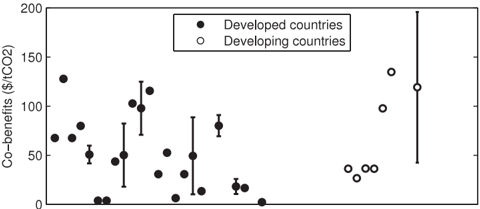
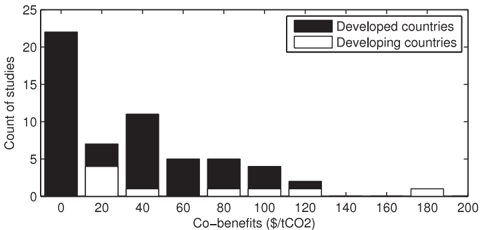
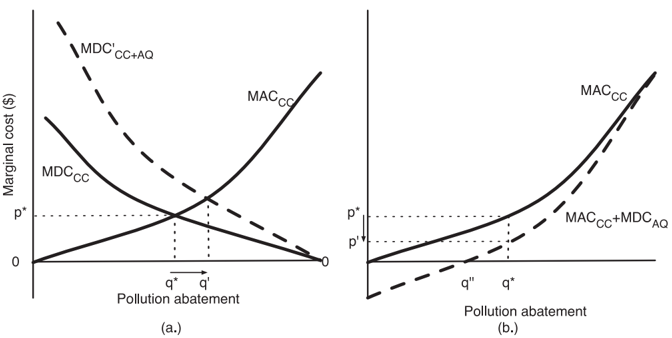
We present an analysis of the barriers and opportunities for incorporating air quality co-benefits into climate policy assessments. It is well known that many strategies for reducing greenhouse gas emissions also decrease emissions of health-damaging air pollutants and precursor species, including particulate matter, nitrogen oxides, and sulfur dioxide. In a survey of previous studies we found a range of estimates for the air quality co-benefits of climate change mitigation of $2 - 196/tCO 2 with a mean of $49/tCO 2 , and the highest co-benefits found in developing countries. These values, although of a similar order of magnitude to abatement cost estimates, are only rarely included in integrated assessments of climate policy. Full inclusion of these co-benefits would have pervasive implications for climate policy in areas including: optimal policy stringency, overall costs, distributional effects, robustness to discount rates, incentives for international cooperation, and the value of adaptation, forests, and climate engineering relative to mitigation. Under-valuation results in part from uncertainty in climatic damages, valuation inconsistency, and institutional barriers. Because policy debates are framed in terms of cost minimization, policy makers are unlikely to fully value air quality co-benefits unless they can be compared on an equivalent basis with the benefits of avoided climatic damages. While air quality co-benefits have been prominently portrayed as a hedge against uncertainty in the benefits of climate change abatement, this assessment finds that full inclusion of co-benefits depends on —rather than substitutes for—better valuation of climate damages.
Overview
The claims and statistics of this paper haven’t been checked yet.
Free: it reads the open-access text and checks the first 5 claims that cite a source we can check. Create a free account to check every claim.
Integrity signals
Registry
Cites
Statistics
Figures
Verification
Claims the paper makes
The claims and statistics of this paper haven’t been checked yet.
Free: it reads the open-access text and checks the first 5 claims that cite a source we can check. Create a free account to check every claim.
Claims other papers make about this one
Each is checked against this paper’s own text: does it say what the citing paper says it does?
The cited source says what the claim attributes to it.
In the citing paper
“mitigation efforts can reduce pollution 11,12”
From Co-benefits of addressing climate change can motivate action around the world (2016) · cites this paper as [11]
The cited source says what the claim attributes to it.
In the citing paper
“Commonly cited co-benefits addressing Dysfunction (for example, pollution, disease 11,12,15,16 ) were actually the weakest motivators of action overall.”
From Co-benefits of addressing climate change can motivate action around the world (2016) · cites this paper as [11]
Self-check
Percentages, sums and reported differences re-computed from the paper’s own numbers.
The self-check needs the paper’s full text.
Citations
Cites
(2007) · London School of Economics and Political Science Research Online (London School of Economics and Political Science) · Cited by 9,690
Slovic, P. (1987) · Science · doi:10.1126/science.3563507 · Cited by 9,271 · cited 2×
“I UK Stern 2005/PAGE2002d 2200 Yes Yes Yes Yes No J US C.B.O. (2009)e 2019 No No No — — K US EIA NEMS (2008)f 2030 Yes No No — — L US EPA ADAGE (2008)g 2050 Yes No No — — M US EPA IGEM (2008)g 2050 Yes No No — —”
BackgroundThe Economics of Climate Change: The Stern Review
Stern, N. (2007) · doi:10.1017/cbo9780511817434 · Cited by 8,371
The "Stern Review" on the Economics of Climate Change
Nordhaus, W. (2006) · National Bureau of Economic Research · doi:10.3386/w12741 · Cited by 2,774
A tale of two market failures: Technology and environmental policy
Jaffe, A. B., Newell, R. G., & Stavins, R. N. (2005) · Ecological Economics · doi:10.1016/j.ecolecon.2004.12.027 · Cited by 1,683
Albedo enhancement by stratospheric sulfur injections: a contribution to resolve a policy dilemma?
Crutzen, P. J. (2006) · Climatic Change · doi:10.1007/s10584-006-9101-y · Cited by 1,541 · cited 1×
“Indeed, some solar radiation modification schemes have the potential to reduce air quality (Crutzen 2006, Victor 2008), and even those with no adverse affect must take into account the opportunity cost of missed air quality improvements.”
BackgroundThe Economic Effects of Climate Change
Tol, R. S. J. (2009) · Journal of Economic Perspectives · doi:10.1257/jep.23.2.29 · Cited by 1,251
A question of balance: weighing the options on global warming policies
(2008) · Choice Reviews Online · doi:10.5860/choice.46-1603 · Cited by 1,239
A Question of Balance: Weighing the Options on Global Warming Policies
Nordhaus, W. (2008) · Yale University Press eBooks · doi:10.2307/j.ctt1npzkh · Cited by 1,081
Lifting the taboo on adaptation
Pielke, R., Prins, G., Rayner, S., & Sarewitz, D. (2007) · Nature · doi:10.1038/445597a · Cited by 557 · cited 1×
“The observed under-prioritization of adaptation and climate engineering relative to mitigation (Pielke et al 2007) may be partially attributable to concern over the loss of AQ co-benefits, even if not explicitly expressed.”
Background
Research works printed but not linked: 18
- Amann M et al 2009 Potentials and Costs for Greenhouse Gas Mitigation in Annex 1 Countries: Initial Results (Laxenburg: International Institute for Applied Systems Analysis)
- Barker T 1993 Secondary Benefits of Greenhouse Gas Abatement: The Effects of a UK Carbon/Energy Tax on Air Pollution (Cambridge: Department of Applied Economics, University of Cambridge)
- Caton R, 2000, Clearing the Air: A Preliminary Analysis of Air Quality Co-Benefits from Reduced Greenhouse Gas Emissions in Canada
- Caton R and Constable S 2000 Clearing the Air: A Preliminary Analysis of Air Quality Co-Benefits from Reduced Greenhouse Gas Emissions in Canada The David Suzuki Foundation CBO 2009 Congressional Budget Office Cost Estimate of H.R. 2454, American Clean Energy and Security Act of 2009 (Washington DC: Congressional Budget Office)
- DECC 2008 Climate Change Act 2008 Impact Assessment (London: UK Department of Energy and Climate Change)
- Dowlatabadi H, 1993, Estimating the Ancillary Benefits of Selected Carbon Dioxide Mitigation Strategies: Electicity Sector
- Dowlatabadi H, Tschang F and Siegel S 1993 Estimating the Ancillary Benefits of Selected Carbon Dioxide Mitigation Strategies: Electicity Sector Climate Change Division, US Environmental Protection Agency EIA 2008 Energy Market and Economic Impacts of S.1766, the Low Carbon Economy Act of 2007 (Washington DC: Energy Information Administration)
- 1997, Regulatory Impact Analysis for the Particulate Matter and Ozone National Ambient Air Quality Standards and Proposed Regional Haze Rule
- 2008, EPA’s Economic Analysis of the Low Carbon Economy Act of 2007 (S.1766)
- Goulder L 1993 Economy-Wide Emissions Impacts of Alternative Energy Tax Proposals Climate Change Division, US Environmental Protection Agency
- Han H 2001 Analysis of the Environmental Benefits of Reductions in Greenhouse Gas Emissions (Seoul: Korean Environmental Institute)
- Holmes R, 1993, Ancillary Benefits of Mitigating Climate Change: Selected Actions from the Climate Change Action Plan
- Holmes R, Keinath D and Sussman F 1993 Ancillary Benefits of Mitigating Climate Change: Selected Actions from the Climate Change Action Plan Climate Change Division, US Environmental Protection Agency IPCC 2007 Climate change 2007: Mitigation. Contribution of Working group III to the 4th Assessment Report of the Intergovernmental Panel on Climate Change (Cambridge: Cambridge University Press)
- Johnson M 2001 'Hidden Health Benefits of Greenhouse Gas Mitigation' offers nothing to policy-makers (eLetter response) Science www.sciencemag.org/cgi/eletters/293/5533/1257
- Mccubbin D, 1999, Co-Control Benefits of Greenhouse Gas Control Policies
- Nemet G, 2010, Clim. Change
- Pearce D W, 1992, The Secondary Benefits of Greenhouse Gas Control
- Rowe R, 1995, The New York State Externalities Cost Study
Cited by
Items 301–400 of 430
Bolorinos, J., Ajami, N., Meléndez, G. M., & Jackson, R. B. (2018) · Environmental Science & Technology · doi:10.1021/acs.est.7b06580 · Cited by 7
Litman, T. A. (2014) · Cited by 7
Chapter 14 : Air Quality. Fifth National Climate Assessment
West, J. J., Nolte, C. G., Bell, M. L., Fiore, A. M., Georgopoulos, P. G., Hess, J. J., Mickley, L. J., O’Neill, S. M., Pierce, J. R., Pinder, R. W., et al. (2023) · doi:10.7930/nca5.2023.ch14 · Cited by 15
Wu, X., Holloway, T., Meier, P., & Edwards, M. R. (2024) · Environmental Research Letters · doi:10.1088/1748-9326/ad5ab6 · Cited by 8
“Nemet et al summarized the global air quality co-benefits of climate policies with a range of $2-196 per ton of CO 2 avoided [29].”
Self-citationRowlands, I. H. (2011) · Mitigation and Adaptation Strategies for Global Change · doi:10.1007/s11027-011-9292-z · Cited by 6
The Effect of Low-Carbon Innovations on Reducing Environmental Threats to Health
Karpa, W. (2017) · Journal of Innovation Economics & Management · doi:10.3917/jie.pr1.0017 · Cited by 6
“…impacts of GHG mitigation in terms of general public health policy (Cheng, Berry, 2013; Haines et al., 2012), several papers have acknowledged reduced morbidity and mortality attributable to the reduction in household energy emissions (Nemet et al., 2010; West et al., 2013; Wilkinson et al., 2009).”
Multi-criteria Approaches to Ancillary Effects: The Example of E-Mobility
Vögele, S., Ball, C. S., & Kuckshinrichs, W. (2019) · Springer climate · doi:10.1007/978-3-030-30978-7_9 · Cited by 11
“Likewise, vehicles emit co-pollutants in addition to GHG emissions [Chavez-Baeza & Sheinbaum-Pardo, 2014] and a reduction in these copollutants, which include NOx and SOx, would represent an ancillary benefit (in this case for health) [Muller, 2012, Nemet et al., 2010].”
BackgroundEnvironmental co-benefits of carbon taxation on air pollution under a low-carbon pathway in Chile
Nasirov, S., O’Ryan, R., & Morales, I. (2025) · Energy Nexus · doi:10.1016/j.nexus.2025.100499 · Cited by 5
The role of co-benefits in motivating climate change mitigation – Experimental evidence
Feldhaus, C., Gleue, M., Löschel, A., & Werner, P. (2025) · Ecological Economics · doi:10.1016/j.ecolecon.2025.108783 · Cited by 7
Paying lip service to health: An analysis of health in climate change mitigation policies in Spain
Junquera, A. B. (2022) · The Journal of Climate Change and Health · doi:10.1016/j.joclim.2022.100128 · Cited by 5
Aligning Ocean Plastic Pollution and Human Health a Co-benefits Approach
Morrissey, K. (2019) · Journal of Ocean and Coastal Economics · doi:10.15351/2373-8456.1090 · Cited by 6
“In response, the term ‘co-benefits’ has exploded in in both academia and official policy documents (Nemet et al., 2010; Mayrhofer & Gupta, 2016).”
BackgroundInfluentialCarbon pricing, health co-benefits and trade-offs: protocol for a systematic framework synthesis
Cuevas, S., Nachtigall, D., Jaber, A. A., Belesova, K., Falconer, J., Haines, A., Whitmee, S., Reynolds, T., & Green, R. (2023) · Wellcome Open Research · doi:10.12688/wellcomeopenres.18873.1 · Cited by 5
An Introduction to Co-benefits: Core Concepts and Applications
Zusman, E., Chae, Y., Kim, H., & Farzaneh, H. (2021) · Springer eBooks · doi:10.1007/978-981-16-0135-4_1 · Cited by 5
Diko, S. K. (2018) · Elsevier eBooks · doi:10.1016/b978-0-12-811477-3.00018-3 · Cited by 5
Geographic Hotspots for World Bank Action on Climate Change and Health
Bank, W. (2017) · World Bank, Washington, DC eBooks · doi:10.1596/27810 · Cited by 8
Strand, J. (2020) · World Bank, Washington, DC eBooks · doi:10.1596/1813-9450-9251 · Cited by 6
The truth about co-benefits: a multidimensional feasibility assessment for thailand and beyond
Zusman, E., Akahoshi, K., Hanaoka, T., Malley, C. S., Wangwongwatana, S., Onmek, N., Pawarmart, I., Oanh, N. T. K., Huy, L. N., Kuylenstierna, J., et al. (2025) · Environmental Research Communications · doi:10.1088/2515-7620/adae5e · Cited by 4
Shaqour, A., & Farzaneh, H. (2021) · Springer eBooks · doi:10.1007/978-981-16-0135-4_2 · Cited by 4
Wu, X., Holloway, T., Meier, P., & Edwards, M. R. (2024) · ACS ES&T Air · doi:10.1021/acsestair.4c00114 · Cited by 4
Self-citationSchmale, J., von Schneidemesser, E., Chabay, I., Maas, A., & Lawrence, M. G. (2015) · Advances in natural and technological hazards research · doi:10.1007/978-3-319-20161-0_5 · Cited by 5
Responses to the Clean Power Plan: Factors Influencing State Decision‐Making
Besco, L. (2018) · Review of Policy Research · doi:10.1111/ropr.12307 · Cited by 5
Liu, L.-J., Liang, Q.-M., Creutzig, F., Ward, H., & Zhang, K. (2020) · Ecological Economics · doi:10.1016/j.ecolecon.2020.106590 · Cited by 4
Some benefits of improving urban air quality from the perspective of Ho Chi Minh City people
Danh, N. T., & Quang, L. M. (2020) · E3S Web of Conferences · doi:10.1051/e3sconf/202021101005 · Cited by 4
Air quality and health benefits of increasing carbon mitigation tech-innovation in China
Jin, S., Wang, W., Ostic, D., Zhang, C., Lü, N., Wang, D., & Ni, W. (2022) · Environmental Science and Pollution Research · doi:10.1007/s11356-022-22602-y · Cited by 4
“2019; Sharifi 2020), and the value generated by this effect is higher in developing countries (Nemet et al. 2010).”
BackgroundConnecting social and environmental policy in Australia: Collateral gains or collateral damage?
Marston, G., Stark, A., Matthews, T., & Baker, D. (2018) · Australian Journal of Public Administration · doi:10.1111/1467-8500.12339 · Cited by 5
Rowlands, I. (2011) · RePEc: Research Papers in Economics · Cited by 4
Traffic solutions for greener and cleaner cities
Prada, F. P. (2017) · UPM Digital Archive (Technical University of Madrid) · doi:10.20868/upm.thesis.47653 · Cited by 4
anon, M., Massetti, E., Melichar, J., & Carrara, S. (2016) · SSRN Electronic Journal · doi:10.2139/ssrn.2715473 · Cited by 4
McCollum, D. L. (2011) · RePEc: Research Papers in Economics · Cited by 4
A Public Finance Perspective on Climate Policy: Six Interactions That May Enhance WelfarePreprint
Siegmeier, J., Mattauch, L., Franks, M., Klenert, D., Schultes, A., & Edenhofer, O. (2015) · SSRN Electronic Journal · doi:10.2139/ssrn.2596604 · Cited by 5
“Even if many co-benefits are said to be less uncertain than future mitigation benefits, estimates of the uncertainties might still be incommensurable (Nemet et al., 2010; West et al., 2013).”
BackgroundLi, R., Xu, J., Yang, X., Yan, L., & Ouyang, Q. (2026) · Energy Strategy Reviews · doi:10.1016/j.esr.2026.102143 · Cited by 3
Comparison of global air pollution impacts across horizontal resolutions
Jansakoo, T., Watanabe, R., UETANI, A., SEKIZAWA, S., Fujimori, S., Hasegawa, T., & Oshiro, K. (2024) · Atmospheric Environment X · doi:10.1016/j.aeaoa.2024.100303 · Cited by 5
Integrating environmental costs when calculating the energy efficiency potential
Arnold-Keifer, S., Müller, J., & Mandel, T. D. (2025) · Cleaner Environmental Systems · doi:10.1016/j.cesys.2025.100281 · Cited by 3
Eto, R., Murata, A., Uchiyama, Y., & Okajima, K. (2013) · Journal of Sustainable Development of Energy Water and Environment Systems · doi:10.13044/j.sdewes..2013.01.25 · Cited by 3
Mathy, S., Bouscasse, H., Chardonnel, S., Chalabaëv, A., Gabet, S., Treibich, C., & Slama, R. (2019) · Springer climate · doi:10.1007/978-3-030-30978-7_18 · Cited by 5
Singh, P., Singh, H., & Singh, A. K. (2021) · International Journal of Metalcasting · doi:10.1007/s40962-021-00713-5 · Cited by 3
“It is reported that the global emission of NO2 and SO2 can be decreased by 55% and 59%, respectively, by improving the efficiency of the energy generation systems, which can be enhanced by employing innovative design and development.(14)”
BackgroundBuonocore, J. J. (2014) · Nature Climate Change · doi:10.1038/nclimate2391 · Cited by 3
The Paris Agreement saves lives in China
Patz, J. A., & West, J. J. (2018) · The Lancet Planetary Health · doi:10.1016/s2542-5196(18)30052-4 · Cited by 3
Teaching Climate Science to Increase Understanding & Receptivity
Watts, E. M. (2019) · The American Biology Teacher · doi:10.1525/abt.2019.81.5.308 · Cited by 3
Mitigation here and now or there and then: the role of co-benefits
Wagner, F. (2012) · Carbon Management · doi:10.4155/cmt.12.37 · Cited by 3
Synergy between Pollution and Carbon Emissions Control: Comparing China and the U.S.
Nam, K.-M., Waugh, C., Paltsev, S., Reilly, J. M., & Karplus, V. J. (2013) · DSpace@MIT (Massachusetts Institute of Technology) · Cited by 3
Optimal regulation of carbon and co-pollutants with spatially differentiated damagesPreprint
Crago, C. L., & Stranlund, J. K. (2015) · RePEc: Research Papers in Economics · doi:10.22004/ag.econ.205594 · Cited by 3
A Public Finance Perspective on Climate Policy: Six Interactions That May Enhance WelfarePreprint
Siegmeier, J., Mattauch, L., Franks, M., Klenert, D., Schultes, A., & Edenhofer, O. (2015) · RePEc: Research Papers in Economics · doi:10.22004/ag.econ.202119 · Cited by 6
Kleiman, G. N., Bouley, T. A., Meiro-Lorenzo, M., & Wang, H. (2017) · Cited by 2
Emissions abatement under a rate-based emissions trading system: facility-level evidence from China
Quan, Y., Tan‐Soo, J., Duan, M., & Cai, B. (2026) · Journal of Public Economics · doi:10.1016/j.jpubeco.2026.105797 · Cited by 2
Assessing co-benefits incentivizes climate-mitigation action
Horton, D. E. (2021) · One Earth · doi:10.1016/j.oneear.2021.08.003 · Cited by 2
Gaps in climate health literacy: an analysis of Kosovo’s pre-university curricula and textbooks
Ramadani, L., Boeckmann, M., Klüsener, C., & Sioen, G. B. (2025) · Frontiers in Climate · doi:10.3389/fclim.2025.1531555 · Cited by 2
Eory, V., Topp, K., de Haan, B. J., & Moran, D. (2015) · Springer eBooks · doi:10.1007/978-94-017-9722-1_7 · Cited by 2
Analysis of Ancillary Benefits of Climate Policy
Buchholz, W., Markandya, A., Rübbelke, D., & Vögele, S. (2019) · Springer climate · doi:10.1007/978-3-030-30978-7_1 · Cited by 4
Integrating climate, air, and health goals: the impact of efficient cooling policies in India
Agarwal, S., Phore, G., Singh, M., Singh, N. K., Sharma, S., Juneja, M., Mangotra, K., & Sharma, S. (2024) · Journal of Environmental Studies and Sciences · doi:10.1007/s13412-024-00954-w · Cited by 2
“These measures, however, offer more than just climate benefits; they can also reduce exposure to air pollution (Bloomberg and Aggarwala 2008) and contribute to improved regional-scale air quality and human health (Bell et al. 2008; Nemet et al. 2010; Zhang et al. 2017).”
Shifting to low-carbon transport in Asean : policy development in a rapidly motorising region
Bakker, S. (2018) · doi:10.3990/1.9789036545181 · Cited by 5
“for air quality, reduced congestion, energy security and social equality (e.g. Leather & CAI-Asia, 2010; CCAP, 2010; Nemet et al., 2010), the transport sector is likely to benefit from such an approach.”
BackgroundClimate Change, Economic Growth, and HealthPreprint
Ikefuji, M., Magnus, J. R., & Sakamoto, H. (2010) · SSRN Electronic Journal · doi:10.2139/ssrn.1665102 · Cited by 2
Roth, M. (2020) · Figshare · doi:10.1184/r1/12001224 · Cited by 2
Wambuguh, O. J. (2020) · Education Society and Human Studies · doi:10.22158/eshs.v1n2p113 · Cited by 1
“…accruing from decreases in GHG emissions from fossil fuel combustion greatly improve local air quality; and evidence that the economic cost savings of reduced air-pollution-related illnesses and death outweighs the costs of GHG mitigation abounds (Smith & Haigler, 2008; Nemet et al., 2010).”
BackgroundAli, Z., Zusman, E., Chiu, B.-Y., & Hengesbaugh, M. (2025) · Sustainability Science · doi:10.1007/s11625-025-01730-7 · Cited by 1
European Climate Policy and the Global Context
Pittel, K., Ringel, M., Rübbelke, D., Vögele, S., & Сіліна, І. (2025) · Springer eBooks · doi:10.1007/978-3-031-84483-6_4 · Cited by 1
CLIMATE POLICY, AIR POLLUTION IMPACTS, AND THE DISTRIBUTION OF INCOME
Muller, N. Z., Adams, P. J., Dennin, L. R., Jaramillo, P., & Jordan, K. H. (2026) · Climate Change Economics · doi:10.1142/s2010007826400063 · Cited by 1
Coping with Climate Change in the Next Half-Century
Kennel, C. F., Ramanathan, V., & Victor, D. G. (2012) · Proceedings of the American Philosophical Society: Held at Philadelphia for Promoting Useful Knowledge · Cited by 1
Kanada, M., Fujita, T., & Ohnishi, S. (2012) · Journal of Japan Society of Civil Engineers Ser G (Environmental Research) · doi:10.2208/jscejer.68.ii_507 · Cited by 1
Hirayama, T., Fujiwara, K., Hibino, G., Hanaoka, T., & Masui, T. (2017) · Journal of Japan Society of Civil Engineers Ser G (Environmental Research) · doi:10.2208/jscejer.73.ii_301 · Cited by 1
Climate science can’t be trumped: a look at how to translate empirical data into political action
Watts, E. M., Hoßfeld, U., & Levit, G. S. (2019) · Vestnik of Saint Petersburg University Philosophy and Conflict Studies · doi:10.21638/spbu17.2019.112 · Cited by 1
“This is in stark contrast to the general, global and long-term effects of climate change and it is a concept that individuals comprehend more easily [25].”
ResultHow Existing Environmental Laws Respond to Climate Change and Its Mitigation
Gundlach, J. (2018) · Cambridge University Press eBooks · doi:10.1017/9781108278010.014 · Cited by 2
A review of international climate change and health websites : Current status and implications
Hwang, J., Bae, M., & Choi, S. K. (2023) · 보건교육·건강증진학회지 · doi:10.14367/kjhep.2023.40.4.71 · Cited by 1
Economic impact assessment of the climate change on the health sector: case of Montenegro
Ćetković, J., Žarković, M., Knežević, M., Vujadinović, R., & Stanković, J. (2023) · E3S Web of Conferences · doi:10.1051/e3sconf/202346203036 · Cited by 1
“…of studies evaluated reducing health damage costs, as a result of reducing GHG emissions (Barker and Bashmakov, 2007; European Commission, 2007; Nemet et al., 2010), while Markandya and Chiabai (2009b) estimated health gains in the EU, China and India in the amount of US$145 billion in 2030,…”
BackgroundDumayas, A. G., Bello, P. M. B., Guilla, J. J. M., & Buenaventura, V. P. (2025) · Asian Journal of Education and Social Studies · doi:10.9734/ajess/2025/v51i41857 · Cited by 1
Liang, J., Murata, A., Tokimatsu, K., & Uchiyama, Y. (2014) · Journal of Energy and Power Engineering · doi:10.17265/1934-8975/2014.02.006 · Cited by 1
“Incorporating CCS into the CDM is necessary to mitigate CO2 emissions, and some of the barriers to this technology have previously been discussed [27-30].”
BackgroundClimate Change, Economic Growth, and HealthPreprint
Ikefuji, M., Magnus, J. R., & Sakamoto, H. (2010) · SSRN Electronic Journal · doi:10.2139/ssrn.1677770 · Cited by 2
“Climate: The temperature equation is inspired by Nordhaus (2008): Zj,t+1 = τ0,j + τ1,jZj,t + τ2 log(Mt) + τ3,jE a j,t + τ4,j log(1 + τ5,jE a j,t) (15) In the Nordhaus model, however, the radiative forcing of aerosols is given exogenously.”
BackgroundMethodSaari, R. K. (2015) · DSpace@MIT (Massachusetts Institute of Technology) · Cited by 2
ANALYSING ATMOSPHERIC IMPACTS OF REGIONAL TRUCK EMISSIONS USING AN INTEGRATED MODELLING APPROACH
Wang, W. (2018) · UWSpace (University of Waterloo) · Cited by 2
Workman, A. (2019) · Minerva Access (University of Melbourne) · Cited by 1
Policy design in the context of multiple pollutants and regulatorsPreprint
Goetz, R., Xabadia, À., & Zilberman, D. (2021) · SSRN Electronic Journal · doi:10.2139/ssrn.3960697 · Cited by 1
Comparison of Global Air Pollution Impacts Across Horizontal ResolutionsPreprint
Jansakoo, T., Watanabe, R., UETANI, A., SEKIZAWA, S., Fujimori, S., Hasekawa, T., & Oshiro, K. (2024) · SSRN Electronic Journal · doi:10.2139/ssrn.4856924 · Cited by 1
Psychological approaches to social change for environmental protection and environmental justicePreprint
Lutz, A., & Schmitt, M. T. (2025) · OSF Preprints (OSF Preprints) · doi:10.31219/osf.io/76y2d_v1 · Cited by 1
Understanding the Clean Development Mechanism and its dual aims the case of China's projects
Sun, Q. (2011) · KTH Publication Database DiVA (KTH Royal Institute of Technology) · Cited by 3
Methods for Valuing Preferences for Environmental and Natural Resources: An Overview
Lamond, J. E., & Bateman, I. J. (2012) · Wiley eBooks · doi:10.1002/9781444354539.ch8
Huizenga, C., & Bakker, S. (2010) · doi:10.18235/0010267
Bioenergy and mobility : cooperation between Japan and Brazil within a low carbon world
Pacca, S. A. (2011) · Institutional Repositories DataBase (IRDB) · doi:10.15027/32458
Wood, J. (2013) · Murdoch University Research Portal · Cited by 1
MacLeod, M. J., Eory, V., Gruère, G., & Lankoski, J. (2015) · doi:10.1787/5jrvvkhfn7nr-fr
Russian Federation, & Marino, S. (2013)
Ahenkorah, A. O., Pan, J., Pathak, H. K., Rice, J. C., Richels, R., Stern, D. I., Zhou, P. J., Baiocchi, G., Hanemann, W. M., Rose, S., et al. (2012)
Chafe, Z. A. (2016) · eScholarship (California Digital Library)
Constraining climate and health impacts of atmospheric aerosols using adjoint modeling
Lacey, F. G. (2016) · CU Scholar (University of Colorado Boulder)
Yeh, S. (2011) · Institutions, Efficiency and Evolving Energy Technologies,34th IAEE International Conference,June 19-23, 2011
Impediments, incentives and interrelations with other objectives
Zimmer, A. (2017) · DepositOnce · doi:10.14279/depositonce-6176
Using atmospheric models to estimate global air pollution mortality
Anenberg, S. C. (2011) · Carolina Digital Repository (University of North Carolina at Chapel Hill) · doi:10.17615/vqcz-zn96
Priya, A. S., Naincy, V., Vivek, P., Isha, K., Shraddha, S., Saumya, G., & Singh, M. (2019) · International Journal of Agriculture Environment and Bioresearch · doi:10.35410/ijaeb.2019.129144
Gunawan, H. (2019) · doi:10.3990/1.9789402816549 · Cited by 1
“Another approach, which deals simultaneously with both the global and the local problems, is the so-called co-benefits approach (Creutzig et al., 2012; Jack & Kinney, 2010; Lee & Van De Meene, 2013; Nemet et al., 2010; Puppim De Oliveira et al., 2013; Schwanitz et al., 2015; Thambiran & Diab, 2011).”
BackgroundHealth-EDRM in International Policy Agenda II: Paris Climate Agreement
Chan, E. Y. Y., Hung, H., & Shaw, R. (2020) · Disaster risk reduction · doi:10.1007/978-981-15-0924-7_6
Lokala fördelar av minskade klimatutsläpp
Carlestam, J. (2020) · Lund University Publications Student Papers (Lund University)
Interpreting Global Energy Scenarios for Emissions Planning at the Utility Scale
Holloway, T., & Jackson, C. M. (2020) · Minds at UW (University of Wisconsin)
Self-citationSummarising Key Carbon Reduction Co-benefits
Cheshmehzangi, A., & Chen, H. (2021) · Springer eBooks · doi:10.1007/978-981-16-2621-0_3
Samadi, S. (2018) · Carl von Ossiezky University of Oldenburg · Cited by 1
Air quality co-benefits of renewable energy policy in the U.S.
Dimanchev, E. (2018) · DSpace@MIT (Massachusetts Institute of Technology)
(2022) · Geoscientific model development · doi:10.5194/gmd-2022-103-rc2
A research on PM2.5 transmission mode based on motif analysisPreprint
Wang, D., Wang, Q., & Li, C. (2022) · Research Square · doi:10.21203/rs.3.rs-1577002/v1
Minimum participation requirements and the role of co-benefits in international climate policy
Brumme, A., & Rübbelke, D. (2023) · Frontiers in Environmental Economics · doi:10.3389/frevc.2022.1106186 · Cited by 1
Peszko, G., Amann, M. C., Awe, Y., Kleiman, G. N., & Rabie, T. S. (2023) · World Bank, Washington, DC eBooks · doi:10.1596/978-1-4648-1835-6_ch5
Metadata
- Authors
- Nemet, G. F., Holloway, T., & Meier, P.
- Affiliations
- University of Wisconsin–Madison (US)
- Venue
- Environmental Research Letters
- Publisher
- IOP Publishing
- Published
- 2010-01
- Volume
- 5
- Issue
- 1
- Pages
- 014007
- ISSN
- 1748-9326 (ISSN-L)
- OpenAlex
- W2099269882
- Semantic Scholar
- 6fc02bfc2b956b0db9f559129bcf336be95d27f2
- Cited by
- 411
- References
- 71
- Citations by year
- 2026: 16 · 2025: 12 · 2024: 16 · 2023: 22 · 2022: 22 · 2021: 25 · 2020: 33 · 2019: 25 · 2018: 48 · 2017: 29 · 2016: 32 · 2015: 35 · 2014: 29 · 2013: 21 · 2012: 13
- FWCI
- 49.81
- Type
- journal article
- Language
- en
- Open access
- gold
- doi.org
- Licence
- cc-by
- Locations
- Environmental Research Letters (publishedVersion, cc-by)
- Topics
- Social Sciences › Economics, Econometrics and Finance › Economics and Econometrics › Climate Change Policy and Economics
- Physical Sciences › Environmental Science › Global and Planetary Change › Climate Change and Geoengineering
- Physical Sciences › Environmental Science › Environmental Engineering › Environmental and Air Quality Management
- Keywords
- air quality co-benefits, climate change mitigation, greenhouse gas emissions reduction, particulate matter, nitrogen oxides, sulfur dioxide, climate policy assessment, integrated assessment models, discount rate, international climate cooperation, geoengineering, forests, distributional effects
About these checks
Registry, retraction, Cites and statistics results are computed, not judged, with one exception: a printed reference that no index lists is read once by a model before it counts as a citation error. Claims are extracted by a model and kept only when their quote appears verbatim in the text; each cited source is then checked, with a model’s help, for whether it says what the claim relies on. Those verdicts can be wrong — read the claim’s quote and the cited source before relying on one.
Statistics and arithmetic are recomputed, not judged.
Confidence bands are shown only for fields calibrated on our annotated test set. None is calibrated yet, so no band is shown.
What counts as a claim ›How we measure confidence ›How we check this ›
Are you an author, or do you see a problem with this page? Request a review
Data sources
Bibliographic data: Semantic Scholar, OpenAlex, Crossref.
Contains information from the Semantic Scholar Academic Graph Datasets, made available under the ODC Attribution License (ODC-BY 1.0).
Semantic Scholar’s data is described in: Kinney, R., et al. (2023). The Semantic Scholar Open Data Platform. arXiv:2301.10140.
