

Implications of incorporating air-quality co-benefits into climate change policymaking
Open accessThe DOI matches its Crossref record; 73 of the 74 references it cites were found in a registry or an index.
Abstract
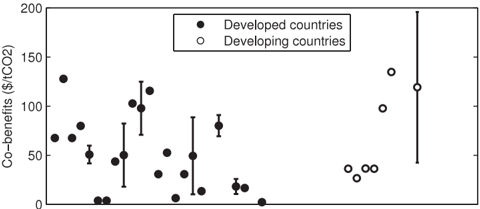
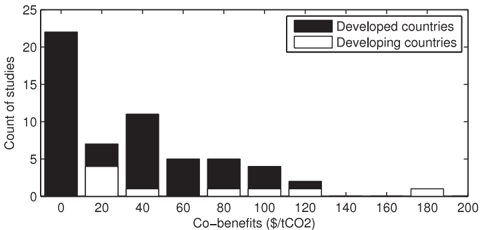
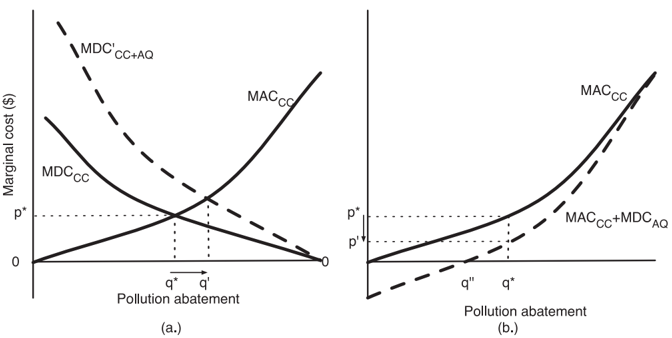
We present an analysis of the barriers and opportunities for incorporating air quality co-benefits into climate policy assessments. It is well known that many strategies for reducing greenhouse gas emissions also decrease emissions of health-damaging air pollutants and precursor species, including particulate matter, nitrogen oxides, and sulfur dioxide. In a survey of previous studies we found a range of estimates for the air quality co-benefits of climate change mitigation of $2 - 196/tCO 2 with a mean of $49/tCO 2 , and the highest co-benefits found in developing countries. These values, although of a similar order of magnitude to abatement cost estimates, are only rarely included in integrated assessments of climate policy. Full inclusion of these co-benefits would have pervasive implications for climate policy in areas including: optimal policy stringency, overall costs, distributional effects, robustness to discount rates, incentives for international cooperation, and the value of adaptation, forests, and climate engineering relative to mitigation. Under-valuation results in part from uncertainty in climatic damages, valuation inconsistency, and institutional barriers. Because policy debates are framed in terms of cost minimization, policy makers are unlikely to fully value air quality co-benefits unless they can be compared on an equivalent basis with the benefits of avoided climatic damages. While air quality co-benefits have been prominently portrayed as a hedge against uncertainty in the benefits of climate change abatement, this assessment finds that full inclusion of co-benefits depends on —rather than substitutes for—better valuation of climate damages.
Overview
The claims and statistics of this paper haven’t been checked yet.
Free: it reads the open-access text and checks the first 5 claims that cite a source we can check. Create a free account to check every claim.
Integrity signals
Registry
Cites
Statistics
Figures
Verification
Claims the paper makes
The claims and statistics of this paper haven’t been checked yet.
Free: it reads the open-access text and checks the first 5 claims that cite a source we can check. Create a free account to check every claim.
Claims other papers make about this one
Each is checked against this paper’s own text: does it say what the citing paper says it does?
The cited source says what the claim attributes to it.
In the citing paper
“mitigation efforts can reduce pollution 11,12”
From Co-benefits of addressing climate change can motivate action around the world (2016) · cites this paper as [11]
The cited source says what the claim attributes to it.
In the citing paper
“Commonly cited co-benefits addressing Dysfunction (for example, pollution, disease 11,12,15,16 ) were actually the weakest motivators of action overall.”
From Co-benefits of addressing climate change can motivate action around the world (2016) · cites this paper as [11]
Self-check
Percentages, sums and reported differences re-computed from the paper’s own numbers.
The self-check needs the paper’s full text.
Citations
Cites
(2007) · London School of Economics and Political Science Research Online (London School of Economics and Political Science) · Cited by 9,690
Slovic, P. (1987) · Science · doi:10.1126/science.3563507 · Cited by 9,271 · cited 2×
“I UK Stern 2005/PAGE2002d 2200 Yes Yes Yes Yes No J US C.B.O. (2009)e 2019 No No No — — K US EIA NEMS (2008)f 2030 Yes No No — — L US EPA ADAGE (2008)g 2050 Yes No No — — M US EPA IGEM (2008)g 2050 Yes No No — —”
BackgroundThe Economics of Climate Change: The Stern Review
Stern, N. (2007) · doi:10.1017/cbo9780511817434 · Cited by 8,371
The "Stern Review" on the Economics of Climate Change
Nordhaus, W. (2006) · National Bureau of Economic Research · doi:10.3386/w12741 · Cited by 2,774
A tale of two market failures: Technology and environmental policy
Jaffe, A. B., Newell, R. G., & Stavins, R. N. (2005) · Ecological Economics · doi:10.1016/j.ecolecon.2004.12.027 · Cited by 1,683
Albedo enhancement by stratospheric sulfur injections: a contribution to resolve a policy dilemma?
Crutzen, P. J. (2006) · Climatic Change · doi:10.1007/s10584-006-9101-y · Cited by 1,541 · cited 1×
“Indeed, some solar radiation modification schemes have the potential to reduce air quality (Crutzen 2006, Victor 2008), and even those with no adverse affect must take into account the opportunity cost of missed air quality improvements.”
BackgroundThe Economic Effects of Climate Change
Tol, R. S. J. (2009) · Journal of Economic Perspectives · doi:10.1257/jep.23.2.29 · Cited by 1,251
A question of balance: weighing the options on global warming policies
(2008) · Choice Reviews Online · doi:10.5860/choice.46-1603 · Cited by 1,239
A Question of Balance: Weighing the Options on Global Warming Policies
Nordhaus, W. (2008) · Yale University Press eBooks · doi:10.2307/j.ctt1npzkh · Cited by 1,081
Lifting the taboo on adaptation
Pielke, R., Prins, G., Rayner, S., & Sarewitz, D. (2007) · Nature · doi:10.1038/445597a · Cited by 557 · cited 1×
“The observed under-prioritization of adaptation and climate engineering relative to mitigation (Pielke et al 2007) may be partially attributable to concern over the loss of AQ co-benefits, even if not explicitly expressed.”
Background
Research works printed but not linked: 18
- Amann M et al 2009 Potentials and Costs for Greenhouse Gas Mitigation in Annex 1 Countries: Initial Results (Laxenburg: International Institute for Applied Systems Analysis)
- Barker T 1993 Secondary Benefits of Greenhouse Gas Abatement: The Effects of a UK Carbon/Energy Tax on Air Pollution (Cambridge: Department of Applied Economics, University of Cambridge)
- Caton R, 2000, Clearing the Air: A Preliminary Analysis of Air Quality Co-Benefits from Reduced Greenhouse Gas Emissions in Canada
- Caton R and Constable S 2000 Clearing the Air: A Preliminary Analysis of Air Quality Co-Benefits from Reduced Greenhouse Gas Emissions in Canada The David Suzuki Foundation CBO 2009 Congressional Budget Office Cost Estimate of H.R. 2454, American Clean Energy and Security Act of 2009 (Washington DC: Congressional Budget Office)
- DECC 2008 Climate Change Act 2008 Impact Assessment (London: UK Department of Energy and Climate Change)
- Dowlatabadi H, 1993, Estimating the Ancillary Benefits of Selected Carbon Dioxide Mitigation Strategies: Electicity Sector
- Dowlatabadi H, Tschang F and Siegel S 1993 Estimating the Ancillary Benefits of Selected Carbon Dioxide Mitigation Strategies: Electicity Sector Climate Change Division, US Environmental Protection Agency EIA 2008 Energy Market and Economic Impacts of S.1766, the Low Carbon Economy Act of 2007 (Washington DC: Energy Information Administration)
- 1997, Regulatory Impact Analysis for the Particulate Matter and Ozone National Ambient Air Quality Standards and Proposed Regional Haze Rule
- 2008, EPA’s Economic Analysis of the Low Carbon Economy Act of 2007 (S.1766)
- Goulder L 1993 Economy-Wide Emissions Impacts of Alternative Energy Tax Proposals Climate Change Division, US Environmental Protection Agency
- Han H 2001 Analysis of the Environmental Benefits of Reductions in Greenhouse Gas Emissions (Seoul: Korean Environmental Institute)
- Holmes R, 1993, Ancillary Benefits of Mitigating Climate Change: Selected Actions from the Climate Change Action Plan
- Holmes R, Keinath D and Sussman F 1993 Ancillary Benefits of Mitigating Climate Change: Selected Actions from the Climate Change Action Plan Climate Change Division, US Environmental Protection Agency IPCC 2007 Climate change 2007: Mitigation. Contribution of Working group III to the 4th Assessment Report of the Intergovernmental Panel on Climate Change (Cambridge: Cambridge University Press)
- Johnson M 2001 'Hidden Health Benefits of Greenhouse Gas Mitigation' offers nothing to policy-makers (eLetter response) Science www.sciencemag.org/cgi/eletters/293/5533/1257
- Mccubbin D, 1999, Co-Control Benefits of Greenhouse Gas Control Policies
- Nemet G, 2010, Clim. Change
- Pearce D W, 1992, The Secondary Benefits of Greenhouse Gas Control
- Rowe R, 1995, The New York State Externalities Cost Study
Cited by
Items 201–300 of 430
Lah, O. (2017) · Transportation research procedia · doi:10.1016/j.trpro.2017.05.495 · Cited by 27
“However, generating the highest potential level of synergies is likely to have a positive impact on the potential to form coalitions that can support the take-up of a specific policy measure or packages of measures (Nemet et al. 2010; Grubler et al. 2012).”
BackgroundGunawan, H., Bressers, H. T. A., Mohlakoana, N., & Hoppe, T. (2017) · Environments · doi:10.3390/environments4030045 · Cited by 27
Yang, X., Teng, F., Xi, X., Khayrullin, E., & Zhang, Q. (2017) · Applied Energy · doi:10.1016/j.apenergy.2017.08.016 · Cited by 25
THE ECONOMIC COSTS AND CO-BENEFITS OF CARBON TAXATION: A GENERAL EQUILIBRIUM ASSESSMENT
Woollacott, J. C. (2018) · Climate Change Economics · doi:10.1142/s2010007818400067 · Cited by 25
Mittal, S., Liu, J., Fujimori, S., & Shukla, P. R. (2018) · Energies · doi:10.3390/en11092213 · Cited by 30
GLIMPSE: A Rapid Decision Framework for Energy and Environmental Policy
Akhtar, F., Pinder, R. W., Loughlin, D. H., & Henze, D. K. (2013) · Environmental Science & Technology · doi:10.1021/es402283j · Cited by 26
Sun, L., Tian, Z., Zou, H., Shao, L., Sun, L., Dong, G., Fan, D., Huang, X., Frost, L., & James, L. W. (2019) · Sustainability · doi:10.3390/su11072099 · Cited by 24
“Literature on climate change risk assessment estimates the extent of climate hazard with climatic projections, as well as the potential impact on human activities, with specific focus on a variety of climate change circumstances, such as flooding [6,7], forest [8], air quality [9], and agriculture [10].”
BackgroundChen, W., Tang, H., He, L., Zhang, Y., & Ma, W. (2022) · The Science of The Total Environment · doi:10.1016/j.scitotenv.2022.158119 · Cited by 24
New Directions: Adapting air quality management to climate change: A must for planning
Ravishankara, A. R., Dawson, J. P., & Winner, D. A. (2011) · Atmospheric Environment · doi:10.1016/j.atmosenv.2011.12.048 · Cited by 24
The co-pollutant cost of carbon emissions: an analysis of the US electric power generation sector
Dedoussi, I. C., Allroggen, F., Flanagan, R., Hansen, T., Taylor, B., Barrett, S. R. H., & Boyce, J. K. (2019) · Environmental Research Letters · doi:10.1088/1748-9326/ab34e3 · Cited by 24
Cao, L., Tang, Y., Cai, B., Wu, P., Zhang, Y., Zhang, F., Bo, X., Chen, L., Chen, K., & Fang, K. (2020) · Energy · doi:10.1016/j.energy.2020.119427 · Cited by 30
Balbus, J. M., Greenblatt, J. B., Chari, R., Millstein, D. E., & Ebi, K. L. (2015) · Climatic Change · doi:10.1007/s10584-015-1336-z · Cited by 24
“date, co-benefits studies have had limited usefulness in policy decision-making because of variability in methods used, health outcomes assessed, the limited number of sectors evaluated, and uncertainty regarding climate change-related damages (Bell et al. 2008; Nemet et al. 2010; Jack and Kinney 2010; Groosman et al.…”
BackgroundEnvironmental Quality and the U.S. Power Sector: Air Quality, Land Use and Environmental Justice
Massetti, E., USDOE, Brown, M., Lapsa, M. V., Sharma, I., Bradbury, J., Li, Y., & Li, Y. (2017) · OSTI OAI (U.S. Department of Energy Office of Scientific and Technical Information) · doi:10.2172/1339359 · Cited by 31
A bibliometric analysis on renewable energy's public health benefits
Şenyapar, H. N. D. (2023) · Journal of Energy Systems · doi:10.30521/jes.1252122 · Cited by 28
Liu, M., Huang, Y., Hiscock, R., Li, Q., Bi, J., Kinney, P. L., & Sabel, C. E. (2016) · International Journal of Environmental Research and Public Health · doi:10.3390/ijerph13030344 · Cited by 25
“Reduce energy intensity from industry Air quality and related health [2,28]”
BackgroundWang, J., He, B., Wang, H., & Santamouris, M. (2019) · Solar Energy · doi:10.1016/j.solener.2019.09.089 · Cited by 23
Nolte, C. G., Dolwick, P., Fann, N. L., Horowitz, L. W., Naïk, V., Pinder, R. W., Spero, T. L., Winner, D. A., & Ziska, L. H. (2018) · doi:10.7930/nca4.2018.ch13 · Cited by 52
Dimitrova, A., Marois, G., Kiesewetter, G., Samir, K. C., Rafaj, P., & Tonne, C. C. (2021) · Environmental Research Letters · doi:10.1088/1748-9326/abe5d5 · Cited by 24
Hidden benefits and dangers of carbon tax
Prasad, M. (2022) · PLOS Climate · doi:10.1371/journal.pclm.0000052 · Cited by 27
“As Nemet, Holloway, and Meier write, because these benefits are not considered in economic studies “the focus on cost minimization—rather than comparison of benefits and costs —diminishes the role of benefits in general”[28].”
BackgroundSynergy Solutions for a World in Crisis: Tackling Climate and SDG Action Together
United Nations Department of Economic and Social Affairs (2023) · United Nations eBooks · doi:10.18356/9789213585238 · Cited by 50
Strategic planning for climate change mitigation and adaptation: the case of Greece
Spyridi, D., Vlachokostas, C., Michailidou, A. V., Sioutas, C., & MOUSSIOPOULOS, N. (2015) · International Journal of Climate Change Strategies and Management · doi:10.1108/ijccsm-02-2014-0027 · Cited by 21
Galiana, I., Green, C., Bosetti, V., & Nemet, G. F. (2010) · Cambridge University Press eBooks · doi:10.1017/cbo9780511779015.008 · Cited by 21
Self-citationLee, Y., Shindell, D. T., Faluvegi, G., & Pinder, R. W. (2016) · Atmospheric chemistry and physics · doi:10.5194/acp-16-5323-2016 · Cited by 21
“Our findings agree well with other studies showing air quality co-benefits of a climate policy (e.g., Groosman et al., 2011; Nemet et al., 2010; Thompson et al., 2014).”
ResultRennkamp, B., & Boulle, M. (2017) · Climate and Development · doi:10.1080/17565529.2017.1318741 · Cited by 22
Toward evaluating the effect of technology choices on linkages between sustainable development goals
Klemun, M. M., Ojanperä, S., & Schweikert, A. E. (2022) · iScience · doi:10.1016/j.isci.2022.105727 · Cited by 20
Kleeman, M. J., Zapata, C. B., Stilley, J., & Hixson, M. (2012) · Climatic Change · doi:10.1007/s10584-012-0546-x · Cited by 21
“Previous studies suggest that the air quality benefits of climate mitigation strategies may be appreciable (Nemet et al. 2010), especially when considering health benefits from reduced PM2.”
BackgroundAir Pollution Risks to Northern European Forests in a Changing Climate
Tuovinen, J., Hakola, H., Karlsson, P. E., & Simpson, D. M. (2013) · Developments in environmental science · doi:10.1016/b978-0-08-098349-3.00005-0 · Cited by 24
Trust and CO 2 emissions: Cooperation on a global scale
Jo, A., & Carattini, S. (2021) · Journal of Economic Behavior & Organization · doi:10.1016/j.jebo.2021.08.010 · Cited by 20
Schlaerth, H., Silva, S. J., & Li, Y. (2023) · Journal of Geophysical Research Atmospheres · doi:10.1029/2023jd039199 · Cited by 23
“…O 3 reductions following reduced NO x emissions as renewable energy and electrification are adopted (Bell et al., 2008; Cifuentes et al., 2001; Nemet et al., 2010; West et al., 2013) with some regional increases in urban O 3 concentrations following reduced O 3 titration (Gallagher and Tacey,…”
BackgroundTackling the chronic disease burden: are there co-benefits from climate policy measures?
Vandenberghe, D., & Albrecht, J. (2018) · The European Journal of Health Economics · doi:10.1007/s10198-018-0972-4 · Cited by 21
Health Benefits from Renewable Electricity Sources: A Review
Silva, S., Laranjeira, E., & Soares, I. (2021) · Energies · doi:10.3390/en14206678 · Cited by 19
Prices Versus Quantities Versus Hybrids in the Presence of Co-pollutants
Stranlund, J. K., & Son, I. (2018) · Environmental and Resource Economics · doi:10.1007/s10640-018-0266-4 · Cited by 21
Valuing a Statistical Life Year in Relation to Clean Air
Hein, L., Roberts, P. T., & González, L. Á. (2016) · Journal of Environmental Assessment Policy and Management · doi:10.1142/s1464333216500253 · Cited by 20
“Analysing and valuing the benefits of environmental policies is often, however, more complicated (Nemet et al., 2010; Amann et al., 2011; Bateman et al., 2011; Thompson et al., 2014).”
BackgroundMercury Stories: Understanding Sustainability through a Volatile Element
Selin, H., & Selin, N. E. (2020) · The MIT Press eBooks · doi:10.7551/mitpress/11856.001.0001 · Cited by 22
The objects, agents, and tools of Chinese co-governance on air pollution: a review
Li, Z., Yuan, X., Xi, J., & Yang, L. (2021) · Environmental Science and Pollution Research · doi:10.1007/s11356-021-13642-x · Cited by 17
“parameters result in part from uncertainty in climatic damages, valuation inconsistency, and institutional barriers (Nemet et al. 2010).”
BackgroundOn the Nexus of SO2 and CO2 emissions in China: the ancillary benefits of CO2 emission reductions
Zheng, X., Zhang, L., Yu, Y., & Lin, S. (2011) · Regional Environmental Change · doi:10.1007/s10113-011-0227-8 · Cited by 17
Ummel, K. (2010) · SSRN Electronic Journal · doi:10.2139/ssrn.1694129 · Cited by 17
“Studies of air quality co-benefits in response to GHG mitigation estimate a median benefit of $43 per tCO2 averted in developing countries (Nemet et al. 2010).”
Jiang, X.-T. (2023) · Resources Policy · doi:10.1016/j.resourpol.2023.103482 · Cited by 18
Loughlin, D. H., Barron, A. R., Chettri, C. B., O'Meara, A., Sarmiento, L., Dong, D., McCollum, D. L., Showalter, S., Beach, R., Bistline, J. E. T., et al. (2024) · Energy and Climate Change · doi:10.1016/j.egycc.2024.100165 · Cited by 16
“The monetized benefits to air quality from climate policies are often of a similar order of magnitude or greater than the monetized climate benefits, with significant benefits unquantified in both cases [4,64].”
Zhang, R., Hanaoka, T., Liu, J., Li, Z., & Sun, L. (2024) · Energy · doi:10.1016/j.energy.2024.134090 · Cited by 16
Quantifying the reductions in mortality from air-pollution by cancelling new coal power plants
Sampedro, J., Cui, R. Y., McJeon, H. C., Smith, S. J., Hultman, N., He, L., Sen, A., Dingenen, R. V., & Cazcarro, I. (2020) · Energy and Climate Change · doi:10.1016/j.egycc.2020.100023 · Cited by 19
Overstraining International Climate Finance: When Conflicts of Objectives Threaten Its Success
Buchholz, W., & Rübbelke, D. (2020) · International Journal of Climate Change Strategies and Management · doi:10.1108/ijccsm-06-2021-0071 · Cited by 16
Yang, T., & Liu, W. (2019) · International Journal of Environmental Research and Public Health · doi:10.3390/ijerph16173022 · Cited by 17
“In addition, some studies have quantified the health co-benefits of emission reduction, suggesting that the reduction of one ton of CO2 emissions would save between US $2 and US $380 [62] and the reduction of one ton of CH4 emissions would save between US $700 and US $5000 [63,64].”
BackgroundScience, media and public perception: implications for climate and health policies
Campbell-Lendrum, D. H., & Bertollini, R. (2010) · Bulletin of the World Health Organization · doi:10.2471/blt.10.077362 · Cited by 17
Preferences for climate change policies: the role of co-benefits
Abildtrup, J., Jacobsen, J. B., Vedel, S. E., Mantau, U., Mavsar, R., Pettenella, D., Prokofieva, I., Schubert, F., Stenger, A., Varela, E., et al. (2023) · Journal of Environmental Economics and Policy · doi:10.1080/21606544.2023.2223182 · Cited by 17
“Similarly, we expect a positive impact on preferences for local implementation of renewable energy and industry e ffi ciency measures if the respondents consider reduction of air pollution a positive side e ff ect (Nemet, Holloway, and Meier 2010; West et al. 2014).”
BackgroundCo-Benefits of CO2 Mitigation for NOX Emission Reduction: A Research Based on the DICE Model
Xie, X., Weng, Y., & Cai, W. (2018) · Sustainability · doi:10.3390/su10041109 · Cited by 15
“Therefore, the results of quantifying co-benefits from different assessments vary greatly because of the models and parameters chosen in different studies [18].”
BackgroundVergara, W., Ríos, A. R., Galindo, L. M., Gutman, P., Isbell, P., Suding, P. H., & Samaniego, J. (2013) · Inter-American Development Bank eBooks · doi:10.18235/0014355 · Cited by 91
Estimating the costs of climate change adaptation in the agricultural sector.
Wreford, A., & Renwick, A. (2012) · CABI Reviews · doi:10.1079/pavsnnr20127040 · Cited by 14
“[51] but also across other sectors [52]), the authors are not aware of any studies valuing the ancillary benefits of adaptation measures.”
BackgroundSchmale, J., van Aardenne, J., & von Schneidemesser, E. (2014) · Atmospheric Environment · doi:10.1016/j.atmosenv.2014.03.016 · Cited by 15
Co-managing carbon and air quality: pros and cons of local sustainability initiatives
Tiwary, A., Chatterton, T. J., & Namdeo, A. K. (2013) · Journal of Environmental Planning and Management · doi:10.1080/09640568.2013.802677 · Cited by 14
The politics of co-benefits in India’s energy sector
Mayrhofer, J., & Gupta, J. (2015) · Environment and Planning C Government and Policy · doi:10.1177/0263774x15619629 · Cited by 14
The Role of Health Co-Benefits in the Development of Australian Climate Change Mitigation Policies
Workman, A., Blashki, G. A., Karoly, D. J., & Wiseman, J. (2016) · International Journal of Environmental Research and Public Health · doi:10.3390/ijerph13090927 · Cited by 14
“While environmental health impacts researchers acknowledge that health co-benefits have not gained the political traction they potentially warrant in the development of climate policy [15–17], there is minimal research examining the role of health co-benefits in the development of national climate change mitigation po…”
BackgroundClimate, air quality, and health benefits of a carbon fee-and-rebate bill in Massachusetts, USA
Buonocore, J. J., Levy, J. I., Guinto, R., & Bernstein, A. S. (2018) · Environmental Research Letters · doi:10.1088/1748-9326/aae62c · Cited by 18
Research priorities for supporting subnational climate policies
Klemun, M. M., Edwards, M. R., & Trancik, J. E. (2020) · Wiley Interdisciplinary Reviews Climate Change · doi:10.1002/wcc.646 · Cited by 14
How Much Carbon Pricing is in Countries' Own Interests? The Critical Role of Co-BenefitsPreprint
Parry, I. W. H., Veung, C., & Heine, D. (2014) · SSRN Electronic Journal · doi:10.2139/ssrn.2511732 · Cited by 21
Asikainen, A. H., Pärjälä, E., Jantunen, M. J., Tuomisto, J. T., & Sabel, C. E. (2017) · Climate · doi:10.3390/cli5020043 · Cited by 13
“When assessing and comparing the planned or executed GHG abatement policies, it is informative to also estimate their local co-benefits instead of assessing only direct costs of the measures and their impacts on GHG emissions [5,6].”
BackgroundZhang, J., Liu, M., & Bi, J. (2022) · Applied Energy · doi:10.1016/j.apenergy.2022.118740 · Cited by 14
The Climate and Clean Air Coalition: A Voluntary Initiative for Climate and Air Quality
Unger, C. (2023) · Brill | Nijhoff eBooks · doi:10.1163/9789004684089_008 · Cited by 13
Co-benefits: taking a multidisciplinary approach
Zusman, E., Miyatsuka, A., Evarts, D., Oanh, N. T. K., Klimont, Z., Amann, M. C., Suzuki, K., Mohammad, A., Akimoto, H., Romero, J., et al. (2013) · Carbon Management · doi:10.4155/cmt.13.12 · Cited by 13
Suliman, M. S., Farzaneh, H., Zusman, E., Mulumba, A. N., Muchtar, M., Lestari, P., Permadi, D. A., & Janardhanan, N. (2024) · Climate · doi:10.3390/cli12020023 · Cited by 12
Jansakoo, T., SEKIZAWA, S., Fujimori, S., Hasegawa, T., & Oshiro, K. (2024) · Sustainability Science · doi:10.1007/s11625-024-01490-w · Cited by 13
“Thus, climate change mitigation efforts may contribute to reducing air pollution, and clean air policies may have a mitigation effect on climate change (Jiang et al. 2013; Nemet et al. 2010; Thurston and Bell 2021; Vandyck et al. 2018; West et al. 2013).”
BackgroundPolicy spillovers from climate actions to energy poverty: international evidence
Li, J., Li, J., Guo, K., Ji, Q., & Zhang, D. (2024) · Humanities and Social Sciences Communications · doi:10.1057/s41599-024-03614-0 · Cited by 20
“Climate actions and policies can affect sustainable development (Swart et al., 2003), improve health conditions through better air quality (Nemet et al., 2010), in fl uence the fi nancial sector (Stolbova et al., 2018), and have spillover effects in many other aspects of the global community.”
Spatiotemporal dynamics of NO2 concentration with linear mixed models: A Bangladesh case study
Islam, K. M. A., Adnan, M. S. G., Zannat, K. E., & Dewan, A. M. (2022) · Physics and Chemistry of the Earth Parts A/B/C · doi:10.1016/j.pce.2022.103119 · Cited by 13
Enhanced Integration of Health, Climate, and Air Quality Management Planning at the Urban Scale
Kleiman, G. N., Anenberg, S. C., Chafe, Z. A., Appiah, D. C., Assefa, T., Bizberg, A., Coombes, T., Cuestas, D., Henze, D. K., Kessler, A., et al. (2022) · Frontiers in Sustainable Cities · doi:10.3389/frsc.2022.934672 · Cited by 12
Lessons from co-impacts assessment under the Mitigation Action Plans and Scenarios (MAPS) Programme
Cohen, B., Tyler, E., & Gunfaus, M. T. (2016) · Climate Policy · doi:10.1080/14693062.2016.1222258 · Cited by 15
“…Tollefsen, Rypdal, Torvanger, and Rive (2009); van Vliet et al. (2012); Van Vuuren et al. (2006) Bollen et al. (2009a); Bollen et al. (2009b); Harlan and Ruddell (2011); Nemet, Holloway, and Meier (2010) Water Wilcock, Elliott, Hudson, Parkyn, and Quinn (2008) CLIMATE POLICY vas, & Cohen, 2015).”
Dynamic Economic Analysis of Subsidies for New and Renewable Energy in South Korea
Choi, G., Heo, E., & Lee, C.-Y. (2018) · Sustainability · doi:10.3390/su10061832 · Cited by 12
Williams, M. L., Beevers, S. D., Kitwiroon, N., Dajnak, D., Walton, H., Lott, M. C., Pye, S., Fecht, D., Toledano, M. B., & Holland, M. (2018) · Public Health Research · doi:10.3310/phr06070 · Cited by 14
Weng, W., Cobourn, K. M., Kemanian, A. R., Boyle, K., Shi, Y., Stachelek, J., & White, C. (2023) · American Journal of Agricultural Economics · doi:10.1111/ajae.12423 · Cited by 12
Can carbon pricing jointly promote climate change mitigation and human development in Peru?
Jakob, M. (2018) · Energy Sustainable Development/Energy for sustainable development · doi:10.1016/j.esd.2018.03.005 · Cited by 12
Silver bullet or bitter pill? Reassessing the scope of CO2capture and storage in India
Sharma, N. (2018) · Carbon Management · doi:10.1080/17583004.2018.1518108 · Cited by 11
“This difference can also be attributed to inconsistency in data available for developing countries with regards to assessing economic values to co-benefits [79].”
BackgroundNear term carbon tax policy in the US Economy: limits to deep decarbonization
Roth, M., Adams, P. J., Jaramillo, P., & Muller, N. Z. (2020) · Environmental Research Communications · doi:10.1088/2515-7620/ab8616 · Cited by 11
Effects of Carbon Mitigation on Co-pollutants at Industrial Facilities in Europe
Zwickl, K., Sturn, S., & Boyce, J. K. (2021) · The Energy Journal · doi:10.5547/01956574.42.5.kzwi · Cited by 12
“Comparing this range to previous findings based on different methodologies, we take the average of the results from various studies for European countries reported by Nemet et al. (2010, Table A.1) and convert them into 2005 EUR.”
ResultHe, B., & Guan, Q. (2021) · International Journal of Environmental Research and Public Health · doi:10.3390/ijerph18094905 · Cited by 15
Gao, P. (2026) · Nature Health · doi:10.1038/s44360-025-00026-5 · Cited by 15
“Cost–benefit analyses should account not only for direct healthcare savings but also for productivity improvements, ecosystem services and reduced climate impacts—benefits often omitted from traditional regulatory assessments 85 .”
Health co-benefits and trade-offs of carbon pricing: a narrative synthesis
Cuevas, S., Nachtigall, D., Jaber, A. A., Belesova, K., Falconer, J., Haines, A., Reynolds, T., Schuster, T. M., Whitmee, S., & Green, R. (2024) · Climate Policy · doi:10.1080/14693062.2024.2356822 · Cited by 12
“…fl ect actual budgetary implications for governments and health departments (Chen & Wang, 2023; Cleghorn et al., 2022) who, as highly organized and motivated stakeholders could constitute powerful advocates for ambitious carbon price levels (Jenkins, 2014; Nemet et al., 2010; Workman et al., 2018).”
BackgroundInfluentialTorres, A. B., MacMillan, D. C., Skutsch, M., & Lovett, J. C. (2015) · Ecological Economics · doi:10.1016/j.ecolecon.2015.03.021 · Cited by 10
Weighing the Costs and Benefits of Climate Change to Our Children
Dietz, S., Groom, B., & Pizer, W. A. (2016) · The Future of Children · doi:10.1353/foc.2016.0007 · Cited by 13
Russia and Global Green Transition
Makarov, I. A., Besley, D. J., Dudu, H., Boratynski, J. S., Chepeliev, M. G., Golub, E., Nemova, V. I., & Stepanov, I. (2021) · World Bank, Washington, DC eBooks · doi:10.1596/36757 · Cited by 22
Ethical implications of co-benefits rationale within climate change mitigation strategy
Oliveira, R. V., & Thorseth, M. (2016) · Etikk i praksis - Nordic Journal of Applied Ethics · doi:10.5324/eip.v10i2.1942 · Cited by 10
A Review of the Integrated Strategy for Climate Change and Air Pollution Management
Song, C., Lee, S.-J., & Yoon, J. (2011) · Journal of Korean Society for Atmospheric Environment · doi:10.5572/kosae.2011.27.6.805 · Cited by 9
Evaluating Modeled Impact Metrics for Human Health, Agriculture Growth, and Near‐Term Climate
Seltzer, K. M., Shindell, D. T., Faluvegi, G., & Murray, L. T. (2017) · Journal of Geophysical Research Atmospheres · doi:10.1002/2017jd026780 · Cited by 10
“…have similar sources, cleverly designed policy can produce far greater gains beyond the benefits to air quality or climate alone (Anenberg et al., 2012; Cifuentes et al., 2001; Driscoll et al., 2015; Nemet et al., 2010; Shindell et al., 2012, 2016; Thompson et al., 2014; West et al., 2013).”
BackgroundCo-benefits of including CCS projects in the CDM in India's power sector
Eto, R., Murata, A., Uchiyama, Y., & Okajima, K. (2013) · Energy Policy · doi:10.1016/j.enpol.2013.03.001 · Cited by 9
“Pittela and Rübbelkeb (2008) and Nemet et al. (2010) survey studies of co-benefits.”
BackgroundPublic Health Co-benefits of Reducing Greenhouse Gas Emissions
Liu, Q., & Gao, J. (2020) · Springer eBooks · doi:10.1007/978-3-030-31125-4_23 · Cited by 11
Jacoby, H. D., Janetos, A. C., Birdsey, R. A., Buizer, J. L., Calvin, K., de la Chesnaye, F. C., SCHIMEL, D. S., Wing, I. S., Detchon, R., Edmonds, J., et al. (2014) · doi:10.7930/j0c8276j · Cited by 15
Ummel, K. (2010) · SSRN Electronic Journal · doi:10.2139/ssrn.1646603 · Cited by 9
Three in Motion: A Mobile Study on the Interlinked Dynamics of CO2, Air Temperature, and PM2.5
Zhang, Y., Yu, D., Li, D., Li, Y., & Zhang, J. (2025) · Journal of Cleaner Production · doi:10.1016/j.jclepro.2025.145449 · Cited by 8
Climate policy and the concept of co-benefits in India
Stahlke, T. (2023) · Journal of Social and Economic Development · doi:10.1007/s40847-023-00235-2 · Cited by 8
Scolobig, A., Santos, M. J., Willemin, R. D., Kock, R. A., Battiston, S., Petchey, O. L., Rohrer, M., & Stoffel, M. (2024) · Environmental Science & Policy · doi:10.1016/j.envsci.2024.103726 · Cited by 10
Improving cost–benefit analyses for health-considered climate mitigation policymaking
Shen, J., Zhang, S., Zhao, M., Zhang, C., Cai, W., & Wang, C. (2025) · Nature Climate Change · doi:10.1038/s41558-025-02351-9 · Cited by 10
“Although the concept of incorporating health co-benefits into climate policy has been proposed for a long time 126 , more explorations on optimizing mitigation pathways while considering health are needed.”
Atkinson, W., Eastham, S. D., Chen, Y.-H. H., Morris, J., Paltsev, S., Schlosser, C. A., & Selin, N. E. (2022) · Geoscientific model development · doi:10.5194/gmd-15-7767-2022 · Cited by 8
“…focus on the health “co-benefits” of reduced air pollutant emissions from mitigating GHG emis- Published by Copernicus Publications on behalf of the European Geosciences Union. sions (Gallagher and Holloway, 2020; Karlsson et al., 2020; Nemet et al., 2010; Rao et al., 2016; Sampedro et al., 2020b).”
BackgroundClimate Finance and the Peace Dividend, Articulating the Co-benefits Argument
Wong, C. (2022) · International political economy series · doi:10.1007/978-3-031-12619-2_9 · Cited by 8
Quantifying the environment and health co-benefits of low-emission vehicles in Taiwan
Tseng, C., Chen, L., & Shih, Y.-H. (2014) · Journal of Integrative Environmental Sciences · doi:10.1080/1943815x.2014.980747 · Cited by 9
“Although uncertainties exist when assessing the impacts of climate change and the co-benefits of strategies that reduce greenhouse gas emissions (Nemet et al. 2010), studies still treat air pollution and greenhouse gases as separate issues.”
BackgroundAir quality, urban fluxes and cities resilience under climate change – A brief overview
Borrego, C. S., Rafael, S. I. M., Rodrigues, V., Monteiro, A., Sorte, S., Coelho, S., & Lopes, M. A. D. S. B. D. N. (2018) · International Journal of Environmental Impacts · doi:10.2495/ei-v1-n1-14-27 · Cited by 8
“[54] presented an analysis of the barriers and opportunities for incorporating air quality cobenefits into climate policy assessments.”
BackgroundHarnessing deep mitigation opportunities of urbanisation patterns in LDCs
Mulugetta, Y., & Broto, V. C. (2018) · Current Opinion in Environmental Sustainability · doi:10.1016/j.cosust.2018.03.007 · Cited by 8
Jordan, A. B., Rodriguez, D. S., Bennett, J. A., Sale, K., & Gilhooley, C. (2024) · Frontiers in Public Health · doi:10.3389/fpubh.2024.1394678 · Cited by 8
“These decarbonization co-benefits may deliver the most significant near-term benefits to people subject to poor air quality, which historically have not always been considered during policy analysis surrounding decarbonization and the clean energy transition (3).”
BackgroundSamet, J. M., & Zhang, J. J. (2015) · Routledge eBooks · doi:10.4324/9781315818719.ch20 · Cited by 7
Do CO2 emissions trading schemes deliver co-benefits? Evidence from Shanghai
Tan‐Soo, J., Li, L., Qin, P., & Zhang, X.-B. (2021) · Climate Policy · doi:10.1080/14693062.2021.2009432 · Cited by 7
Climate-Related Co-Benefits and the Case of Swedish Policy
Karlsson, M., Westling, N., & Lindgren, O. (2023) · Climate · doi:10.3390/cli11020040 · Cited by 7
Abdala, S. A., Khomsi, K., Houdou, A., Marouani, I. E., Badisy, I. E., Najmi, H., Obtel, M., Belyamani, L., Ibrahimi, A., & Khalis, M. (2024) · BMJ Open · doi:10.1136/bmjopen-2023-083214 · Cited by 10
Distributional issues in climate policy: air quality co-benefits and carbon rent
Boyce, J. K. (2020) · Edward Elgar Publishing eBooks · doi:10.4337/9780857939067.00007 · Cited by 8
“Summarizing 37 studies of air quality co-‐benefits from around the world, Nemet et al. (2010) found a mean co-‐benefit of $49 per ton of CO 2 .”
Background
Metadata
- Authors
- Nemet, G. F., Holloway, T., & Meier, P.
- Affiliations
- University of Wisconsin–Madison (US)
- Venue
- Environmental Research Letters
- Publisher
- IOP Publishing
- Published
- 2010-01
- Volume
- 5
- Issue
- 1
- Pages
- 014007
- ISSN
- 1748-9326 (ISSN-L)
- OpenAlex
- W2099269882
- Semantic Scholar
- 6fc02bfc2b956b0db9f559129bcf336be95d27f2
- Cited by
- 411
- References
- 71
- Citations by year
- 2026: 16 · 2025: 12 · 2024: 16 · 2023: 22 · 2022: 22 · 2021: 25 · 2020: 33 · 2019: 25 · 2018: 48 · 2017: 29 · 2016: 32 · 2015: 35 · 2014: 29 · 2013: 21 · 2012: 13
- FWCI
- 49.81
- Type
- journal article
- Language
- en
- Open access
- gold
- doi.org
- Licence
- cc-by
- Locations
- Environmental Research Letters (publishedVersion, cc-by)
- Topics
- Social Sciences › Economics, Econometrics and Finance › Economics and Econometrics › Climate Change Policy and Economics
- Physical Sciences › Environmental Science › Global and Planetary Change › Climate Change and Geoengineering
- Physical Sciences › Environmental Science › Environmental Engineering › Environmental and Air Quality Management
- Keywords
- air quality co-benefits, climate change mitigation, greenhouse gas emissions reduction, particulate matter, nitrogen oxides, sulfur dioxide, climate policy assessment, integrated assessment models, discount rate, international climate cooperation, geoengineering, forests, distributional effects
About these checks
Registry, retraction, Cites and statistics results are computed, not judged, with one exception: a printed reference that no index lists is read once by a model before it counts as a citation error. Claims are extracted by a model and kept only when their quote appears verbatim in the text; each cited source is then checked, with a model’s help, for whether it says what the claim relies on. Those verdicts can be wrong — read the claim’s quote and the cited source before relying on one.
Statistics and arithmetic are recomputed, not judged.
Confidence bands are shown only for fields calibrated on our annotated test set. None is calibrated yet, so no band is shown.
What counts as a claim ›How we measure confidence ›How we check this ›
Are you an author, or do you see a problem with this page? Request a review
Data sources
Bibliographic data: Semantic Scholar, OpenAlex, Crossref.
Contains information from the Semantic Scholar Academic Graph Datasets, made available under the ODC Attribution License (ODC-BY 1.0).
Semantic Scholar’s data is described in: Kinney, R., et al. (2023). The Semantic Scholar Open Data Platform. arXiv:2301.10140.
