

All is not lost: deriving a top-down mass budget of plastic at sea
Open accessThe DOI matches its Crossref record; 35 of the 35 references it cites were found in a registry or an index.
Abstract
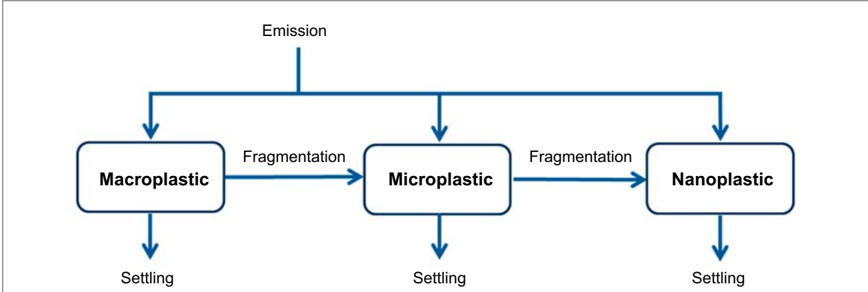
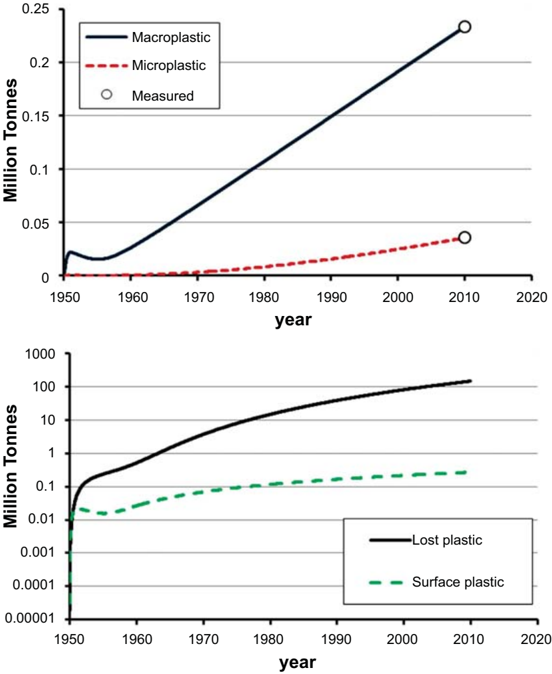
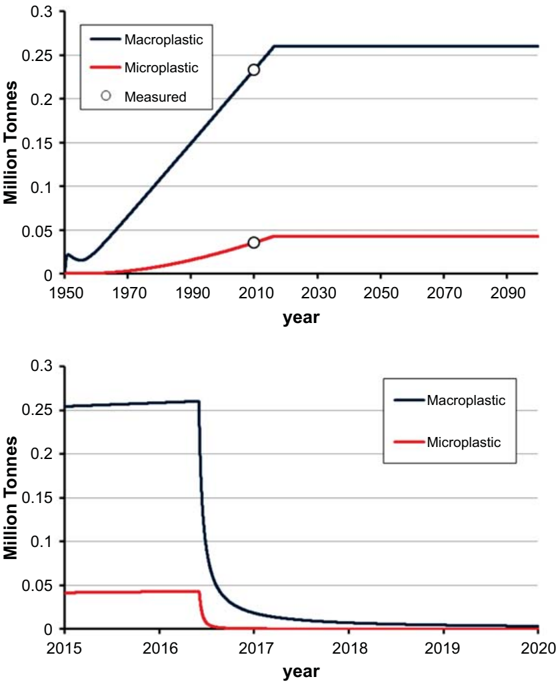
Understanding the global mass inventory is one of the main challenges in present research on plastic marine debris. Especially the fragmentation and vertical transport processes of oceanic plastic are poorly understood. However, whereas fragmentation rates are unknown, information on plastic emissions, concentrations of plastics in the ocean surface layer (OSL) and fragmentation mechanisms is available. Here, we apply a systems engineering analytical approach and propose a tentative 'whole ocean' mass balance model that combines emission data, surface area-normalized plastic fragmentation rates, estimated concentrations in the OSL, and removal from the OSL by sinking. We simulate known plastic abundances in the OSL and calculate an average whole ocean apparent surface area-normalized plastic fragmentation rate constant, given representative radii for macroplastic and microplastic. Simulations show that 99.8% of the plastic that had entered the ocean since 1950 had settled below the OSL by 2016, with an additional 9.4 million tons settling per year. In 2016, the model predicts that of the 0.309 million tons in the OSL, an estimated 83.7% was macroplastic, 13.8% microplastic, and 2.5% was < 0.335 mm 'nanoplastic'. A zero future emission simulation shows that almost all plastic in the OSL would be removed within three years, implying a fast response time of surface plastic abundance to changes in inputs. The model complements current spatially explicit models, points to future experiments that would inform critical model parameters, and allows for further validation when more experimental and field data become available.
Overview
The claims and statistics of this paper haven’t been checked yet.
Free: it reads the open-access text and checks the first 5 claims that cite a source we can check. Create a free account to check every claim.
Integrity signals
Registry
Cites
Statistics
Figures
Verification
Claims the paper makes
The claims and statistics of this paper haven’t been checked yet.
Free: it reads the open-access text and checks the first 5 claims that cite a source we can check. Create a free account to check every claim.
Self-check
Percentages, sums and reported differences re-computed from the paper’s own numbers.
The self-check needs the paper’s full text.
Citations
Cites
Lost at sea: where is all the plastic?
Thompson, R. C., Olsen, Y., Mitchell, R. P., Davis, A., Rowland, S. J., John, A. W. G., McGonigle, D., & Russell, A. E. (2004) · Science · doi:10.1126/science.1094559 · Cited by 7,765 · cited 3×
“This approach complements recent studies that estimate the global inventory from the bottomup using ocean measurements (Thompson et al 2004, Eriksen et al 2014, Cózar et al 2014, van Sebille et al 2015).”
BackgroundEriksen, M., Lebreton, L. C. M., Carson, H. S., Thiel, M., Moore, C. J., Borerro, J. C., Galgani, F., Ryan, P. G., & Reisser, J. (2014) · PLoS ONE · doi:10.1371/journal.pone.0111913 · Cited by 4,710 · cited 7×
“There is much uncertainty in the limited data on abundance of plastic debris in the oceans (Eriksen et al 2014, Cózar et al 2014, Van Sebille et al 2015).”
BackgroundMethodInfluential(2015) · Springer eBooks · doi:10.1007/978-3-319-16510-3 · Cited by 3,502
de Boyer Montégut, C., Madec, G., Fischer, A. S., Lazar, A., & Iudicone, D. (2004) · Journal of Geophysical Research: Oceans · doi:10.1029/2004jc002378 · Cited by 3,182 · cited 1×
“A range of 10– 100 m applies to the vast majority of locations in the world oceans (de Boyer Montégut et al 2004).”
BackgroundPlastic debris in the open ocean
Cózar, A., Echevarría, F., González-Gordillo, J. I., Irigoien, X., Úbeda, B., Hernández-León, S., Palma, Á. T., Navarro, S., García-de-Lomas, J., Ruiz, A., et al. (2014) · Proceedings of the National Academy of Sciences · doi:10.1073/pnas.1314705111 · Cited by 3,133 · cited 5×
“There is much uncertainty in the limited data on abundance of plastic debris in the oceans (Eriksen et al 2014, Cózar et al 2014, Van Sebille et al 2015).”
BackgroundInfluentialMicroplastic ingestion by zooplankton
Cole, M., Lindeque, P., Fileman, E., Halsband, C., Goodhead, R., Moger, J., & Galloway, T. S. (2013) · Environmental Science & Technology · doi:10.1021/es400663f · Cited by 2,763 · cited 1×
“Cole et al 2013, Choy and Drazen 2013, Van Franeker et al 2011b) and return to the OSL, which would result in a time-delay in the OSL abundance that can be assumed tobe small and relatively constant in time.”
BackgroundA global inventory of small floating plastic debris
van Sebille, E., Wilcox, C., Lebreton, L., Maximenko, N., Hardesty, B. D., van Franeker, J. A., Eriksen, M., Siegel, D., Galgani, F., & Law, K. L. (2015) · Environmental Research Letters · doi:10.1088/1748-9326/10/12/124006 · Cited by 1,713 · cited 6×
“There is much uncertainty in the limited data on abundance of plastic debris in the oceans (Eriksen et al 2014, Cózar et al 2014, Van Sebille et al 2015).”
BackgroundInfluentialSelf-citationKoelmans, A. A., Bakir, A., Burton, G. A., & Janssen, C. R. (2016) · Environmental Science & Technology · doi:10.1021/acs.est.5b06069 · Cited by 1,599 · cited 1×
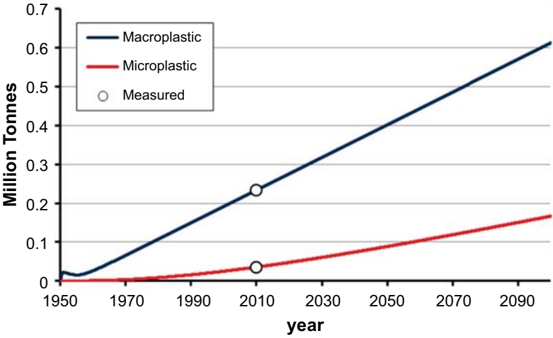
“The BAU scenario assumes that annual plastic production and leakage/emission continue to increase according to the polynomial parameters derived from 1950–2013 data (PlasticsEurope 2013, Koelmans et al 2016).”
Self-citationIngestion of Microplastics by Zooplankton in the Northeast Pacific Ocean
Desforges, J.-P. W., Galbraith, M., & Ross, P. S. (2015) · Archives of Environmental Contamination and Toxicology · doi:10.1007/s00244-015-0172-5 · Cited by 1,019
Ups and Downs in the Ocean: Effects of Biofouling on Vertical Transport of Microplastics
Kooi, M., Nes, E. H. V., Scheffer, M., & Koelmans, A. A. (2017) · Environmental Science & Technology · doi:10.1021/acs.est.6b04702 · Cited by 977 · cited 4×
“Furthermore, it is known that chemical degradation of polymers results in weakening and fragmentation, and that biological colonization and aggregation can induce sinking of buoyant polymers (Kooi et al 2017).”
BackgroundResultInfluentialSelf-citationDeleterious Effects of Litter on Marine Life
Kühn, S., Bravo Rebolledo, E. L., & van Franeker, J. A. (2015) · Marine Anthropogenic Litter · doi:10.1007/978-3-319-16510-3_4 · Cited by 856 · cited 1×
“…to the heterogeneity of plastics and the wide variety of associated chemical contaminants, the (toxic) effect mechanisms are manifold, causing widely differing responses in individuals and species with different biological traits (Diepens et al 2015, Rico and van den Brink 2015, Kühn et al 2015).”
BackgroundEnders, K., Lenz, R., Stedmon, C. A., & Nielsen, T. G. (2015) · Marine Pollution Bulletin · doi:10.1016/j.marpolbul.2015.09.027 · Cited by 775 · cited 1×
“This requires more and better data on the abundance of plastic debris, also for the smaller size classes (e.g. Song et al 2014, Enders et al 2015, Kanhai et al 2017).”
BackgroundGlobal Distribution, Composition and Abundance of Marine Litter
Galgani, F., Hanke, G., & Maes, T. (2015) · Marine Anthropogenic Litter · doi:10.1007/978-3-319-16510-3_2 · Cited by 732 · cited 1×
“Published by IOP Publishing Ltd hundreds of kilometers, with considerable uncertainty in the processes governing distributions between ocean surface, water column and deep sea sediments (Galgani et al2015).”
BackgroundInteractions between microplastics and phytoplankton aggregates: Impact on their respective fates
Long, M., Moriceau, B., Gallinari, M., Lambert, C., Huvet, A., Raffray, J., & Soudant, P. (2015) · Marine Chemistry · doi:10.1016/j.marchem.2015.04.003 · Cited by 711 · cited 2×
“Microplastics incorporated into biological aggregates have been reported to slow the settling rate by reducing their density (Long et al 2015, Cole et al 2016).”
BackgroundMicroplastics Alter the Properties and Sinking Rates of Zooplankton Faecal Pellets
Cole, M., Lindeque, P. K., Fileman, E., Clark, J., Lewis, C., Halsband, C., & Galloway, T. S. (2016) · Environmental Science & Technology · doi:10.1021/acs.est.5b05905 · Cited by 683 · cited 3×
“Alternatively, egested plastics are known to settle in fecal pellets (Cole et al 2016), which is accounted for in assumption 7.”
BackgroundInfluentialPersistence of Plastic Litter in the Oceans
Andrady, A. L. (2015) · Marine Anthropogenic Litter · doi:10.1007/978-3-319-16510-3_3 · Cited by 667 · cited 1×
“Plastic items and particles tend to sink and change properties over time due to weathering, embrittlement, fragmentation and fouling (Andrady 2015), processes whose rates are poorly known.”
BackgroundNanoplastics in the Aquatic Environment. Critical Review
Koelmans, A. A., Besseling, E., & Shim, W. J. (2015) · Marine Anthropogenic Litter · doi:10.1007/978-3-319-16510-3_12 · Cited by 648 · cited 1×
“Nanoplastics in the OSL (NP𝑡) are assumed to be formed from fragmentation of microplastics (Koelmans et al 2015) (third term in equation (2)) and are assumed to be removed from the OSL by heteroaggregationsedimentation (Peijnenburg et al 2015).”
BackgroundSelf-citationMonitoring plastic ingestion by the northern fulmar Fulmarus glacialis in the North Sea
van Franeker, J. A., Blaize, C., Danielsen, J., Fairclough, K., Gollan, J., Guse, N., Hansen, P.-L., Heubeck, M., Jensen, J.-K., Le Guillou, G., et al. (2011) · Environmental Pollution · doi:10.1016/j.envpol.2011.06.008 · Cited by 646 · cited 4×
“There is much uncertainty in the limited data on abundance of plastic debris in the oceans (Eriksen et al 2014, Cózar et al 2014, Van Sebille et al 2015).”
BackgroundInfluentialLarge Accumulation of Micro-sized Synthetic Polymer Particles in the Sea Surface Microlayer
Song, Y. K., Hong, S. H., Jang, M., Kang, J.-H., Kwon, O. Y., Han, G. M., & Shim, W. J. (2014) · Environmental Science & Technology · doi:10.1021/es501757s · Cited by 609 · cited 2×
“We calibrated the model using data provided by Eriksen et al (2014), who estimated both macroplastic and microplastic abundances based on recent available data. Parameters k) and * MI + were optimized until MA" and MI" for 2010 matched the data provided by Eriksen et al (2014). For the future, three additional hypothe…”
MethodKanhai, L. D. K., Officer, R., Lyashevska, O., Thompson, R. C., & O'Connor, I. (2017) · Marine Pollution Bulletin · doi:10.1016/j.marpolbul.2016.12.025 · Cited by 438 · cited 1×
“This requires more and better data on the abundance of plastic debris, also for the smaller size classes (e.g. Song et al 2014, Enders et al 2015, Kanhai et al 2017).”
BackgroundPlastic ingestion by mesopelagic fishes in the North Pacific Subtropical Gyre
Davison, P., & Asch, R. (2011) · Marine Ecology Progress Series · doi:10.3354/meps09142 · Cited by 426
Risks of Plastic Debris: Unravelling Fact, Opinion, Perception, and Belief
Koelmans, A. A., Besseling, E., Foekema, E., Kooi, M., Mintenig, S., Ossendorp, B. C., Redondo-Hasselerharm, P. E., Verschoor, A., van Wezel, A. P., & Scheffer, M. (2017) · Environmental Science & Technology · doi:10.1021/acs.est.7b02219 · Cited by 381 · cited 1×
“Uncertainty in model parameters and predictions Uncertainty and variability in data is considered as one of the main factors hampering a realistic assessment of risks associated with plastic debris (Koelmans et al 2017).”
BackgroundSelf-citationSeabirds, gyres and global trends in plastic pollution
van Franeker, J. A., & Law, K. L. (2015) · Environmental Pollution · doi:10.1016/j.envpol.2015.02.034 · Cited by 305 · cited 1×
“That plastics disappear from the sea surface on relatively short time scales is consistent with recent observations showing a steep reduction in pre-production plastic pellets since the 1980s in both the North Atlantic subtropical gyre and in North Sea fulmars (Van Franeker and Law 2015).”
Self-citationHardesty, B. D., Harari, J., Isobe, A., Lebreton, L., Maximenko, N., Potemra, J., van Sebille, E., Vethaak, A. D., & Wilcox, C. (2017) · Frontiers in Marine Science · doi:10.3389/fmars.2017.00030 · Cited by 262 · cited 1×
“Hence, closing the global inventory of ocean plastics is one of the main challenges in present research on marine debris (Thompson et al 2004, Hardesty et al 2017).”
BackgroundVariability in the average sinking velocity of marine particles
McDonnell, A. M. P., & Buesseler, K. O. (2010) · Limnology and Oceanography · doi:10.4319/lo.2010.55.5.2085 · Cited by 257
Choy, C., & Drazen, J. (2013) · Marine Ecology Progress Series · doi:10.3354/meps10342 · Cited by 238
Peijnenburg, W. J. G. M., Baalousha, M., Chen, J., Chaudry, Q., Von der kammer, F., Kuhlbusch, T. A. J., Lead, J., Nickel, C., Quik, J. T. K., Renker, M., et al. (2015) · Critical Reviews in Environmental Science and Technology · doi:10.1080/10643389.2015.1010430 · Cited by 208 · cited 1×
“Nanoplastics in the OSL (NP𝑡) are assumed to be formed from fragmentation of microplastics (Koelmans et al 2015) (third term in equation (2)) and are assumed to be removed from the OSL by heteroaggregationsedimentation (Peijnenburg et al 2015).”
BackgroundSelf-citationPlastics and Environmental Sustainability
Andrady, A. L. (2015) · Wiley eBooks · doi:10.1002/9781119009405 · Cited by 196 · cited 1×
“Plastic items and particles tend to sink and change properties over time due to weathering, embrittlement, fragmentation and fouling (Andrady 2015), processes whose rates are poorly known.”
BackgroundPlastic debris and policy: Using current scientific understanding to invoke positive change
Rochman, C. M., Cook, A.-M., & Koelmans, A. A. (2016) · Environmental Toxicology and Chemistry · doi:10.1002/etc.3408 · Cited by 148 · cited 1×
“Contamination of the marine environment with plastic debris has received considerable interest from the public, policymakers and the scientific community (Rochman et al 2016).”
BackgroundSelf-citationRico, A., & den Brink, P. J. V. (2015) · Environmental Toxicology and Chemistry · doi:10.1002/etc.3008 · Cited by 145
Rapid settling of nanoparticles due to heteroaggregation with suspended sediment
Velzeboer, I., Quik, J. T. K., van de Meent, D., & Koelmans, A. A. (2014) · Environmental Toxicology and Chemistry · doi:10.1002/etc.2611 · Cited by 106 · cited 1×
“If aggregation is sufficiently fast, the latter process can be approximated by first order removal (Quik et al 2014) whereas the settling aggregate flocs can be assumed to have the same settling rate from the OSL as microplastics (with settling rate 𝑉 MI 𝑆 ) (Velzeboer et al 2014).”
BackgroundSelf-citationQuik, J. T. K., van de Meent, D., & Koelmans, A. A. (2014) · Water Research · doi:10.1016/j.watres.2014.05.048 · Cited by 76 · cited 1×
“If aggregation is sufficiently fast, the latter process can be approximated by first order removal (Quik et al 2014) whereas the settling aggregate flocs can be assumed to have the same settling rate from the OSL as microplastics (with settling rate 𝑉 MI 𝑆 ) (Velzeboer et al 2014).”
BackgroundSelf-citationPosthuma, L., Eijsackers, H. J. P., Koelmans, A. A., & Vijver, M. G. (2008) · The Science of The Total Environment · doi:10.1016/j.scitotenv.2008.06.065 · Cited by 52 · cited 1×
“Within the context of ERAs for traditional ecological stressors, tiered approaches are frequently used (Posthuma et al 2008).”
Self-citationDiepens, N. J., Van den Heuvel-Greve, M. J., & Koelmans, A. A. (2015) · Environmental Science & Technology · doi:10.1021/acs.est.5b02500 · Cited by 37 · cited 1×
“…to the heterogeneity of plastics and the wide variety of associated chemical contaminants, the (toxic) effect mechanisms are manifold, causing widely differing responses in individuals and species with different biological traits (Diepens et al 2015, Rico and van den Brink 2015, Kühn et al 2015).”
BackgroundSelf-citationReshape and relocate: seabirds as transformers and transporters of microplastics
van Franeker, J. A. (2011) · Socio-Environmental Systems Modeling · Cited by 13
Research works printed but not linked: 2
- Plastics—the Facts, 2013, An Analysis of European Latest Plastics Production Demand and Waste Data
- Van Franeker J A, 2011, NOAA Technical Memorandum
Cited by
The global threat from plastic pollution
MacLeod, M., Arp, H. P. H., Tekman, M. B., & Jahnke, A. (2021) · Science · doi:10.1126/science.abg5433 · Cited by 2,951
Hartmann, N. B., Hüffer, T., Thompson, R. C., Hassellöv, M., Verschoor, A., Daugaard, A. E., Rist, S., Karlsson, T., Brennholt, N., Cole, M., et al. (2019) · Environmental Science & Technology · doi:10.1021/acs.est.8b05297 · Cited by 2,881
Marine microplastic debris: An emerging issue for food security, food safety and human health
Barboza, L. G. A., Dick Vethaak, A., Lavorante, B. R. B. O., Lundebye, A.-K., & Guilhermino, L. (2018) · Marine Pollution Bulletin · doi:10.1016/j.marpolbul.2018.05.047 · Cited by 1,591
Qi, Y., Yang, X., Pelaez, A. M., Huerta Lwanga, E., Beriot, N., Gertsen, H., Garbeva, P., & Geissen, V. (2018) · Science of The Total Environment · doi:10.1016/j.scitotenv.2018.07.229 · Cited by 1,216
“, 2016b; Rillig, 2012; Zubris and Richards, 2005), most of the research done so far has been focused on microplastics in the aquatic ecosystem (Auta et al., 2017; Cole et al., 2011; Duis and Coors, 2016; Eerkes-Medrano et al., 2015; Koelmans et al., 2014; Koelmans et al., 2017; Nizzetto et al., 2016b).”
BackgroundRisk assessment of microplastic particles
Koelmans, A. A., Redondo-Hasselerharm, P. E., Nor, N. H. M., de Ruijter, V. N., Mintenig, S. M., & Kooi, M. (2022) · Nature Reviews Materials · doi:10.1038/s41578-021-00411-y · Cited by 1,140
Self-citation
Metadata
- Authors
- Koelmans, A. A., Kooi, M., Law, K. L., & van Sebille, E.
- Affiliations
- Wageningen Marine Research (NL)
- Wageningen University & Research (NL)
- Sea Education Association (US)
- Corresponding author
- Koelmans, Albert A
- Venue
- Environmental Research Letters
- Publisher
- IOP Publishing
- Published
- 2017-11-01
- Volume
- 12
- Issue
- 11
- Pages
- 114028
- ISSN
- 1748-9326 (ISSN-L)
- OpenAlex
- W2767179800
- Cited by
- 396
- References
- 35
- Citations by year
- 2026: 31 · 2025: 47 · 2024: 58 · 2023: 48 · 2022: 55 · 2021: 58 · 2020: 50 · 2019: 32 · 2018: 16
- FWCI
- 12.07
- Type
- journal article
- Language
- en
- Open access
- gold
- doi.org
- Licence
- cc-by
- iopscience.iop.org/info/page/text-and-data-mining (tdm, 9 d)
- creativecommons.org/licenses/by/3.0/ (vor, 9 d)
- Locations
- Environmental Research Letters (publishedVersion, cc-by)
- Socio-Environmental Systems Modeling (acceptedVersion, cc-by)
- DOAJ (DOAJ: Directory of Open Access Journals) (submittedVersion)
- Utrecht University Repository (Utrecht University) (submittedVersion, other-oa)
- Spiral (Imperial College London) (submittedVersion, cc-by)
- Data Archiving and Networked Services (DANS) (submittedVersion, cc-by)
- Funders
- National Science Foundation (OCE-1260403)
- European Research Council (grant agreement No 715386)
- Topics
- Physical Sciences › Environmental Science › Pollution › Microplastics and Plastic Pollution
- Physical Sciences › Earth and Planetary Sciences › Oceanography › Marine Plankton and Biogeochemistry
- Physical Sciences › Environmental Science › Pollution › Oil Spill Detection and Mitigation
- Keywords
- marine plastic debris, mass balance, ocean surface layer, vertical transport, plastic emissions
About these checks
Registry, retraction, Cites and statistics results are computed, not judged, with one exception: a printed reference that no index lists is read once by a model before it counts as a citation error. Claims are extracted by a model and kept only when their quote appears verbatim in the text; each cited source is then checked, with a model’s help, for whether it says what the claim relies on. Those verdicts can be wrong — read the claim’s quote and the cited source before relying on one.
Statistics and arithmetic are recomputed, not judged.
Confidence bands are shown only for fields calibrated on our annotated test set. None is calibrated yet, so no band is shown.
What counts as a claim ›How we measure confidence ›How we check this ›
Are you an author, or do you see a problem with this page? Request a review
Data sources
Bibliographic data: Semantic Scholar, OpenAlex, Crossref.
Contains information from the Semantic Scholar Academic Graph Datasets, made available under the ODC Attribution License (ODC-BY 1.0).
Semantic Scholar’s data is described in: Kinney, R., et al. (2023). The Semantic Scholar Open Data Platform. arXiv:2301.10140.
