

The growing importance of scope 3 greenhouse gas emissions from industry
Open accessThe DOI matches its Crossref record; 57 of the 57 references it cites were found in a registry or an index.
Abstract
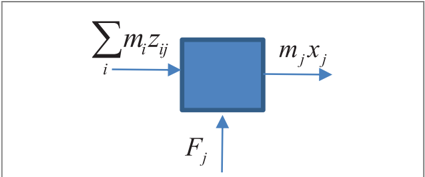
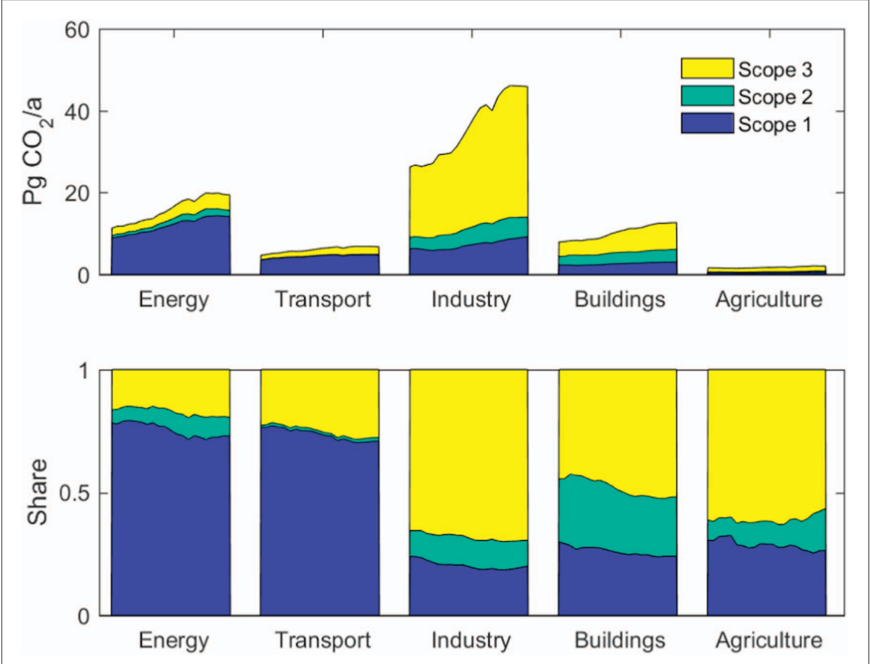
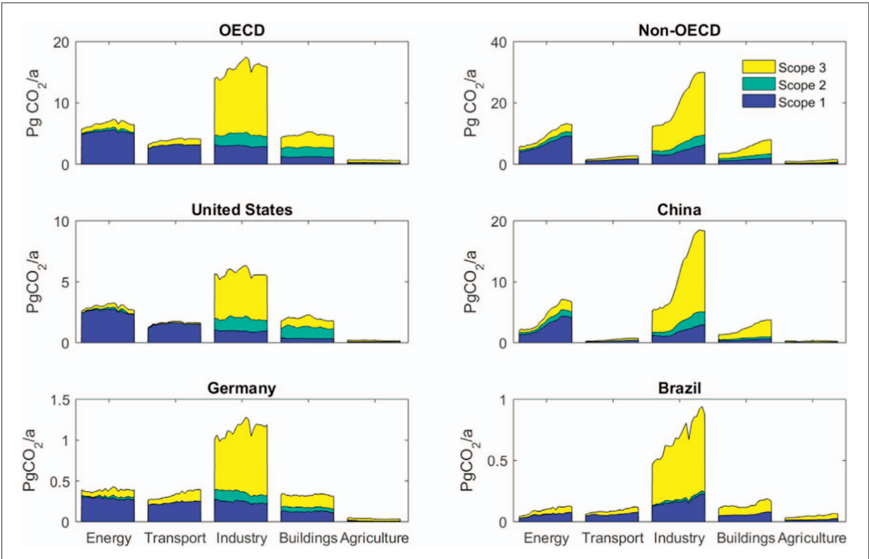
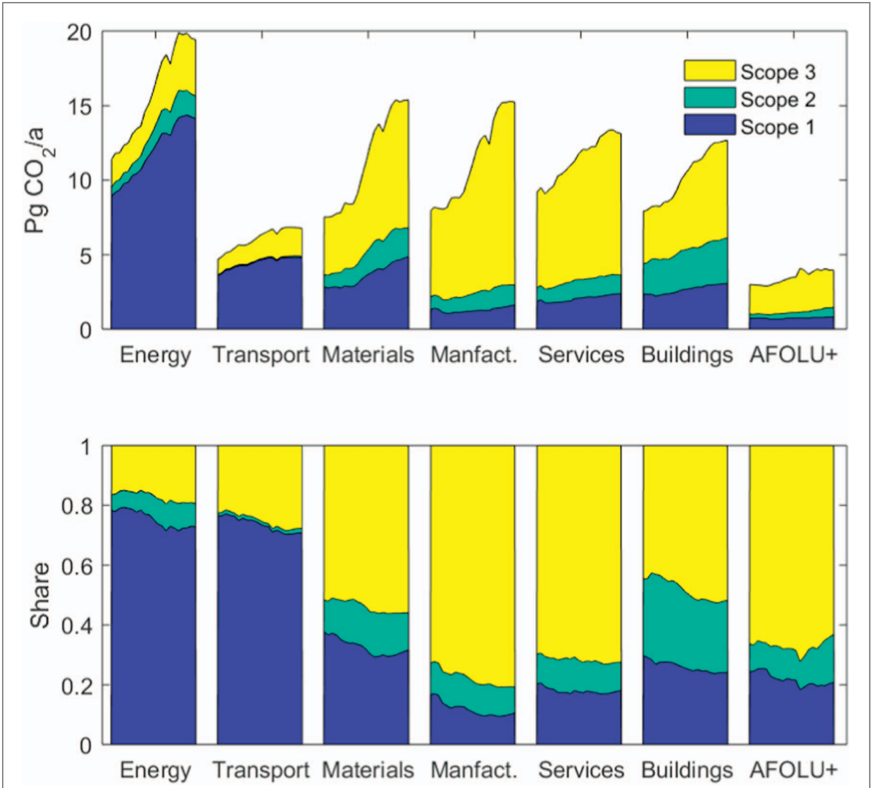
Carbon reporting is increasingly focussing on indirect emissions that occur in the supply chain of establishments. The GHG protocol, a corporate standard, distinguishes scope 2 (emissions associated with electricity consumption) and scope 3 (emissions associated with other inputs), in addition to scope 1 emissions (occurring directly at the facility or company in question). However, the magnitude and growth trajectory of scopes 2 and 3 emissions at the economy-wide level is unknown. Here we conduct an input–output investigation of indirect carbon dioxide (CO 2 ) emissions for the global economy organized in five sectors—energy supply, transport, industry, buildings, and agriculture and forestry—as defined by the Intergovernmental Panel on Climate Change (IPCC). In comparison to previous work that looks at indirect emissions of consumption, we present the first economy-wide analysis of indirect emissions of gross production. The goal of the work is thus to capture the potential agency different sectors have over supply chain emissions, rather allocating emissions between production and consumption. Between 1995 and 2015, global scopes 1, 2, and 3 emissions grew by 47%, 78%, and 84%, to 32, 10, and 45 Pg CO 2 , respectively. Globally, the industry sector was most important with scope 2 emissions of 5 Pg and scope 3 emissions of 32 Pg. For buildings, scope 3 emissions of 7 Pg were twice as high as direct emissions. Industry and buildings stood in marked contrast to energy and transport, where direct emissions accounted for >70% of total emissions responsibility. Most of the growth happened in developing countries. The proposed analysis scheme could improve the integration of sector chapters in future IPCC reports.
Overview
The claims and statistics of this paper haven’t been checked yet.
Free: it reads the open-access text and checks the first 5 claims that cite a source we can check. Create a free account to check every claim.
Integrity signals
Registry
Cites
Statistics
Figures



Verification
Claims the paper makes
The claims and statistics of this paper haven’t been checked yet.
Free: it reads the open-access text and checks the first 5 claims that cite a source we can check. Create a free account to check every claim.
Claims other papers make about this one
Each is checked against this paper’s own text: does it say what the citing paper says it does?
The source backs part of the claim, not all of it — or backs it for a different population, condition or comparison.
In the citing paper
“Materials constituted 55% of the carbon footprint of vehicle and transport equipment manufacturing of 1.6 Gt [27,42,119].”
From Material efficiency strategies to reducing greenhouse gas emissions associated with buildings, vehicles, and electronics—a review (2019) · cites this paper as [42]
Experimental — accuracy not yet measuredThe cited source says what the claim attributes to it.
In the citing paper
“GHGemissions can be added along the supply chain to calculate the carbon footprint or embodied emissions of a product (1, 49).”
From Carbon Leakage, Consumption, and Trade (2022) · cites this paper as [49]
In the citing paper
“According to EXIO-BASE, production of materials (figure 3) accounted for 56% of the carbon footprint of the construction sector, or 3.3 Gt CO 2 [42].”
From Material efficiency strategies to reducing greenhouse gas emissions associated with buildings, vehicles, and electronics—a review (2019) · cites this paper as [42]
Self-check
Percentages, sums and reported differences re-computed from the paper’s own numbers.
The self-check needs the paper’s full text.
Citations
Cites
Change, I. P. O. C. (2015) · Cambridge University Press eBooks · doi:10.1017/cbo9781107415416 · Cited by 4,693
Climate change 2014 : mitigation of climate change
Edenhofer, O., Pichs-Madruga, R., & Sokona, Y. (2014) · University of North Texas Digital Library (University of North Texas) · Cited by 1,975
Carbon Footprint of Nations: A Global, Trade-Linked Analysis
Hertwich, E. G., & Peters, G. P. (2009) · Environmental Science & Technology · doi:10.1021/es803496a · Cited by 1,715
Self-citationComparative Environmental Life Cycle Assessment of Conventional and Electric Vehicles
Hawkins, T. R., Singh, B., Majeau‐Bettez, G., & Strømman, A. H. (2013) · Journal of Industrial Ecology · doi:10.1111/j.1530-9290.2012.00532.x · Cited by 1,670
Growth in emission transfers via international trade from 1990 to 2008
Peters, G. P., Minx, J. C., Weber, C. L., & Edenhofer, O. (2011) · Proceedings of the National Academy of Sciences · doi:10.1073/pnas.1006388108 · Cited by 1,599
The material footprint of nations
Wiedmann, T. O., Schandl, H., Lenzen, M., Moran, D., Suh, S., West, J., & Kanemoto, K. (2015) · Proceedings of the National Academy of Sciences · doi:10.1073/pnas.1220362110 · Cited by 1,597
Household actions can provide a behavioral wedge to rapidly reduce US carbon emissions
Dietz, T., Gardner, G. T., Gilligan, J., Stern, P. C., & Vandenbergh, M. P. (2009) · Proceedings of the National Academy of Sciences · doi:10.1073/pnas.0908738106 · Cited by 1,450
Emerging approaches, challenges and opportunities in life cycle assessment
Hellweg, S., & Milà i Canals, L. (2014) · Science · doi:10.1126/science.1248361 · Cited by 1,416
CO2Embodied in International Trade with Implications for Global Climate Policy
Peters, G. P., & Hertwich, E. G. (2008) · Environmental Science & Technology · doi:10.1021/es072023k · Cited by 1,243
Self-citationInternational trade drives biodiversity threats in developing nations
Lenzen, M., Moran, D., Kanemoto, K., Foran, B., Lobefaro, L., & Geschke, A. (2012) · Nature · doi:10.1038/nature11145 · Cited by 1,238
Research works printed but not linked: 3
- Bhatia P, 2011, Corporate Value Chain (Scope 3) Accounting and Reporting Standard
- Lenzen M, 2004, J. Appl. Input-Output Anal., 10, 1
- Bruckner T ed Edenhofer O, 2014, Climate Change 2014: Mitigation of Climate Change
Cited by
Items 301–400 of 490
Nicolajsen, A. B., Bjørn, A., McAloone, T. C., & Pigosso, D. C. A. (2025) · Proceedings of the 6th Product Lifetimes and the Environment Conference (PLATE2025) · doi:10.54337/plate2025-10312 · Cited by 1
Rehman, M. U., & Bertoni, A. (2025) · Proceedings of the Design Society · doi:10.1017/pds.2025.10259 · Cited by 1
“…that are owned or controlled by the company (e.g. emission from facilities, vehicles, and fuel burnt by ships during construction and sea trial) (Hertwich & Wood, 2018); Scope 2 involves the indirect emissions from the generation of purchased power (Roston, 2021), steam, heating, and cooling by…”
Carbon Footprint of the Recent Bioenergy Crop Sugarcane Transition in Bolivia and Outlook to 2028
Mercado, V. S. V., Silva, J. F. L., & Tovar, L. P. (2024) · Chemical engineering transactions · doi:10.3303/cet24109074 · Cited by 1
baitong, L., jian, L., & Yan, T. (2023) · Research Square · doi:10.21203/rs.3.rs-3080513/v1 · Cited by 1
Pineau, E., & Estran, R. (2024) · SSRN Electronic Journal · doi:10.2139/ssrn.5054144 · Cited by 1
Multi-Counting in Scope 1, 2, and 3 Upstream EmissionsPreprint
O’Kane, D. (2025) · SSRN Electronic Journal · doi:10.2139/ssrn.5257413 · Cited by 1
Brown, E. A., Hsu, A., & Manya, D. (2025) · Research Square · doi:10.21203/rs.3.rs-6802349/v1 · Cited by 1
Deciphering the global production network from cross-border firm transactionsPreprint
O’Clery, N., Radcliffe-Brown, B., Spencer, T., & Tarling-Hunter, D. (2025) · arXiv (Cornell University) · doi:10.48550/arxiv.2508.12315 · Cited by 1
“To capture production complexity, we adopt an approach proposed by Hidalgo and Hausmann [2009] to infer product complexity (PCI) from patterns of geographical production.”
Kunkel, S. (2023) · Publication Database IASS (Institute for Advanced Sustainability Studies (IASS)) · doi:10.25932/publishup-61395 · Cited by 1
Sustainable Industrial Packaging : Elevating Supply Chain Circularity and Business Competitiveness
Silva, N. (2024) · Lund University Publications (Lund University) · Cited by 1
Comparative sustainability assessment of bio-based vs mineral-based hydraulic oils.
Makinde, D. O. (2025) · DiVA (Digitala Vetenskapliga Arkivet) · Cited by 1
Essays on climate finance transition risk
Nguyễn, Q. (2021) · Otago University Research Archive (University of Otago) · Cited by 1
Smit, R. J. (2024) · mediaTUM (Technical University of Munich) · Cited by 1
Equal transitions towards carbon neutrality
Sun, X. (2025) · UCL Discovery (University College London) · Cited by 1
Šoba, M. (2023) · Repository of the University of Ljubljana (University of Ljubljana) · Cited by 1
Billedeau, D. B. (2024) · UWSpace (University of Waterloo) · Cited by 1
Utilizing the Environmental Advantages in the Sales Process
Jetsu, R. (2023) · Tampere University Institutional Repository (Tampere University) · Cited by 1
How to communicate effectively to foster climate action
Linczenyiova, E., Etchanchu, H., Kassardjian, E., & Jahier, A. (2021) · ORBi UMONS · Cited by 1
Adams, C. A. (2016) · Swinburne figshare (Swinburne University of Technology)
Transport externalities of bus stations produced by Greenhouse Gas (GHG)
Suárez, M. A. C., Ávila, E. M. B., Cevallos, E. P. V., & Robalino, O. E. R. (2020) · E3S Web of Conferences · doi:10.1051/e3sconf/202016704001
Lagos, D. C., Mancilla, R., Leal, P., & Fox, F. E. (2020) · IOP Conference Series Earth and Environmental Science · doi:10.1088/1755-1315/503/1/012045
The significance of municipal energy related actions when aiming at carbon neutral cities
Laine, J. (2021) · Opin vísindi (Opin vísindi)
Sustainability scores for portfolio performance
Stern, F. (2020) · KTH Publication Database DiVA (KTH Royal Institute of Technology)
The Global Dissemination to Multinationals of the Carbon Emissions Ruling on ShellPreprint
Santiago, L. A. L., Arce, G., Cadarso, M., Ortiz, M., & Zafrilla, J. E. (2022) · SSRN Electronic Journal · doi:10.2139/ssrn.4072559
State-led carbon data value chain development: a case study of the Republic of KoreaPreprint
In, S. Y., Zegas, G., & Baek, Y. J. (2022) · SSRN Electronic Journal · doi:10.2139/ssrn.4112884
Dijmǎrescu, E., Maftei, M., & Fogoroş, T. E. (2022) · Proceedings of the ... International Conference on Business Excellence · doi:10.2478/picbe-2022-0105
Diffusion in dynamic networks with time-varying inputs to allocate responsibilityPreprint
van den Ende, R., & Mermoud, D. L. (2023) · arXiv (Cornell University) · doi:10.48550/arxiv.2301.02728
“…proportion of the carbon emissions associated with a given firm takes place elsewhere in its supply chain - for example, during the manufacturing process that has been outsourced to another country, during the extraction phase of raw materials, or during the end-of-life disposal of a product [25].”
VCA, a method for mapping and neutralizing the environmental impact of a company's value chain
van Moort, M. R., Toxopeus, M. E., & Jokic, S. (2023) · Procedia CIRP · doi:10.1016/j.procir.2023.02.093
Shaw, A., Chetty, K., Chan, T. F., Lindsey, E., Kadava, A., & Stevenson, B. (2023) · IWA Publishing eBooks · doi:10.2166/9781789063738_0039
García-Velásquez, C. (2023) · Research Publications (Maastricht University) · doi:10.26481/dis.20230908cv
Putri, W. H., & Bakhtiar, I. (2023) · E3S Web of Conferences · doi:10.1051/e3sconf/202346705005
Schulte, S. (2024) · Earth system science data · doi:10.5194/essd-2023-473-ac3
Organizational Responses to Societal Demands and Their Implications for Environmental Performance
Dembetembe, G. G., Avidan, M., & Walls, J. L. (2024) · Academy of Management Proceedings · doi:10.5465/amproc.2024.16576abstract
Zero-emission scenario for Dutch industry
OECD (2021) · OECD eBooks · doi:10.1787/fa067b82-en
Energy Efficiency Process Improvement in the Indian Real Estate Industry
Ariyil, P., & Weerakoon, T. G. (2024) · Baltic Journal of Real Estate Economics and Construction Management · doi:10.2478/bjreecm-2024-0011
de Sena, K. A. C., Neto, M. P. M., Dinamarco, V. M., & Delai, A. P. D. (2024) · Anais do 60º Congresso da Sociedade Brasileira de Economia, Administração e Sociologia Rural (SOBER) · doi:10.29327/62-congresso-da-sober-397784.818891
Carbon pricing and the labour market
Fugazza, M. (2024) · Edward Elgar Publishing eBooks · doi:10.4337/9781035348466.00011
Supply-chain decarbonization: A crucial requirement to achieve Net-Zero
Thanawala, Z. (2022) · International Journal of Multidisciplinary Research and Growth Evaluation · doi:10.54660/.ijmrge.2021.3.1.607-612
“Although these emissions are indirect, they are a significant part of an organization’s carbon footprint, especially in industries heavily reliant on electricity (Hertwich & Wood, 2018) [5] .”
Lessons Learned About Scope 3 Emissions from Companies Serving the Oil and Gas Industry
Lima, L. J. B., Persch, M., Borchardt, M., Chaves, B. T., & Milan, G. S. (2025) · Springer proceedings in mathematics & statistics · doi:10.1007/978-3-031-80785-5_25
Measuring emission intensity of jobs identifies distinct sector challenges for climate policyPreprint
Hansen, O. W., & Koslowski, M. (2025) · OSF Preprints (OSF Preprints) · doi:10.31219/osf.io/wz8tc_v1
Sostenibilidad y Eficiencia: La estrategia de LVMH para reducir su huella de carbono
Vázquez, B. L., Fernández, M., & Rangel, C. (2025) · SOCIAL REVIEW International Social Sciences Review / Revista Internacional de Ciencias Sociales · doi:10.62701/revsocial.v13.5418
Luo, R., Geng, Q., Shi, C., & Dang, C. (2026) · Journal of Industrial Ecology · doi:10.1007/s44498-026-00105-0
“However, industry-specific variations indicate that a uniform approach is insufficient: Information Technology and Indus-trials benefit from extending supplier engagement to Tier 2, while Utilities and Materials can focus more narrowly on direct suppliers (Hertwich & Wood, 2018).”
Disapproval: A Real Danger for Fossil Fuel Companies?Preprint
Cellou, M., & Rainelli-Weiss, H. (2025) · SSRN Electronic Journal · doi:10.2139/ssrn.5349464
Emissions Accounting in Global Supply Chains: An Input-Output Model ApproachPreprint
O’Kane, D. (2025) · SSRN Electronic Journal · doi:10.2139/ssrn.5351143
Carbon Emission Hotspots and Mitigation Strategies in Aluminum Ingot Manufacturing
Lee, C.-W., & Chen, P. (2025) · Advances in management and applied economics · doi:10.47260/amae/1567
Ji, Y., Zhang, J., Lv, B., Wang, C., Yang, M., Che, Y., Wang, T., Yang, K., Zhang, K., & Zimmerman, J. B. (2025) · Environment International · doi:10.1016/j.envint.2025.109847
Marini, M., Pigosso, D. C. A., & McAloone, T. C. (2025) · SSRN Electronic Journal · doi:10.2139/ssrn.5611019
Air quality impacts of electricity purchase and air travel by organizations
Chen, Y., Allroggen, F., Eastham, S. D., Gibney, E. M., Clark, W. C., & Selin, N. E. (2025) · Environmental Research Letters · doi:10.1088/1748-9326/ae21f9
MZ Generation Leadership and Environmental Performance: Empirical Evidence From Korea
Kim, Y. (2025) · Corporate Social Responsibility and Environmental Management · doi:10.1002/csr.70345
Pan, D., Yang, Y., Chen, S., Deng, J., Zhao, G., & Zhong, M. (2025) · PLoS ONE · doi:10.1371/journal.pone.0339058
“Scope 3 emissions and battery end-of-life management constitute the critical implementation gap in achieving carbon neutrality for medical devices [29,30].”
Ollerenshaw, L. (2024) · CLOK (University of Central Lancashire) · doi:10.17030/uclan.thesis.00053710
Unahalekhaka, A. (2024) · Apollo (University of Cambridge) · doi:10.17863/cam.108082
Tasrih, A. M. N., Kusuma, A. R., Dewi, F., Megawati, L. R., & Natsir, A. A. (2024) · International Journal of Progressive Sciences and Technologies · doi:10.52155/ijpsat.v42.2.5915
Li, M. (2020) · UNSWorks (University of New South Wales, Sydney, Australia) · doi:10.26190/unsworks/3958
Leiner, M. (2024) · Common Library Network (Der Gemeinsame Bibliotheksverbund) · doi:10.22032/dbt.64207
Μελέτη του ανθρακικού αποτυπώματος μιας βιομηχανικής μονάδας παραγωγής προϊόντων οικιακής χρήσης
Leounakis, N. (2025) · DSpace - NTUA (National Technical University of Athens) · doi:10.26240/heal.ntua.29643
Pásztor, A. (2023) · reposiTUm (TU Wien) · doi:10.34726/hss.2023.110666
Investment in the energy transition: capital markets and climate policy
Wilson, C. (2024) · Oxford University Research Archive (ORA) (University of Oxford) · doi:10.5287/ora-aeobr4egm
Wiegand, M. S., & Hagl, M. (2020) · Malmö University Publications (Malmö University)
Jussila, E. (2024) · LUTPub (LUT University)
Karlsson, E., & Beer, A. (2025) · DiVA (Digitala Vetenskapliga Arkivet)
Palrão, G. V. (2022) · Portuguese National Funding Agency for Science, Research and Technology (RCAAP Project by FCT)
Päästöraportointi keskittymiskohteena Scope 3
Koskinen, M. (2023) · Aaltodoc (Aalto University)
Hertel, H., & Linnea, G. (2023) · Uppsala University Publications (Uppsala University)
Broich, C. (2024) · Portuguese National Funding Agency for Science, Research and Technology (RCAAP Project by FCT)
Myhrman, C. (2023) · KTH Publication Database DiVA (KTH Royal Institute of Technology)
Impact assessment of media streaming services : case Elisa Viihde
Knyajev, D. (2023) · LUTPub (LUT University)
Hedberg, N., & Rosenlöf, S. (2023) · DiVA (Digitala Vetenskapliga Arkivet)
De Bruycker, T. (. (2023) · Research Repository (Delft University of Technology)
Brock, A. (2025) · ePrints Soton (University of Southampton)
Caught in the middle : Challenges and Opportunities for SMEs under Indirect CSRD Compliance
von Cotzhausen Modin, S., & Higwall, P. (2025) · DiVA (Digitala Vetenskapliga Arkivet)
Teixeira, A. (2024) · theses.fr (ABES)
Rossewij, B. (. (2023) · Research Repository (Delft University of Technology)
Berndtsson, L., & Nensén, L. (2023) · DiVA (Linkoping University)
Palacios Valdez, J. A., & Schrader Peña, L. K. (2023) · renati
Kiinteistöalan kasvihuonekaasupäästöt
Corda, M. (2024) · Aaltodoc (Aalto University)
Measuring sustainability achievements in the cleaning sector: The case of Iberlim
Evangelista, B. R. D. S. D. C. G. (2022) · Repositório do ISCTE-IUL
Affinito, M. (2024) · Lund University Publications Student Papers (Lund University)
Crosthwaite, E. (2025) · Portuguese National Funding Agency for Science, Research and Technology (RCAAP Project by FCT)
Haiko, S. (2025) · Osuva (University of Vaasa)
Nilsson, F., & Wruck Thorsell, R. (2025) · DiVA (Mälardalen University College)
Hendriks, R. (. (2020) · Research Repository (Delft University of Technology)
Maeno, K. (2024) · Kyushu University Institutional Repository (QIR) (Kyushu University)
Hosseinzadeh Moghaddam, M. (2025) · Nottingham Trent University's Institutional Repository (Nottingham Trent Repository)
Hadziosmanovic, M. (2023) · Spectrum Research Repository (Concordia University)
Heydenreich, T. (2024) · Tesis Doctorals en Xarxa (Consorci de Serveis Universitaris de Catalunya)
Rahimidehban, K. (2023) · Spectrum Research Repository (Concordia University)
Svensson, A., & Ghebremichael, A. (2024) · DiVA (Linkoping University)
Schulze-Berge, J. C., Friedl, G., & München, T. U. (2023)
Lamberg, S. (2023) · New University of Lisbon's Repository (New University of Lisbon)
Scope 3 alkupään päästöjen hallinta suomalaisissa vaateteollisuuden toimitusketjuissa
Ronkainen, J. (2025) · LUTPub (LUT University)
Mooney, C. (2022) · Knowledge UdeS (Institutional Deposit of the University of Sherbrooke)
Metadata
- Authors
- Hertwich, E. G., & Wood, R.
- Affiliations
- Yale University (US)
- Norwegian University of Science and Technology (NO)
- Corresponding author
- Hertwich, Edgar G
- Venue
- Environmental Research Letters
- Publisher
- IOP Publishing
- Published
- 2018-10-05
- Volume
- 13
- Issue
- 10
- Pages
- 104013
- ISSN
- 1748-9326 (ISSN-L)
- OpenAlex
- W2891897243
- Cited by
- 350
- References
- 57
- Citations by year
- 2026: 67 · 2025: 70 · 2024: 60 · 2023: 58 · 2022: 47 · 2021: 26 · 2020: 9 · 2019: 13
- FWCI
- 6.03
- Type
- journal article
- Language
- en
- Open access
- gold
- doi.org
- Licence
- cc-by
- iopscience.iop.org/info/page/text-and-data-mining (tdm)
- creativecommons.org/licenses/by/3.0/ (vor)
- Locations
- Environmental Research Letters (publishedVersion, cc-by)
- DOAJ (DOAJ: Directory of Open Access Journals) (submittedVersion)
- NORA - Norwegian Open Research Archives (submittedVersion, cc-by)
- Topics
- Physical Sciences › Environmental Science › Environmental Engineering › Environmental Impact and Sustainability
- Physical Sciences › Environmental Science › Environmental Engineering › Sustainability and Ecological Systems Analysis
- Social Sciences › Economics, Econometrics and Finance › Economics and Econometrics › Climate Change Policy and Economics
- Keywords
- Scope 3 emissions, indirect greenhouse gas emissions, supply chain emissions, industry sectors, CO2 emissions, GHG Protocol, input-output analysis, energy supply, transport sector, building sector, agriculture and forestry, developing countries
About these checks
Registry, retraction, Cites and statistics results are computed, not judged, with one exception: a printed reference that no index lists is read once by a model before it counts as a citation error. Claims are extracted by a model and kept only when their quote appears verbatim in the text; each cited source is then checked, with a model’s help, for whether it says what the claim relies on. Those verdicts can be wrong — read the claim’s quote and the cited source before relying on one.
Statistics and arithmetic are recomputed, not judged.
Confidence bands are shown only for fields calibrated on our annotated test set. None is calibrated yet, so no band is shown.
What counts as a claim ›How we measure confidence ›How we check this ›
Are you an author, or do you see a problem with this page? Request a review
Data sources
Bibliographic data: Semantic Scholar, OpenAlex, Crossref.
Contains information from the Semantic Scholar Academic Graph Datasets, made available under the ODC Attribution License (ODC-BY 1.0).
Semantic Scholar’s data is described in: Kinney, R., et al. (2023). The Semantic Scholar Open Data Platform. arXiv:2301.10140.
