

The growing importance of scope 3 greenhouse gas emissions from industry
Open accessThe DOI matches its Crossref record; 57 of the 57 references it cites were found in a registry or an index.
Abstract
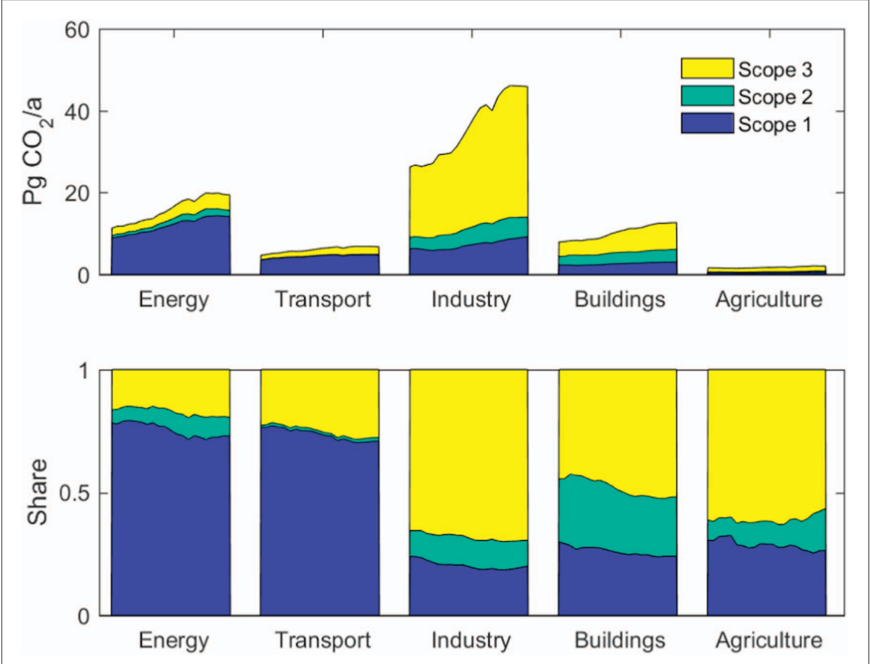
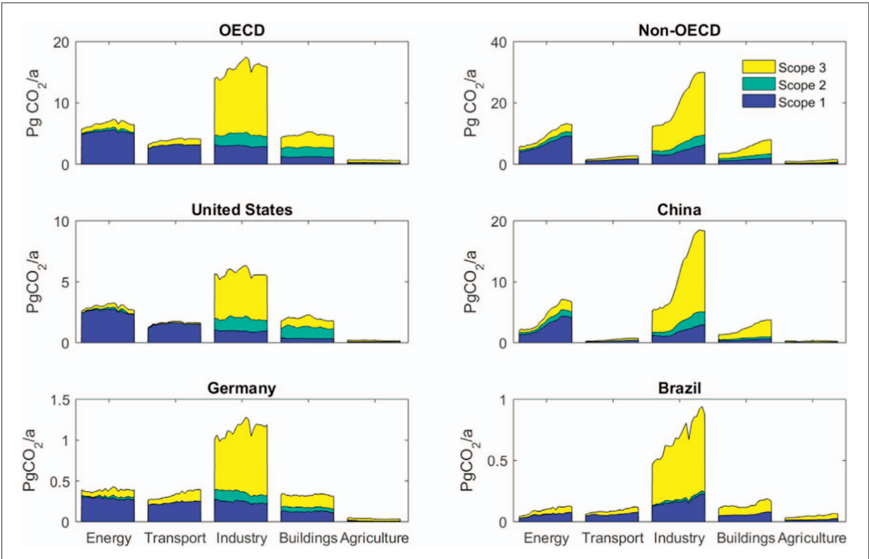
Carbon reporting is increasingly focussing on indirect emissions that occur in the supply chain of establishments. The GHG protocol, a corporate standard, distinguishes scope 2 (emissions associated with electricity consumption) and scope 3 (emissions associated with other inputs), in addition to scope 1 emissions (occurring directly at the facility or company in question). However, the magnitude and growth trajectory of scopes 2 and 3 emissions at the economy-wide level is unknown. Here we conduct an input–output investigation of indirect carbon dioxide (CO 2 ) emissions for the global economy organized in five sectors—energy supply, transport, industry, buildings, and agriculture and forestry—as defined by the Intergovernmental Panel on Climate Change (IPCC). In comparison to previous work that looks at indirect emissions of consumption, we present the first economy-wide analysis of indirect emissions of gross production. The goal of the work is thus to capture the potential agency different sectors have over supply chain emissions, rather allocating emissions between production and consumption. Between 1995 and 2015, global scopes 1, 2, and 3 emissions grew by 47%, 78%, and 84%, to 32, 10, and 45 Pg CO 2 , respectively. Globally, the industry sector was most important with scope 2 emissions of 5 Pg and scope 3 emissions of 32 Pg. For buildings, scope 3 emissions of 7 Pg were twice as high as direct emissions. Industry and buildings stood in marked contrast to energy and transport, where direct emissions accounted for >70% of total emissions responsibility. Most of the growth happened in developing countries. The proposed analysis scheme could improve the integration of sector chapters in future IPCC reports.
Overview
The claims and statistics of this paper haven’t been checked yet.
Free: it reads the open-access text and checks the first 5 claims that cite a source we can check. Create a free account to check every claim.
Integrity signals
Registry
Cites
Statistics
Figures



Verification
Claims the paper makes
The claims and statistics of this paper haven’t been checked yet.
Free: it reads the open-access text and checks the first 5 claims that cite a source we can check. Create a free account to check every claim.
Claims other papers make about this one
Each is checked against this paper’s own text: does it say what the citing paper says it does?
The source backs part of the claim, not all of it — or backs it for a different population, condition or comparison.
In the citing paper
“Materials constituted 55% of the carbon footprint of vehicle and transport equipment manufacturing of 1.6 Gt [27,42,119].”
From Material efficiency strategies to reducing greenhouse gas emissions associated with buildings, vehicles, and electronics—a review (2019) · cites this paper as [42]
Experimental — accuracy not yet measuredThe cited source says what the claim attributes to it.
In the citing paper
“GHGemissions can be added along the supply chain to calculate the carbon footprint or embodied emissions of a product (1, 49).”
From Carbon Leakage, Consumption, and Trade (2022) · cites this paper as [49]
In the citing paper
“According to EXIO-BASE, production of materials (figure 3) accounted for 56% of the carbon footprint of the construction sector, or 3.3 Gt CO 2 [42].”
From Material efficiency strategies to reducing greenhouse gas emissions associated with buildings, vehicles, and electronics—a review (2019) · cites this paper as [42]
Self-check
Percentages, sums and reported differences re-computed from the paper’s own numbers.
The self-check needs the paper’s full text.
Citations
Cites
Change, I. P. O. C. (2015) · Cambridge University Press eBooks · doi:10.1017/cbo9781107415416 · Cited by 4,693
Climate change 2014 : mitigation of climate change
Edenhofer, O., Pichs-Madruga, R., & Sokona, Y. (2014) · University of North Texas Digital Library (University of North Texas) · Cited by 1,975
Carbon Footprint of Nations: A Global, Trade-Linked Analysis
Hertwich, E. G., & Peters, G. P. (2009) · Environmental Science & Technology · doi:10.1021/es803496a · Cited by 1,715
Self-citationComparative Environmental Life Cycle Assessment of Conventional and Electric Vehicles
Hawkins, T. R., Singh, B., Majeau‐Bettez, G., & Strømman, A. H. (2013) · Journal of Industrial Ecology · doi:10.1111/j.1530-9290.2012.00532.x · Cited by 1,670
Growth in emission transfers via international trade from 1990 to 2008
Peters, G. P., Minx, J. C., Weber, C. L., & Edenhofer, O. (2011) · Proceedings of the National Academy of Sciences · doi:10.1073/pnas.1006388108 · Cited by 1,599
The material footprint of nations
Wiedmann, T. O., Schandl, H., Lenzen, M., Moran, D., Suh, S., West, J., & Kanemoto, K. (2015) · Proceedings of the National Academy of Sciences · doi:10.1073/pnas.1220362110 · Cited by 1,597
Household actions can provide a behavioral wedge to rapidly reduce US carbon emissions
Dietz, T., Gardner, G. T., Gilligan, J., Stern, P. C., & Vandenbergh, M. P. (2009) · Proceedings of the National Academy of Sciences · doi:10.1073/pnas.0908738106 · Cited by 1,450
Emerging approaches, challenges and opportunities in life cycle assessment
Hellweg, S., & Milà i Canals, L. (2014) · Science · doi:10.1126/science.1248361 · Cited by 1,416
CO2Embodied in International Trade with Implications for Global Climate Policy
Peters, G. P., & Hertwich, E. G. (2008) · Environmental Science & Technology · doi:10.1021/es072023k · Cited by 1,243
Self-citationInternational trade drives biodiversity threats in developing nations
Lenzen, M., Moran, D., Kanemoto, K., Foran, B., Lobefaro, L., & Geschke, A. (2012) · Nature · doi:10.1038/nature11145 · Cited by 1,238
Research works printed but not linked: 3
- Bhatia P, 2011, Corporate Value Chain (Scope 3) Accounting and Reporting Standard
- Lenzen M, 2004, J. Appl. Input-Output Anal., 10, 1
- Bruckner T ed Edenhofer O, 2014, Climate Change 2014: Mitigation of Climate Change
Cited by
Items 401–490 of 490
Maier, L., & Eichenberg, T. (2025) · Springer eBooks · doi:10.1007/978-3-662-72004-2_5
Globaali ilmastohallinta metsäyhtiöiden kestävyysraporteissa
Liljeblad, A. (2025) · Lauda (University of Lapland)
Schwoerer, V. (2025) · Portuguese National Funding Agency for Science, Research and Technology (RCAAP Project by FCT)
Li, B., Yao, X., Tang, Y., Li, J., & Guo, H. (2025) · Engineering Economics · doi:10.5755/j01.ee.36.5.35700
“The industrial sector is undeniably a cornerstone of China's economy, accounting for a significant portion of both energy consumption and CO 2 emissions (Bounman et al., 2015; Hertwich & Wood, 2018; Guo & Yuan, 2020; Liu & Xiao, 2021).”
Principles of Sustainable Finance
Küfeoğlu, S. (2025) · Sustainable development goals series · doi:10.1007/978-3-032-10440-3_1
On the evaluation of carbon footprint calculators
Heijungs, R. (2026) · Clean Technologies and Environmental Policy · doi:10.1007/s10098-025-03378-4
“The article does not specify anything about the scope of the CF, while it is well-known that for most products and sectors the scope 3 emissions take the lion’s share (Hertwich & Wood 2018).”
Global Environmental Benefits of Plant-Based Diets: A Multi-Regional Input Output AnalysisPreprint
Hafner, F., Pfister, S., Green, A., & Cabernard, L. (2026) · EarthArXiv (California Digital Library) · doi:10.31223/x5xn23
Stolt, R., & Löfving, M. (2026) · Sustainability · doi:10.3390/su18020679
Macário, M. D. S. (2023) · LA Referencia (Red Federada de Repositorios Institucionales de Publicaciones Científicas)
Estêvão, J., & Lopes, J. D. (2026) · The Journal of Risk Finance · doi:10.1108/jrf-05-2025-0248
Ramteke, S. V., Varadwaj, P. K., & Tiwari, V. (2026) · Lecture notes in networks and systems · doi:10.1007/978-3-032-13177-5_31
Applying The Carbon Scope Framework for Decarbonisation in a South African High Alloy Foundry
Kabasele, J. K., Nyembwe, K. D., & Mashinini, P. M. (2025) · The South African Journal of Industrial Engineering · doi:10.7166/36-3-3328
“In addition, with limited regulatory pressure and lower perceived responsibility, many companies struggle to track these emissions consistently [13].”
Wang, W., Shao, L., & Wu, S. (2026) · Mathematics · doi:10.3390/math14020363
Assessing Scope 3 Emissions in Industrial Value Chains: A Query Combination Methodology Approach
Retegi, J., Ibarra, D., Igartua, J. I., & Rabanete, L. (2026) · Lecture notes on data engineering and communications technologies · doi:10.1007/978-3-032-12099-1_31
Schnabl, L., Schmitz, A., Waltermann, E., & Göring-Lensing-Hebben, K. (2026) · Journal of Business Research · doi:10.1016/j.jbusres.2026.116040
Wu, Y., Sobh, D., Gulemye, N. S., Aguirre, A. S., Hammad, A., Gonzalez, V. A., & Hamzeh, F. (2025) · doi:10.22260/crc-csce-2025/0121
Achten, G. (2021) · Portuguese National Funding Agency for Science, Research and Technology (RCAAP Project by FCT)
Novel methods in corporate ESG education: A case study in SingaporePreprint
Das, P., Hamel, P., Chua, T., Daud, A. A., Chan, J., & Tan, L. (2026) · doi:10.31223/x5dr0q
Calculating Countries' Fair Shares for Addressing Climate Change
Ives, N. (2025) · Tuwhera (Auckland University of Technology)
Kallio, E. (2025) · Tampere University Institutional Repository (Tampere University)
Barragán, L. B. (2022) · Repositorio Institucional Universidad El Bosque
Kim, D., Kim, E., & Eun, J. (2026) · Journal of Cleaner Production · doi:10.1016/j.jclepro.2026.147967
Green Foreign Direct Investment is flowing far beyond renewables: a taxonomy-guided LLM analysis
Alvarez-Vilanova, J., Crescenzi, R., & Mager, L. (2026) · London School of Economics and Political Science Theses Online (London School of Economics and Political Science)
Ritter, A. (2025) · Portuguese National Funding Agency for Science, Research and Technology (RCAAP Project by FCT)
Demand response for sustainable manufacturing – A prescheduled experiment on cost and CO2 reduction
Sunesen, S. C., Sotiropoulos, A., & Xydis, G. A. (2026) · Next Energy · doi:10.1016/j.nxener.2026.100593
Environmentally Extended Input-Output Models in Agriculture: A Bibliometric Review
Grassi, G., Zadmirzaei, M., Cozzi, M., Romano, S., & Viccaro, M. (2026) · Agriculture · doi:10.3390/agriculture16070786
Carbon Footprint in Mining Activities: A Conceptual Framework
Akbay, D., Sert, M., & EKİNCİOĞLU, G. (2026) · Sürdürülebilir Mühendislik Uygulamaları ve Teknolojik Gelişmeler Dergisi · doi:10.51764/smutgd.1863112
Socially responsible investments : from assessing the risk premium to creating value for investors
Ferrat, Y. J. (2022) · theses.fr (ABES) · doi:10.70675/36fa619dz161dz458ezb8fbzb86d15bcabce
Mobilisation des Marchés Financiers vers une Economie Bas Carbone
Samama, F. (2023) · theses.fr (ABES) · doi:10.70675/56146917z4b03z46dfz89e7z65a54003344b
Cellou, M. (2024) · theses.fr (ABES) · doi:10.70675/efba2637zd7aaz4491za4fcza094c775dac5
Allan, G., Kilian, L., Kodoli, S., Michie, C., Owen, A., Tachtatzis, C., & Williamson, J. (2026) · Environmental Research Communications · doi:10.1088/2515-7620/ae5d98
“On the other hand, some authors note that the same ‘emissions’ being accounted for by several agencies only increases the potential reduction capability [10].”
García, G. H. (2026) · UPCommons institutional repository (Universitat Politècnica de Catalunya)
Brandão, A., Klopatek, S. C., Rausch, L. L., DIAS, F., Munger, J., Spawn, S., & Gibbs, H. (2026) · Research Square · doi:10.21203/rs.3.rs-9138992/v1
Rahman, S. (2026) · Современные инновации системы и технологии - Modern Innovations Systems and Technologies · doi:10.47813/2782-2818-2026-6-1-1010-1017
Perona, M., & Scalvini, L. (2026) · Applied Sciences · doi:10.3390/app16084024
Zhang, Y., Dai, W., & Heath, T. (2026) · Sustainability · doi:10.3390/su18094542
Complexities of Climate Policy : Three Essays
Hansen, O. W. (2026) · Tesis Doctorals en Xarxa (Consorci de Serveis Universitaris de Catalunya)
Mubarok, H., Setiawan, B., Kristanto, A., Iriani, S. S., Utami, P. L., & Yossatorn, Y. (2026) · Springer Link (Chiba Institute of Technology) · doi:10.1051/e3sconf/202670904002/pdf
Udol, P., & Varabuntoonvit, V. (2026) · Journal of Industrial Ecology · doi:10.1007/s44498-026-00095-z
Marini, M., Pigosso, D. C. A., & McAloone, T. C. (2026) · Environmental Impact Assessment Review · doi:10.1016/j.eiar.2026.108515
Liu, Z., Ke, P., Deng, Z., Ciais, P., Andrew, R. M., Bastos, A., Bai, Y., Canadell, J. G., Guan, D., Dou, X., et al. (2026) · Nature Reviews Earth & Environment · doi:10.1038/s43017-026-00791-1
“Estab-lished CO 2 mitigation frameworks rely on NDCs 105 and accounting meth-ods focus on direct emissions (scope 1) 59 , emissions from imported electricity (scope 2) 54 and supply chain emissions (scope 3) 55,106 or consumption-based emissions 72–75 .”
Spatiotemporal analysis and drivers of urban building carbon dioxide emissions: Chongqing case study
Wang, J., Ly, S., Li, Q., Chen, J., & Song, L. (2026) · Proceedings of the Institution of Civil Engineers - Engineering Sustainability · doi:10.1680/jensu.25.00121
Yedri, A. B., Bougrine, O., Ammari, M., & Allal, L. B. (2026) · Results in Engineering · doi:10.1016/j.rineng.2026.111211
Scope 3 -päästölaskenta teollisuusyrityksessä
Jokinen, A. (2026) · Theseus (Ammattikorkeakoulujen)
Phillpotts, A. (2025) · White Rose eTheses Online (University of Leeds, The University of Sheffield, University of York)
International Business Environment: Diagnosis, Risk and Strategic Judgement
Rideg, A. (2026) · Pesci Egyetemi Archivum (University of Pécs) · doi:10.15170/ibe-drsj-ktk-2026
Jiang, Y., Tan, Q., Woon, K. S., & Xie, D. (2026) · SSRN Electronic Journal · doi:10.2139/ssrn.7068318
Smarter LCA: Using large language models to predict manufacturing processes and their uncertainties
Belyaeva, A., Helbig, C., & Hummen, T. (2026) · Sustainable Production and Consumption · doi:10.1016/j.spc.2026.07.008
Feng, S., Wang, Y., Yang, H., Ding, Y., & Shao, P. (2026) · Journal of Food Process Engineering · doi:10.1111/jfpe.70698
Ajayi, O., Ugwu, J. O., & Okonta, E. D. (2026) · Research Square · doi:10.21203/rs.3.rs-10059637/v1
Zheng, S., Duan, Y., Xue, C. Y., & Salim, F. D. (2026) · Findings of the Association for Computational Linguistics: EMNLP (Findings of EMNLP) · doi:10.18653/2026.findings-emnlp.1167
Heilscher, V. E. (2025) · Portuguese National Funding Agency for Science, Research and Technology (RCAAP Project by FCT)
Third-country carbon embedded in global tradePreprint
Managi, S., Zhang, J., Wang, X., Li, C., & Keeley, A. (2026) · Research Square · doi:10.21203/rs.3.rs-10440088/v1
Circularity in Supply Chains : A Coursebook on Circular Economy – Course 4
Sarna, B., Kashif, K., Weerasinghe, S., & Wijesinghe, C. (2026) · Jyväskylä University Digital Archive (University of Jyväskylä)
Csutora, M., Dobos, I., & Mózner, Z. V. (2026) · Regional Statistics · doi:10.15196/rs160404
Voluntary climate pledges widen what firms measure, not what they abatePreprint
Pothin, F. (2026) · Research Square · doi:10.21203/rs.3.rs-10501111/v1
Usubiaga‐Liaño, A., Cazcarro, I., Acosta‐Fernández, J., Piñero, P., Rueda‐Cantuche, J. M., & Arto, I. (2026) · Research Square · doi:10.21203/rs.3.rs-10445915/v1
Greenhouse gas emission mitigation for the sustainable palm oil industry
Kristanto, B. Y., Sodri, A., & Frimawaty, E. (2026) · Journal of Innovation Materials Energy and Sustainable Engineering · doi:10.61511/jimese.v4i1.2026.3791
“Scope 2 accounts for indirect emissions from purchased electricity, while Scope 3 includes other indirect emissions from the value chain (Chew et al., 2021; Hertwich & Wood, 2018).”
Munkaila, A.-B. D., Mustapha, A.-A., & Saani, A. S. (2026) · Research Square · doi:10.21203/rs.3.rs-10364534/v1
Methodological Challenges in Carbon Footprint Accounting Across Global Supply Chains
Coleman, I., & Nezami, F. G. (2026) · International Conference on Industrial Engineering and Operations Management (IEOM) · doi:10.46254/na11.20260129
Charpentier, F. (2026) · Journal of Cleaner Production · doi:10.1016/j.jclepro.2026.149296
Multi-regional decomposition of direct and indirect carbon emissions in ASEAN
Teng, J. R. C., Tan, R. R., Li, M., & Gue, I. H. V. (2026) · Carbon Footprints · doi:10.20517/cf.2026.74
Sibai, D. Y., Kassab, A., Pannier, C. P., Ayoub, G. Y., & Mohanty, P. (2026) · Cleaner Engineering and Technology · doi:10.1016/j.clet.2026.101325
Rakhecha, D. (2026) · SSRN Electronic Journal · doi:10.2139/ssrn.7506778
Li, N., Liu, J., & Goh, M. (2026) · Transport Policy · doi:10.1016/j.tranpol.2026.104444
Systematic bias in Scope 3 emissions accounting: evidence from firm-level supply networks
Wang, Z., Hubacek, K., & Ruzzenenti, F. (2026) · npj Environmental Social Sciences · doi:10.1038/s44432-026-00017-1
“The value of evaluating corporate Scope 3 emissions lies not only in identifying climate-related risks, but also in enabling effective interventions across value chains 47 .”
Hanwatanawuthi, P., Pongput, K., Wongpho, B., & Veeravatnanond, V. (2024) · The Journal of Industrial Technology Suan Sunandha Rajabhat University
A series of analyses on the factors influencing firms’ adoption and response behavior
Hettler, M. (2024) · Technische Universität Dortmund Eldorado (Technische Universität Dortmund) · doi:10.17877/de290r-24780
Information, Markets, and Networks: Essays in Climate Finance
TRIVINO, N. A. G. (n.d.) · Archivio istituzionale della Ricerca - Bocconi
Zhang, X. (n.d.) · PolyU Institutional Research Archive (Hong Kong Polytechnic University)
Scope 3 emissions reporting as an instrument for accelerating sustainable aviation fuel deployment
Chang, R., Xu, Y., Deng, Y., & Zhang, Y. (2026) · Journal of Air Transport Management · doi:10.1016/j.jairtraman.2026.103138
Kaksoisolennaisuuden haasteet elintarvikealan yritysten kestävyysraportoinnissa
Matikainen, N. (2026) · UTUPub (University of Turku)
Akram, H. W. (2026) · IGI Global eBooks · doi:10.4018/979-8-3373-3740-1.ch010
Dilane, M. P. J., & Xu, R. (2026) · OALib · doi:10.4236/oalib.1115659
GRIDS: An integrated sustainability framework for the net-zero transition
Choudhary, P. (2026) · Energy Strategy Reviews · doi:10.1016/j.esr.2026.102368
Ziouzios, D., Metallidis, T., Katotikidou, T., Tsepoura, A., & Vasileiadis, V. (2026) · Environments · doi:10.3390/environments13100558
Klaiber, A., & Haddad, S. (2026) · Sustainable Development · doi:10.1002/sd.71785
Mckenzie, J. (2025) · Adelaide Research & Scholarship (AR&S) (University of Adelaide)
Xi, S., & Li, Z. (2026) · SSRN Electronic Journal · doi:10.2139/ssrn.7675459
Adhikary, A., Borah, S. B., Sharma, A., & Jena, S. K. (2026) · Journal of Business Research · doi:10.1016/j.jbusres.2026.116515
Testini, L., Misul, A., Mombelli, D., & Dotelli, G. (2026) · Sustainable materials and technologies · doi:10.1016/j.susmat.2026.e02321
Market-Average Data Can Misrepresent Supply Chain Environmental Impacts and Their Uncertainty
Dineen, C. P. J., Lupton, R., & Allen, S. R. (2026) · Environmental Science & Technology · doi:10.1021/acs.est.6c11530
Bhat, C. (2026) · INTERANTIONAL JOURNAL OF SCIENTIFIC RESEARCH IN ENGINEERING AND MANAGEMENT · doi:10.55041/ijsrem68682
Ayrancı, M. (2026) · Modern Supply Chain Research and Applications · doi:10.1108/mscra-06-2026-0087
AI to the Rescue: A Framework for Unmasking Greenwashing in Finance and Boosting ESG Transparency
Gallant, M., & Subramani, L. (2026) · Springer eBooks · doi:10.1007/978-3-032-32865-6_6
Jalil, S., Khan, G. Y., Hafeez, Z., Ullah, A., & Gul, B. (2026) · Social Prism · doi:10.69671/socialprism.3.9.2026.331
Vaio, A. D., Esposito, A., D’Amore, G., & Mastellone, L. (2026) · Business Strategy and the Environment · doi:10.1002/bse.71870
Armero, G., Martínez, S., León, H. D. P., Álvarez, S., & Gil, R. (2026) · Sustainability · doi:10.3390/su182211642
Metadata
- Authors
- Hertwich, E. G., & Wood, R.
- Affiliations
- Yale University (US)
- Norwegian University of Science and Technology (NO)
- Corresponding author
- Hertwich, Edgar G
- Venue
- Environmental Research Letters
- Publisher
- IOP Publishing
- Published
- 2018-10-05
- Volume
- 13
- Issue
- 10
- Pages
- 104013
- ISSN
- 1748-9326 (ISSN-L)
- OpenAlex
- W2891897243
- Cited by
- 350
- References
- 57
- Citations by year
- 2026: 67 · 2025: 70 · 2024: 60 · 2023: 58 · 2022: 47 · 2021: 26 · 2020: 9 · 2019: 13
- FWCI
- 6.03
- Type
- journal article
- Language
- en
- Open access
- gold
- doi.org
- Licence
- cc-by
- iopscience.iop.org/info/page/text-and-data-mining (tdm)
- creativecommons.org/licenses/by/3.0/ (vor)
- Locations
- Environmental Research Letters (publishedVersion, cc-by)
- DOAJ (DOAJ: Directory of Open Access Journals) (submittedVersion)
- NORA - Norwegian Open Research Archives (submittedVersion, cc-by)
- Topics
- Physical Sciences › Environmental Science › Environmental Engineering › Environmental Impact and Sustainability
- Physical Sciences › Environmental Science › Environmental Engineering › Sustainability and Ecological Systems Analysis
- Social Sciences › Economics, Econometrics and Finance › Economics and Econometrics › Climate Change Policy and Economics
- Keywords
- Scope 3 emissions, indirect greenhouse gas emissions, supply chain emissions, industry sectors, CO2 emissions, GHG Protocol, input-output analysis, energy supply, transport sector, building sector, agriculture and forestry, developing countries
About these checks
Registry, retraction, Cites and statistics results are computed, not judged, with one exception: a printed reference that no index lists is read once by a model before it counts as a citation error. Claims are extracted by a model and kept only when their quote appears verbatim in the text; each cited source is then checked, with a model’s help, for whether it says what the claim relies on. Those verdicts can be wrong — read the claim’s quote and the cited source before relying on one.
Statistics and arithmetic are recomputed, not judged.
Confidence bands are shown only for fields calibrated on our annotated test set. None is calibrated yet, so no band is shown.
What counts as a claim ›How we measure confidence ›How we check this ›
Are you an author, or do you see a problem with this page? Request a review
Data sources
Bibliographic data: Semantic Scholar, OpenAlex, Crossref.
Contains information from the Semantic Scholar Academic Graph Datasets, made available under the ODC Attribution License (ODC-BY 1.0).
Semantic Scholar’s data is described in: Kinney, R., et al. (2023). The Semantic Scholar Open Data Platform. arXiv:2301.10140.
