

STAT3 controls COL1A2 enhancer activation cooperatively with JunB, regulates type I collagen synthesis posttranscriptionally, and is essential for lung myofibroblast differentiation
Open accessThe DOI matches its Crossref record; 33 of the 33 references it cites were found in a registry or an index.
Abstract
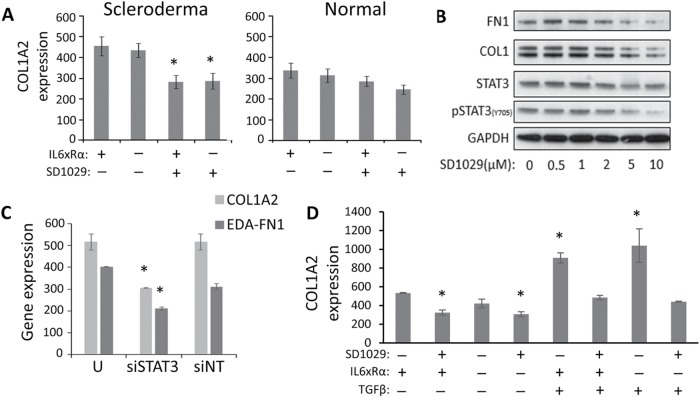
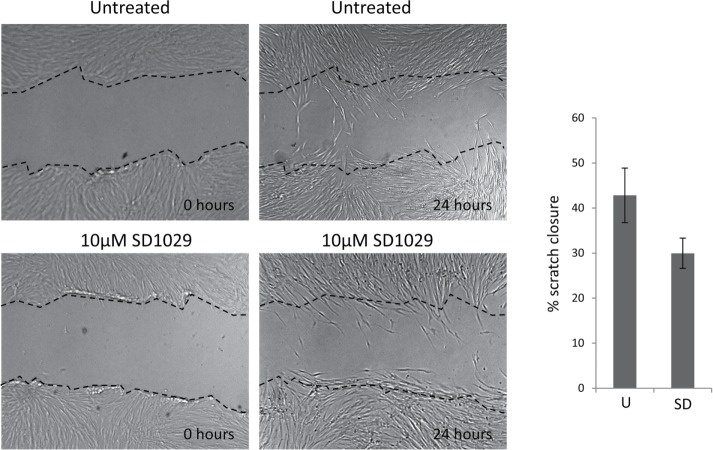
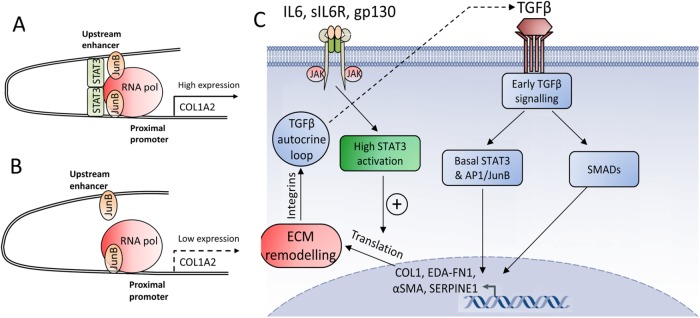
Fibroblast differentiation is a key cellular process that underlies the process of fibrosis, a deadly complication of fibrotic diseases like scleroderma (SSc). This transition coincides with the overproduction of collagen type I (COL1) and other extracellular matrix proteins. High-level expression of the collagen type 1α2 subunit (COL1A2), requires the engagement of a far-upstream enhancer, whose activation is strongly dependent on the AP1 factor JunB. We now report that STAT3 also binds the COL1A2 enhancer and is essential for RNA polymerase recruitment, without affecting JunB binding. STAT3 is required for the increased COL1A2 expression observed in myofibroblasts. We also report that TGFβ partially activates STAT3 and show that inhibiting STAT3 potently blocks TGFβ signaling, matrix remodeling, and TGFβ-induced myofibroblast differentiation. Activation of STAT3 with IL6 transsignaling alone, however, only increased COL1A2 protein expression, leaving COL1A2 mRNA levels unchanged. Our results suggest that activated STAT3 is not the limiting factor for collagen enhancer activation in human lung fibroblasts. Yet, a certain threshold level of STAT3 activity is essential to support activation of the COL1A2 enhancer and TGFβ signaling in fibroblasts. We propose that STAT3 operates at the posttranscriptional as well as the transcriptional level.
Overview
The claims and statistics of this paper haven’t been checked yet.
Free: it reads the open-access text and checks the first 5 claims that cite a source we can check. Create a free account to check every claim.
Integrity signals
Registry
Cites
Statistics
Figures




Verification
Claims the paper makes
The claims and statistics of this paper haven’t been checked yet.
Free: it reads the open-access text and checks the first 5 claims that cite a source we can check. Create a free account to check every claim.
Claims other papers make about this one
Each is checked against this paper’s own text: does it say what the citing paper says it does?
The source backs part of the claim, not all of it — or backs it for a different population, condition or comparison.
In the citing paper
“In SSc skin, STAT3 signaling is activated (81) resulting in pro-fibrotic gene expression in fibroblasts; for example, STAT3 regulates collagen type I expression in SSc skin fibroblasts (82). However, of note, in lungs of SSc patients no enhanced STAT3 activation can be observed (82).”
From Unraveling SSc Pathophysiology; The Myofibroblast (2018) · cites this paper as [82]
Experimental — accuracy not yet measured
Self-check
Percentages, sums and reported differences re-computed from the paper’s own numbers.
The self-check needs the paper’s full text.
Citations
Cites
Goecks, J., Nekrutenko, A., Taylor, J., & The Galaxy Team (2010) · Genome Biology · doi:10.1186/gb-2010-11-8-r86 · Cited by 3,453 · cited 1×
“The degree of conservation for each site was checked using the Galaxy UCSC genome browser (Giardine et al., 2005, Goecks et al., 2010).”
MethodTGF-β signaling and the fibrotic response
Leask, A., & Abraham, D. J. (2004) · The FASEB Journal · doi:10.1096/fj.03-1273rev · Cited by 2,319 · cited 5×
“Transforming growth factor β (TGFβ) is the master regulator of wound healing and the gene expression program drives myofibroblast differentiation and function (e.g., CTGF, COL1, α-SMA, EDA-fibronectin; Leask and Abraham, 2004).”
BackgroundInfluentialSelf-citationTRANSFAC(R) and its module TRANSCompel(R): transcriptional gene regulation in eukaryotes
Matys, V. (2006) · Nucleic Acids Research · doi:10.1093/nar/gkj143 · Cited by 2,166 · cited 2×
“…factor binding site in silico analysis Analysis of STAT3 binding to the COL1A2 enhancer was carried out using the Transfac Match program (Matys et al., 2016) and the Our results offer a new understanding of the avenues of interaction between profibrotic and inflammatory signaling, which…”
MethodHinz, B., Phan, S. H., Thannickal, V. J., Galli, A., Bochaton-Piallat, M.-L., & Gabbiani, G. (2007) · The American Journal of Pathology · doi:10.2353/ajpath.2007.070112 · Cited by 2,068 · cited 1×
“A key feature of fibroproliferative disorders is the abnormal persistence of myofibroblasts and their excessive proliferation leading to inappropriate connective tissue expansion (Hinz et al., 2007).”
BackgroundGalaxy: A platform for interactive large-scale genome analysis
Giardine, B., Riemer, C., Hardison, R. C., Burhans, R., Elnitski, L., Shah, P., Zhang, Y., Blankenberg, D., Albert, I., Taylor, J., et al. (2005) · Genome Research · doi:10.1101/gr.4086505 · Cited by 2,026 · cited 1×
“The degree of conservation for each site was checked using the Galaxy UCSC genome browser (Giardine et al., 2005, Goecks et al., 2010).”
MethodThe JAK/STAT signaling pathway
Rawlings, J. S., Rosler, K. M., & Harrison, D. A. (2004) · Journal of Cell Science · doi:10.1242/jcs.00963 · Cited by 1,858 · cited 2×
“In addition, JAK-independent activation of STATs by Src and MAPK family members has been described (Rawlings et al., 2004).”
BackgroundHirano, T., Ishihara, K., & Hibi, M. (2000) · Oncogene · doi:10.1038/sj.onc.1203551 · Cited by 1,190 · cited 1×
“In addition to regulating the ECM and growth factor signaling, STAT 3 can contribute to fibrosis through its links to survival and proliferation (Hirano et al., 2000).”
BackgroundSystemic sclerosis: a prototypic multisystem fibrotic disorder
Varga, J., & Abraham, D. (2007) · Journal of Clinical Investigation · doi:10.1172/jci31139 · Cited by 1,163 · cited 10×
“In normal wound healing this is an essential process, allowing wound closure and reformation of lost connective tissue to support reepithelization (Leask and Abraham, 2004; Varga and Abraham, 2007).”
BackgroundInfluentialSelf-citationMathelier, A., Zhao, X., Zhang, A. W., Parcy, F., Worsley-Hunt, R., Arenillas, D. J., Buchman, S., Chen, C.-Y., Chou, A., Ienasescu, H., et al. (2014) · Nucleic Acids Research · doi:10.1093/nar/gkt997 · Cited by 983 · cited 1×
“Jaspar database (Mathelier et al., 2014) using STAT-specific matrices.”
Kojima, Y., Acar, A., Eaton, E. N., Mellody, K. T., Scheel, C., Ben-Porath, I., Onder, T. T., Wang, Z. C., Richardson, A. L., Weinberg, R. A., et al. (2010) · Proceedings of the National Academy of Sciences · doi:10.1073/pnas.1013805107 · Cited by 848 · cited 2×
“…the collagen 1α2 enhancer | 91 naling initiating a self-reinforcing process of ECM modification and integrin signaling activation (Thannickal et al., 2003) that culminates in the creation of a high mechanical tension environment and the establishment of a TGFβ autocrine loop (Kojima et al., 2010).”
Background
Cited by
Tocilizumab in systemic sclerosis: a randomised, double-blind, placebo-controlled, phase 3 trial
Khanna, D., Lin, C. J. F., Furst, D. E., Goldin, J., Kim, G., Kuwana, M., Allanore, Y., Matucci-Cerinic, M., Distler, O., Shima, Y., et al. (2020) · The Lancet Respiratory Medicine · doi:10.1016/s2213-2600(20)30318-0 · Cited by 662
Self-citationBharadwaj, U., Kasembeli, M. M., Robinson, P., & Tweardy, D. J. (2020) · Pharmacological Reviews · doi:10.1124/pr.119.018440 · Cited by 314
Kasembeli, M. M., Bharadwaj, U., Robinson, P., & Tweardy, D. J. (2018) · International Journal of Molecular Sciences · doi:10.3390/ijms19082299 · Cited by 199
“Recent findings demonstrate that, in conjunction with JunB, STAT3 is able to directly control COL1A2 enhancer activation [177].”
BackgroundZhang, J., Wang, D., Wang, L., Wang, S., Roden, A. C., Zhao, H., Li, X., Prakash, Y. S., Matteson, E. L., Tschumperlin, D. J., et al. (2019) · American Journal of Physiology-Lung Cellular and Molecular Physiology · doi:10.1152/ajplung.00301.2018 · Cited by 194
“Recent studies have also implicated a role for JAK2 and STAT3-dependent signaling in lung fibrosis (2, 38, 44, 47, 49, 50) and ECM regulation (44, 67).”
BackgroundFibroblast senescence in the pathology of idiopathic pulmonary fibrosis
Waters, D. W., Blokland, K. E. C., Pathinayake, P. S., Burgess, J. K., Mutsaers, S. E., Prele, C. M., Schuliga, M., Grainge, C. L., & Knight, D. A. (2018) · American Journal of Physiology-Lung Cellular and Molecular Physiology · doi:10.1152/ajplung.00037.2018 · Cited by 163
Metadata
- Authors
- Papaioannou, I., Xu, S., Denton, C. P., Abraham, D. J., & Ponticos, M.
- Affiliations
- University College London (GB)
- Corresponding author
- Ponticos, Markella
- Venue
- Molecular Biology of the Cell
- Published
- 2018-01-15
- Volume
- 29
- Issue
- 2
- Pages
- 84-95
- ISSN
- 1059-1524 (ISSN-L)
- 1939-4586
- PMC
- PMC5909935
- OpenAlex
- W2769262718
- Cited by
- 64
- References
- 33
- Citations by year
- 2026: 6 · 2025: 4 · 2024: 5 · 2023: 6 · 2022: 10 · 2021: 14 · 2020: 6 · 2019: 8 · 2018: 5
- FWCI
- 2.29
- Type
- journal article
- Language
- en
- Open access
- green
- www.ncbi.nlm.nih.gov
- Licence
- cc-by-nc-sa
- Locations
- Molecular Biology of the Cell (publishedVersion)
- Europe PMC (PubMed Central) (publishedVersion, cc-by-nc-sa)
- PubMed Central (publishedVersion, cc-by-nc-sa)
- PubMed (publishedVersion)
- UCL Discovery (University College London) (submittedVersion)
- Funders
- Rosetrees Trust (M96-F1)
- Versus Arthritis (19427, 18420)
- Topics
- Life Sciences › Immunology and Microbiology › Immunology › Cytokine Signaling Pathways and Interactions
- Health Sciences › Medicine › Rheumatology › Systemic Sclerosis and Related Diseases
- Life Sciences › Biochemistry, Genetics and Molecular Biology › Molecular Biology › TGF-β signaling in diseases
- Keywords
- STAT3, COL1A2, type I collagen, enhancer activation, JunB, AP-1, myofibroblast differentiation, lung fibroblasts, TGF-beta signaling, post-transcriptional regulation, RNA polymerase recruitment, extracellular matrix remodeling, systemic sclerosis, fibrosis
- MeSH terms
- Cell Differentiation, Cells, Cultured, Enhancer Elements, Genetic, Fibrosis, Gene Expression Regulation, Humans, Lung, Transcription Factors, Signal Transduction, Interleukin-6, Transforming Growth Factor beta, Collagen Type I, STAT3 Transcription Factor, Myofibroblasts
About these checks
Registry, retraction, Cites and statistics results are computed, not judged, with one exception: a printed reference that no index lists is read once by a model before it counts as a citation error. Claims are extracted by a model and kept only when their quote appears verbatim in the text; each cited source is then checked, with a model’s help, for whether it says what the claim relies on. Those verdicts can be wrong — read the claim’s quote and the cited source before relying on one.
Statistics and arithmetic are recomputed, not judged.
Confidence bands are shown only for fields calibrated on our annotated test set. None is calibrated yet, so no band is shown.
What counts as a claim ›How we measure confidence ›How we check this ›
Are you an author, or do you see a problem with this page? Request a review
How to cite
Cite CoChat for the checks on this page, and the paper for its own findings.
- This page
- CoChat. (2026). Citation check: STAT3 controls COL1A2 enhancer activation cooperatively with JunB, regulates type I collagen synthesis posttranscriptionally, and is essential for lung myofibroblast differentiation. https://app.cochat.ai/papers/10.1091/mbc.e17-06-0342
- The paper
- Papaioannou, I., Xu, S., Denton, C. P., Abraham, D. J., & Ponticos, M. (2018). STAT3 controls COL1A2 enhancer activation cooperatively with JunB, regulates type I collagen synthesis posttranscriptionally, and is essential for lung myofibroblast differentiation. Molecular Biology of the Cell. https://doi.org/10.1091/mbc.e17-06-0342
Data sources
Bibliographic data: Semantic Scholar, OpenAlex, Crossref.
Contains information from the Semantic Scholar Academic Graph Datasets, made available under the ODC Attribution License (ODC-BY 1.0).
Semantic Scholar’s data is described in: Kinney, R., et al. (2023). The Semantic Scholar Open Data Platform. arXiv:2301.10140.
