

Effect of cocoa flavanol supplementation for the prevention of cardiovascular disease events: the COcoa Supplement and Multivitamin Outcomes Study (COSMOS) randomized clinical trial
Open accessThe DOI matches its Crossref record; 73 of the 73 references it cites were found in a registry or an index.
Abstract
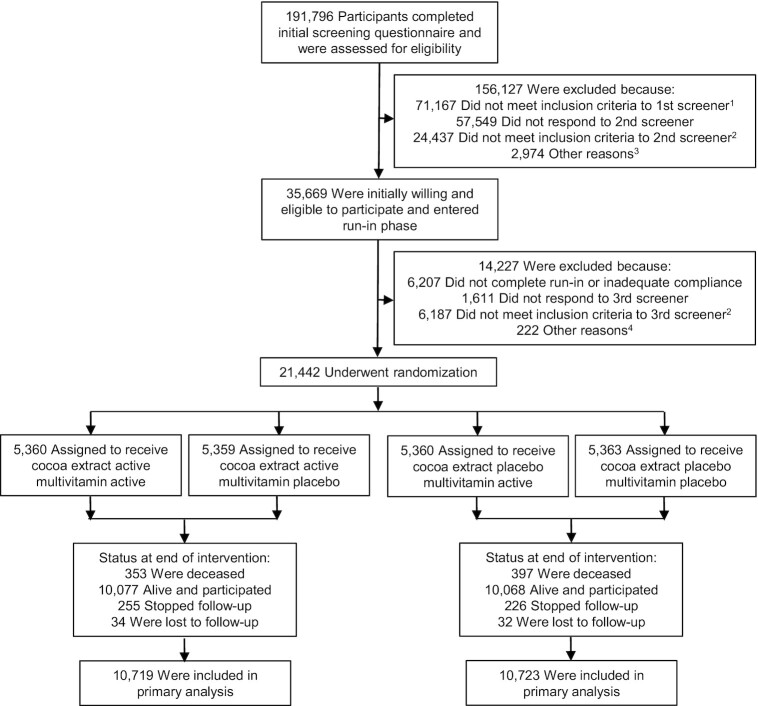
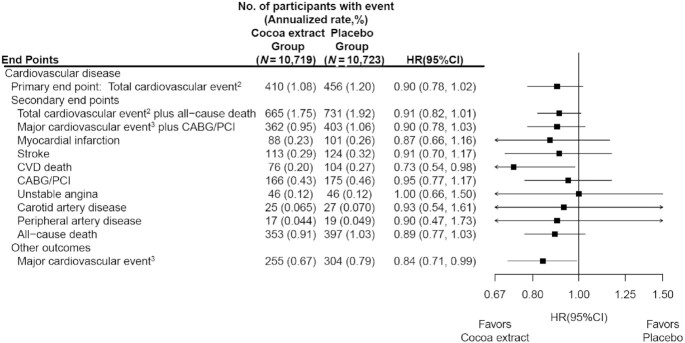
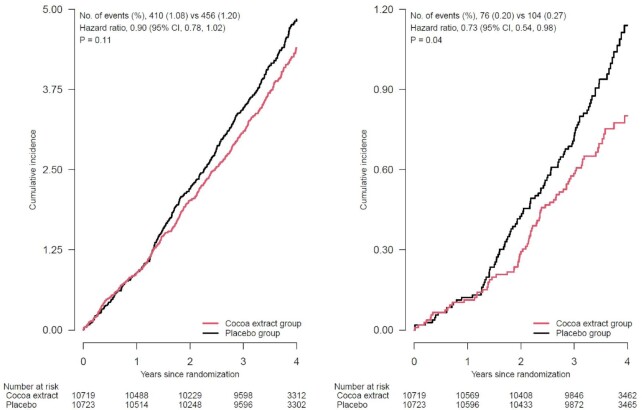
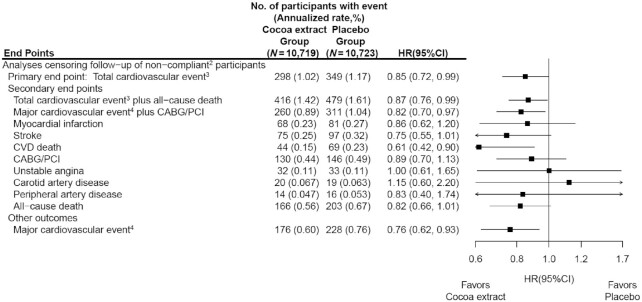
BACKGROUND: Cocoa extract is a source of flavanols that favorably influence vascular risk factors in small and short-term trials, yet effects on clinical cardiovascular events are untested. OBJECTIVES: We examined whether cocoa extract supplementation decreases total cardiovascular disease (CVD) among older adults. METHODS: We conducted a randomized, double-blind, placebo-controlled, 2-by-2 factorial trial of cocoa extract supplementation and multivitamins for prevention of CVD and cancer among 21,442 US adults (12,666 women aged ≥65 y and 8776 men aged ≥60 y), free of major CVD and recently diagnosed cancer. The intervention phase was June 2015 through December 2020. This article reports on the cocoa extract intervention. Participants were randomly assigned to a cocoa extract supplement [500 mg flavanols/d, including 80 mg (-)-epicatechin] or placebo. The primary outcome was a composite of confirmed incident total cardiovascular events, including myocardial infarction (MI), stroke, coronary revascularization, cardiovascular death, carotid artery disease, peripheral artery surgery, and unstable angina. RESULTS: During a median follow-up of 3.6 y, 410 participants taking cocoa extract and 456 taking placebo had confirmed total cardiovascular events (HR: 0.90; 95% CI: 0.78, 1.02; P = 0.11). For secondary endpoints, HRs were 0.73 (95% CI: 0.54, 0.98) for CVD death, 0.87 (95% CI: 0.66, 1.16) for MI, 0.91 (95% CI: 0.70, 1.17) for stroke, 0.95 (95% CI: 0.77, 1.17) for coronary revascularization, neutral for other individual cardiovascular endpoints, and 0.89 (95% CI: 0.77, 1.03) for all-cause mortality. Per-protocol analyses censoring follow-up at nonadherence supported a lower risk of total cardiovascular events (HR: 0.85; 95% CI: 0.72, 0.99). There were no safety concerns. CONCLUSIONS: Cocoa extract supplementation did not significantly reduce total cardiovascular events among older adults but reduced CVD death by 27%. Potential reductions in total cardiovascular events were supported in per-protocol analyses. Additional research is warranted to clarify whether cocoa extract may reduce clinical cardiovascular events. This trial is registered at www.clinicaltrials.gov as NCT02422745.
Overview
The claims and statistics of this paper haven’t been checked yet.
Free: it reads the open-access text and checks the first 5 claims that cite a source we can check. Create a free account to check every claim.
Integrity signals
Registry
Cites
Statistics
Figures
Verification
Claims the paper makes
The claims and statistics of this paper haven’t been checked yet.
Free: it reads the open-access text and checks the first 5 claims that cite a source we can check. Create a free account to check every claim.
Claims other papers make about this one
Each is checked against this paper’s own text: does it say what the citing paper says it does?
The cited source says what the claim attributes to it.
In the citing paper
“In the COSMOS trial, flavanol-enriched cocoa extract was shown to reduce CVD mortality during 3.6 years’ follow-up (HR: 0.73; 95% CI: 0.54-0.98).”
From Micronutrient Supplementation to Reduce Cardiovascular Risk (2022) · cites this paper as [21]
Self-check
Percentages, sums and reported differences re-computed from the paper’s own numbers.
The self-check needs the paper’s full text.
Citations
Cites
Regression Models and Life-Tables
Cox, D. R. (1972) · Journal of the Royal Statistical Society Series B: Statistical Methodology · doi:10.1111/j.2517-6161.1972.tb00899.x · Cited by 39,793
Adams, H. P., Bendixen, B. H., Kappelle, L. J., Biller, J., Love, B. B., Gordon, D. L., & Marsh, E. E. (1993) · Stroke · doi:10.1161/01.str.24.1.35 · Cited by 12,335
Modeling Survival Data: Extending the Cox Model
Therneau, T. M., & Grambsch, P. M. (2000) · Statistics for Biology and Health · doi:10.1007/978-1-4757-3294-8 · Cited by 8,674
Bioavailability and bioefficacy of polyphenols in humans. I. Review of 97 bioavailability studies
Manach, C., Williamson, G., Morand, C., Scalbert, A., & Rémésy, C. (2005) · The American Journal of Clinical Nutrition · doi:10.1093/ajcn/81.1.230s · Cited by 4,219
Isolated Hand Paresis: A Case Series
Alstadhaug, K. B., & Sjulstad, A. (2013) · Cerebrovascular Diseases Extra · doi:10.1159/000350708 · Cited by 4,058
Estruch, R., Ros, E., Salas-Salvadó, J., Covas, M.-I., Corella, D., Arós, F., Gómez-Gracia, E., Ruiz-Gutiérrez, V., Fiol, M., Lapetra, J., et al. (2018) · New England Journal of Medicine · doi:10.1056/nejmoa1800389 · Cited by 3,616 · cited 1×
“In sensitivity analyses either allowing the baseline hazard to change on 1 January 2020 to account for the impact of the COVID-19 pandemic or accounting for intrahousehold correlation among 101 households with ≥2 participants randomly assigned to the same intervention arm using a robust sandwich estimator of variance…”
Classification and natural history of clinically identifiable subtypes of cerebral infarction
Bamford, J., Sandercock, P., Dennis, M., Warlow, C., & Burn, J. (1991) · The Lancet · doi:10.1016/0140-6736(91)93206-o · Cited by 3,294 · cited 1×
“MI (43), stroke (44, 45), and coronary revascularization, which included documented coronary artery bypass graft (CABG) surgery, percutaneous coronary intervention (PCI), coronary stent, or atherectomy (42), were confirmed using established criteria.”
Third Universal Definition of Myocardial Infarction
Thygesen, K., Alpert, J. S., Jaffe, A. S., Simoons, M. L., Chaitman, B. R., & White, H. D. (2012) · Circulation · doi:10.1161/cir.0b013e31826e1058 · Cited by 2,985
Third universal definition of myocardial infarction
the Writing Group on behalf of the Joint ESC/ACCF/AHA/WHF Task Force for the Universal Definition of Myocardial Infarction, Thygesen, K., Alpert, J. S., Jaffe, A. S., Simoons, M. L., Chaitman, B. R., & White, H. D. (2012) · Nature Reviews Cardiology · doi:10.1038/nrcardio.2012.122 · Cited by 2,053
Feskanich, D., Rimm, E. B., Giovannucci, E. L., Colditz, G. A., Stampfer, M. J., Litin, L. B., & Willett, W. C. (1993) · Journal of the American Dietetic Association · doi:10.1016/0002-8223(93)91754-e · Cited by 1,070 · cited 1×
“At the end of the run-in, participants returned a final compliance, eligibility, and risk factor questionnaire and semi-quantitative food-frequency questionnaire (40).”
Cited by
The interplay between diet and the gut microbiome: implications for health and disease
Ross, F. C., Patangia, D., Grimaud, G., Lavelle, A., Dempsey, E. M., Ross, R. P., & Stanton, C. (2024) · Nature Reviews Microbiology · doi:10.1038/s41579-024-01068-4 · Cited by 638
“However, the event of cardiovascular disease was not reduced 50 .”
The Role of Oxidative Stress in Atherosclerosis
Batty, M., Bennett, M. R., & Yu, E. (2022) · Cells · doi:10.3390/cells11233843 · Cited by 536
Charchar, F. J., Prestes, P. R., Mills, C., Ching, S. M., Neupane, D., Marques, F. Z., Sharman, J. E., Vogt, L., Burrell, L. M., Korostovtseva, L., et al. (2024) · Journal of Hypertension · doi:10.1097/hjh.0000000000003563 · Cited by 297
“Looking beyond traditional macronutrients and micronutrients for health benefits might be important, for example, evidence suggests that cocoa flavanol f o m h tt p intake could be beneficial for CVD risk prevention [118].”
Human trials exploring anti-aging medicines
Guarente, L., Sinclair, D. A., & Kroemer, G. (2024) · Cell Metabolism · doi:10.1016/j.cmet.2023.12.007 · Cited by 244
US Preventive Services Task Force, Mangione, C. M., Barry, M. J., Nicholson, W. K., Cabana, M., Chelmow, D., Coker, T. R., Davis, E. M., Donahue, K. E., Doubeni, C. A., et al. (2022) · JAMA · doi:10.1001/jama.2022.8970 · Cited by 194
Micronutrient Supplementation to Reduce Cardiovascular Risk
An, P., Wan, S., Luo, Y., Luo, J., Zhang, X., Zhou, S., Xu, T., He, J., Mechanick, J. I., Wu, W.-C., et al. (2022) · Journal of the American College of Cardiology · doi:10.1016/j.jacc.2022.09.048 · Cited by 189
Diet, cardiovascular disease, and mortality in 80 countries
Mente, A., Dehghan, M., Rangarajan, S., O’Donnell, M., Hu, W., Dagenais, G., Wielgosz, A., A. Lear, S., Wei, L., Diaz, R., et al. (2023) · European Heart Journal · doi:10.1093/eurheartj/ehad269 · Cited by 158
“Recent evidence suggests that bioactive compounds and, in particular, polyphenols which are found in certain fruit or vegetables (e.g. berries, spinach, and beans) may be especially protective against CVD.61 Future work is needed to sort out what proportion of fruit and vegetable-related health benefits are driven by…”
BackgroundDietary Phenolic Compounds: Their Health Benefits and Association with the Gut Microbiota
Matsumura, Y., Kitabatake, M., Kayano, S.-I., & Ito, T. (2023) · Antioxidants · doi:10.3390/antiox12040880 · Cited by 142
“Cocoa flavanols also exert endothelium-dependent vasodilatory effects [79], suggesting their potential to ameliorate cardiovascular diseases [80].”
BackgroundFlavan-3-ols and Cardiometabolic Health: First Ever Dietary Bioactive Guideline
Crowe-White, K. M., Evans, L. W., Kuhnle, G., Milenković, D., Stote, K. S., Wallace, T. C., Handu, D., & Senkus, K. E. (2022) · Advances in Nutrition · doi:10.1093/advances/nmac105 · Cited by 157
“was published from the COSMOS randomized clinical trial evaluating a cocoa extract supplement (500 mg flavanols/d) in ∼21,000 older adults (41).”
Goya, L., Kongor, J. E., & de Pascual‐Teresa, S. (2022) · International Journal of Molecular Sciences · doi:10.3390/ijms232214365 · Cited by 132
Potential Role of Quercetin Glycosides as Anti-Atherosclerotic Food-Derived Factors for Human Health
Terao, J. (2023) · Antioxidants · doi:10.3390/antiox12020258 · Cited by 117
Sensory Nutrition and Bitterness and Astringency of Polyphenols
Osakabe, N., Shimizu, T., Fujii, Y., Fushimi, T., & Calabrese, V. (2024) · Biomolecules · doi:10.3390/biom14020234 · Cited by 114
Effects of cocoa extract and a multivitamin on cognitive function: a randomized clinical trial
Baker, L. D., Manson, J. E., Rapp, S. R., Sesso, H. D., Gaussoin, S. A., Shumaker, S. A., & Espeland, M. A. (2023) · Alzheimer's & Dementia · doi:10.1002/alz.12767 · Cited by 88
Self-citationKiyimba, T., Yiga, P., Bamuwamye, M., Ogwok, P., der Schueren, B. V., & Matthys, C. (2023) · Advances in Nutrition · doi:10.1016/j.advnut.2023.01.002 · Cited by 88
Pede, G. D., Mena, P. R., Bresciani, L., Achour, M., Lamuela-Raventós, R. M., Estruch, R., Landberg, R., Kulling, S. E., Wishart, D. S., Rodriguez‐Mateos, A., et al. (2022) · Molecular Aspects of Medicine · doi:10.1016/j.mam.2022.101146 · Cited by 76
Carregosa, D., Pinto, C., Ávila‐Gálvez, M. Á., Bastos, P., Berry, D., & dos Santos, C. N. (2022) · Comprehensive Reviews in Food Science and Food Safety · doi:10.1111/1541-4337.13006 · Cited by 67
Gál, R., Halmosi, R., Gallyas, F., Tschida, M., Mutirangura, P., Tóth, K., Alexy, T., & Czopf, L. (2023) · Biomedicines · doi:10.3390/biomedicines11112888 · Cited by 64
Multivitamin Supplementation Improves Memory in Older Adults: A Randomized Clinical Trial
Yeung, L., Alschuler, D. M., Wall, M. M., Luttmann‐Gibson, H., Copeland, T., Hale, C., Sloan, R. P., Sesso, H. D., Manson, J. E., & Brickman, A. M. (2023) · American Journal of Clinical Nutrition · doi:10.1016/j.ajcnut.2023.05.011 · Cited by 61
Self-citationVyas, C. M., Manson, J. E., Sesso, H. D., Cook, N. R., Rist, P. M., Weinberg, A., Moorthy, M. V., Baker, L. D., Espeland, M. A., Yeung, L., et al. (2024) · American Journal of Clinical Nutrition · doi:10.1016/j.ajcnut.2023.12.011 · Cited by 57
Self-citationBrickman, A. M., Yeung, L.-K., Alschuler, D. M., Ottaviani, J. I., Kuhnle, G. G. C., Sloan, R. P., Luttmann-Gibson, H., Copeland, T., Schroeter, H., Sesso, H. D., et al. (2023) · Proceedings of the National Academy of Sciences · doi:10.1073/pnas.2216932120 · Cited by 51
Self-citationWan, S., Luo, J., Zhu, Y., An, P., Luo, Y., & Xing, Q. (2024) · Nutrients · doi:10.3390/nu16234206 · Cited by 51
“In addition to vegetables and fruits, beverages such as tea, cocoa, and coffee have also been linked to a reduced risk of CVD [9–11].”
Speckmann, B., Ehring, E., Hu, J., & Rodriguez‐Mateos, A. (2024) · Gut Microbes · doi:10.1080/19490976.2024.2305716 · Cited by 43
“68–70 In healthy adults, the improvement in FMD can be predicted by certain plasma polyphenol metabolites; for example, 3’-hydroxycinnamic acid and glucuronide metabolites were predictors of 1-month FMD effects.”
BackgroundRoss, F. C., Mayer, D. E., Horn, J. V., Cryan, J. F., Rio, D. D., Randolph, E., Gill, C. I. R., Gupta, A., Ross, R. P., Stanton, C., et al. (2024) · Nutritional Neuroscience · doi:10.1080/1028415x.2023.2298098 · Cited by 42
Ottaviani, J. I., Sági‐Kiss, V., Schroeter, H., & Kuhnle, G. (2024) · eLife · doi:10.7554/elife.92941 · Cited by 38
Stankovic, S. D., Mutavdžin, S., Djuric, D. M., Milošević, V., & Milenković, D. (2025) · International Journal of Molecular Sciences · doi:10.3390/ijms26030915 · Cited by 40
“The COcoa Supplement and Multivitamin Outcomes Study (COSMOS) [194] evaluated the effect of cocoa intake on cardiovascular prevention among older adults.”
Charoenwoodhipong, P., Zuelch, M. L., Keen, C. L., Hackman, R. M., & Holt, R. R. (2024) · Critical Reviews in Food Science and Nutrition · doi:10.1080/10408398.2024.2398634 · Cited by 44
“In 3.6 years of follow up, flavanol intake was associated with a 27% reduction in cardiovascular death (Sesso et al. 2022).”
InfluentialZhu, W., & Oteiza, P. I. (2022) · Critical Reviews in Food Science and Nutrition · doi:10.1080/10408398.2022.2105802 · Cited by 39
“…placebo-controlled, two-by-two factorial trial (COSMOS) of a PACs-rich cocoa extract (500 mg flavanols/d, including 390 mg PACs), showed that 3.6 y treatment of individuals of 60 y and older with the cocoa extract significantly reduced death of cardiovascular disease (Sesso et al. 2022).”
MethodInfluentialRodriguez‐Mateos, A., Sayec, M. L., & Cheok, A. (2024) · Proceedings of The Nutrition Society · doi:10.1017/s0029665124000156 · Cited by 38
Theobroma spp.: A review of it's chemical and innovation potential for the food industry
Mar, J. M., Júnior, E. Q. D. F., Corrêa, R. F., Campelo, P. H., Sanches, E. A., & Bezerra, J. D. A. (2024) · Food Chemistry Advances · doi:10.1016/j.focha.2024.100683 · Cited by 33
The Molecular Bases of Anti-Oxidative and Anti-Inflammatory Properties of Paraoxonase 1
Jakubowski, H. (2024) · Antioxidants · doi:10.3390/antiox13111292 · Cited by 36
LI, S., Hamaya, R., Zhu, H., Chen, B. H., Pereira, A. C., Ivey, K. L., Rist, P. M., Manson, J. E., Dong, Y., & Sesso, H. D. (2026) · Nature Medicine · doi:10.1038/s41591-026-04239-3 · Cited by 30
Self-citationContributions of the Women’s Health Initiative to Cardiovascular Research
LaMonte, M. J., Manson, J. E., Anderson, G. L., Baker, L. D., Bea, J. W., Eaton, C. B., Follis, S., Hayden, K. M., Kooperberg, C. L., LaCroix, A. Z., et al. (2022) · Journal of the American College of Cardiology · doi:10.1016/j.jacc.2022.05.016 · Cited by 30
Self-citationA review of air pollution as a driver of cardiovascular disease risk across the diabetes spectrum
Bonanni, L. J., Wittkopp, S., Long, C., Alemán, J. O., & Newman, J. D. (2024) · Frontiers in Endocrinology · doi:10.3389/fendo.2024.1321323 · Cited by 31
Vyas, C. M., Manson, J. E., Sesso, H. D., Rist, P. M., Weinberg, A., Kim, E., Moorthy, M. V., Cook, N. R., & Okereke, O. I. (2023) · American Journal of Clinical Nutrition · doi:10.1016/j.ajcnut.2023.10.031 · Cited by 24
Self-citationPlants as a source of dietary bioactives: Flavonoids and basis for their health benefits
Galatro, A., Más, A. L., Luquet, M., Fraga, C. G., & Galleano, M. (2024) · Aspects of Molecular Medicine · doi:10.1016/j.amolm.2024.100048 · Cited by 24
Have safety and efficacy assessments of bioactives come of age?
Dwyer, J. T. (2022) · Molecular Aspects of Medicine · doi:10.1016/j.mam.2022.101103 · Cited by 26
Lagou, V., Greyling, A., Ferruzzi, M. G., Skene, S. S., Dubost, J., Demirkan, A., Prokopenko, I., Shlisky, J., Rodriguez‐Mateos, A., & Heiß, C. (2025) · European Journal of Preventive Cardiology · doi:10.1093/eurjpc/zwaf173 · Cited by 25
The role of dietary polyphenols in the control of chronic noncommunicable diseases
Díaz, Y. A., Cotorruelo, M. S. F., & Battino, M. A. (2023) · Food Safety and Health · doi:10.1002/fsh3.12013 · Cited by 23
“Administration of cocoa flavanol significantly reduced CVD death by 27% in US healthy adults (Sesso et al., 2022).”
BackgroundSachs, B. C., Williams, B. J., Gaussoin, S. A., Baker, L. D., Manson, J. E., Espeland, M. A., Sesso, H. D., Shumaker, S. A., & Rapp, S. R. (2023) · Alzheimer s & Dementia · doi:10.1002/alz.13078 · Cited by 21
Self-citationDicks, L., Haddad, Z., Deisling, S., & Ellinger, S. (2022) · Nutrients · doi:10.3390/nu14214500 · Cited by 22
“, methylxanthines (50 mg theobromine, 5 mg caffeine) [11].”
Ottaviani, J. I., Ensunsa, J. L., Fong, R. Y., Kimball, J., Medici, V., Kuhnle, G., Crozier, A., Schroeter, H., & Kwik-Uribe, C. L. (2023) · Food & Function · doi:10.1039/d3fo01599h · Cited by 22
Shoji, T., Masumoto, S., Miura, T., & Desjardins, Y. (2024) · Trends in Food Science & Technology · doi:10.1016/j.tifs.2024.104419 · Cited by 19
Functionalization of Chocolate: Current Trends and Approaches to Health-Oriented Nutrition
Tuigunov, D. N., Smagul, G., Sinyavskiy, Y. A., Omarov, Y., & Barmak, S. M. (2025) · Processes · doi:10.3390/pr13051431 · Cited by 21
“This high proportion of cocoa butter determines the texture and consumer properties of chocolate [55,56].”
Osakabe, N., Fushimi, T., & Fujii, Y. (2022) · Frontiers in Nutrition · doi:10.3389/fnut.2022.969823 · Cited by 18
Holt, R. R., Barile, D., Wang, S. C., Munafo, J. P., Arvik, T. J., Li, X., Lee, F., Keen, C. L., Tagkopoulos, I., & Schmitz, H. H. (2022) · Journal of Agricultural and Food Chemistry · doi:10.1021/acs.jafc.2c04519 · Cited by 16
Perspective: Challenges and Future Directions in Clinical Research with Nuts and Berries
Zuelch, M. L., Radtke, M. D., Holt, R. R., Basu, A., Burton‐Freeman, B. M., Ferruzzi, M. G., Li, Z., Shay, N. F., Shukitt‐Hale, B., Keen, C. L., et al. (2023) · Advances in Nutrition · doi:10.1016/j.advnut.2023.07.010 · Cited by 15
Chocolate intake and risk of type 2 diabetes: prospective cohort studies
Liu, B., Zong, G., Zhu, L., Hu, Y., Manson, J. E., Wang, Μ., Rimm, E. B., Hu, F. B., & Sun, Q. (2024) · BMJ · doi:10.1136/bmj-2023-078386 · Cited by 17
Self-citationChan, Y., Moss, J. W. E., Williams, J. O., Ferekidis, N., Alshehri, N., Hughes, T. R., Menendez-Gonzalez, J. B., Plummer, S. F., Michael, D. R., Rodrigues, N. P., et al. (2023) · Molecular Nutrition & Food Research · doi:10.1002/mnfr.202200716 · Cited by 13
Phytonutrients in the promotion of healthspan: a new perspective
Jacquier, E. F., Kassis, A. N., Marcu, D. E., Contractor, N., Hong, J., Hu, C., Kuehn, M., Lenderink, C., & Rajgopal, A. (2024) · Frontiers in Nutrition · doi:10.3389/fnut.2024.1409339 · Cited by 14
Bondonno, N. P., Parmenter, B. H., Murray, K., Bondonno, C. P., Blekkenhorst, L. C., Wood, A. C., Post, W. S., Allison, M., Criqui, M. H., Lewis, J. R., et al. (2024) · Arteriosclerosis Thrombosis and Vascular Biology · doi:10.1161/atvbaha.124.321106 · Cited by 13
Li, J., Sesso, H. D., Kim, E., Manson, J. E., Friedenberg, G., Clar, A., Copeland, T., Shadyab, A. H., Wactawski‐Wende, J., Tinker, L. F., et al. (2023) · Diabetes Care · doi:10.2337/dc23-1012 · Cited by 13
Self-citationBapir, M., Campagnolo, P., Rodriguez‐Mateos, A., Skene, S. S., & Heiß, C. (2022) · Frontiers in Nutrition · doi:10.3389/fnut.2022.886597 · Cited by 14
Angelino, D., Caffrey, A., McNulty, H., Gill, C. I., Mena, P. R., Rosi, A., Moore, K., Hoey, L., Clements, M., Laird, E. J., et al. (2023) · American Journal of Clinical Nutrition · doi:10.1016/j.ajcnut.2023.06.006 · Cited by 12
Performance of Urinary Phenyl-γ-Valerolactones as Biomarkers of Dietary Flavan-3-ol Exposure
Parmenter, B. H., Shinde, S., Croft, K. D., Murray, K., Bondonno, C. P., Genoni, A., Christophersen, C. T., Bindon, K. A., Kay, C. D., Mena, P. R., et al. (2023) · Journal of Nutrition · doi:10.1016/j.tjnut.2023.06.035 · Cited by 12
Fushimi, T., Hirahata, C., Hiroki, K., Fujii, Y., Calabrese, V., Suhara, Y., & Osakabe, N. (2023) · Biochemical Pharmacology · doi:10.1016/j.bcp.2023.115682 · Cited by 12
Vargas-Munévar, L., Fajardo, J. G. B., Sandoval‐Aldana, A., García, W., Moreno, É. M., Henríquez, J. C., Stashenko, E. E., García, L. T., & García‐Beltrán, O. (2024) · Biomedicine & Pharmacotherapy · doi:10.1016/j.biopha.2024.116307 · Cited by 12
Nutraceuticals in osteoporosis prevention
Roseti, L., Borciani, G., Grassi, F., Desando, G., Gambari, L., & Grigolo, B. (2024) · Frontiers in Nutrition · doi:10.3389/fnut.2024.1445955 · Cited by 12
Bioactives in the Food Supply: Effects on CVD Health
Cao, S., & Weaver, C. M. (2022) · Current Atherosclerosis Reports · doi:10.1007/s11883-022-01040-8 · Cited by 13
Ottaviani, J. I., Fong, R. Y., Borges, G., Kimball, J., Ensunsa, J. L., Medici, V., Pourshahidi, L. K., Kane, E., Ward, K., Durkan, R., et al. (2023) · Free Radical Biology and Medicine · doi:10.1016/j.freeradbiomed.2023.01.003 · Cited by 12
Higher adherence to (poly)phenol-rich diet is associated with lower CVD risk in the TwinsUK cohort
Li, Y., Yan, X., Xu, Y., Pope, R., Spector, T. D., Falchi, M., Steves, C. J., Bell, J. T., Small, K. S., Menni, C., et al. (2025) · BMC Medicine · doi:10.1186/s12916-025-04481-5 · Cited by 13
“Here, phenolic acids and flavonoids represented two main (poly)phenol classes with the most significant associations with favourable outcomes, i.e. DBP, TC, HDL-C, ASCVD risk score, and HeartScore, consistent with their cardioprotective and anti-athero-sclerotic effects [8, 9, 80, 81].”
da Cunha, M. C., da Cunha, M. C., Ferrari, Y. B. S., de Melo, N. C., de Carvalho, L. M., Ortega, M. M., & Carvalho, P. D. O. (2026) · Antioxidants · doi:10.3390/antiox15050539 · Cited by 11
“…no statistically significant reduction was observed in the primary endpoint of total cardiovascular events, an approximate 27% reduction in cardiovascular mortality was reported in the supplemented group compared with the placebo group, suggesting a potential benefit for specific outcomes [108].”
Seecheran, N. A., Sukha, D. A., Grimaldos, K., Grimaldos, G., Richard, S., Ishmael, A., Gomes, C., Kampradi, L., Seecheran, R. V., Seecheran, V. K., et al. (2022) · Open Heart · doi:10.1136/openhrt-2022-002066 · Cited by 13
Effects of (−)-epicatechin on hepatic triglyceride metabolism
Mostofinejad, Z., Cremonini, E., Kang, J., & Oteiza, P. I. (2024) · Food & Function · doi:10.1039/d3fo03666a · Cited by 11
Li, S., Hamaya, R., Zhu, H., Clar, A., Rist, P. M., Huang, Y., Manson, J. E., Sesso, H. D., & Dong, Y. (2025) · Age and Ageing · doi:10.1093/ageing/afaf269 · Cited by 11
Self-citationZhao, Y., Lu, H., & Jiang, X. (2025) · Pharmacological Research · doi:10.1016/j.phrs.2025.108082 · Cited by 10
Effects of diet-modulated gut microbiota and microbial metabolites in atherosclerosis
Feng, S., Jiang, Y., Jiang, J., Bian, H., & Zhu, R. (2026) · Biomedicine & Pharmacotherapy · doi:10.1016/j.biopha.2026.119328 · Cited by 10
Daniele, A., Lucas, S. J. E., & Rendeiro, C. (2025) · The Journal of Physiology · doi:10.1113/jp289038 · Cited by 9
“Cocoa flavanols, in particular, have been shown to reduce the risk of cardiovascular events (Sesso et al., 2022), so using these strategically to target periods during which the vasculature is more vulnerable (e.g. sitting) may enhance long-term health.”
Personal Strategies to Reduce the Cardiovascular Impacts of Environmental Exposures
Bonanni, L. J., & Newman, J. D. (2024) · Circulation Research · doi:10.1161/circresaha.123.323624 · Cited by 11
Biomarkers of (poly)phenol intake: a systematic review
Li, Y., Xu, Y., Nash, M., Yue, Q., Sevim, M., Manach, C., Gibson, R., & Rodriguez‐Mateos, A. (2025) · Critical Reviews in Food Science and Nutrition · doi:10.1080/10408398.2025.2469770 · Cited by 8
“Biomarkers in spot urine have been successfully applied in feeding studies (Sesso et al. 2022; Bender, Strassmann, and Golz 2023) and observational studies (Ottaviani, Fong, Kimball, et al. 2018; Ottaviani et al. 2019; Ottaviani et al. 2020).”
InfluentialMurphy, B., Neill, H. R., Magee, N., Rosbotham, E. J., Pourshahidi, L. K., Richardson, P., Pouchieu, C., Gaudout, D., Ray, S., Bresciani, L., et al. (2025) · Food & Function · doi:10.1039/d5fo01106j · Cited by 10
Grassi, D., Mai, F., Feo, M. D., Barnabei, R., Carducci, A., Desideri, G., Necozione, S., Allegaert, L., Bernaert, H., & Ferri, C. (2023) · High Blood Pressure & Cardiovascular Prevention · doi:10.1007/s40292-023-00571-8 · Cited by 9
Ruskovska, T., Postolov, F., & Milenković, D. (2024) · Nutrients · doi:10.3390/nu16091362 · Cited by 8
“Recently, a long-term, large-scale, randomized, double-blind, placebo-controlled trial with cocoa extract supplementation [500 mg flavanols/d, including 80 mg ( − )-epicatechin] showed a significant reduction in cardiovascular disease death by 27% among older adults [10].”
BackgroundDelage, P., Segrestin, B., Seyssel, K., Chanon, S., Vieille‐Marchiset, A., Durand, A., Nemeth, A., Métairon, S., Charpagne, A., Descombes, P., et al. (2023) · The Journal of Nutritional Biochemistry · doi:10.1016/j.jnutbio.2023.109334 · Cited by 9
Gröne, M., Duse, D. A., Kramser, N., Ophoff, N., Schweers, H., Voß, F., Quast, C., Sansone, R., Heiß, C., Jung, C., et al. (2023) · Food & Function · doi:10.1039/d3fo01737k · Cited by 7
Prepandemic Physical Activity and Risk of COVID-19 Diagnosis and Hospitalization in Older Adults
Muñoz‐Vergara, D., Wayne, P. M., Kim, E.-J., Lee, I.-M. M., Buring, J. E., Manson, J. E., & Sesso, H. D. (2024) · JAMA Network Open · doi:10.1001/jamanetworkopen.2023.55808 · Cited by 7
Self-citationKiyimba, T., Kigozi, F. N., Bamuwamye, M., Yiga, P., Nakatudde, K., Nabbanja, W., Ogwok, P., Verdonck, T., Cabooter, D., der Schueren, B. V., et al. (2025) · Food & Function · doi:10.1039/d4fo03595j · Cited by 7
Bioactive component analysis of aqueous seed extract of Aframomum melengueta
Olunkwa, U. E., Iheanacho, K. M., Igwe, C. U., Nwaogu, L. A., & Iheanacho, J. N. (2023) · GSC Biological and Pharmaceutical Sciences · doi:10.30574/gscbps.2023.25.2.0458 · Cited by 8
Terao, J. (2024) · Journal of Clinical Biochemistry and Nutrition · doi:10.3164/jcbn.24-30 · Cited by 7
“…human intervention studies of polyphenols using vas‐ cular biomarkers (122) and a recent large-scale intervention study of cocoa polyphenols (mixtures of (−)-epicatechin and procyani‐ dins) (123) indicated the validity of polyphenol intake on the pre‐ vention of atherosclerosis leading to CVD.”
The overlooked impact of background diet and adherence in nutrition trials
Ottaviani, J. I., Schroeter, H., Bier, D. M., Erdman, J. W., Sesso, H. D., Manson, J. E., & Kuhnle, G. (2025) · Food & Function · doi:10.1039/d5fo01134e · Cited by 6
Self-citationCocoa flavonoids: A natural approach to regulating metabolic health and combating metabolic syndrome
Dimeji, I. Y., Abass, K. S., Jabba, H. L., Murtala, N., Adeoye, S. W., & Baba, Z. M. (2025) · Food Bioscience · doi:10.1016/j.fbio.2025.107210 · Cited by 7
Long-Term Effect of Cocoa Extract Supplementation on Incident Hypertension
Hamaya, R., Li, S., Lau, J., Allison, M., Haring, B., Shadyab, A. H., Nudy, M. S., Martin, L. W., Rist, P. M., Manson, J. E., et al. (2025) · Hypertension · doi:10.1161/hypertensionaha.125.25209 · Cited by 7
Self-citationYoshida, Y., Shimizu, K., Nakamura, H., Fujii, Y., Fritsch, T., Abdelhameed, A. S., Calabrese, V., & Osakabe, N. (2024) · The FASEB Journal · doi:10.1096/fj.202401865r · Cited by 6
A Review of the Effects of Flavonoids on NAD(P)H Quinone Oxidoreductase 1 Expression and Activity
Froyen, E., & Barrantes, G. P. (2025) · Journal of Medicinal Food · doi:10.1089/jmf.2023.0132 · Cited by 5
Daniele, A., Lucas, S. J. E., & Rendeiro, C. (2025) · Nutrients · doi:10.3390/nu17132099 · Cited by 5
“Finally, previous studies have indicated that older populations with a lower flavonoid intake may benefit more from the addition of flavonoids to their diet [136].”
Catechins for use in cardiovascular disease: Molecular mechanisms and contemporary bioassays
Keller, A. C., & Lanaspa, M. A. (2025) · Journal of Pharmaceutical and Biomedical Analysis · doi:10.1016/j.jpba.2025.117216 · Cited by 5
Yiga, P., der Schueren, B. V., Seghers, J., Kiyimba, T., Ogwok, P., Tafiire, H., Muluuta, S. N., & Matthys, C. (2022) · American Journal of Clinical Nutrition · doi:10.1016/j.ajcnut.2022.12.005 · Cited by 6
Gröne, M., Schillings, M., Duse, D. A., Kramser, N., Quast, C., Heiß, C., Sansone, R., Jung, C., Kelm, M., & Erkens, R. (2023) · Food & Function · doi:10.1039/d3fo01116j · Cited by 5
Lorenzo, G. D., Verde, A., Scafuri, L., Costabile, F., Caputo, V., Trolio, R. D., Strianese, O., Montanaro, V., Crocetto, F., Giudice, F. D., et al. (2024) · Nutrients · doi:10.3390/nu16193302 · Cited by 5
“In this regard, it is noteworthy that cocoa extract supplementation, rich in flavanols (a subclass of flavonoids), was associated with a 27% reduction in cardiovascular death in a large-scale randomized controlled trial involving 21,442 US adults [11].”
BackgroundMultivitamins After Myocardial Infarction in Patients With Diabetes: A Randomized Clinical Trial
Ujueta, F., Lamas, G. A., Anstrom, K. J., Navas‐Acién, A., Boineau, R., Rosenberg, Y., Stylianou, M. P., Jones, T. L. Z., Joubert, B. R., Yu, Q., et al. (2025) · JAMA Internal Medicine · doi:10.1001/jamainternmed.2024.8408 · Cited by 5
Milev, M., Roglev, B., Rogleva, M. K., Georgieva, M., Miloshev, G. A., & Ruskovska, T. (2025) · British Journal Of Nutrition · doi:10.1017/s000711452500073x · Cited by 5
Momma, T. Y., Kuhnle, G., Fong, R. Y., Ensunsa, J. L., Crozier, A., Schroeter, H., & Ottaviani, J. I. (2023) · Molecular Nutrition & Food Research · doi:10.1002/mnfr.202300281 · Cited by 5
Alves, A. M., Silva, M. M. D. A., Lima, M. S., de Souza, E. L., & Naves, M. M. V. (2023) · Journal of Applied Microbiology · doi:10.1093/jambio/lxad206 · Cited by 5
Ogwu, M. C., Ogwu, H. I., & Kosoe, E. A. (2023) · Reference series in phytochemistry · doi:10.1007/978-3-031-21973-3_4-1 · Cited by 9
Olas, B. (2024) · Frontiers in Pharmacology · doi:10.3389/fphar.2024.1366076 · Cited by 5
Kang, J., Oteiza, P. I., & Milenković, D. (2022) · Food & Function · doi:10.1039/d2fo01897g · Cited by 5
Characterization of Flavonoid Constituents in Four Yellow Camellia Leaves by UHPLC-MS/MS
Sun, S., Ma, S., Pang, L., Han, X., Zhu, Τ., Li, W., & Ge, L. (2025) · Journal of AOAC International · doi:10.1093/jaoacint/qsaf036 · Cited by 4
Bragagnolo, F. S., Strieder, M. M., Sanches, V. L., Mesquita, L. M. D. S., Arrua, R. D., González‐Miquel, M., & Rostagno, M. A. (2025) · Food Chemistry · doi:10.1016/j.foodchem.2025.146198 · Cited by 5
Longitudinal changes in epigenetic measures over 2 years: methodological implications
Hamaya, R., Li, S., Chen, B. H., Pereira, A. C., Rigby, N., Zhu, H., Ivey, K. L., Rist, P. M., Manson, J. E., Dong, Y., et al. (2025) · GeroScience · doi:10.1007/s11357-025-01990-2 · Cited by 4
Self-citationChristopher, C. N., Erdman, J. W., Kim, E., Black, M., Rist, P. M., Tobias, D. K., Rautiainen, S., Manson, J. E., & Sesso, H. D. (2026) · Journal of the Academy of Nutrition and Dietetics · doi:10.1016/j.jand.2026.156299 · Cited by 4
Self-citationNájera, N., Ortíz-Flores, M., Duran, J. P., Reyes-Muñoz, E., Romo‐Yáñez, J., Ortíz-Luna, G. F., Villarreal, F. J., Meaney, E., Ceballos, G. M., & Montoya-Estrada, A. (2023) · Journal of Clinical Medicine · doi:10.3390/jcm13010195 · Cited by 5
“On the other hand, a recent report (COSMOS trial) demonstrated that in a follow-up of 3.6 years, cocoa extract reduced CVD death by 27%, showing that extracts and no pure molecules can still induce cardioprotection [51].”
BackgroundInfluential
Metadata
- Authors
- Sesso, H. D., Manson, J. E., Aragaki, A. K., Rist, P. M., Johnson, L. G., Friedenberg, G., Copeland, T., Clar, A., Mora, S., Moorthy, M. V., Sarkissian, A., Carrick, W. R., & Anderson, G. L.
- Affiliations
- Brigham and Women's Hospital (US)
- Fred Hutch Cancer Center (US)
- Corresponding author
- Sesso, Howard D
- ORCID
- Venue
- The American Journal of Clinical Nutrition
- Publisher
- Elsevier BV
- Published
- 2022-06
- Volume
- 115
- Issue
- 6
- Pages
- 1490-1500
- ISSN
- 0002-9165 (ISSN-L)
- PMC
- PMC9170467
- OpenAlex
- W4221025812
- Cited by
- 187
- References
- 73
- Citations by year
- 2026: 39 · 2025: 40 · 2024: 45 · 2023: 38 · 2022: 25
- FWCI
- 19.36
- Type
- journal article
- Language
- en
- Open access
- hybrid
- doi.org
- Licence
- cc-by
- www.elsevier.com/tdm/userlicense/1.0/ (tdm)
- creativecommons.org/licenses/by/4.0/ (vor)
- Locations
- American Journal of Clinical Nutrition (publishedVersion, cc-by)
- PubMed Central (publishedVersion, cc-by)
- PubMed (publishedVersion)
- Funders
- COSMOS (AG050657, AG071611, EY025623, HL157665)
- National Institutes of Health
- National Heart, Lung, and Blood Institute
- U.S. Department of Health and Human Services (75N92021D00001, 75N92021D00002, 75N92021D00003, 75N92021D00004, 75N92021D00005)
- Mars Edge
- Topics
- Health Sciences › Medicine › Biochemistry (medical) › Phytochemicals and Antioxidant Activities
- Life Sciences › Agricultural and Biological Sciences › Food Science › Food Chemistry and Fat Analysis
- Health Sciences › Medicine › Public Health, Environmental and Occupational Health › Nutritional Studies and Diet
- Keywords
- cocoa flavanols, cocoa extract, epicatechin, cardiovascular disease prevention, cardiovascular events, myocardial infarction, stroke, coronary revascularization, cardiovascular mortality, older adults, multivitamin supplementation, cancer prevention, dietary supplementation, COSMOS trial, safety and tolerability, vascular risk factors, all-cause mortality, carotid artery disease, peripheral arterial disease
- MeSH terms
- Aged, Cacao, Cardiovascular Diseases, Double-Blind Method, Female, Humans, Male, Myocardial Infarction, Neoplasms, Plant Extracts, Risk Factors, Vitamins, Dietary Supplements, Stroke, Polyphenols
About these checks
Registry, retraction, Cites and statistics results are computed, not judged, with one exception: a printed reference that no index lists is read once by a model before it counts as a citation error. Claims are extracted by a model and kept only when their quote appears verbatim in the text; each cited source is then checked, with a model’s help, for whether it says what the claim relies on. Those verdicts can be wrong — read the claim’s quote and the cited source before relying on one.
Statistics and arithmetic are recomputed, not judged.
Confidence bands are shown only for fields calibrated on our annotated test set. None is calibrated yet, so no band is shown.
What counts as a claim ›How we measure confidence ›How we check this ›
Are you an author, or do you see a problem with this page? Request a review
Data sources
Bibliographic data: Semantic Scholar, OpenAlex, Crossref.
Contains information from the Semantic Scholar Academic Graph Datasets, made available under the ODC Attribution License (ODC-BY 1.0).
Semantic Scholar’s data is described in: Kinney, R., et al. (2023). The Semantic Scholar Open Data Platform. arXiv:2301.10140.
