

Effect of cocoa flavanol supplementation for the prevention of cardiovascular disease events: the COcoa Supplement and Multivitamin Outcomes Study (COSMOS) randomized clinical trial
Open accessThe DOI matches its Crossref record; 73 of the 73 references it cites were found in a registry or an index.
Abstract
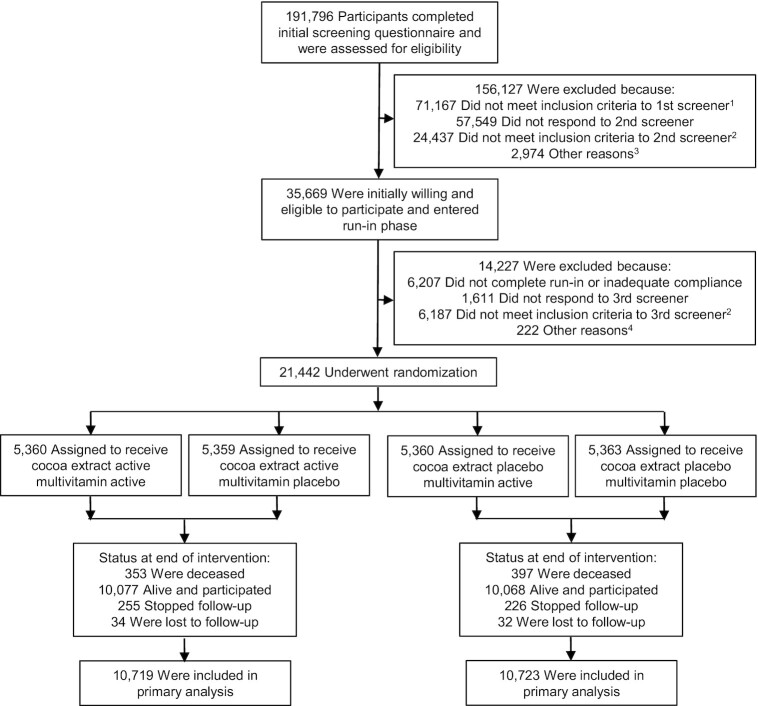
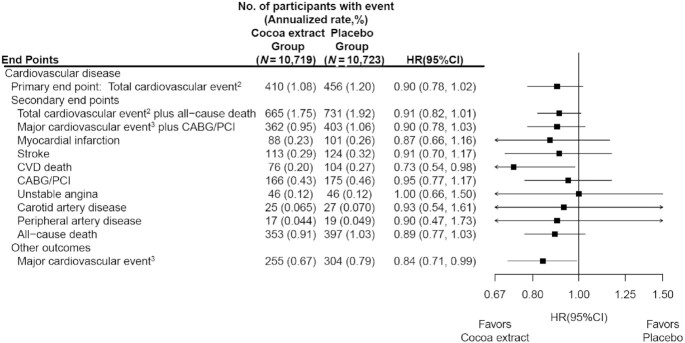
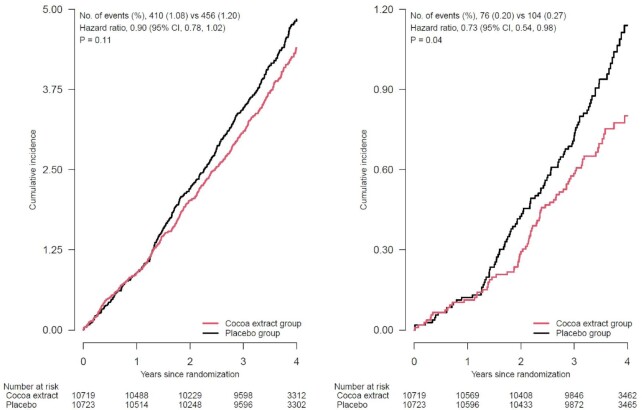
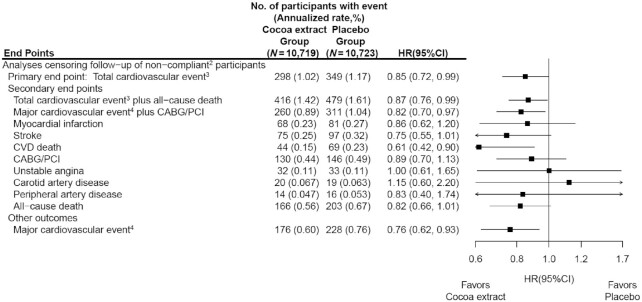
BACKGROUND: Cocoa extract is a source of flavanols that favorably influence vascular risk factors in small and short-term trials, yet effects on clinical cardiovascular events are untested. OBJECTIVES: We examined whether cocoa extract supplementation decreases total cardiovascular disease (CVD) among older adults. METHODS: We conducted a randomized, double-blind, placebo-controlled, 2-by-2 factorial trial of cocoa extract supplementation and multivitamins for prevention of CVD and cancer among 21,442 US adults (12,666 women aged ≥65 y and 8776 men aged ≥60 y), free of major CVD and recently diagnosed cancer. The intervention phase was June 2015 through December 2020. This article reports on the cocoa extract intervention. Participants were randomly assigned to a cocoa extract supplement [500 mg flavanols/d, including 80 mg (-)-epicatechin] or placebo. The primary outcome was a composite of confirmed incident total cardiovascular events, including myocardial infarction (MI), stroke, coronary revascularization, cardiovascular death, carotid artery disease, peripheral artery surgery, and unstable angina. RESULTS: During a median follow-up of 3.6 y, 410 participants taking cocoa extract and 456 taking placebo had confirmed total cardiovascular events (HR: 0.90; 95% CI: 0.78, 1.02; P = 0.11). For secondary endpoints, HRs were 0.73 (95% CI: 0.54, 0.98) for CVD death, 0.87 (95% CI: 0.66, 1.16) for MI, 0.91 (95% CI: 0.70, 1.17) for stroke, 0.95 (95% CI: 0.77, 1.17) for coronary revascularization, neutral for other individual cardiovascular endpoints, and 0.89 (95% CI: 0.77, 1.03) for all-cause mortality. Per-protocol analyses censoring follow-up at nonadherence supported a lower risk of total cardiovascular events (HR: 0.85; 95% CI: 0.72, 0.99). There were no safety concerns. CONCLUSIONS: Cocoa extract supplementation did not significantly reduce total cardiovascular events among older adults but reduced CVD death by 27%. Potential reductions in total cardiovascular events were supported in per-protocol analyses. Additional research is warranted to clarify whether cocoa extract may reduce clinical cardiovascular events. This trial is registered at www.clinicaltrials.gov as NCT02422745.
Overview
The claims and statistics of this paper haven’t been checked yet.
Free: it reads the open-access text and checks the first 5 claims that cite a source we can check. Create a free account to check every claim.
Integrity signals
Registry
Cites
Statistics
Figures
Verification
Claims the paper makes
The claims and statistics of this paper haven’t been checked yet.
Free: it reads the open-access text and checks the first 5 claims that cite a source we can check. Create a free account to check every claim.
Claims other papers make about this one
Each is checked against this paper’s own text: does it say what the citing paper says it does?
The cited source says what the claim attributes to it.
In the citing paper
“In the COSMOS trial, flavanol-enriched cocoa extract was shown to reduce CVD mortality during 3.6 years’ follow-up (HR: 0.73; 95% CI: 0.54-0.98).”
From Micronutrient Supplementation to Reduce Cardiovascular Risk (2022) · cites this paper as [21]
Self-check
Percentages, sums and reported differences re-computed from the paper’s own numbers.
The self-check needs the paper’s full text.
Citations
Cites
Regression Models and Life-Tables
Cox, D. R. (1972) · Journal of the Royal Statistical Society Series B: Statistical Methodology · doi:10.1111/j.2517-6161.1972.tb00899.x · Cited by 39,793
Adams, H. P., Bendixen, B. H., Kappelle, L. J., Biller, J., Love, B. B., Gordon, D. L., & Marsh, E. E. (1993) · Stroke · doi:10.1161/01.str.24.1.35 · Cited by 12,335
Modeling Survival Data: Extending the Cox Model
Therneau, T. M., & Grambsch, P. M. (2000) · Statistics for Biology and Health · doi:10.1007/978-1-4757-3294-8 · Cited by 8,674
Bioavailability and bioefficacy of polyphenols in humans. I. Review of 97 bioavailability studies
Manach, C., Williamson, G., Morand, C., Scalbert, A., & Rémésy, C. (2005) · The American Journal of Clinical Nutrition · doi:10.1093/ajcn/81.1.230s · Cited by 4,219
Isolated Hand Paresis: A Case Series
Alstadhaug, K. B., & Sjulstad, A. (2013) · Cerebrovascular Diseases Extra · doi:10.1159/000350708 · Cited by 4,058
Estruch, R., Ros, E., Salas-Salvadó, J., Covas, M.-I., Corella, D., Arós, F., Gómez-Gracia, E., Ruiz-Gutiérrez, V., Fiol, M., Lapetra, J., et al. (2018) · New England Journal of Medicine · doi:10.1056/nejmoa1800389 · Cited by 3,616 · cited 1×
“In sensitivity analyses either allowing the baseline hazard to change on 1 January 2020 to account for the impact of the COVID-19 pandemic or accounting for intrahousehold correlation among 101 households with ≥2 participants randomly assigned to the same intervention arm using a robust sandwich estimator of variance…”
Classification and natural history of clinically identifiable subtypes of cerebral infarction
Bamford, J., Sandercock, P., Dennis, M., Warlow, C., & Burn, J. (1991) · The Lancet · doi:10.1016/0140-6736(91)93206-o · Cited by 3,294 · cited 1×
“MI (43), stroke (44, 45), and coronary revascularization, which included documented coronary artery bypass graft (CABG) surgery, percutaneous coronary intervention (PCI), coronary stent, or atherectomy (42), were confirmed using established criteria.”
Third Universal Definition of Myocardial Infarction
Thygesen, K., Alpert, J. S., Jaffe, A. S., Simoons, M. L., Chaitman, B. R., & White, H. D. (2012) · Circulation · doi:10.1161/cir.0b013e31826e1058 · Cited by 2,985
Third universal definition of myocardial infarction
the Writing Group on behalf of the Joint ESC/ACCF/AHA/WHF Task Force for the Universal Definition of Myocardial Infarction, Thygesen, K., Alpert, J. S., Jaffe, A. S., Simoons, M. L., Chaitman, B. R., & White, H. D. (2012) · Nature Reviews Cardiology · doi:10.1038/nrcardio.2012.122 · Cited by 2,053
Feskanich, D., Rimm, E. B., Giovannucci, E. L., Colditz, G. A., Stampfer, M. J., Litin, L. B., & Willett, W. C. (1993) · Journal of the American Dietetic Association · doi:10.1016/0002-8223(93)91754-e · Cited by 1,070 · cited 1×
“At the end of the run-in, participants returned a final compliance, eligibility, and risk factor questionnaire and semi-quantitative food-frequency questionnaire (40).”
(–)-Epicatechin mediates beneficial effects of flavanol-rich cocoa on vascular function in humans
Schroeter, H., Heiss, C., Balzer, J., Kleinbongard, P., Keen, C. L., Hollenberg, N. K., Sies, H., Kwik-Uribe, C., Schmitz, H. H., & Kelm, M. (2006) · Proceedings of the National Academy of Sciences · doi:10.1073/pnas.0510168103 · Cited by 1,052 · cited 1×
“(30, 31), and provide insight into the absorption, distribution, metabolism, and excretion of flavanols (32–34) as well as cocoa’s potential vascular effects due to intake of the flavanol (−)epicatechin (24, 35).”
Robins, J. M., & Finkelstein, D. M. (2000) · Biometrics · doi:10.1111/j.0006-341x.2000.00779.x · Cited by 877 · cited 2×
“History of CVD and hypertension, significant predictors of both dependent censoring and total CVD, was used to estimate weights for compliance-based analyses (48).”
Flavan‐3‐ols: Nature, occurrence and biological activity
Aron, P. M., & Kennedy, J. A. (2008) · Molecular Nutrition & Food Research · doi:10.1002/mnfr.200700137 · Cited by 770 · cited 1×
“Cocoa is made from the bean of the cacao tree, Theobroma cacao, and has a long history of medicinal use (1) and potential health benefits based upon its flavanol and procyanidin content (2) also found in tea, grapes, wine, and other foods.”
Outcomes ascertainment and adjudication methods in the women's health initiative
Curb, J. D., Mctiernan, A., Heckbert, S. R., Kooperberg, C., Stanford, J., Nevitt, M., Johnson, K. C., Proulx-Burns, L., Pastore, L., Criqui, M., et al. (2003) · Annals of Epidemiology · doi:10.1016/s1047-2797(03)00048-6 · Cited by 698 · cited 3×
“MI (43), stroke (44, 45), and coronary revascularization, which included documented coronary artery bypass graft (CABG) surgery, percutaneous coronary intervention (PCI), coronary stent, or atherectomy (42), were confirmed using established criteria.”
Hooper, L., Kay, C., Abdelhamid, A., Kroon, P. A., Cohn, J. S., Rimm, E. B., & Cassidy, A. (2012) · The American Journal of Clinical Nutrition · doi:10.3945/ajcn.111.023457 · Cited by 610 · cited 2×
“Meta-analyses support benefits for flavanols on cardiometabolic biomarkers including lipids and inflammation (20), endothelium-dependent vasodilation measured by flow-mediated dilation (23), BP (25), arterial stiffness measured by pulse-wave velocity (50), and insulin resistance (19).”
Rodriguez-Mateos, A., Vauzour, D., Krueger, C. G., Shanmuganayagam, D., Reed, J., Calani, L., Mena, P., Del Rio, D., & Crozier, A. (2014) · Archives of Toxicology · doi:10.1007/s00204-014-1330-7 · Cited by 602 · cited 1×
“These trials have provided broader insights on the absorption, metabolism, and excretion of flavanols in humans (33, 34), with those focused on cocoa flavanol intake (as beverages, supplements, or chocolate) at up to 2000 mg/d and up to 1 y of treatment.”
Grassi, D., Necozione, S., Lippi, C., Croce, G., Valeri, L., Pasqualetti, P., Desideri, G., Blumberg, J. B., & Ferri, C. (2005) · Hypertension · doi:10.1161/01.hyp.0000174990.46027.70 · Cited by 546
Flavonoid intake and cardiovascular disease mortality in a prospective cohort of US adults
McCullough, M. L., Peterson, J. J., Patel, R., Jacques, P. F., Shah, R., & Dwyer, J. T. (2012) · The American Journal of Clinical Nutrition · doi:10.3945/ajcn.111.016634 · Cited by 536 · cited 1×
“Nevertheless, prospective cohort studies have reported an inverse association between dietary flavanols—at lower concentrations than tested in COSMOS— with CVD (11, 12), carotid atherosclerosis (9), hypertension (10), and type 2 diabetes (14).”
Habitual intake of flavonoid subclasses and incident hypertension in adults
Cassidy, A., O’Reilly, É. J., Kay, C., Sampson, L., Franz, M., Forman, J., Curhan, G., & Rimm, E. B. (2011) · The American Journal of Clinical Nutrition · doi:10.3945/ajcn.110.006783 · Cited by 500 · cited 1×
“Nevertheless, prospective cohort studies have reported an inverse association between dietary flavanols—at lower concentrations than tested in COSMOS— with CVD (11, 12), carotid atherosclerosis (9), hypertension (10), and type 2 diabetes (14).”
Loke, W. M., Hodgson, J. M., Proudfoot, J. M., McKinley, A. J., Puddey, I. B., & Croft, K. D. (2008) · The American Journal of Clinical Nutrition · doi:10.1093/ajcn/88.4.1018 · Cited by 372 · cited 1×
“(30, 31), and provide insight into the absorption, distribution, metabolism, and excretion of flavanols (32–34) as well as cocoa’s potential vascular effects due to intake of the flavanol (−)epicatechin (24, 35).”
Cocoa inhibits platelet activation and function
Rein, D., Paglieroni, T. G., Wun, T., Pearson, D. A., Schmitz, H. H., Gosselin, R., & Keen, C. L. (2000) · The American Journal of Clinical Nutrition · doi:10.1093/ajcn/72.1.30 · Cited by 358 · cited 1×
“(30, 31), and provide insight into the absorption, distribution, metabolism, and excretion of flavanols (32–34) as well as cocoa’s potential vascular effects due to intake of the flavanol (−)epicatechin (24, 35).”
Food of the Gods: Cure for Humanity? A Cultural History of the Medicinal and Ritual Use of Chocolate
Dillinger, T. L., Barriga, P., Escárcega, S., Jimenez, M., Lowe, D. S., & Grivetti, L. E. (2000) · The Journal of Nutrition · doi:10.1093/jn/130.8.2057s · Cited by 290 · cited 1×
“Cocoa is made from the bean of the cacao tree, Theobroma cacao, and has a long history of medicinal use (1) and potential health benefits based upon its flavanol and procyanidin content (2) also found in tea, grapes, wine, and other foods.”
Effect of cocoa on blood pressure
Ried, K., Fakler, P., & Stocks, N. P. (2017) · Cochrane Database of Systematic Reviews · doi:10.1002/14651858.cd008893.pub3 · Cited by 263
Ottaviani, J. I., Borges, G., Momma, T. Y., Spencer, J. P. E., Keen, C. L., Crozier, A., & Schroeter, H. (2016) · Scientific Reports · doi:10.1038/srep29034 · Cited by 255 · cited 1×
“Mars Edge supported the measurement of the 5-(3′,4′-dihydroxyphenyl)γ -valerolactone (gVL)-3′/4′-sulfate (gVL3S) and gVL-3′/4′-Oglucuronide (gVLG) metabolites (gVLM) (32), a biomarker of flavanol intake (41), to evaluate compliance with the cocoa extract intervention.”
Buijsse, B., Weikert, C., Drogan, D., Bergmann, M., & Boeing, H. (2010) · European Heart Journal · doi:10.1093/eurheartj/ehq068 · Cited by 227
van Dam, R. M., Naidoo, N., & Landberg, R. (2013) · Current Opinion in Lipidology · doi:10.1097/mol.0b013e32835bcdff · Cited by 212 · cited 2×
“Nevertheless, prospective cohort studies have reported an inverse association between dietary flavanols—at lower concentrations than tested in COSMOS— with CVD (11, 12), carotid atherosclerosis (9), hypertension (10), and type 2 diabetes (14).”
Cocoa and Wine Polyphenols Modulate Platelet Activation and Function
Rein, D., Paglieroni, T. G., Pearson, D. A., Wun, T., Schmitz, H. H., Gosselin, R., & Keen, C. L. (2000) · The Journal of Nutrition · doi:10.1093/jn/130.8.2120s · Cited by 203 · cited 1×
“(30, 31), and provide insight into the absorption, distribution, metabolism, and excretion of flavanols (32–34) as well as cocoa’s potential vascular effects due to intake of the flavanol (−)epicatechin (24, 35).”
Flavanols and cardiovascular disease prevention
Heiss, C., Keen, C. L., & Kelm, M. (2010) · European Heart Journal · doi:10.1093/eurheartj/ehq332 · Cited by 195
Mursu, J., Voutilainen, S., Nurmi, T., Tuomainen, T.-P., Kurl, S., & Salonen, J. T. (2008) · British Journal of Nutrition · doi:10.1017/s0007114508945694 · Cited by 184 · cited 1×
“Nevertheless, prospective cohort studies have reported an inverse association between dietary flavanols—at lower concentrations than tested in COSMOS— with CVD (11, 12), carotid atherosclerosis (9), hypertension (10), and type 2 diabetes (14).”
Dower, J. I., Geleijnse, J. M., Gijsbers, L., Schalkwijk, C., Kromhout, D., & Hollman, P. C. (2015) · The Journal of Nutrition · doi:10.3945/jn.115.211888 · Cited by 179 · cited 1×
“Data have shown improvements in endothelium-dependent vasodilation (21–24), blood pressure (BP) (21, 25–27), inflammation (28, 29), and platelet activation”
Sansone, R., Rodriguez-Mateos, A., Heuel, J., Falk, D., Schuler, D., Wagstaff, R., Kuhnle, G. G. C., Spencer, J. P. E., Schroeter, H., Merx, M. W., et al. (2015) · British Journal of Nutrition · doi:10.1017/s0007114515002822 · Cited by 178
Chocolate, “Food of the Gods”: History, Science, and Human Health
Montagna, M. T., Diella, G., Triggiano, F., Caponio, G. R., Giglio, O. D., Caggiano, G., Ciaula, A. D., & Portincasa, P. (2019) · International Journal of Environmental Research and Public Health · doi:10.3390/ijerph16244960 · Cited by 159 · cited 1×
“Further, the COSMOS cocoa extract supplement avoided the perils of food-based cocoa interventions highly susceptible to variation in flavanol, theobromine, and other bioactive content (62).”
Lin, X., Zhang, I., Li, A., Manson, J. E., Sesso, H. D., Wang, L., & Liu, S. (2016) · The Journal of Nutrition · doi:10.3945/jn.116.237644 · Cited by 150 · cited 2×
“Meta-analyses support benefits for flavanols on cardiometabolic biomarkers including lipids and inflammation (20), endothelium-dependent vasodilation measured by flow-mediated dilation (23), BP (25), arterial stiffness measured by pulse-wave velocity (50), and insulin resistance (19).”
Self-citationEffect of cocoa on blood pressure
Ried, K., Sullivan, T. R., Fakler, P., Frank, O. R., & Stocks, N. P. (2012) · Cochrane Database of Systematic Reviews · doi:10.1002/14651858.cd008893.pub2 · Cited by 150
Actis‐Goretta, L., Lévèques, A., Rein, M. J., Teml, A., Schäfer, C., Hofmann, U., Li, H., Schwab, M. G., Eichelbaum, M. F., & Williamson, G. (2013) · American Journal of Clinical Nutrition · doi:10.3945/ajcn.113.065789 · Cited by 125
Sansone, R., Ottaviani, J. I., Rodriguez‐Mateos, A., Heinen, Y., Noske, D., Spencer, J. P. E., Crozier, A., Merx, M. W., Kelm, M., Schroeter, H., et al. (2016) · American Journal of Clinical Nutrition · doi:10.3945/ajcn.116.140046 · Cited by 125 · cited 1×
“Cocoa extract also contains methylxanthines such as theobromine and caffeine, which may enhance the vascular and central nervous system effects of cocoa flavanols (3, 4).”
Dietary flavonoids as cancer-preventive and therapeutic biofactors
Nishiumi, S., Miyamoto, S., Kawabata, K., Ohnishi, K., Mukai, R., Murakami, A., Ashida, H., & Terao, J. (2011) · Frontiers in Bioscience-Scholar · doi:10.2741/229 · Cited by 122 · cited 1×
“Several mechanisms have been proposed for flavanols on the inhibition of proliferation, inflammation, invasion, metastasis, and activation of apoptosis (54, 55).”
Vogiatzoglou, A., Mulligan, A. A., Luben, R. N., Lentjes, M. A. H., Heiss, C., Kelm, M., Merx, M. W., Spencer, J. P. E., Schroeter, H., & Kuhnle, G. G. C. (2014) · British Journal of Nutrition · doi:10.1017/s0007114513003930 · Cited by 121 · cited 1×
“The 500 mg/d cocoa flavanols in COSMOS substantially exceeds the mean intake reported in Europe of 105 mg/d [ranging from 84 mg/d (Sweden) to 138 mg/d (Spain)] (60) and aligns with amounts tested in short-term trials (25, 61).”
Schroeter, H., Heiss, C., Spencer, J. P. E., Keen, C. L., Lupton, J. R., & Schmitz, H. H. (2010) · Molecular Aspects of Medicine · doi:10.1016/j.mam.2010.09.008 · Cited by 120 · cited 1×
“Dietary flavonoids are a structurally diverse set of naturally occurring polyphenolic compounds in plant-based foods, and flavan-3-ols are derivatives of flavanols, a major subclass of flavonoids, that include complex, bioactive monomeric and polymeric compounds found in tea leaves, cocoa, grapes, and other foods (51).”
Potatoes and risk of chronic disease: a systematic review and dose–response meta-analysis
Schwingshackl, L., Schwedhelm, C., Hoffmann, G., & Boeing, H. (2019) · European Journal of Nutrition · doi:10.1007/s00394-018-1774-2 · Cited by 119
Ávila‐Gálvez, M. Á., García-Villalba, R., Martínez‐Díaz, F., Ocaña‐Castillo, B., Monedero‐Saiz, T., Torrecillas‐Sánchez, A., Abellán, B., González‐Sarrías, A., & Espín, J. C. (2019) · Molecular Nutrition & Food Research · doi:10.1002/mnfr.201801239 · Cited by 119 · cited 1×
“However, limited trials have tested cocoa on cancer mechanisms, with equivocal results (56, 57).”
The effect of alkalization on the bioactive and flavor related components in commercial cocoa powder
Li, Y., Feng, Y., Zhu, S., Luo, C., Ma, J., & Zhong, F. (2011) · Journal of Food Composition and Analysis · doi:10.1016/j.jfca.2011.04.010 · Cited by 110 · cited 1×
“The resulting variable changes in amino acids (64), polyphenols (65), methylxanthines including theobromine (66), and other functional compounds of cocoa products (63) contradict our goal to test a simple cocoa extract supplement that preserves the known bioactive contents of the cocoa bean without adding excessive su…”
Raman, G., Avendano, E. E., Chen, S., Wang, J., Matson, J., Gayer, B., Novotny, J. A., & Cassidy, A. (2019) · The American Journal of Clinical Nutrition · doi:10.1093/ajcn/nqz178 · Cited by 109
Todorović, V., Milenković, M., Vidović, B. B., Todorović, Z. B., & Sobajic, S. S. (2017) · Journal of Food Science · doi:10.1111/1750-3841.13672 · Cited by 106 · cited 1×
“The resulting variable changes in amino acids (64), polyphenols (65), methylxanthines including theobromine (66), and other functional compounds of cocoa products (63) contradict our goal to test a simple cocoa extract supplement that preserves the known bioactive contents of the cocoa bean without adding excessive su…”
Health benefits of methylxanthines in neurodegenerative diseases
Oñatibia‐Astibia, A., Franco, R., & Martínez‐Pinilla, E. (2017) · Molecular Nutrition & Food Research · doi:10.1002/mnfr.201600670 · Cited by 105 · cited 1×
“Cocoa extract also contains methylxanthines such as theobromine and caffeine, which may enhance the vascular and central nervous system effects of cocoa flavanols (3, 4).”
Baseline characteristics of participants in the VITamin D and OmegA-3 TriaL (VITAL)
Bassuk, S. S., Manson, J. E., Lee, I.-M., Cook, N. R., Christen, W. G., Bubes, V. Y., Gordon, D. S., Copeland, T., Friedenberg, G., D'Agostino, D. M., et al. (2016) · Contemporary Clinical Trials · doi:10.1016/j.cct.2015.12.022 · Cited by 101 · cited 3×
“Recruitment included mailings to 71,521 active Women’s Health Initiative (WHI) Extension Study participants (37) and mailings by Brigham and Women’s Hospital (BWH) to 237,736 women and men contacted for, but not randomly assigned to, the VITamin D and OmegA-3 TriaL (VITAL) (38); mass mailings to 2,616,343 US men and w…”
Self-citationEstimating the effect of the run‐in on the power of the physicians' health study
Lang, J. M., Buring, J. E., Rosner, B., Cook, N., & Hennekens, C. H. (1991) · Statistics in Medicine · doi:10.1002/sim.4780101010 · Cited by 99
Habitual chocolate consumption and risk of cardiovascular disease among healthy men and women
Kwok, C. S., Boekholdt, S. M., Lentjes, M. A. H., Loke, Y. K., Luben, R., Yeong, J. K.-Y., Wareham, N. J., Myint, P. K., & Khaw, K. (2015) · Heart · doi:10.1136/heartjnl-2014-307050 · Cited by 98 · cited 1×
“6 g/d of chocolate intake compared with no intake was significantly associated with a 14% reduction in incident CVD (7) and a nonsignificant 13% reduction in heart failure (53).”
Recommending flavanols and procyanidins for cardiovascular health: Revisited
Ottaviani, J. I., Heiß, C., Spencer, J. P. E., Kelm, M., & Schroeter, H. (2018) · Molecular Aspects of Medicine · doi:10.1016/j.mam.2018.02.001 · Cited by 97 · cited 1×
“Numerous shortterm, small-scale dietary intervention studies have examined the cardiovascular effects of flavanols and procyanidins (15– 17), which have included well-characterized cocoa and cocoa product test materials linked to cardiovascular (18, 19) and cardiometabolic (20) benefits.”
Zamora‐Ros, R., Agudo, A., Luján‐Barroso, L., Romieu, I., Ferrari, P., Knaze, V., Bueno-de-Mesquita, H. B., Leenders, M. B., Travis, R. C., Navarro, C., et al. (2012) · American Journal of Clinical Nutrition · doi:10.3945/ajcn.112.037358 · Cited by 96 · cited 1×
“Cohort studies are equally inconsistent, with some suggested benefits of flavanols on digestive cancers, including colorectal cancer (58) and gastric cancer in women but not in men (59).”
Dose-related effects of flavanol-rich cocoa on blood pressure
Davison, K., Berry, N., Misan, G., Coates, A. M., Buckley, J. D., & Howe, P. R. C. (2010) · Journal of Human Hypertension · doi:10.1038/jhh.2009.105 · Cited by 90
Cancer Protective Properties of Cocoa: A Review of the Epidemiologic Evidence
Maskarinec, G. (2009) · Nutrition and Cancer · doi:10.1080/01635580902825662 · Cited by 89 · cited 1×
“Several mechanisms have been proposed for flavanols on the inhibition of proliferation, inflammation, invasion, metastasis, and activation of apoptosis (54, 55).”
Ottaviani, J. I., Fong, R., Kimball, J., Ensunsa, J. L., Britten, A., Lucarelli, D., Luben, R., Grace, P. B., Mawson, D. H., Tym, A., et al. (2018) · Scientific Reports · doi:10.1038/s41598-018-28333-w · Cited by 83 · cited 1×
“Mars Edge supported the measurement of the 5-(3′,4′-dihydroxyphenyl)γ -valerolactone (gVL)-3′/4′-sulfate (gVL3S) and gVL-3′/4′-Oglucuronide (gVLG) metabolites (gVLM) (32), a biomarker of flavanol intake (41), to evaluate compliance with the cocoa extract intervention.”
Changes in cocoa properties induced by the alkalization process: A review
García, D. V., Pérez‐Esteve, É., & Baviera, J. M. B. (2020) · Comprehensive Reviews in Food Science and Food Safety · doi:10.1111/1541-4337.12581 · Cited by 79 · cited 1×
“The resulting variable changes in amino acids (64), polyphenols (65), methylxanthines including theobromine (66), and other functional compounds of cocoa products (63) contradict our goal to test a simple cocoa extract supplement that preserves the known bioactive contents of the cocoa bean without adding excessive su…”
Sun, Y., Zimmermann, D., Castro, C. A. D., & Actis‐Goretta, L. (2019) · Food & Function · doi:10.1039/c9fo01747j · Cited by 69 · cited 1×
“Meta-analyses support benefits for flavanols on cardiometabolic biomarkers including lipids and inflammation (20), endothelium-dependent vasodilation measured by flow-mediated dilation (23), BP (25), arterial stiffness measured by pulse-wave velocity (50), and insulin resistance (19).”
Rodriguez‐Mateos, A., Weber, T., Skene, S. S., Ottaviani, J. I., Crozier, A., Kelm, M., Schroeter, H., & Heiß, C. (2018) · American Journal of Clinical Nutrition · doi:10.1093/ajcn/nqy229 · Cited by 65
Ottaviani, J. I., Balz, M., Kimball, J., Ensunsa, J. L., Fong, R. Y., Momma, T. Y., Kwik-Uribe, C. L., Schroeter, H., & Keen, C. L. (2015) · American Journal of Clinical Nutrition · doi:10.3945/ajcn.115.116178 · Cited by 61 · cited 1×
“The cocoa extract intervention was well tolerated and taking it with food was recommended (68); the slightly greater likelihood of nausea likely reflects noncompliance with study guidelines.”
Mursu, J., Nurmi, T., Tuomainen, T., Ruusunen, A. A., Salonen, J. T., & Voutilainen, S. (2007) · British Journal Of Nutrition · doi:10.1017/s0007114507744410 · Cited by 57 · cited 1×
“Nevertheless, prospective cohort studies have reported an inverse association between dietary flavanols—at lower concentrations than tested in COSMOS— with CVD (11, 12), carotid atherosclerosis (9), hypertension (10), and type 2 diabetes (14).”
Chocolate and risk of chronic disease: a systematic review and dose-response meta-analysis
Morze, J., Schwedhelm, C., Bencic, A., Hoffmann, G., Boeing, H., Przybylowicz, K., & Schwingshackl, L. (2020) · European Journal of Nutrition · doi:10.1007/s00394-019-01914-9 · Cited by 57 · cited 1×
“Prospective studies examining cocoa products restricted to chocolate intake (5–8) or to usual levels of dietary flavanol intake (9–12) with risk of cardiovascular disease (CVD) have been inconsistent, likely due to uncertainty of cocoa flavanol content and measurement error, although some meta-analyses suggest modest…”
Effect of alkalization on the Maillard reaction products formed in cocoa during roasting
Taş, N. G., & Gökmen, V. (2015) · Food Research International · doi:10.1016/j.foodres.2015.12.021 · Cited by 52 · cited 1×
“The resulting variable changes in amino acids (64), polyphenols (65), methylxanthines including theobromine (66), and other functional compounds of cocoa products (63) contradict our goal to test a simple cocoa extract supplement that preserves the known bioactive contents of the cocoa bean without adding excessive su…”
Dietary flavonoid for preventing colorectal neoplasms
Jin, H., Leng, Q., & Li, C. (2012) · Cochrane Database of Systematic Reviews · doi:10.1002/14651858.cd009350.pub2 · Cited by 51 · cited 1×
“Cohort studies are equally inconsistent, with some suggested benefits of flavanols on digestive cancers, including colorectal cancer (58) and gastric cancer in women but not in men (59).”
Nutrition epidemiology of flavan-3-ols: The known unknowns
Kuhnle, G. (2017) · Molecular Aspects of Medicine · doi:10.1016/j.mam.2017.10.003 · Cited by 48 · cited 1×
“measurement error, food and nutrient variability, and generalized nutrient-composition data (52).”
Kuebler, U., Arpagaus, A., Meister, R. E., von Känel, R., Huber, S., Ehlert, U., & Wirtz, P. H. (2016) · Brain Behavior and Immunity · doi:10.1016/j.bbi.2016.04.006 · Cited by 45 · cited 1×
“Data have shown improvements in endothelium-dependent vasodilation (21–24), blood pressure (BP) (21, 25–27), inflammation (28, 29), and platelet activation”
Chocolate flavanols and skin photoprotection: a parallel, double-blind, randomized clinical trial
Mogollon, J. A., Boivin, C., Lemieux, S., Blanchet, C., Claveau, J., & Dodin, S. (2014) · Nutrition Journal · doi:10.1186/1475-2891-13-66 · Cited by 37 · cited 1×
“However, limited trials have tested cocoa on cancer mechanisms, with equivocal results (56, 57).”
Rist, P. M., Sesso, H. D., Johnson, L. G., Aragaki, A. K., Wang, L., Rautiainen, S., Hazra, A., Tobias, D. K., LeBoff, M. S., Schroeter, H., et al. (2022) · Contemporary Clinical Trials · doi:10.1016/j.cct.2022.106728 · Cited by 36 · cited 1×
“nonmelanoma skin cancer) within the past 2 y (36).”
Self-citationAzad, B. J., Daneshzad, E., Meysamie, A. P., & Koohdani, F. (2020) · Critical Reviews in Food Science and Nutrition · doi:10.1080/10408398.2020.1733484 · Cited by 29 · cited 1×
“Meta-analyses support benefits for flavanols on cardiometabolic biomarkers including lipids and inflammation (20), endothelium-dependent vasodilation measured by flow-mediated dilation (23), BP (25), arterial stiffness measured by pulse-wave velocity (50), and insulin resistance (19).”
Habitual chocolate consumption and the risk of incident heart failure among healthy men and women
Kwok, C. S., Loke, Y. K., Welch, A. A., Luben, R., Lentjes, M. A. H., Boekholdt, S. M., Pfister, R., Mamas, M. A., Wareham, N. J., Khaw, K.-T., et al. (2016) · Nutrition Metabolism and Cardiovascular Diseases · doi:10.1016/j.numecd.2016.01.003 · Cited by 21 · cited 1×
“6 g/d of chocolate intake compared with no intake was significantly associated with a 14% reduction in incident CVD (7) and a nonsignificant 13% reduction in heart failure (53).”
Marsh, C. E., GREEN, D. J., Naylor, L. H., & Guelfi, K. J. (2017) · Appetite · doi:10.1016/j.appet.2017.05.050 · Cited by 20 · cited 1×
“The resulting variable changes in amino acids (64), polyphenols (65), methylxanthines including theobromine (66), and other functional compounds of cocoa products (63) contradict our goal to test a simple cocoa extract supplement that preserves the known bioactive contents of the cocoa bean without adding excessive su…”
The Women's Health Initiative: A Landmark Resource for Skeletal Research Since 1992
Cauley, J. A., & Crandall, C. J. (2020) · Journal of Bone and Mineral Research · doi:10.1002/jbmr.4026 · Cited by 19
Greenberg, J. A., Manson, J. E., Neuhouser, M. L., Tinker, L. F., Eaton, C. B., Johnson, K., & Shikany, J. M. (2018) · American Journal of Clinical Nutrition · doi:10.1093/ajcn/nqy073 · Cited by 18
Self-citationZhong, G., Hu, T., Yang, P., Peng, Y., Wu, J., Sun, W., Cheng, L., & Wang, C. (2021) · Aging · doi:10.18632/aging.203302 · Cited by 17 · cited 1×
“A J-shaped association between chocolate intake and lower total and cardiovascular mortality was found in 91,891 participants (8).”
Ngo, Y. T. (2013) · International Journal of Evidence-Based Healthcare · doi:10.1111/1744-1609.12012 · Cited by 11
Liu, S., & Sesso, H. D. (2021) · American Journal of Clinical Nutrition · doi:10.1093/ajcn/nqab147 · Cited by 7 · cited 1×
“Second, we tested a cocoa extract supplement (Supplementary Table 2) containing all naturally occurring bioactive components of the cocoa bean, including cocoa flavanols, (–)-epicatechin, and theobromine, against a true placebo; thus, we cannot disentangle the effects of its individual components (69).”
Self-citation
Cited by
The interplay between diet and the gut microbiome: implications for health and disease
Ross, F. C., Patangia, D., Grimaud, G., Lavelle, A., Dempsey, E. M., Ross, R. P., & Stanton, C. (2024) · Nature Reviews Microbiology · doi:10.1038/s41579-024-01068-4 · Cited by 638
“However, the event of cardiovascular disease was not reduced 50 .”
The Role of Oxidative Stress in Atherosclerosis
Batty, M., Bennett, M. R., & Yu, E. (2022) · Cells · doi:10.3390/cells11233843 · Cited by 536
Charchar, F. J., Prestes, P. R., Mills, C., Ching, S. M., Neupane, D., Marques, F. Z., Sharman, J. E., Vogt, L., Burrell, L. M., Korostovtseva, L., et al. (2024) · Journal of Hypertension · doi:10.1097/hjh.0000000000003563 · Cited by 297
“Looking beyond traditional macronutrients and micronutrients for health benefits might be important, for example, evidence suggests that cocoa flavanol f o m h tt p intake could be beneficial for CVD risk prevention [118].”
Human trials exploring anti-aging medicines
Guarente, L., Sinclair, D. A., & Kroemer, G. (2024) · Cell Metabolism · doi:10.1016/j.cmet.2023.12.007 · Cited by 244
US Preventive Services Task Force, Mangione, C. M., Barry, M. J., Nicholson, W. K., Cabana, M., Chelmow, D., Coker, T. R., Davis, E. M., Donahue, K. E., Doubeni, C. A., et al. (2022) · JAMA · doi:10.1001/jama.2022.8970 · Cited by 194
Metadata
- Authors
- Sesso, H. D., Manson, J. E., Aragaki, A. K., Rist, P. M., Johnson, L. G., Friedenberg, G., Copeland, T., Clar, A., Mora, S., Moorthy, M. V., Sarkissian, A., Carrick, W. R., & Anderson, G. L.
- Affiliations
- Brigham and Women's Hospital (US)
- Fred Hutch Cancer Center (US)
- Corresponding author
- Sesso, Howard D
- ORCID
- Venue
- The American Journal of Clinical Nutrition
- Publisher
- Elsevier BV
- Published
- 2022-06
- Volume
- 115
- Issue
- 6
- Pages
- 1490-1500
- ISSN
- 0002-9165 (ISSN-L)
- PMC
- PMC9170467
- OpenAlex
- W4221025812
- Cited by
- 187
- References
- 73
- Citations by year
- 2026: 39 · 2025: 40 · 2024: 45 · 2023: 38 · 2022: 25
- FWCI
- 19.36
- Type
- journal article
- Language
- en
- Open access
- hybrid
- doi.org
- Licence
- cc-by
- www.elsevier.com/tdm/userlicense/1.0/ (tdm)
- creativecommons.org/licenses/by/4.0/ (vor)
- Locations
- American Journal of Clinical Nutrition (publishedVersion, cc-by)
- PubMed Central (publishedVersion, cc-by)
- PubMed (publishedVersion)
- Funders
- COSMOS (AG050657, AG071611, EY025623, HL157665)
- National Institutes of Health
- National Heart, Lung, and Blood Institute
- U.S. Department of Health and Human Services (75N92021D00001, 75N92021D00002, 75N92021D00003, 75N92021D00004, 75N92021D00005)
- Mars Edge
- Topics
- Health Sciences › Medicine › Biochemistry (medical) › Phytochemicals and Antioxidant Activities
- Life Sciences › Agricultural and Biological Sciences › Food Science › Food Chemistry and Fat Analysis
- Health Sciences › Medicine › Public Health, Environmental and Occupational Health › Nutritional Studies and Diet
- Keywords
- cocoa flavanols, cocoa extract, epicatechin, cardiovascular disease prevention, cardiovascular events, myocardial infarction, stroke, coronary revascularization, cardiovascular mortality, older adults, multivitamin supplementation, cancer prevention, dietary supplementation, COSMOS trial, safety and tolerability, vascular risk factors, all-cause mortality, carotid artery disease, peripheral arterial disease
- MeSH terms
- Aged, Cacao, Cardiovascular Diseases, Double-Blind Method, Female, Humans, Male, Myocardial Infarction, Neoplasms, Plant Extracts, Risk Factors, Vitamins, Dietary Supplements, Stroke, Polyphenols
About these checks
Registry, retraction, Cites and statistics results are computed, not judged, with one exception: a printed reference that no index lists is read once by a model before it counts as a citation error. Claims are extracted by a model and kept only when their quote appears verbatim in the text; each cited source is then checked, with a model’s help, for whether it says what the claim relies on. Those verdicts can be wrong — read the claim’s quote and the cited source before relying on one.
Statistics and arithmetic are recomputed, not judged.
Confidence bands are shown only for fields calibrated on our annotated test set. None is calibrated yet, so no band is shown.
What counts as a claim ›How we measure confidence ›How we check this ›
Are you an author, or do you see a problem with this page? Request a review
Data sources
Bibliographic data: Semantic Scholar, OpenAlex, Crossref.
Contains information from the Semantic Scholar Academic Graph Datasets, made available under the ODC Attribution License (ODC-BY 1.0).
Semantic Scholar’s data is described in: Kinney, R., et al. (2023). The Semantic Scholar Open Data Platform. arXiv:2301.10140.
