

Effect of cocoa flavanol supplementation for the prevention of cardiovascular disease events: the COcoa Supplement and Multivitamin Outcomes Study (COSMOS) randomized clinical trial
Open accessThe DOI matches its Crossref record; 73 of the 73 references it cites were found in a registry or an index.
Abstract
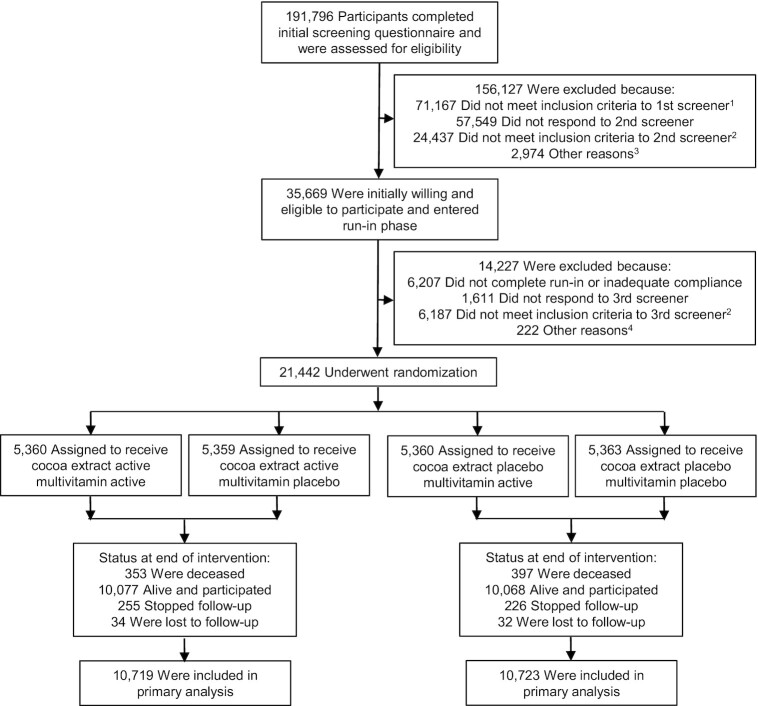
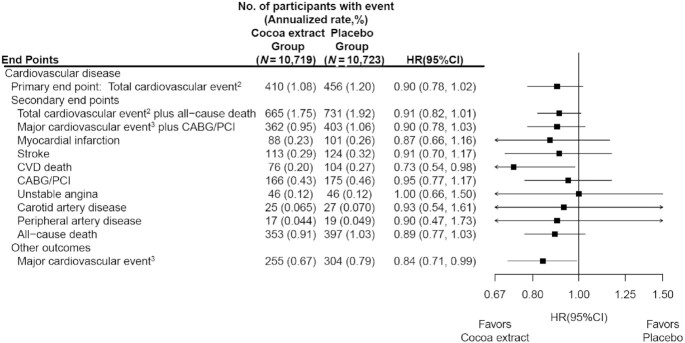
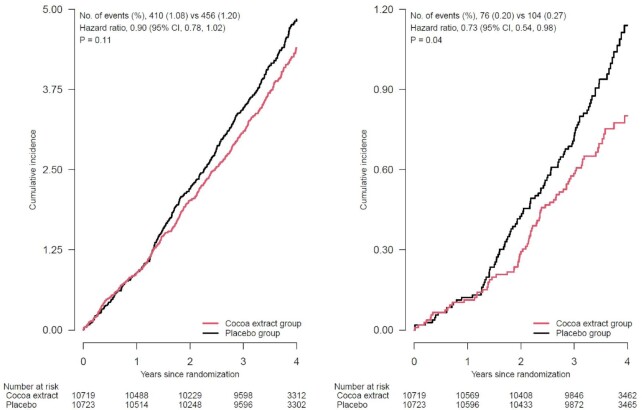
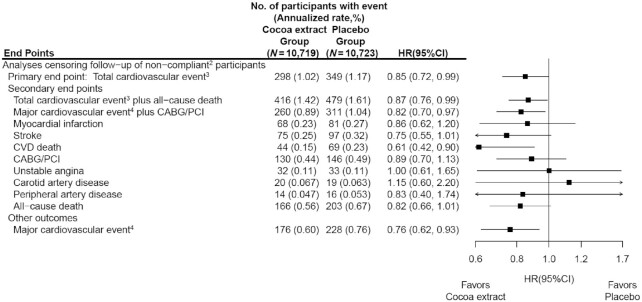
BACKGROUND: Cocoa extract is a source of flavanols that favorably influence vascular risk factors in small and short-term trials, yet effects on clinical cardiovascular events are untested. OBJECTIVES: We examined whether cocoa extract supplementation decreases total cardiovascular disease (CVD) among older adults. METHODS: We conducted a randomized, double-blind, placebo-controlled, 2-by-2 factorial trial of cocoa extract supplementation and multivitamins for prevention of CVD and cancer among 21,442 US adults (12,666 women aged ≥65 y and 8776 men aged ≥60 y), free of major CVD and recently diagnosed cancer. The intervention phase was June 2015 through December 2020. This article reports on the cocoa extract intervention. Participants were randomly assigned to a cocoa extract supplement [500 mg flavanols/d, including 80 mg (-)-epicatechin] or placebo. The primary outcome was a composite of confirmed incident total cardiovascular events, including myocardial infarction (MI), stroke, coronary revascularization, cardiovascular death, carotid artery disease, peripheral artery surgery, and unstable angina. RESULTS: During a median follow-up of 3.6 y, 410 participants taking cocoa extract and 456 taking placebo had confirmed total cardiovascular events (HR: 0.90; 95% CI: 0.78, 1.02; P = 0.11). For secondary endpoints, HRs were 0.73 (95% CI: 0.54, 0.98) for CVD death, 0.87 (95% CI: 0.66, 1.16) for MI, 0.91 (95% CI: 0.70, 1.17) for stroke, 0.95 (95% CI: 0.77, 1.17) for coronary revascularization, neutral for other individual cardiovascular endpoints, and 0.89 (95% CI: 0.77, 1.03) for all-cause mortality. Per-protocol analyses censoring follow-up at nonadherence supported a lower risk of total cardiovascular events (HR: 0.85; 95% CI: 0.72, 0.99). There were no safety concerns. CONCLUSIONS: Cocoa extract supplementation did not significantly reduce total cardiovascular events among older adults but reduced CVD death by 27%. Potential reductions in total cardiovascular events were supported in per-protocol analyses. Additional research is warranted to clarify whether cocoa extract may reduce clinical cardiovascular events. This trial is registered at www.clinicaltrials.gov as NCT02422745.
Overview
The claims and statistics of this paper haven’t been checked yet.
Free: it reads the open-access text and checks the first 5 claims that cite a source we can check. Create a free account to check every claim.
Integrity signals
Registry
Cites
Statistics
Figures
Verification
Claims the paper makes
The claims and statistics of this paper haven’t been checked yet.
Free: it reads the open-access text and checks the first 5 claims that cite a source we can check. Create a free account to check every claim.
Claims other papers make about this one
Each is checked against this paper’s own text: does it say what the citing paper says it does?
The cited source says what the claim attributes to it.
In the citing paper
“In the COSMOS trial, flavanol-enriched cocoa extract was shown to reduce CVD mortality during 3.6 years’ follow-up (HR: 0.73; 95% CI: 0.54-0.98).”
From Micronutrient Supplementation to Reduce Cardiovascular Risk (2022) · cites this paper as [21]
Self-check
Percentages, sums and reported differences re-computed from the paper’s own numbers.
The self-check needs the paper’s full text.
Citations
Cites
Regression Models and Life-Tables
Cox, D. R. (1972) · Journal of the Royal Statistical Society Series B: Statistical Methodology · doi:10.1111/j.2517-6161.1972.tb00899.x · Cited by 39,793
Adams, H. P., Bendixen, B. H., Kappelle, L. J., Biller, J., Love, B. B., Gordon, D. L., & Marsh, E. E. (1993) · Stroke · doi:10.1161/01.str.24.1.35 · Cited by 12,335
Modeling Survival Data: Extending the Cox Model
Therneau, T. M., & Grambsch, P. M. (2000) · Statistics for Biology and Health · doi:10.1007/978-1-4757-3294-8 · Cited by 8,674
Bioavailability and bioefficacy of polyphenols in humans. I. Review of 97 bioavailability studies
Manach, C., Williamson, G., Morand, C., Scalbert, A., & Rémésy, C. (2005) · The American Journal of Clinical Nutrition · doi:10.1093/ajcn/81.1.230s · Cited by 4,219
Isolated Hand Paresis: A Case Series
Alstadhaug, K. B., & Sjulstad, A. (2013) · Cerebrovascular Diseases Extra · doi:10.1159/000350708 · Cited by 4,058
Estruch, R., Ros, E., Salas-Salvadó, J., Covas, M.-I., Corella, D., Arós, F., Gómez-Gracia, E., Ruiz-Gutiérrez, V., Fiol, M., Lapetra, J., et al. (2018) · New England Journal of Medicine · doi:10.1056/nejmoa1800389 · Cited by 3,616 · cited 1×
“In sensitivity analyses either allowing the baseline hazard to change on 1 January 2020 to account for the impact of the COVID-19 pandemic or accounting for intrahousehold correlation among 101 households with ≥2 participants randomly assigned to the same intervention arm using a robust sandwich estimator of variance…”
Classification and natural history of clinically identifiable subtypes of cerebral infarction
Bamford, J., Sandercock, P., Dennis, M., Warlow, C., & Burn, J. (1991) · The Lancet · doi:10.1016/0140-6736(91)93206-o · Cited by 3,294 · cited 1×
“MI (43), stroke (44, 45), and coronary revascularization, which included documented coronary artery bypass graft (CABG) surgery, percutaneous coronary intervention (PCI), coronary stent, or atherectomy (42), were confirmed using established criteria.”
Third Universal Definition of Myocardial Infarction
Thygesen, K., Alpert, J. S., Jaffe, A. S., Simoons, M. L., Chaitman, B. R., & White, H. D. (2012) · Circulation · doi:10.1161/cir.0b013e31826e1058 · Cited by 2,985
Third universal definition of myocardial infarction
the Writing Group on behalf of the Joint ESC/ACCF/AHA/WHF Task Force for the Universal Definition of Myocardial Infarction, Thygesen, K., Alpert, J. S., Jaffe, A. S., Simoons, M. L., Chaitman, B. R., & White, H. D. (2012) · Nature Reviews Cardiology · doi:10.1038/nrcardio.2012.122 · Cited by 2,053
Feskanich, D., Rimm, E. B., Giovannucci, E. L., Colditz, G. A., Stampfer, M. J., Litin, L. B., & Willett, W. C. (1993) · Journal of the American Dietetic Association · doi:10.1016/0002-8223(93)91754-e · Cited by 1,070 · cited 1×
“At the end of the run-in, participants returned a final compliance, eligibility, and risk factor questionnaire and semi-quantitative food-frequency questionnaire (40).”
Cited by
Items 101–200 of 207
Crandall, C. J., Chou, S. H.-H., Kim, E., Ratnarajah, D. M., Cook, N. R., Clar, A., Sesso, H. D., Manson, J. E., & LeBoff, M. S. (2025) · Journal of Bone and Mineral Research · doi:10.1093/jbmr/zjaf030 · Cited by 4
Self-citationFlavonoid derivatives as anticancer moiety and its effect on cancer cell lines: An updated review
Chandramouli, M., Pasha, T. Y., Nagaprashant, K., Ramesh, B., Eain, N. U., & Purushotham, K. N. (2023) · Journal of the Serbian Chemical Society · doi:10.2298/jsc221228041m · Cited by 4
A Posteriori Dietary Patterns and Coronary Artery Disease in a Greek Case–Control Study
Dimitriou, M., Kalafati, I. P., Rallidis, L. S., Kolovou, G. D., & Dedoussis, G. V. (2023) · Nutrients · doi:10.3390/nu15224733 · Cited by 6
Bias attributable to the use of a composite outcome in evaluating a cocoa extract supplement
Ramírez, P. C., & Díaz-Quijano, F. A. (2022) · American Journal of Clinical Nutrition · doi:10.1093/ajcn/nqac185 · Cited by 4
Christen, W. G., Rist, P. M., Moorthy, M. V., Smith, D. C., Holman, B., Clar, A., Glynn, R. J., Mares, J. A., Sobrin, L., Shadyab, A. H., et al. (2025) · JAMA Ophthalmology · doi:10.1001/jamaophthalmol.2025.0353 · Cited by 5
Self-citationFeeding vascular health: role of nutrition in peripheral artery disease prevention and management
Butler, T., Twine, C. P., Rodriguez‐Mateos, A., & Heiß, C. (2025) · European Journal of Preventive Cardiology · doi:10.1093/eurjpc/zwaf611 · Cited by 3
LeBoff, M. S., Chou, S. H.-H., Ratliff, K. A., Cook, N. R., Clar, A., Holman, B., Copeland, T., Smith, D. C., Rist, P. M., Manson, J. E., et al. (2023) · Contemporary Clinical Trials · doi:10.1016/j.cct.2023.107078 · Cited by 3
Self-citationKumar, S. S., Jalil, A. M. M., Hussin, N., Daud, Z. A. M., & Ismail, A. (2024) · Bioscience Biotechnology and Biochemistry · doi:10.1093/bbb/zbae011 · Cited by 3
Shyr, C., Sulieman, L. M., & Harris, P. A. (2024) · Journal of the American Medical Informatics Association · doi:10.1093/jamia/ocae062 · Cited by 3
Ros, E., Pérez‐Martínez, P., Estruch, R., López‐Miranda, J., Ferrer, C. S. I., Delgado‐Lista, J., Gómez-Delgado, F., Solà, R., & Pascual, V. (2024) · Clínica e Investigación en Arteriosclerosis · doi:10.1016/j.arteri.2024.10.001 · Cited by 6
Osakabe, N., Shoji, T., Onishi, K., Hirahata, C., Hiroki, K., Fushimi, T., Fujii, Y., Jacob, U. M., Abdelhameed, A. S., Fritsch, T., et al. (2025) · Journal of Dietary Supplements · doi:10.1080/19390211.2024.2446186 · Cited by 2
“A study on over 21,000 older Americans revealed that the daily intake of 500 mg of flavanols from cocoa led to a 27% reduction in cardiovascular mortality over 3.6 years (Sesso et al. 2022).”
InfluentialHamaya, R., Rist, P. M., Kupelian, V. A., Gotter, A. L., Sohn, J., Rubel, C. E., Gaziano, J. M., Manson, J. E., & Sesso, H. D. (2025) · Journal of Neuromuscular Diseases · doi:10.1177/22143602241301636 · Cited by 2
Self-citationAssociation Between Dietary Polyphenol Intake and Polyphenol-Utilizing Bacteria in Healthy Adults
Wilson, S. M. G., Oliver, A., Alkan, Z., Patil, B. S., Stephensen, C. B., Kable, M. E., & Lemay, D. G. (2025) · Food & Function · doi:10.1039/d6fo00158k · Cited by 2
Teissandier, D., Gillet, C., Chaumont, S., Mercier, S., Lefebvre, M., Lasri, W., Guedi, A. D., Taillandier, M., Hanet, N., Jiménez, L., et al. (2025) · Food & Function · doi:10.1039/d4fo06326k · Cited by 2
Duse, D. A., Gröne, M., Ophoff, N., Kramser, N., Schweers, H., Ottaviani, J. I., Schroeter, H., Quast, C., Bönner, F., Heiß, C., et al. (2025) · Food & Function · doi:10.1039/d5fo02589c · Cited by 2
Nguyen, N. Q., Ta, K.-N. T., & Chuang, K.-J. (2026) · Cerebrovascular Diseases · doi:10.1159/000550330 · Cited by 2
Ponsuporn, W., Naumovski, N., McKune, A. J., Khemacheewakul, J., Leksawasdi, N., Rachtanapun, P., & Taesuwan, S. (2026) · European Journal of Nutrition · doi:10.1007/s00394-026-03893-0 · Cited by 2
Rivera-Manzorro, L., Aliaño–González, M. J., Barbero, G. F., Chinchilla, N., Macías, F. A., Lovillo, M. P., & Carrera, C. (2026) · Food & Function · doi:10.1039/d5fo05193b · Cited by 2
de la Lastra, J. M. P., Andrés, C. M. C., Munguira, E. B., Andrés, C., & Lebeña, E. P. (2026) · Current Issues in Molecular Biology · doi:10.3390/cimb48070732 · Cited by 2
“With those guardrails in mind, we first review randomized interventions that test cocoa flavanols and urolithin A/analogs as exemplars of mechanistic plausibility meeting clinical pragmatism [112].”
Functional Foods and Dietary Supplements
Kuesten, C. L., & Hu, C. (2020) · Springer eBooks · doi:10.1007/978-3-030-14504-0_153 · Cited by 2
Bussy, U., You, H., Curtis, J., & Kwik-Uribe, C. L. (2023) · Food Research International · doi:10.1016/j.foodres.2023.113230 · Cited by 2
Hamaya, R., Li, S., Lau, J., Rautiainen, S., Haring, B., Liu, S., Shadyab, A. H., Martin, L. W., Wassertheil-Smoller, S. W., Rist, P. M., et al. (2025) · American Journal of Hypertension · doi:10.1093/ajh/hpaf224 · Cited by 2
Self-citationThe year in nutrition medicine 2023
Cicero, A. F. G., & Fogacci, F. (2023) · Archives of Medical Science · doi:10.5114/aoms/174787 · Cited by 2
Coffee consumption and disease networks
Cornelis, M. C., & van Dam, R. M. (2022) · American Journal of Clinical Nutrition · doi:10.1093/ajcn/nqac165 · Cited by 2
Lu, Y., Zhao, Y. C., Li, X., Liu, Y., & Giovannucci, E. L. (2022) · European Journal of Epidemiology · doi:10.1007/s10654-022-00928-8 · Cited by 2
“This study is particularly relevant in light of a recent randomized trial showing that a cocoa extract supplement [500 mg flavanols/d] reduced CVD mortality by 27% relative to placebo [2].”
BackgroundNájera, N. (2022) · Cardiovascular and Metabolic Science · doi:10.35366/105818 · Cited by 1
Lessard‐Lord, J., Auger, S., Demers, S., Plante, P.-L., Picard, P., & Desjardins, Y. (2023) · Journal of Agricultural and Food Chemistry · doi:10.1021/acs.jafc.3c03888 · Cited by 1
Ramírez‐Sánchez, I., Ramirez, L., Navarrete-Yañez, V., Flores, C. P., Najera, V., Ceballos, G. M., & Villarreal, F. J. (2024) · Food Bioscience · doi:10.1016/j.fbio.2024.104989 · Cited by 1
Арманович, А. А., Kaktursky, L. V., Urazova, O. I., Трофименко, А. И., Sukiasyan, L. M., Коган, Е. А., Демура, Т. А., & Вачиковна, П. Н. (2025) · Bulletin of Siberian Medicine · doi:10.20538/1682-0363-2025-2-124-140 · Cited by 1
Phenolic Compounds in Fruits and Vegetables
Kurčubić, V., Miletić, N. M., Stajić, S. B., & Petković, M. M. (2025) · Food engineering series · doi:10.1007/978-3-031-96610-1_8 · Cited by 2
Sánchez-Gavilán, I., Li, S., Sweet, M. G., Ratliff, J. G., Rist, P. M., Kim, E., Manson, J. E., Sesso, H. D., & Neilson, A. P. (2025) · Food & Function · doi:10.1039/d5fo02596f · Cited by 1
Self-citationElevated Salivary Theobromine and Long‐Term Improvement of Periodontal Health in Two Cohort Studies
Kocher, T., Baumeister, S., Völzke, H., Nauck, M. A., Meisel, P., Suhre, K., Völker, U., Friedrich, N., & Holtfreter, B. (2025) · Journal Of Clinical Periodontology · doi:10.1111/jcpe.70072 · Cited by 1
“However, a large RCT investigating the potential of flavanol-enriched cocoa bars failed to show a statistically significant reduction in cardio-vascular disease (CVD) incidence in the test group (Sesso et al. 2022).”
Theobromine is associated with slower epigenetic ageing
Saad, R., Costeira, R., Matías‐García, P. R., Villicaña, S., Gieger, C., Suhre, K., Peters, A., Kastenmüller, G., Rodriguez‐Mateos, A., Dias, C., et al. (2025) · Aging · doi:10.18632/aging.206344 · Cited by 2
Park, S. J., Manson, J. E., Kim, E., Glynn, R. J., Rist, P. M., Allison, M., & Sesso, H. D. (2026) · Thrombosis and Haemostasis · doi:10.1055/a-2806-3554 · Cited by 1
Self-citationChou, S. H.-H., Cook, N. R., Kim, E., Kotler, G., Ganz, D. A., Cawthon, P. M., Clar, A., Shadyab, A. H., Manson, J. E., Sesso, H. D., et al. (2026) · JBMR Plus · doi:10.1093/jbmrpl/ziag041 · Cited by 1
Self-citationOgata, S., Manson, J. E., Rist, P. M., Hamaya, R., Aragaki, A. K., Allison, M., Haring, B., Martin, L. W., Nishimura, K., Clar, A., et al. (2026) · European Journal of Epidemiology · doi:10.1007/s10654-026-01382-6 · Cited by 1
“…CVD event rates were lower than expected, reflecting increased use of statins and other preventive treatments, the impact of coronavirus disease 2019 (COVID-19) on CVD event rates in 2020, and fewer older participants from the Women's Health Initiative (WHI) being enrolled than anticipated [ 7 ].”
InfluentialSelf-citationNakamura, H., Ogata, M., Shimizu, T., Fujii, Y., Aso, K., Tagata, C., Calabrese, V., & Osakabe, N. (2026) · Foods · doi:10.3390/foods15081409 · Cited by 1
“Specifically, a large-scale, long-term intervention study of procyanidin in elderly subjects reported improvements in hippocampus-dependent cognitive function [23] and a reduced risk of cardiovascular disease [24].”
Sheldon, R., Chin, E. M., Gan, A., Wadodkar, M., Sandalova, E., & Mahadzir, M. D. A. (2026) · Current Developments in Nutrition · doi:10.1016/j.cdnut.2026.107708 · Cited by 1
“The COcoa Supplement and Multivitamin Outcomes Study (COSMOS) [2], which randomly assigned > 21,442 older males and females, also found that MVM supplementation did not reduce the risk of cardiovascular disease (CVD) or cancer.”
Jankowska, J., Szeleszczuk, Ł., & Pisklak, D. M. (2026) · Pharmaceutics · doi:10.3390/pharmaceutics18060738 · Cited by 1
“In particular, EGCG has been extensively investigated for its ability to modulate p53 activity, alter the Bax/Bcl-2 balance, promote caspase activation, and suppress pro-survival signaling pathways in various cancer models [96,97].”
Gaczyński, C., Polikowska, A., Goszka, M., Serwin, N. M., Łacek, U., Jerzyk, A., Heryć, R., Dołęgowska, B., & Cecerska‐Heryć, E. (2026) · International Journal of Molecular Sciences · doi:10.3390/ijms27156705 · Cited by 1
“In addition, regular supplementation—with at least 75% of doses taken– has contributed to a 15% reduction in the overall number of cardiovascular events, confirming the importance of systematic supplementation for achieving therapeutic benefits [150].”
Yazdani, A., Wang, C., Demler, O., Osifala, O., Sesso, H. D., LeBoff, M. S., Mora, S., Lee, I.-M. M., Manson, J. E., Giovannucci, E. L., et al. (2026) · American Journal of Clinical Nutrition · doi:10.1016/j.ajcnut.2026.101517 · Cited by 1
Self-citationCardiovascular Protective Effects and Mechanisms of Action of Cacao: A Comprehensive Review
Lee, Y. G., Choi, H., & Hwang, J. (2026) · Reviews in Cardiovascular Medicine · doi:10.31083/rcm45461 · Cited by 1
Nawathe, V. A., Verma, S., Pal, A., Pawar, D., & Sharma, A. (2026) · Cureus · doi:10.7759/cureus.108032 · Cited by 1
“Several clinical studies, including meta-analyses [27,123-125], RCTs [126,127], and a cohort study [128], have evaluated the potential benefits of MVM supplementation in reducing the mortality risk associated with CVD. Meta-analyses, systematic reviews, and RCTs found no significant effect of…”
Zhang, W., Kang, M., Xu, Q., Zhu, S., Chen, G., Wang, Y., Zhao, R., Yuan, Y., Li, Y., Ling, W., et al. (2026) · Food Research International · doi:10.1016/j.foodres.2026.119623 · Cited by 1
Zhao, B., Albanes, D., & Huang, J. (2022) · European Journal of Epidemiology · doi:10.1007/s10654-022-00943-9 · Cited by 1
Suhail, N., Agarwal, A., Alsel, B. T. A., & Aftab, T. (2024) · Tropical Journal of Pharmaceutical Research · doi:10.4314/tjpr.v23i2.21 · Cited by 1
Adibi, A., Zandieh, G., Zolfaghari, B., Ashtari, F., Shaygannejad, V., & Adibi, I. (2024) · Clinical Nutrition Open Science · doi:10.1016/j.nutos.2024.03.013 · Cited by 3
Physico-chemical and chemometric analysis of milk chocolate sold in Ghana using NIR spectroscopy
Abe-Inge, V., Zaukuu, J. Z., Mohammed, L., Agbenorhevi, J. K., & Oduro, I. (2024) · Future Foods · doi:10.1016/j.fufo.2024.100427 · Cited by 1
Ogwu, M. C., Ogwu, H. I., & Kosoe, E. A. (2024) · Reference series in phytochemistry · doi:10.1007/978-3-031-43199-9_4 · Cited by 2
Banks as the Actors of a Modern Monetary Policy in Russia: Effects of Exposure on the Econom
Maulana, G. A., Rahmawati, I. S., & Fibrianto, K. (2018) · Jurnal Gizi dan Dietetik Indonesia (Indonesian Journal of Nutrition and Dietetics) · doi:10.21927/ijnd.2026.14(1).55-67 · Cited by 1
“For instance, a 27% reduction in cardiovascular disease (CVD)-related mortality was reported with cocoa flavanol supplementation (p 0.11), yet no significant impact was found on total CVD events (25).”
InfluentialThe Power of Plants: The Role of Phytonutrients in Vascular Health
Zuelch, M. L. (2023) · eScholarship (California Digital Library) · Cited by 1
Reply to PC Ramírez and FA Diaz-Quijano
(2022) · American Journal of Clinical Nutrition · doi:10.1093/ajcn/nqac187
“Critical to their validity is their prespecification; a post hoc determination of The COcoa Supplement and Multivitamin Outcomes Study (COSMOS) is supported by an investigator-initiated grant from Mars Edge, a segment of Mars dedicated to nutrition research and products, which included infrastructure support and the d…”
InfluentialAshwagandha Modulates Stress, Sleep Dynamics, and Mental Clarity
Zemel, M. B. (2022) · Journal of Medicinal Food · doi:10.1089/jmf.2022.29009.editorial
Gut Microbial Mechanisms in Nutrition and Health
Ishiguro, E. E., Haskey, N., & Campbell, K. (2023) · Elsevier eBooks · doi:10.1016/b978-0-323-91387-4.00004-1
Ottaviani, J. I., Sági‐Kiss, V., Schroeter, H., & Kuhnle, G. (2024) · eLife · doi:10.7554/elife.92941.1 · Cited by 4
Ohmine, K., Morinaga, Y., Kobayashi, S., Matsubara, A., Sadanaga, K., Tohtani, S., Saeki, H., Horiuchi, H., Fujikawa, Y., Sumi, K., et al. (2024) · The Journals of Gerontology Series A · doi:10.1093/gerona/glae050
Functional Foods and Dietary Supplements
Kuesten, C. L., & Hu, C. (2024) · Springer eBooks · doi:10.1007/978-3-319-75388-1_153-2 · Cited by 1
消化管で感じる味と生体調節作用: 味物質-消化管味覚受容体-脳軸による食品機能性発現メカニズム
FUJII, Y. (2023) · KAGAKU TO SEIBUTSU · doi:10.1271/kagakutoseibutsu.61.246
Ottaviani, J. I., Sági‐Kiss, V., Schroeter, H., & Kuhnle, G. (2024) · eLife · doi:10.7554/elife.92941.2
Ottaviani, J. I., Sági‐Kiss, V., Schroeter, H., & Kuhnle, G. (2024) · eLife · doi:10.7554/elife.92941.3.sa2
Rojas-Solé, C., Pinilla-González, V., Lillo‐Moya, J., & Rodrigo, R. (2024) · Advances in biogerontology · doi:10.1016/bs.abger.2024.05.009
Cocoa flavanol supplementation and incident atrial fibrillation in the COSMOS trial
Middeldorp, M. E., Manson, J. E., Aragaki, A. K., Clar, A., Sesso, H. D., & Albert, C. M. (2024) · European Journal of Preventive Cardiology · doi:10.1093/eurjpc/zwae229
Self-citationPhytochemicals for Preventing and Treating Chronic Diseases
Guerrero-Flores, G. N., Carlino, B., Gili, R. V., Leeson, S., & Mayta, M. L. (2024) · Springer eBooks · doi:10.1007/978-3-031-63677-6_4 · Cited by 1
An update on vitamin and mineral supplementation: is it essential?
Schoeman, N. (2024) · SA pharmaceutical journal. · doi:10.36303/sapj.0951
Ros, E., Pérez‐Martínez, P., Estruch, R., López‐Miranda, J., Ferrer, C. S. I., Delgado‐Lista, J., Gómez-Delgado, F., Solà, R., & Pascual, V. (2024) · Clínica e Investigación en Arteriosclerosis (English Edition) · doi:10.1016/j.artere.2024.100741
Maulidyananta, H., & Wulansari, D. A. (2024) · Plexus Medical Journal · doi:10.20961/p6cagh85
“…dan stroke (Micek et al., 2021), efektivitas suplementasi ekstrak kakao pada penurunan risiko mortalitas akibat penyakit kardiovaskular (CVD) (Sesso et al., 2022), efektivitas diet Mediterania terhadap penurunan kejadian penyakit kardiovaskular (CVD), kejadian infark miokard (MI), serta…”
Lourenço, R., & Marques-Vidal, P. M. (2025) · European Journal of Nutrition · doi:10.1007/s00394-025-03593-1 · Cited by 1
Osakabe, N., Nakamura, H., Yoshida, Y., Katsuragawa, S., Iida, N., Fujii, Y., Jacob, U. M., Fritsch, T., Abdelhameed, A. S., & Calabrese, V. (2025) · Open Medicine · doi:10.1515/med-2025-1152
USE OF NUTRICEUTIC PRODUCTS FOR PREVENTION OF DEFICIENCY OF BIOLOGICALLY ACTIVE SUBSTANCES
Lichman, D. V., Tarashevska, Y. Y., Davydenko, V. Y., & Khilinich, Y. S. (2025) · Bulletin of Problems Biology and Medicine · doi:10.29254/2077-4214-2025-2-177-53-59
Park, S. J., Rosen, R. L., Muñoz‐Vergara, D., Manson, J. E., Yeh, G. Y., Wayne, P. M., & Sesso, H. D. (2025) · SSRN Electronic Journal · doi:10.2139/ssrn.5363323
Self-citationSenff, J. R., Tack, R. W. P., Tan, B. Y., Kimball, T. N., Prapiadou, S., Choksi, D., Ranman, T., McVeigh, T., Shadyab, A. H., Brouwers, H. B., et al. (2025) · American Journal of Lifestyle Medicine · doi:10.1177/15598276251368345
Self-citationQuantitative descriptive analysis for evaluating the sensory properties of polyphenolsPreprint
Nakamura, H., Ogata, M., Onishi, K., Shimizu, T., Fujii, Y., Kenta, A., Tagata, C., Calabrese, V., & Osakabe, N. (2025) · SSRN Electronic Journal · doi:10.2139/ssrn.5420658
Better health through plant-based functional foods
Charoenwoodhipong, P. (2023) · eScholarship (California Digital Library) · Cited by 1
Beery, D. M. (2023) · ResearchWorks at the University of Washington (University of Washington)
Hid, E. J. (2024) · Repositorio Digital Institucional de la Universidad de Buenos Aires (Universidad de Buenos Aires)
McBurney, M. I., Weaver, C. M., Clemens, R., & Vidry, S. (2025) · Nutrition Today · doi:10.1097/nt.0000000000000771
Li, Y., Sayec, M. L., Xu, Y., Bergland, A. K., Khalifa, K. N., de Lucia, C., Aarsland, D., Gibson, R., & Rodriguez‐Mateos, A. (2026) · The Journal of Nutritional Biochemistry · doi:10.1016/j.jnutbio.2026.110300
Polyphenols and Sensory Nutrition
Osakabe, N. (2026) · Nippon Eiyo Shokuryo Gakkaishi · doi:10.4327/jsnfs.79.5
Factores modificadores de los resultados en la determinación de hemoglobina en heces
Sanz, J. E. G. (2023) · e_Buah
Nutrition's role in extending healthspan: CRN-international symposium report
Huber, L. G., Bischoff-Ferrari, H. A., Folta, S. C., Marsman, D. S., Moore, D. R., Shao, A. E., Stout, M., Williamson, G., & Griffiths, J. C. (2026) · European Journal of Nutrition · doi:10.1007/s00394-025-03860-1
Park, S. J., Sánchez-Gavilán, I., LI, S., Clar, A., Lau, J., Karbowski, G. C., Sarkissian, A. A., Cámara, M., & Sesso, H. D. (2026) · Contemporary Clinical Trials · doi:10.1016/j.cct.2026.108316
Self-citationMagee, N., Murphy, B., Pereira‐Caro, G., Cáceres-Jiménez, S., Slevin, M. M., Lawther, R., O’Connor, G., Davis, J., Pourshahidi, L. K., Crozier, A., et al. (2026) · Food & Function · doi:10.1039/d6fo00497k
Cacao Polyphenols and Cardiovascular Health: Evidence from Clinical and Epidemiological Studies
Natsume, M. (2026) · Springer eBooks · doi:10.1007/978-981-95-7068-3_17
Brain-Gut Interactions: Sensory Nutrition and Polyphenols
Osakabe, N., & Fujii, Y. (2026) · Springer eBooks · doi:10.1007/978-981-95-7068-3_54
Nutrients in cardiology: A review. Part 2
Галенко, А. С., & Bulaeva, S. P. (2026) · Clinical nutrition and metabolism · doi:10.17816/clinutr703794
“Этот клинический эффект основан, в первую очередь, на способности флаванолов улучшать эндотелий-зависимую вазодилатацию за счёт увеличения биодоступности NO и подавлять оксидативный стресс [22].”
Hamaya, R., LI, S., Rist, P. M., Shadyab, A. H., Manson, J. E., & Sesso, H. D. (2026) · European Journal of Epidemiology · doi:10.1007/s10654-026-01361-x
“…and unstable angina, was expanded from the original defini - tion due to a lower event rate associated with coronavirus disease 2019 (COVID-19) [18 ] and was not adjudicated in VITAL, we instead used the original primary CVD outcome of COSMOS (a composite of MI, stroke, cardiovascular death,…”
InfluentialSelf-citationDietary Supplement Bioactives: When Rigorous Frameworks Meet Regulatory Uncertainty
Klatt, K. C. (2026) · Advances in Nutrition · doi:10.1016/j.advnut.2026.100635
Bamogo, W. M., Zio, S., Zida, I., Tankoano, A., Parkouda, C., & Savadogo, A. (2026) · Cogent Food & Agriculture · doi:10.1080/23311932.2026.2679302
Li, Y., Lessard‐Lord, J., Gibson, R., & Rodriguez‐Mateos, A. (2026) · Trends in Food Science & Technology · doi:10.1016/j.tifs.2026.105884
Baynham, R., Li, Y., Rodriguez‐Mateos, A., Ntoumanis, N., Zanten, J. V., & Rendeiro, C. (2026) · Food & Function · doi:10.1039/d6fo00567e
Fan, J., Bai, X., Chen, H., & Wei, S. (2026) · Molecular Biology Reports · doi:10.1007/s11033-026-12288-7
Thombre, K. R., Gupta, K. R., Rathod, N., & Umekar, M. J. (2026) · Pharmacological Research - Natural Products · doi:10.1016/j.prenap.2026.100824
Dietary Polyphenols in Type 2 Diabetes: A Metabolite-Centric Review of Human Evidence
Andrés, C. M. C., de la Lastra, J. M. P., Munguira, E. B., Andrés, C., & Lebeña, E. P. (2026) · Nutrients · doi:10.3390/nu18172856
“Large cocoa flavanol trials illustrate this blunt-endpoint problem clearly, since disease incidence provides a poor readout for a modest nutrient signal when dose, matrix and verification all remain suboptimal [98].”
Gong, L., Qi-Wu, Geng-Xue, Huang, F.-C., Pu, L., Ning-Xu, & Li, W.-L. (2026) · Frontiers in Nutrition · doi:10.3389/fnut.2026.1877860
Effects of Dietary Components on Cardiometabolic Health in Postmenopausal Women
Yim, S. J. (2026) · eScholarship (California Digital Library)
Rist, P. M., LI, S., Hamaya, R., Anderson, A. K., Yang, T., Xu, Y. R., Ostaszewski, B. L., Selkoe, D. J., Sesso, H. D., & Manson, J. E. (2026) · Journal of Alzheimer s Disease · doi:10.1177/13872877261489739
Self-citationInflammatory Proteomic Network Architecture of Visceral Adiposity and Cardiometabolic TraitsPreprint
Yazdani, A. (2026) · Research Square · doi:10.21203/rs.3.rs-11156776/v1
Ottaviani, J. I., Schroeter, H., Bier, D. M., Erdman, J. W., Sesso, H. D., Manson, J. E., & Kuhnle, G. (2026) · Food & Function · doi:10.1039/d6fo02488b
Self-citation
Metadata
- Authors
- Sesso, H. D., Manson, J. E., Aragaki, A. K., Rist, P. M., Johnson, L. G., Friedenberg, G., Copeland, T., Clar, A., Mora, S., Moorthy, M. V., Sarkissian, A., Carrick, W. R., & Anderson, G. L.
- Affiliations
- Brigham and Women's Hospital (US)
- Fred Hutch Cancer Center (US)
- Corresponding author
- Sesso, Howard D
- ORCID
- Venue
- The American Journal of Clinical Nutrition
- Publisher
- Elsevier BV
- Published
- 2022-06
- Volume
- 115
- Issue
- 6
- Pages
- 1490-1500
- ISSN
- 0002-9165 (ISSN-L)
- PMC
- PMC9170467
- OpenAlex
- W4221025812
- Cited by
- 187
- References
- 73
- Citations by year
- 2026: 39 · 2025: 40 · 2024: 45 · 2023: 38 · 2022: 25
- FWCI
- 19.36
- Type
- journal article
- Language
- en
- Open access
- hybrid
- doi.org
- Licence
- cc-by
- www.elsevier.com/tdm/userlicense/1.0/ (tdm)
- creativecommons.org/licenses/by/4.0/ (vor)
- Locations
- American Journal of Clinical Nutrition (publishedVersion, cc-by)
- PubMed Central (publishedVersion, cc-by)
- PubMed (publishedVersion)
- Funders
- COSMOS (AG050657, AG071611, EY025623, HL157665)
- National Institutes of Health
- National Heart, Lung, and Blood Institute
- U.S. Department of Health and Human Services (75N92021D00001, 75N92021D00002, 75N92021D00003, 75N92021D00004, 75N92021D00005)
- Mars Edge
- Topics
- Health Sciences › Medicine › Biochemistry (medical) › Phytochemicals and Antioxidant Activities
- Life Sciences › Agricultural and Biological Sciences › Food Science › Food Chemistry and Fat Analysis
- Health Sciences › Medicine › Public Health, Environmental and Occupational Health › Nutritional Studies and Diet
- Keywords
- cocoa flavanols, cocoa extract, epicatechin, cardiovascular disease prevention, cardiovascular events, myocardial infarction, stroke, coronary revascularization, cardiovascular mortality, older adults, multivitamin supplementation, cancer prevention, dietary supplementation, COSMOS trial, safety and tolerability, vascular risk factors, all-cause mortality, carotid artery disease, peripheral arterial disease
- MeSH terms
- Aged, Cacao, Cardiovascular Diseases, Double-Blind Method, Female, Humans, Male, Myocardial Infarction, Neoplasms, Plant Extracts, Risk Factors, Vitamins, Dietary Supplements, Stroke, Polyphenols
About these checks
Registry, retraction, Cites and statistics results are computed, not judged, with one exception: a printed reference that no index lists is read once by a model before it counts as a citation error. Claims are extracted by a model and kept only when their quote appears verbatim in the text; each cited source is then checked, with a model’s help, for whether it says what the claim relies on. Those verdicts can be wrong — read the claim’s quote and the cited source before relying on one.
Statistics and arithmetic are recomputed, not judged.
Confidence bands are shown only for fields calibrated on our annotated test set. None is calibrated yet, so no band is shown.
What counts as a claim ›How we measure confidence ›How we check this ›
Are you an author, or do you see a problem with this page? Request a review
Data sources
Bibliographic data: Semantic Scholar, OpenAlex, Crossref.
Contains information from the Semantic Scholar Academic Graph Datasets, made available under the ODC Attribution License (ODC-BY 1.0).
Semantic Scholar’s data is described in: Kinney, R., et al. (2023). The Semantic Scholar Open Data Platform. arXiv:2301.10140.
