

The Impact of Brief Alcohol Interventions in Primary Healthcare: A Systematic Review of Reviews
Open accessThe DOI matches its Crossref record; 68 of the 68 references it cites were found in a registry or an index.
Abstract
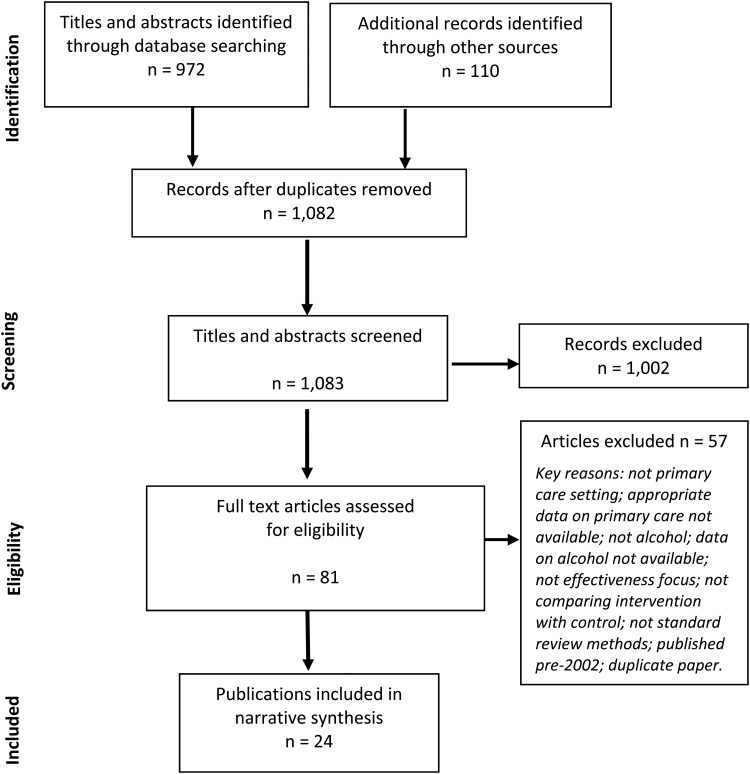
AIMS: The aim of the study was to assess the cumulative evidence on the effectiveness of brief alcohol interventions in primary healthcare in order to highlight key knowledge gaps for further research. METHODS: An overview of systematic reviews and meta-analyses of the effectiveness of brief alcohol intervention in primary healthcare published between 2002 and 2012. FINDINGS: Twenty-four systematic reviews met the eligibility criteria (covering a total of 56 randomized controlled trials reported across 80 papers). Across the included studies, it was consistently reported that brief intervention was effective for addressing hazardous and harmful drinking in primary healthcare, particularly in middle-aged, male drinkers. Evidence gaps included: brief intervention effectiveness in key groups (women, older and younger drinkers, minority ethnic groups, dependent/co-morbid drinkers and those living in transitional and developing countries); and the optimum brief intervention length and frequency to maintain longer-term effectiveness. CONCLUSION: This overview highlights the large volume of primarily positive evidence supporting brief alcohol intervention effects as well as some unanswered questions with regards to the effectiveness of brief alcohol intervention across different cultural settings and in specific population groups, and in respect of the optimum content of brief interventions that might benefit from further research.
Overview
The claims and statistics of this paper haven’t been checked yet.
Free: it reads the open-access text and checks the first 5 claims that cite a source we can check. Create a free account to check every claim.
Integrity signals
Registry
Cites
Statistics
Figures
Verification
Claims the paper makes
The claims and statistics of this paper haven’t been checked yet.
Free: it reads the open-access text and checks the first 5 claims that cite a source we can check. Create a free account to check every claim.
Claims other papers make about this one
Each is checked against this paper’s own text: does it say what the citing paper says it does?
The source backs part of the claim, not all of it — or backs it for a different population, condition or comparison.
In the citing paper
“findings show that university and ambulatory/primary care settings were the most effective in terms of magnitude of effect size”
From How effective are brief interventions in reducing alcohol consumption: do the setting, practitioner group and content matter? Findings from a systematic review and metaregression analysis (2016) · cites this paper as [15]
Experimental — accuracy not yet measuredThe cited source says what the claim attributes to it.
In the citing paper
“Some studies of brief interventions for problem drinking have nonetheless reported positive influences on alcohol reduction up to four years later [67] and on mortality [72].”
From Effectiveness of Guided and Unguided Low-Intensity Internet Interventions for Adult Alcohol Misuse: A Meta-Analysis (2014) · cites this paper as [67]
The cited source says what the claim attributes to it.
In the citing paper
“Early identification and secondary prevention of alcohol problems, using screening and brief interventions in primary care, has long been advocated as a strategy to reduce excessive drinking and is the focus of a great deal of research (O'Donnell 2014).”
From Effectiveness of brief alcohol interventions in primary care populations (2018) · cites this paper as O'Donnell 2014
In the citing paper
“several studies on face-to-face alcohol interventions in primary care had reported that men were more likely to benefit than women [30], [67].”
From Effectiveness of Guided and Unguided Low-Intensity Internet Interventions for Adult Alcohol Misuse: A Meta-Analysis (2014) · cites this paper as [67]
Self-check
Percentages, sums and reported differences re-computed from the paper’s own numbers.
The self-check needs the paper’s full text.
Citations
Cites
Preferred Reporting Items for Systematic Reviews and Meta-Analyses: the PRISMA statement
Moher, D., Liberati, A., Tetzlaff, J., Altman, D. G., & for the PRISMA Group (2009) · BMJ · doi:10.1136/bmj.b2535 · Cited by 83,823
Preferred reporting items for systematic reviews and meta-analyses: the PRISMA Statement.
(2009) · PubMed Central · Cited by 44,859
Preferred reporting items for systematic reviews and meta-analyses: The PRISMA statement
Moher, D., Liberati, A., Tetzlaff, J., Altman, D. G., & the PRISMA Group* (2009) · Annals of Internal Medicine · doi:10.7326/0003-4819-151-4-200908180-00135 · Cited by 37,554
Effectiveness of brief alcohol interventions in primary care populations
Kaner, E. F., Beyer, F. R., Muirhead, C., Campbell, F., Pienaar, E. D., Bertholet, N., Daeppen, J. B., Saunders, J. B., & Burnand, B. (2018) · Cochrane Database of Systematic Reviews · doi:10.1002/14651858.cd004148.pub4 · Cited by 1,665
Self-citationA pragmatic–explanatory continuum indicator summary (PRECIS): a tool to help trial designers
Thorpe, K. E., Zwarenstein, M., Oxman, A. D., Treweek, S., Furberg, C. D., Altman, D. G., Tunis, S., Bergel, E., Harvey, I., Magid, D. J., et al. (2009) · Journal of Clinical Epidemiology · doi:10.1016/j.jclinepi.2008.12.011 · Cited by 1,389
Standards of Evidence: Criteria for Efficacy, Effectiveness and Dissemination
Flay, B. R., Biglan, A., Boruch, R. F., Castro, F. G., Gottfredson, D., Kellam, S., Mościcki, E. K., Schinke, S., Valentine, J. C., & Ji, P. (2005) · Prevention Science · doi:10.1007/s11121-005-5553-y · Cited by 1,338 · cited 2×
“The US Society for Prevention Research (Flay et al., 2004, 2005) has outlined that efficacy testing requires at least two rigorous trials involving: tightly defined populations; psychometrically sound measures and data collection procedures; rigorous statistical analysis; consistent positive effects (without adverse e…”
BackgroundMethodology in conducting a systematic review of systematic reviews of healthcare interventions
Smith, V., Devane, D., Begley, C. M., & Clarke, M. (2011) · BMC Medical Research Methodology · doi:10.1186/1471-2288-11-15 · Cited by 1,227 · cited 2×
“Fourth, we did not verify the information reported in the reviews by consulting individual studies, which may have introduced bias (e.g. resulting from inaccurate reporting of findings (Smith et al., 2011)).”
BackgroundEffectiveness and cost-effectiveness of policies and programmes to reduce the harm caused by alcohol
Anderson, P., Chisholm, D., & Fuhr, D. C. (2009) · The Lancet · doi:10.1016/s0140-6736(09)60744-3 · Cited by 1,102 · cited 1×
“Although the behavioural theory that underpins the design and delivery of brief intervention is likely to be ‘universally’ effective (Anderson et al., 2009), and certainly Jonas et al. (2012) found similar effectiveness for brief alcohol intervention both within and outside the USA, a need remains…”
BackgroundSelf-citationMoyer, A., Finney, J. W., Swearingen, C. E., & Vergun, P. (2002) · Addiction · doi:10.1046/j.1360-0443.2002.00018.x · Cited by 1,092 · cited 12×
“Short and simple is still effective First, busy practitioners need to be reassured that there is little evidence to suggest that longer or more intensive input provides additional benefit over shorter, simpler input (Moyer et al., 2002; Kaner et al., 2007).”
BackgroundInfluentialLanguage bias in randomised controlled trials published in English and German
Egger, M., Zellweger-Zähner, T., Schneider, M., Junker, C., Lengeler, C., & Antes, G. (1997) · The Lancet · doi:10.1016/s0140-6736(97)02419-7 · Cited by 1,028 · cited 2×
“Given the resulting potential for publication bias (authors are more likely to publish significant results in English-language journals (Egger et al., 1997)), this suggests a need for increased linguistic (alongside geographic) diversity in future systematic reviews in this field (Babor et al.,…”
Background
Research works printed but not linked: 5
- 8. Babor T, Kaner E, Nilsen P et al. (2013) Rapid Review of Current Evidence for Health Promotion Actions for Hazardous and Harmful Alcohol Use, with Specific Reference to Low-and Middle-Income Countries: WHO Mainstreaming Health Promotion Project. Geneva: World Health Organization (in press).
- 1986, Preventive medicine, 14, 451
- 44. Latimer N, Guillaume L, Goyder E et al. (2010) Prevention and Early Identification of Alcohol Use Disorders in Adults and Young People: Screening and Brief Interventions, Cost Effectiveness Review. Sheffield: University of Sheffield, School of Health and Related Research (ScHARR) Public Health Collaborating Centre.
- 2004, Journal of substance abuse, 9, 91
- 55. Parkes T, Poole N, Salmon A et al. (2008) Double Exposure: A Better Practices Review on Alcohol Interventions during Pregnancy. Vancouver: British Columbia Centre of Excellence for Women's Health.
Cited by
Items 401–500 of 612
Almonacid, I., Olaya, L., Cuevas, V., Castillo, J. S., Becerra, N., Delgado, J., Cañas, A., & Alba, L. H. (2020) · Revista Colombiana de Psiquiatría · doi:10.1016/j.rcp.2020.06.005 · Cited by 5
e-Interventions for Alcohol Misuse
Dedert, E. A., Williams, J. W., STEIN, R. M., McNeil, J. M., McDuffie, J. R., Ross, I., Feiermuth, C., Hemminger, A., Kosinski, A., & Nagi, A. (2014) · PubMed · Cited by 4
Teaching family medicine residents brief interventions for alcohol misuse
Rule, J. C., & Samuel, P. (2015) · The International Journal of Psychiatry in Medicine · doi:10.1177/0091217415592363 · Cited by 3
Lasebikan, V. O., & Ola, B. A. (2016) · Mental Health in Family Medicine · doi:10.25149/1756-8358.1201006 · Cited by 3
Non-specialist health workers to treat excessive alcohol consumption and depression
Agabio, R. (2016) · The Lancet · doi:10.1016/s0140-6736(16)32566-1 · Cited by 5
Okonoda, K. M. (2017) · Journal of Medical Science And clinical Research · doi:10.18535/jmscr/v5i5.127 · Cited by 3
Yu, J., Harris, B. R., & Shi, J. (2017) · Drugs Education Prevention and Policy · doi:10.1080/09687637.2017.1335286 · Cited by 3
Baldacchino, A., O’Rourke, L., & Humphris, G. M. (2018) · Drug and Alcohol Dependence · doi:10.1016/j.drugalcdep.2018.03.035 · Cited by 3
Schawohl, A., & Odenwald, M. G. (2018) · Verhaltenstherapie · doi:10.1159/000492086 · Cited by 4
“In zukünftigen Studien sollte untersucht werden, ob alkoholbezogene Interventionen zu Beginn der Probatorik, z.B. motivierende Kurzinterventionen [O’Donnell et al., 2013], Therapieabbrüche verhindern können.”
BackgroundAnderson, P., O'Donnell, A. J., Kaner, E., Gual, A., Schulte, B., Gómez, A. P., de Vries, H., Rey, G. N., & Rehm, J. T. (2017) · F1000Research · doi:10.12688/f1000research.11173.2 · Cited by 3
Self-citationEditorial: Brief Interventions for Risky Drinkers
Gual, A., López‐Pelayo, H., Reynolds, J., & Anderson, P. (2016) · Frontiers in Psychiatry · doi:10.3389/fpsyt.2016.00042 · Cited by 3
Self-citationMcNeely, J., Bradley, K. A., Liebschutz, J. M., & Subramaniam, G. (2025) · Journal of Substance Use and Addiction Treatment · doi:10.1016/j.josat.2025.209780 · Cited by 2
Hohmeier, K. C., Broussard, G., Tyszko, M., Barland, K. M., Carlston, K., Wei, Y., Field, C. A., Gordon, A. J., Cernasev, A., & Cochran, G. (2025) · JACCP JOURNAL OF THE AMERICAN COLLEGE OF CLINICAL PHARMACY · doi:10.1002/jac5.70113 · Cited by 2
Potthoff, S., Brendryen, H., Bosnic, H., Bhardwaj-Gosling, R., Iden, K. R., Njå, A. L. M., O'Donnell, A. J., & Lid, T. G. (2025) · Scandinavian Journal of Primary Health Care · doi:10.1080/02813432.2025.2598835 · Cited by 2
“…brief alcohol interventions (Bais) are effective, challenges remain regarding identifying which patients should receive these interventions [7,8,12–14]. the suboptimal implementation of potentially effective Bais in clinical practice is an increasing concern, and strategies to reduce this…”
Self-citationOuimet, M. C., Averill, F., & Brown, T. G. (2015) · Drogues santé et société · doi:10.7202/1032274ar · Cited by 6
Exploring the feasibility of general health promotion in UK dental primary care: ENGAGE in Scotland
Bonetti, D. L., Young, L., Lovelock-Hempleman, L. A., Deas, J., Shepherd, S. D., & Clarkson, J. (2018) · BDJ · doi:10.1038/sj.bdj.2018.809 · Cited by 3
Enfermedad hepática relacionada con el alcohol
Cabezas, J., Cuadrado, A., Rodríguez, J. C., Fernández, S. A., & Crespo, J. (2024) · Medicine - Programa de Formación Médica Continuada Acreditado · doi:10.1016/j.med.2024.03.011 · Cited by 3
The acceptability of alcohol screening and brief intervention for older adults in community venues
Seddon, J. L., Bareham, B. K., Kaner, E., Hanratty, B., & Wadd, S. (2024) · Drug and Alcohol Review · doi:10.1111/dar.13949 · Cited by 2
Self-citationLiu, S., Gao, L., Jin, Y., Chen, J., Wu, D., Cai, Y., Wang, T., Huang, S., Yan, C., Wang, R. S., et al. (2025) · BMC Health Services Research · doi:10.1186/s12913-024-12032-6 · Cited by 3
A Randomized Trial of Alcohol Telemedicine in Primary Care: Pharmacotherapy and Referral Outcomes
Sterling, S., Leibowitz, A., Satre, D. D., Cocohoba, J. M., Kline‐Simon, A. H., Weisner, C. M., Metz, V. E., Ghadiali, M., Corriveau, C., O’Malley, S. S., et al. (2025) · Journal of General Internal Medicine · doi:10.1007/s11606-025-09708-y · Cited by 3
“11,12 Brief interventions can help patients reduce unhealthy alcohol use 13,14 but are often insufficient for more severe problems.”
Changing Behavior Using Control Theory
Mansell, W. (2020) · Cambridge University Press eBooks · doi:10.1017/9781108677318.009 · Cited by 13
Hansen, M. B., Kloster, S., Danquah, I. H., Nielsen, A. S., Becker, U., Tjørnhøj‐Thomsen, T., & Tolstrup, J. S. (2015) · BMC Public Health · doi:10.1186/s12889-015-1620-x · Cited by 2
“A systematic review of reviews of controlled trials has shown that screening for alcohol problems by questionnaire followed by brief intervention significantly reduces alcohol consumption in primary care populations [5].”
BackgroundA group-based brief intervention for surgery patients with high-risk substance use
Wyman, M. F., Kallio, P., Allred, E., & Meyer, D. (2014) · General Hospital Psychiatry · doi:10.1016/j.genhosppsych.2014.08.002 · Cited by 2
SBI and EHR: understanding, adoption, and implementation in family medicine clinics
Zoorob, R., Gonzalez, S. J., Snell, H., O’Hara, H. M., & Sidani, M. A. (2015) · Addiction Science & Clinical Practice · doi:10.1186/1940-0640-10-s2-o48 · Cited by 2
“Alcohol screening and brief intervention (SBI) programs have been shown to be effective in reducing risky alcohol consumption among primary care patients [1-3].”
BackgroundFitzgerald, N. (2015) · Addiction Science & Clinical Practice · doi:10.1186/1940-0640-10-s2-o39 · Cited by 2
“Alcohol screening and brief interventions (SBI) have a history and good evidence of efficacy in primary care settings [1].”
BackgroundBellón, J. Á., Luna, J. D. D., King, M., Nazareth, I., Motrico, E., GildeGómez-Barragán, M. J., Torres‐González, F., Montón-Franco, C., Sánchez-Celaya, M., Díaz-Barreiros, M. Á., et al. (2017) · British Journal of General Practice · doi:10.3399/bjgp17x690245 · Cited by 2
Promoting SBIRT Training for Social Work Students Across Field Settings
Tajima, E. A., McCowan, K. J., Lindhorst, T. P., Haggerty, K. P., Rivara, J. B., Schack, S., Ramey, A., & Jackson, T. R. (2019) · Journal of Social Work Practice in the Addictions · doi:10.1080/1533256x.2019.1592993 · Cited by 2
“The evidence for brief interventions such as SBIRT has been well documented, particularly for harmful drinking, and training in this evidence-informed intervention is now spreading beyond early implementers such as physicians and providers (Bien, Miller, & Tonigan, 1993; Kahan, Wilson, & Becker, 1995; O’Donnell et al.…”
BackgroundLópez‐Pelayo, H., Caballería, E., Díaz, E., Sánchez, A., Segura, L., Colom, J., Wallace, P., & Gual, A. (2019) · Health Informatics Journal · doi:10.1177/1460458219855177 · Cited by 5
“Professionals who participated in the Effectiveness of primary care based Facilitated Access to alcohol Reduction website (EFAR)digital brief intervention clinical trial were surveyed on April 2017 on the following areas: (1) satisfaction, (2) usefulness, (3) perceived ability of digital interventions on overcoming tr…”
BackgroundMethodBehavior Change in Community Contexts
Trickett, E. J., & Paterson, S. E. (2020) · Cambridge University Press eBooks · doi:10.1017/9781108677318.028 · Cited by 2
Colom, J., & Segura, L. (2020) · PubMed Central · Cited by 2
Buckheit, K. A., Barden, E. P., Shaw, R. J., Possemato, K., Mastroleo, N. R., & Rauch, S. A. M. (2022) · Cognitive and Behavioral Practice · doi:10.1016/j.cbpra.2022.02.020 · Cited by 2
Vignoli, T., Zavan, V., Cozzolino, E., Addolorato, G., Amendola, M. F., Caputo, F., Cibin, M., Lucchini, A., Nava, F. A., Pellicano, R., et al. (2022) · Panminerva Medica · doi:10.23736/s0031-0808.22.04689-4 · Cited by 2
Guía para el manejo de los problemas relacionados con el consumo de alcohol
García, R. C., & Guillem, F. C. (2024) · FMC - Formación Médica Continuada en Atención Primaria · doi:10.1016/j.fmc.2023.10.004 · Cited by 2
Unit, F. M. R. V. L. F. H., Santos, G., & Rosário, F. (2015) · Revista Portuguesa de Clínica Geral · doi:10.32385/rpmgf.v31i6.11622 · Cited by 2
Brief Interventions as Evidence-Based Prevention Strategies
Tanner‐Smith, E. E., & Grant, S. (2019) · Advances in prevention science · doi:10.1007/978-3-030-00627-3_11 · Cited by 3
Emenyonu, N. I., Kekibiina, A., Woolf‐King, S. E., Kyampire, C., Fatch, R., Dawson-Rose, C. S., Muyindike, W. R., & Hahn, J. A. (2022) · JMIR Formative Research · doi:10.2196/35015 · Cited by 2
Fetterhoff, K., Kuhns, K., & Minter, C. (2024) · Journal of Addictions Nursing · doi:10.1097/jan.0000000000000588 · Cited by 2
Ferguson, J. (2024) · International Journal of Environmental Research and Public Health · doi:10.3390/ijerph21121671 · Cited by 1
Kyte, S., Song, J., Nikolova, Y. S., Ruocco, A. C., Agarwal, S. M., Amaev, A., Bukovsky, D., Carmona-Torres, E., Felsky, D., Graff‐Guerrero, A., et al. (2026) · Frontiers in Neurology · doi:10.3389/fneur.2025.1694826 · Cited by 3
Cost-Effectiveness Evaluations of Behavior Change Interventions
Wang, T., Downes, M., Byrnes, J., & Scuffham, P. (2020) · Cambridge University Press eBooks · doi:10.1017/9781108677318.026 · Cited by 1
Brockdorf, A. N., Tilstra-Ferrell, E. L., Danielson, C. K., Moreland, A. D., Rheingold, A. A., Salim, S. R., Gilmore, A. K., Siciliano, R. E., Smith, D. W., & Hahn, C. K. (2025) · International Journal of Environmental Research and Public Health · doi:10.3390/ijerph22020190 · Cited by 1
Chapter 2. Prevention of Substance Use and Substance Use Disorders
Scheier, L. M., Catalano, R. F., & Winters, K. C. (2019) · American Psychiatric Association Publishing eBooks · doi:10.1176/appi.books.9781615372812.lg02 · Cited by 2
Yamashiki, N., Kudo, N., Kawabata, K., Fujimaki, T., Aramaki, E., Murata, M., Ikeda, S., Yoshii, H., Yamada, H., & Naganuma, M. (2026) · JMIR Formative Research · doi:10.2196/80421 · Cited by 1
Monitoring and Evaluation of Addiction Treatment
Uchtenhagen, A. (2020) · Springer eBooks · doi:10.1007/978-3-030-36391-8_57 · Cited by 1
Fitzgerald, N., Angus, K., Bryce, J., & Bauld, L. (2015) · Addiction Science & Clinical Practice · doi:10.1186/1940-0640-10-s2-o38 · Cited by 1
“Good evidence for the efficacy of alcohol brief interventions (ABIs) delivered in primary care [1] has been insufficient to drive routine implementation [2] and may not translate to normal clinical settings, possibly due to a loss of fidelity [3].”
BackgroundPrevention Systems: Structure and Challenges: Europe as an Example
Burkhart, G., & Helmer, S. M. (2019) · Advances in prevention science · doi:10.1007/978-3-030-00627-3_26 · Cited by 2
Programa de Auto-cambio Dirigido en abuso de alcohol en población española: un estudio de caso
Carballo, J. L., Coloma‐Carmona, A., Sobell, L. C., & Sobell, M. B. (2020) · Revista de PSICOLOGÍA DE LA SALUD · doi:10.21134/pssa.v8i1.1156 · Cited by 1
Bendtsen, M., Garnett, C. V., Toner, P., & Shorter, G. W. (2023) · Digital Health · doi:10.1177/20552076231155684 · Cited by 1
The effect of the primary health care preventive program on the alcohol consumption
Максимова, Ж. В., & Максимов, Д. М. (2023) · Russian Journal of Preventive Medicine · doi:10.17116/profmed20232610143 · Cited by 1
Treatments for Substance Use Disorders
da Costa, S. C., Moustafa, Y., Vasquez, A., & Rummans, T. A. (2023) · Elsevier eBooks · doi:10.1016/b978-0-323-95702-1.00047-6 · Cited by 1
Soberano, J. I. D., Hernandez, M. A., Cacciata, M. C., Flores, J. L., Leyva, E. W. A., Tuazon, J. A., & Evangelista, L. S. (2023) · PubMed · Cited by 1
Healthcare interactions prior to first hospital admission with alcohol‐related liver disease
Lewis, H., Parker, R., Haq, Z. U., Lucas, A. N., Cohen, C., Vergis, N., & Thursz, M. R. (2024) · Liver International · doi:10.1111/liv.15969 · Cited by 1
“10,11 Treatment for AUD including brief interventions delivered in primary healthcare environments is effective at reducing hazardous and harmful alcohol consumption 8,12 and so could prevent the development of ArLD.”
Managing substance use in the practice
Hamilton, I., & Watson, J. (2014) · Practice Nursing · doi:10.12968/pnur.2014.25.10.480 · Cited by 1
Telling your patients to cut down on alcohol: does it work?
Patton, R., & Joubert, E. (2016) · Trends in Urology & Men s Health · doi:10.1002/tre.511 · Cited by 1
Spithoff, S. M., & Kahan, M. (2015) · Canadian Family Physician · Cited by 3
Preventing Substance Abuse and Addiction
Wright, A. J., & Henes, R. (2018) · Springer eBooks · doi:10.1007/978-3-319-72778-3_16 · Cited by 1
Does Documented Brief Intervention Predict Decreases in Alcohol Use in Primary Care?
Hepner, K. A., Hoggatt, K. J., Bogart, A., & Paddock, S. M. (2018) · Substance Use & Misuse · doi:10.1080/10826084.2017.1421225 · Cited by 1
“While BIs have been found to be efficacious in reducing alcohol consumption (Jonas et al., 2012; Kaner et al., 2007; O’Donnell et al., 2014), questions have been raised about the effectiveness of BI in routine practice settings (Williams et al.”
BackgroundNurse practitioner alcohol intervention for people with viral hepatitis: Randomised controlled trial
Reid, C., Fenech, M., Jones, L. V., & Saleh, A. (2019) · Collegian Journal of the Royal College of Nursing Australia · doi:10.1016/j.colegn.2019.02.003 · Cited by 1
Nowalk, A., & Pringle, J. L. (2019) · Oxford University Press eBooks · doi:10.1093/oso/9780190056810.003.0009 · Cited by 1
Brief interventions for excessive alcohol consumption
O'Donnell, A. J., Kaner, E., & Heather, N. (2020) · doi:10.1093/med/9780198746690.003.0640 · Cited by 1
Self-citationHealth care consumption for somatic patients following a brief outreach alcohol intervention
Schwarz, A.-S., Kruse, M., Nielsen, A. S., Nielsen, B., & Søgaard, J. (2020) · Nordic Journal of Health Economics · doi:10.5617/njhe.6470 · Cited by 1
Dung, N. T. T., Säfsten, E., Andersson, F., & Galanti, M. R. (2021) · Nordic Studies on Alcohol and Drugs · doi:10.1177/14550725211007823 · Cited by 1
“Although the effectiveness of brief interventions in addressing problematic alcohol use has been established (O’Donnell et al., 2014), their superiority compared with extended counselling is still under debate, and they have not been studied in the context of telephone helplines.”
BackgroundCounseling an alcohol abuse patient
Максимова, Ж. В., & Максимов, Д. М. (2021) · CARDIOVASCULAR THERAPY AND PREVENTION · doi:10.15829/1728-8800-2021-2782 · Cited by 1
Brief interventions for reducing alcohol consumption in users of a family health unit
Jorge, F. M., Moreira, M. T., Pereira, M. D. C., & Barroso, T. M. M. D. D. A. (2017) · Revista de Enfermagem Referência · doi:10.12707/riv17037 · Cited by 7
Marianian, A. Y., & Kalkova, A. N. (2022) · Obstetrics Gynecology and Reproduction · doi:10.17749/2313-7347/ob.gyn.rep.2021.254 · Cited by 1
Muncie, H. L., Anderson, G., II, & Oge, L. K. (2022) · Springer eBooks · doi:10.1007/978-3-030-54441-6_66 · Cited by 1
Alkoholkonsum – Bedeutung für Prävention und Gesundheitsförderung
John, U., Meyer, C., Baumann, S., Rumpf, H., & Freyer‐Adam, J. (2019) · Springer Reference Pflege, Therapie, Gesundheit · doi:10.1007/978-3-662-55793-8_33-1 · Cited by 3
Fernandes, D., D’Souza, E., Sambari, S., Pacheco, M. G., D’souza, J., Velleman, R. D. B., Bhatia, U., & Nadkarni, A. (2023) · Cambridge Prisms Global Mental Health · doi:10.1017/gmh.2023.51 · Cited by 1
“Other ‘active ingredients’ in alcohol BIs that improve intervention outcomes are those that improve self-efficacy through goal setting and management strategies, thus assisting individuals to prepare and act on change (Connors et al., 2013; L’Engle et al., 2014; O’Donnell et al., 2014).”
Schäfer, I., Heinz, A., Penka, S., Lindert, J., Klein, M. C., Albayrak, Ş., Lotzin, A., Hiller, P., Milin, S., & Raiser, P. (2023) · SUCHT - Zeitschrift für Wissenschaft und Praxis / Journal of Addiction Research and Practice · doi:10.1024/0939-5911/a000832 · Cited by 3
Barbosa, C., & Cowell, A. J. (2016) · Addiction · doi:10.1111/add.13362 · Cited by 1
“recommended levels and reducing their alcohol consumption [3,4].”
BackgroundO que aprendemos sobre implementação das Intervenções Breves na América Latina?
Ronzani, T. M. (2018) · SMAD Revista Eletrônica Saúde Mental Álcool e Drogas (Edição em Português) · doi:10.11606/issn.1806-6976.smad.2018.152064 · Cited by 1
“Apesar desses resultados iniciais, alguns dados demonstram que a IB apresenta uma limitação de efeito, havendo uma perda de resultados após alguns meses de sua aplicação(12).”
Ponce, T. D. (2020) · Digital Library of Theses and Dissertations (Universidade de São Paulo) · doi:10.11606/t.83.2020.tde-17122019-140842 · Cited by 5
Stevens, A. K., Blanchard, B. E., Shi, M., & Littlefield, A. K. (2020) · Wiley eBooks · doi:10.1002/9781119057840.ch178 · Cited by 4
Farinelli, L. A. (2020) · UA Campus Repository (The University of Arizona) · Cited by 1
Botwright, S., Sutawong, J., Anothaisintawee, T., Kingkaew, P., Teerawattananon, Y., Khampang, R., Dabak, S. V., & Isaranuwatchai, W. (2022) · Research Square · doi:10.21203/rs.3.rs-1233643/v1 · Cited by 1
Importance of Fetal Alcohol Spectrum Disorders Prevention and Intervention
Donaldson, T., Dang, E. P., Pierce‐Bulger, M., Mitchell, K. T., Kachor, A. R., & Arvizu, R. (2024) · Substance Use & Addiction Journal · doi:10.1177/29767342241300797 · Cited by 1
“40 41-43 The interventions stimulate self-reflection and introduce realistic strategies to reduce drinking.”
Effects of Computerized Interventions on Risky Alcohol Use Among Youth: Systematic Review
Smedslund, G., Nilsen, W., Wollscheid, S., Steiro, A., Fang, L., & Larun, L. (2018) · Sage Journals Data · doi:10.25384/sage.c.4351538 · Cited by 1
Muncie, H. L. (2015) · Springer eBooks · doi:10.1007/978-1-4939-0779-3_66-1
Trajectories of Adolescent Alcohol Use in the Year Following a Brief Alcohol Intervention
Abar, C. C., Hernández, L., Rodríguez, A. M., & Spirito, A. (2015) · Journal of Studies on Alcohol and Drugs · doi:10.15288/jsad.2015.76.710 · Cited by 1
“Brief interventions, particularly among participants defined by the transtheoretical model of change as in the precontemplation stage (Prochaska et al., 1988), can be susceptible to decay of effects over time (O’Donnell et al., 2014).”
BackgroundAn informational resource to enhance nursing care for patients with problematic alcohol use
Romano‐Andrioni, B. (2015) · UVic’s Research and Learning Repository (University of Victoria)
New Directions in Healthcare for Alcohol Use Disorder
Roh, S. (2015) · Health Care Current Reviews · doi:10.4172/2375-4273.1000144
“However, there are still many challenges when it comes to providing aftercare with ongoing monitoring and providing opportunities for improvement to various population [8,9].”
BackgroundSubstance Use in Primary Care: What Do We Do?
Moran, M. E., & Blocker, D. J. (2015)
Barinova, A. N., Боярский, С. Г., Plavinski, S. L., Kuznetsova, O. Y., Degtyareva, L. N., & Чичерина, С. Л. (2014) · Russian Family Doctor · doi:10.17816/rfd2014120-26
Sartes, L. M. A., Cruvinel, É., & Ferreira, M. L. (2016) · Springer eBooks · doi:10.1007/978-3-319-43172-7_8 · Cited by 1
Cesare, M. D., Jomini, V., Selz, R., Mangin, P. J., Vaucher, P., Favrat, B., & Augsburger, M. P. (2015) · International Journal of Research -GRANTHAALAYAH · doi:10.29121/granthaalayah.v3.i9.2015.2942
Drinking, Aging, and Global Public Policy
Martinic, M., & Sheveland, A. (2016) · Springer eBooks · doi:10.1007/978-3-319-47233-1_16
Sober mom, healthy baby? Effects of brief alcohol interventions in Swedish maternity carePreprint
Grönqvist, E., Norén, A., Sjögren, A., & Svaleryd, H. (2016) · RePEc: Research Papers in Economics · Cited by 2
Financial Incentives for Alcohol Brief Interventions in Primary Care in Scotland
Schölin, L., O'Donnell, A. J., & Fitzgerald, N. (2017) · doi:10.13140/rg.2.2.16494.72003 · Cited by 2
Self-citationBarinova, A. N., Боярский, С. Г., Плавинский, С. Л., Кузнецова, О. Ю., Дегтярева, Л. Н., & Чичерина, С. Л. (2014) · Russian Family Doctor
Situational analysis: regional review of the substance use Atlas 2015
Gehring, E., & Saeed, K. (2017) · Eastern Mediterranean Health Journal · doi:10.26719/2017.23.3.131
“Such programmes have been shown to be effective in addressing harmful alcohol use in primary health care settings (16).”
BackgroundBrief Intervention for Risky Alcohol Use: A Critical Analysis
Joseph, J., & Basu, D. (2017) · International Journal of Psychology and Psychoanalysis · doi:10.23937/2572-4037.1510020
PSIQUIATRÍA DE ENLACE EN ADICCIONES EN EL HOSPITAL GENERAL
Daniel Seijas, B. (2017) · Revista Médica Clínica Las Condes · doi:10.1016/j.rmclc.2017.10.011 · Cited by 1
Auditing mothers: The effect of targeted alcohol prevention on infant health and maternal behaviorPreprint
Grönqvist, E., Norén, A., Sjögren, A., & Svaleryd, H. (2017) · RePEc: Research Papers in Economics
Alcohol and Other Substance Misuse
Ray, J. M., & Cucciare, M. A. (2018) · Springer eBooks · doi:10.1007/978-3-319-70539-2_4
Põlluste, K., & Lember, M. (2018) · Family Medicine & Primary Care Review · doi:10.5114/fmpcr.2018.73848
“A number of studies have confirmed the effectiveness of BI at reducing hazardous or harmful drinking in PHC settings [7, 8].”
BackgroundLópez‐Pelayo, H., Oliveras, C., Segura, L., Colom, J., Díaz, E., Wallace, P., & Gual, A. (2018) · Adicciones · doi:10.20882/adicciones.1098
Freund, M., Hobden, B., Deeming, S., Noble, N., Bryant, J., & Sanson‐Fisher, R. (2018) · Family Practice · doi:10.1093/fampra/cmy103
Douglas, L. (2017) · Cited by 3
Carlson, J. M. (2019) · Journal of Social Work Practice in the Addictions · doi:10.1080/1533256x.2019.1592994
“SBIRT has proven to be beneficial for hazardous alcohol users (O’Donnell et al., 2014).”
Background
Metadata
- Authors
- O'Donnell, A., Anderson, P., Newbury-Birch, D., Schulte, B., Schmidt, C., Reimer, J., & Kaner, E.
- Affiliations
- Newcastle University (GB)
- Maastricht University (NL)
- Universität Hamburg (DE)
- Corresponding author
- Kaner, E.
- Venue
- Alcohol and Alcoholism
- Publisher
- Oxford University Press (OUP)
- Published
- 2013-11-13
- Volume
- 49
- Issue
- 1
- Pages
- 66-78
- ISSN
- 0735-0414 (ISSN-L)
- 1464-3502
- PMC
- PMC3865817
- OpenAlex
- W2153422660
- Cited by
- 613
- References
- 68
- Citations by year
- 2026: 12 · 2025: 16 · 2024: 24 · 2023: 49 · 2022: 40 · 2021: 49 · 2020: 90 · 2019: 84 · 2018: 52 · 2017: 65 · 2016: 50 · 2015: 58 · 2014: 24
- FWCI
- 5.22
- Type
- journal article
- Language
- en
- Open access
- hybrid
- doi.org
- Licence
- cc-by-nc
- Locations
- Alcohol and Alcoholism (publishedVersion, cc-by-nc)
- Europe PMC (PubMed Central) (publishedVersion, cc-by-nc)
- PubMed Central (publishedVersion, cc-by-nc)
- PubMed (publishedVersion)
- Teesside University Research Portal (Teesside University) (submittedVersion)
- Newcastle University ePrints (Newcastle Univesity) (cc-by-nc)
- Funders
- Newcastle University
- European Commission
- Medical Research Council (MR/K02325X/1)
- Topics
- Health Sciences › Medicine › Epidemiology › Substance Abuse Treatment and Outcomes
- Health Sciences › Medicine › Pathology and Forensic Medicine › Alcohol Consumption and Health Effects
- Social Sciences › Psychology › Applied Psychology › Behavioral Health and Interventions
- Keywords
- brief alcohol intervention, primary care, hazardous drinking, intervention effectiveness, knowledge gaps, ethnic minorities, cultural context
- MeSH terms
- Alcoholism, Counseling, Humans, Primary Health Care, Early Medical Intervention
About these checks
Registry, retraction, Cites and statistics results are computed, not judged, with one exception: a printed reference that no index lists is read once by a model before it counts as a citation error. Claims are extracted by a model and kept only when their quote appears verbatim in the text; each cited source is then checked, with a model’s help, for whether it says what the claim relies on. Those verdicts can be wrong — read the claim’s quote and the cited source before relying on one.
Statistics and arithmetic are recomputed, not judged.
Confidence bands are shown only for fields calibrated on our annotated test set. None is calibrated yet, so no band is shown.
What counts as a claim ›How we measure confidence ›How we check this ›
Are you an author, or do you see a problem with this page? Request a review
Data sources
Bibliographic data: Semantic Scholar, OpenAlex, Crossref.
Contains information from the Semantic Scholar Academic Graph Datasets, made available under the ODC Attribution License (ODC-BY 1.0).
Semantic Scholar’s data is described in: Kinney, R., et al. (2023). The Semantic Scholar Open Data Platform. arXiv:2301.10140.
