

The Impact of Brief Alcohol Interventions in Primary Healthcare: A Systematic Review of Reviews
Open accessThe DOI matches its Crossref record; 68 of the 68 references it cites were found in a registry or an index.
Abstract
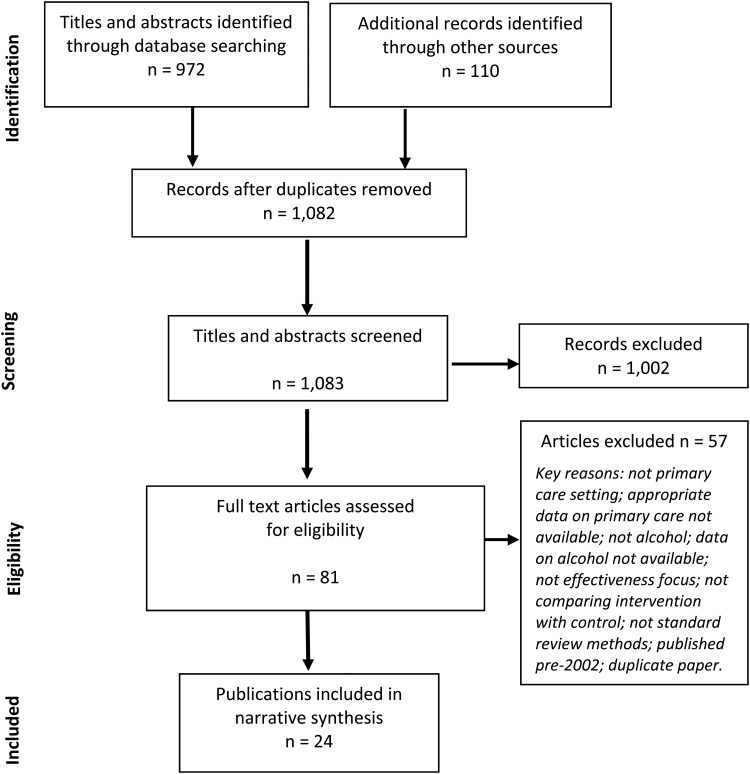
AIMS: The aim of the study was to assess the cumulative evidence on the effectiveness of brief alcohol interventions in primary healthcare in order to highlight key knowledge gaps for further research. METHODS: An overview of systematic reviews and meta-analyses of the effectiveness of brief alcohol intervention in primary healthcare published between 2002 and 2012. FINDINGS: Twenty-four systematic reviews met the eligibility criteria (covering a total of 56 randomized controlled trials reported across 80 papers). Across the included studies, it was consistently reported that brief intervention was effective for addressing hazardous and harmful drinking in primary healthcare, particularly in middle-aged, male drinkers. Evidence gaps included: brief intervention effectiveness in key groups (women, older and younger drinkers, minority ethnic groups, dependent/co-morbid drinkers and those living in transitional and developing countries); and the optimum brief intervention length and frequency to maintain longer-term effectiveness. CONCLUSION: This overview highlights the large volume of primarily positive evidence supporting brief alcohol intervention effects as well as some unanswered questions with regards to the effectiveness of brief alcohol intervention across different cultural settings and in specific population groups, and in respect of the optimum content of brief interventions that might benefit from further research.
Overview
The claims and statistics of this paper haven’t been checked yet.
Free: it reads the open-access text and checks the first 5 claims that cite a source we can check. Create a free account to check every claim.
Integrity signals
Registry
Cites
Statistics
Figures
Verification
Claims the paper makes
The claims and statistics of this paper haven’t been checked yet.
Free: it reads the open-access text and checks the first 5 claims that cite a source we can check. Create a free account to check every claim.
Claims other papers make about this one
Each is checked against this paper’s own text: does it say what the citing paper says it does?
The source backs part of the claim, not all of it — or backs it for a different population, condition or comparison.
In the citing paper
“findings show that university and ambulatory/primary care settings were the most effective in terms of magnitude of effect size”
From How effective are brief interventions in reducing alcohol consumption: do the setting, practitioner group and content matter? Findings from a systematic review and metaregression analysis (2016) · cites this paper as [15]
Experimental — accuracy not yet measuredThe cited source says what the claim attributes to it.
In the citing paper
“Some studies of brief interventions for problem drinking have nonetheless reported positive influences on alcohol reduction up to four years later [67] and on mortality [72].”
From Effectiveness of Guided and Unguided Low-Intensity Internet Interventions for Adult Alcohol Misuse: A Meta-Analysis (2014) · cites this paper as [67]
The cited source says what the claim attributes to it.
In the citing paper
“Early identification and secondary prevention of alcohol problems, using screening and brief interventions in primary care, has long been advocated as a strategy to reduce excessive drinking and is the focus of a great deal of research (O'Donnell 2014).”
From Effectiveness of brief alcohol interventions in primary care populations (2018) · cites this paper as O'Donnell 2014
In the citing paper
“several studies on face-to-face alcohol interventions in primary care had reported that men were more likely to benefit than women [30], [67].”
From Effectiveness of Guided and Unguided Low-Intensity Internet Interventions for Adult Alcohol Misuse: A Meta-Analysis (2014) · cites this paper as [67]
Self-check
Percentages, sums and reported differences re-computed from the paper’s own numbers.
The self-check needs the paper’s full text.
Citations
Cites
Preferred Reporting Items for Systematic Reviews and Meta-Analyses: the PRISMA statement
Moher, D., Liberati, A., Tetzlaff, J., Altman, D. G., & for the PRISMA Group (2009) · BMJ · doi:10.1136/bmj.b2535 · Cited by 83,823
Preferred reporting items for systematic reviews and meta-analyses: the PRISMA Statement.
(2009) · PubMed Central · Cited by 44,859
Preferred reporting items for systematic reviews and meta-analyses: The PRISMA statement
Moher, D., Liberati, A., Tetzlaff, J., Altman, D. G., & the PRISMA Group* (2009) · Annals of Internal Medicine · doi:10.7326/0003-4819-151-4-200908180-00135 · Cited by 37,554
Effectiveness of brief alcohol interventions in primary care populations
Kaner, E. F., Beyer, F. R., Muirhead, C., Campbell, F., Pienaar, E. D., Bertholet, N., Daeppen, J. B., Saunders, J. B., & Burnand, B. (2018) · Cochrane Database of Systematic Reviews · doi:10.1002/14651858.cd004148.pub4 · Cited by 1,665
Self-citationA pragmatic–explanatory continuum indicator summary (PRECIS): a tool to help trial designers
Thorpe, K. E., Zwarenstein, M., Oxman, A. D., Treweek, S., Furberg, C. D., Altman, D. G., Tunis, S., Bergel, E., Harvey, I., Magid, D. J., et al. (2009) · Journal of Clinical Epidemiology · doi:10.1016/j.jclinepi.2008.12.011 · Cited by 1,389
Standards of Evidence: Criteria for Efficacy, Effectiveness and Dissemination
Flay, B. R., Biglan, A., Boruch, R. F., Castro, F. G., Gottfredson, D., Kellam, S., Mościcki, E. K., Schinke, S., Valentine, J. C., & Ji, P. (2005) · Prevention Science · doi:10.1007/s11121-005-5553-y · Cited by 1,338 · cited 2×
“The US Society for Prevention Research (Flay et al., 2004, 2005) has outlined that efficacy testing requires at least two rigorous trials involving: tightly defined populations; psychometrically sound measures and data collection procedures; rigorous statistical analysis; consistent positive effects (without adverse e…”
BackgroundMethodology in conducting a systematic review of systematic reviews of healthcare interventions
Smith, V., Devane, D., Begley, C. M., & Clarke, M. (2011) · BMC Medical Research Methodology · doi:10.1186/1471-2288-11-15 · Cited by 1,227 · cited 2×
“Fourth, we did not verify the information reported in the reviews by consulting individual studies, which may have introduced bias (e.g. resulting from inaccurate reporting of findings (Smith et al., 2011)).”
BackgroundEffectiveness and cost-effectiveness of policies and programmes to reduce the harm caused by alcohol
Anderson, P., Chisholm, D., & Fuhr, D. C. (2009) · The Lancet · doi:10.1016/s0140-6736(09)60744-3 · Cited by 1,102 · cited 1×
“Although the behavioural theory that underpins the design and delivery of brief intervention is likely to be ‘universally’ effective (Anderson et al., 2009), and certainly Jonas et al. (2012) found similar effectiveness for brief alcohol intervention both within and outside the USA, a need remains…”
BackgroundSelf-citationMoyer, A., Finney, J. W., Swearingen, C. E., & Vergun, P. (2002) · Addiction · doi:10.1046/j.1360-0443.2002.00018.x · Cited by 1,092 · cited 12×
“Short and simple is still effective First, busy practitioners need to be reassured that there is little evidence to suggest that longer or more intensive input provides additional benefit over shorter, simpler input (Moyer et al., 2002; Kaner et al., 2007).”
BackgroundInfluentialLanguage bias in randomised controlled trials published in English and German
Egger, M., Zellweger-Zähner, T., Schneider, M., Junker, C., Lengeler, C., & Antes, G. (1997) · The Lancet · doi:10.1016/s0140-6736(97)02419-7 · Cited by 1,028 · cited 2×
“Given the resulting potential for publication bias (authors are more likely to publish significant results in English-language journals (Egger et al., 1997)), this suggests a need for increased linguistic (alongside geographic) diversity in future systematic reviews in this field (Babor et al.,…”
Background
Research works printed but not linked: 5
- 8. Babor T, Kaner E, Nilsen P et al. (2013) Rapid Review of Current Evidence for Health Promotion Actions for Hazardous and Harmful Alcohol Use, with Specific Reference to Low-and Middle-Income Countries: WHO Mainstreaming Health Promotion Project. Geneva: World Health Organization (in press).
- 1986, Preventive medicine, 14, 451
- 44. Latimer N, Guillaume L, Goyder E et al. (2010) Prevention and Early Identification of Alcohol Use Disorders in Adults and Young People: Screening and Brief Interventions, Cost Effectiveness Review. Sheffield: University of Sheffield, School of Health and Related Research (ScHARR) Public Health Collaborating Centre.
- 2004, Journal of substance abuse, 9, 91
- 55. Parkes T, Poole N, Salmon A et al. (2008) Double Exposure: A Better Practices Review on Alcohol Interventions during Pregnancy. Vancouver: British Columbia Centre of Excellence for Women's Health.
Cited by
Forouzanfar, M. H., Afshin, A., Alexander, L. T., Anderson, H. R., Bhutta, Z. A., Biryukov, S., Brauer, M., Burnett, R., Cercy, K., Charlson, F. J., et al. (2016) · The Lancet · doi:10.1016/s0140-6736(16)31679-8 · Cited by 7,698
Effectiveness of brief alcohol interventions in primary care populations
Kaner, E. F., Beyer, F. R., Muirhead, C., Campbell, F., Pienaar, E. D., Bertholet, N., Daeppen, J. B., Saunders, J. B., & Burnand, B. (2018) · Cochrane Database of Systematic Reviews · doi:10.1002/14651858.cd004148.pub4 · Cited by 1,665
Self-citationEASL Clinical Practice Guidelines: Management of alcohol-related liver disease
Thursz, M., Gual, A., Lackner, C., Mathurin, P., Moreno, C., Spahr, L., Sterneck, M., & Cortez-Pinto, H. (2018) · Journal of Hepatology · doi:10.1016/j.jhep.2018.03.018 · Cited by 943
Pimpin, L., Cortez-Pinto, H., Negro, F., Corbould, E., Lazarus, J. V., Webber, L., & Sheron, N. (2018) · Journal of Hepatology · doi:10.1016/j.jhep.2018.05.011 · Cited by 710
The expanding role of primary care in cancer control
Rubin, G., Berendsen, A., Crawford, S. M., Dommett, R., Earle, C., Emery, J., Fahey, T., Grassi, L., Grunfeld, E., Gupta, S., et al. (2015) · The Lancet Oncology · doi:10.1016/s1470-2045(15)00205-3 · Cited by 555
“55 By contrast with smoking and alcohol use, fewer studies of primary care intervention in diet and obesity have been done, although one study found that a health professional’s recommendation was associated with an increased likelihood of weight loss attempts.”
Prevention, early intervention, harm reduction, and treatment of substance use in young people
Stockings, E., Hall, W. D., Lynskey, M., Morley, K. I., Reavley, N., Strang, J., Patton, G., & Degenhardt, L. (2016) · The Lancet Psychiatry · doi:10.1016/s2215-0366(16)00002-x · Cited by 433
The Handbook of Behavior Change
(2020) · Cambridge University Press eBooks · doi:10.1017/9781108677318 · Cited by 407
Bushnell, C., Kernan, W. N., Sharrief, A. Z., Chaturvedi, S., Cole, J. W., Cornwell, W. K., Cosby-Gaither, C., Doyle, S., Goldstein, L. B., Lennon, O., et al. (2024) · Stroke · doi:10.1161/str.0000000000000475 · Cited by 360
Connor, J. P., Haber, P. S., & Hall, W. D. (2016) · The Lancet · doi:10.1016/s0140-6736(15)00122-1 · Cited by 389
Kaner, E. F., Beyer, F. R., Garnett, C., Crane, D., Brown, J., Muirhead, C., Redmore, J., O'Donnell, A., Newham, J. J., de Vocht, F., et al. (2017) · Cochrane Database of Systematic Reviews · doi:10.1002/14651858.cd011479.pub2 · Cited by 308
Self-citationMcNeely, J., Kumar, P. C., Rieckmann, T., Sedlander, E., Farkas, S., Chollak, C., Kannry, J. L., Vega, A., Waite, E. A., Peccoralo, L. A., et al. (2018) · Addiction Science & Clinical Practice · doi:10.1186/s13722-018-0110-8 · Cited by 303
Changing Behavior Using the Theory of Planned Behavior
Ajzen, I., & Schmidt, P. (2020) · The Handbook of Behavior Change · doi:10.1017/9781108677318.002 · Cited by 266
Riper, H., Blankers, M., Hadiwijaya, H., Cunningham, J., Clarke, S., Wiers, R., Ebert, D., & Cuijpers, P. (2014) · PLoS ONE · doi:10.1371/journal.pone.0099912 · Cited by 265
“The current overall effect also compares with meta-analyses of face-to-face primary care samples [3,30,67,68] and of non-clinical samples performing postal self-help interventions based on bibliotherapy [69–71].”
BackgroundResultHow does the alcohol industry attempt to influence marketing regulations? A systematic review
Savell, E., Fooks, G., & Gilmore, A. B. (2016) · Addiction · doi:10.1111/add.13048 · Cited by 257
“Controlled trials of brief alcohol interventions, for example, have reported primarily positive outcomes on weekly drinking and a range of alcohol-related problems [59].”
BackgroundTreatment of alcohol use disorders in patients with alcoholic liver disease
Addolorato, G., Mirijello, A., Barrio, P., & Gual, A. (2016) · Journal of Hepatology · doi:10.1016/j.jhep.2016.04.029 · Cited by 197
“Several systematic reviews and meta-analysis support the efficacy of screening and brief intervention [24-26], and a majority of guidelines advocate for the universal implementation of screening and brief intervention in primary care [27,28].”
BackgroundTreatment of Alcohol Use Disorder in Patients with Alcoholic Liver Disease
Leggio, L., & Lee, M. R. (2017) · The American Journal of Medicine · doi:10.1016/j.amjmed.2016.10.004 · Cited by 166
Alcohol Use Disorders in Primary Health Care: What Do We Know and Where Do We Go?
Rehm, J., Anderson, P., Manthey, J., Shield, K. D., Struzzo, P., Wojnar, M., & Gual, A. (2016) · Alcohol and Alcoholism · doi:10.1093/alcalc/agv127 · Cited by 163
Self-citationKozak, A., Schedlbauer, G., Wirth, T., von Euler, U. S., Westermann, C., & Nienhaus, A. (2015) · BMC Musculoskeletal Disorders · doi:10.1186/s12891-015-0685-0 · Cited by 200
“To differentiate between the SRs, the numerical score was converted to quality grades: A = 37 – 44 (very good); B = 29 – 36 (good); C = 21 – 28 (moderate); D = 13 – 20 (poor) points [33].”
Changing Behavior Using the Model of Action Phases
Keller, L., Gollwitzer, P. M., & Sheeran, P. (2020) · The Handbook of Behavior Change · doi:10.1017/9781108677318.006 · Cited by 147
Rethinking brief interventions for alcohol in general practice
McCambridge, J., & Saitz, R. (2017) · BMJ · doi:10.1136/bmj.j116 · Cited by 146
Mechanisms of Action of Brief Alcohol Interventions Remain Largely Unknown – A Narrative Review
Gaume, J., McCambridge, J., Bertholet, N., & Daeppen, J.-B. (2014) · Frontiers in Psychiatry · doi:10.3389/fpsyt.2014.00108 · Cited by 137
Platt, L., Melendez-Torres, G. J., O'Donnell, A., Bradley, J., Newbury-Birch, D., Kaner, E., & Ashton, C. (2016) · BMJ Open · doi:10.1136/bmjopen-2016-011473 · Cited by 136
Self-citationBallard, M., & Montgomery, P. (2017) · Research Synthesis Methods · doi:10.1002/jrsm.1229 · Cited by 136
“…reviews’, ‘reviews of reviews’, and ‘systematic review of systematic reviews’, among others; each of these terms has its adherents and has been used in recent publications (O’Donnell et al., 2014; Theodoratou et al., 2014; Martínez-González et al., 2014; Hill and Ryan, 2014; Lamming et al., 2014).”
MethodMertens, J. R., Chi, F. W., Weisner, C. M., Satre, D. D., Ross, T. B., Allen, S., Pating, D., Campbell, C. I., Lu, Y. W., & Sterling, S. A. (2015) · Addiction Science & Clinical Practice · doi:10.1186/s13722-015-0047-0 · Cited by 127
“Screening and brief intervention to address non-dependent unhealthy alcohol use within primary care is effective [4–6] and recommended in national practice guidelines (including the U.”
MethodEvolving Models of Integrated Behavioral Health and Primary Care
Ramanuj, P., Ferenchick, E. K., Docherty, M. J., Spaeth‐Rublee, B., & Pincus, H. A. (2019) · Current Psychiatry Reports · doi:10.1007/s11920-019-0985-4 · Cited by 144
Rehm, J. T., Allamani, A., Elekes, Z., Jakubczyk, A., Manthey, J., Probst, C., Struzzo, P., Vedova, R. D., Gual, A., & Wojnar, M. (2015) · BMC Family Practice · doi:10.1186/s12875-015-0308-8 · Cited by 138
Schmidt, C. S., Schulte, B., Seo, H., Kuhn, S., O'Donnell, A., Kriston, L., Verthein, U., & Reimer, J. (2016) · Addiction · doi:10.1111/add.13263 · Cited by 107
Self-citationChanging Behavior Using the Health Action Process Approach
Schwarzer, R., & Hamilton, K. (2020) · The Handbook of Behavior Change · doi:10.1017/9781108677318.007 · Cited by 102
Bajunirwe, F., Haberer, J. E., Boum, Y., Hunt, P., Mocello, R., Martin, J. N., Bangsberg, D. R., & Hahn, J. A. (2014) · PLoS ONE · doi:10.1371/journal.pone.0113152 · Cited by 111
Validation of the AUDIT-C in adults seeking help with their drinking online
Khadjesari, Z., White, I. R., McCambridge, J., Marston, L., Wallace, P., Godfrey, C., & Murray, E. (2017) · Addiction Science & Clinical Practice · doi:10.1186/s13722-016-0066-5 · Cited by 106
The burden of disease attributable to cannabis use in Canada in 2012
Imtiaz, S., Shield, K. D., Roerecke, M., Cheng, J., Popova, S., Kurdyak, P., Fischer, B., & Rehm, J. (2016) · Addiction · doi:10.1111/add.13237 · Cited by 102
Addressing inequities in alcohol consumption and related harms
ROCHE, A. M., Kostadinov, V., Fischer, J., Nicholas, R. S., OʼRourke, K., Pidd, K., & Trifonoff, A. (2015) · Health Promotion International · doi:10.1093/heapro/dav030 · Cited by 123
Anderson, P., Bendtsen, P., Spak, F., Reynolds, J., Drummond, C., Segura, L., Keurhorst, M. N., Palacio-Vieira, J., Wojnar, M., Parkinson, K., et al. (2016) · Addiction · doi:10.1111/add.13476 · Cited by 98
Self-citationHahn, J. A., Emenyonu, N. I., Fatch, R., Muyindike, W. R., Kekiibina, A., Carrico, A. W., Woolf‐King, S., & Shiboski, S. (2016) · Addiction · doi:10.1111/add.13173 · Cited by 97
Abuse and misuse of antidepressants
Sullivan, M., & Evans, E. (2014) · Substance Abuse and Rehabilitation · doi:10.2147/sar.s37917 · Cited by 91
Angus, C., Latimer, N., Preston, L., Li, J., & Purshouse, R. (2014) · Frontiers in Psychiatry · doi:10.3389/fpsyt.2014.00114 · Cited by 97
Rehm, J., Allamani, A., Vedova, R. D., Elekes, Z., Jakubczyk, A., Landsmane, I., Manthey, J., Moreno-Espana, J., Pieper, L., Probst, C., et al. (2015) · The Annals of Family Medicine · doi:10.1370/afm.1742 · Cited by 91
McNeely, J., Strauss, S. M., Saitz, R., Cleland, C. M., Palamar, J. J., Rotrosen, J., & Gourevitch, M. N. (2015) · The American Journal of Medicine · doi:10.1016/j.amjmed.2015.02.007 · Cited by 87
Anderson, P., Wojnar, M., Jakubczyk, A., Gual, A., Reynolds, J., Segura, L., Sovinova, H., Csemy, L., Kaner, E., Newbury-Birch, D., et al. (2014) · Alcohol and Alcoholism · doi:10.1093/alcalc/agu043 · Cited by 83
“Identification and brief advice conducted in primary health care is a highly effective and cost-effective method to reduce alcohol consumption (O’Donnell et al., 2014) and has been shown to be even cost saving (Purshouse et al.”
MethodSelf-citationChander, G., Hutton, H. E., Lau, B., Xu, X., & McCaul, M. E. (2015) · JAIDS Journal of Acquired Immune Deficiency Syndromes · doi:10.1097/qai.0000000000000679 · Cited by 83
“Alcohol screening and brief intervention can significantly impact drinking levels in health care settings.(10) Project TrEAT, a 2-session brief alcohol intervention delivered in primary care offices, significantly reduced weekly alcohol consumption and binge drinking among women of childbearing age.”
BackgroundSaxton, J., Rodda, S. N., Booth, N., Merkouris, S., & Dowling, N. A. (2021) · PLoS ONE · doi:10.1371/journal.pone.0248262 · Cited by 94
Lynch, T., Ryan, C., Hughes, C. M., Presseau, J., van Allen, Z. M., Bradley, C. P., & Cadogan, C. A. (2020) · Addiction · doi:10.1111/add.14981 · Cited by 76
“Brief interventions have been extensively reviewed in the context of alcohol use [35] and defined as ‘in-person, time-limited efforts to provide information or advice, increase motivation to avoid substance use, or to teach behaviour change skills with the aim of reducing substance use and the likelihood of experienci…”
BackgroundTrends in Substance Use and Related Disorders
Seitz, N.-N., Lochbühler, K., Atzendorf, J., Rauschert, C., Tim, Pfeiffer-Gerschel, & Kraus, L. (2019) · Deutsches Ärzteblatt international · doi:10.3238/arztebl.2019.0585 · Cited by 77
Screening, treatment initiation, and referral for substance use disorders
Bernstein, S. L., & D’Onofrio, G. (2017) · Addiction Science & Clinical Practice · doi:10.1186/s13722-017-0083-z · Cited by 73
Ghosh, A., Singh, P., Das, N., Pandit, P. M., Das, S., & Sarkar, S. (2022) · Addiction · doi:10.1111/add.15613 · Cited by 73
Beyer, F. R., Campbell, F., Bertholet, N., Daeppen, J. B., Saunders, J. B., Pienaar, E. D., Muirhead, C. R., & Kaner, E. F. S. (2019) · Alcohol and Alcoholism · doi:10.1093/alcalc/agz035 · Cited by 72
Self-citationChanging Behavior Using Social Cognitive Theory
Łuszczyńska, A., & Schwarzer, R. (2020) · Cambridge University Press eBooks · doi:10.1017/9781108677318.003 · Cited by 104
Measham, F. C., & Turnbull, G. (2021) · International Journal of Drug Policy · doi:10.1016/j.drugpo.2021.103270 · Cited by 76
Gardner, B., Rebar, A. L., & Lally, P. J. (2020) · Cambridge University Press eBooks · doi:10.1017/9781108677318.041 · Cited by 83
Beyer, F., Lynch, E., & Kaner, E. (2018) · Current Addiction Reports · doi:10.1007/s40429-018-0198-7 · Cited by 66
Self-citationGlass, J. E., Andréasson, S., Bradley, K. A., Finn, S. W., Williams, E. C., Bakshi, A.-S., Gual, A., Heather, N., Sainz, M. T., Benegal, V., et al. (2017) · Addiction Science & Clinical Practice · doi:10.1186/s13722-017-0079-8 · Cited by 65
“However, important evidence gaps exist regarding the efficacy of SBI among women, younger and older persons, minority ethnic groups, those with comorbid mental health and drug use conditions, and those living in developing countries [27].”
BackgroundInfluentialHow effects on health equity are assessed in systematic reviews of interventions
Welch, V., Dewidar, O., Ghogomu, E. T., Abdisalam, S., Ameer, A. A., Barbeau, V. I., Brand, K., Kebedom, K., Benkhalti, M., Kristjansson, E., et al. (2022) · Cochrane Database of Systematic Reviews · doi:10.1002/14651858.mr000028.pub3 · Cited by 88
Elzerbi, C., Donoghue, K., & Drummond, C. (2015) · Addiction · doi:10.1111/add.12960 · Cited by 64
Wamsley, M. A., Satterfield, J. M., Curtis, A. C., Lundgren, L. M., & Satre, D. D. (2018) · Journal of Addiction Medicine · doi:10.1097/adm.0000000000000410 · Cited by 76
Cook, P. A., Hargreaves, S. C., Burns, E. J., de Vocht, F., Parrott, S., Coffey, M., Audrey, S., Ure, C., Duffy, P., Ottiwell, D., et al. (2018) · BMC Public Health · doi:10.1186/s12889-018-5410-0 · Cited by 66
“Brief interventions and brief advice have been shown in systematic reviews and meta-analyses to be effective in a variety of settings including emergency departments [11] and primary care [8].”
BackgroundSinclair, J., McCann, M., Sheldon, E., Gordon, I., Brierley‐Jones, L., & Copson, E. (2019) · BMJ Open · doi:10.1136/bmjopen-2018-027371 · Cited by 66
Kelly, S. A., Olanrewaju, O., Cowan, A., Brayne, C., & Lafortune, L. (2017) · Age and Ageing · doi:10.1093/ageing/afx132 · Cited by 62
“A more recent overview of 27 systematic reviews of brief alcohol interventions in primary care in adults [30], also found that brief interventions are effective in reducing alcohol consumption in adults in general but highlighted an evidence gap in older people.”
BackgroundQuigley, J. M., Ryan, S. A., Camenga, D. R., Patrick, S. W., Plumb, J., & Walker-Harding, L. (2019) · PEDIATRICS · doi:10.1542/peds.2019-1356 · Cited by 69
Wandera, B., Tumwesigye, N. M., Nankabirwa, J. I., Mafigiri, D. K., Parkes-Ratanshi, R. M., Kapiga, S., Hahn, J., & Sethi, A. K. (2017) · Journal of the International Association of Providers of AIDS Care (JIAPAC) · doi:10.1177/2325957416649669 · Cited by 61
“The median (IQR) age of the enrolled participants was 39 (32-46) years, 221 (65.”
BackgroundKeurhorst, M., van de Glind, I., Bitarello do. Amaral‐Sabadini, M., Anderson, P., Kaner, E., Newbury‐Birch, D., Braspenning, J., Wensing, M., Heinen, M., & Laurant, M. (2015) · Addiction · doi:10.1111/add.13088 · Cited by 59
Self-citationRyan, S. A., Kokotailo, P. K., Camenga, D. R., Patrick, S. W., Plumb, J., Quigley, J. M., & Walker-Harding, L. R. (2019) · PEDIATRICS · doi:10.1542/peds.2019-1357 · Cited by 70
Fordham, B., Sugavanam, T., Edwards, K., Hemming, K., Howick, J., Copsey, B. J., Lee, H., Kaidesoja, M., Kirtley, S., Hopewell, S., et al. (2021) · Health Technology Assessment · doi:10.3310/hta25090 · Cited by 68
Angus, C., Thomas, C., Anderson, P., Meier, P. S., & Brennan, A. (2016) · The European Journal of Public Health · doi:10.1093/eurpub/ckw122 · Cited by 57
“One of the key recommended policy approaches to target this problem is a programme of screening and brief interventions for heavy drinking in primary health care (SBI) (3,4), which has been shown to result in significant reductions in alcohol consumption (5,6).”
BackgroundSelf-citationDiagnosis and Treatment of Alcohol Use Disorder in Patients With End‐Stage Alcoholic Liver Disease
Caputo, F., Domenicali, M., & Bernardi, M. (2018) · Hepatology · doi:10.1002/hep.30358 · Cited by 57
Gomez, K. U., Goodwin, L., Jackson, L., Jones, A., Chisholm, A., & Rose, A. K. (2020) · Addiction · doi:10.1111/add.15296 · Cited by 59
Methodological quality of meta-analyses of single-case experimental studies
Jamshidi, L., Heyvaert, M., Declercq, L., Fernández-Castilla, B., Ferron, J. M., Moeyaert, M., Beretvas, S. N., Onghena, P., & Van den Noortgate, W. (2018) · Research in Developmental Disabilities · doi:10.1016/j.ridd.2017.12.016 · Cited by 56
Covid-19 and alcohol associated liver disease
Deutsch‐Link, S., Curtis, B. L., & Singal, A. K. (2022) · Digestive and Liver Disease · doi:10.1016/j.dld.2022.07.007 · Cited by 58
Recent cannabis use among Veterans in the United States: Results from a national sample
Davis, A. K., Lin, L. A., Ilgen, M. A., & Bohnert, K. M. (2018) · Addictive Behaviors · doi:10.1016/j.addbeh.2017.08.010 · Cited by 55
“…non-medical cannabis use may want to consider a broader discussion of service needs, such as those designed to reduce risky alcohol consumption (O’Donnell et al., 2014) and recognize that they may be less likely to have a supportive partner or significant other at home and to be using other…”
BackgroundTanner‐Smith, E. E., Parr, N. J., Schweer‐Collins, M., & Saitz, R. (2022) · Addiction · doi:10.1111/add.15674 · Cited by 54
“Consistent with prior work, our results provide limited evidence that screening and BIs for drug use are efficacious for reducing drug use [27–29,60] despite consistent evidence of small beneficial effects for alcohol BIs [8,18,20].”
ResultMcGovern, R., Gilvarry, E. A., Addison, M. T., Alderson, H., Geijer‐Simpson, E., Lingam, R., Smart, D., & Kaner, E. (2018) · Trauma Violence & Abuse · doi:10.1177/1524838018772850 · Cited by 61
“There is a large amount of high-quality evidence that has accumulated to support the effectiveness of alcohol screening and brief interventions with adults who have an alcohol use disorder with nondependent populations in primary care setting (Kaner et al., 2007; O’Donnell et al., 2013).”
BackgroundSelf-citationBarai, N., Monroe, A., Lesko, C., Lau, B., Hutton, H., Yang, C., Alvanzo, A., McCaul, M. E., & Chander, G. (2017) · AIDS and Behavior · doi:10.1007/s10461-016-1580-x · Cited by 53
“Implementing alcohol screenings and brief interventions in a primary care setting has been shown to reduce alcohol use in women with hazardous drinking [40, 41] and in women with co-occurring alcohol abuse and HIV-infection, namely the RCT from which our study data were derived [29].”
BackgroundQuantifying harms to others due to alcohol consumption in Germany: a register-based study
Kraus, L., Seitz, N., Shield, K. D., Gmel, G. E., & Rehm, J. T. (2019) · BMC Medicine · doi:10.1186/s12916-019-1290-0 · Cited by 62
Warner, L. M., & French, D. (2020) · Cambridge University Press eBooks · doi:10.1017/9781108677318.032 · Cited by 77
Stoner, S. A., Mikko, A. T., & Carpenter, K. M. (2014) · Journal of Substance Abuse Treatment · doi:10.1016/j.jsat.2014.06.009 · Cited by 52
“, 2012) though not for very heavy or dependent drinkers (O'Donnell et al., 2014; Saitz, 2010).”
Joseph, J., & Basu, D. (2017) · Alcohol and Alcoholism · doi:10.1093/alcalc/agw054 · Cited by 52
Management of alcohol use disorder in patients with chronic liver disease
Mellinger, J. L., Fernandez, A. C., & Winder, G. S. (2023) · Hepatology Communications · doi:10.1097/hc9.0000000000000145 · Cited by 52
Tait, R. J., Castro, R. P., Kirkman, J. J. L., Moore, J. C., & Schaub, M. P. (2019) · Journal of Medical Internet Research · doi:10.2196/14967 · Cited by 58
“In order to provide interventions, particularly for those with at-risk patterns of alcohol use (as opposed to those with alcohol use disorders, such as alcohol dependence), opportunistic screening and brief interventions have been developed [9,10].”
Shorter, G. W., Bray, J. W., Heather, N., Berman, A. H., Giles, E. L., Clarke, M. J., Barbosa, C., O'Donnell, A. J., Holloway, A. S., Riper, H. M., et al. (2021) · Journal of Studies on Alcohol and Drugs · doi:10.15288/jsad.2021.82.638 · Cited by 56
“There is an extensive evidence base on the efficacy of ABIs in primary care settings and online for improving self-reported drinking (Kaner et al., 2018; O’Donnell et al., 2014; Riper et al., 2018).”
BackgroundSelf-citationChanging Behavior Using Ecological Models
Salmon, J., Hesketh, K. D., Arundell, L., Downing, K. L., & Biddle, S. (2020) · Cambridge University Press eBooks · doi:10.1017/9781108677318.017 · Cited by 89
Alcohol use disorder in community management of chronic liver diseases
Leggio, L., & Mellinger, J. L. (2023) · Hepatology · doi:10.1002/hep.32531 · Cited by 49
“Systematic and meta‐analytic reviews support the use of BI to reduce drinking in populations managed in primary health care.[21,22] Although BI approaches are ineffective in individuals with more severe heavy alcohol use and alcohol dependence per se,[23] they still may play an important role when integrated with a co…”
BackgroundAlcohol-associated liver disease: Natural history, management and novel targeted therapies
Alvarado‐Tápias, E., Pose, E., Gratacós‐Ginès, J., Clemente, A. P. G., López‐Pelayo, H., & Bataller, R. A. (2024) · Clinical and Molecular Hepatology · doi:10.3350/cmh.2024.0709 · Cited by 65
Management of alcohol use disorder: a gastroenterology and hepatology-focused perspective
Díaz, L. A., König, D., Weber, S., Ayares, G., Fuentealba, J. M., Vázquez, V., Bataller, R. A., Kamath, P. S., Winder, G. S., Leggio, L., et al. (2025) · The Lancet. Gastroenterology & hepatology · doi:10.1016/s2468-1253(24)00380-7 · Cited by 57
Treating alcohol-related liver disease from a public health perspective
Hydes, T., Gilmore, W., Sheron, N., & Gilmore, I. T. (2019) · Journal of Hepatology · doi:10.1016/j.jhep.2018.10.036 · Cited by 63
Changing Behavior Using Self-Determination Theory
Hagger, M. S., Hankonen, N. E., Chatzisarantis, N. L. D., & Ryan, R. M. (2020) · Cambridge University Press eBooks · doi:10.1017/9781108677318.008 · Cited by 83
Newbury-Birch, D., McGovern, R., Birch, J., O'Neill, G., Kaner, H., Sondhi, A., & Lynch, K. (2016) · International Journal of Prisoner Health · doi:10.1108/ijph-08-2015-0024 · Cited by 48
“…intervention in health care settings in reducing alcohol consumption, most notably within the primary-care setting (National Institute for Health and Clinical Excellence, 2010; O’Donnell et al., 2014) as well as some evidence of short-term efficacy in the inpatient setting (McQueen et al., 2011).”
BackgroundSelf-citationThe efficacy-effectiveness distinction in trials of alcohol brief intervention
Heather, N. (2014) · Addiction Science & Clinical Practice · doi:10.1186/1940-0640-9-13 · Cited by 48
Schulte, B., O’Donnell, A. J., Kastner, S., Schmidt, C. S., Schäfer, I., & Reimer, J. (2014) · Frontiers in Psychiatry · doi:10.3389/fpsyt.2014.00131 · Cited by 49
Self-citationGargaritano, K. L., Murphy, C., Auyeung, A. B., & Doyle, F. (2020) · Alcoholism Clinical and Experimental Research · doi:10.1111/acer.14491 · Cited by 54
Barbosa, C., Cowell, A., Dowd, W., Landwehr, J., Aldridge, A., & Bray, J. (2017) · Addiction · doi:10.1111/add.13658 · Cited by 46
Angus, C., Scafato, E., Ghirini, S., Torbica, A., Ferre, F., Struzzo, P., Purshouse, R., & Brennan, A. (2014) · BMC Family Practice · doi:10.1186/1471-2296-15-26 · Cited by 46
“Whilst several studies have attempted to investigate differential effectiveness by age and gender, a recent review of reviews identified that this evidence is still inconclusive [46].”
BackgroundFrom Efficacy to Effectiveness and Beyond: What Next for Brief Interventions in Primary Care?
O’Donnell, A., Wallace, P., & Kaner, E. (2014) · Frontiers in Psychiatry · doi:10.3389/fpsyt.2014.00113 · Cited by 44
Self-citationFinn, S. W., Hammarberg, A., & Andréasson, S. (2017) · Alcohol and Alcoholism · doi:10.1093/alcalc/agx126 · Cited by 48
Management of mild traumatic brain injury
van Gils, A., Stone, J., Welch, K., Davidson, L. R., Kerslake, D., Caesar, D., McWhirter, L., & Carson, A. (2020) · Practical Neurology · doi:10.1136/practneurol-2018-002087 · Cited by 45
Newton, A. S., Mushquash, C. J., Krank, M. D., Wild, T. C., Dyson, M. P., Hartling, L., & Stewart, S. H. (2018) · The Journal of Pediatrics · doi:10.1016/j.jpeds.2018.02.002 · Cited by 45
Managing Alcohol Use Disorder in Primary Health Care
Anderson, P., O'Donnell, A. J., & Kaner, E. (2017) · Current Psychiatry Reports · doi:10.1007/s11920-017-0837-z · Cited by 53
Self-citationBombardier, C. H., Azuero, C. B., Fann, J. R., Kautz, D. D., Richards, J. S., & Sabharwal, S. (2021) · Topics in Spinal Cord Injury Rehabilitation · doi:10.46292/sci2702-152 · Cited by 48
Double screening for dual disorder, alcoholism and depression
Pavkovic, B., Zarić, M., Markovic, M., Klačar, M., Huljić, A., & Caričić, A. (2018) · Psychiatry Research · doi:10.1016/j.psychres.2018.10.013 · Cited by 52
Anderson, P., Coulton, S., Kaner, E., Bendtsen, P., Kłoda, K., Reynolds, J., Segura, L., Wojnar, M., Mierzecki, A., Deluca, P., et al. (2017) · The Annals of Family Medicine · doi:10.1370/afm.2051 · Cited by 47
Self-citationPlanning and Implementation Intention Interventions
Rhodes, R. E., Grant, S. J., & de Bruijn, G. (2020) · Cambridge University Press eBooks · doi:10.1017/9781108677318.039 · Cited by 49
Over-the-Counter Codeine—from Therapeutic Use to Dependence, and the Grey Areas in Between
Nielsen, S., & Hout, M. C. V. (2015) · Current topics in behavioral neurosciences · doi:10.1007/7854_2015_422 · Cited by 42
“The evidence base regarding delivery of patient information and healthcare advice, screening and brief intervention relating to smoking, hazardous/harmful problem drinking in primary care and pharmacy settings is compelling (Dhital et al. 2010; Zahradnik et al. 2009; Wilk et al. 1997; Strobbe 2014; Sheridan et al. 200…”
Background
Metadata
- Authors
- O'Donnell, A., Anderson, P., Newbury-Birch, D., Schulte, B., Schmidt, C., Reimer, J., & Kaner, E.
- Affiliations
- Newcastle University (GB)
- Maastricht University (NL)
- Universität Hamburg (DE)
- Corresponding author
- Kaner, E.
- Venue
- Alcohol and Alcoholism
- Publisher
- Oxford University Press (OUP)
- Published
- 2013-11-13
- Volume
- 49
- Issue
- 1
- Pages
- 66-78
- ISSN
- 0735-0414 (ISSN-L)
- 1464-3502
- PMC
- PMC3865817
- OpenAlex
- W2153422660
- Cited by
- 613
- References
- 68
- Citations by year
- 2026: 12 · 2025: 16 · 2024: 24 · 2023: 49 · 2022: 40 · 2021: 49 · 2020: 90 · 2019: 84 · 2018: 52 · 2017: 65 · 2016: 50 · 2015: 58 · 2014: 24
- FWCI
- 5.22
- Type
- journal article
- Language
- en
- Open access
- hybrid
- doi.org
- Licence
- cc-by-nc
- Locations
- Alcohol and Alcoholism (publishedVersion, cc-by-nc)
- Europe PMC (PubMed Central) (publishedVersion, cc-by-nc)
- PubMed Central (publishedVersion, cc-by-nc)
- PubMed (publishedVersion)
- Teesside University Research Portal (Teesside University) (submittedVersion)
- Newcastle University ePrints (Newcastle Univesity) (cc-by-nc)
- Funders
- Newcastle University
- European Commission
- Medical Research Council (MR/K02325X/1)
- Topics
- Health Sciences › Medicine › Epidemiology › Substance Abuse Treatment and Outcomes
- Health Sciences › Medicine › Pathology and Forensic Medicine › Alcohol Consumption and Health Effects
- Social Sciences › Psychology › Applied Psychology › Behavioral Health and Interventions
- Keywords
- brief alcohol intervention, primary care, hazardous drinking, intervention effectiveness, knowledge gaps, ethnic minorities, cultural context
- MeSH terms
- Alcoholism, Counseling, Humans, Primary Health Care, Early Medical Intervention
About these checks
Registry, retraction, Cites and statistics results are computed, not judged, with one exception: a printed reference that no index lists is read once by a model before it counts as a citation error. Claims are extracted by a model and kept only when their quote appears verbatim in the text; each cited source is then checked, with a model’s help, for whether it says what the claim relies on. Those verdicts can be wrong — read the claim’s quote and the cited source before relying on one.
Statistics and arithmetic are recomputed, not judged.
Confidence bands are shown only for fields calibrated on our annotated test set. None is calibrated yet, so no band is shown.
What counts as a claim ›How we measure confidence ›How we check this ›
Are you an author, or do you see a problem with this page? Request a review
Data sources
Bibliographic data: Semantic Scholar, OpenAlex, Crossref.
Contains information from the Semantic Scholar Academic Graph Datasets, made available under the ODC Attribution License (ODC-BY 1.0).
Semantic Scholar’s data is described in: Kinney, R., et al. (2023). The Semantic Scholar Open Data Platform. arXiv:2301.10140.
