

The Impact of Brief Alcohol Interventions in Primary Healthcare: A Systematic Review of Reviews
Open accessThe DOI matches its Crossref record; 68 of the 68 references it cites were found in a registry or an index.
Abstract
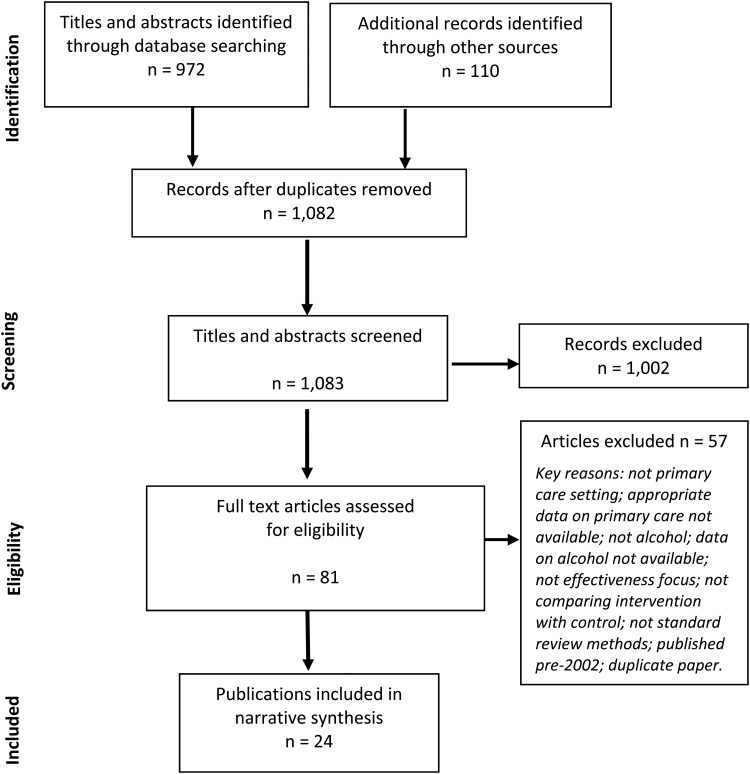
AIMS: The aim of the study was to assess the cumulative evidence on the effectiveness of brief alcohol interventions in primary healthcare in order to highlight key knowledge gaps for further research. METHODS: An overview of systematic reviews and meta-analyses of the effectiveness of brief alcohol intervention in primary healthcare published between 2002 and 2012. FINDINGS: Twenty-four systematic reviews met the eligibility criteria (covering a total of 56 randomized controlled trials reported across 80 papers). Across the included studies, it was consistently reported that brief intervention was effective for addressing hazardous and harmful drinking in primary healthcare, particularly in middle-aged, male drinkers. Evidence gaps included: brief intervention effectiveness in key groups (women, older and younger drinkers, minority ethnic groups, dependent/co-morbid drinkers and those living in transitional and developing countries); and the optimum brief intervention length and frequency to maintain longer-term effectiveness. CONCLUSION: This overview highlights the large volume of primarily positive evidence supporting brief alcohol intervention effects as well as some unanswered questions with regards to the effectiveness of brief alcohol intervention across different cultural settings and in specific population groups, and in respect of the optimum content of brief interventions that might benefit from further research.
Overview
The claims and statistics of this paper haven’t been checked yet.
Free: it reads the open-access text and checks the first 5 claims that cite a source we can check. Create a free account to check every claim.
Integrity signals
Registry
Cites
Statistics
Figures
Verification
Claims the paper makes
The claims and statistics of this paper haven’t been checked yet.
Free: it reads the open-access text and checks the first 5 claims that cite a source we can check. Create a free account to check every claim.
Claims other papers make about this one
Each is checked against this paper’s own text: does it say what the citing paper says it does?
The source backs part of the claim, not all of it — or backs it for a different population, condition or comparison.
In the citing paper
“findings show that university and ambulatory/primary care settings were the most effective in terms of magnitude of effect size”
From How effective are brief interventions in reducing alcohol consumption: do the setting, practitioner group and content matter? Findings from a systematic review and metaregression analysis (2016) · cites this paper as [15]
Experimental — accuracy not yet measuredThe cited source says what the claim attributes to it.
In the citing paper
“Some studies of brief interventions for problem drinking have nonetheless reported positive influences on alcohol reduction up to four years later [67] and on mortality [72].”
From Effectiveness of Guided and Unguided Low-Intensity Internet Interventions for Adult Alcohol Misuse: A Meta-Analysis (2014) · cites this paper as [67]
The cited source says what the claim attributes to it.
In the citing paper
“Early identification and secondary prevention of alcohol problems, using screening and brief interventions in primary care, has long been advocated as a strategy to reduce excessive drinking and is the focus of a great deal of research (O'Donnell 2014).”
From Effectiveness of brief alcohol interventions in primary care populations (2018) · cites this paper as O'Donnell 2014
In the citing paper
“several studies on face-to-face alcohol interventions in primary care had reported that men were more likely to benefit than women [30], [67].”
From Effectiveness of Guided and Unguided Low-Intensity Internet Interventions for Adult Alcohol Misuse: A Meta-Analysis (2014) · cites this paper as [67]
Self-check
Percentages, sums and reported differences re-computed from the paper’s own numbers.
The self-check needs the paper’s full text.
Citations
Cites
Preferred Reporting Items for Systematic Reviews and Meta-Analyses: the PRISMA statement
Moher, D., Liberati, A., Tetzlaff, J., Altman, D. G., & for the PRISMA Group (2009) · BMJ · doi:10.1136/bmj.b2535 · Cited by 83,823
Preferred reporting items for systematic reviews and meta-analyses: the PRISMA Statement.
(2009) · PubMed Central · Cited by 44,859
Preferred reporting items for systematic reviews and meta-analyses: The PRISMA statement
Moher, D., Liberati, A., Tetzlaff, J., Altman, D. G., & the PRISMA Group* (2009) · Annals of Internal Medicine · doi:10.7326/0003-4819-151-4-200908180-00135 · Cited by 37,554
Effectiveness of brief alcohol interventions in primary care populations
Kaner, E. F., Beyer, F. R., Muirhead, C., Campbell, F., Pienaar, E. D., Bertholet, N., Daeppen, J. B., Saunders, J. B., & Burnand, B. (2018) · Cochrane Database of Systematic Reviews · doi:10.1002/14651858.cd004148.pub4 · Cited by 1,665
Self-citationA pragmatic–explanatory continuum indicator summary (PRECIS): a tool to help trial designers
Thorpe, K. E., Zwarenstein, M., Oxman, A. D., Treweek, S., Furberg, C. D., Altman, D. G., Tunis, S., Bergel, E., Harvey, I., Magid, D. J., et al. (2009) · Journal of Clinical Epidemiology · doi:10.1016/j.jclinepi.2008.12.011 · Cited by 1,389
Standards of Evidence: Criteria for Efficacy, Effectiveness and Dissemination
Flay, B. R., Biglan, A., Boruch, R. F., Castro, F. G., Gottfredson, D., Kellam, S., Mościcki, E. K., Schinke, S., Valentine, J. C., & Ji, P. (2005) · Prevention Science · doi:10.1007/s11121-005-5553-y · Cited by 1,338 · cited 2×
“The US Society for Prevention Research (Flay et al., 2004, 2005) has outlined that efficacy testing requires at least two rigorous trials involving: tightly defined populations; psychometrically sound measures and data collection procedures; rigorous statistical analysis; consistent positive effects (without adverse e…”
BackgroundMethodology in conducting a systematic review of systematic reviews of healthcare interventions
Smith, V., Devane, D., Begley, C. M., & Clarke, M. (2011) · BMC Medical Research Methodology · doi:10.1186/1471-2288-11-15 · Cited by 1,227 · cited 2×
“Fourth, we did not verify the information reported in the reviews by consulting individual studies, which may have introduced bias (e.g. resulting from inaccurate reporting of findings (Smith et al., 2011)).”
BackgroundEffectiveness and cost-effectiveness of policies and programmes to reduce the harm caused by alcohol
Anderson, P., Chisholm, D., & Fuhr, D. C. (2009) · The Lancet · doi:10.1016/s0140-6736(09)60744-3 · Cited by 1,102 · cited 1×
“Although the behavioural theory that underpins the design and delivery of brief intervention is likely to be ‘universally’ effective (Anderson et al., 2009), and certainly Jonas et al. (2012) found similar effectiveness for brief alcohol intervention both within and outside the USA, a need remains…”
BackgroundSelf-citationMoyer, A., Finney, J. W., Swearingen, C. E., & Vergun, P. (2002) · Addiction · doi:10.1046/j.1360-0443.2002.00018.x · Cited by 1,092 · cited 12×
“Short and simple is still effective First, busy practitioners need to be reassured that there is little evidence to suggest that longer or more intensive input provides additional benefit over shorter, simpler input (Moyer et al., 2002; Kaner et al., 2007).”
BackgroundInfluentialLanguage bias in randomised controlled trials published in English and German
Egger, M., Zellweger-Zähner, T., Schneider, M., Junker, C., Lengeler, C., & Antes, G. (1997) · The Lancet · doi:10.1016/s0140-6736(97)02419-7 · Cited by 1,028 · cited 2×
“Given the resulting potential for publication bias (authors are more likely to publish significant results in English-language journals (Egger et al., 1997)), this suggests a need for increased linguistic (alongside geographic) diversity in future systematic reviews in this field (Babor et al.,…”
Background
Research works printed but not linked: 5
- 8. Babor T, Kaner E, Nilsen P et al. (2013) Rapid Review of Current Evidence for Health Promotion Actions for Hazardous and Harmful Alcohol Use, with Specific Reference to Low-and Middle-Income Countries: WHO Mainstreaming Health Promotion Project. Geneva: World Health Organization (in press).
- 1986, Preventive medicine, 14, 451
- 44. Latimer N, Guillaume L, Goyder E et al. (2010) Prevention and Early Identification of Alcohol Use Disorders in Adults and Young People: Screening and Brief Interventions, Cost Effectiveness Review. Sheffield: University of Sheffield, School of Health and Related Research (ScHARR) Public Health Collaborating Centre.
- 2004, Journal of substance abuse, 9, 91
- 55. Parkes T, Poole N, Salmon A et al. (2008) Double Exposure: A Better Practices Review on Alcohol Interventions during Pregnancy. Vancouver: British Columbia Centre of Excellence for Women's Health.
Cited by
Items 301–400 of 612
Scott, S., & Kaner, E. (2015) · Wiley eBooks · doi:10.1002/9781118887318.ch16 · Cited by 10
Self-citationImproving reporting and utility of evaluations of complex interventions
Campbell-Scherer, D. L., & Saitz, R. (2015) · BMJ Evidence-Based Medicine · doi:10.1136/ebmed-2015-110342 · Cited by 8
“There are now two dozen systematic reviews and meta-analyses of alcohol screening and brief intervention trials.(20) They find modest efficacy for reducing self-reported alcohol consumption and no consistent effects on laboratory evidence of harm, clinical outcomes or healthcare utilisation outcomes.”
BackgroundClair, V., Musau, A., Mutiso, V., Tele, A., Atkinson, K., Rossa-Roccor, V., Bosire, E., Ndetei, D., & Frank, E. (2022) · International Journal of Mental Health and Addiction · doi:10.1007/s11469-022-00841-x · Cited by 7
“However, most of these studies have been conducted in high-income countries (HICs) (Babor et al., 2013; Kaner et al., 2018; O’Donnell et al., 2013).”
BackgroundMellor, R., & Ritter, A. J. (2020) · SUCHT - Zeitschrift für Wissenschaft und Praxis / Journal of Addiction Research and Practice · doi:10.1024/0939-5911/a000640 · Cited by 8
Rennick‐Egglestone, S., Subhani, M., Knight, H., Jones, K. A., Hutton, C., Jackson, T., Hutton, M., Wragg, A., Morling, J. R., Sprange, K., et al. (2023) · JMIR Formative Research · doi:10.2196/47109 · Cited by 7
“A systematic review has demonstrated that brief alcohol interventions reduce alcohol consumption in harmful drinkers [10].”
BackgroundRosário, F., Wojnar, M., & Ribeiro, C. (2016) · International Journal of Family Medicine · doi:10.1155/2016/3635907 · Cited by 9
“As to physician-related barriers, doctors often report lack of training [5, 6, 9, 15, 22]; lack of knowledge and skills, [6, 9, 15]; and low confidence and motivation to identify risky drinkers and deliver advice [9, 15].”
BackgroundInfluentialIrvine, L. A., Melson, A. J., Williams, B., Sniehotta, F. F., Humphris, G. M., & Crombie, I. K. (2018) · Pilot and Feasibility Studies · doi:10.1186/s40814-018-0298-0 · Cited by 9
Rombouts, S. A., Conigrave, J. H., Louie, E., Haber, P., & Morley, K. C. (2019) · Systematic Reviews · doi:10.1186/s13643-019-1157-7 · Cited by 8
Evaluation of Behavior Change Interventions
Matthews, L., & Simpson, S. A. (2020) · Cambridge University Press eBooks · doi:10.1017/9781108677318.022 · Cited by 10
Büchele, N., Keller, L., Rukundo-Zeller, A. C., Schrietter, F., Treiber, J., Gollwitzer, P. M., & Odenwald, M. G. (2020) · PLoS ONE · doi:10.1371/journal.pone.0238833 · Cited by 9
“Screening and Brief Intervention (SBI) is a preventive approach with proven effectiveness to reduce hazardous alcohol consumption that usually consists of an initial assessment, the feedback of the respective results, and additional short interventions; it can be delivered by professionals of different training levels…”
BackgroundPreliminary study of alcohol problem severity and response to brief intervention
Meredith, L. R., Grodin, E. N., Karno, M. P., Montoya, A. K., MacKillop, J. M., Lim, A. C., & Ray, L. A. (2021) · Addiction Science & Clinical Practice · doi:10.1186/s13722-021-00262-6 · Cited by 9
“Findings have been mixed as to whether BI is appropriate and effective for more severe clinical populations, such as those with comorbid psychiatric conditions or higher alcohol problem severity [17, 18].”
BackgroundLearning from 50 Years of Aboriginal Alcohol Programs: Beating the Grog in Australia
D'Abbs, P. H., & Hewlett, N. (2023) · Springer eBooks · doi:10.1007/978-981-99-0401-3 · Cited by 11
Do women grow out of risky drinking? A prospective study of three cohorts of A ustralian women
Powers, J. R., Anderson, A., Byles, J., Mishra, G. D., & Loxton, D. J. (2015) · Drug and Alcohol Review · doi:10.1111/dar.12246 · Cited by 7
Wigham, S., Bauer, A., Robalino, S., Ferguson, J., Burke, A., & Newbury‐Birch, D. (2017) · Journal of the Royal Army Medical Corps · doi:10.1136/jramc-2016-000712 · Cited by 7
Self-citationBěláčková, V., Janíková, B., Vacek, J., Fidesová, H., & Miovský, M. (2017) · Nordic Studies on Alcohol and Drugs · doi:10.1177/1455072517733597 · Cited by 7
“There is strong evidence in support of brief interventions as an intervention to reduce alcohol consumption (O’Donnell et al., 2014), and it is desirable that this intervention is made broadly accessible (not only) in times of crisis.”
BackgroundIrvine, L. A., Crombie, I. K., Swanson, V., Dimova, E. D., Melson, A. J., Fraser, T. M., Barbour, R. S., Rice, P. M., & Allan, S. (2018) · PLoS ONE · doi:10.1371/journal.pone.0193434 · Cited by 7
Hall, N. J., Mooney, J. D., Sattar, Z., & Ling, J. (2019) · BMC Health Services Research · doi:10.1186/s12913-018-3796-0 · Cited by 9
Grekin, E. R., Beatty, J. R., McGoron, L., Kugler, K. C., McClure, J. B., Pop, D. E., & Ondersma, S. J. (2019) · Psychology of Addictive Behaviors · doi:10.1037/adb0000502 · Cited by 7
Bendtsen, M., Garnett, C. V., Toner, P., & Shorter, G. W. (2020) · JMIR Research Protocols · doi:10.2196/24175 · Cited by 7
Anderson, P., O'Donnell, A. J., Kaner, E., Gual, A., Schulte, B., Gómez, A. P., de Vries, H., Rey, G. N., & Rehm, J. T. (2017) · F1000Research · doi:10.12688/f1000research.11173.1 · Cited by 11
Self-citationMotivational Interviewing Interventions
Berman, A. H., Beckman, M., & Lindqvist, H. (2020) · Cambridge University Press eBooks · doi:10.1017/9781108677318.045 · Cited by 14
Saitz, R. (2015) · Addiction · doi:10.1111/add.13054 · Cited by 8
Sturgiss, E. A., Advocat, J. R., Lam, T., Nielsen, S., Ball, L., Gunatillaka, N., Martin, C., Barton, C., Tam, C. W. M., Skouteris, H., et al. (2023) · British Journal of General Practice · doi:10.3399/bjgp.2022.0613 · Cited by 6
Subhani, M., Jones, K. A., Sprange, K., Rennick‐Egglestone, S., Knight, H., Morling, J. R., Enki, D. G., Wragg, A., & Ryder, S. D. (2021) · BMJ Open · doi:10.1136/bmjopen-2021-054954 · Cited by 8
Schweer‐Collins, M. L., Parr, N. J., Saitz, R., & Tanner‐Smith, E. E. (2023) · Prevention Science · doi:10.1007/s11121-023-01525-1 · Cited by 9
“…findings are less surprising when considering that prior reviews also suggest there are a limited number of studies that have data disaggregated by sex and a larger number of primary studies that focus on BI effects for men only (Kaner et al., 2018; Moyer et al., 2002; O’Donnell et al., 2014).”
BackgroundResultPrimary health care utilization for alcohol-attributed diseases in British Columbia Canada 2001–2011
Slaunwhite, A., & Macdonald, S. (2015) · BMC Family Practice · doi:10.1186/s12875-015-0247-4 · Cited by 6
“Background In the past decade there has been a renewed focus on leveraging opportunities in primary health care to reduce health inequities through regular screening and health promotion counseling that work to detect illnesses early in their development and address negative health behaviors among patient populations…”
BackgroundHolloway, A. S., Landale, S., Ferguson, J., Newbury‐Birch, D., Parker, R. A., Smith, P. A., & Sheikh, A. (2017) · BMJ Open · doi:10.1136/bmjopen-2016-014561 · Cited by 7
Self-citationBrief Underage Alcohol Use Screener Scores Predict Health Risk Behaviors
Tubman, J. G., Meca, A., Schwartz, S. J., Velázquez, M. R., Egbert, A. W., Soares, M. H., & Regan, T. (2019) · The Journal of School Nursing · doi:10.1177/1059840519871092 · Cited by 7
Schulte, B., Lindemann, C., Buchholz, A., Rosahl, A., Härter, M. C., Kraus, L., Kiefer, F., Frischknecht, U., Hoffmann, S., Wensing, M., et al. (2019) · SUCHT - Zeitschrift für Wissenschaft und Praxis / Journal of Addiction Research and Practice · doi:10.1024/0939-5911/a000629 · Cited by 9
Self-citationGrigg, J., Arunogiri, S., Manning, V., Phan, V., Campbell, S. C., Frei, M. Y., & Lubman, D. I. (2020) · Drug and Alcohol Review · doi:10.1111/dar.13035 · Cited by 6
Economic and Behavioral Economic Approaches to Behavior Change
Brown, P. M., Cameron, L. D., Wilkinson, M., & Taylor, D. (2020) · Cambridge University Press eBooks · doi:10.1017/9781108677318.042 · Cited by 10
Changing Behavior Using Integrative Self-Control Theory
Hofmann, W., Dohle, S., & Diel, K. (2020) · Cambridge University Press eBooks · doi:10.1017/9781108677318.011 · Cited by 8
Brem, M. J., Shorey, R. C., Ramsey, S. E., & Stuart, G. L. (2023) · Psychosocial Intervention · doi:10.5093/pi2023a4 · Cited by 7
“Consistent with data supporting the general efficacy of brief, motivationallybased interventions in reducing alcohol use (DiClemente et al., 2017; Kaner et al., 2018; Lundahl et al., 2010; O’Donnell et al., 2014), our findings suggest that just 90 minutes of alcohol intervention can reduce women’s substance use and ph…”
O’Neill, G., Masson, S., Bewick, L., Doyle, J., McGovern, R., Stoker, E., Wright, H., & Newbury‐Birch, D. (2015) · Frontline Gastroenterology · doi:10.1136/flgastro-2014-100519 · Cited by 7
Self-citationAbidi, L., Oenema, A., Candel, M. J. J. M., & van de Mheen, D. (2016) · Contemporary Clinical Trials · doi:10.1016/j.cct.2016.10.008 · Cited by 6
McGovern, R., Stamp, E., Javanbakht, M., McColl, E., Hickman, M., & Kaner, E. (2018) · Pilot and Feasibility Studies · doi:10.1186/s40814-018-0305-5 · Cited by 7
Self-citationWard, J., Elison, S., Davies, G., Dugdale, S., & Jones, A. (2019) · Journal of Substance Use · doi:10.1080/14659891.2019.1651915 · Cited by 6
Conner, M. T., Williams, D. M., & Rhodes, R. E. (2020) · Cambridge University Press eBooks · doi:10.1017/9781108677318.034 · Cited by 8
Kokole, D., Mercken, L. A. G., Jané‐Llopis, E., Rey, G. N., Arroyo, M., Medina, P., Pérez‐Gómez, A., Mejía‐Trujillo, J., Piazza, M., Bustamante, I. V., et al. (2021) · Primary Health Care Research & Development · doi:10.1017/s1463423620000675 · Cited by 8
Self-citationThørrisen, M. M., Bonsaksen, T., Skogen, J. C., Skarpaas, L. S., Sevic, A., van Mechelen, W., & Aas, R. W. (2021) · Frontiers in Public Health · doi:10.3389/fpubh.2021.692605 · Cited by 6
McNeely, J., Mazumdar, M., Appleton, N., Bunting, A. M., Polyn, A., Floyd, S., Sharma, A., Shelley, D., & Cleland, C. M. (2022) · Substance Abuse · doi:10.1080/08897077.2021.1975868 · Cited by 7
Russian-Language Mobile Apps for Reducing Alcohol Use: Systematic Search and Evaluation
Bunova, A., Wiemker, V., Gornyi, B., Ferreira-Borges, C., & Neufeld, M. (2022) · JMIR mHealth and uHealth · doi:10.2196/31058 · Cited by 6
Effects of Computerized Interventions on Risky Alcohol Use Among Youth: Systematic Review
Smedslund, G., Nilsen, W., Wollscheid, S., Steiro, A., Fang, L., & Larun, L. (2018) · Research on Social Work Practice · doi:10.1177/1049731518815259 · Cited by 10
Russian-Language Mobile Apps for Reducing Alcohol Use: Systematic Search and Evaluation (Preprint)
Bunova, A., Wiemker, V., Gornyi, B., Ferreira-Borges, C., & Neufeld, M. (2021) · doi:10.2196/preprints.31058 · Cited by 6
Knowledge as prevention: A cost‐effective intervention to reduce prenatal alcohol exposure
Keating, O., Brown, R., McDougall, S., Kuenssberg, R., & O’Rourke, S. J. (2025) · Alcoholism Clinical and Experimental Research · doi:10.1111/acer.70089 · Cited by 5
A Narrative Review of Alcohol Prevention Interventions Among Older Adults
Kuerbis, A., Behrendt, S., Elswick, A., Kostelic, A., & Schultz, S. E. (2025) · Alcohol research · doi:10.35946/arcr.v45.1.10 · Cited by 7
“15,16 17-20 Subsequent grants were awarded to providers focusing on older adults, 10 and SBIRT was adapted for older adults primarily by adding an age-specific health workbook 21 for patients and providers to guide interventions.”
Herms, Q., Gratacós‐Ginès, J., & Pose, E. (2025) · Gastroenterology report · doi:10.1093/gastro/goaf088 · Cited by 5
Reinson, T., Bradbury, K. J., Moore, M. V., & Sheron, N. (2019) · BMJ Open · doi:10.1136/bmjopen-2018-028591 · Cited by 5
“…of the LOCATE intervention will address this by showing clinicians how to provide effective brief interventions for lifestyle changes using techniques identified as important within a review of reviews, 20 such as discussing patient’s thoughts on alcohol and diet, and/or agreeing realistic goals.”
Collier, E. S., Blomqvist, J., & Bendtsen, M. (2023) · Alcohol and Alcoholism · doi:10.1093/alcalc/agad070 · Cited by 7
King, D. K., Ondersma, S. J., McRee, B. G., German, J. S., Loree, A. M., Harlowe, A., Alford, D. P., Sedotto, R. N. M., & Weber, M. K. (2024) · Substance Use & Addiction Journal · doi:10.1177/29767342241271404 · Cited by 5
Reduction of the treatment gap for problematic alcohol use in Belgium
Mistiaen, P., Kohn, L., Mambourg, F., Ketterer, F., Tiedtke, C., Lambrechts, M., Godderis, L., Vanmeerbeek, M., Eyssen, M., & Paulus, D. (2015) · doi:10.57598/r258cs · Cited by 5
Brief Intervention for Heavy Drinking in Primary Care: Role of Patient Initiation
Rose, G. L., Guth, S. E., Badger, G. J., Plante, D. A., Fazzino, T. L., & Helzer, J. E. (2015) · Journal of Addiction Medicine · doi:10.1097/adm.0000000000000141 · Cited by 7
“…of the efficacy and effectivenessof alcohol screening and brief intervention (BI) in primary care (Bertholet et al., 2005; Kaner et al., 2007; O’Donnell et al., 2014), which prompted the 2013 US Preventive Services Task Force recommendation that health care providers proactively screen…”
BackgroundGornyi, B., Калинина, А. М., & Boytsov, S. A. (2016) · Russian Journal of Preventive Medicine · doi:10.17116/profmed201619151-55 · Cited by 5
Lid, T. G., Eide, G. E., Dalen, I., & Meland, E. (2016) · Scandinavian Journal of Primary Health Care · doi:10.1080/02813432.2016.1207138 · Cited by 6
“…0.002 Abbreviations: HR: hazard ratio; CI: confidence interval; ICD-10: International Classification of Diseases, version 10; ICPC-2: International Classification of Primary Care, version 2. aPer 10 predictor events. and collecting data for the prediction of future health problems is less relevant.”
InfluentialSAOR screening and brief intervention for problem alcohol and substance use.
O'Shea, J., Goff, P., & Armstrong, R. (2017) · Cited by 7
McGrath, E., Elliott, R., Millar, T., & Armitage, C. J. (2019) · Journal of Behavioral Medicine · doi:10.1007/s10865-019-00078-5 · Cited by 5
Watterson, J. R., Gabbe, B. J., Rosenfeld, J. V., Ball, H., Romero, L., & Dietze, P. (2020) · BMJ Military Health · doi:10.1136/bmjmilitary-2020-001584 · Cited by 5
Gibson, B., Umeh, K. F., Davies, I. G., & Newson, L. (2021) · Health Expectations · doi:10.1111/hex.13311 · Cited by 12
Patient and practitioner views on cancer risk discussions in primary care: a qualitative study
Blane, D. N., Macdonald, S., & O'Donnell, C. A. (2021) · BJGP Open · doi:10.3399/bjgpo.2021.0108 · Cited by 5
Buntrock, C., Freund, J., Smit, F., Riper, H. M., Lehr, D., Boß, L., Berking, M., & Ebert, D. D. (2021) · Addiction · doi:10.1111/add.15718 · Cited by 5
“Evidence suggests that screening and brief interventions are effective at reducing excessive alcohol consumption [6].”
BackgroundSolovei, A., Mercken, L. A. G., Jané‐Llopis, E., Bustamante, I. V., Evers, S., Gual, A., Medina, P., Mejía‐Trujillo, J., Rey, G. N., O'Donnell, A. J., et al. (2021) · Health Promotion International · doi:10.1093/heapro/daab192 · Cited by 8
“, 1998), and providing brief advice to those identified as heavy drinkers, has been shown to be clinically- (O’Donnell et al., 2014; Platt et al., 2016; Kaner et al., 2018) and cost-effective (Solberg et al.”
InfluentialSelf-citationSorrento, C., Shah, I., Yakah, W., Ahmed, A., Tintara, S., Kandasamy, C., Freedman, S. D., Kothari, D. J., & Sheth, S. G. (2022) · Journal of Clinical Gastroenterology · doi:10.1097/mcg.0000000000001666 · Cited by 6
Cannabis und Schadensminderung in Deutschland
Manthey, J., Stöver, H., & Meyer-Thompson, H.-G. (2017) · Suchttherapie · doi:10.1055/s-0043-112067 · Cited by 9
“Da sie gut er forscht sind [90] und robuste Wirksamkeitshinweise vorliegen [91], werden sie als eine zentrale Methode zur Reduzierung globaler al koholbezogener Schäden empfohlen [92].”
Sharpe, S., Kool, B., Whittaker, R., Lee, A. C.-L., Reid, P., Civil, I. D., & Ameratunga, S. N. (2019) · BMC Research Notes · doi:10.1186/s13104-019-4308-y · Cited by 5
Addressing Underserved Populations and Disparities in Behavior Change
Schüz, B., & Hooper, M. W. (2020) · Cambridge University Press eBooks · doi:10.1017/9781108677318.027 · Cited by 8
Bolton, J. M., Leong, C., Ekuma, O., Prior, H. J., Konrad, G., Enns, J. E., Singal, D., Nepon, J., Paillé, M. T., Finlayson, G., et al. (2020) · CMAJ Open · doi:10.9778/cmajo.20200124 · Cited by 5
Ntouva, A., Sanatinia, R., & Watt, R. G. (2016) · European Journal Of Dental Education · doi:10.1111/eje.12241 · Cited by 5
Perman‐Howe, P. R., Davies, E., & Foxcroft, D. (2018) · Current Addiction Reports · doi:10.1007/s40429-018-0190-2 · Cited by 5
Goldschmidt, L., Mncina, B., Langa, M., Rebello, S., Budaza, T., Tshabalala, J., Kinfu, Y., & Achoki, T. (2023) · BMC Public Health · doi:10.1186/s12889-023-16775-5 · Cited by 4
Nurse-Led Approaches to Lowering Alcohol Use among Adolescents: Study Findings
Moreira, M. T., Lima, A., Fernandes, C. S., Pereira, A., Lemos, D., Pereira, L. C., Delgado, R., Rodrigues, S., & Sampaio, F. (2024) · Nursing Reports · doi:10.3390/nursrep14020054 · Cited by 7
Changing Behavior in the Digital Age
Kavanagh, D. J. (2020) · Cambridge University Press eBooks · doi:10.1017/9781108677318.029 · Cited by 20
Verthein, U., Lahusen, H., Martens, M., Prilutskaya, M., Yussopov, O., Kaliyeva, Z., & Schulte, B. (2022) · International Journal of Public Health · doi:10.3389/ijph.2022.1604803 · Cited by 6
Self-citationCollier, E. S., Blomqvist, J., Crawford, J., McCambridge, J., & Bendtsen, M. (2023) · Substance Abuse Treatment Prevention and Policy · doi:10.1186/s13011-023-00569-4 · Cited by 4
“Behavioural change interventions are one option for supporting individuals to reduce their alcohol consumption [4].”
BackgroundCurrent treatments of alcohol use disorder
Dionisi, T., Sario, G. D., Mori, L. D., Spagnolo, G., Antonelli, M., Tarli, C., Sestito, L., Mancarella, F. A., Ferrarese, D., Mirijello, A., et al. (2024) · International review of neurobiology · doi:10.1016/bs.irn.2024.02.005 · Cited by 8
Schøler, P. N., Volke, K. H., Andréasson, S., Rasmussen, S., Søndergaard, J., & Nielsen, A. S. (2024) · Addiction Science & Clinical Practice · doi:10.1186/s13722-024-00474-6 · Cited by 6
“The HCP provides the patient with information on the findings in relation to alcohol consumption and offers brief advice with a menu of options [48, 49] including step two of the method.”
BackgroundSterling, S., Lu, Y., Grijalva, C., Ross, T. B., Weisner, C. M., Elson, J., & Chi, F. W. (2024) · Journal of Substance Use and Addiction Treatment · doi:10.1016/j.josat.2024.209532 · Cited by 7
Carlin-Menter, S. M., Ra, M., WinklerPrins, V. J., Danzo, A., & Rd, B. (2016) · PubMed · Cited by 4
Rosário, F., Wojnar, M., & Ribeiro, C. (2016) · Substance Use & Misuse · doi:10.1080/10826084.2016.1225092 · Cited by 6
“…of training is one of the most commonly cited barriers to the widespread delivery of screening and brief intervention in primary care (Anderson et al., 2014; Babor & Higgins-Biddle, 2000; Kaner, Heather, McAvoy, Lock, & Gilvarry, 1999; O’Donnell et al., 2014; Ribeiro, 2011; Wilson et al., 2011).”
BackgroundPsychotherapy for substance use disorders
MYERS, B. J. (2019) · Elsevier eBooks · doi:10.1016/b978-0-12-814932-4.00011-2 · Cited by 5
Detección y registro del consumo de alcohol en Urgencias
Bruguera, P., Barrio, P., Oliveras, C., Vázquez, M., Soler, V. G., Nuño, L., Vieta, E., & Gual, A. (2020) · Revista Española de Salud Pública · doi:10.4321/s1135-57272020000100021 · Cited by 5
“Medicina interna (%) 97 (67,3) 36 (64,3) 133 (66,5) Cirugía (%) 22 (15,2) 7 (12,5) 29 (14,5) Traumatología (%) 13 (9) 4 (7,1) 17 (8,5) Psiquiatría (%) 12 (8,3) 9 (16,1) 21 (10,5) Media puntuación AUDIT-C (IQR) 8 (3) 7 (3) 7,61 (3)”
BackgroundYamashiki, N., Kawabata, K., Murata, M., Ikeda, S., Fujimaki, T., Suwa, K., Seki, T., Aramaki, E., & Naganuma, M. (2023) · JMIR Formative Research · doi:10.2196/44762 · Cited by 6
“In primary care settings, “screening and brief intervention” are effective to reduce drinking in the general population [9].”
BackgroundBarriers for identification and treatment of problem drinkers in primary care
Coloma‐Carmona, A., Carballo, J. L., & González, S. T. (2016) · Gaceta Sanitaria · doi:10.1016/j.gaceta.2016.07.009 · Cited by 12
Experiencias del personal de enfermería con pacientes hospitalizados por abuso de alcohol
Sánchez, A., & Jorge, X. D. S. (2017) · Enfermería Universitaria · doi:10.1016/j.reu.2016.12.001 · Cited by 8
Babor, T. F., Robaina, K., & Noel, J. K. (2017) · American Public Health Association eBooks · doi:10.2105/9780875532929ch26 · Cited by 5
Taplin, S., Richmond, G., & McArthur, M. (2014) · doi:10.24268/fhs.8348 · Cited by 4
Rodríguez, E. M. R., de Torres, L. Á. P., Ruiz, A. L., García, J., Rejano, J. M. P., & Villalobos, A. R. (2018) · Atención Primaria · doi:10.1016/j.aprim.2018.07.004 · Cited by 9
Sturgiss, E. A., Gunatillaka, N., Ball, L., Lam, T., Nielsen, S., O’Donnell, R., Barton, C., Skouteris, H., Tam, C. W. M., Jacka, D., et al. (2021) · BJGP Open · doi:10.3399/bjgpo.2021.0037 · Cited by 6
“Few trials on the effectiveness of ABIs have considered the specific needs of low- income groups, potentially contributing to greater health disparities.(10) The overall aim of the project is to: (a) increase screening for problematic alcohol use; and (b) increase the application of ABIs in general practice.”
BackgroundKokole, D., Jané‐Llopis, E., Rey, G. N., Aguilar, N. B., Aguilar, P. S. M., Mejía‐Trujillo, J., Mora, K., Restrepo, N., Bustamante, I. V., Piazza, M., et al. (2022) · Implementation Research and Practice · doi:10.1177/26334895221112693 · Cited by 7
Self-citationIntervenções para enfrentamento do abuso de álcool: revisão integrativa
Guimarães, F. J., Fernandes, A. F. C., & Pagliuca, L. M. F. (2015) · Revista Eletrônica de Enfermagem · doi:10.5216/ree.v17i3.29290 · Cited by 6
The 3rd National Emergency Department Survey of Alcohol Identification and Intervention Activity
Patton, R. (2016) · Surrey Research Insight Open Access (The University of Surrey) · Cited by 4
LLopis, E. J., Anderson, P., Piazza, M., O'Donnell, A., Gual, A., Schulte, B., Gómez, A. P., de Vries, H., Rey, G. N., Kokole, D., et al. (2020) · Research Square · doi:10.21203/rs.2.22734/v1 · Cited by 7
Self-citationWidmann, M., Apondi, B., Musau, A., Warsame, A. H., Isse, M., Mutiso, V., Veltrup, C., Schalinski, I., Ndetei, D., & Odenwald, M. (2022) · BMC Public Health · doi:10.1186/s12889-022-14681-w · Cited by 3
“There is strong evidence for the effectiveness of SBI in primary healthcare settings in reducing hazardous alcohol use [19]; however, the evidence for other substances is weaker [20, 21].”
BackgroundSolovei, A., Jané‐Llopis, E., Mercken, L. A. G., Bustamante, I. V., Kokole, D., Mejía‐Trujillo, J., Aguilar, P. S. M., Rey, G. N., O'Donnell, A. J., Piazza, M., et al. (2022) · Prevention Science · doi:10.1007/s11121-021-01329-1 · Cited by 6
“However, in spite of consistent empirical evidence showing that this programme is efficacious (Kaner et al., 2018; O’Donnell et al., 2013; Platt et al., 2016) and cost-effective (Anderson et al.”
BackgroundSelf-citationGunnarsson, K. U., Henriksson, M., & Bendtsen, M. (2024) · Journal of Medical Internet Research · doi:10.2196/44574 · Cited by 3
“Provisioning of psychosocial interventions for persons with harmful alcohol use is also included on the list of recommended actions, and has been operationalized by, for instance, delivering face-to-face interventions in primary health care [8].”
Stockings, E., Hall, W., Lynskey, M. T., Morley, K. I., Reavley, N. J., Strang, J., Patton, G. C., & Degenhardt, L. J. (2016) · Cited by 3
Metz, V. E., Leibowitz, A., Satre, D. D., Parthasarathy, S., Jackson-Morris, M., Cocohoba, J. M., & Sterling, S. (2022) · Contemporary Clinical Trials · doi:10.1016/j.cct.2022.107004 · Cited by 3
Smith, A., Buchanan, R. M., Parkes, J., Stone, H., Tan, Q. Y., & Ibrahim, K. (2023) · International Journal of Pharmacy Practice · doi:10.1093/ijpp/riad071 · Cited by 6
“It is recognized that implementation of SBI into routine healthcare practice has been limited [17].”
Nissilä, E., Hynninen, M. S., Jalkanen, V., Kuitunen, A. H., Bäcklund, M., Inkinen, O., & Hästbacka, J. (2024) · Critical Care · doi:10.1186/s13054-024-04925-z · Cited by 4
“The effectiveness of BIs has been demonstrated in primary care settings [11, 13, 33].”
BackgroundBrief Intervention in Addictive Behaviors: Promoting Change
Carballo, J. L., & Coloma‐Carmona, A. (2025) · Papeles del Psicólogo - Psychologist Papers · doi:10.70478/pap.psicol.2025.46.11 · Cited by 4
A Web-Based Alcohol Risk Communication Tool: Development and Pretesting Study
Kool, B., Dobson, R., Sharpe, S., Humphrey, G., Whittaker, R., & Ameratunga, S. (2020) · JMIR Formative Research · doi:10.2196/13224 · Cited by 3
“Alcohol brief interventions (BIs) are broadly defined as a single short session of structured advice and information for those identified via screening as hazardous or harmful drinkers.”
BackgroundResultInfluential
Metadata
- Authors
- O'Donnell, A., Anderson, P., Newbury-Birch, D., Schulte, B., Schmidt, C., Reimer, J., & Kaner, E.
- Affiliations
- Newcastle University (GB)
- Maastricht University (NL)
- Universität Hamburg (DE)
- Corresponding author
- Kaner, E.
- Venue
- Alcohol and Alcoholism
- Publisher
- Oxford University Press (OUP)
- Published
- 2013-11-13
- Volume
- 49
- Issue
- 1
- Pages
- 66-78
- ISSN
- 0735-0414 (ISSN-L)
- 1464-3502
- PMC
- PMC3865817
- OpenAlex
- W2153422660
- Cited by
- 613
- References
- 68
- Citations by year
- 2026: 12 · 2025: 16 · 2024: 24 · 2023: 49 · 2022: 40 · 2021: 49 · 2020: 90 · 2019: 84 · 2018: 52 · 2017: 65 · 2016: 50 · 2015: 58 · 2014: 24
- FWCI
- 5.22
- Type
- journal article
- Language
- en
- Open access
- hybrid
- doi.org
- Licence
- cc-by-nc
- Locations
- Alcohol and Alcoholism (publishedVersion, cc-by-nc)
- Europe PMC (PubMed Central) (publishedVersion, cc-by-nc)
- PubMed Central (publishedVersion, cc-by-nc)
- PubMed (publishedVersion)
- Teesside University Research Portal (Teesside University) (submittedVersion)
- Newcastle University ePrints (Newcastle Univesity) (cc-by-nc)
- Funders
- Newcastle University
- European Commission
- Medical Research Council (MR/K02325X/1)
- Topics
- Health Sciences › Medicine › Epidemiology › Substance Abuse Treatment and Outcomes
- Health Sciences › Medicine › Pathology and Forensic Medicine › Alcohol Consumption and Health Effects
- Social Sciences › Psychology › Applied Psychology › Behavioral Health and Interventions
- Keywords
- brief alcohol intervention, primary care, hazardous drinking, intervention effectiveness, knowledge gaps, ethnic minorities, cultural context
- MeSH terms
- Alcoholism, Counseling, Humans, Primary Health Care, Early Medical Intervention
About these checks
Registry, retraction, Cites and statistics results are computed, not judged, with one exception: a printed reference that no index lists is read once by a model before it counts as a citation error. Claims are extracted by a model and kept only when their quote appears verbatim in the text; each cited source is then checked, with a model’s help, for whether it says what the claim relies on. Those verdicts can be wrong — read the claim’s quote and the cited source before relying on one.
Statistics and arithmetic are recomputed, not judged.
Confidence bands are shown only for fields calibrated on our annotated test set. None is calibrated yet, so no band is shown.
What counts as a claim ›How we measure confidence ›How we check this ›
Are you an author, or do you see a problem with this page? Request a review
Data sources
Bibliographic data: Semantic Scholar, OpenAlex, Crossref.
Contains information from the Semantic Scholar Academic Graph Datasets, made available under the ODC Attribution License (ODC-BY 1.0).
Semantic Scholar’s data is described in: Kinney, R., et al. (2023). The Semantic Scholar Open Data Platform. arXiv:2301.10140.
