

The Impact of Brief Alcohol Interventions in Primary Healthcare: A Systematic Review of Reviews
Open accessThe DOI matches its Crossref record; 68 of the 68 references it cites were found in a registry or an index.
Abstract
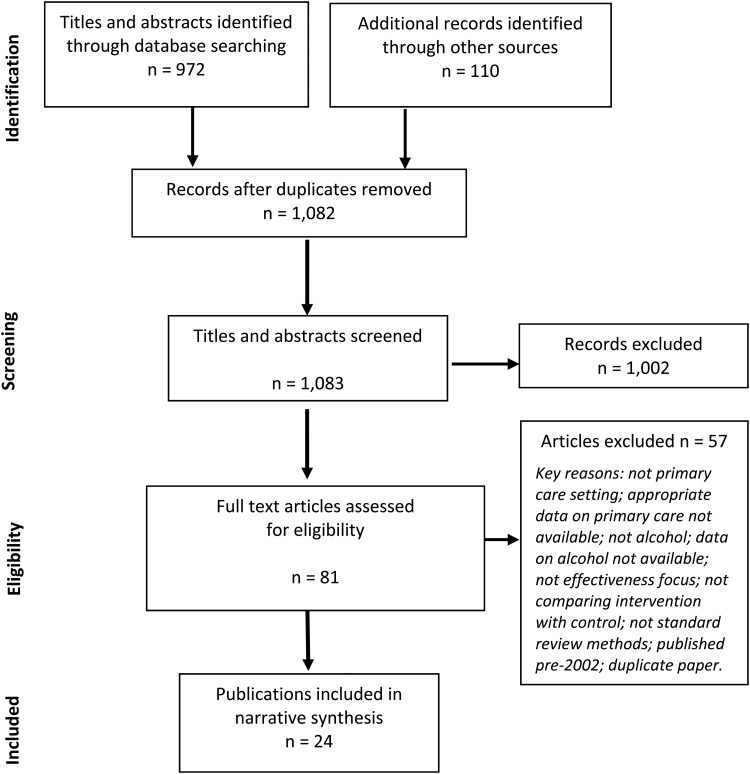
AIMS: The aim of the study was to assess the cumulative evidence on the effectiveness of brief alcohol interventions in primary healthcare in order to highlight key knowledge gaps for further research. METHODS: An overview of systematic reviews and meta-analyses of the effectiveness of brief alcohol intervention in primary healthcare published between 2002 and 2012. FINDINGS: Twenty-four systematic reviews met the eligibility criteria (covering a total of 56 randomized controlled trials reported across 80 papers). Across the included studies, it was consistently reported that brief intervention was effective for addressing hazardous and harmful drinking in primary healthcare, particularly in middle-aged, male drinkers. Evidence gaps included: brief intervention effectiveness in key groups (women, older and younger drinkers, minority ethnic groups, dependent/co-morbid drinkers and those living in transitional and developing countries); and the optimum brief intervention length and frequency to maintain longer-term effectiveness. CONCLUSION: This overview highlights the large volume of primarily positive evidence supporting brief alcohol intervention effects as well as some unanswered questions with regards to the effectiveness of brief alcohol intervention across different cultural settings and in specific population groups, and in respect of the optimum content of brief interventions that might benefit from further research.
Overview
The claims and statistics of this paper haven’t been checked yet.
Free: it reads the open-access text and checks the first 5 claims that cite a source we can check. Create a free account to check every claim.
Integrity signals
Registry
Cites
Statistics
Figures
Verification
Claims the paper makes
The claims and statistics of this paper haven’t been checked yet.
Free: it reads the open-access text and checks the first 5 claims that cite a source we can check. Create a free account to check every claim.
Claims other papers make about this one
Each is checked against this paper’s own text: does it say what the citing paper says it does?
The source backs part of the claim, not all of it — or backs it for a different population, condition or comparison.
In the citing paper
“findings show that university and ambulatory/primary care settings were the most effective in terms of magnitude of effect size”
From How effective are brief interventions in reducing alcohol consumption: do the setting, practitioner group and content matter? Findings from a systematic review and metaregression analysis (2016) · cites this paper as [15]
Experimental — accuracy not yet measuredThe cited source says what the claim attributes to it.
In the citing paper
“Some studies of brief interventions for problem drinking have nonetheless reported positive influences on alcohol reduction up to four years later [67] and on mortality [72].”
From Effectiveness of Guided and Unguided Low-Intensity Internet Interventions for Adult Alcohol Misuse: A Meta-Analysis (2014) · cites this paper as [67]
The cited source says what the claim attributes to it.
In the citing paper
“Early identification and secondary prevention of alcohol problems, using screening and brief interventions in primary care, has long been advocated as a strategy to reduce excessive drinking and is the focus of a great deal of research (O'Donnell 2014).”
From Effectiveness of brief alcohol interventions in primary care populations (2018) · cites this paper as O'Donnell 2014
In the citing paper
“several studies on face-to-face alcohol interventions in primary care had reported that men were more likely to benefit than women [30], [67].”
From Effectiveness of Guided and Unguided Low-Intensity Internet Interventions for Adult Alcohol Misuse: A Meta-Analysis (2014) · cites this paper as [67]
Self-check
Percentages, sums and reported differences re-computed from the paper’s own numbers.
The self-check needs the paper’s full text.
Citations
Cites
Preferred Reporting Items for Systematic Reviews and Meta-Analyses: the PRISMA statement
Moher, D., Liberati, A., Tetzlaff, J., Altman, D. G., & for the PRISMA Group (2009) · BMJ · doi:10.1136/bmj.b2535 · Cited by 83,823
Preferred reporting items for systematic reviews and meta-analyses: the PRISMA Statement.
(2009) · PubMed Central · Cited by 44,859
Preferred reporting items for systematic reviews and meta-analyses: The PRISMA statement
Moher, D., Liberati, A., Tetzlaff, J., Altman, D. G., & the PRISMA Group* (2009) · Annals of Internal Medicine · doi:10.7326/0003-4819-151-4-200908180-00135 · Cited by 37,554
Effectiveness of brief alcohol interventions in primary care populations
Kaner, E. F., Beyer, F. R., Muirhead, C., Campbell, F., Pienaar, E. D., Bertholet, N., Daeppen, J. B., Saunders, J. B., & Burnand, B. (2018) · Cochrane Database of Systematic Reviews · doi:10.1002/14651858.cd004148.pub4 · Cited by 1,665
Self-citationA pragmatic–explanatory continuum indicator summary (PRECIS): a tool to help trial designers
Thorpe, K. E., Zwarenstein, M., Oxman, A. D., Treweek, S., Furberg, C. D., Altman, D. G., Tunis, S., Bergel, E., Harvey, I., Magid, D. J., et al. (2009) · Journal of Clinical Epidemiology · doi:10.1016/j.jclinepi.2008.12.011 · Cited by 1,389
Standards of Evidence: Criteria for Efficacy, Effectiveness and Dissemination
Flay, B. R., Biglan, A., Boruch, R. F., Castro, F. G., Gottfredson, D., Kellam, S., Mościcki, E. K., Schinke, S., Valentine, J. C., & Ji, P. (2005) · Prevention Science · doi:10.1007/s11121-005-5553-y · Cited by 1,338 · cited 2×
“The US Society for Prevention Research (Flay et al., 2004, 2005) has outlined that efficacy testing requires at least two rigorous trials involving: tightly defined populations; psychometrically sound measures and data collection procedures; rigorous statistical analysis; consistent positive effects (without adverse e…”
BackgroundMethodology in conducting a systematic review of systematic reviews of healthcare interventions
Smith, V., Devane, D., Begley, C. M., & Clarke, M. (2011) · BMC Medical Research Methodology · doi:10.1186/1471-2288-11-15 · Cited by 1,227 · cited 2×
“Fourth, we did not verify the information reported in the reviews by consulting individual studies, which may have introduced bias (e.g. resulting from inaccurate reporting of findings (Smith et al., 2011)).”
BackgroundEffectiveness and cost-effectiveness of policies and programmes to reduce the harm caused by alcohol
Anderson, P., Chisholm, D., & Fuhr, D. C. (2009) · The Lancet · doi:10.1016/s0140-6736(09)60744-3 · Cited by 1,102 · cited 1×
“Although the behavioural theory that underpins the design and delivery of brief intervention is likely to be ‘universally’ effective (Anderson et al., 2009), and certainly Jonas et al. (2012) found similar effectiveness for brief alcohol intervention both within and outside the USA, a need remains…”
BackgroundSelf-citationMoyer, A., Finney, J. W., Swearingen, C. E., & Vergun, P. (2002) · Addiction · doi:10.1046/j.1360-0443.2002.00018.x · Cited by 1,092 · cited 12×
“Short and simple is still effective First, busy practitioners need to be reassured that there is little evidence to suggest that longer or more intensive input provides additional benefit over shorter, simpler input (Moyer et al., 2002; Kaner et al., 2007).”
BackgroundInfluentialLanguage bias in randomised controlled trials published in English and German
Egger, M., Zellweger-Zähner, T., Schneider, M., Junker, C., Lengeler, C., & Antes, G. (1997) · The Lancet · doi:10.1016/s0140-6736(97)02419-7 · Cited by 1,028 · cited 2×
“Given the resulting potential for publication bias (authors are more likely to publish significant results in English-language journals (Egger et al., 1997)), this suggests a need for increased linguistic (alongside geographic) diversity in future systematic reviews in this field (Babor et al.,…”
Background
Research works printed but not linked: 5
- 8. Babor T, Kaner E, Nilsen P et al. (2013) Rapid Review of Current Evidence for Health Promotion Actions for Hazardous and Harmful Alcohol Use, with Specific Reference to Low-and Middle-Income Countries: WHO Mainstreaming Health Promotion Project. Geneva: World Health Organization (in press).
- 1986, Preventive medicine, 14, 451
- 44. Latimer N, Guillaume L, Goyder E et al. (2010) Prevention and Early Identification of Alcohol Use Disorders in Adults and Young People: Screening and Brief Interventions, Cost Effectiveness Review. Sheffield: University of Sheffield, School of Health and Related Research (ScHARR) Public Health Collaborating Centre.
- 2004, Journal of substance abuse, 9, 91
- 55. Parkes T, Poole N, Salmon A et al. (2008) Double Exposure: A Better Practices Review on Alcohol Interventions during Pregnancy. Vancouver: British Columbia Centre of Excellence for Women's Health.
Cited by
Items 201–300 of 612
Anderson, P., Manthey, J., Jané‐Llopis, E., Rey, G. N., Bustamante, I. V., Piazza, M., Aguilar, P. S. M., Mejía‐Trujillo, J., Pérez‐Gómez, A., Rowlands, G., et al. (2021) · Journal of General Internal Medicine · doi:10.1007/s11606-020-06503-9 · Cited by 19
Self-citationGaume, J., Grazioli, V. S., Paroz, S., Fortini, C., Bertholet, N., & Daeppen, J. (2021) · PLoS ONE · doi:10.1371/journal.pone.0246652 · Cited by 22
“Systematic reviews on alcohol BI and BMI have not clearly determined the optimal intervention length [65], even if more intensive interventions tended to yield overall more favorable results in ED-based interventions [66].”
BackgroundSinger, A. G., Kosowan, L., Loewen, S., Spithoff, S. M., Greiver, M., & Lynch, J. (2021) · Preventive Medicine Reports · doi:10.1016/j.pmedr.2021.101346 · Cited by 17
“There is evidence that supports screening for alcohol use and brief interventions for heavy alcohol use as effective for the reduction of heavy alcohol consumption (Zur and Zaric, 2016; Kaner et al., 2018; O’Donnell et al., 2014; Spithoff and Kahan, 2015a, 2015b).”
BackgroundWamsley, M. A., Steiger, S., Julian, K. A., Gleason, N. J., O’Sullivan, P., Guy, M., & Satterfield, J. M. (2016) · Substance Abuse · doi:10.1080/08897077.2015.1127869 · Cited by 16
“If alcohol use was identified in the visit note, the resident was asked (1) where alcohol use fell on the resident’s list of priorities during the visit; (2) their assessment of the patient’s alcohol use; (3) their assessment of the patient’s stage of change; (4) whether a brief intervention and/or referral”
BackgroundA Randomized Controlled Trial of Brief Intervention by Interactive Voice Response
Rose, G. L., Badger, G. J., Skelly, J. M., MacLean, C. D., Ferraro, T. A., & Helzer, J. E. (2017) · Alcohol and Alcoholism · doi:10.1093/alcalc/agw102 · Cited by 21
“In spite of strong evidence for efficacy (Whitlock et al., 2004; O’Donnell et al., 2014), implementation of BI in practice is far from universal.”
BackgroundAnderson, P., O'Donnell, A. J., Kaner, E., Gual, A., Schulte, B., Gómez, A. P., de Vries, H., Rey, G. N., & Rehm, J. T. (2017) · F1000Research · doi:10.12688/f1000research.11173.3 · Cited by 17
Self-citationEvaluating Alcohol Industry Action to Reduce the Harmful Use of Alcohol
Anderson, P., & Rehm, J. T. (2016) · Alcohol and Alcoholism · doi:10.1093/alcalc/agv139 · Cited by 18
Self-citationReducing alcohol-associated liver disease burden in the general population
Asrani, S. K., Mellinger, J. L., Sterling, S., Lucey, M. R., Bradley, K. A., Bhala, N. B., Bray, J. W., Chen, P., DiMartini, A. F., Fernandez, A. C., et al. (2025) · The Lancet. Gastroenterology & hepatology · doi:10.1016/s2468-1253(25)00193-1 · Cited by 19
Irvine, L. A., Melson, A. J., Williams, B., Sniehotta, F. F., McKenzie, A., Jones, C., & Crombie, I. K. (2017) · International Journal of Behavioral Medicine · doi:10.1007/s12529-017-9666-z · Cited by 20
Solution-Focused Brief Therapy for Individuals With Alcohol Use Disorders in Chile
Suitt, K. G., Geraldo, P., Estay, M., & Franklin, C. (2017) · Research on Social Work Practice · doi:10.1177/1049731517740958 · Cited by 15
“…different health-care professionals, and promising research indicates that BIs in primary care are effective and that their implementation remained effective regardless of the health provider that delivered the BI (O’Donnell et al., 2014; Sullivan, Tetrault, Braithwaite, Turner, & Fiellin, 2011).”
BackgroundTait, R. J., Kirkman, J. J. L., & Schaub, M. P. (2018) · JMIR Research Protocols · doi:10.2196/resprot.9982 · Cited by 18
“One approach to addressing alcohol use among those with less severe problems is opportunistic screening and brief intervention (SBI), with the evidence base for the effectiveness of SBI being substantial [10-13].”
BackgroundNewhouse, R. P., Janney, M. A., Gilbert, A., Agley, J. D., Bakoyannis, G., Ferren, M. D., Mullins, C. D., Johantgen, M., Schwindt, R. G., & Thoele, K. (2018) · Addiction Science & Clinical Practice · doi:10.1186/s13722-018-0130-4 · Cited by 17
Bonnevie, E., Kigozi, G., Kairania, R., Ssemanda, J. B., Nakyanjo, N., Ddaaki, W. G., Ssekyewa, C., & Wagman, J. A. (2019) · Culture Health & Sexuality · doi:10.1080/13691058.2019.1587002 · Cited by 16
“Clinic-based and health-focused alcohol interventions have been among the most successful and cost-effective approaches for reducing problematic alcohol use in highincome areas, and alcohol treatment has also shown promise for reducing IPV in these settings (O’Donnell et al. 2013; Solberg, Maciosek and Edwards 2008; O…”
MethodLeibowitz, A., Satre, D. D., Lu, W. Y., Weisner, C. M., Corriveau, C., Gizzi, E., & Sterling, S. (2020) · Journal of Addiction Medicine · doi:10.1097/adm.0000000000000666 · Cited by 15
“Screening, Brief Intervention, and Referral to Treatment (SBIRT) is an intervention designed to detect unhealthy drinking in primary care and facilitate addiction treatment if needed (O’Donnell et al., 2014; Kaner et al., 2018).”
BackgroundRosário, F., Vasiljevic, M., Pas, L., Angus, C., Ribeiro, C., & Fitzgerald, N. (2022) · Addiction · doi:10.1111/add.15782 · Cited by 17
Kastenholz, K. J., & Agarwal, G. (2015) · Academic Psychiatry · doi:10.1007/s40596-015-0380-3 · Cited by 16
“The intervention of physicians has been demonstrated to be effective at reducing problematic substance use, even when the intervention is brief advice [2].”
BackgroundMeeting the challenges of the new frontier of youth mental health care
MALLA, A. K., Boksa, P., & Joober, R. (2022) · World Psychiatry · doi:10.1002/wps.20927 · Cited by 16
Alcohol enquiry by GPs - Understanding patients' perspectives: A qualitative study.
Tam, C. W. M., Leong, L. H.-L., Zwar, N. A., & Hespe, C. M. (2015) · PubMed · Cited by 20
Kim, J., & Hendershot, C. S. (2020) · Journal of Substance Abuse Treatment · doi:10.1016/j.jsat.2020.01.006 · Cited by 16
Staton, C. A., Zadey, S., O’Leary, P., Phillips, A., Minja, L., Swahn, M. H., Hirshon, J. M., Boshe, J., Sakita, F., Vissoci, J. R. N., et al. (2022) · Trials · doi:10.1186/s13063-022-06060-y · Cited by 14
“In light of the recent negative findings of brief interventions for ED patients during effectiveness trials in Europe, many have argued that the intervention fidelity is poor in those large effectiveness trials [10, 11, 42].”
BackgroundBeyer, F. R., Kenny, R. P. W., Johnson, E. E., Caldwell, D. M., Garnett, C. V., Rice, S. J. C., Simpson, J., Angus, C., Craig, D., Hickman, M., et al. (2022) · Addiction · doi:10.1111/add.15999 · Cited by 18
Self-citationZur, R. M., & Zaric, G. S. (2015) · Addiction · doi:10.1111/add.13201 · Cited by 18
Support for community pharmacy-based alcohol interventions: a Scottish general public survey
Fitzgerald, N., Youngson, E., Cunningham, S., Watson, M. C., & Stewart, D. C. (2015) · Public Health · doi:10.1016/j.puhe.2015.07.005 · Cited by 18
“Despite this, implementation has progressed in an increasing number of sites.(49-51) The next phase of research should involve an efficacy (rather than effectiveness) trial, i.”
Pharmacy-based alcohol-misuse services: current perspectives
Hattingh, L., & Tait, R. J. (2018) · Integrated Pharmacy Research and Practice · doi:10.2147/iprp.s140431 · Cited by 17
“The provision of alcohol advice, for example, provided through opportunistic screening and brief intervention (SBI), has proven successful in primary care settings in reducing alcohol consumption and alcohol-related harms.(7) This creates an opportunity for community pharmacies, as pharmacy staff have regular contact…”
Webb, T. L., & de Bruin, M. (2020) · Cambridge University Press eBooks · doi:10.1017/9781108677318.037 · Cited by 17
Dunn, C. W., Darnell, D. A., Carmel, A., Atkins, D. C., Bumgardner, K., & Roy‐Byrne, P. (2014) · Journal of Substance Abuse Treatment · doi:10.1016/j.jsat.2014.10.009 · Cited by 16
Kraus, L., Schulte, B., Manthey, J., & Rehm, J. T. (2016) · Addiction Research & Theory · doi:10.1080/16066359.2016.1263728 · Cited by 21
“…et al. 2013) and an on-going debate on the efficacy versus effectiveness as well as on the concept of alcohol brief interventions in primary health care (Heather 2014a, 2014b; Saitz 2014), 30 years of evidence support brief alcohol intervention effects (Kaner et al. 2007; O'Donnell et al. 2014).”
BackgroundInfluentialSelf-citationvan der Westhuizen, C., Malan, M., Naledi, T., Roelofse, M., Myers, B., Stein, D. J., Lahri, S., & Sorsdahl, K. (2021) · Addiction Science & Clinical Practice · doi:10.1186/s13722-021-00239-5 · Cited by 13
Satre, D. D., Ly, K., Wamsley, M., Curtis, A., & Satterfield, J. (2017) · JMIR Research Protocols · doi:10.2196/resprot.7070 · Cited by 13
“Available evidence supports the effectiveness of screening and brief intervention in addressing hazardous drinking within primary care [8-10], although evidence for effectiveness in reducing drug use is weak and trials have been mixed [11-14].”
BackgroundCity-based action to reduce harmful alcohol use: review of reviews
Anderson, P., Jané‐Llopis, E., Hasan, O. S. M., & Rehm, J. T. (2018) · F1000Research · doi:10.12688/f1000research.13783.2 · Cited by 14
“…reviews and meta-analyses find a positive impact of screening and brief advice programmes on alcohol consumption, mortality, morbidity, alcohol-related injuries, alcohol-related social consequences, healthcare resource use and laboratory indicators of harmful alcohol use (O’Donnell et al., 2014).”
Self-citationSnowden, C. P., Lynch, E. M., Avery, L., Haighton, C., Howel, D., Mamasoula, V., Gilvarry, E. A., McColl, E., Prentis, J. M., Gerrand, C., et al. (2020) · Health Technology Assessment · doi:10.3310/hta24120 · Cited by 15
Self-citationSullivan, C. F., Martin, N., White, C., & Newbury‐Birch, D. (2017) · BMC Public Health · doi:10.1186/s12889-017-4878-3 · Cited by 14
Self-citationHays, A. M., Gilrain, K., Grunberg, V. A., Bullock, A. J., Fizur, P. J., & Ross, S. E. (2019) · Journal of Clinical Psychology in Medical Settings · doi:10.1007/s10880-019-09681-9 · Cited by 16
Angus, C., Li, J., Rodríguez, E. M. R., Anderson, P., Parrott, S., & Brennan, A. (2018) · European Journal of Public Health · doi:10.1093/eurpub/cky181 · Cited by 19
Self-citationDobbels, F., Denhaerynck, K., Klem, M. L., Sereika, S. M., Geest, S. D., SIMONE, P. D., Berben, L., Binet, I., Burkhalter, H., Drent, G., et al. (2018) · Transplantation Reviews · doi:10.1016/j.trre.2018.09.003 · Cited by 13
Xiaolu, R., Wenwen, W., Ali, R., Xu, L., Hong, W., Min, Z., & Jiang, D. (2017) · Alcohol and Alcoholism · doi:10.1093/alcalc/agx014 · Cited by 12
“The utility of a BI for AUD has been investigated in a variety of settings, including general hospitals, emergency departments and primary healthcare (McDevitt-Murphy et al., 2014; McQueen et al., 2015; O’Donnell et al., 2013; Rhodes et al., 2015).”
BackgroundForray, A., Martino, S., Gilstad‐Hayden, K., Kershaw, T., Ondersma, S., Olmstead, T. A., & Yonkers, K. A. (2019) · Addictive Behaviors · doi:10.1016/j.addbeh.2019.05.007 · Cited by 13
Variation in SBIRT delivery among acute care facilities
Keen, A., Thoele, K., & Newhouse, R. P. (2019) · Nursing Outlook · doi:10.1016/j.outlook.2019.09.001 · Cited by 15
Zewdu, S., Hanlon, C., Fekadu, A., Medhin, G., & Teferra, S. (2022) · Journal of Substance Abuse Treatment · doi:10.1016/j.jsat.2021.108636 · Cited by 12
Kable, J. A., & Jones, K. L. (2023) · Alcohol research · doi:10.35946/arcr.v43.1.03 · Cited by 16
Alcohol-induced hypertension: an important healthcare target in Belgium
Collart, F., de Timary, P., Dom, G., Dor, B., Duprez, D. A., Lengelé, J., Matthys, F., Peuskens, H., Rehm, J. T., & Stärkel, P. (2015) · Acta Clinica Belgica · doi:10.1179/2295333715y.0000000039 · Cited by 18
Stockings, E., Shakeshaft, A. P., & Farrell, M. (2018) · Current Addiction Reports · doi:10.1007/s40429-018-0210-2 · Cited by 13
“care [63], and in this issue, Beyer and colleagues [6] highlight the consistent positive effect SBIRT has had on alcohol consumption in these settings.”
BackgroundCrombie, I. K., Irvine, L. A., Williams, B., Sniehotta, F. F., Petrie, D., Jones, C., Norrie, J. D., Evans, J. M. M., Emslie, C., Rice, P. M., et al. (2018) · Public Health Research · doi:10.3310/phr06060 · Cited by 18
“The content of the interventions also varies substantially.(5,94) They can contain motivational interviewing, feedback and advice, self-monitoring of alcohol consumption, self-help manuals, counselling and cognitive–behavioural therapy.”
BackgroundPossemato, K., Shepardson, R. L., & Funderburk, J. S. (2018) · FOCUS The Journal of Lifelong Learning in Psychiatry · doi:10.1176/appi.focus.20180024 · Cited by 16
Critical and Qualitative Approaches to Behavior Change
Chamberlain, K., & Lyons, A. C. (2020) · Cambridge University Press eBooks · doi:10.1017/9781108677318.030 · Cited by 16
López‐Pelayo, H., Miquel, L., Altamirano, J., Blanch, J. L., Gual, A., & Lligoña, A. (2016) · Alcohol · doi:10.1016/j.alcohol.2016.01.002 · Cited by 13
Miller, A. P., Ddaaki, W. G., Bloom, B. E., Wirtz, A. L., Nakyanjo, N., Kigozi, G., & Wagman, J. A. (2022) · Violence Against Women · doi:10.1177/10778012211019054 · Cited by 11
“Although there is evidence globally of alcohol reduction SBIs having success in other populations (O’Donnell et al., 2014; Vasilaki et al., 2006), these studies have been conducted among non-HIVpositive persons or persons with unknown HIV status; similar evidence of effectiveness among PLWH in a…”
BackgroundRosário, F., Vasiljevic, M., Pas, L., Fitzgerald, N., & Ribeiro, C. (2019) · Family Practice · doi:10.1093/fampra/cmy062 · Cited by 11
The Feasibility and Impact of a Brief Internet Intervention for Pornography Reduction
Rodda, S. N., & Luoto, S. (2022) · Sexual Health & Compulsivity · doi:10.1080/26929953.2022.2153772 · Cited by 16
Senreich, E., Ogden, L. P., & Greenberg, J. P. (2017) · Social Work in Health Care · doi:10.1080/00981389.2017.1290010 · Cited by 14
“Although a meta-analysis by O’Donnell et al. (2014) generally supported the effectiveness of brief alcohol interventions in primary care settings, there were unanswered questions regarding the efficacy of these interventions across different cultural settings with specific population groups and…”
MethodAnderson, P., Kłoda, K., Kaner, E., Reynolds, J., Bendtsen, P., Pelgrum-Keurhorst, M. N., Segura, L., Wojnar, M., Mierzecki, A., Deluca, P., et al. (2017) · European Journal of General Practice · doi:10.1080/13814788.2017.1374365 · Cited by 12
“While primary healthcare based screening and brief advice is effective in reducing heavy drinking [2], it is poorly implemented [3].”
BackgroundSelf-citationMaximizing User Engagement with Behavior Change Interventions
Yardley, L., Morrison, L. G., Müller, I., & Bradbury, K. J. (2020) · Cambridge University Press eBooks · doi:10.1017/9781108677318.025 · Cited by 13
Subhani, M., Harman, D. J., Scott, R. A., Bennett, L., Wilkes, E., James, M. W., Aithal, G. P., Ryder, S. D., & Guha, I. N. (2022) · Biomedicines · doi:10.3390/biomedicines10020477 · Cited by 15
“Alcohol brief interventions do impact drinking behaviour and reduce alcohol consumption [19,20].”
BackgroundLygidakis, C., Wallace, P., Tersar, C., Marcatto, F., Ferrante, D., Vedova, R. D., Scafuri, F., Scafato, E., & Struzzo, P. (2016) · JMIR Research Protocols · doi:10.2196/resprot.5232 · Cited by 11
“Brief interventions delivered in primary health care settings have been shown to be both efficacious and effective in reducing excessive drinking in Italy and worldwide [3-7].”
Patient Perspectives on Discussions of Electronic Cigarettes in Primary Care
Doescher, M. P., Wu, M., Rainwater, E., Khan, A. S., & Rhoades, D. A. (2018) · The Journal of the American Board of Family Medicine · doi:10.3122/jabfm.2018.01.170206 · Cited by 13
Sallis, A., Attwood, S., Harper, H., LARSEN, J. A., Berry, D., Vlaev, I., Sanders, M., & Chadborn, T. (2019) · Psychology and Health · doi:10.1080/08870446.2019.1579911 · Cited by 11
Impact of brief intervention and art therapy for alcohol users
Soares, M. H., Rolin, T. F. D. C., Machado, F. P., Ramos, L. K. F., & Rampazzo, A. R. P. (2019) · Revista Brasileira de Enfermagem · doi:10.1590/0034-7167-2018-0317 · Cited by 11
“The subjects identified with the required score received the Bi and, subsequently, the appropriate information regarding the participation in the project(19-20).”
BackgroundResultInfluentialFreyer‐Adam, J., Baumann, S., Bischof, G., John, U., & Gaertner, B. (2020) · Preventive Medicine · doi:10.1016/j.ypmed.2020.106106 · Cited by 12
The Science of Behavior Change: The Road Ahead
Hagger, M. S., Cameron, L. D., Hamilton, K., Hankonen, N. E., & Lintunen, T. (2020) · Cambridge University Press eBooks · doi:10.1017/9781108677318.046 · Cited by 16
Nikkola, J., Laukkarinen, J., Huhtala, H., & Sand, J. A. (2017) · Alcohol and Alcoholism · doi:10.1093/alcalc/agx023 · Cited by 11
“Follow-up visits to primary health care after discharge would probably yield good results and cost-effectiveness as described before (O’Donnell et al., 2014).”
BackgroundLuciano, M. T., McDevitt‐Murphy, M. E., Acuff, S. F., Bellet, B. W., Tripp, J. C., & Murphy, J. G. (2019) · Psychological Trauma Theory Research Practice and Policy · doi:10.1037/tra0000378 · Cited by 12
“A recent metaanalysis showed that BAIs in primary health care were effective in reducing hazardous drinking, particularly among middle-aged male drinkers (O’Donnell et al., 2014).”
BackgroundScreening and Brief Advice to Reduce Adolescents’ Risk of Riding With Substance-Using Drivers
Knight, J. R., Csémy, L., Sherritt, L., Starostova, O., Hook, S. V., Bacic, J. D., Finlay, C., Tauber, J., Brooks, T., Kossack, R., et al. (2018) · Journal of Studies on Alcohol and Drugs · doi:10.15288/jsad.2018.79.611 · Cited by 11
“Unfortunately, all effects dissipated by the 12-month follow-up, consistent with prior studies of brief interventions in primary care, which found that effect sizes tend to be strongest at earliest follow-up points, with decay in intervention effects over time (O’Donnell et al., 2014).”
ResultRehm, J. T., Gmel, G. E., Sierra, C., & Gual, A. (2016) · Adicciones · doi:10.20882/adicciones.726 · Cited by 12
An Ethnographic study of unhealthy alcohol use in a Danish Emergency Department
Sivertsen, D. M., Becker, U., Andersen, O., & Kirk, J. W. (2021) · Addiction Science & Clinical Practice · doi:10.1186/s13722-021-00269-z · Cited by 15
Cribado e intervención breve en consumo de alcohol
García, R. C., & Guillem, F. C. (2022) · Atención Primaria · doi:10.1016/j.aprim.2022.102349 · Cited by 16
Lessons in Implementation from a 5-Year SBIRT Effort Using a Mixed-Methods Approach
Evans, B., Kamon, J. L., & Turner, W. C. (2023) · The Journal of Behavioral Health Services & Research · doi:10.1007/s11414-023-09835-6 · Cited by 11
Tait, R. J., Teoh, L., Kelty, E. A., Geelhoed, E. A., Mountain, D., & Hulse, G. K. (2016) · Drug and Alcohol Dependence · doi:10.1016/j.drugalcdep.2016.06.005 · Cited by 10
“The most robust evidence for the ffectiveness of alcohol BI is among middle aged males receiving nterventions from primary care physicians (O’Donnell et al., 2014).”
BackgroundClinical Manual of Youth Addictive Disorders
(2019) · American Psychiatric Association Publishing eBooks · doi:10.1176/appi.books.9781615372812 · Cited by 13
Schøler, P. N., Søndergaard, J., Barfod, S. M., & Nielsen, A. S. (2022) · BMC Family Practice · doi:10.1186/s12875-022-01639-5 · Cited by 10
“Step one is to raise the topic, recognize symptoms or complaints that could be alcohol-related and give brief advice [36].”
BackgroundSturgiss, E. A., Lam, T., Russell, G. M., Ball, L., Gunatillaka, N., Barton, C., Tam, C. W. M., O’Donnell, R., Chacko, E., Skouteris, H., et al. (2021) · Family Practice · doi:10.1093/fampra/cmab091 · Cited by 13
“As there is a lack of research that focuses on effective interventions for people in low-income groups (11), we foregrounded our methods so interventions we develop would be accessible and feasible for low-income groups (16).”
BackgroundMethodPrimary Care Management of Alcohol Misuse
Berger, D. B., & Bradley, K. A. (2015) · Medical Clinics of North America · doi:10.1016/j.mcna.2015.05.004 · Cited by 12
Nweze, I. C., DiGiacomo, J. C., Shin, S. S., Gupta, C., Ramakrishnan, R., & Angus, L. D. G. (2016) · Injury · doi:10.1016/j.injury.2016.10.020 · Cited by 12
Crombie, I. K., Cunningham, K. B., Irvine, L. A., Williams, B., Sniehotta, F. F., Norrie, J. D., Melson, A. J., Jones, C., Briggs, A. H., Rice, P. M., et al. (2017) · Health Technology Assessment · doi:10.3310/hta21190 · Cited by 12
“7) Distribution of BMI, kg/m(2) 29–34 16 (52) 13 (42) 29 (47) 35–39 9 (29) 13 (42) 22 (35) 40–44 6 (19) 5 (16) 11 (18) SD, standard deviation.”
(2021) · The Journal of Spinal Cord Medicine · doi:10.1080/10790268.2021.1863738 · Cited by 9
Norman, P., Webb, T. L., Millings, A., & Pechey, L. (2019) · Translational Behavioral Medicine · doi:10.1093/tbm/ibz110 · Cited by 9
“Brief alcohol interventions that are delivered in primary care typically involve screening for harmful or hazardous drinking, providing personalised feedback and information on the risks of excessive alcohol consumption, and giving tips on ways to cut down [1].”
BackgroundTreatment of Alcohol Use Disorder
Tareen, K., Clifton, E. G., Perumalswami, P., Mellinger, J. L., & Winder, G. S. (2024) · Clinics in Liver Disease · doi:10.1016/j.cld.2024.06.011 · Cited by 11
Kilian, C., Lemp, J. M., & Probst, C. (2023) · Addictive Behaviors · doi:10.1016/j.addbeh.2023.107765 · Cited by 19
Alcohol and public health: heavy drinking is a heavy price to pay for populations
Scott, S., & Kaner, E. (2014) · Journal of Public Health · doi:10.1093/pubmed/fdu071 · Cited by 9
Self-citationIsted, A., Fiorini, F., & Tillmann, T. (2015) · BMC Family Practice · doi:10.1186/s12875-015-0290-1 · Cited by 11
“Measures that have shown benefit include simple provision of an information leaflet, brief lifestyle advice during a consultation, or more lengthy and detailed counseling sessions [18].”
BackgroundHolt, S. R., & Tetrault, J. M. (2016) · Clinics in Liver Disease · doi:10.1016/j.cld.2016.02.003 · Cited by 11
Proeschold‐Bell, R. J., Evon, D. M., Makarushka, C., Wong, J. B., Datta, S., Yao, J., Patkar, A. A., Mannelli, P., Hodge, T., Naggie, S., et al. (2018) · Contemporary Clinical Trials · doi:10.1016/j.cct.2018.07.003 · Cited by 10
Martínez, E. Z., da Silva, A. S., Giglio, F. M., Terada, N. A. Y., & Zucoloto, M. L. (2019) · Cadernos Saúde Coletiva · doi:10.1590/1414-462x201900020234 · Cited by 13
Lubman, D. I., Grigg, J., Manning, V., Hall, K., Volpe, I., Dias, S. M. D. N., Baker, A., Staiger, P. K., Reynolds, J., Harris, A., et al. (2019) · Trials · doi:10.1186/s13063-019-3462-9 · Cited by 9
Autonomy-Supportive Interventions
Reeve, J., & Cheon, S. H. (2020) · Cambridge University Press eBooks · doi:10.1017/9781108677318.035 · Cited by 15
Lubman, D. I., Grigg, J., Reynolds, J., Hall, K., Baker, A., Staiger, P. K., Tyler, J., Volpe, I., Stragalinos, P., Harris, A., et al. (2022) · JAMA Psychiatry · doi:10.1001/jamapsychiatry.2022.2779 · Cited by 9
The Profound Implications of the Meaning of Health for Health Care and Health Equity
Fiscella, K. A., & Epstein, R. M. (2023) · Milbank Quarterly · doi:10.1111/1468-0009.12660 · Cited by 10
Wilson, H., Palk, G. R. M., Sheehan, M. C., Wishart, D. E., & Watson, B. C. (2017) · International Journal of Behavioral Medicine · doi:10.1007/s12529-017-9664-1 · Cited by 13
“The aggregate evidence of systematic reviews (24 systematic reviews covering a total of 56 randomized controlled trials reported across 80 papers) indicates that a brief intervention is effective for addressing hazardous and harmful drinking in different cultural settings and across age groups [25].”
Backgroundde Ridder, D. T. D., Gillebaart, M., & Friese, M. (2020) · Cambridge University Press eBooks · doi:10.1017/9781108677318.040 · Cited by 11
Supporting Future Cannabis Policy – Developing a Standard Joint Unit: A Brief Back-Casting Exercise
López‐Pelayo, H., Matrai, S., Balcells‐Oliveró, M., Campeny, E., Braddick, F., Bossong, M. G., Cruz, O. S., Deluca, P., Dom, G., Feingold, D., et al. (2021) · Frontiers in Psychiatry · doi:10.3389/fpsyt.2021.675033 · Cited by 10
Implementation Science and Translation in Behavior Change
Łuszczyńska, A., Łobczowska, K., & Horodyska, K. (2020) · Cambridge University Press eBooks · doi:10.1017/9781108677318.023 · Cited by 13
Spreading alcohol brief interventions from health care to non-health care settings: Is it justified?
Heather, N. (2016) · Drugs Education Prevention and Policy · doi:10.1080/09687637.2016.1187113 · Cited by 12
Lilienthal, K. R., Possemato, K., Funderburk, J. S., Wade, M. J., Eaker, A., & Beehler, G. P. (2016) · The Journal of Behavioral Health Services & Research · doi:10.1007/s11414-016-9496-9 · Cited by 9
Nichol, B., Rodrigues, A., Wilson, R., & Haighton, C. (2024) · Health & Social Care in the Community · doi:10.1155/2024/6786899 · Cited by 9
Vieira, J. A. P., Segura, L., Anderson, P., Wolstenholme, A., Drummond, C., Bendtsen, P., Wojnar, M., Kaner, E., Keurhorst, M. N., van Steenkiste, B., et al. (2017) · Journal of Evaluation in Clinical Practice · doi:10.1111/jep.12854 · Cited by 11
Self-citationRosenbaum, A., Rojas, P. A. F., Rodriguez, M. V., Barticevic, N. A., & Solange Rivera, M. (2018) · Medwave · doi:10.5867/medwave.2018.01.7148 · Cited by 8
Epton, T., & Armitage, C. J. (2020) · Cambridge University Press eBooks · doi:10.1017/9781108677318.038 · Cited by 8
Rodríguez, E. M. R., de Torres, L. Á. P., Moral, R. R., García, J., Rejano, J. M. P., Villalobos, A. R., Guillem, F. C., & Collaborative Group Alco-AP (2020) · BMC Health Services Research · doi:10.1186/s12913-020-05730-4 · Cited by 10
The Finnish Drinking Habits Survey: Implications for alcohol policy and prevention
Warpenius, K., & Mäkelä, P. (2020) · Nordic Studies on Alcohol and Drugs · doi:10.1177/1455072520954328 · Cited by 8
Technological Interventions for the Treatment of Substance Use Disorders
Schulte, M. H. J., Boumparis, N., Huizink, A. C., & Riper, H. M. (2020) · Elsevier eBooks · doi:10.1016/b978-0-12-818697-8.00010-8 · Cited by 8
“For instance, it remains unclear how BIs can be optimized for target groups including pregnant women, adolescents, older adults, ethnic minority groups (Kaner et al., 2018; O ’ Donnell et al., 2014), or groups with lower socioeconomic status (SES) or low literacy.”
BackgroundExamining untreated and treated alcohol problem resolution in an Australian online survey sample
Mellor, R., Lancaster, K., & Ritter, A. J. (2021) · Drug and Alcohol Review · doi:10.1111/dar.13257 · Cited by 8
Metadata
- Authors
- O'Donnell, A., Anderson, P., Newbury-Birch, D., Schulte, B., Schmidt, C., Reimer, J., & Kaner, E.
- Affiliations
- Newcastle University (GB)
- Maastricht University (NL)
- Universität Hamburg (DE)
- Corresponding author
- Kaner, E.
- Venue
- Alcohol and Alcoholism
- Publisher
- Oxford University Press (OUP)
- Published
- 2013-11-13
- Volume
- 49
- Issue
- 1
- Pages
- 66-78
- ISSN
- 0735-0414 (ISSN-L)
- 1464-3502
- PMC
- PMC3865817
- OpenAlex
- W2153422660
- Cited by
- 613
- References
- 68
- Citations by year
- 2026: 12 · 2025: 16 · 2024: 24 · 2023: 49 · 2022: 40 · 2021: 49 · 2020: 90 · 2019: 84 · 2018: 52 · 2017: 65 · 2016: 50 · 2015: 58 · 2014: 24
- FWCI
- 5.22
- Type
- journal article
- Language
- en
- Open access
- hybrid
- doi.org
- Licence
- cc-by-nc
- Locations
- Alcohol and Alcoholism (publishedVersion, cc-by-nc)
- Europe PMC (PubMed Central) (publishedVersion, cc-by-nc)
- PubMed Central (publishedVersion, cc-by-nc)
- PubMed (publishedVersion)
- Teesside University Research Portal (Teesside University) (submittedVersion)
- Newcastle University ePrints (Newcastle Univesity) (cc-by-nc)
- Funders
- Newcastle University
- European Commission
- Medical Research Council (MR/K02325X/1)
- Topics
- Health Sciences › Medicine › Epidemiology › Substance Abuse Treatment and Outcomes
- Health Sciences › Medicine › Pathology and Forensic Medicine › Alcohol Consumption and Health Effects
- Social Sciences › Psychology › Applied Psychology › Behavioral Health and Interventions
- Keywords
- brief alcohol intervention, primary care, hazardous drinking, intervention effectiveness, knowledge gaps, ethnic minorities, cultural context
- MeSH terms
- Alcoholism, Counseling, Humans, Primary Health Care, Early Medical Intervention
About these checks
Registry, retraction, Cites and statistics results are computed, not judged, with one exception: a printed reference that no index lists is read once by a model before it counts as a citation error. Claims are extracted by a model and kept only when their quote appears verbatim in the text; each cited source is then checked, with a model’s help, for whether it says what the claim relies on. Those verdicts can be wrong — read the claim’s quote and the cited source before relying on one.
Statistics and arithmetic are recomputed, not judged.
Confidence bands are shown only for fields calibrated on our annotated test set. None is calibrated yet, so no band is shown.
What counts as a claim ›How we measure confidence ›How we check this ›
Are you an author, or do you see a problem with this page? Request a review
Data sources
Bibliographic data: Semantic Scholar, OpenAlex, Crossref.
Contains information from the Semantic Scholar Academic Graph Datasets, made available under the ODC Attribution License (ODC-BY 1.0).
Semantic Scholar’s data is described in: Kinney, R., et al. (2023). The Semantic Scholar Open Data Platform. arXiv:2301.10140.
