

The Impact of Brief Alcohol Interventions in Primary Healthcare: A Systematic Review of Reviews
Open accessThe DOI matches its Crossref record; 68 of the 68 references it cites were found in a registry or an index.
Abstract
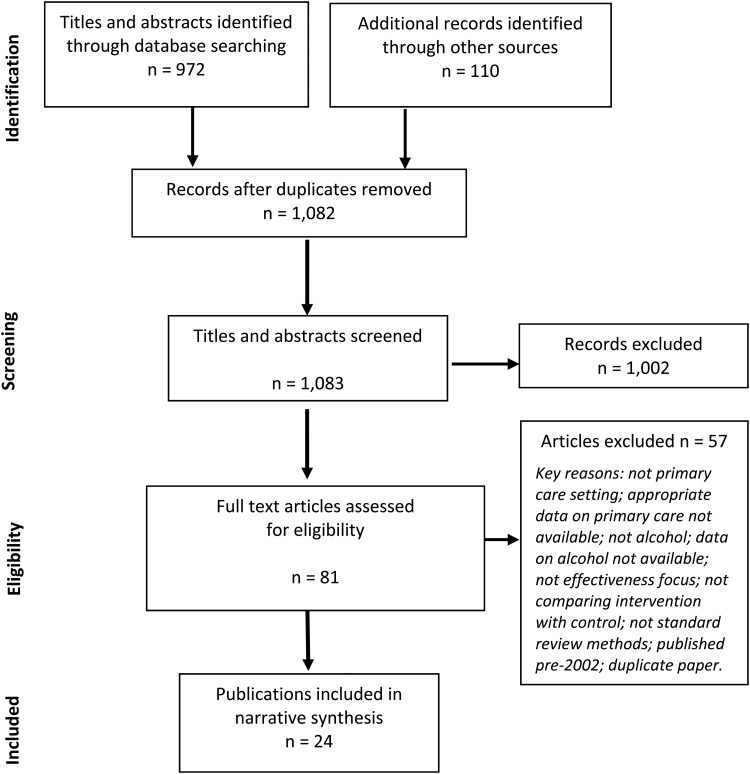
AIMS: The aim of the study was to assess the cumulative evidence on the effectiveness of brief alcohol interventions in primary healthcare in order to highlight key knowledge gaps for further research. METHODS: An overview of systematic reviews and meta-analyses of the effectiveness of brief alcohol intervention in primary healthcare published between 2002 and 2012. FINDINGS: Twenty-four systematic reviews met the eligibility criteria (covering a total of 56 randomized controlled trials reported across 80 papers). Across the included studies, it was consistently reported that brief intervention was effective for addressing hazardous and harmful drinking in primary healthcare, particularly in middle-aged, male drinkers. Evidence gaps included: brief intervention effectiveness in key groups (women, older and younger drinkers, minority ethnic groups, dependent/co-morbid drinkers and those living in transitional and developing countries); and the optimum brief intervention length and frequency to maintain longer-term effectiveness. CONCLUSION: This overview highlights the large volume of primarily positive evidence supporting brief alcohol intervention effects as well as some unanswered questions with regards to the effectiveness of brief alcohol intervention across different cultural settings and in specific population groups, and in respect of the optimum content of brief interventions that might benefit from further research.
Overview
The claims and statistics of this paper haven’t been checked yet.
Free: it reads the open-access text and checks the first 5 claims that cite a source we can check. Create a free account to check every claim.
Integrity signals
Registry
Cites
Statistics
Figures
Verification
Claims the paper makes
The claims and statistics of this paper haven’t been checked yet.
Free: it reads the open-access text and checks the first 5 claims that cite a source we can check. Create a free account to check every claim.
Claims other papers make about this one
Each is checked against this paper’s own text: does it say what the citing paper says it does?
The source backs part of the claim, not all of it — or backs it for a different population, condition or comparison.
In the citing paper
“findings show that university and ambulatory/primary care settings were the most effective in terms of magnitude of effect size”
From How effective are brief interventions in reducing alcohol consumption: do the setting, practitioner group and content matter? Findings from a systematic review and metaregression analysis (2016) · cites this paper as [15]
Experimental — accuracy not yet measuredThe cited source says what the claim attributes to it.
In the citing paper
“Some studies of brief interventions for problem drinking have nonetheless reported positive influences on alcohol reduction up to four years later [67] and on mortality [72].”
From Effectiveness of Guided and Unguided Low-Intensity Internet Interventions for Adult Alcohol Misuse: A Meta-Analysis (2014) · cites this paper as [67]
The cited source says what the claim attributes to it.
In the citing paper
“Early identification and secondary prevention of alcohol problems, using screening and brief interventions in primary care, has long been advocated as a strategy to reduce excessive drinking and is the focus of a great deal of research (O'Donnell 2014).”
From Effectiveness of brief alcohol interventions in primary care populations (2018) · cites this paper as O'Donnell 2014
In the citing paper
“several studies on face-to-face alcohol interventions in primary care had reported that men were more likely to benefit than women [30], [67].”
From Effectiveness of Guided and Unguided Low-Intensity Internet Interventions for Adult Alcohol Misuse: A Meta-Analysis (2014) · cites this paper as [67]
Self-check
Percentages, sums and reported differences re-computed from the paper’s own numbers.
The self-check needs the paper’s full text.
Citations
Cites
Preferred Reporting Items for Systematic Reviews and Meta-Analyses: the PRISMA statement
Moher, D., Liberati, A., Tetzlaff, J., Altman, D. G., & for the PRISMA Group (2009) · BMJ · doi:10.1136/bmj.b2535 · Cited by 83,823
Preferred reporting items for systematic reviews and meta-analyses: the PRISMA Statement.
(2009) · PubMed Central · Cited by 44,859
Preferred reporting items for systematic reviews and meta-analyses: The PRISMA statement
Moher, D., Liberati, A., Tetzlaff, J., Altman, D. G., & the PRISMA Group* (2009) · Annals of Internal Medicine · doi:10.7326/0003-4819-151-4-200908180-00135 · Cited by 37,554
Effectiveness of brief alcohol interventions in primary care populations
Kaner, E. F., Beyer, F. R., Muirhead, C., Campbell, F., Pienaar, E. D., Bertholet, N., Daeppen, J. B., Saunders, J. B., & Burnand, B. (2018) · Cochrane Database of Systematic Reviews · doi:10.1002/14651858.cd004148.pub4 · Cited by 1,665
Self-citationA pragmatic–explanatory continuum indicator summary (PRECIS): a tool to help trial designers
Thorpe, K. E., Zwarenstein, M., Oxman, A. D., Treweek, S., Furberg, C. D., Altman, D. G., Tunis, S., Bergel, E., Harvey, I., Magid, D. J., et al. (2009) · Journal of Clinical Epidemiology · doi:10.1016/j.jclinepi.2008.12.011 · Cited by 1,389
Standards of Evidence: Criteria for Efficacy, Effectiveness and Dissemination
Flay, B. R., Biglan, A., Boruch, R. F., Castro, F. G., Gottfredson, D., Kellam, S., Mościcki, E. K., Schinke, S., Valentine, J. C., & Ji, P. (2005) · Prevention Science · doi:10.1007/s11121-005-5553-y · Cited by 1,338 · cited 2×
“The US Society for Prevention Research (Flay et al., 2004, 2005) has outlined that efficacy testing requires at least two rigorous trials involving: tightly defined populations; psychometrically sound measures and data collection procedures; rigorous statistical analysis; consistent positive effects (without adverse e…”
BackgroundMethodology in conducting a systematic review of systematic reviews of healthcare interventions
Smith, V., Devane, D., Begley, C. M., & Clarke, M. (2011) · BMC Medical Research Methodology · doi:10.1186/1471-2288-11-15 · Cited by 1,227 · cited 2×
“Fourth, we did not verify the information reported in the reviews by consulting individual studies, which may have introduced bias (e.g. resulting from inaccurate reporting of findings (Smith et al., 2011)).”
BackgroundEffectiveness and cost-effectiveness of policies and programmes to reduce the harm caused by alcohol
Anderson, P., Chisholm, D., & Fuhr, D. C. (2009) · The Lancet · doi:10.1016/s0140-6736(09)60744-3 · Cited by 1,102 · cited 1×
“Although the behavioural theory that underpins the design and delivery of brief intervention is likely to be ‘universally’ effective (Anderson et al., 2009), and certainly Jonas et al. (2012) found similar effectiveness for brief alcohol intervention both within and outside the USA, a need remains…”
BackgroundSelf-citationMoyer, A., Finney, J. W., Swearingen, C. E., & Vergun, P. (2002) · Addiction · doi:10.1046/j.1360-0443.2002.00018.x · Cited by 1,092 · cited 12×
“Short and simple is still effective First, busy practitioners need to be reassured that there is little evidence to suggest that longer or more intensive input provides additional benefit over shorter, simpler input (Moyer et al., 2002; Kaner et al., 2007).”
BackgroundInfluentialLanguage bias in randomised controlled trials published in English and German
Egger, M., Zellweger-Zähner, T., Schneider, M., Junker, C., Lengeler, C., & Antes, G. (1997) · The Lancet · doi:10.1016/s0140-6736(97)02419-7 · Cited by 1,028 · cited 2×
“Given the resulting potential for publication bias (authors are more likely to publish significant results in English-language journals (Egger et al., 1997)), this suggests a need for increased linguistic (alongside geographic) diversity in future systematic reviews in this field (Babor et al.,…”
Background
Research works printed but not linked: 5
- 8. Babor T, Kaner E, Nilsen P et al. (2013) Rapid Review of Current Evidence for Health Promotion Actions for Hazardous and Harmful Alcohol Use, with Specific Reference to Low-and Middle-Income Countries: WHO Mainstreaming Health Promotion Project. Geneva: World Health Organization (in press).
- 1986, Preventive medicine, 14, 451
- 44. Latimer N, Guillaume L, Goyder E et al. (2010) Prevention and Early Identification of Alcohol Use Disorders in Adults and Young People: Screening and Brief Interventions, Cost Effectiveness Review. Sheffield: University of Sheffield, School of Health and Related Research (ScHARR) Public Health Collaborating Centre.
- 2004, Journal of substance abuse, 9, 91
- 55. Parkes T, Poole N, Salmon A et al. (2008) Double Exposure: A Better Practices Review on Alcohol Interventions during Pregnancy. Vancouver: British Columbia Centre of Excellence for Women's Health.
Cited by
Items 101–200 of 612
Brief interventions for alcohol misuse
Moyer, A. E., & Finney, J. W. (2015) · Canadian Medical Association Journal · doi:10.1503/cmaj.140254 · Cited by 47
Shorter, G. W., Bray, J. W., Giles, E. L., O’Donnell, A. J., Berman, A. H., Holloway, A., Heather, N., Barbosa, C., Stockdale, K. J., Scott, S. J., et al. (2019) · Journal of Studies on Alcohol and Drugs · doi:10.15288/jsad.2019.80.286 · Cited by 39
“Numerous systematic reviews (Ballesteros et al., 2003; Ballesteros et al., 2004a; Ballesteros et al., 2004b; Beich et al., 2003; Bertholet et al., 2005; Kaner et al., 2018; O'Donnell et al., 2014) suggest ABIs in primary health care are effective, but these reviews report substantial”
BackgroundSelf-citationAttitudes and Persuasive Communication Interventions
Hamilton, K., & Johnson, B. T. (2020) · Cambridge University Press eBooks · doi:10.1017/9781108677318.031 · Cited by 61
Dhungana, R. R., Pedišić, Ž., & de Courten, M. (2022) · BMC Family Practice · doi:10.1186/s12875-022-01884-8 · Cited by 48
“However, evidence on the effectiveness of this intervention among individuals with severe alcohol dependence, women, older adults, younger adults, minority groups, and those from low- and middle-income countries is scarce [38, 42].”
BackgroundKaner, E. F. S., Beyer, F. R., Brown, J., Crane, D., Garnett, C., Hickman, M., Muirhead, C., Redmore, J., Michie, S., & de Vocht, F. (2015) · Cochrane Database of Systematic Reviews · doi:10.1002/14651858.cd011479 · Cited by 39
Self-citationHahn, J. A., Fatch, R., Wanyenze, R. K., Baveewo, S., Kamya, M. R., Bangsberg, D. R., & Coates, T. J. (2014) · BMC Infectious Diseases · doi:10.1186/1471-2334-14-403 · Cited by 39
Hemrage, S., Brobbin, E., Deluca, P., & Drummond, C. (2023) · Alcohol and Alcoholism · doi:10.1093/alcalc/agad051 · Cited by 40
Changing Behavior: A Theory- and Evidence-Based Approach
Hagger, M. S., Cameron, L. D., Hamilton, K., Hankonen, N. E., & Lintunen, T. (2020) · Cambridge University Press eBooks · doi:10.1017/9781108677318.001 · Cited by 63
Changing Behavior Using Integrated Theories
Hagger, M. S., & Hamilton, K. (2020) · Cambridge University Press eBooks · doi:10.1017/9781108677318.015 · Cited by 51
Changing Behavior Using Habit Theory
Orbell, S., & Verplanken, B. (2020) · Cambridge University Press eBooks · doi:10.1017/9781108677318.013 · Cited by 66
Preusse, M., Neuner, F., & Ertl, V. (2020) · Frontiers in Psychiatry · doi:10.3389/fpsyt.2020.00768 · Cited by 38
“(66, 67)], findings derived from HIC may not be generalizable to LMIC settings due to a number of reasons, including context-specific health issues, structural differences regarding the availability of resources, variations in drinking patterns and types of alcohol, and the severity of alcohol-related symptoms and con…”
BackgroundTrajectories of alcohol use in the UK military and associations with mental health
Goodwin, L., Norton, S., Fear, N. T., Jones, M. G., Hull, L., Wessely, S. C., & Rona, R. J. (2017) · Addictive Behaviors · doi:10.1016/j.addbeh.2017.07.010 · Cited by 42
Tarrant, M., Haslam, C., Carter, M., Calitri, R., & Haslam, S. A. (2020) · Cambridge University Press eBooks · doi:10.1017/9781108677318.044 · Cited by 43
Myers, B., van der Westhuizen, C., Naledi, T., Stein, D. J., & Sorsdahl, K. (2016) · BMC Psychiatry · doi:10.1186/s12888-016-0742-8 · Cited by 34
Rehm, J. T., Anderson, P., Prieto, J. A. A., Armstrong, I. J., Aubin, H., Bachmann, M., Bastús, N. B., Brotons, C., Burton, R., Cardoso, M., et al. (2017) · BMC Medicine · doi:10.1186/s12916-017-0934-1 · Cited by 44
“This limitation for 1 year is consistent with knowledge that brief intervention effects will show some attrition over time [64].”
BackgroundSelf-citationStockings, E., Bartlem, K. M., Hall, A. E., Hodder, R. K., Gilligan, C., Wiggers, J., Sherker, S., & Wolfenden, L. (2018) · Addiction · doi:10.1111/add.14277 · Cited by 42
Harris, S. (2014) · Alcohol Research: Current Reviews · doi:10.35946/arcr.v36.1.07 · Cited by 35
Hanschmidt, F., Manthey, J., Kraus, L., Scafato, E., Gual, A., Grimm, C., & Rehm, J. (2017) · Alcohol and Alcoholism · doi:10.1093/alcalc/agx032 · Cited by 34
“In order to reduce adverse public health effects of alcohol, screening and brief interventions (SBI) in primary healthcare settings have been identified as (cost-) effective means (World Health Organization, 2010; O’Donnell et al., 2014; OECD, 2015).”
BackgroundWidmann, M., Apondi, B., Musau, A., Warsame, A. H., Isse, M., Mutiso, V., Veltrup, C., Ndetei, D., & Odenwald, M. (2017) · Social Psychiatry and Psychiatric Epidemiology · doi:10.1007/s00127-017-1368-y · Cited by 34
Hattingh, L., Hallett, J., & Tait, R. J. (2016) · BMC Public Health · doi:10.1186/s12889-016-3805-3 · Cited by 37
“The effectiveness of brief alcohol interventions has been demonstrated in primary care settings [21, 62] and there is support for broader health promotion including alcohol screening in pharmacies [31, 32, 63].”
BackgroundDoherty, A. M., Mason, C., Fear, N. T., Rona, R. J., Greenberg, N. L., & Goodwin, L. (2017) · Drug and Alcohol Dependence · doi:10.1016/j.drugalcdep.2017.05.029 · Cited by 37
“A systematic review of systematic reviews suggested that face-to-face BAIs are effective in reducing hazardous drinking in primary healthcare settings (O’Donnell et al., 2014).”
BackgroundBeard, E., Brown, J., Kaner, E., West, R., & Michie, S. (2017) · PLoS ONE · doi:10.1371/journal.pone.0173458 · Cited by 34
Self-citationCounseling Patients in Primary Care: Evidence-Based Strategies.
Searight, H. R. (2018) · PubMed · Cited by 37
Frost, M. C., Glass, J. E., Bradley, K. A., & Williams, E. C. (2019) · Addiction · doi:10.1111/add.14836 · Cited by 36
Johnson, E., Ghosh, S. M., Daniels, V. J., Wild, T. C., Tandon, P., & Hyde, A. M. (2022) · Addiction Science & Clinical Practice · doi:10.1186/s13722-022-00292-8 · Cited by 37
“A structured approach to brief interventions can reduce alcohol consumption [36].”
Backgroundvan der Westhuizen, C., Myers, B., Malan, M., Naledi, T., Roelofse, M., Stein, D. J., Lahri, S., & Sorsdahl, K. (2019) · PLOS ONE · doi:10.1371/journal.pone.0224951 · Cited by 32
“First, in certain settings, particularly emergency centres, outcomes are inconsistent [25–27], and SBIRT seems to benefit certain populations more than others [28, 29].”
BackgroundMushi, D., Moshiro, C., Hanlon, C., Francis, J. M., & Teferra, S. (2022) · Substance Abuse Treatment, Prevention, and Policy · doi:10.1186/s13011-022-00479-x · Cited by 32
Changing Behavior Using the Health Belief Model and Protection Motivation Theory
Orbell, S., Zahid, H., & Henderson, C. J. (2020) · Cambridge University Press eBooks · doi:10.1017/9781108677318.004 · Cited by 40
Bruguera, P., Barrio, P., Oliveras, C., Braddick, F., Gavotti, C., Bruguera, C., López‐Pelayo, H., Miquel, L., Segura, L., Colom, J., et al. (2018) · Academic Emergency Medicine · doi:10.1111/acem.13384 · Cited by 40
Changing Behavior Using the Transtheoretical Model
DiClemente, C. C., & Graydon, M. M. (2020) · Cambridge University Press eBooks · doi:10.1017/9781108677318.010 · Cited by 38
Brief Interventions Implementation on Alcohol from the European Health Systems Perspective
Colom, J., Scafato, E., Segura, L., Gandin, C., & Struzzo, P. (2014) · Frontiers in Psychiatry · doi:10.3389/fpsyt.2014.00161 · Cited by 32
Interpreting Null Findings from Trials of Alcohol Brief Interventions
Heather, N. (2014) · Frontiers in Psychiatry · doi:10.3389/fpsyt.2014.00085 · Cited by 32
“The effectiveness of alcohol brief intervention (ABI) in reducing alcohol consumption among hazardous and harmful drinkers is generally considered to have been demonstrated by a succession of systematic reviews with meta-analysis (1).”
BackgroundO'Donnell, A. J., & Kaner, E. (2017) · International Journal of Environmental Research and Public Health · doi:10.3390/ijerph14040350 · Cited by 36
“Despite the substantial health, social and economic gains that could be realised through the effective implementation of screening (using a validated self-report questionnaire to identify problem drinkers [1]) and brief alcohol interventions (brief advice or behaviour change counselling to reduce problem drinking [2])…”
BackgroundSelf-citationOptimizing Making Every Contact Count (MECC) interventions: A strategic behavioral analysis.
Haighton, C., Newbury‐Birch, D., Durlik, C., Sallis, A., Chadborn, T., Porter, L., Harling, M., & Rodrigues, A. (2021) · Health Psychology · doi:10.1037/hea0001100 · Cited by 34
Self-citationRehm, J. T., Prieto, J. A. A., Beier, M., Duhot, D., Rossi, A., Schulte, B., Zarco, J., Aubin, H., Bachmann, M., Grimm, C. J., et al. (2016) · BMC Family Practice · doi:10.1186/s12875-016-0529-5 · Cited by 38
“Three different indicators for good practice alcohol management in patients with HTN were derived from responses given in the questionnaire: a) sufficient screening for alcohol use (at least 7 out of 10 HTN patients); b) sufficient screening (as above) in addition to management of alcohol problems in hypertensive pati…”
MethodSelf-citationZerbi, C. E., Donoghue, K., Boniface, S., & Drummond, C. (2017) · Annals of Emergency Medicine · doi:10.1016/j.annemergmed.2017.05.004 · Cited by 33
“To address the possibility of an English-language bias, no language restrictions were placed on search filters to enable a wide range of linguistic and geographic diversity.(31)”
BackgroundO'Donnell, A. J., Abidi, L., Brown, J., Karlsson, N. E., Nilsén, P., Roback, K., Skagerström, J., & Thomas, K. (2018) · BMC Public Health · doi:10.1186/s12889-018-5275-2 · Cited by 37
“Despite substantial evidence for the effectiveness of screening and brief interventions [3], a well-established theme in the alcohol Table 4 Odds ratios for being “pro-personal”: viewing alcohol consumption as a personal matter and not something health care providers should ask patients about”
BackgroundSelf-citationD’Souza-Li, L. F. R., & Harris, S. K. (2016) · Current Opinion in Pediatrics · doi:10.1097/mop.0000000000000371 · Cited by 34
“There is a large body of research suggesting that brief interventions can be effective for reducing hazardous drinking among adult primary care patients [25].”
BackgroundDavies, E., Conroy, D., WINSTOCK, A. R., & Ferris, J. (2017) · Addictive Behaviors · doi:10.1016/j.addbeh.2017.06.019 · Cited by 35
Saitz, R. (2014) · Addiction Science & Clinical Practice · doi:10.1186/1940-0640-9-14 · Cited by 35
“Several meta-analyses find that patients with nondependent, unhealthy, alcohol use (identified by screening) who are randomized to receive brief counseling subsequently report drinking less than those randomized to control groups [1-4].”
Backgroundlid, T. G., Nesvåg, S., & Meland, E. (2015) · Scandinavian Journal of Public Health · doi:10.1177/1403494814565129 · Cited by 29
Anderson, P., Kaner, E., Keurhorst, M. N., Bendtsen, P., van Steenkiste, B., Reynolds, J., Segura, L., Wojnar, M., Kłoda, K., Parkinson, K. N., et al. (2017) · International Journal of Environmental Research and Public Health · doi:10.3390/ijerph14020121 · Cited by 33
Self-citationPutney, J. M., O’Brien, K. H. M., Collin, C.-R., & Levine, A. (2017) · Journal of Social Work Practice in the Addictions · doi:10.1080/1533256x.2017.1302884 · Cited by 29
“SBIRT is a cost-effective, empirically supported practice that aims to prevent and alleviate alcohol misuse and its consequences (O’Donnell et al., 2014).”
BackgroundEdelman, E. J., Maisto, S. A., Hansen, N. B., Cutter, C. J., Dziura, J. D., Fiellin, L. E., O’Connor, P. G., Bedimo, R. G., Gibert, C. L., Marconi, V. C., et al. (2016) · Contemporary Clinical Trials · doi:10.1016/j.cct.2016.11.008 · Cited by 28
Testino, G., Vignoli, T., Patussi, V., Scafato, E., & Caputo, F. (2019) · Digestive and Liver Disease · doi:10.1016/j.dld.2019.09.017 · Cited by 31
Changing Behavior Using the Reflective-Impulsive Model
Deutsch, R., & Strack, F. (2020) · Cambridge University Press eBooks · doi:10.1017/9781108677318.012 · Cited by 37
Jané‐Llopis, E., Anderson, P., Piazza, M., O'Donnell, A. J., Gual, A., Schulte, B., Gómez, A. P., de Vries, H., Rey, G. N., Kokole, D., et al. (2020) · BMJ Open · doi:10.1136/bmjopen-2020-038226 · Cited by 31
“14 Questionnaire-based measurement and brief advice programmes delivered in PHC are effective 15 and cost-effective 16 17 in reducing heavy drinking.”
Self-citationThe inclusion of substance use-related content in advanced practice registered nurse curricula
Savage, C. L., Daniels, J., Johnson, J. A., Kesten, K. S., Finnell, D. S., & Seale, J. P. (2017) · Journal of Professional Nursing · doi:10.1016/j.profnurs.2017.08.006 · Cited by 28
Changing Behavior by Changing Environments
Marteau, T. M., Fletcher, P. C., Hollands, G. J., & Munafo, M. R. (2020) · Cambridge University Press eBooks · doi:10.1017/9781108677318.014 · Cited by 35
Are workplace factors associated with employee alcohol use? The WIRUS cross-sectional study
Thørrisen, M. M., Skogen, J. C., Bonsaksen, T., Skarpaas, L. S., & Aas, R. W. (2022) · BMJ Open · doi:10.1136/bmjopen-2022-064352 · Cited by 33
Joya, X., Mazarico, E., Ramis, J., Pacifici, R., Salat‐Batlle, J., Mortali, C., García‐Algar, Ó., & Pichini, S. (2015) · Drug and Alcohol Dependence · doi:10.1016/j.drugalcdep.2015.10.028 · Cited by 26
Alcohol identification and intervention in English emergency departments
Patton, R., & Green, G. (2017) · Emergency Medicine Journal · doi:10.1136/emermed-2016-206467 · Cited by 26
“1 Given that alcohol IBA is effective at reducing consumption and harm in young people, 19 it is imperative that departments increase the levels of screening activity for this population.”
BackgroundInfluentialDeveloping Behavior Change Interventions
Hankonen, N. E., & Hardeman, W. (2020) · Cambridge University Press eBooks · doi:10.1017/9781108677318.021 · Cited by 38
Schölin, L., & Fitzgerald, N. (2019) · BMC Pregnancy and Childbirth · doi:10.1186/s12884-019-2431-3 · Cited by 29
Design, Implementation, and Evaluation of Behavior Change Interventions: A Ten-Task Guide
Abraham, C., & Denford, S. (2020) · Cambridge University Press eBooks · doi:10.1017/9781108677318.019 · Cited by 36
A Narrative Review of Current and Emerging Trends in the Treatment of Alcohol Use Disorder
Celik, M., Gold, M. S., & Fuehrlein, B. (2024) · Brain Sciences · doi:10.3390/brainsci14030294 · Cited by 25
“These interventions typically take 5 to 20 min and are recommended for all patients with risky alcohol use [116].”
BackgroundUnmet treatment need: The size of the gap for alcohol and other drugs in Australia
Ritter, A. J., & O'Reilly, K. (2025) · Drug and Alcohol Review · doi:10.1111/dar.14008 · Cited by 28
Chinnakali, P., Sujiv, A., Laksham, K. B., Lakshminarayanan, S., Kumar, S., & Roy, G. (2015) · Industrial Psychiatry Journal · doi:10.4103/0972-6748.181711 · Cited by 25
Alcohol Screening and Brief Intervention: A Potential Role in Cancer Prevention for Young Adults
McKnight-Eily, L. R., Henley, S. J., Green, P. P., Odom, E., & Hungerford, D. W. (2017) · American Journal of Preventive Medicine · doi:10.1016/j.amepre.2017.04.021 · Cited by 29
Rothman, A. J., Klein, W. M. P., & Sheeran, P. (2020) · Cambridge University Press eBooks · doi:10.1017/9781108677318.020 · Cited by 30
Rombouts, S. A., Conigrave, J. H., Saitz, R., Louie, E., Haber, P., & Morley, K. C. (2020) · BMC Family Practice · doi:10.1186/s12875-020-01288-6 · Cited by 29
Stewart, R. E., Cardamone, N. C., Schachter, A., Becker, C., McKay, J. R., & Becker‐Haimes, E. M. (2022) · Drug and Alcohol Dependence · doi:10.1016/j.drugalcdep.2022.109729 · Cited by 29
Dyadic Behavior Change Interventions
Scholz, U., Berli, C., Lüscher, J., & Knoll, N. (2020) · Cambridge University Press eBooks · doi:10.1017/9781108677318.043 · Cited by 29
Putney, J. M., Levine, A. A., Collin, C.-R. R., O’Brien, K. H. M., Mountain-Ray, S., & Cadet, T. J. (2019) · Journal of Social Work Education · doi:10.1080/10437797.2018.1508394 · Cited by 28
Changing Behavior Using the Common-Sense Model of Self-Regulation
Cameron, L. D., Fleszar‐Pavlović, S. E., & Khachikian, T. (2020) · Cambridge University Press eBooks · doi:10.1017/9781108677318.005 · Cited by 32
Spithoff, S. M., & Kahan, M. (2015) · Canadian Family Physician · Cited by 31
Torres, V. N., Williams, E. C., Ceballos, R. M., Donovan, D. M., & Ornelas, I. J. (2020) · American Journal of Men s Health · doi:10.1177/1557988320925652 · Cited by 22
Brochu, S. (2016) · International Journal of Integrated Care · doi:10.5334/ijic.2457 · Cited by 28
Imagery, Visualization, and Mental Simulation Interventions
Hagger, M. S., & Conroy, D. (2020) · Cambridge University Press eBooks · doi:10.1017/9781108677318.033 · Cited by 25
Chang, C., Wang, T.-J. T., Chen, M., Liang, S., Wu, S. V., & Bai, M. (2020) · Journal of Psychiatric and Mental Health Nursing · doi:10.1111/jpm.12677 · Cited by 24
Role of the prescriber in supporting patients to discontinue benzodiazepines: a qualitative study
Oldenhof, E., Mason, T., Anderson‐Wurf, J., & Staiger, P. K. (2021) · British Journal of General Practice · doi:10.3399/bjgp.2020.1062 · Cited by 27
“33 This study marries a patient focus with a theoretical lens (TTM) to extend available evidence and explore the experiences of long-term BZD users within the general population.”
O’Brien, K. H. M., Putney, J. M., Collin, C.-R. R., Halmo, R. S., & Cadet, T. J. (2019) · Substance Abuse · doi:10.1080/08897077.2019.1576087 · Cited by 24
Thørrisen, M. M., Skogen, J. C., Kjeken, I., Jensen, I. B., & Aas, R. W. (2019) · Substance Abuse Treatment Prevention and Policy · doi:10.1186/s13011-019-0217-2 · Cited by 24
Engagement of Stakeholders in the Design, Evaluation, and Implementation of Complex Interventions
Hudson, J. L., Moon, Z., Hughes, L. D., & Moss-Morris, R. E. (2020) · Cambridge University Press eBooks · doi:10.1017/9781108677318.024 · Cited by 29
Bruguera, P., Barrio, P., Manthey, J., Oliveras, C., López‐Pelayo, H., Nuño, L., Miquel, L., López-Lazcano, A., Blithikioti, C., Caballería, E., et al. (2021) · European Journal of Emergency Medicine · doi:10.1097/mej.0000000000000810 · Cited by 21
Factors associated with alcohol consumption among medical cannabis patients with chronic pain
Davis, A. K., Walton, M. A., Bohnert, K. M., Bourque, C. A., & Ilgen, M. A. (2017) · Addictive Behaviors · doi:10.1016/j.addbeh.2017.10.007 · Cited by 22
“…and negative health/social consequences (Subbaraman & Kerr, 2015; Dubois et al., 2015) and the positive, but modest, effects of implementing brief alcohol interventions in medical settings (Sullivan et al., 2011; O’Donnell et al., 2014) support the need to test such approaches in this population.”
BackgroundImaginal retraining reduces alcohol craving in problem drinkers: A randomized controlled trial
Moritz, S., Paulus, A. M., Hottenrott, B., Weierstall, R., Gallinat, J., & Kühn, S. (2019) · Journal of Behavior Therapy and Experimental Psychiatry · doi:10.1016/j.jbtep.2019.04.001 · Cited by 22
Gneezy, U., Kajackaite, A., & Meier, S. (2020) · Cambridge University Press eBooks · doi:10.1017/9781108677318.036 · Cited by 28
Bye, E. K., Bogstrand, S. T., & Rossow, I. M. (2021) · Nordic Studies on Alcohol and Drugs · doi:10.1177/14550725211015836 · Cited by 25
“In general, screening and brief intervention in primary healthcare services are shown to be an effective measure to reduce hazardous drinking (Kaner et al., 2009; O’Donnell et al., 2014), and as primary healthcare services are widely used among the elderly (Ionescu-Ittu et al.”
BackgroundMyran, D. T., Hsu, A. T., Kunkel, E., Rhodes, E., Imsirovic, H., & Tanuseputro, P. (2021) · The Canadian Journal of Psychiatry · doi:10.1177/07067437211027321 · Cited by 22
O'Donnell, A. J., Haighton, C., Chappel, D., Shevills, C., & Kaner, E. (2016) · BMC Family Practice · doi:10.1186/s12875-016-0561-5 · Cited by 23
“In particular, despite consistent evidence to the contrary, [5] many physicians remain unconvinced of the effectiveness of brief alcohol interventions: a barrier to delivery raised in previous implementation literature in this field [38].”
BackgroundSelf-citationImpact of binge alcohol on mortality among people who inject drugs
Johnson, C., Dong, H., Ahamad, K., Hayashi, K., Milloy, M., Kerr, T. H., & Wood, E. (2015) · Addictive Behaviors Reports · doi:10.1016/j.abrep.2015.05.002 · Cited by 19
Identification of smokers, drinkers and risky drinkers by general practitioners
Manthey, J., Probst, C., Hanschmidt, F., & Rehm, J. T. (2015) · Drug and Alcohol Dependence · doi:10.1016/j.drugalcdep.2015.06.017 · Cited by 22
Kirkman, J. J. L., Leo, B., & Moore, J. C. (2018) · Journal of Medical Internet Research · doi:10.2196/jmir.9605 · Cited by 23
“SBI has a growing evidence base for its effectiveness [15-18]; however, there is an absence of evidence for those experiencing more severe alcohol use problems [15,17,19].”
BackgroundUre, C., Hargreaves, S. C., Burns, E. J., Coffey, M., Audrey, S., Ardern, K., & Cook, P. A. (2021) · Health & Place · doi:10.1016/j.healthplace.2020.102504 · Cited by 25
Botwright, S., Sutawong, J., Kingkaew, P., Anothaisintawee, T., Dabak, S. V., Suwanpanich, C., Promchit, N., Kampang, R., & Isaranuwatchai, W. (2023) · BMC Public Health · doi:10.1186/s12889-023-15152-6 · Cited by 24
Stead, M., Parkes, T., Nicoll, A., Wilson, S., Burgess, C. A., Eadie, D. R., Fitzgerald, N., McKell, J., Reid, G., Jepson, R. G., et al. (2017) · BMC Public Health · doi:10.1186/s12889-017-4256-1 · Cited by 19
Zhang, D., Li, S. T.-S., Lee, Q. K.-Y., Chan, K. H.-S., Kim, J. H., Yip, B. H. K., Chung, R. Y., Wong, A. H.-C., Fang, Y., Liang, M., et al. (2017) · Alcohol and Alcoholism · doi:10.1093/alcalc/agx034 · Cited by 18
Hyland, K., Hammarberg, A., Hedman‐Lagerlöf, E., Johansson, M., Lindner, P., & Andréasson, S. (2023) · Addiction · doi:10.1111/add.16157 · Cited by 22
Martínez, K. I., Departamento de Psicología, C. D. C. S. Y. H., Pacheco, A. Y., Echeverría, L., Medina-Mora, M. E., Escuela de la Salud, U. M. D. Y., Facultad de Psicología, C. U., & Dirección General del Instituto Nacional de Psiquiatría Ramón de la Fuente Muñiz. Secretaría de Salud, M. (2016) · Salud mental · doi:10.17711/sm.0185-3325.2016.030 · Cited by 17
Freyer‐Adam, J., Noetzel, F., Baumann, S., Aghdassi, A. A., Siewert‐Markus, U., Gaertner, B., & John, U. (2019) · BMC Public Health · doi:10.1186/s12889-019-7931-6 · Cited by 17
Changing Behavior Using Social Identity Processes
Reynolds, K. J., Branscombe, N. R., Subašić, E., & Willis, L. (2020) · Cambridge University Press eBooks · doi:10.1017/9781108677318.016 · Cited by 24
Ruiter, R. A. C., Crutzen, R., de Leeuw, E., & Kok, G. (2020) · Cambridge University Press eBooks · doi:10.1017/9781108677318.018 · Cited by 22
Manthey, J., Solovei, A., Anderson, P., Carr, S., & Rehm, J. T. (2021) · PLoS ONE · doi:10.1371/journal.pone.0255843 · Cited by 21
“A number of literature reviews on that matter suggest that BI in PHC settings are most impactful among drinkers who are not dependent and not seeking treatment [45].”
BackgroundSelf-citationPrevalence of at-risk drinking recognition: A systematic review and meta-analysis
Smith, J. J., Spanakis, P., Gribble, R., Stevelink, S. A. M., Rona, R. J., Fear, N. T., & Goodwin, L. (2022) · Drug and Alcohol Dependence · doi:10.1016/j.drugalcdep.2022.109449 · Cited by 24
A Systematic Review of the Efficacy of Alcohol Interventions for Incarcerated People
Newbury‐Birch, D., Ferguson, J., Landale, S., Giles, E. L., McGeechan, G., Gill, C. E., Stockdale, K. J., & Holloway, A. S. (2018) · Alcohol and Alcoholism · doi:10.1093/alcalc/agy032 · Cited by 20
Self-citationMathis, S. M., Hagemeier, N. E., Hagaman, A. M., Dreyzehner, J. J., & Pack, R. P. (2018) · Current HIV/AIDS Reports · doi:10.1007/s11904-018-0409-9 · Cited by 20
Newbury‐Birch, D., Ferguson, J., Connor, N., Divers, A., & Waller, G. (2022) · Frontiers in Psychiatry · doi:10.3389/fpsyt.2022.900186 · Cited by 18
Self-citationPatrick, M. E., Pang, Y. C., Jang, J. B., Arterberry, B. J., & Terry‐McElrath, Y. M. (2023) · Substance Use & Misuse · doi:10.1080/10826084.2022.2161826 · Cited by 18
Complementing SBIRT for Alcohol Misuse with SBIRT for Trauma: A Feasibility Study
Topitzes, J., Berger, L., Otto‐Salaj, L. L., Mersky, J. P., Weeks, F. H., & Ford, J. D. (2017) · Journal of Social Work Practice in the Addictions · doi:10.1080/1533256x.2017.1305392 · Cited by 17
“Furthermore, efficacy studies report positive SBIRT outcomes among middle-class White adults, but less is known about SBIRT effects with low-income, ethnic and racial minorities (O’Donnell et al., 2014).”
Background
Metadata
- Authors
- O'Donnell, A., Anderson, P., Newbury-Birch, D., Schulte, B., Schmidt, C., Reimer, J., & Kaner, E.
- Affiliations
- Newcastle University (GB)
- Maastricht University (NL)
- Universität Hamburg (DE)
- Corresponding author
- Kaner, E.
- Venue
- Alcohol and Alcoholism
- Publisher
- Oxford University Press (OUP)
- Published
- 2013-11-13
- Volume
- 49
- Issue
- 1
- Pages
- 66-78
- ISSN
- 0735-0414 (ISSN-L)
- 1464-3502
- PMC
- PMC3865817
- OpenAlex
- W2153422660
- Cited by
- 613
- References
- 68
- Citations by year
- 2026: 12 · 2025: 16 · 2024: 24 · 2023: 49 · 2022: 40 · 2021: 49 · 2020: 90 · 2019: 84 · 2018: 52 · 2017: 65 · 2016: 50 · 2015: 58 · 2014: 24
- FWCI
- 5.22
- Type
- journal article
- Language
- en
- Open access
- hybrid
- doi.org
- Licence
- cc-by-nc
- Locations
- Alcohol and Alcoholism (publishedVersion, cc-by-nc)
- Europe PMC (PubMed Central) (publishedVersion, cc-by-nc)
- PubMed Central (publishedVersion, cc-by-nc)
- PubMed (publishedVersion)
- Teesside University Research Portal (Teesside University) (submittedVersion)
- Newcastle University ePrints (Newcastle Univesity) (cc-by-nc)
- Funders
- Newcastle University
- European Commission
- Medical Research Council (MR/K02325X/1)
- Topics
- Health Sciences › Medicine › Epidemiology › Substance Abuse Treatment and Outcomes
- Health Sciences › Medicine › Pathology and Forensic Medicine › Alcohol Consumption and Health Effects
- Social Sciences › Psychology › Applied Psychology › Behavioral Health and Interventions
- Keywords
- brief alcohol intervention, primary care, hazardous drinking, intervention effectiveness, knowledge gaps, ethnic minorities, cultural context
- MeSH terms
- Alcoholism, Counseling, Humans, Primary Health Care, Early Medical Intervention
About these checks
Registry, retraction, Cites and statistics results are computed, not judged, with one exception: a printed reference that no index lists is read once by a model before it counts as a citation error. Claims are extracted by a model and kept only when their quote appears verbatim in the text; each cited source is then checked, with a model’s help, for whether it says what the claim relies on. Those verdicts can be wrong — read the claim’s quote and the cited source before relying on one.
Statistics and arithmetic are recomputed, not judged.
Confidence bands are shown only for fields calibrated on our annotated test set. None is calibrated yet, so no band is shown.
What counts as a claim ›How we measure confidence ›How we check this ›
Are you an author, or do you see a problem with this page? Request a review
Data sources
Bibliographic data: Semantic Scholar, OpenAlex, Crossref.
Contains information from the Semantic Scholar Academic Graph Datasets, made available under the ODC Attribution License (ODC-BY 1.0).
Semantic Scholar’s data is described in: Kinney, R., et al. (2023). The Semantic Scholar Open Data Platform. arXiv:2301.10140.
