

Reconstructing gene regulatory dynamics from high-dimensional single-cell snapshot data
Open accessThe DOI matches its Crossref record; 37 of the 37 references it cites were found in a registry or an index.
Abstract
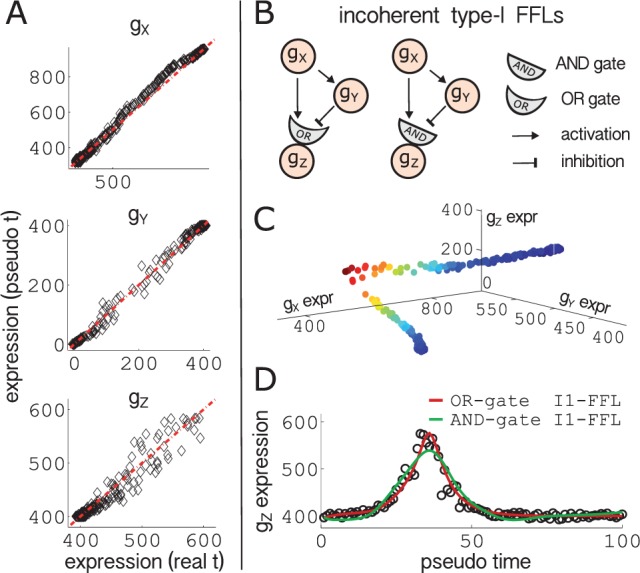
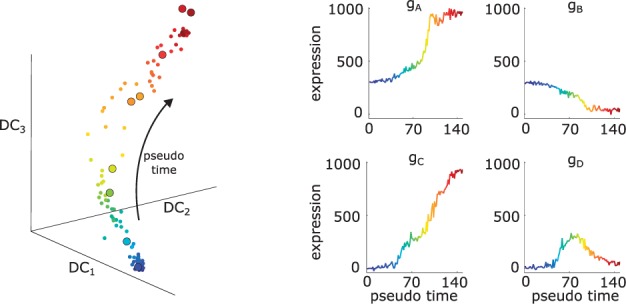
Motivation: High-dimensional single-cell snapshot data are becoming widespread in the systems biology community, as a mean to understand biological processes at the cellular level. However, as temporal information is lost with such data, mathematical models have been limited to capture only static features of the underlying cellular mechanisms. Results: Here, we present a modular framework which allows to recover the temporal behaviour from single-cell snapshot data and reverse engineer the dynamics of gene expression. The framework combines a dimensionality reduction method with a cell time-ordering algorithm to generate pseudo time-series observations. These are in turn used to learn transcriptional ODE models and do model selection on structural network features. We apply it on synthetic data and then on real hematopoietic stem cells data, to reconstruct gene expression dynamics during differentiation pathways and infer the structure of a key gene regulatory network. Availability and implementation: C++ and Matlab code available at https://www.helmholtz-muenchen.de/fileadmin/ICB/software/inferenceSnapshot.zip. Contact: fabian.theis@helmholtz-muenchen.de Supplementary information: Supplementary data are available at Bioinformatics online.
Overview
The claims and statistics of this paper haven’t been checked yet.
Free: it reads the open-access text and checks the first 5 claims that cite a source we can check. Create a free account to check every claim.
Integrity signals
Registry
Cites
Statistics
Figures




Verification
Claims the paper makes
The claims and statistics of this paper haven’t been checked yet.
Free: it reads the open-access text and checks the first 5 claims that cite a source we can check. Create a free account to check every claim.
Claims other papers make about this one
Each is checked against this paper’s own text: does it say what the citing paper says it does?
The cited source says what the claim attributes to it.
In the citing paper
“Indeed, several single‐cell GRN inference methods use trajectories with mechanistic differential equation models (Ocone et al, 2015; Matsumoto et al, 2017).”
From Current best practices in single-cell RNA-seq analysis: a tutorial (2019) · cites this paper as Ocone et al, 2015
In the citing paper
“A special category within these is the ODE models, which reconstruct expression profiles over time to detect and merge similar profiles.”
From Mapping gene regulatory networks from single-cell omics data (2018) · cites this paper as [46]
Self-check
Percentages, sums and reported differences re-computed from the paper’s own numbers.
The self-check needs the paper’s full text.
Citations
Cites
Jeffreys, H., Moran, P. A. P., & Chatfield, C. (1922) · Nature · doi:10.1093/oso/9780198503682.001.0001 · Cited by 7,878
Trapnell, C., Cacchiarelli, D., Grimsby, J., Pokharel, P., Li, S., Morse, M., Lennon, N. J., Livak, K. J., Mikkelsen, T. S., & Rinn, J. L. (2014) · Nature Biotechnology · doi:10.1038/nbt.2859 · Cited by 7,314
Stochastic Gene Expression in a Single Cell
Elowitz, M. B., Levine, A. J., Siggia, E. D., & Swain, P. S. (2002) · Science · doi:10.1126/science.1070919 · Cited by 5,441
Construction of a genetic toggle switch in Escherichia coli
Gardner, T. S., Cantor, C. R., & Collins, J. J. (2000) · Nature · doi:10.1038/35002131 · Cited by 4,268
An Introduction to Systems Biology: Design Principles of Biological Circuits
Alon, U. (2006) · doi:10.1201/9781420011432 · Cited by 2,825
Hematopoiesis: An Evolving Paradigm for Stem Cell Biology
Orkin, S. H., & Zon, L. I. (2008) · Cell · doi:10.1016/j.cell.2008.01.025 · Cited by 2,570
Inferring Regulatory Networks from Expression Data Using Tree-Based Methods
Huynh-Thu, V. A., Irrthum, A., Wehenkel, L., & Geurts, P. (2010) · PLoS ONE · doi:10.1371/journal.pone.0012776 · Cited by 2,131
Advances in Neural Information Processing Systems 18
Murray, I., Mackay, D., Zoubin Ghahramani, A., & Skilling, J. (2006) · Cited by 1,927
Coifman, R. R., Lafon, S., Lee, A. B., Maggioni, M., Nadler, B., Warner, F., & Zucker, S. W. (2005) · Proceedings of the National Academy of Sciences · doi:10.1073/pnas.0500334102 · Cited by 1,675 · cited 2×
“Here, we use a nonlinear method, known as diffusion map (Coifman et al. , 2005), which represents the probabilistic version of spectral clustering techniques (Nadler et al. , 2005).”
Amir, E.-A. D., Davis, K. L., Tadmor, M. D., Simonds, E. F., Levine, J. H., Bendall, S. C., Shenfeld, D. K., Krishnaswamy, S., Nolan, G. P., & Pe'er, D. (2013) · Nature Biotechnology · doi:10.1038/nbt.2594 · Cited by 1,550
Research works printed but not linked: 1
- Jeffreys H. (1961) Theory of Probability. Clarendon Press, Oxford.
Cited by
Items 101–155 of 155
Gene regulatory network inference from single-cell data using a self-consistent proteomic fieldPreprint
Herbach, U. (2021) · arXiv (Cornell University) · doi:10.48550/arxiv.2109.14888 · Cited by 8
Quantifying the clusterness and trajectoriness of single-cell RNA-seq data
Lim, H. S., & Qiu, P. (2024) · PLoS Computational Biology · doi:10.1371/journal.pcbi.1011866 · Cited by 8
Wittenstein, T., Leibovich, N., & Hilfinger, A. (2022) · PLoS Computational Biology · doi:10.1371/journal.pcbi.1010183 · Cited by 8
Peng, T., & Qing, N. (2017) · bioRxiv (Cold Spring Harbor Laboratory) · doi:10.1101/124693 · Cited by 8
Machine learning prediction of network dynamics with privacy protection
Xia, X., Su, Y., Lü, L., Zhang, X., Lai, Y., & Zhang, H. (2022) · Physical Review Research · doi:10.1103/physrevresearch.4.043076 · Cited by 6
Single-Cell RNA-Seq Steps Up to the Growth Plate
Morris, S. A. (2016) · Trends in biotechnology · doi:10.1016/j.tibtech.2016.05.007 · Cited by 5
Reconstructing Gene Regulatory Networks That Control Hematopoietic Commitment
Hamey, F., & Göttgens, B. (2019) · Methods in molecular biology · doi:10.1007/978-1-4939-9224-9_11 · Cited by 5
Das, S., Pradhan, U. K., & Rai, S. N. (2022) · Current Bioinformatics · doi:10.2174/1574893617666220823114108 · Cited by 5
Gene Regulatory Network Inference Using Time-Stamped Cross-Sectional Single Cell Expression Data
Gao, N. P., Ud-Dean, S. M. M., & Gunawan, R. (2016) · IFAC-PapersOnLine · doi:10.1016/j.ifacol.2016.12.117 · Cited by 5
Inference of genetic regulatory network for stem cell using single cells expression data
Wei, J., Hu, X. T., Zou, X., & Tian, T. (2016) · IEEE International Conference on Bioinformatics and Biomedicine (BIBM) · doi:10.1109/bibm.2016.7822521 · Cited by 4
Eugenio Cinquemani, B. (2018) · Automatica · doi:10.1016/j.automatica.2018.11.047 · Cited by 4
Gene Regulatory Networks from Single Cell Data for Exploring Cell Fate Decisions
Chan, T. E., Stumpf, M. P. H., & Babtie, A. C. (2019) · Methods in molecular biology · doi:10.1007/978-1-4939-9224-9_10 · Cited by 4
Tree‐ensemble analysis assesses presence of multifurcations in single cell data
Macnair, W., Roditi, L. D. V., Ganscha, S., & Claassen, M. (2019) · Molecular Systems Biology · doi:10.15252/msb.20188552 · Cited by 7
Peng, T., & Nie, Q. H. (2017) · bioRxiv (Cold Spring Harbor Laboratory) · doi:10.1101/124735 · Cited by 5
Gandrillon, O. (2025) · F1000Research · doi:10.12688/f1000research.164530.2 · Cited by 3
Yan, Y., Jiang, F., Zhang, X., & Tian, T. (2021) · Symmetry · doi:10.3390/sym13061097 · Cited by 3
Integrated Pipelines for Inferring Gene Regulatory Networks from Single-Cell Data
Chen, A., Zhou, T., & Tian, T. (2022) · Current Bioinformatics · doi:10.2174/1574893617666220511234247 · Cited by 3
Tsakanikas, P., Manatakis, D. V., & Manolakos, E. S. (2018) · bioRxiv (Cold Spring Harbor Laboratory) · doi:10.1101/264671 · Cited by 3
A Logic-incorporated Gene Regulatory Network Deciphers Principles in Cell Fate DecisionsPreprint
Xue, G., Zhang, X., Li, W., Zhang, L., Zhang, Z., Zhou, X., Zhang, D., Zhang, L., & Li, Z. (2023) · eLife · doi:10.7554/elife.88742.1 · Cited by 4
Modélisation stochastique de l'expression des gènes et inférence de réseaux de régulation
Herbach, U. (2018) · theses.fr (ABES) · doi:10.70675/891893e9z94a8z4733z97dfz7e3508b89aaa · Cited by 5
Structural identification of biochemical reaction networks from population snapshot data
Eugenio Cinquemani, B. (2017) · IFAC-PapersOnLine · doi:10.1016/j.ifacol.2017.08.2227 · Cited by 2
Kimura, S., Kitajima, H., Tokuhisa, M., & Okada, M. (2023) · IEEE Symposium Series on Computational Intelligence (SSCI) · doi:10.1109/ssci52147.2023.10371900 · Cited by 2
Reconstructing Statistics of Promoter Switching from Reporter Protein Population Snapshot Data
Eugenio Cinquemani, B. (2015) · Lecture notes in computer science · doi:10.1007/978-3-319-26916-0_1 · Cited by 2
Adigun, T. O., Makolo, A., & Fatumo, S. (2015) · Computational Biology and Bioinformatics · doi:10.11648/j.cbb.20150306.11 · Cited by 2
A Consensus Gene Regulatory Network for Neurodegenerative Diseases Using Single-Cell RNA-Seq Data
Koumadorakis, D. E., Krokidis, M. G., Dimitrakopoulos, G. Ν., & Vrahatis, A. G. (2023) · Advances in experimental medicine and biology · doi:10.1007/978-3-031-31978-5_20 · Cited by 1
Wu, Q., Dai, X., Lou, S., Wu, S., & Tian, T. (2026) · Bioinformatics Advances · doi:10.1093/bioadv/vbag033 · Cited by 1
Monga, I., Randhawa, V., & Dhanda, S. K. (2022) · Springer eBooks · doi:10.1007/978-981-16-5993-5_6 · Cited by 1
Deciphering sperm functions using biological networks
Kutchy, N. A., Morenikeji, O. B., Memili, A., & Uğur, M. R. (2023) · Biotechnology and Genetic Engineering Reviews · doi:10.1080/02648725.2023.2168912 · Cited by 1
Magni, S., Sawlekar, R., Capelle, C., Tslaf, V., Baron, A., Zeng, N., Mombaerts, L., Yue, Z., Yuan, Y., HeFeng, F. Q., et al. (2024) · npj Systems Biology and Applications · doi:10.1038/s41540-024-00387-9 · Cited by 1
Inferring cellular heterogeneity of associations from single cell genomics
Levy, M., Frishberg, A., & Gat‐Viks, I. (2020) · Bioinformatics · doi:10.1093/bioinformatics/btaa151 · Cited by 1
Causal dynamical modelling predicts novel regulatory genes of FOXP3 in human regulatory T cellsPreprint
Sawlekar, R., Magni, S., Capelle, C., Baron, A., Zeng, N., Mombaerts, L., Yue, Z., Yuan, Y., HeFeng, F. Q., & Gonçalves, J. M. (2020) · bioRxiv (Cold Spring Harbor Laboratory) · doi:10.1101/2020.02.13.943688 · Cited by 1
Computational inference in mathematical biology: Methodological developments and applications
Warne, D. J. (2020) · Queensland University of Technology · doi:10.5204/thesis.eprints.202835 · Cited by 1
Graph Neural Networks to Identify Genetic Modifiers of Rare Complex Inheritable Diseases
Niktab, E. (2023) · Open Access Victoria University of Wellington | Te Herenga Waka (Figshare) · doi:10.26686/wgtn.22714963 · Cited by 1
Niktab, E., Atkinson, P. H., Walterfang, M., Winship, I., Sturley, S. L., & Munkacsi, A. B. (2023) · bioRxiv (Cold Spring Harbor Laboratory) · doi:10.1101/2023.05.18.540731 · Cited by 1
Hassan, J., Reda, O., Irie, N., Pedersen, M., Foo, S., Appleton, L., Okazaki, I., Okazaki, T., Satou, Y., Harrington, K. J., et al. (2026) · bioRxiv (Cold Spring Harbor Laboratory) · doi:10.64898/2026.03.10.710825 · Cited by 1
Systems modeling and network inference for genetic and epigenetic regulation of gene expression
Chen, H. (2016) · DR-NTU (Nanyang Technological University) · doi:10.32657/10356/66633
Rôle de la stochasticité de l’expression des gènes dans les processus de différenciation
Guillemin, A. (2018) · theses.fr (ABES) · doi:10.70675/20f01994z6784z4c79z931ez7b1e65244fce
The Methods and Tools for Molecular Network Construction
Cheung, F. K. M., & Qin, J. (2019) · Elsevier eBooks · doi:10.1016/b978-0-12-801238-3.11464-3
Eugenio Cinquemani, B. (2020) · IFAC-PapersOnLine · doi:10.1016/j.ifacol.2020.12.1140
Inference of Molecular Regulatory Systems Using Statistical Path-Consistency Algorithm
Yan, Y., Jiang, F., Zhang, X., & Tian, T. (2022) · Entropy · doi:10.3390/e24050693
Eugenio Cinquemani, B. (2017) · arXiv (Cornell University) · doi:10.48550/arxiv.1710.06259
de Vries, D. H. (2022) · University of Groningen research database (University of Groningen / Centre for Information Technology) · doi:10.33612/diss.255266474
Inference of Gene Regulatory Networks from Multi‐scale Dynamic Data
Bonnaffoux, A. (2023) · Wiley eBooks · doi:10.1002/9781394229086.ch1
Soibam, B. (2023) · Bioinformatics Advances · doi:10.1093/bioadv/vbad126
Computational analysis in epithelial tissue regeneration
Chhabra, P., & Gandhi, K. (2024) · Elsevier eBooks · doi:10.1016/b978-0-443-13222-3.00024-1
Nomura, S., Kojima, Y., Minoura, K., Hayashi, S., Abe, K., Hirose, H., & Shimamura, T. (2026) · Bioinformatics · doi:10.1093/bioinformatics/btag652
“Regulatory networks within cells have been estimated using time-series or ordinary differentiation equations (Gardner et al. 2003, Di Bernardo et al. 2004, Bansal et al. 2006, Wu et al. 2014, Ocone et al. 2015, Matsumoto et al. 2017, Ma et al. 2020a).”
Computational approaches for single-cell omics and multi-omics data
Adossa, N. A. (2023) · UTUPub (University of Turku)
Anomaly Detection with Graph Embedding in Bioinformatics: A Survey
Wang, T., & Liu, Z.-P. (2026) · Current Genomics · doi:10.2174/0113892029378251251210215239 · Cited by 1
“Moreover, the graphical information and structure within biomolecular networks often evolve over time, with edges and nodes appearing or disappearing as time progresses [10].”
Inférence de réseaux de régulation de gènes à partir de données dynamiques multi-échelles
Bonnaffoux, A. (2018) · theses.fr (ABES) · doi:10.70675/2ffff267zef51z40dbzbd5fz1e090da2e930
Structure learning to unravel mechanisms of the immune system
Todorov, H. (2020) · theses.fr (ABES) · doi:10.70675/69543fb0zccf0z4c4dzbd34z6aa4482b1101
Studying a stochastic gene regulatory network driving the germinal center B cell differentiation
Koshkin, A. (2021) · theses.fr (ABES) · doi:10.70675/4c8904ecz95e6z443czbb0ez7aaa9dabe7f6
Logic programs to infer computational models of human embryonic development
Bolteau, M. (2024) · theses.fr (ABES) · doi:10.70675/258d6c4ez1135z4e52z96bez7da60569409f
Huang, X., Ang, A. M. S., Vasoya, A. P., Huang, K., Przytycka, T. M., & Wang, Y. (2026) · bioRxiv (Cold Spring Harbor Laboratory) · doi:10.64898/2026.05.18.726023
“ODE-based approaches [8, 9, 10, 11, 12, 13], in contrast, explicitly parameterize the underlying dynamical law from time-course expression data.”
Koering, C., Vallin, E., Picard, F., Gonin-Giraud, S., & Gandrillon, O. (2026) · bioRxiv (Cold Spring Harbor Laboratory) · doi:10.64898/2026.07.07.737136
Metadata
- Authors
- Ocone, A., Haghverdi, L., Mueller, N. S., & Theis, F. J.
- Affiliations
- Helmholtz Munich (DE)
- Corresponding author
- Theis, Fabian J.
- Venue
- Bioinformatics
- Publisher
- Oxford University Press (OUP)
- Published
- 2015-06-10
- Volume
- 31
- Issue
- 12
- Pages
- i89-i96
- ISSN
- 1367-4803 (ISSN-L)
- 1367-4811
- PMC
- PMC4765871
- OpenAlex
- W2125258701
- Cited by
- 155
- References
- 36
- Citations by year
- 2026: 7 · 2025: 6 · 2024: 12 · 2023: 16 · 2022: 11 · 2021: 8 · 2020: 20 · 2019: 22 · 2018: 17 · 2017: 19 · 2016: 14 · 2015: 3
- FWCI
- 7.67
- Type
- journal article
- Language
- en
- Open access
- hybrid
- doi.org
- Licence
- Locations
- Bioinformatics (publishedVersion, cc-by-nc)
- PubMed Central (publishedVersion, cc-by-nc)
- PubMed (publishedVersion)
- MDC Repository (Max-Delbrueck-Center for Molecular Medicine) (acceptedVersion)
- HighWire Press Open Archive (submittedVersion)
- Site cant be reached (submittedVersion, cc-by-nc)
- PuSH - Publication Server of Helmholtz Zentrum München (submittedVersion)
- Topics
- Life Sciences › Biochemistry, Genetics and Molecular Biology › Molecular Biology › Gene Regulatory Network Analysis
- Life Sciences › Biochemistry, Genetics and Molecular Biology › Molecular Biology › Single-cell and spatial transcriptomics
- Life Sciences › Biochemistry, Genetics and Molecular Biology › Molecular Biology › Gene expression and cancer classification
- Keywords
- gene regulatory network inference, gene expression dynamics, dimensionality reduction, model selection, hematopoietic stem cells, cell differentiation, temporal reconstruction
- MeSH terms
- Algorithms, Hematopoiesis, Hematopoietic Stem Cells, Kinetics, Models, Genetic, Gene Expression Profiling, Systems Biology, Gene Regulatory Networks, Single-Cell Analysis
About these checks
Registry, retraction, Cites and statistics results are computed, not judged, with one exception: a printed reference that no index lists is read once by a model before it counts as a citation error. Claims are extracted by a model and kept only when their quote appears verbatim in the text; each cited source is then checked, with a model’s help, for whether it says what the claim relies on. Those verdicts can be wrong — read the claim’s quote and the cited source before relying on one.
Statistics and arithmetic are recomputed, not judged.
Confidence bands are shown only for fields calibrated on our annotated test set. None is calibrated yet, so no band is shown.
What counts as a claim ›How we measure confidence ›How we check this ›
Are you an author, or do you see a problem with this page? Request a review
Data sources
Bibliographic data: Semantic Scholar, OpenAlex, Crossref.
Contains information from the Semantic Scholar Academic Graph Datasets, made available under the ODC Attribution License (ODC-BY 1.0).
Semantic Scholar’s data is described in: Kinney, R., et al. (2023). The Semantic Scholar Open Data Platform. arXiv:2301.10140.
