

MOLI: multi-omics late integration with deep neural networks for drug response prediction
Open accessPublished version of a preprint
The DOI matches its Crossref record; 48 of the 49 references it cites were found in a registry or an index.
Abstract
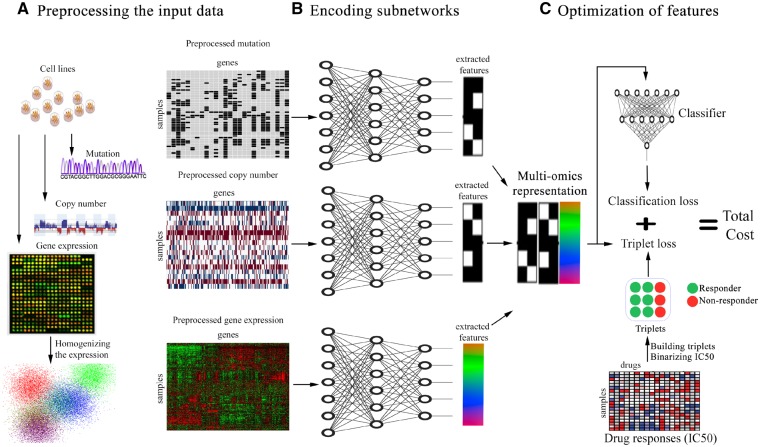
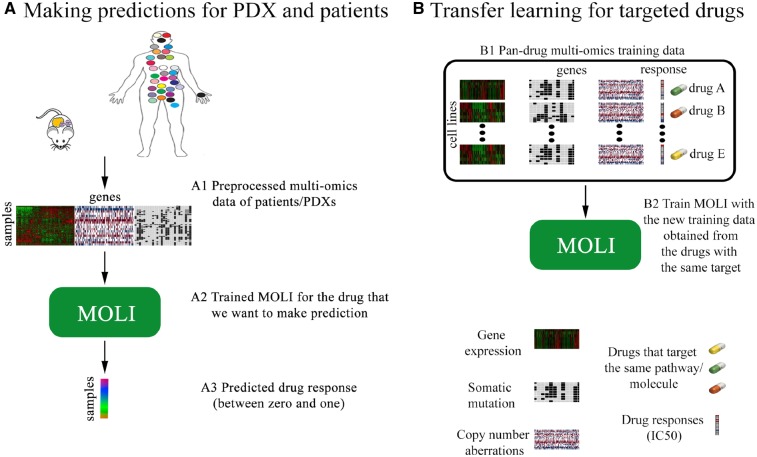
Motivation: Historically, gene expression has been shown to be the most informative data for drug response prediction. Recent evidence suggests that integrating additional omics can improve the prediction accuracy which raises the question of how to integrate the additional omics. Regardless of the integration strategy, clinical utility and translatability are crucial. Thus, we reasoned a multi-omics approach combined with clinical datasets would improve drug response prediction and clinical relevance. Results: We propose MOLI, a multi-omics late integration method based on deep neural networks. MOLI takes somatic mutation, copy number aberration and gene expression data as input, and integrates them for drug response prediction. MOLI uses type-specific encoding sub-networks to learn features for each omics type, concatenates them into one representation and optimizes this representation via a combined cost function consisting of a triplet loss and a binary cross-entropy loss. The former makes the representations of responder samples more similar to each other and different from the non-responders, and the latter makes this representation predictive of the response values. We validate MOLI on in vitro and in vivo datasets for five chemotherapy agents and two targeted therapeutics. Compared to state-of-the-art single-omics and early integration multi-omics methods, MOLI achieves higher prediction accuracy in external validations. Moreover, a significant improvement in MOLI’s performance is observed for targeted drugs when training on a pan-drug input, i.e. using all the drugs with the same target compared to training only on drug-specific inputs. MOLI’s high predictive power suggests it may have utility in precision oncology. Availability and implementation: https://github.com/hosseinshn/MOLI. Supplementary information: Supplementary data are available at Bioinformatics online.
Overview
The claims and statistics of this paper haven’t been checked yet.
Free: it reads the open-access text and checks the first 5 claims that cite a source we can check. Create a free account to check every claim.
Integrity signals
Registry
Cites
Statistics
Figures
Verification
Claims the paper makes
The claims and statistics of this paper haven’t been checked yet.
Free: it reads the open-access text and checks the first 5 claims that cite a source we can check. Create a free account to check every claim.
Claims other papers make about this one
Each is checked against this paper’s own text: does it say what the citing paper says it does?
The cited source says what the claim attributes to it.
In the citing paper
“MOLI (multi-omics late integration) (Sharifi-Noghabi et al., 2019) method used type-specific encoding sub-networks to learn features from somatic mutation, CNA and gene expression data independently and then later concatenated them for predicting the response to a given drug.”
From Using machine learning approaches for multi-omics data analysis: A review (2021) · cites this paper as Sharifi-Noghabi et al., 2019
Self-check
Percentages, sums and reported differences re-computed from the paper’s own numbers.
The self-check needs the paper’s full text.
Citations
Cites
Pan, S. J., & Yang, Q. (2010) · IEEE Transactions on Knowledge and Data Engineering · doi:10.1109/tkde.2009.191 · Cited by 23,387
RSEM: accurate transcript quantification from RNA-Seq data with or without a reference genome
Li, B., & Dewey, C. N. (2011) · BMC Bioinformatics · doi:10.1186/1471-2105-12-323 · Cited by 22,179
FaceNet: A unified embedding for face recognition and clustering
Schroff, F., Kalenichenko, D., & Philbin, J. (2015) · 2015 IEEE Conference on Computer Vision and Pattern Recognition (CVPR) · doi:10.1109/cvpr.2015.7298682 · Cited by 15,267 · cited 3×
“To the best of our knowledge, MOLI is the first end-to-end late integration method with deep neural networks that optimizes this representation via a combined cost function consisting of a triplet loss function (Schroff et al., 2015) and a binary cross-entropy loss function.”
BackgroundMethodInfluentialProceedings of IEEE Conference on Computer Vision and Pattern Recognition
(1993) · Proceedings of IEEE Conference on Computer Vision and Pattern Recognition · doi:10.1109/cvpr.1993.341010 · Cited by 14,265
(2016) · Cited by 11,679
The cancer genome atlas pan-cancer analysis project
The Cancer Genome Atlas Research Network, Weinstein, J. N., Collisson, E. A., Mills, G. B., Shaw, K. R. M., Ozenberger, B. A., Ellrott, K., Shmulevich, I., Sander, C., & Stuart, J. M. (2013) · Nature Genetics · doi:10.1038/ng.2764 · Cited by 9,092
Adjusting batch effects in microarray expression data using empirical Bayes methods
Johnson, W. E., Li, C., & Rabinovic, A. (2007) · Biostatistics · doi:10.1093/biostatistics/kxj037 · Cited by 8,658
(2010) · Cited by 8,261
The Cancer Cell Line Encyclopedia enables predictive modelling of anticancer drug sensitivity
Barretina, J., Caponigro, G., Stransky, N., Venkatesan, K., Margolin, A. A., Kim, S., Wilson, C. J., Lehár, J., Kryukov, G. V., Sonkin, D., et al. (2012) · Nature · doi:10.1038/nature11003 · Cited by 7,950 · cited 3×
“We note that the classifier was validated only on CCLE cell lines without studying its translatability to patients or PDX models.”
BackgroundVogelstein, B., Papadopoulos, N., Velculescu, V. E., Zhou, S., Diaz, L. A., & Kinzler, K. W. (2013) · Science · doi:10.1126/science.1235122 · Cited by 7,863 · cited 1×
“However, inreality, themajorityofthesegenomicalterationsseemtohavenoimpact on cancer development (Vogelstein et al. , 2013) and might appear just by chance.”
Background
Research works printed but not linked: 1
- Khakabimamaghani, 2016, CC BY: PSB 2016 proceedings are published as Open Access chapters by World Scientific Publishing Company and distributed under the terms of the Creative Commons Attribution (CC BY) 4.0 License, 345
Cited by
Using machine learning approaches for multi-omics data analysis: A review
Reel, P. S., Reel, S., Pearson, E., Trucco, E., & Jefferson, E. (2021) · Biotechnology Advances · doi:10.1016/j.biotechadv.2021.107739 · Cited by 903
Multimodal deep learning for biomedical data fusion: a review
Stahlschmidt, S. R., Ulfenborg, B., & Synnergren, J. (2022) · Briefings in Bioinformatics · doi:10.1093/bib/bbab569 · Cited by 766
Integration strategies of multi-omics data for machine learning analysis
Picard, M., Scott-Boyer, M.-P., Bodein, A., Périn, O., & Droit, A. (2021) · Computational and Structural Biotechnology Journal · doi:10.1016/j.csbj.2021.06.030 · Cited by 696
Vatansever, S., Schlessinger, A., Wacker, D., Kaniskan, H. Ü., Jin, J., Zhou, M., & Zhang, B. (2021) · Medicinal Research Reviews · doi:10.1002/med.21764 · Cited by 429
Deep learning in drug discovery: an integrative review and future challenges
Askr, H., Elgeldawi, E., Aboul Ella, H., Elshaier, Y. A. M. M., Gomaa, M. M., & Hassanien, A. E. (2023) · Artificial Intelligence Review · doi:10.1007/s10462-022-10306-1 · Cited by 390
A roadmap for multi-omics data integration using deep learning
Kang, M., Ko, E., & Mersha, T. B. (2022) · Briefings in Bioinformatics · doi:10.1093/bib/bbab454 · Cited by 389
Current progress and open challenges for applying deep learning across the biosciences
Sapoval, N., Aghazadeh, A., Nute, M. G., Antunes, D. A., Balaji, A., Baraniuk, R., Barberan, C. J., Dannenfelser, R., Dun, C., Edrisi, M., et al. (2022) · Nature Communications · doi:10.1038/s41467-022-29268-7 · Cited by 359
Ensemble deep learning in bioinformatics
Cao, Y., Geddes, T. A., Yang, J. Y. H., & Yang, P. (2020) · Nature Machine Intelligence · doi:10.1038/s42256-020-0217-y · Cited by 354
State of the field in multi-omics research: from computational needs to data mining and sharing
Krassowski, M., Das, V., Sahu, S. K., & Misra, B. B. (2020) · Frontiers in Genetics · doi:10.3389/fgene.2020.610798 · Cited by 351
Machine learning for multi-omics data integration in cancer
Cai, Z., Poulos, R. C., Liu, J., & Zhong, Q. (2022) · iScience · doi:10.1016/j.isci.2022.103798 · Cited by 327
Integrated Multi-Omics Analyses in Oncology: A Review of Machine Learning Methods and Tools
Nicora, G., Vitali, F., Dagliati, A., Geifman, N., & Bellazzi, R. (2020) · Frontiers in Oncology · doi:10.3389/fonc.2020.01030 · Cited by 284
DeepCDR: a hybrid graph convolutional network for predicting cancer drug response
Liu, Q., Hu, Z., Jiang, R., & Zhou, M. (2020) · Bioinformatics · doi:10.1093/bioinformatics/btaa822 · Cited by 263
Deep learning-based approaches for multi-omics data integration and analysis
Ballard, J. L., Wang, Z., Li, W., Shen, L., & Long, Q. (2024) · BioData Mining · doi:10.1186/s13040-024-00391-z · Cited by 258
Deep learning for drug response prediction in cancer
Baptista, D., Ferreira, P. G., & Rocha, M. (2021) · Briefings in Bioinformatics · doi:10.1093/bib/bbz171 · Cited by 237
Deep multimodal fusion of image and non-image data in disease diagnosis and prognosis: a review
Cui, C., Yang, H., Wang, Y., Zhao, S., Asad, Z., Coburn, L. A., Wilson, K. T., Landman, B. A., & Huo, Y. (2023) · Progress in Biomedical Engineering · doi:10.1088/2516-1091/acc2fe · Cited by 218
Kong, J., Lee, H., Kim, D., Han, S. K., Ha, D., Shin, K., & Kim, S. (2020) · Nature Communications · doi:10.1038/s41467-020-19313-8 · Cited by 212
Baião, A. R., Cai, Z., Poulos, R. C., Robinson, P. J., Reddel, R. R., Zhong, Q., Vinga, S., & Gonçalves, E. (2025) · Briefings in Bioinformatics · doi:10.1093/bib/bbaf355 · Cited by 211
Artificial Intelligence (AI)-Based Systems Biology Approaches in Multi-Omics Data Analysis of Cancer
Biswas, N., & Chakrabarti, S. (2020) · Frontiers in Oncology · doi:10.3389/fonc.2020.588221 · Cited by 209
Deep learning methods for drug response prediction in cancer: Predominant and emerging trends
Partin, A., Brettin, T. S., Zhu, Y., Narykov, O., Clyde, A., Overbeek, J., & Stevens, R. L. (2023) · Frontiers in Medicine · doi:10.3389/fmed.2023.1086097 · Cited by 190
Deep learning for drug repurposing: Methods, databases, and applications
Pan, X., Lin, X., Cao, D., Zeng, X., Yu, P. S., He, L., Nussinov, R., & Cheng, F. (2022) · WIREs Computational Molecular Science · doi:10.1002/wcms.1597 · Cited by 188
Translational precision medicine: an industry perspective
Hartl, D., Luca, V. D., Kostikova, A., Laramie, J. M., Kennedy, S., Ferrero, E., Siegel, R. W., Fink, M., Ahmed, S., Millholland, J. M., et al. (2021) · Journal of Translational Medicine · doi:10.1186/s12967-021-02910-6 · Cited by 186
Akhoundova, D., & Rubin, M. A. (2022) · Cancer Cell · doi:10.1016/j.ccell.2022.08.011 · Cited by 182
Missing data in multi-omics integration: Recent advances through artificial intelligence
Flores, J. E., Claborne, D. M., Weller, Z. D., Webb-Robertson, B.-J. M., Waters, K. M., & Bramer, L. M. (2023) · Frontiers in Artificial Intelligence · doi:10.3389/frai.2023.1098308 · Cited by 181
“Another example, MOLI (Sharifi-Noghabi et al., 2019), similarly processes each view separately through a DNN and concatenates The vast majority of these integration approaches require completely observed data for their implementation.”
BackgroundMulti-OMICS approaches in cancer biology: New era in cancer therapy
Chakraborty, S., Sharma, G., Karmakar, S., & Banerjee, S. (2024) · Biochimica et Biophysica Acta (BBA) - Molecular Basis of Disease · doi:10.1016/j.bbadis.2024.167120 · Cited by 178
Classifying Breast Cancer Subtypes Using Deep Neural Networks Based on Multi-Omics Data
Lin, Y., Zhang, W., Cao, H., Li, G., & Du, W. (2020) · Genes · doi:10.3390/genes11080888 · Cited by 148
Machine learning in the prediction of cancer therapy
Rafique, R., Islam, S. M. R., & Kazi, J. U. (2021) · Computational and Structural Biotechnology Journal · doi:10.1016/j.csbj.2021.07.003 · Cited by 173
Incorporating Machine Learning into Established Bioinformatics Frameworks
Auslander, N., Gussow, A. B., & Koonin, E. V. (2021) · International Journal of Molecular Sciences · doi:10.3390/ijms22062903 · Cited by 170
A benchmark study of deep learning-based multi-omics data fusion methods for cancer
Leng, D., Zheng, L., Wen, Y., Zhang, Y., Wu, L., Wang, J., Wang, M., Zhang, Z., He, S., & Bo, X. (2022) · Genome Biology · doi:10.1186/s13059-022-02739-2 · Cited by 162
Acharya, D., & Mukhopadhyay, A. (2024) · Briefings in Functional Genomics · doi:10.1093/bfgp/elae013 · Cited by 162
Artificial Intelligence in Pharmaceutical Sciences
Lu, M., Yin, J., Zhu, Q., Lin, G., Mou, M., Liu, F., Pan, Z., You, N., Lian, X., Li, F., et al. (2023) · Engineering · doi:10.1016/j.eng.2023.01.014 · Cited by 157
Liu, X., Song, C., Huang, F. F., Fu, H., Xiao, W., & Zhang, W. (2021) · Briefings in Bioinformatics · doi:10.1093/bib/bbab457 · Cited by 150
DeepTTA: a transformer-based model for predicting cancer drug response
Jiang, L., Jiang, C., Yu, X., Fu, R., Jin, S., & Liu, X. (2022) · Briefings in Bioinformatics · doi:10.1093/bib/bbac100 · Cited by 122
Causal integration of multi‐omics data with prior knowledge to generate mechanistic hypotheses
Dugourd, A., Kuppe, C., Sciacovelli, M., Gjerga, E., Gabor, A., Emdal, K. B., Vieira, V., Bekker‐Jensen, D. B., Kranz, J., Bindels, E. M. J., et al. (2021) · Molecular Systems Biology · doi:10.15252/msb.20209730 · Cited by 149
Hybrid Quantum Neural Network for Drug Response Prediction
Sagingalieva, A., Kordzanganeh, M., Kenbaev, N. R., Kosichkina, D., Tomashuk, T., & Melnikov, A. A. (2023) · Cancers · doi:10.3390/cancers15102705 · Cited by 146
Malik, V., Kalakoti, Y., & Sundar, D. (2021) · BMC Genomics · doi:10.1186/s12864-021-07524-2 · Cited by 139
Advances in bulk and single-cell multi-omics approaches for systems biology and precision medicine
Li, Y., Ma, L., Wu, D., & Chen, G. (2021) · Briefings in Bioinformatics · doi:10.1093/bib/bbab024 · Cited by 133
Integrating multi-omics data with EHR for precision medicine using advanced artificial intelligence
Tong, L., Shi, W., Isgut, M., Zhong, Y., Lais, P., Gloster, L., Sun, J., Swain, A., Giuste, F., & Wang, M. D. (2024) · IEEE Reviews in Biomedical Engineering · doi:10.1109/rbme.2023.3324264 · Cited by 130
A Review of Integrative Imputation for Multi-Omics Datasets
Song, M., Greenbaum, J., Luttrell, J., Zhou, W., Wu, C., Shen, H., Gong, P., Zhang, C., & Deng, H.-W. (2020) · Frontiers in Genetics · doi:10.3389/fgene.2020.570255 · Cited by 127
Computational strategies for single-cell multi-omics integration
Adossa, N., Khan, S., Rytkönen, K. T., & Elo, L. L. (2021) · Computational and Structural Biotechnology Journal · doi:10.1016/j.csbj.2021.04.060 · Cited by 111
A multimodal graph neural network framework for cancer molecular subtype classification
Li, B., & Nabavi, S. (2024) · BMC Bioinformatics · doi:10.1186/s12859-023-05622-4 · Cited by 118
Advancing pharmaceutical research: A comprehensive review of cutting-edge tools and technologies
Chen, J., Lin, A., & Luo, P. (2024) · Current Pharmaceutical Analysis · doi:10.1016/j.cpan.2024.11.001 · Cited by 112
Reel, P. S., Reel, S., van Kralingen, J. C., Langton, K., Lang, K., Erlic, Z., Larsen, C. K., Amar, L., Pamporaki, C., Mulatero, P., et al. (2022) · EBioMedicine · doi:10.1016/j.ebiom.2022.104276 · Cited by 112
Raufaste-Cazavieille, V., Santiago, R., & Droit, A. (2022) · Frontiers in Molecular Biosciences · doi:10.3389/fmolb.2022.962743 · Cited by 110
Predicting Drug Response Based on Multi-Omics Fusion and Graph Convolution
Peng, W., Chen, T., & Dai, W. (2021) · IEEE Journal of Biomedical and Health Informatics · doi:10.1109/jbhi.2021.3102186 · Cited by 109
Alemu, R. G., Sharew, N. T., Arsano, Y. Y., Ahmed, M. B., Ayele, F. T., Baye, T. M., & Amare, A. T. (2025) · Human Genomics · doi:10.1186/s40246-025-00718-9 · Cited by 109
Multi-omics data integration by generative adversarial network
Ahmed, K. T., Sun, J., Cheng, S., Yong, J., & Zhang, W. (2021) · Bioinformatics · doi:10.1093/bioinformatics/btab608 · Cited by 88
The application of artificial neural networks in metabolomics: a historical perspective
Mendez, K. M., Broadhurst, D., & Reinke, S. N. (2019) · Metabolomics · doi:10.1007/s11306-019-1608-0 · Cited by 105
Positive-unlabeled learning in bioinformatics and computational biology: a brief review
Li, F., Dong, S., Leier, A., Han, M., Guo, X., Xu, J., Wang, X., Pan, S., Jia, C., Zhang, Y., et al. (2021) · Briefings in Bioinformatics · doi:10.1093/bib/bbab461 · Cited by 103
Moon, S., & Lee, H. (2022) · Bioinformatics · doi:10.1093/bioinformatics/btac080 · Cited by 104
Wysocka, M., Wysocki, O., Zufferey, M., Landers, D., & Freitas, A. (2023) · BMC Bioinformatics · doi:10.1186/s12859-023-05262-8 · Cited by 103
Machine learning: its challenges and opportunities in plant system biology
Hesami, M., Alizadeh, M., Jones, A. M. P., & Torkamaneh, D. (2022) · Applied Microbiology and Biotechnology · doi:10.1007/s00253-022-11963-6 · Cited by 102
Choi, J. M., & Chae, H. (2023) · BMC Bioinformatics · doi:10.1186/s12859-023-05273-5 · Cited by 98
Artificial intelligence revolution in drug discovery: A paradigm shift in pharmaceutical innovation
Jarallah, S. J., Almughem, F. A., Alhumaid, N. K., Fayez, N. A., Alradwan, I. A., Alsulami, K. A., Tawfik, E. A., & Alshehri, A. A. (2025) · International Journal of Pharmaceutics · doi:10.1016/j.ijpharm.2025.125789 · Cited by 92
Integrative Network Fusion: A Multi-Omics Approach in Molecular Profiling
Chierici, M., Bussola, N., Marcolini, A., Francescatto, M., Zandonà, A., Trastulla, L., Agostinelli, C., Jurman, G., & Furlanello, C. (2020) · Frontiers in Oncology · doi:10.3389/fonc.2020.01065 · Cited by 89
An OpenData portal to share COVID-19 drug repurposing data in real time
Brimacombe, K. R., Zhao, T., Eastman, R. T., Hu, X., Wang, K., Backus, M., Baljinnyam, B., Chen, C. Z., Chen, L., Eicher, T., et al. (2020) · bioRxiv (Cold Spring Harbor Laboratory) · doi:10.1101/2020.06.04.135046 · Cited by 88
Noordijk, B., García‐Gómez, M. L., ten Tusscher, K., de Ridder, D., van Dijk, A. D. J., & Smith, R. W. (2024) · Frontiers in Systems Biology · doi:10.3389/fsysb.2024.1407994 · Cited by 85
Zhu, Y., Ouyang, Z., Chen, W., Feng, R., Chen, D. Z., Cao, J., & Wu, J. (2021) · Bioinformatics · doi:10.1093/bioinformatics/btab650 · Cited by 83
Paltun, B. G., Mamitsuka, H., & Kaski, S. (2019) · Briefings in Bioinformatics · doi:10.1093/bib/bbz153 · Cited by 82
An overview of machine learning methods for monotherapy drug response prediction
Firoozbakht, F., Yousefi, B., & Schwikowski, B. (2021) · Briefings in Bioinformatics · doi:10.1093/bib/bbab408 · Cited by 80
Trends and Potential of Machine Learning and Deep Learning in Drug Study at Single-Cell Level
Qi, R., & Zou, Q. (2023) · Research · doi:10.34133/research.0050 · Cited by 80
Sharifi-Noghabi, H., Jahangiri, S., Smirnov, P., Hon, C. S.-Y., Mammoliti, A., Nair, S. K., Mer, A. S., Ester, M., & Haibe‐Kains, B. (2021) · Briefings in Bioinformatics · doi:10.1093/bib/bbab294 · Cited by 78
Self-citationA survey on single and multi omics data mining methods in cancer data classification
Momeni, Z., Hassanzadeh, E., Abadeh, M. S., & Bellazzi, R. (2020) · Journal of Biomedical Informatics · doi:10.1016/j.jbi.2020.103466 · Cited by 78
Odenkirk, M. T., Reif, D. M., & Baker, E. S. (2021) · Analytical Chemistry · doi:10.1021/acs.analchem.0c04850 · Cited by 74
Graph Neural Networks With Multiple Prior Knowledge for Multi-Omics Data Analysis
Xiao, S., Lin, H., Wang, C., Wang, S., & Rajapakse, J. C. (2023) · IEEE Journal of Biomedical and Health Informatics · doi:10.1109/jbhi.2023.3284794 · Cited by 74
Gong, P., Cheng, L., Zhang, Z., Meng, A., Li, E., Chen, J., & Zhang, L. (2023) · Computer Methods and Programs in Biomedicine · doi:10.1016/j.cmpb.2023.107377 · Cited by 72
Liu, X. F., Tao, Y., Cai, Z., Bao, P., Ma, H., Li, K., Li, M., Zhu, Y., & Lu, Z. J. (2024) · Bioinformatics · doi:10.1093/bioinformatics/btae316 · Cited by 72
Artificial intelligence and multi-omics in pharmacogenomics: a new era of precision medicine
Zack, M., Stupichev, D. N., Moore, A. J., Slobodchikov, I. D., Sokolov, D. G., Trifonov, I. F., & Gobbs, A. (2025) · Mayo Clinic Proceedings: Digital Health · doi:10.1016/j.mcpdig.2025.100246 · Cited by 70
Zhang, T., Hasib, M. M., Chiu, Y., Han, Z.-F., Jin, Y.-F., Flores, M. A., Chen, Y., & Huang, Y. (2022) · Cancers · doi:10.3390/cancers14194763 · Cited by 70
Shin, J., Piao, Y., Bang, D., Kim, S., & Jo, K. (2022) · International Journal of Molecular Sciences · doi:10.3390/ijms232213919 · Cited by 70
Peng, W., Liu, H., Dai, W., Ning, Y., & Wang, J. (2022) · Bioinformatics · doi:10.1093/bioinformatics/btac574 · Cited by 68
Sharifi-Noghabi, H., Peng, S., Zolotareva, O. I., Collins, C. C., & Ester, M. (2020) · Bioinformatics · doi:10.1093/bioinformatics/btaa442 · Cited by 66
Self-citationChallenges and Opportunities in Implementing Pharmacogenetic Testing in Clinical Settings
Chang, W., Tanoshima, R., Ross, C. J., & Carleton, B. (2020) · The Annual Review of Pharmacology and Toxicology · doi:10.1146/annurev-pharmtox-030920-025745 · Cited by 65
Network-based drug sensitivity prediction
Ahmed, K. T., Park, S., Jiang, Q., Yeu, Y., Hwang, T., & Zhang, W. (2020) · BMC Medical Genomics · doi:10.1186/s12920-020-00829-3 · Cited by 61
Machine learning-based analysis of multi-omics data on the cloud for investigating gene regulations
Oh, M., Park, S., Kim, S., & Chae, H. (2021) · Briefings in Bioinformatics · doi:10.1093/bib/bbaa032 · Cited by 54
Graph Convolutional Network for Drug Response Prediction Using Gene Expression Data
Kim, S., Bae, S., Piao, Y., & Jo, K. (2021) · Mathematics · doi:10.3390/math9070772 · Cited by 59
Multi-omics data integration approaches for precision oncology
Aguila, R. C., Alonso-Pupo, N., & Hernández‐Rodríguez, E. W. (2022) · Molecular Omics · doi:10.1039/d1mo00411e · Cited by 58
Mourragui, S. M. C., Loog, M., Vis, D. J., Moore, K., Manjón, A. G., van de Wiel, M. A., Reinders, M. J. T., & Wessels, L. F. A. (2021) · Proceedings of the National Academy of Sciences · doi:10.1073/pnas.2106682118 · Cited by 56
A machine learning and deep learning-based integrated multi-omics technique for leukemia prediction
Abbasi, E. Y., Deng, Z., Arain, Q. A., Khan, A., Shaikh, A., Reshan, M. S. A., Sulaiman, A. A., & Alshahrani, H. M. (2024) · Heliyon · doi:10.1016/j.heliyon.2024.e25369 · Cited by 55
Yan, H. H., Weng, D., Li, D., Gu, Y., Ma, W., & Liu, Q. (2024) · Briefings in Bioinformatics · doi:10.1093/bib/bbae184 · Cited by 56
Park, A., Joo, M., Kim, K., Son, W., Lim, G., Lee, J., Kim, J. H., Lee, D. H., & Nam, S. (2022) · Bioinformatics · doi:10.1093/bioinformatics/btac177 · Cited by 55
Yi-ran, H., Zeng, P., & Zhong, C. (2024) · BMC Bioinformatics · doi:10.1186/s12859-024-05749-y · Cited by 55
Multi-omics based artificial intelligence for cancer research
Li, L., Sun, M., Wang, J., & Wan, S. (2024) · Advances in cancer research · doi:10.1016/bs.acr.2024.06.005 · Cited by 58
DeepDRA: Drug repurposing using multi-omics data integration with autoencoders
Mohammadzadeh-Vardin, T., Ghareyazi, A., Gharizadeh, A., Abbasi, K., & Rabiee, H. R. (2024) · PLOS ONE · doi:10.1371/journal.pone.0307649 · Cited by 40
Large-scale pharmacogenomic studies and drug response prediction for personalized cancer medicine
Feng, F., Shen, B., Mou, X., Li, Y., & Li, H. (2021) · Journal of genetics and genomics/Journal of Genetics and Genomics · doi:10.1016/j.jgg.2021.03.007 · Cited by 55
Fawaz, A., Ferraresi, A., & Isidoro, C. (2023) · Journal of Personalized Medicine · doi:10.3390/jpm13111590 · Cited by 54
Sharifi-Noghabi, H., Harjandi, P. A., Zolotareva, O. I., Collins, C. C., & Ester, M. (2021) · Nature Machine Intelligence · doi:10.1038/s42256-021-00408-w · Cited by 53
Self-citationGADRP: graph convolutional networks and autoencoders for cancer drug response prediction
Wang, H., Dai, C., Wen, Y., Wang, X., Liu, W., He, S., Bo, X., & Peng, S. (2022) · Briefings in Bioinformatics · doi:10.1093/bib/bbac501 · Cited by 52
A performance evaluation of drug response prediction models for individual drugs
Park, A., Lee, Y., & Nam, S. (2023) · Scientific Reports · doi:10.1038/s41598-023-39179-2 · Cited by 52
TMO-Net: an explainable pretrained multi-omics model for multi-task learning in oncology
Wang, F.-A., Zhuang, Z., Gao, F., He, R., Zhang, S., Wang, L., Liu, J., & Li, Y. (2024) · Genome Biology · doi:10.1186/s13059-024-03293-9 · Cited by 51
Park, Y., Heider, D., & Hauschild, A.-C. (2021) · Cancers · doi:10.3390/cancers13133148 · Cited by 51
Sharma, A. K., Lysenko, A., Boroevich, K. A., & Tsunoda, T. (2023) · Scientific Reports · doi:10.1038/s41598-023-29644-3 · Cited by 51
Supervised multiple kernel learning approaches for multi-omics data integration
Briscik, M., Tazza, G., Vidács, D. L., Dillies, M., & Dejean, S. (2024) · BioData Mining · doi:10.1186/s13040-024-00406-9 · Cited by 50
Wu, Y., Chen, M., & Qin, Y. (2025) · PLoS Computational Biology · doi:10.1371/journal.pcbi.1012905 · Cited by 49
SRDFM: Siamese Response Deep Factorization Machine to improve anti-cancer drug recommendation
Su, R., Huang, Y., Zhang, D., Xiao, G., & Wei, L. (2022) · Briefings in Bioinformatics · doi:10.1093/bib/bbab534 · Cited by 49
Lac, L., Leung, C. K.-S., & Hu, P. (2024) · Journal of Biomedical Informatics · doi:10.1016/j.jbi.2024.104629 · Cited by 48
Multi-omics subtyping pipeline for chronic obstructive pulmonary disease
Gillenwater, L. A., Helmi, S., Stene, E., Pratte, K., Zhuang, Y., Schuyler, R. P., Lange, L. A., Castaldi, P. J., Hersh, C. P., Banaei‐Kashani, F., et al. (2021) · PLoS ONE · doi:10.1371/journal.pone.0255337 · Cited by 47
Zheng, X., Wang, M., Huang, K., & Zhu, E. (2023) · Information Fusion · doi:10.1016/j.inffus.2023.102077 · Cited by 46
The Role and Applications of Artificial Intelligence in the Treatment of Chronic Pain
Meier, T. A., Refahi, M. S., Hearne, G., Restifo, D., Munoz‐Acuna, R., ROSEN, G. L., & Woloszynek, S. (2024) · Current Pain and Headache Reports · doi:10.1007/s11916-024-01264-0 · Cited by 46
DRGAT: Predicting Drug Responses Via Diffusion-Based Graph Attention Network
Sefer, E. (2024) · Journal of Computational Biology · doi:10.1089/cmb.2024.0807 · Cited by 46
Heterogeneous data integration methods for patient similarity networks
Gliozzo, J., Mesiti, M., Notaro, M., Petrini, A., Patak, A., Gallardo, A. P., Paccanaro, A., Valentini, G., & Casiraghi, E. (2022) · Briefings in Bioinformatics · doi:10.1093/bib/bbac207 · Cited by 46
Metadata
- Authors
- Sharifi-Noghabi, H., Zolotareva, O., Collins, C. C., & Ester, M.
- Affiliations
- Simon Fraser University (CA)
- Bielefeld University (DE)
- University of British Columbia (CA)
- Corresponding author
- Collins, Colin C
- Ester, Martin
- Venue
- Bioinformatics
- Publisher
- Oxford University Press (OUP)
- Published
- 2019-07
- Volume
- 35
- Issue
- 14
- Pages
- i501-i509
- ISSN
- 1367-4803 (ISSN-L)
- 1367-4811
- PMC
- PMC6612815
- OpenAlex
- W2955502047
- Cited by
- 421
- References
- 49
- Citations by year
- 2026: 60 · 2025: 71 · 2024: 85 · 2023: 58 · 2022: 58 · 2021: 58 · 2020: 26 · 2019: 5
- FWCI
- 25.12
- Type
- journal article
- Language
- en
- Open access
- hybrid
- doi.org
- Licence
- Locations
- Bioinformatics (publishedVersion, cc-by-nc)
- bioRxiv (Cold Spring Harbor Laboratory) (acceptedVersion, cc-by-nc-nd)
- Europe PMC (PubMed Central) (publishedVersion, cc-by-nc)
- PubMed Central (publishedVersion, cc-by-nc)
- PubMed (publishedVersion)
- PUB – Publications at Bielefeld University (Bielefeld University) (submittedVersion)
- Funders
- Canada Foundation for Innovation (33440)
- The Canadian Institutes of Health Research (PJT-153073)
- Terry Fox Foundation (201012TFF)
- National Science and Engineering Research Council of Canada (R611347)
- Topics
- Life Sciences › Pharmacology, Toxicology and Pharmaceutics › Drug Discovery › Computational Drug Discovery Methods
- Life Sciences › Biochemistry, Genetics and Molecular Biology › Molecular Biology › Gene expression and cancer classification
- Life Sciences › Biochemistry, Genetics and Molecular Biology › Cancer Research › Cancer Genomics and Diagnostics
- Keywords
- drug response prediction, multi-omics integration, somatic mutations, copy number alterations, gene expression, deep neural network, triplet loss, precision oncology, chemotherapy, targeted therapy
- MeSH terms
- Algorithms, Antineoplastic Agents, Pharmaceutical Preparations, Forecasting, Humans, Neoplasms, Neural Networks, Computer, Precision Medicine
About these checks
Registry, retraction, Cites and statistics results are computed, not judged, with one exception: a printed reference that no index lists is read once by a model before it counts as a citation error. Claims are extracted by a model and kept only when their quote appears verbatim in the text; each cited source is then checked, with a model’s help, for whether it says what the claim relies on. Those verdicts can be wrong — read the claim’s quote and the cited source before relying on one.
Statistics and arithmetic are recomputed, not judged.
Confidence bands are shown only for fields calibrated on our annotated test set. None is calibrated yet, so no band is shown.
What counts as a claim ›How we measure confidence ›How we check this ›
Are you an author, or do you see a problem with this page? Request a review
Data sources
Bibliographic data: Semantic Scholar, OpenAlex, Crossref.
Contains information from the Semantic Scholar Academic Graph Datasets, made available under the ODC Attribution License (ODC-BY 1.0).
Semantic Scholar’s data is described in: Kinney, R., et al. (2023). The Semantic Scholar Open Data Platform. arXiv:2301.10140.
