

MOLI: multi-omics late integration with deep neural networks for drug response prediction
Open accessPublished version of a preprint
The DOI matches its Crossref record; 48 of the 49 references it cites were found in a registry or an index.
Abstract
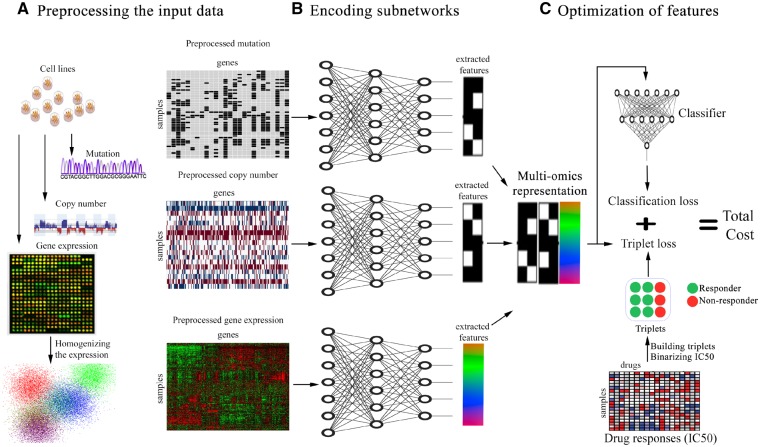
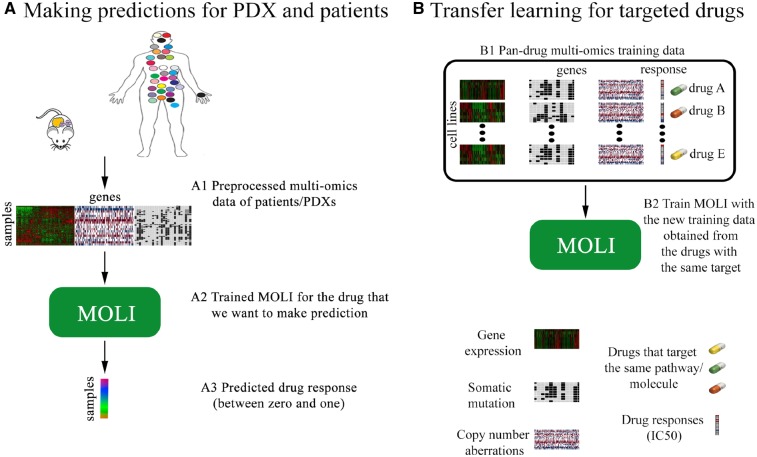
Motivation: Historically, gene expression has been shown to be the most informative data for drug response prediction. Recent evidence suggests that integrating additional omics can improve the prediction accuracy which raises the question of how to integrate the additional omics. Regardless of the integration strategy, clinical utility and translatability are crucial. Thus, we reasoned a multi-omics approach combined with clinical datasets would improve drug response prediction and clinical relevance. Results: We propose MOLI, a multi-omics late integration method based on deep neural networks. MOLI takes somatic mutation, copy number aberration and gene expression data as input, and integrates them for drug response prediction. MOLI uses type-specific encoding sub-networks to learn features for each omics type, concatenates them into one representation and optimizes this representation via a combined cost function consisting of a triplet loss and a binary cross-entropy loss. The former makes the representations of responder samples more similar to each other and different from the non-responders, and the latter makes this representation predictive of the response values. We validate MOLI on in vitro and in vivo datasets for five chemotherapy agents and two targeted therapeutics. Compared to state-of-the-art single-omics and early integration multi-omics methods, MOLI achieves higher prediction accuracy in external validations. Moreover, a significant improvement in MOLI’s performance is observed for targeted drugs when training on a pan-drug input, i.e. using all the drugs with the same target compared to training only on drug-specific inputs. MOLI’s high predictive power suggests it may have utility in precision oncology. Availability and implementation: https://github.com/hosseinshn/MOLI. Supplementary information: Supplementary data are available at Bioinformatics online.
Overview
The claims and statistics of this paper haven’t been checked yet.
Free: it reads the open-access text and checks the first 5 claims that cite a source we can check. Create a free account to check every claim.
Integrity signals
Registry
Cites
Statistics
Figures
Verification
Claims the paper makes
The claims and statistics of this paper haven’t been checked yet.
Free: it reads the open-access text and checks the first 5 claims that cite a source we can check. Create a free account to check every claim.
Claims other papers make about this one
Each is checked against this paper’s own text: does it say what the citing paper says it does?
The cited source says what the claim attributes to it.
In the citing paper
“MOLI (multi-omics late integration) (Sharifi-Noghabi et al., 2019) method used type-specific encoding sub-networks to learn features from somatic mutation, CNA and gene expression data independently and then later concatenated them for predicting the response to a given drug.”
From Using machine learning approaches for multi-omics data analysis: A review (2021) · cites this paper as Sharifi-Noghabi et al., 2019
Self-check
Percentages, sums and reported differences re-computed from the paper’s own numbers.
The self-check needs the paper’s full text.
Citations
Cites
Pan, S. J., & Yang, Q. (2010) · IEEE Transactions on Knowledge and Data Engineering · doi:10.1109/tkde.2009.191 · Cited by 23,387
RSEM: accurate transcript quantification from RNA-Seq data with or without a reference genome
Li, B., & Dewey, C. N. (2011) · BMC Bioinformatics · doi:10.1186/1471-2105-12-323 · Cited by 22,179
FaceNet: A unified embedding for face recognition and clustering
Schroff, F., Kalenichenko, D., & Philbin, J. (2015) · 2015 IEEE Conference on Computer Vision and Pattern Recognition (CVPR) · doi:10.1109/cvpr.2015.7298682 · Cited by 15,267 · cited 3×
“To the best of our knowledge, MOLI is the first end-to-end late integration method with deep neural networks that optimizes this representation via a combined cost function consisting of a triplet loss function (Schroff et al., 2015) and a binary cross-entropy loss function.”
BackgroundMethodInfluentialProceedings of IEEE Conference on Computer Vision and Pattern Recognition
(1993) · Proceedings of IEEE Conference on Computer Vision and Pattern Recognition · doi:10.1109/cvpr.1993.341010 · Cited by 14,265
(2016) · Cited by 11,679
The cancer genome atlas pan-cancer analysis project
The Cancer Genome Atlas Research Network, Weinstein, J. N., Collisson, E. A., Mills, G. B., Shaw, K. R. M., Ozenberger, B. A., Ellrott, K., Shmulevich, I., Sander, C., & Stuart, J. M. (2013) · Nature Genetics · doi:10.1038/ng.2764 · Cited by 9,092
Adjusting batch effects in microarray expression data using empirical Bayes methods
Johnson, W. E., Li, C., & Rabinovic, A. (2007) · Biostatistics · doi:10.1093/biostatistics/kxj037 · Cited by 8,658
(2010) · Cited by 8,261
The Cancer Cell Line Encyclopedia enables predictive modelling of anticancer drug sensitivity
Barretina, J., Caponigro, G., Stransky, N., Venkatesan, K., Margolin, A. A., Kim, S., Wilson, C. J., Lehár, J., Kryukov, G. V., Sonkin, D., et al. (2012) · Nature · doi:10.1038/nature11003 · Cited by 7,950 · cited 3×
“We note that the classifier was validated only on CCLE cell lines without studying its translatability to patients or PDX models.”
BackgroundVogelstein, B., Papadopoulos, N., Velculescu, V. E., Zhou, S., Diaz, L. A., & Kinzler, K. W. (2013) · Science · doi:10.1126/science.1235122 · Cited by 7,863 · cited 1×
“However, inreality, themajorityofthesegenomicalterationsseemtohavenoimpact on cancer development (Vogelstein et al. , 2013) and might appear just by chance.”
Background
Research works printed but not linked: 1
- Khakabimamaghani, 2016, CC BY: PSB 2016 proceedings are published as Open Access chapters by World Scientific Publishing Company and distributed under the terms of the Creative Commons Attribution (CC BY) 4.0 License, 345
Cited by
Items 301–400 of 488
MCNET: Multi-Omics Integration for Gene Regulatory Network Inference from scRNA-seqPreprint
Tiwari, A., & Trankatwar, S. (2023) · medRxiv · doi:10.1101/2023.05.29.23290691 · Cited by 3
Optimal normalization in quantum-classical hybrid models for anti-cancer drug response predictionPreprint
Ito, T., Artem, L., & Tsunoda, T. (2025) · arXiv (Cornell University) · doi:10.48550/arxiv.2505.10037 · Cited by 3
Asiaee, A., Strauch, J., Azinfar, L., Pal, S., Pua, H. H., Long, J. P., & Coombes, K. R. (2026) · bioRxiv (Cold Spring Harbor Laboratory) · doi:10.64898/2026.02.05.704016 · Cited by 3
Abinas, V., Unniyattil, A., Haneem, E. M., Vishnusankar, A., & Nazeer, K. A. A. (2024) · Journal of Bioinformatics and Computational Biology · doi:10.1142/s0219720024500136 · Cited by 2
DvaDRP: a dual variational autoencoder based on big data for drug response prediction
Liao, X., & Yu, B. (2024) · International Conference on Big-data Service and Intelligent Computation (BDSIC) · doi:10.1145/3686540.3686551 · Cited by 2
GCLM-CDR: a graph contrastive learning method with multi-omics for cancer drug response prediction
Yao, Z., & Zhang, Q. (2024) · IEEE International Conference on Bioinformatics and Biomedicine (BIBM) · doi:10.1109/bibm62325.2024.10822189 · Cited by 2
Digital Exposome: A Digital Age Approach to Environmental Exposure and Cancer Risk Assessment
Ernawati, K., Hasyim, H., Utomo, A. R. H., Budiman, D., & Widiyanti, D. (2025) · IGI Global eBooks · doi:10.4018/979-8-3373-2165-3.ch008 · Cited by 2
Guo, H., Lv, X., Li, S., Ma, D., Li, Y., & Li, M. (2025) · Journal of Pharmaceutical Analysis · doi:10.1016/j.jpha.2025.101386 · Cited by 2
Zhang, Y., Wu, T., Nie, L., Jiang, Y., Li, G., Xu, J., Zhou, Z., Chen, Y., Quan, L., & Lyu, Q. (2025) · Journal of Chemical Information and Modeling · doi:10.1021/acs.jcim.5c01026 · Cited by 2
Mandal, K., & Bandyopadhyay, S. (2026) · BMC Bioinformatics · doi:10.1186/s12859-026-06406-2 · Cited by 2
Belharar, F. Z., Belharar, O., Retal, S., Kharmoum, N., & Ziti, S. (2025) · Lecture notes in networks and systems · doi:10.1007/978-3-032-01967-7_20 · Cited by 2
Hazarika, A., Kumar, A., & Halder, A. (2025) · Mammalian Genome · doi:10.1007/s00335-025-10171-7 · Cited by 2
DVFGCDR: a dual-view fusion graph neural network for cancer drug response prediction
Huang, W., Qin, S., Li, H., Zhu, H., Yao, Y., & Li, Z. (2025) · NAR Cancer · doi:10.1093/narcan/zcaf043 · Cited by 2
Introduction to artificial intelligence in multi-omics analysis
Saha, A., Pal, R. K., & Saha, S. (2026) · Progress in molecular biology and translational science · doi:10.1016/bs.pmbts.2026.01.022 · Cited by 2
Precision Oncology: Multimodal and Multiscale Methods to Promote Mechanistic Understanding
Öztürk, K., Klie, A., & Carter, H. K. (2026) · Annual Review of Biomedical Data Science · doi:10.1146/annurev-biodatasci-092724-043507 · Cited by 2
HAHGL-CDR: Heterogeneous adaptive hypergraph learning for cancer drug response prediction
Song, B., Meng, H., Zhang, W., & Qiu, H. (2026) · Knowledge-Based Systems · doi:10.1016/j.knosys.2026.115783 · Cited by 2
AI‐Driven Cancer Multi‐Omics: A Review From the Data Pipeline Perspective
Liu, S., Li, S. X., & Qian, K. (2026) · Advanced Intelligent Discovery · doi:10.1002/aidi.202500249 · Cited by 2
Topology‐Aware Deep Learning on Higher‐Order Structures for Drug Response Prediction
Shen, C., Lin, G., Hu, C.-S., & Wang, Y. (2026) · Advanced Science · doi:10.1002/advs.75816 · Cited by 2
Deep neural network aided multi-omics drug response prediction for breast cancer
Vishnusankar, A., Unniyattil, A., Haneem, E. M., Abinas, V., & Nazeer, K. A. A. (2022) · IEEE India Conference · doi:10.1109/indicon56171.2022.10040137 · Cited by 2
Hou, Z., Zhao, Z., Zhu, D., Pan, M., Zhou, Y., & Ge, Q. (2025) · International Symposium on Intelligent Robotics and Systems (ISoIRS) · doi:10.1109/isoirs65690.2025.11167916 · Cited by 2
Shi, H., Gu, Y., Zhang, H., Li, X., & Cao, Y. (2023) · Lecture notes in computer science · doi:10.1007/978-981-99-4749-2_17 · Cited by 2
Deng, D., Xu, X., Cui, T., Xu, M., Luo, K., Zhang, H., Wang, Q., Song, C., Li, C., Li, G., et al. (2024) · Journal of Cellular and Molecular Medicine · doi:10.1111/jcmm.18298 · Cited by 2
Piyush, V., Yan, Y., Zhou, Y., Yin, Y., & Ghosh, S. (2023) · arXiv (Cornell University) · doi:10.48550/arxiv.2307.10436 · Cited by 2
INSIGHT: In Silico Drug Screening Platform using Interpretable Deep Learning NetworkPreprint
Shi, X., Ramathal, C. Y., & Dezső, Z. (2025) · bioRxiv (Cold Spring Harbor Laboratory) · doi:10.1101/2025.04.21.649855 · Cited by 2
Enhancing Symbolic Machine Learning by Subsymbolic RepresentationsPreprint
Roth, S., Baur, L., Boer, D., & Krämer, S. (2025) · arXiv (Cornell University) · doi:10.48550/arxiv.2506.14569 · Cited by 2
Zhang, Z., Xie, J., Zhong, W., Liang, F., Yang, R., & Zhen, X. (2024) · PubMed Central · doi:10.12122/j.issn.1673-4254.2024.01.16 · Cited by 1
Artificial intelligence: empowering new insights into gamete and embryo development
Du, Z., & Gao, S. (2025) · Scientia Sinica Vitae · doi:10.1360/ssv-2024-0072 · Cited by 1
Karimova, N. V., & Senanayake, R. D. (2025) · Artificial Intelligence Chemistry · doi:10.1016/j.aichem.2025.100084 · Cited by 1
Future Trends in Artificial Intelligence for Medical Applications
Chaudhuri, T., & Ghosh, J. (2025) · Advances in medical diagnosis, treatment, and care (AMDTC) book series · doi:10.4018/979-8-3693-9816-6.ch020 · Cited by 1
Rolli, L.-M., Eckhart, L., Herrmann, L., Volkamer, A., Lenhof, H., & Lenhof, K. (2026) · Digital Discovery · doi:10.1039/d5dd00284b · Cited by 2
Wang, H., Zhang, Y., Zhang, D., & Luo, M. (2025) · Scientific Reports · doi:10.1038/s41598-025-07813-w · Cited by 1
ImmFinder: A Multiomics-Based Neural Network Approach for Predicting the Immune Genes in Livestock
Thambiraja, M., Karthikeyan, P. P., Sezen, M., Senthilkumar, S., Singh, D., Onteru, S. K., & Yennamalli, R. M. (2025) · OMICS A Journal of Integrative Biology · doi:10.1177/15578100251389910 · Cited by 1
Gu, G., Han, H., Wu, H., Sun, Y., Liu, P., Jiang, G., Deng, J., Xie, G., & Chen, J. (2025) · IEEE Transactions on Computational Biology and Bioinformatics · doi:10.1109/tcbbio.2025.3642615 · Cited by 1
Muhammad, B. L., Kim, H., Aliyu, I., Shehu, H. A., & Ki, J. (2026) · Toxins · doi:10.3390/toxins18010026 · Cited by 1
HyperCausal: A Multi-Task Causal Learning Framework for Cancer Drug Response Prediction
Xing, J., Zhang, Y., & Wang, J. (2025) · IEEE International Conference on Bioinformatics and Biomedicine (BIBM) · doi:10.1109/bibm66473.2025.11356459 · Cited by 1
Zhao, J., Bao, H., Guan, P., Zhao, X., Wang, B., Yan, Z., Zhao, C., Zhao, Y., Lu, X., & Xu, G. (2026) · Analytical Chemistry · doi:10.1021/acs.analchem.5c06539 · Cited by 1
Ma, H., Wang, Z., Jia, Y., Li, Z., Zhao, Y., & Yu, C. (2026) · IEEE Transactions on Computational Biology and Bioinformatics · doi:10.1109/tcbbio.2026.3683695 · Cited by 1
Introduction of AI in drug design
Huang, S., & Ou, T. (2026) · Elsevier eBooks · doi:10.1016/b978-0-443-45105-8.00008-1 · Cited by 1
Lee, H., Sajid, K., & Lee, D. (2026) · Journal of Personalized Medicine · doi:10.3390/jpm16060332 · Cited by 1
Machine Learning Based Drug Response Prediction for Heart Disease Patients
Rekha, P, M. K., S, S. T., Nandini, K., Hiremath, S., & Pattan, K. I. (2026) · International Conference on Intelligent Technologies (CONIT) · doi:10.1109/conit69683.2026.11621480 · Cited by 1
Jin, M., Lou, M., Wang, P., Xu, W., Hou, G., Wang, L., & Li, M. (2026) · BMC Bioinformatics · doi:10.1186/s12859-026-06723-6 · Cited by 1
The Prediction of Anti-cancer Drug Response by Integrating Multi-omics Data
Liu, S., Wu, J., & Feng, Y. (2021) · Lecture notes on data engineering and communications technologies · doi:10.1007/978-3-030-81007-8_132 · Cited by 1
Gautam, U. K., Rashid, T. A., Nizamani, Q. U. A., Mubasher, R., Costadopoulos, N., Salah, R. M., & Alrubaie, A. (2022) · Advances in intelligent systems and computing · doi:10.1007/978-3-031-14054-9_25 · Cited by 1
Multimodal Deep Learning Analysis for Biomedical Data Fusion
Sinha, D., Rao, B. J., Basha, D. K., Kumar, P. P., Shilpa, N., & Sharma, S. (2024) · Wiley eBooks · doi:10.1002/9781394197705.ch4 · Cited by 1
The multiomics revolution in the era of deep learning: Allies or enemies?
Labory, J., & Bottini, S. (2024) · Elsevier eBooks · doi:10.1016/b978-0-443-13671-9.00017-x · Cited by 1
Bioinformatics Databases and Tools for Analysis of Multi-omics
Pham, C. A., Ngo, A. D., Bui, N. L., & Chu, D. (2024) · Springer eBooks · doi:10.1007/978-981-97-1844-3_4 · Cited by 1
An Ensemble Cascade Forest‐Based Framework for Multi‐Omics Drug Response and Synergy Prediction
Li, R., Sui, B., Leng, D., He, S., Liu, K., & Bo, X. (2024) · Advanced Intelligent Systems · doi:10.1002/aisy.202400180 · Cited by 1
MGTDR: A Multi-modal Graph Transformer Network for Cancer Drug Response Prediction
Yan, C. (2024) · International Conference on Artificial Intelligence and Big Data (ICAIBD) · doi:10.1109/icaibd62003.2024.10604610 · Cited by 1
A Revolution in Healthcare: AI-powered Cancer Imaging
Kumar, G., Verma, S., Malviya, R., Paliwal, S., & Narayan, C. V. (2024) · Current Cancer Therapy Reviews · doi:10.2174/0115733947304178240804182938 · Cited by 1
Distilling Multi-Modal Genomic Knowledge for Drug Response Prediction
Ge, S., Sun, S., Xu, H., & Ren, Z. (2024) · ACM International Conference on Bioinformatics, Computational Biology, and Health Informatics (ACM-BCB) · doi:10.1145/3698587.3701430 · Cited by 1
Huang, S. (2021) · Mspace (University of Manitoba) · Cited by 1
DC and SA: Robust and Efficient Hyperparameter Optimization of Multi-subnetwork Deep Learning ModelsPreprint
Treacher, A., & Montillo, A. (2022) · arXiv (Cornell University) · doi:10.48550/arxiv.2202.11841 · Cited by 1
Oh, M., Park, S., Kim, S., & Chae, H. (2020) · Briefings in Bioinformatics · doi:10.1093/bib/bbaa078 · Cited by 1
Dynamic Interaction Learning and Multimodal Representation for Drug Response PredictionPreprint
Bi, Y., Zhou, M., Hu, Z., Zhang, S., & Lyu, G. (2022) · bioRxiv (Cold Spring Harbor Laboratory) · doi:10.1101/2022.11.23.517777 · Cited by 1
Yasrab, R., Agrawal, R., Saber-Ayad, M. M., & El-Hadidi, M. S. (2025) · bioRxiv (Cold Spring Harbor Laboratory) · doi:10.1101/2025.06.26.661832 · Cited by 1
Aman, L. O., Arfan, A., Asnaw, A., Putra, P. P., Hasan, H., & Papeo, D. R. P. (2025) · arXiv (Cornell University) · doi:10.48550/arxiv.2512.12113 · Cited by 1
Multi-omics representation learning using sparse variational autoencoders
Kocak Balik, M. (2025) · Aaltodoc (Aalto University) · Cited by 1
Central Dogma Transformer: Towards Mechanism-Oriented AI for Cellular UnderstandingPreprint
Ota, N. (2026) · arXiv (Cornell University) · doi:10.48550/arxiv.2601.01089 · Cited by 1
Mendez, K. M. (2020) · Australasian Journal of Paramedicine
Identification de signature causale pathologie par intégration de données multi-omiques
Wery, M. (2020) · theses.fr (ABES) · doi:10.70675/cf048a19z8c9cz4db3z9a25z513d03ba57a1
AIM in Genomic Basis of Medicine: Applications
Kamada, M., & Okuno, Y. (2021) · Springer eBooks · doi:10.1007/978-3-030-58080-3_264-1
Research on Drug Response Prediction Model Based on Big Data
Li, G., & Xie, M. (2021) · Communications in computer and information science · doi:10.1007/978-3-030-78615-1_46
AIM in Genomic Basis of Medicine: Applications
Kamada, M., & Okuno, Y. (2022) · Springer eBooks · doi:10.1007/978-3-030-64573-1_264
Computational precision therapeutics and drug repositioning
Powell, R. T. (2023) · Elsevier eBooks · doi:10.1016/b978-0-12-824010-6.00063-0
Single Cell Analysis and Multiomics
Ramsden, J. J. (2023) · Computational biology · doi:10.1007/978-3-030-45607-8_21
Vulture: VULnerabilities in impuTing drUg REsistance
Bumin, A., Shah, M., Huang, K., & Kahveci, T. (2023) · ACM International Conference on Bioinformatics, Computational Biology, and Health Informatics (ACM-BCB) · doi:10.1145/3584371.3612993
Binary Classification of Drug Sensitivity Prediction Using Multimodal Deep LearningPreprint
Aqeeli, N., & Alzaid, E. (2023) · Research Square · doi:10.21203/rs.3.rs-3490258/v1
Machine learning applications in cancer genomics
El-Charif, O., Schwartz, R. S., Yuan, Y., & Tao, Y. (2024) · Elsevier eBooks · doi:10.1016/b978-0-12-822000-9.00006-9
Zhang, Y., Lian, L., & Yang, X.-H. (2023) · IEEE International Conference on Bioinformatics and Biomedicine (BIBM) · doi:10.1109/bibm58861.2023.10385310
Yao, Z., Liu, R., & Zhang, Q. (2023) · IEEE Smart World Congress (SWC) · doi:10.1109/swc57546.2023.10448992
Park, S., Soh, J., & Lee, H. (2021) · Figshare · doi:10.6084/m9.figshare.14677133
Lee, S., Sun, M., Hu, Y., Wang, Y., Islam, M. N., Goerlitz, D. S., Lucas, P. C., Lee, A. V., Swain, S. M., Tang, G., et al. (2024) · BMC Bioinformatics · doi:10.1186/s12859-024-05835-1
PRO-OS: A MACHINE LEARNING-BASED PROGNOSTIC PREDICTION MODEL FOR OSTEOSARCOMA
Zeng, K., Yang, X., Mu, H., HUA, Y., & Cai, Z. (2025) · Journal of Mechanics in Medicine and Biology · doi:10.1142/s0219519425400299
Stacked Meta-Model Drug Response Prediction SystemPreprint
Boddu, A. S., & Jan, A. (2025) · Research Square · doi:10.21203/rs.3.rs-6875619/v1
Using AI to Integrate Multiple Omics to Predict the Mechanisms of Rare Diseases
Sharif, M., Niedzialek, J., Khan, I., & Khan, Z. (2025) · Open Access Public Health and Health Administration Review · doi:10.59644/oaphhar.4(1).183
Niu, Y., Xu, T., & Li, J. (2025) · Elsevier eBooks · doi:10.1016/b978-0-44-332908-1.00010-6
Enhancing Tree-Based Machine Learning for Personalized Drug Assignment
Real, K. S. D., & Rubio, Á. (2025) · Applied Sciences · doi:10.3390/app151910853
Chemotherapy Drug-induced Neurotoxicity: A Pharmacogenomic Perspective
Wibowo, A. D. K., Mahendra, M. R., Irham, L. M., Adikusuma, W., Amukti, D. P., Mazaya, M., Chong, R., Mutiara, R., Darmawi, D., Vidyanti, A. N., et al. (2025) · Current pharmacogenomics and personalized medicine (Online)/Current pharmacogenomics and personalized medicine · doi:10.2174/0118756921374917251002055229
Use of artificial intelligence and machine learning for multiomics
Karađuzović-Hadžiabdić, K., & Gruca, A. (2025) · Elsevier eBooks · doi:10.1016/b978-0-443-33064-3.00018-9
Wang, W., Zhu, Y., & Wang, Z. (2025) · Applied Soft Computing · doi:10.1016/j.asoc.2025.114344
SHIFT-DRP: Dynamic Multi-Scale Active Learning for Drug Response Prediction
Wang, X., Xu, H., Zhao, Y., Liu, S., Zan, P., He, S., & Bo, X. (2025) · Journal of Chemical Information and Modeling · doi:10.1021/acs.jcim.5c02453
Hauptmann, T., & Kramer, S. (2024) · Figshare · doi:10.6084/m9.figshare.26568484
Lee, S., Sun, M., Hu, Y., Wang, Y., Islam, M. N., Goerlitz, D. S., Lucas, P. C., Lee, A. V., Swain, S. M., Tang, G., et al. (2024) · Figshare · doi:10.6084/m9.figshare.26736336
Additional file 1 of Network-based drug sensitivity prediction
Ahmed, K. T., Park, S., Jiang, Q., Yeu, Y., Hwang, T., & Zhang, W. (2020) · Figshare · doi:10.6084/m9.figshare.13498042
Lee, S., Sun, M., Hu, Y., Wang, Y., Islam, M. N., Goerlitz, D. S., Lucas, P. C., Lee, A. V., Swain, S. M., Tang, G., et al. (2024) · Figshare · doi:10.6084/m9.figshare.26736342
Hauptmann, T., & Kramer, S. (2024) · Figshare · doi:10.6084/m9.figshare.26568472
Wang, F.-A., Zhuang, Z., Gao, F., He, R., Zhang, S., Wang, L., Liu, J., & Li, Y. (2024) · Figshare · doi:10.6084/m9.figshare.26730532
Hauptmann, T., & Kramer, S. (2024) · Figshare · doi:10.6084/m9.figshare.26568481
Hauptmann, T., & Kramer, S. (2024) · Figshare · doi:10.6084/m9.figshare.26568493
Leng, D., Zheng, L., Wen, Y., Zhang, Y., Wu, L., Wang, J., Wang, M., Zhang, Z., He, S., & Bo, X. (2022) · Figshare · doi:10.6084/m9.figshare.20461986
Wysocka, M., Wysocki, O., Zufferey, M., Landers, D., & Freitas, A. (2024) · Figshare · doi:10.6084/m9.figshare.26589750
Wang, F.-A., Zhuang, Z., Gao, F., He, R., Zhang, S., Wang, L., Liu, J., & Li, Y. (2024) · Figshare · doi:10.6084/m9.figshare.25989234
Predicting outcomes for rare diseases using machine learning
Ferrato, M. (2023) · Library, Museums and Press - UDSpace (University of Delaware) · doi:10.58088/82vj-nc92
Hauptmann, T., & Kramer, S. (2024) · Figshare · doi:10.6084/m9.figshare.26568478
Additional file 1 of Widespread redundancy in -omics profiles of cancer mutation states
Crawford, J., Christensen, B. C., Chikina, M. D., & Greene, C. S. (2022) · Figshare · doi:10.6084/m9.figshare.20167985
Hauptmann, T., & Kramer, S. (2024) · Figshare · doi:10.6084/m9.figshare.26568475
Wysocka, M., Wysocki, O., Zufferey, M., Landers, D., & Freitas, A. (2024) · Figshare · doi:10.6084/m9.figshare.26589753
Harmonizing Multi-Omics for Enhanced Machine Learning
K, P. K. N. (2023) · International Journal of Advanced Scientific Innovation · doi:10.5281/zenodo.10509459
Lee, S., Sun, M., Hu, Y., Wang, Y., Islam, M. N., Goerlitz, D. S., Lucas, P. C., Lee, A. V., Swain, S. M., Tang, G., et al. (2024) · Figshare · doi:10.6084/m9.figshare.26736339
Hauptmann, T., & Kramer, S. (2024) · Figshare · doi:10.6084/m9.figshare.26568487
Metadata
- Authors
- Sharifi-Noghabi, H., Zolotareva, O., Collins, C. C., & Ester, M.
- Affiliations
- Simon Fraser University (CA)
- Bielefeld University (DE)
- University of British Columbia (CA)
- Corresponding author
- Collins, Colin C
- Ester, Martin
- Venue
- Bioinformatics
- Publisher
- Oxford University Press (OUP)
- Published
- 2019-07
- Volume
- 35
- Issue
- 14
- Pages
- i501-i509
- ISSN
- 1367-4803 (ISSN-L)
- 1367-4811
- PMC
- PMC6612815
- OpenAlex
- W2955502047
- Cited by
- 421
- References
- 49
- Citations by year
- 2026: 60 · 2025: 71 · 2024: 85 · 2023: 58 · 2022: 58 · 2021: 58 · 2020: 26 · 2019: 5
- FWCI
- 25.12
- Type
- journal article
- Language
- en
- Open access
- hybrid
- doi.org
- Licence
- Locations
- Bioinformatics (publishedVersion, cc-by-nc)
- bioRxiv (Cold Spring Harbor Laboratory) (acceptedVersion, cc-by-nc-nd)
- Europe PMC (PubMed Central) (publishedVersion, cc-by-nc)
- PubMed Central (publishedVersion, cc-by-nc)
- PubMed (publishedVersion)
- PUB – Publications at Bielefeld University (Bielefeld University) (submittedVersion)
- Funders
- Canada Foundation for Innovation (33440)
- The Canadian Institutes of Health Research (PJT-153073)
- Terry Fox Foundation (201012TFF)
- National Science and Engineering Research Council of Canada (R611347)
- Topics
- Life Sciences › Pharmacology, Toxicology and Pharmaceutics › Drug Discovery › Computational Drug Discovery Methods
- Life Sciences › Biochemistry, Genetics and Molecular Biology › Molecular Biology › Gene expression and cancer classification
- Life Sciences › Biochemistry, Genetics and Molecular Biology › Cancer Research › Cancer Genomics and Diagnostics
- Keywords
- drug response prediction, multi-omics integration, somatic mutations, copy number alterations, gene expression, deep neural network, triplet loss, precision oncology, chemotherapy, targeted therapy
- MeSH terms
- Algorithms, Antineoplastic Agents, Pharmaceutical Preparations, Forecasting, Humans, Neoplasms, Neural Networks, Computer, Precision Medicine
About these checks
Registry, retraction, Cites and statistics results are computed, not judged, with one exception: a printed reference that no index lists is read once by a model before it counts as a citation error. Claims are extracted by a model and kept only when their quote appears verbatim in the text; each cited source is then checked, with a model’s help, for whether it says what the claim relies on. Those verdicts can be wrong — read the claim’s quote and the cited source before relying on one.
Statistics and arithmetic are recomputed, not judged.
Confidence bands are shown only for fields calibrated on our annotated test set. None is calibrated yet, so no band is shown.
What counts as a claim ›How we measure confidence ›How we check this ›
Are you an author, or do you see a problem with this page? Request a review
Data sources
Bibliographic data: Semantic Scholar, OpenAlex, Crossref.
Contains information from the Semantic Scholar Academic Graph Datasets, made available under the ODC Attribution License (ODC-BY 1.0).
Semantic Scholar’s data is described in: Kinney, R., et al. (2023). The Semantic Scholar Open Data Platform. arXiv:2301.10140.
