

MOLI: multi-omics late integration with deep neural networks for drug response prediction
Open accessPublished version of a preprint
The DOI matches its Crossref record; 48 of the 49 references it cites were found in a registry or an index.
Abstract
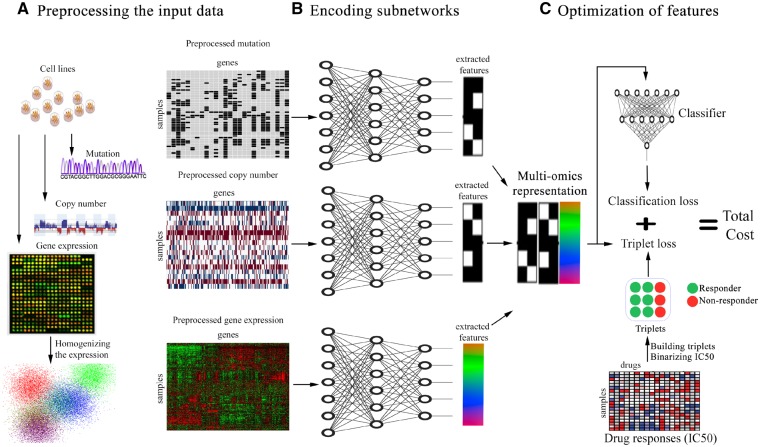
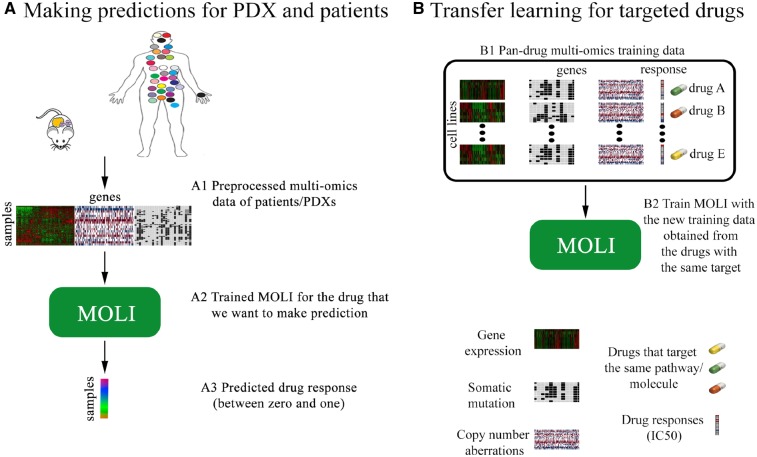
Motivation: Historically, gene expression has been shown to be the most informative data for drug response prediction. Recent evidence suggests that integrating additional omics can improve the prediction accuracy which raises the question of how to integrate the additional omics. Regardless of the integration strategy, clinical utility and translatability are crucial. Thus, we reasoned a multi-omics approach combined with clinical datasets would improve drug response prediction and clinical relevance. Results: We propose MOLI, a multi-omics late integration method based on deep neural networks. MOLI takes somatic mutation, copy number aberration and gene expression data as input, and integrates them for drug response prediction. MOLI uses type-specific encoding sub-networks to learn features for each omics type, concatenates them into one representation and optimizes this representation via a combined cost function consisting of a triplet loss and a binary cross-entropy loss. The former makes the representations of responder samples more similar to each other and different from the non-responders, and the latter makes this representation predictive of the response values. We validate MOLI on in vitro and in vivo datasets for five chemotherapy agents and two targeted therapeutics. Compared to state-of-the-art single-omics and early integration multi-omics methods, MOLI achieves higher prediction accuracy in external validations. Moreover, a significant improvement in MOLI’s performance is observed for targeted drugs when training on a pan-drug input, i.e. using all the drugs with the same target compared to training only on drug-specific inputs. MOLI’s high predictive power suggests it may have utility in precision oncology. Availability and implementation: https://github.com/hosseinshn/MOLI. Supplementary information: Supplementary data are available at Bioinformatics online.
Overview
The claims and statistics of this paper haven’t been checked yet.
Free: it reads the open-access text and checks the first 5 claims that cite a source we can check. Create a free account to check every claim.
Integrity signals
Registry
Cites
Statistics
Figures
Verification
Claims the paper makes
The claims and statistics of this paper haven’t been checked yet.
Free: it reads the open-access text and checks the first 5 claims that cite a source we can check. Create a free account to check every claim.
Claims other papers make about this one
Each is checked against this paper’s own text: does it say what the citing paper says it does?
The cited source says what the claim attributes to it.
In the citing paper
“MOLI (multi-omics late integration) (Sharifi-Noghabi et al., 2019) method used type-specific encoding sub-networks to learn features from somatic mutation, CNA and gene expression data independently and then later concatenated them for predicting the response to a given drug.”
From Using machine learning approaches for multi-omics data analysis: A review (2021) · cites this paper as Sharifi-Noghabi et al., 2019
Self-check
Percentages, sums and reported differences re-computed from the paper’s own numbers.
The self-check needs the paper’s full text.
Citations
Cites
Pan, S. J., & Yang, Q. (2010) · IEEE Transactions on Knowledge and Data Engineering · doi:10.1109/tkde.2009.191 · Cited by 23,387
RSEM: accurate transcript quantification from RNA-Seq data with or without a reference genome
Li, B., & Dewey, C. N. (2011) · BMC Bioinformatics · doi:10.1186/1471-2105-12-323 · Cited by 22,179
FaceNet: A unified embedding for face recognition and clustering
Schroff, F., Kalenichenko, D., & Philbin, J. (2015) · 2015 IEEE Conference on Computer Vision and Pattern Recognition (CVPR) · doi:10.1109/cvpr.2015.7298682 · Cited by 15,267 · cited 3×
“To the best of our knowledge, MOLI is the first end-to-end late integration method with deep neural networks that optimizes this representation via a combined cost function consisting of a triplet loss function (Schroff et al., 2015) and a binary cross-entropy loss function.”
BackgroundMethodInfluentialProceedings of IEEE Conference on Computer Vision and Pattern Recognition
(1993) · Proceedings of IEEE Conference on Computer Vision and Pattern Recognition · doi:10.1109/cvpr.1993.341010 · Cited by 14,265
(2016) · Cited by 11,679
The cancer genome atlas pan-cancer analysis project
The Cancer Genome Atlas Research Network, Weinstein, J. N., Collisson, E. A., Mills, G. B., Shaw, K. R. M., Ozenberger, B. A., Ellrott, K., Shmulevich, I., Sander, C., & Stuart, J. M. (2013) · Nature Genetics · doi:10.1038/ng.2764 · Cited by 9,092
Adjusting batch effects in microarray expression data using empirical Bayes methods
Johnson, W. E., Li, C., & Rabinovic, A. (2007) · Biostatistics · doi:10.1093/biostatistics/kxj037 · Cited by 8,658
(2010) · Cited by 8,261
The Cancer Cell Line Encyclopedia enables predictive modelling of anticancer drug sensitivity
Barretina, J., Caponigro, G., Stransky, N., Venkatesan, K., Margolin, A. A., Kim, S., Wilson, C. J., Lehár, J., Kryukov, G. V., Sonkin, D., et al. (2012) · Nature · doi:10.1038/nature11003 · Cited by 7,950 · cited 3×
“We note that the classifier was validated only on CCLE cell lines without studying its translatability to patients or PDX models.”
BackgroundVogelstein, B., Papadopoulos, N., Velculescu, V. E., Zhou, S., Diaz, L. A., & Kinzler, K. W. (2013) · Science · doi:10.1126/science.1235122 · Cited by 7,863 · cited 1×
“However, inreality, themajorityofthesegenomicalterationsseemtohavenoimpact on cancer development (Vogelstein et al. , 2013) and might appear just by chance.”
Background
Research works printed but not linked: 1
- Khakabimamaghani, 2016, CC BY: PSB 2016 proceedings are published as Open Access chapters by World Scientific Publishing Company and distributed under the terms of the Creative Commons Attribution (CC BY) 4.0 License, 345
Cited by
Items 101–200 of 488
Tran, D., Nguyen, H., Pham, V.-D., Nguyen, T. N. P., Luu, H. N., Phan, L. M., DeStefano, C. B., Yeung, S. J., & Nguyen, T. (2025) · Briefings in Bioinformatics · doi:10.1093/bib/bbaf150 · Cited by 45
Shrestha, R., Llauradó, M., Dawson, A., Hoenisch, J., Volik, S. V., Lin, Y., Anderson, S. A., Kim, H. H., Haegert, A. M., Colborne, S., et al. (2021) · Cancer Research · doi:10.1158/0008-5472.can-20-2222 · Cited by 45
Self-citationHow much can deep learning improve prediction of the responses to drugs in cancer cell lines?
Chen, Y., & Zhang, L. (2021) · Briefings in Bioinformatics · doi:10.1093/bib/bbab378 · Cited by 45
Trends in Deep Learning for Property-driven Drug Design
Born, J., & Manica, M. (2021) · Current Medicinal Chemistry · doi:10.2174/0929867328666210729115728 · Cited by 45
Park, S., Soh, J., & Lee, H. (2021) · BMC Bioinformatics · doi:10.1186/s12859-021-04146-z · Cited by 44
Interpretable meta-learning of multi-omics data for survival analysis and pathway enrichment
Cho, H. J., Shu, M., Bekiranov, S., Zang, C., & Zhang, A. (2023) · Bioinformatics · doi:10.1093/bioinformatics/btad113 · Cited by 42
MUMA: A Multi-Omics Meta-Learning Algorithm for Data Interpretation and Classification
Huang, H., Shu, J., & Liang, Y. Q. (2024) · IEEE Journal of Biomedical and Health Informatics · doi:10.1109/jbhi.2024.3363081 · Cited by 42
COVID19 Drug Repository: text-mining the literature in search of putative COVID19 therapeutics
Tworowski, D., Gorohovski, A., Mukherjee, S., Carmi, G., Levy, E., Detroja, R., Mukherjee, S. B., & Frenkel‐Morgenstern, M. (2020) · Nucleic Acids Research · doi:10.1093/nar/gkaa969 · Cited by 42
CODEX, a neural network approach to explore signaling dynamics landscapes
Jacques, M., Dobrzyński, M., Gagliardi, P. A., Sznitman, R., & Pertz, O. C. (2021) · Molecular Systems Biology · doi:10.15252/msb.202010026 · Cited by 41
Liu, X., & Mei, X.-Y. (2023) · Frontiers in Bioengineering and Biotechnology · doi:10.3389/fbioe.2023.1156372 · Cited by 40
Artificial Intelligence in Pediatrics: Learning to Walk Together
Demirbaş, K. C., Yıldız, M., Saygılı, S., Canpolat, N., & Kasapçopur, Ö. (2024) · Turkish Archives of Pediatrics · doi:10.5152/turkarchpediatr.2024.24002 · Cited by 41
Vlachavas, E., Bohn, J. R., Ückert, F., & Nürnberg, S. (2021) · International Journal of Molecular Sciences · doi:10.3390/ijms22062822 · Cited by 38
Shen, B., Feng, F., Li, K., Lin, P., Ma, L., & Li, H. (2022) · Briefings in Bioinformatics · doi:10.1093/bib/bbac605 · Cited by 38
Ren, Y., Wu, C., Zhou, H., Hu, X., & Miao, Z. (2024) · Plant Communications · doi:10.1016/j.xplc.2024.101002 · Cited by 36
Spooner, A., Moridani, M. K., Toplis, B., Behary, J., Safarchi, A., Maher, S., Vafaee, F., Zekry, A., & Sowmya, A. (2025) · Briefings in Bioinformatics · doi:10.1093/bib/bbaf116 · Cited by 36
Looking at the BiG picture: incorporating bipartite graphs in drug response prediction
Hostallero, D. E., Li, Y., & Emad, A. (2022) · Bioinformatics · doi:10.1093/bioinformatics/btac383 · Cited by 35
Artificial intelligence accelerates multi-modal biomedical process: A Survey
Li, J., Han, X., Qin, Y., Tan, F., Chen, Y., Wang, Z., Song, H., Zhou, X., Zhang, Y., Hu, L., et al. (2023) · Neurocomputing · doi:10.1016/j.neucom.2023.126720 · Cited by 36
Improving drug response prediction based on two-space graph convolution
Peng, W., Chen, T., Liu, H., Dai, W., Ning, Y., & Lan, W. (2023) · Computers in Biology and Medicine · doi:10.1016/j.compbiomed.2023.106859 · Cited by 34
Magazzù, G., Zampieri, G., & Angione, C. (2021) · Bioinformatics · doi:10.1093/bioinformatics/btab324 · Cited by 33
Liu, X., Tang, H., Zhou, Q., Zeng, Y.-L., Chen, D., Xu, H., Li, Y., Tan, B., & Qian, J. (2023) · World Journal of Gastroenterology · doi:10.3748/wjg.v29.i2.272 · Cited by 34
Multimodal Learning for Multi-omics: A Survey
Tabakhi, S., Suvon, M. N. I., Ahadian, P., & Lu, H. (2023) · World Scientific Annual Review of Artificial Intelligence · doi:10.1142/s2811032322500047 · Cited by 31
Demirel, H. C., Arici, M. K., & Tunçbağ, N. (2021) · Molecular Omics · doi:10.1039/d1mo00158b · Cited by 30
Sohrabei, S., Moghaddasi, H., Hosseini, A., & Ehsanzadeh, . J. (2024) · BMC Cancer · doi:10.1186/s12885-024-12575-1 · Cited by 30
Feng, Y., Soni, A., Brightwell, G., dos Reis, M. M., Wang, Z., Wang, J., Wu, Q., & Ding, Y. (2024) · Trends in Food Science & Technology · doi:10.1016/j.tifs.2024.104555 · Cited by 29
Qi, R., Liu, S., Hui, X., Shaytan, A. К., & Liu, B. (2025) · Science China Information Sciences · doi:10.1007/s11432-024-4461-0 · Cited by 29
Learning curves for drug response prediction in cancer cell lines
Partin, A., Brettin, T. S., Evrard, Y. A., Zhu, Y., Yoo, H., Xia, F., Jiang, S., Clyde, A., Shukla, M. P., Fonstein, M., et al. (2021) · BMC Bioinformatics · doi:10.1186/s12859-021-04163-y · Cited by 29
Predicting cancer drug TARGETS - TreAtment Response Generalized Elastic-neT Signatures
Rydzewski, N. R., Peterson, E. R., Lang, J. M., Yu, M., Chang, S. L., Sjöström, M., Bakhtiar, H., Song, G., Helzer, K. T., Bootsma, M. L., et al. (2021) · npj Genomic Medicine · doi:10.1038/s41525-021-00239-z · Cited by 30
Huang, Z., Zhang, P., & Deng, L. (2023) · Bioinformatics · doi:10.1093/bioinformatics/btad244 · Cited by 29
Multimodal analysis methods in predictive biomedicine
Qoku, A., Katsaouni, N., Flinner, N., Buettner, F., & Schulz, M. H. (2023) · Computational and Structural Biotechnology Journal · doi:10.1016/j.csbj.2023.11.011 · Cited by 29
Wang, S., Wang, S., & Wang, Z. (2023) · Frontiers in Medicine · doi:10.3389/fmed.2022.1109365 · Cited by 28
PANCDR: precise medicine prediction using an adversarial network for cancer drug response
Kim, J., Park, S., & Lee, H. (2024) · Briefings in Bioinformatics · doi:10.1093/bib/bbae088 · Cited by 31
Drug-induced cell viability prediction from LINCS-L1000 through WRFEN-XGBoost algorithm
Lu, J., Chen, M., & Qin, Y. (2021) · BMC Bioinformatics · doi:10.1186/s12859-020-03949-w · Cited by 28
Li, Y., Guo, Z., Gao, X., & Wang, G. (2023) · Bioinformatics · doi:10.1093/bioinformatics/btad734 · Cited by 27
Gong, P., Sun, Q., Cheng, L., Zhang, Z., Ge, S., Chen, J., & Zhang, L. (2023) · Frontiers in Genetics · doi:10.3389/fgene.2022.1032768 · Cited by 27
Luo, S., Xu, J., Jiang, Z., Liu, L., Wu, Q., Leung, E. L., & Leung, A. P. (2020) · Pharmacological Research · doi:10.1016/j.phrs.2020.105037 · Cited by 27
Deep Learning of radiology-genomics integration for computational oncology: A mini review
Wang, F., Li, Y., & Zeng, T. (2024) · Computational and Structural Biotechnology Journal · doi:10.1016/j.csbj.2024.06.019 · Cited by 27
Khan, D., & Shedole, S. (2022) · Journal of Personalized Medicine · doi:10.3390/jpm12050674 · Cited by 27
Multi-omic integration by machine learning (MIMaL)
Dickinson, Q., Aufschnaiter, A., Ott, M., & Meyer, J. G. (2022) · Bioinformatics · doi:10.1093/bioinformatics/btac631 · Cited by 26
INTEGRATIVE MACHINE LEARNING APPROACHES FOR MULTI-OMICS DATA ANALYSIS IN CANCER RESEARCH
Shoaib, A. S. M., Nishat, N., Raasetti, M., & Arif, I. (2024) · GLOBAL MAINSTREAM JOURNAL · doi:10.62304/ijhm.v1i2.149 · Cited by 26
Huang, Z., Fan, Z., Shen, S., Wu, M., & Deng, L. (2024) · Bioinformatics · doi:10.1093/bioinformatics/btae386 · Cited by 25
CrossAttOmics: multiomics data integration with cross-attention
Beaude, A., Augé, F., Zehraoui, F., & Hanczar, B. (2025) · Bioinformatics · doi:10.1093/bioinformatics/btaf302 · Cited by 25
Eckhart, L., Lenhof, K., Rolli, L.-M., & Lenhof, H. (2024) · Briefings in Bioinformatics · doi:10.1093/bib/bbae242 · Cited by 25
He, D., & Xie, L. (2021) · Bioinformatics · doi:10.1093/bioinformatics/btab580 · Cited by 25
Feng, R., Xie, Y., Lai, M., Chen, D. Z., Cao, J., & Wu, J. F. (2021) · IEEE International Conference on Bioinformatics and Biomedicine (BIBM) · doi:10.1109/bibm52615.2021.9669314 · Cited by 25
Development of bioinformatics and multi-omics analyses in organoids
Ha, D., Kong, J., Kim, D., Lee, K., Lee, J., Park, M., Ahn, H., Oh, Y., & Kim, S. (2022) · BMB Reports · doi:10.5483/bmbrep.2022-0155 · Cited by 23
Deep Learning‐Based Multiomics Data Integration Methods for Biomedical Application
Wen, Y., Zheng, L., Leng, D., Dai, C., Jing, L., Zhang, Z., He, S., & Bo, X. (2023) · Advanced Intelligent Systems · doi:10.1002/aisy.202200247 · Cited by 23
Lao, C., Zheng, P., Chen, H., Liu, Q., An, F., & Zhao, L. (2024) · BMC Bioinformatics · doi:10.1186/s12859-024-05723-8 · Cited by 23
Braytee, A., He, S., Tang, S., Sun, Y., Jiang, X., Yu, X., Khatri, I., Chaturvedi, K., Prasad, M., & Anaissi, A. (2024) · Scientific Reports · doi:10.1038/s41598-024-59670-8 · Cited by 23
Machine learning approach for prediction of hearing preservation in vestibular schwannoma surgery
Cha, D., Shin, S. H., Kim, S. H., Choi, J. Y., & Moon, I. S. (2020) · Scientific Reports · doi:10.1038/s41598-020-64175-1 · Cited by 23
Liu, Y., Tong, S., & Chen, Y. (2023) · Neural Networks · doi:10.1016/j.neunet.2023.08.036 · Cited by 22
Liu, H., Peng, W., Dai, W., Lin, J., Fu, X., Liu, L., Liu, L., & Yu, N. (2023) · Methods · doi:10.1016/j.ymeth.2023.11.018 · Cited by 22
Hajim, W. I., Zainudin, S., Daud, K. M., & Alheeti, K. M. A. (2024) · PeerJ Computer Science · doi:10.7717/peerj-cs.1903 · Cited by 22
The Trifecta of Single-Cell, Systems-Biology, and Machine-Learning Approaches
Weisskittel, T., Correia, C., Yu, G., Ung, C. Y., Kaufmann, S. H., Billadeau, D. D., & Li, H. (2021) · Genes · doi:10.3390/genes12071098 · Cited by 22
Performance Comparisons of AlexNet and GoogLeNet in Cell Growth Inhibition IC50 Prediction
Lee, Y., & Nam, S. (2021) · International Journal of Molecular Sciences · doi:10.3390/ijms22147721 · Cited by 22
Chen, H., Shi, Y., Yuan, M., Li, H., & Liu, X. (2025) · Biotechnology Advances · doi:10.1016/j.biotechadv.2025.108785 · Cited by 21
Nguyen, G. T. T., Vu, H.-N., & Le, D. (2021) · IEEE Transactions on Computational Biology and Bioinformatics · doi:10.1109/tcbb.2021.3096960 · Cited by 21
Oh, M., Park, S., Lee, S., Lee, D., Lim, S., Jeong, D., Jo, K., Jung, I., & Kim, S. (2020) · Frontiers in Genetics · doi:10.3389/fgene.2020.564792 · Cited by 21
Representation Learning for the Clustering of Multi-Omics Data
Viaud, G., Mayilvahanan, P., & Cournède, P.-H. (2021) · IEEE Transactions on Computational Biology and Bioinformatics · doi:10.1109/tcbb.2021.3060340 · Cited by 22
Predicting breast cancer drug response using a multiple-layer cell line drug response network model
Huang, S., Hu, P., & Lakowski, T. M. (2021) · BMC Cancer · doi:10.1186/s12885-021-08359-6 · Cited by 21
Ozdemir, C., Vashishath, Y., Bozdag, S., & Initiative, A. D. N. (2025) · Bioinformatics · doi:10.1093/bioinformatics/btaf313 · Cited by 20
Huang, Z., Zhou, Q., Zhu, X., & Zhang, X. (2021) · Sensors · doi:10.3390/s21030764 · Cited by 20
Tang, Y.-C., Powell, R. T., & Gottlieb, A. (2022) · Scientific Reports · doi:10.1038/s41598-022-20646-1 · Cited by 19
Zhang, D., Bian, G., Zhang, Y., Xie, J., & Hu, C. (2025) · Frontiers in Genetics · doi:10.3389/fgene.2025.1610284 · Cited by 19
DIVERSE: Bayesian Data IntegratiVE Learning for Precise Drug ResponSE Prediction
Paltun, B. G., Kaski, S., & Mamitsuka, H. (2021) · IEEE Transactions on Computational Biology and Bioinformatics · doi:10.1109/tcbb.2021.3065535 · Cited by 19
Trustworthy Deep Neural Network for Inferring Anticancer Synergistic Combinations
Alsherbiny, M. A., Radwan, I., Moustafa, N., Bhuyan, D. J., El-Waisi, M., Chang, D., & Li, C. G. (2021) · IEEE Journal of Biomedical and Health Informatics · doi:10.1109/jbhi.2021.3126339 · Cited by 19
Transfer learning of clinical outcomes from preclinical molecular data, principles and perspectives
Kowald, A., Barrantes, I., Möller, S., Palmer, D. H., Escobar, H. M., Schwerk, A. M. K., & Fuellen, G. (2022) · Briefings in Bioinformatics · doi:10.1093/bib/bbac133 · Cited by 19
Kanchan, S., Kesheri, M., Srivastava, U., Karathia, H., Ratna-Raj, R., Chittoori, B. C. S., Bogomolnaya, L. M., Sinha, R. P., & Denvir, J. (2024) · Elsevier eBooks · doi:10.1016/b978-0-443-16092-9.00015-1 · Cited by 18
Mass Spectrometry Proteomics: A Key to Faster Drug Discovery
Tagliazucchi, L., & Costi, M. P. (2025) · Journal of Medicinal Chemistry · doi:10.1021/acs.jmedchem.5c01986 · Cited by 17
Critical evaluation of drug response prediction models with DrEval
Bernett, J., Iversen, P., Picciani, M., Wilhelm, M., Baum, K., & List, M. (2026) · Nature Communications · doi:10.1038/s41467-026-72903-w · Cited by 18
Morshed, S. (2026) · American Journal of Scholarly Research and Innovation · doi:10.63125/yfme0q12 · Cited by 17
An integral genomic signature approach for tailored cancer therapy using genome-wide sequencing data
Wang, X., Lee, S., Zhang, H., Tang, G., & Wang, Y. (2022) · Nature Communications · doi:10.1038/s41467-022-30449-7 · Cited by 18
Hauptmann, T., & Krämer, S. (2023) · BMC Bioinformatics · doi:10.1186/s12859-023-05166-7 · Cited by 17
Fu, W., Lin, Y., Bai, M., Yao, J., Huang, C., Gao, L., Mi, N., Ma, H., Tian, L., Yue, P., et al. (2024) · Acta Pharmaceutica Sinica B · doi:10.1016/j.apsb.2024.06.028 · Cited by 17
Artificial intelligence methods available for cancer research
Murmu, A., & Győrffy, B. (2024) · Frontiers of Medicine · doi:10.1007/s11684-024-1085-3 · Cited by 18
Shi, M., Li, X., Li, M., & Si, Y. (2023) · Briefings in Bioinformatics · doi:10.1093/bib/bbad329 · Cited by 16
Shi, H., Xu, T., Li, X., Gao, Q., Xiong, Z., Xia, J., & Yue, Z. (2025) · Artificial Intelligence in Medicine · doi:10.1016/j.artmed.2025.103101 · Cited by 16
Predicting N6-Methyladenosine Sites in Multiple Tissues of Mammals through Ensemble Deep Learning
Luo, Z., Lou, L., Qiu, W., Xu, Z., & Xiao, X. (2022) · International Journal of Molecular Sciences · doi:10.3390/ijms232415490 · Cited by 16
NeuMF: Predicting Anti-cancer Drug Response Through a Neural Matrix Factorization Model
Liu, H., Yu, J., Chen, X., & Zhang, L. (2022) · Current Bioinformatics · doi:10.2174/1574893617666220609114052 · Cited by 15
Zhou, L., Wang, N., Zhu, Z., Gao, H., Lu, N., Su, H., & Wang, X. (2023) · Neurocomputing · doi:10.1016/j.neucom.2023.127168 · Cited by 15
Stacked Autoencoder Based Multi-Omics Data Integration for Cancer Survival PredictionPreprint
Wu, X., & Fang, Q. (2022) · arXiv (Cornell University) · doi:10.48550/arxiv.2207.04878 · Cited by 15
Peng, W., Lin, J., Dai, W., Yu, N., & Wang, J. (2024) · IEEE Journal of Biomedical and Health Informatics · doi:10.1109/jbhi.2024.3492806 · Cited by 14
He, Y., Liu, N., Yang, J., Hong, Y., Ni, H., & Zhang, Z. (2025) · Intensive Care Medicine Experimental · doi:10.1186/s40635-024-00706-8 · Cited by 14
AI-Driven Chemometrics for Multi-omics Data Integration: Advances, Challenges, and Future Directions
Polu, P. R. (2026) · Critical Reviews in Analytical Chemistry · doi:10.1080/10408347.2026.2657553 · Cited by 14
Kazakova, E. M., Solovyeva, E. M., Levitsky, L. I., Bubis, J. A., Emekeeva, D. D., Antonets, A. A., Nazarov, A. A., Gorshkov, M. V., & Tarasova, I. A. (2022) · PROTEOMICS · doi:10.1002/pmic.202200275 · Cited by 15
Editorial: The role of multi-omics variants in tumor immunity and immunotherapy
Chen, S., Xu, H. M., Guo, C., Liu, Z., & Han, X. (2022) · Frontiers in Immunology · doi:10.3389/fimmu.2022.1098825 · Cited by 14
Tang, X., Prodduturi, N., Thompson, K. J., Weinshilboum, R. M., O'Sullivan, C. C., Boughey, J. C., Tizhoosh, H. R., Klee, E. W., Wang, L., Goetz, M. P., et al. (2024) · Nucleic Acids Research · doi:10.1093/nar/gkae915 · Cited by 13
Reza, M. S., Qiu, C., Lin, X., Su, K., Liu, A., Zhang, X., Gong, Y., Luo, Z., Tian, Q., Nwadiugwu, M. C., et al. (2025) · Journal of Cachexia Sarcopenia and Muscle · doi:10.1002/jcsm.13661 · Cited by 13
Xiang, Y., Li, X., Gao, Q., Xia, J., & Yue, Z. (2025) · IEEE Journal of Biomedical and Health Informatics · doi:10.1109/jbhi.2025.3550353 · Cited by 14
Wu, J., Lai, J., Zhao, X., Wang, Z., Zhang, Y., Wang, L., Su, Y., He, Y., Li, S., Jiang, Y. H., et al. (2025) · Advanced Science · doi:10.1002/advs.202416958 · Cited by 13
Artificial Intelligence in Drug Discovery and Development: Transforming Pharmaceutical Innovation
Ali, M. S., Alqahtani, T., Shmrany, H. A., Gupta, G., Goh, K. W., Sahebkar, A., & Kesharwani, P. (2026) · Drug Development Research · doi:10.1002/ddr.70281 · Cited by 14
Prediction of Cancer Treatment Using Advancements in Machine Learning
Singh, A. K., Ling, J., & Malviya, R. (2022) · Recent Patents on Anti-Cancer Drug Discovery · doi:10.2174/1574892818666221018091415 · Cited by 13
BDKANN - Biological Domain Knowledge-based Artificial Neural Network for drug response predictionPreprint
Snow, O., Sharifi-Noghabi, H., Lu, J., Zolotareva, O. I., Lee, M., & Ester, M. (2019) · bioRxiv (Cold Spring Harbor Laboratory) · doi:10.1101/840553 · Cited by 13
Self-citationDRN-CDR: A cancer drug response prediction model using multi-omics and drug features
Saranya, K. R., & Vimina, E. R. (2024) · Computational Biology and Chemistry · doi:10.1016/j.compbiolchem.2024.108175 · Cited by 12
Prediction of cancer drug response based on heterogeneous graph neural networks and multi-omics data
Zhang, J., Xiong, S., Xu, Y., & Zhang, Y. (2025) · Neural Networks · doi:10.1016/j.neunet.2025.108001 · Cited by 12
Drug response in the era of precision medicine: A methodological review
Okyere, D., Bravo-Merodio, L., Xu, Y., Guan, X., Parkhi, D., Gkoutos, G. V., & Acharjee, A. (2025) · Computational and Structural Biotechnology Journal · doi:10.1016/j.csbj.2025.11.067 · Cited by 12
Toward Integrative Predictive Toxicology: Advanced Methods for Drug Toxicity and Safety Prediction
Gianquinto, E., Bersani, M., Armando, L. G., Davani, L., Cena, C., Simone, A. D., & Spyrakis, F. (2026) · Wiley Interdisciplinary Reviews Computational Molecular Science · doi:10.1002/wcms.70065 · Cited by 13
Vasanthakumari, P., Zhu, Y., Brettin, T. S., Partin, A., Shukla, M. P., Xia, F., Narykov, O., Weil, M. R., & Stevens, R. L. (2024) · Cancers · doi:10.3390/cancers16030530 · Cited by 12
RedCDR: Dual Relation Distillation for Cancer Drug Response Prediction
Xu, M., Zhu, Z., Zhao, Y., He, K., Huang, Q., & Zhao, Y. (2024) · IEEE Transactions on Computational Biology and Bioinformatics · doi:10.1109/tcbb.2024.3404262 · Cited by 12
Identification of differentially expressed gene modules in heterogeneous diseases
Zolotareva, O. I., Khakabimamaghani, S., Isaeva, O. I., Chervontseva, Z. S., Savchik, A., & Ester, M. (2020) · Bioinformatics · doi:10.1093/bioinformatics/btaa1038 · Cited by 12
Self-citationLicciardi, A., Fiannaca, A., Rosa, M. L., Urso, A. M., & Paglia, L. L. (2024) · Lecture notes in computer science · doi:10.1007/978-3-031-72353-7_1 · Cited by 11
Metadata
- Authors
- Sharifi-Noghabi, H., Zolotareva, O., Collins, C. C., & Ester, M.
- Affiliations
- Simon Fraser University (CA)
- Bielefeld University (DE)
- University of British Columbia (CA)
- Corresponding author
- Collins, Colin C
- Ester, Martin
- Venue
- Bioinformatics
- Publisher
- Oxford University Press (OUP)
- Published
- 2019-07
- Volume
- 35
- Issue
- 14
- Pages
- i501-i509
- ISSN
- 1367-4803 (ISSN-L)
- 1367-4811
- PMC
- PMC6612815
- OpenAlex
- W2955502047
- Cited by
- 421
- References
- 49
- Citations by year
- 2026: 60 · 2025: 71 · 2024: 85 · 2023: 58 · 2022: 58 · 2021: 58 · 2020: 26 · 2019: 5
- FWCI
- 25.12
- Type
- journal article
- Language
- en
- Open access
- hybrid
- doi.org
- Licence
- Locations
- Bioinformatics (publishedVersion, cc-by-nc)
- bioRxiv (Cold Spring Harbor Laboratory) (acceptedVersion, cc-by-nc-nd)
- Europe PMC (PubMed Central) (publishedVersion, cc-by-nc)
- PubMed Central (publishedVersion, cc-by-nc)
- PubMed (publishedVersion)
- PUB – Publications at Bielefeld University (Bielefeld University) (submittedVersion)
- Funders
- Canada Foundation for Innovation (33440)
- The Canadian Institutes of Health Research (PJT-153073)
- Terry Fox Foundation (201012TFF)
- National Science and Engineering Research Council of Canada (R611347)
- Topics
- Life Sciences › Pharmacology, Toxicology and Pharmaceutics › Drug Discovery › Computational Drug Discovery Methods
- Life Sciences › Biochemistry, Genetics and Molecular Biology › Molecular Biology › Gene expression and cancer classification
- Life Sciences › Biochemistry, Genetics and Molecular Biology › Cancer Research › Cancer Genomics and Diagnostics
- Keywords
- drug response prediction, multi-omics integration, somatic mutations, copy number alterations, gene expression, deep neural network, triplet loss, precision oncology, chemotherapy, targeted therapy
- MeSH terms
- Algorithms, Antineoplastic Agents, Pharmaceutical Preparations, Forecasting, Humans, Neoplasms, Neural Networks, Computer, Precision Medicine
About these checks
Registry, retraction, Cites and statistics results are computed, not judged, with one exception: a printed reference that no index lists is read once by a model before it counts as a citation error. Claims are extracted by a model and kept only when their quote appears verbatim in the text; each cited source is then checked, with a model’s help, for whether it says what the claim relies on. Those verdicts can be wrong — read the claim’s quote and the cited source before relying on one.
Statistics and arithmetic are recomputed, not judged.
Confidence bands are shown only for fields calibrated on our annotated test set. None is calibrated yet, so no band is shown.
What counts as a claim ›How we measure confidence ›How we check this ›
Are you an author, or do you see a problem with this page? Request a review
Data sources
Bibliographic data: Semantic Scholar, OpenAlex, Crossref.
Contains information from the Semantic Scholar Academic Graph Datasets, made available under the ODC Attribution License (ODC-BY 1.0).
Semantic Scholar’s data is described in: Kinney, R., et al. (2023). The Semantic Scholar Open Data Platform. arXiv:2301.10140.
