

MOLI: multi-omics late integration with deep neural networks for drug response prediction
Open accessPublished version of a preprint
The DOI matches its Crossref record; 48 of the 49 references it cites were found in a registry or an index.
Abstract
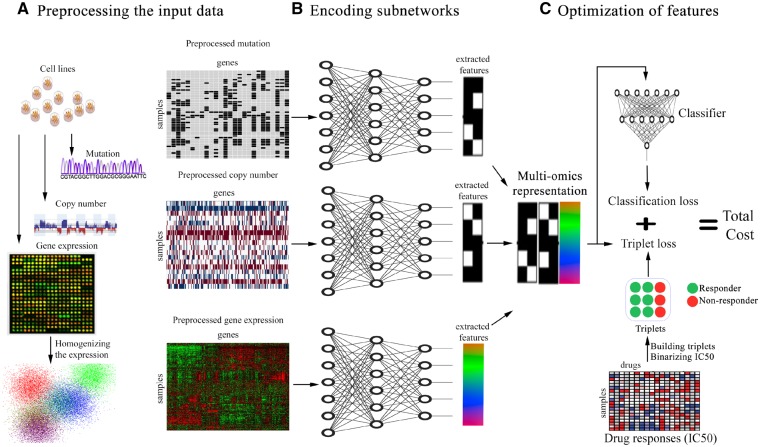
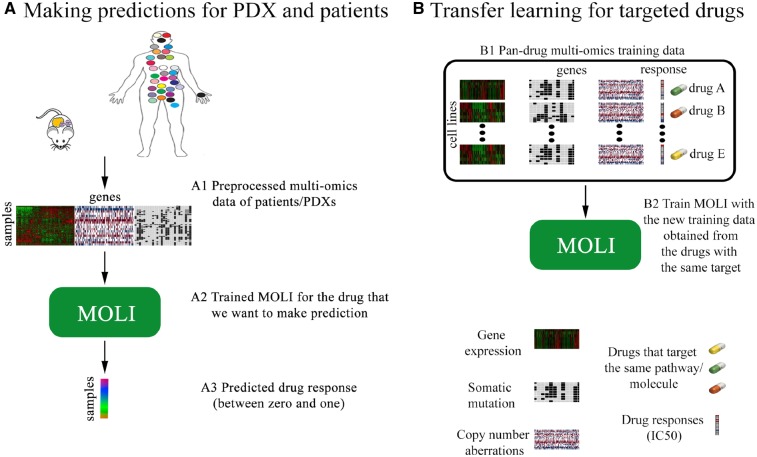
Motivation: Historically, gene expression has been shown to be the most informative data for drug response prediction. Recent evidence suggests that integrating additional omics can improve the prediction accuracy which raises the question of how to integrate the additional omics. Regardless of the integration strategy, clinical utility and translatability are crucial. Thus, we reasoned a multi-omics approach combined with clinical datasets would improve drug response prediction and clinical relevance. Results: We propose MOLI, a multi-omics late integration method based on deep neural networks. MOLI takes somatic mutation, copy number aberration and gene expression data as input, and integrates them for drug response prediction. MOLI uses type-specific encoding sub-networks to learn features for each omics type, concatenates them into one representation and optimizes this representation via a combined cost function consisting of a triplet loss and a binary cross-entropy loss. The former makes the representations of responder samples more similar to each other and different from the non-responders, and the latter makes this representation predictive of the response values. We validate MOLI on in vitro and in vivo datasets for five chemotherapy agents and two targeted therapeutics. Compared to state-of-the-art single-omics and early integration multi-omics methods, MOLI achieves higher prediction accuracy in external validations. Moreover, a significant improvement in MOLI’s performance is observed for targeted drugs when training on a pan-drug input, i.e. using all the drugs with the same target compared to training only on drug-specific inputs. MOLI’s high predictive power suggests it may have utility in precision oncology. Availability and implementation: https://github.com/hosseinshn/MOLI. Supplementary information: Supplementary data are available at Bioinformatics online.
Overview
The claims and statistics of this paper haven’t been checked yet.
Free: it reads the open-access text and checks the first 5 claims that cite a source we can check. Create a free account to check every claim.
Integrity signals
Registry
Cites
Statistics
Figures
Verification
Claims the paper makes
The claims and statistics of this paper haven’t been checked yet.
Free: it reads the open-access text and checks the first 5 claims that cite a source we can check. Create a free account to check every claim.
Claims other papers make about this one
Each is checked against this paper’s own text: does it say what the citing paper says it does?
The cited source says what the claim attributes to it.
In the citing paper
“MOLI (multi-omics late integration) (Sharifi-Noghabi et al., 2019) method used type-specific encoding sub-networks to learn features from somatic mutation, CNA and gene expression data independently and then later concatenated them for predicting the response to a given drug.”
From Using machine learning approaches for multi-omics data analysis: A review (2021) · cites this paper as Sharifi-Noghabi et al., 2019
Self-check
Percentages, sums and reported differences re-computed from the paper’s own numbers.
The self-check needs the paper’s full text.
Citations
Cites
Pan, S. J., & Yang, Q. (2010) · IEEE Transactions on Knowledge and Data Engineering · doi:10.1109/tkde.2009.191 · Cited by 23,387
RSEM: accurate transcript quantification from RNA-Seq data with or without a reference genome
Li, B., & Dewey, C. N. (2011) · BMC Bioinformatics · doi:10.1186/1471-2105-12-323 · Cited by 22,179
FaceNet: A unified embedding for face recognition and clustering
Schroff, F., Kalenichenko, D., & Philbin, J. (2015) · 2015 IEEE Conference on Computer Vision and Pattern Recognition (CVPR) · doi:10.1109/cvpr.2015.7298682 · Cited by 15,267 · cited 3×
“To the best of our knowledge, MOLI is the first end-to-end late integration method with deep neural networks that optimizes this representation via a combined cost function consisting of a triplet loss function (Schroff et al., 2015) and a binary cross-entropy loss function.”
BackgroundMethodInfluentialProceedings of IEEE Conference on Computer Vision and Pattern Recognition
(1993) · Proceedings of IEEE Conference on Computer Vision and Pattern Recognition · doi:10.1109/cvpr.1993.341010 · Cited by 14,265
(2016) · Cited by 11,679
The cancer genome atlas pan-cancer analysis project
The Cancer Genome Atlas Research Network, Weinstein, J. N., Collisson, E. A., Mills, G. B., Shaw, K. R. M., Ozenberger, B. A., Ellrott, K., Shmulevich, I., Sander, C., & Stuart, J. M. (2013) · Nature Genetics · doi:10.1038/ng.2764 · Cited by 9,092
Adjusting batch effects in microarray expression data using empirical Bayes methods
Johnson, W. E., Li, C., & Rabinovic, A. (2007) · Biostatistics · doi:10.1093/biostatistics/kxj037 · Cited by 8,658
(2010) · Cited by 8,261
The Cancer Cell Line Encyclopedia enables predictive modelling of anticancer drug sensitivity
Barretina, J., Caponigro, G., Stransky, N., Venkatesan, K., Margolin, A. A., Kim, S., Wilson, C. J., Lehár, J., Kryukov, G. V., Sonkin, D., et al. (2012) · Nature · doi:10.1038/nature11003 · Cited by 7,950 · cited 3×
“We note that the classifier was validated only on CCLE cell lines without studying its translatability to patients or PDX models.”
BackgroundVogelstein, B., Papadopoulos, N., Velculescu, V. E., Zhou, S., Diaz, L. A., & Kinzler, K. W. (2013) · Science · doi:10.1126/science.1235122 · Cited by 7,863 · cited 1×
“However, inreality, themajorityofthesegenomicalterationsseemtohavenoimpact on cancer development (Vogelstein et al. , 2013) and might appear just by chance.”
Background
Research works printed but not linked: 1
- Khakabimamaghani, 2016, CC BY: PSB 2016 proceedings are published as Open Access chapters by World Scientific Publishing Company and distributed under the terms of the Creative Commons Attribution (CC BY) 4.0 License, 345
Cited by
Items 401–488 of 488
Leng, D., Zheng, L., Wen, Y., Zhang, Y., Wu, L., Wang, J., Wang, M., Zhang, Z., He, S., & Bo, X. (2022) · Figshare · doi:10.6084/m9.figshare.20461983
Choi, J. M., & Chae, H. (2024) · Figshare · doi:10.6084/m9.figshare.26585046
Wang, F.-A., Zhuang, Z., Gao, F., He, R., Zhang, S., Wang, L., Liu, J., & Li, Y. (2024) · Figshare · doi:10.6084/m9.figshare.25989345
Hauptmann, T., & Kramer, S. (2024) · Figshare · doi:10.6084/m9.figshare.26568490
Additional file 3 of Widespread redundancy in -omics profiles of cancer mutation states
Crawford, J., Christensen, B. C., Chikina, M. D., & Greene, C. S. (2022) · Figshare · doi:10.6084/m9.figshare.20167994
Malik, V., Kalakoti, Y., & Sundar, D. (2021) · Figshare · doi:10.6084/m9.figshare.14299371
Alfatemi, A., Peng, H., Rong, W., Zhang, B., & Cai, H. (2022) · Figshare · doi:10.6084/m9.figshare.20367100
Hauptmann, T., & Kramer, S. (2024) · Figshare · doi:10.6084/m9.figshare.26568496
Li, B., & Nabavi, S. (2024) · Figshare · doi:10.6084/m9.figshare.26667903
Deep Modelling for Anticancer Drug Response Prediction with Therapeutic Data
Carvalho, F. G. (2022) · Portuguese National Funding Agency for Science, Research and Technology (RCAAP Project by FCT)
신지혜 (2023) · Seoul National University Open Repository (Seoul National University)
Prediction of compound-induced differential gene expression using graph neural networks
Memon, S. A. (2024) · eScholarship@McGill (McGill) · doi:10.82308/20292
Applications of deep learning and graph representation learning in precision cancer medicine
Hostallero, D. E. (2024) · eScholarship@McGill (McGill) · doi:10.82308/6451
Shin, Y. (2024) · Seoul National University Open Repository (Seoul National University)
Clothier, J. D. (2024) · Lincoln (University of Nebraska)
Evaluating the effect of pathway incorporation on drug response prediction
Li, J. (2023) · eScholarship@McGill (McGill) · doi:10.82308/24072
Martínez Quiroga, S. (2021) · The Oberta in Open Access (Universitat Oberta de Catalunya)
WANCDR: Wasserstein Adversarial Network for Cancer Drug Response
Choi, H., & Kim, M. (2025) · Lecture notes in computer science · doi:10.1007/978-3-032-06103-4_22
MMPCS: multi-view molecular pretraining based on consistency information and specific information
Xie, C., Song, Y., He, S., Bo, X., & Zhang, Z. (2026) · Bioinformatics · doi:10.1093/bioinformatics/btag028
Deep subspace fusion based on integrated self-supervision for cancer subtype identification
Li, M., Zhang, M., Lou, M., Deng, S., Hou, G., Wanzhang, L., & Xu, W. (2026) · Journal of Bioinformatics and Computational Biology · doi:10.1142/s0219720026500010
Ren, H., Leffel, S. C., Xu, Z., & Alphonso, E. (2026) · medRxiv · doi:10.64898/2026.01.20.26344480
EGSDRP: Enhanced Graph Attention Networks and Drug Substructures for Cancer Drug Response Prediction
Li, Y., Zhang, Y., Yang, S., Wang, J., Song, X., & Han, W. (2025) · IEEE International Conference on Bioinformatics and Biomedicine (BIBM) · doi:10.1109/bibm66473.2025.11356376
Han, W., Wang, Z., Xing, J., Zhang, Y., Wang, J., & Wang, J. (2025) · IEEE International Conference on Bioinformatics and Biomedicine (BIBM) · doi:10.1109/bibm66473.2025.11356349
Systematic Evaluation of Transfer Learning Strategies for Clinical Chemotherapy Response PredictionPreprint
Du, H., & Ballester, P. J. (2026) · bioRxiv (Cold Spring Harbor Laboratory) · doi:10.64898/2026.02.16.706121
SGL-CDP: Spectral Graph Learning for Cancer Driver Prioritization
Li, S., & Ma, T. (2026) · IEEE Access · doi:10.1109/access.2026.3675370
Cortes, C. J., Lalanda, P., & Vega, G. (2026) · arXiv (Cornell University) · doi:10.48550/arxiv.2603.16185
MODPN: Dual-Network Graph Attention for Multi-Omics Disease Diagnosis
Huang, Q. (2026) · IEEE International Conference on Power, Electronics and Green Energy (ICPEGE) · doi:10.1109/icpege67691.2026.11451368
Network-based machine learning methods to model variability across individuals
Yousefi, B. (2023) · theses.fr (ABES) · doi:10.70675/b7843ad7z3ae0z43caz9e47zf95945cd3b83
Developping and exploring the interest of deep learning approaches in the field of multi-omics data
Beaude, A. (2024) · theses.fr (ABES) · doi:10.70675/717fb1ffz8eaaz47d6z88c4zec38f96c9ae2
Development of kernel approaches for the integration of biological data from heterogeneous sources
Briscik, M. (2025) · theses.fr (ABES) · doi:10.70675/07704722zb4a3z4abez8ff0z477f2680bcf3
Santiago, K. D. (2025) · theses.fr (ABES) · doi:10.70675/a3f52718z136fz4488z92b7z803f46e08cd4
Graph Representation of Multi-Omic Data for Improved Breast Cancer Subtype Prediction
Kumari, A., & Madhavan, M. (2026) · Lecture notes in networks and systems · doi:10.1007/978-3-032-20253-6_30
Multimodal learning with graphs for multiomics cancer classification
Tabakhi, S. (2026) · White Rose eTheses Online (University of Leeds, The University of Sheffield, University of York)
Vishal, R., Eeshan, K., Tejas, G., Vedant, P., & Yash, G. (2026) · Indian Journal of Computer Science and Technology · doi:10.59256/indjcst.20260501076
Tumor cell specific total mRNA expression informed neural networks predicts cancer progressionPreprint
Paul, A., Lal, J. C., Ji, S., Fong, C., Chen, K., Ding, Y., Li, R., Dai, Y., Tran, Q., Montierth, M. D., et al. (2026) · bioRxiv (Cold Spring Harbor Laboratory) · doi:10.64898/2026.05.01.722212
PiM-X: Pathway-Guided Mamba State-Space Fusion for Interpretable Drug Response Prediction
Xing, J., Zhang, Y., & Wang, J. (2026) · Lecture notes in computer science · doi:10.1007/978-981-92-0369-7_11
Al-Zahra, F., & Idrissi, A. E. (2026) · Pharmacophore · doi:10.51847/bp9qbtx7wl
Zhang, L., Xiao, K., Yang, X., (11986), L. W., Yang, G., & Chu, J. (2026) · Pattern Recognition · doi:10.1016/j.patcog.2026.114142
Zhao, M., Xiao, M., Zhang, X., Zhang, J., Liu, T., & Wang, H. (2026) · Discover Oncology · doi:10.1007/s12672-026-05396-0
MOCDT: multi-cancer detection and tissue-of-origin classification via cfDNA multi-modal integration
Kim, G., Rhee, S., Lee, Y., Jeong, S., Kim, T., & Choi, J. (2026) · Bioinformatics · doi:10.1093/bioinformatics/btag274
A Deep Non-negative Matrix Factorization Algorithm for Acupuncture Omics Data Clustering
Li, Z., Tao, L., Wu, Q., Deng, P., Zhang, P., Wang, D., Li, T., & Yu, S. (2026) · Lecture notes in computer science · doi:10.1007/978-981-92-2494-4_6
Nagy, H. M., Maghraby, F. A., Badawy, O. M., & Omar, A. G. (2026) · BioMedInformatics · doi:10.3390/biomedinformatics6040044
Cadenas, M. R., Segura-Carmona, I., López, A. L., & Gómez-Vela, F. (2026) · Computational Biology and Chemistry · doi:10.1016/j.compbiolchem.2026.109235
Li, H., Jiang, Q., Guan, J., He, X., Xie, P., Zhao, Z., Liu, X., Liu, X., Lee, T.-Y., Wei, L., et al. (2026) · European Journal of Medicinal Chemistry · doi:10.1016/j.ejmech.2026.119134
Advancing multi-omics analysis via dynamic labeling with shared-specific information
Wu, J., Chen, Z., 蒲雅丽, Lin, W., Dai, Y., Liu, G., Wu, W., & Wang, S. (2026) · Information Sciences · doi:10.1016/j.ins.2026.123935
Yang, W., Zhou, H., Li, X., Zheng, Z., & Li, X. (2026) · Computational Biology and Chemistry · doi:10.1016/j.compbiolchem.2026.109265
AI-Driven Drug Repurposing Strategies for Precision Therapy in Breast Cancer
Jakkula, B. K., & Shyam, P. (2026) · Pharmaceutical science. · doi:10.5772/intechopen.1016336
Yang, Z., Wu, S., & Yu, S. (2026) · Computer Methods and Programs in Biomedicine · doi:10.1016/j.cmpb.2026.109566
A Hybrid Graph and Transformer-Based Deep Learning Model for Multi-Omics Drug Response Prediction
Abhang, B. L. G. V. K. (2026) · Journal of Intelligent Decision Making and Information Science · doi:10.59543/jidmis.v3.1226
Precision Medicine Through Multi-Omics Modeling
Dubois, I., & Novák, H. (2025) · The Biosis Bulletin: Bioscience and Information science Journal · doi:10.5281/zenodo.19549542
Multi-Modal Biological Data Fusion
Bianchi, N. (2024) · The Biosis Bulletin: Bioscience and Information science Journal · doi:10.5281/zenodo.19549384
Precision Medicine Approaches in Oncology
Nowak, P., Moreau, J., & Rossi, M. (2022) · Excerpta Medica Archives Journal: Transaction A · doi:10.5281/zenodo.19612926
DeepTraCDR: Prediction of cancer drug response using multimodal deep learning with transformers
Asgari, Z., Eslami, M. H., Kianfar, A., Abbasi, K., Tashnizi, M. B., & Rabiee, H. R. (2026) · Knowledge-Based Systems · doi:10.1016/j.knosys.2026.116933
Elamin, K. M., Elbashir, S. M. I., & Adam, I. (2026) · International Journal of Molecular Sciences · doi:10.3390/ijms27177511
Khaldy, M. A. A., & Gheraibia, Y. (2026) · Advances in computational intelligence and robotics book series · doi:10.4018/979-8-2600-0161-5.ch004
Amjad, S., Beg, M. M. S., & Aziz, M. A. (2026) · Current Issues in Molecular Biology · doi:10.3390/cimb48090897
Bai, J., Faure, J. S., Khalfe, T. A., Huang, R., Burmeister, C. A., van Niekerk, A., & Prince, S. (2026) · Frontiers in Oncology · doi:10.3389/fonc.2026.1937655
Laurent, S., Dubois, P., Lefevre, M. A., & Moreau, C. (2026) · Journal of Artificial Intelligence for Healthcare Systems · doi:10.68159/t715039840
Uma, R., Sreedevi, S., Kamalakannan, V., Jayasundar, S., Dewangan, R. R., Sharma, D., Sivasamy, S. P., & Taj, S. M. (2026) · International Journal of Artificial Intelligence and Machine Learning · doi:10.51483/ijaiml.6.9s.2026.669-678
Montefusco-Pereira, C. V. (2026) · Journal of Pharmaceutical and BioTech Industry · doi:10.3390/jpbi3040027
Liu, M., Song, J., Liu, X., Zhao, L., & Xiong, Y. (2026) · Frontiers in Pharmacology · doi:10.3389/fphar.2026.1923164
The impact of deep learning and omics data in transforming precision therapy for brain cancer
Munquad, S., Upadhyay, A., & Das, A. B. (2026) · Frontiers in Bioinformatics · doi:10.3389/fbinf.2026.1811813
A Survey on Artificial Intelligence in Biomedical Sciences
P. Bhargavi, K. V. N. D. (2023) · Mathematical Statistician and Engineering Applications
Integration of Multi-Omics in AI-Based Models for Predictive Oncology
Nativel, A., Dandou, S., Favier, F., Lesage, C., Mangé, A., Aligon, J., Coopman, P. J., & Larive, R. M. (2026) · Genes · doi:10.3390/genes17101231
Karimisetty, N., Karimisetty, N., Pramod, J. P., & Kumar, K. A. (2025) · Communications on Applied Nonlinear Analysis · doi:10.52710/cana.jrnl.v32.7454
Unleashing AI for preclinical drug developmentPreprint
Kumar, H. D., Yu, Y., Yang, Z., Wang, B., Hu, X., Xu, H., Zhan, X., Zhou, H., Wen, J., & Zhou, X. (2026) · ChemRxiv · doi:10.26434/chemrxiv.15010246/v1
SADRP: A structurally aware multi-modal framework for drug response prediction
Qi, R., Liu, S., Quan, T., 吴天如, Shaytan, A. К., & Liu, B. (2026) · PLoS Computational Biology · doi:10.1371/journal.pcbi.1014861
Artificial intelligence in pharmacogenomics: From data integration to clinical decision support
Fang, X., Ji, P.-Y., Mei, C., Zhu, X., Gong, W., & Wu, S. (2026) · Digital Health · doi:10.1177/20552076261501761
Large language models in personalized oncology
Solovev, I. A., & Golubev, D. (2026) · Patient-Oriented Medicine and Pharmacy · doi:10.37489/2949-1924-0148
Tang, Y.-C. (2022) · Digital Commons-TMC (Texas Medical Center)
Alfawaz, S. A., Almukadi, H. S., Shinawi, T., Alfawaz, D., Alyousfi, D., Nasser, K. K., Harouni, A. A. E., Shaik, N. A., & Banaganapalli, B. (2026) · Cancers · doi:10.3390/cancers18213503
Halab, K., & Akhloufi, M. A. (2026) · Applied Biosciences · doi:10.3390/applbiosci5040108
Wang, W., Wang, D., Li, B., & Zhou, Y. (2026) · Computational Biology and Chemistry · doi:10.1016/j.compbiolchem.2026.109528
Rintala, T., & Fortino, V. (2026) · bioRxiv (Cold Spring Harbor Laboratory) · doi:10.64898/2026.11.04.764164
Chen, S., Zhang, W., Dai, L., Xiong, Z., Lai, S., Xu, H., Gu, J., Peng, K., Jiang, N., Hong, L., et al. (2026) · iMetaOmics. · doi:10.1002/imo2.70156
Structured multi-view relational learning for drug response prediction
Wang, Z., Li, W., Xu, J., Meng, Y., Zhou, H., & Jin, S. (2026) · Briefings in Bioinformatics · doi:10.1093/bib/bbag619
Liu, Z., Chen, Y., Wang, L., Yang, W., Liu, Y., Wang, Z., & Wang, C. (2026) · Metabolites · doi:10.3390/metabo16110880
Seporaitis, D. (2026) · Aaltodoc (Aalto University)
Liu, C., Zhou, Y., Zhang, C., Wu, S., & Ma, W. (2026) · Computational Biology and Chemistry · doi:10.1016/j.compbiolchem.2026.109563
Partin, A., Brettin, T. S., Zhu, Y., Narykov, O., Clyde, A., Overbeek, J., & Stevens, R. L. (2023) · doi:10.3389/fmed.2023.1086097.s001
Yuan, S., Chen, Y.-C., Tsai, C.-H., Chen, H.-W., & Shieh, G. S. (2023) · doi:10.3389/fgene.2023.1217414.s001
Tan, M., Aziz, F., Nagy, P., & de Vries, J. (2026) · Pharmacophore · doi:10.51847/o6idraouiq
Improved normalization in quantum-classical hybrid models for anti-cancer drug response predictionPreprint
Ito, T., Lysenko, A., & Tsunoda, T. (2026) · Research Square · doi:10.21203/rs.3.rs-11587693/v1
Yang, Y.-L., Wang, Q.-Y., Zhou, Y., Zhang, X., Chen, Z.-B., Liu, Y., Hu, Y., Wang, J., & Qin, J. (2026) · Acta Pharmacologica Sinica · doi:10.1038/s41401-026-01958-8
Metadata
- Authors
- Sharifi-Noghabi, H., Zolotareva, O., Collins, C. C., & Ester, M.
- Affiliations
- Simon Fraser University (CA)
- Bielefeld University (DE)
- University of British Columbia (CA)
- Corresponding author
- Collins, Colin C
- Ester, Martin
- Venue
- Bioinformatics
- Publisher
- Oxford University Press (OUP)
- Published
- 2019-07
- Volume
- 35
- Issue
- 14
- Pages
- i501-i509
- ISSN
- 1367-4803 (ISSN-L)
- 1367-4811
- PMC
- PMC6612815
- OpenAlex
- W2955502047
- Cited by
- 421
- References
- 49
- Citations by year
- 2026: 60 · 2025: 71 · 2024: 85 · 2023: 58 · 2022: 58 · 2021: 58 · 2020: 26 · 2019: 5
- FWCI
- 25.12
- Type
- journal article
- Language
- en
- Open access
- hybrid
- doi.org
- Licence
- Locations
- Bioinformatics (publishedVersion, cc-by-nc)
- bioRxiv (Cold Spring Harbor Laboratory) (acceptedVersion, cc-by-nc-nd)
- Europe PMC (PubMed Central) (publishedVersion, cc-by-nc)
- PubMed Central (publishedVersion, cc-by-nc)
- PubMed (publishedVersion)
- PUB – Publications at Bielefeld University (Bielefeld University) (submittedVersion)
- Funders
- Canada Foundation for Innovation (33440)
- The Canadian Institutes of Health Research (PJT-153073)
- Terry Fox Foundation (201012TFF)
- National Science and Engineering Research Council of Canada (R611347)
- Topics
- Life Sciences › Pharmacology, Toxicology and Pharmaceutics › Drug Discovery › Computational Drug Discovery Methods
- Life Sciences › Biochemistry, Genetics and Molecular Biology › Molecular Biology › Gene expression and cancer classification
- Life Sciences › Biochemistry, Genetics and Molecular Biology › Cancer Research › Cancer Genomics and Diagnostics
- Keywords
- drug response prediction, multi-omics integration, somatic mutations, copy number alterations, gene expression, deep neural network, triplet loss, precision oncology, chemotherapy, targeted therapy
- MeSH terms
- Algorithms, Antineoplastic Agents, Pharmaceutical Preparations, Forecasting, Humans, Neoplasms, Neural Networks, Computer, Precision Medicine
About these checks
Registry, retraction, Cites and statistics results are computed, not judged, with one exception: a printed reference that no index lists is read once by a model before it counts as a citation error. Claims are extracted by a model and kept only when their quote appears verbatim in the text; each cited source is then checked, with a model’s help, for whether it says what the claim relies on. Those verdicts can be wrong — read the claim’s quote and the cited source before relying on one.
Statistics and arithmetic are recomputed, not judged.
Confidence bands are shown only for fields calibrated on our annotated test set. None is calibrated yet, so no band is shown.
What counts as a claim ›How we measure confidence ›How we check this ›
Are you an author, or do you see a problem with this page? Request a review
Data sources
Bibliographic data: Semantic Scholar, OpenAlex, Crossref.
Contains information from the Semantic Scholar Academic Graph Datasets, made available under the ODC Attribution License (ODC-BY 1.0).
Semantic Scholar’s data is described in: Kinney, R., et al. (2023). The Semantic Scholar Open Data Platform. arXiv:2301.10140.
