

Specificity of Synaptic Connectivity between Layer 1 Inhibitory Interneurons and Layer 2/3 Pyramidal Neurons in the Rat Neocortex
Open accessThe DOI matches its Crossref record; 76 of the 76 references it cites were found in a registry or an index.
Abstract
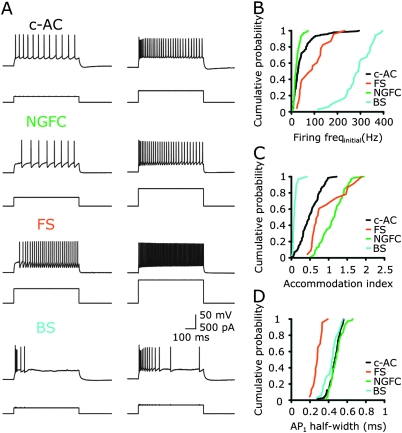
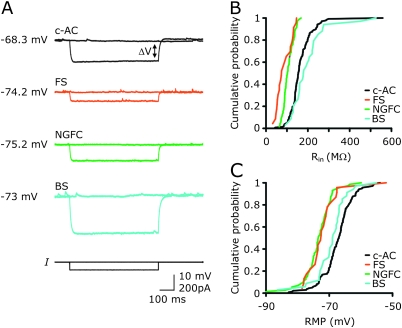
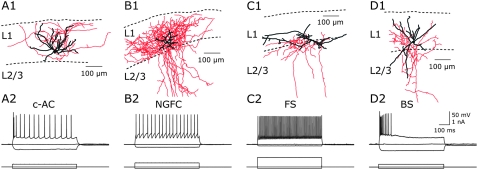
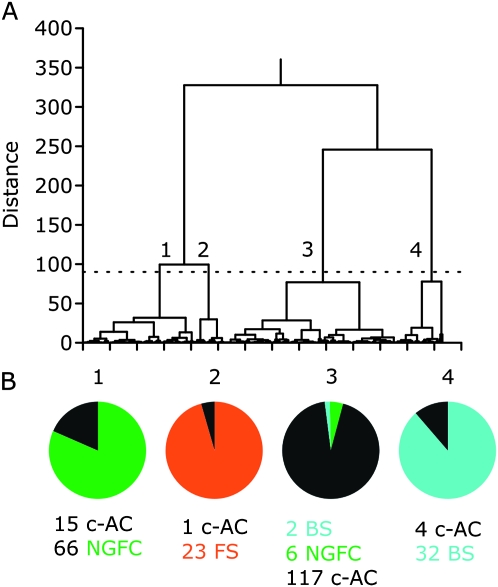
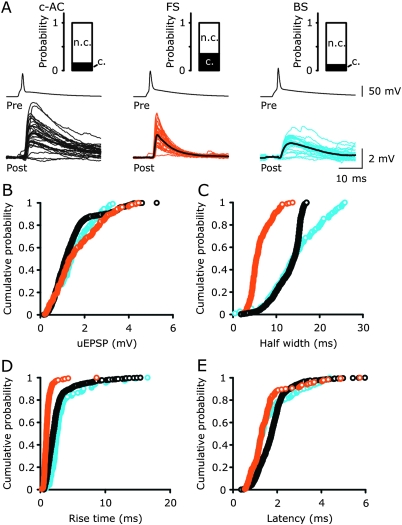
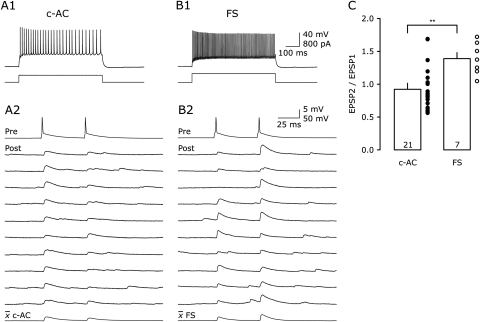
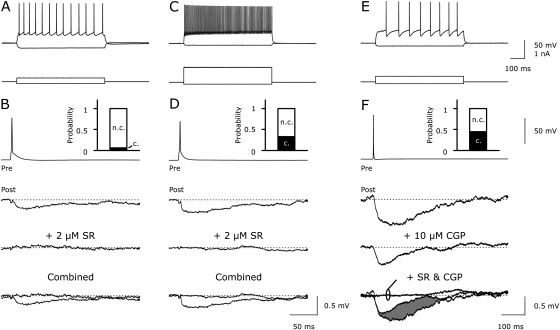
Understanding the structure and function of the neocortical microcircuit requires a description of the synaptic connectivity between identified neuronal populations. Here, we investigate the electrophysiological properties of layer 1 (L1) neurons of the rat somatosensory neocortex (postnatal day 24-36) and their synaptic connectivity with supragranular pyramidal neurons. The active and passive properties of visually identified L1 neurons (n = 266) suggested division into 4 groups according to the Petilla classification scheme with characteristics of neurogliaform cells (NGFCs) (n = 72), classical-accommodating (n = 137), fast-spiking (n = 23), and burst-spiking neurons (n = 34). Anatomical reconstructions of L1 neurons supported the existence of 4 major neuronal groups. Multiparameter unsupervised cluster analysis confirmed the existence of 4 groups, revealing a high degree of similarity with the Petilla scheme. Simultaneous recordings between synaptically connected L1 neurons and L2/3 pyramidal neurons (n = 384) demonstrated neuronal class specificity in both excitatory and inhibitory connectivity and the properties of synaptic potentials. Notably, all groups of L1 neurons received monosynaptic excitatory input from L2/3 pyramidal neurons (n = 33), with the exception of NGFCs (n = 68 pairs tested). In contrast, NGFCs strongly inhibited L2/3 pyramidal neurons (n = 12 out 27 pairs tested). These data reveal a high specificity of excitatory and inhibitory connections in the superficial layers of the neocortex.
Overview
The claims and statistics of this paper haven’t been checked yet.
Free: it reads the open-access text and checks the first 5 claims that cite a source we can check. Create a free account to check every claim.
Integrity signals
Registry
Cites
Statistics
Figures
Verification
Claims the paper makes
The claims and statistics of this paper haven’t been checked yet.
Free: it reads the open-access text and checks the first 5 claims that cite a source we can check. Create a free account to check every claim.
Claims other papers make about this one
Each is checked against this paper’s own text: does it say what the citing paper says it does?
The cited source says what the claim attributes to it.
In the citing paper
“Simultaneous whole cell patch clamp recordings show that they provide strong monosynaptic inhibition to L2/3 pyramidal cells, whose apical dendrites project into L1 (Chu et al., 2003; Wozny and Williams, 2011).”
From Canonical Microcircuits for Predictive Coding (2012) · cites this paper as Wozny and Williams, 2011
Self-check
Percentages, sums and reported differences re-computed from the paper’s own numbers.
The self-check needs the paper’s full text.
Citations
Cites
The Rat Brain in Stereotaxic Coordinates
(1982) · Elsevier eBooks · doi:10.1016/c2009-0-63235-9 · Cited by 51,963
Hierarchical Grouping to Optimize an Objective Function
Ward, J. H. (1963) · Journal of the American Statistical Association · doi:10.1080/01621459.1963.10500845 · Cited by 20,598
AChE-stained horizontal sections of the rat brain in stereotaxic coordinates
Paxinos, G., Watson, C. R. R., & Emson, P. C. (1980) · Journal of Neuroscience Methods · doi:10.1016/0165-0270(80)90021-7 · Cited by 4,497
Interneurons of the neocortical inhibitory system
Markram, H., Toledo-Rodriguez, M., Wang, Y., Gupta, A., Silberberg, G., & Wu, C. (2004) · Nature Reviews Neuroscience · doi:10.1038/nrn1519 · Cited by 2,954 · cited 2×
“The distribution of interneuron classes, however, differs across neocortical layers (Markram et al. 2004; Ascoli et al. 2008).”
BackgroundThe columnar organization of the neocortex
Mountcastle, V. (1997) · Brain · doi:10.1093/brain/120.4.701 · Cited by 2,247
Variations on an inhibitory theme: phasic and tonic activation of GABAA receptors
Farrant, M., & Nusser, Z. (2005) · Nature Reviews Neuroscience · doi:10.1038/nrn1625 · Cited by 2,081 · cited 2×
“As the rise time of uIPSPs also depends on the subunit composition of postsynaptic GABAA receptors, it is, however, possible that GABAA receptor composition may influence these findings (Farrant and Nusser 2005).”
BackgroundNeuronal Diversity and Temporal Dynamics: The Unity of Hippocampal Circuit Operations
Klausberger, T., & Somogyi, P. (2008) · Science · doi:10.1126/science.1149381 · Cited by 2,050 · cited 1×
“For example, classes of cortical interneurons target the axon initial segment, perisomatic regions, or the distal dendrites of pyramidal neurons (Markram et al. 2004; Pouille and Scanziani 2004; Ascoli et al. 2008; Klausberger and Somogyi 2008).”
BackgroundNEURONAL CIRCUITS OF THE NEOCORTEX
Douglas, R. J., & Martin, K. A. C. (2004) · Annual Review of Neuroscience · doi:10.1146/annurev.neuro.27.070203.144152 · Cited by 1,886
Abbott, L. F., & Regehr, W. G. (2004) · Nature · doi:10.1038/nature03010 · Cited by 1,684 · cited 1×
“The amplitude of the second uPSP was measured over a window centered around peak amplitude relative to the subtracted trace.”
MethodTsodyks, M. V., & Markram, H. (1997) · Proceedings of the National Academy of Sciences · doi:10.1073/pnas.94.2.719 · Cited by 1,603
Cited by
Items 101–130 of 130
Information transfer and recovery for the sense of touch
Huang, C., Englitz, B., Reznik, A., Zeldenrust, F., & Celikel, T. (2025) · Cerebral Cortex · doi:10.1093/cercor/bhaf073 · Cited by 9
“…(Blatow et al. 2003), SST + Martinotti neurons (Wang et al. 2004; Kapfer et al. 2007; Fino and Yuste 2011),neurogliaform cells (Tamás et al.2003; Wozny and Williams 2011), CR + bipolar neurons (Xu et al. 2006; Caputi et al. 2009), CR + /VIP + multipolar neurons (Caputi et al. 2009), and VIP +…”
Vadakkan, K. I. (2016) · Epilepsy & Behavior · doi:10.1016/j.yebeh.2016.03.014 · Cited by 7
Localization of the epileptogenic network from scalp EEG using a patient-specific whole-brain model
Mălîia, M. D., Ersöz, E. K., Bénard, A., Calas, T., Nica, A., Denoyer, Y., Yochum, M., Wendling, F., & Benquet, P. (2025) · Network Neuroscience · doi:10.1162/netn_a_00418 · Cited by 8
Genetic labeling reveals spatial and cellular expression pattern of neuregulin 1 in mouse brain
Ding, C., Ding, Y., Ji, H., Wang, Y.-Y., Zhang, X., & Yin, D. (2023) · Cell & Bioscience · doi:10.1186/s13578-023-01032-4 · Cited by 5
“The pyramidal neurons in the layer 2–3 of cerebral cortex are responsible for the communication between different cortical regions [54, 55].”
Sensing and processing whisker deflections in rodents
Burns, T. F., & Rajan, R. (2021) · PeerJ · doi:10.7717/peerj.10730 · Cited by 3
Realistic Subject-Specific Simulation of Resting State Scalp EEG Based on Physiological Model
Bénard, A., Mălîia, M. D., Yochum, M., Ersöz, E. K., Houvenaghel, J., Wendling, F., Sauleau, P., & Benquet, P. (2025) · Brain Topography · doi:10.1007/s10548-025-01115-0 · Cited by 3
Staiger, J. F. (2015) · Elsevier eBooks · doi:10.1016/b978-0-12-397025-1.00202-5 · Cited by 2
Equilibrium and Nonequilibrium Phase Transitions in a Continuum Model of an Anesthetized Cortex
Steyn‐Ross, D. A., Steyn‐Ross, M. L., & SLEIGH, J. W. (2014) · Springer eBooks · doi:10.1007/978-3-642-54593-1_15 · Cited by 2
Analysis of Transsynaptic Attentional Neuronal Circuits with Octuple Patch-Clamp Recordings
Wyskiel, D. R., Larry, T. C., Jiang, X., Wang, G., & Zhu, J. (2016) · Neuromethods · doi:10.1007/978-1-4939-3411-9_7 · Cited by 2
Beerens, S., Winterer, J., Lukacsovich, D., Földy, C., & Wozny, C. (2022) · Zurich Open Repository and Archive (University of Zurich) · doi:10.5167/uzh-225584 · Cited by 2
Self-citationNeurogliaform cells mediate feedback inhibition in the medial entorhinal cortex
Szőcs, S., Henn-Mike, N., Agócs-Laboda, Á., Szabó‐Meleg, E., & Varga, C. (2022) · Frontiers in Neuroanatomy · doi:10.3389/fnana.2022.779390 · Cited by 3
Phase Transitions, Neural Population Models and
Steyn‐Ross, D. A., Steyn‐Ross, M. L., & SLEIGH, J. W. (2014) · Encyclopedia of Computational Neuroscience · doi:10.1007/978-1-4614-7320-6_73-2 · Cited by 1
Isbister, J. B., Ecker, A., Pokorny, C., Bolaños‐Puchet, S., Santander, D. E., Arnaudon, A., Awile, O., Barros-Zulaica, N., Alonso, J. B., Boci, E., et al. (2026) · eLife · doi:10.7554/elife.99693 · Cited by 18
Isbister, J. B., Ecker, A., Pokorny, C., Bolaños‐Puchet, S., Santander, D. E., Arnaudon, A., Awile, O., Barros-Zulaica, N., Alonso, J. B., Boci, E., et al. (2025) · eLife · doi:10.7554/elife.99693.2 · Cited by 2
Zur synaptischen Transmission und Plastizität in kortikalen Hirnschnittpräparaten
Wozny, C. (2014) · Universitätsbibliothek der FU Berlin Hochschulschriftenstelle u. Dokumentenserver · doi:10.17169/refubium-4687
Self-citationPhase Transitions in Neural Population Models
Steyn‐Ross, D. A., Steyn‐Ross, M. L., & SLEIGH, J. W. (2013) · Encyclopedia of Computational Neuroscience · doi:10.1007/978-1-4614-7320-6_73-1
“Since layer 1 of the cortex is predominantly (over 90 %) comprised of inhibitory neurons (Wozny and Williams 2011), conditions for Turing self-organization via strong long-range diffusive inhibition may be satisfied.”
BackgroundOzsvár, A. (2020) · SZTE Repository of Dissertations (University of Szeged) · doi:10.14232/phd.10270
Genetic labeling reveals cellular expression pattern of neuregulin 1 in mouse forebrainPreprint
Ding, C., Ding, Y., Wang, Y.-Y., Ji, H., Yin, D., & Zhang, X. (2022) · Research Square · doi:10.21203/rs.3.rs-1682121/v1
Phase Transitions, Neural Population Models and
Steyn‐Ross, D. A., Steyn‐Ross, M. L., & SLEIGH, J. W. (2022) · Encyclopedia of Computational Neuroscience · doi:10.1007/978-1-0716-1006-0_73
Phase Transitions, Neural Population Models and
Steyn‐Ross, D. A., Steyn‐Ross, M. L., & SLEIGH, J. W. (2015) · Springer eBooks · doi:10.1007/978-1-4614-6675-8_73
Park, K., Chung, H., Im, C., & Jun, S. C. (2023) · International IEEE/EMBS Conference on Neural Engineering · doi:10.1109/ner52421.2023.10123711
“Further, we implemented the postsynaptic location of the microcircuit’s synaptic connections with reference to several studies that specified the synaptic connectivity among the neurons in the neocortex [14], [16]–[19].”
MethodErzurumlu, R. S., Şengül, G., & Ulupınar, E. (2024) · Elsevier eBooks · doi:10.1016/b978-0-323-99725-6.00019-5 · Cited by 1
Presynaptic control of top-down signaling in neocortical layer 1Preprint
Bonekamp, K. E., Ratz, M. L., Gillie, G. R., Xiong, L., Sebek, M., & Crandall, S. R. (2026) · bioRxiv (Cold Spring Harbor Laboratory) · doi:10.64898/2026.01.31.703032
“They do this by directly inhibiting the distal apical tuft dendrites of L2/3 and L5 neurons through both GABA A and GABA B receptors 62,90,146–148 , thereby controlling complex dendritic spikes in these neurons 99,110,148 .”
Hay, Y. A. (2014) · theses.fr (ABES) · doi:10.70675/e05a8175zd583z4b2ezbb03ze7d3e536abc3
Martinez, M. (2025) · theses.fr (ABES) · doi:10.70675/d05e33fcz2cd4z45d4zbe74z5e57fadd4292
Metadata
- Authors
- Wozny, C., & Williams, S. R.
- Affiliations
- MRC Laboratory of Molecular Biology (GB)
- Corresponding author
- Wozny, Christian
- Venue
- Cerebral Cortex
- Publisher
- Oxford University Press (OUP)
- Published
- 2011-01-10
- Volume
- 21
- Issue
- 8
- Pages
- 1818-1826
- ISSN
- 1047-3211 (ISSN-L)
- 1460-2199
- PMC
- PMC3138515
- OpenAlex
- W2159413089
- Semantic Scholar
- 90e49cee47c0f47750fb2ffd568fe2e3bd147844
- Cited by
- 129
- References
- 75
- Citations by year
- 2026: 2 · 2025: 5 · 2024: 8 · 2023: 5 · 2022: 7 · 2021: 9 · 2020: 10 · 2019: 4 · 2018: 12 · 2017: 8 · 2016: 9 · 2015: 11 · 2014: 12 · 2013: 11 · 2012: 12
- FWCI
- 5.16
- Type
- journal article
- Language
- en
- Open access
- hybrid
- doi.org
- Licence
- cc-by-nc
- Locations
- Cerebral Cortex (publishedVersion, cc-by-nc)
- PubMed Central (publishedVersion, cc-by-nc)
- PubMed (publishedVersion)
- Topics
- Life Sciences › Neuroscience › Cellular and Molecular Neuroscience › Neuroscience and Neuropharmacology Research
- Life Sciences › Neuroscience › Cognitive Neuroscience › Neural dynamics and brain function
- Life Sciences › Neuroscience › Cognitive Neuroscience › Memory and Neural Mechanisms
- Keywords
- layer 1 interneurons, layer 2/3 pyramidal neurons, synaptic connectivity, neurogliaform cells, fast-spiking interneurons, somatosensory cortex, monosynaptic inhibition, excitatory synaptic input, unsupervised clustering, rats
- MeSH terms
- Animals, Cell Communication, Interneurons, Neural Inhibition, Neural Pathways, Synaptic Transmission, Organ Culture Techniques, Somatosensory Cortex, Synapses, Rats, Wistar, Pyramidal Cells, Neocortex, Rats
About these checks
Registry, retraction, Cites and statistics results are computed, not judged, with one exception: a printed reference that no index lists is read once by a model before it counts as a citation error. Claims are extracted by a model and kept only when their quote appears verbatim in the text; each cited source is then checked, with a model’s help, for whether it says what the claim relies on. Those verdicts can be wrong — read the claim’s quote and the cited source before relying on one.
Statistics and arithmetic are recomputed, not judged.
Confidence bands are shown only for fields calibrated on our annotated test set. None is calibrated yet, so no band is shown.
What counts as a claim ›How we measure confidence ›How we check this ›
Are you an author, or do you see a problem with this page? Request a review
Data sources
Bibliographic data: Semantic Scholar, OpenAlex, Crossref.
Contains information from the Semantic Scholar Academic Graph Datasets, made available under the ODC Attribution License (ODC-BY 1.0).
Semantic Scholar’s data is described in: Kinney, R., et al. (2023). The Semantic Scholar Open Data Platform. arXiv:2301.10140.
