

Vocal Tract Images Reveal Neural Representations of Sensorimotor Transformation During Speech Imitation
Open accessThe DOI matches its Crossref record; 68 of the 69 references it cites were found in a registry or an index.
Abstract
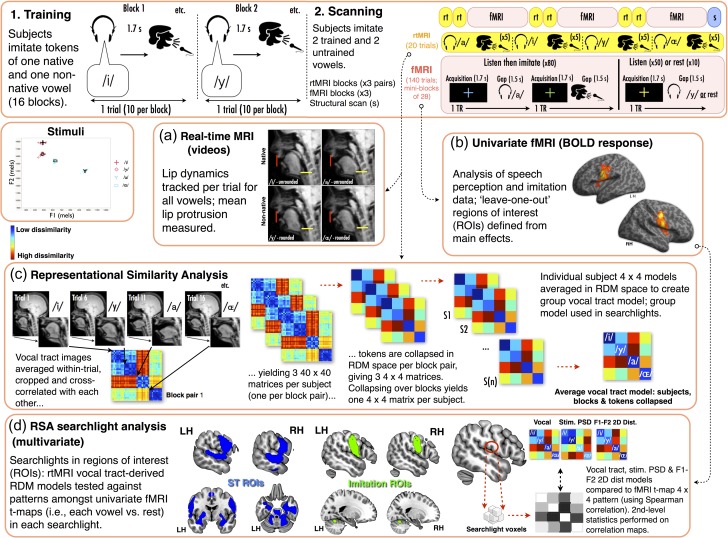
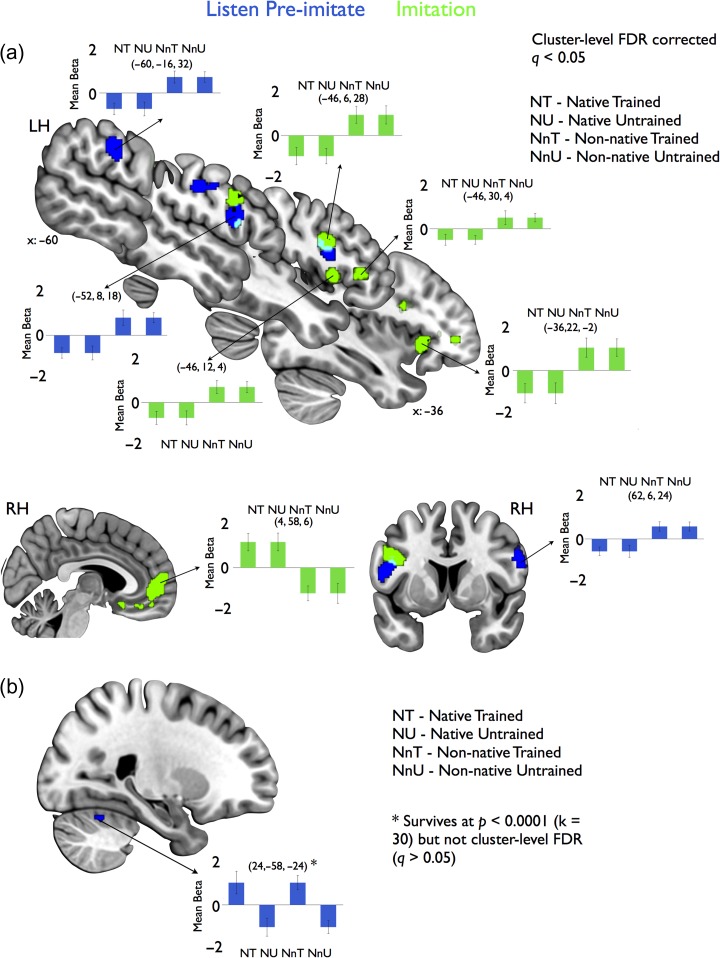
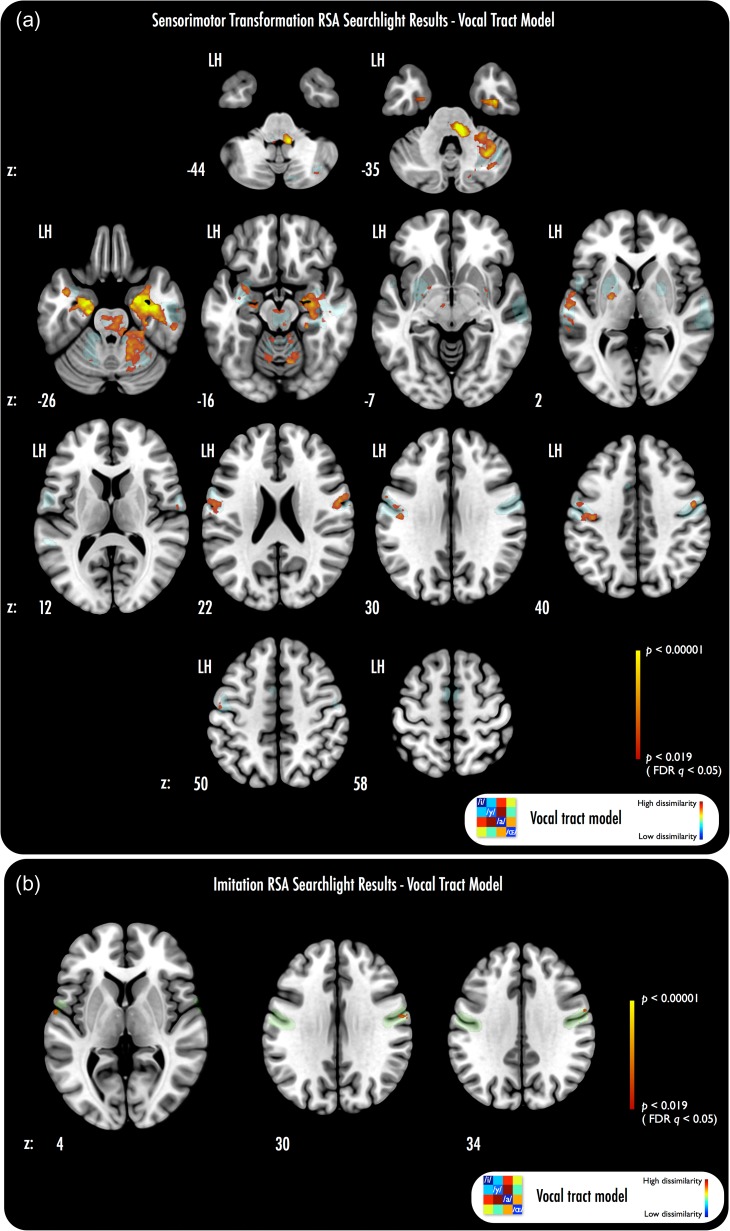
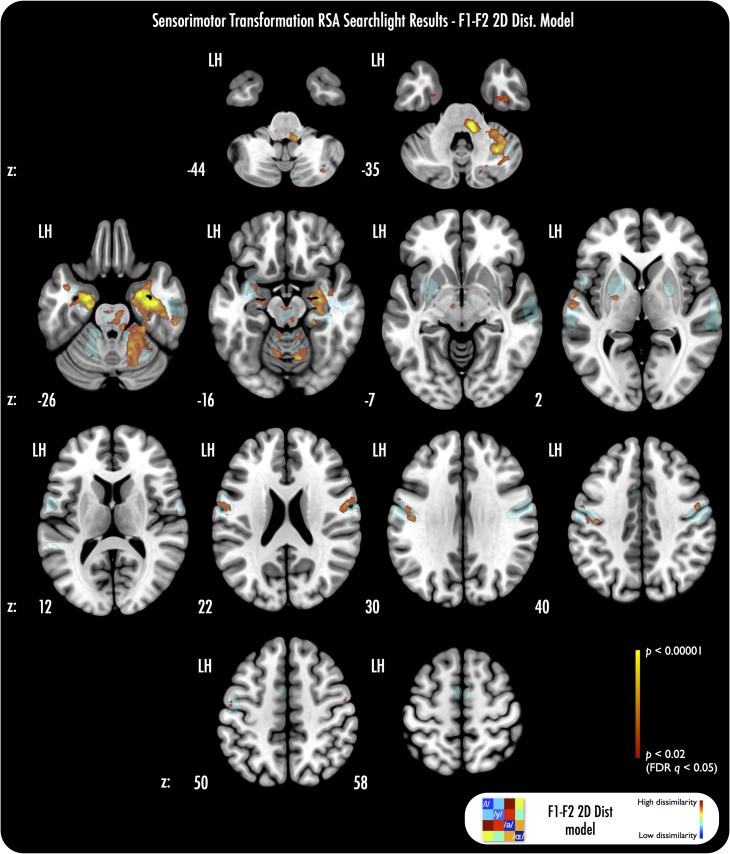
Imitating speech necessitates the transformation from sensory targets to vocal tract motor output, yet little is known about the representational basis of this process in the human brain. Here, we address this question by using real-time MR imaging (rtMRI) of the vocal tract and functional MRI (fMRI) of the brain in a speech imitation paradigm. Participants trained on imitating a native vowel and a similar nonnative vowel that required lip rounding. Later, participants imitated these vowels and an untrained vowel pair during separate fMRI and rtMRI runs. Univariate fMRI analyses revealed that regions including left inferior frontal gyrus were more active during sensorimotor transformation (ST) and production of nonnative vowels, compared with native vowels; further, ST for nonnative vowels activated somatomotor cortex bilaterally, compared with ST of native vowels. Using test representational similarity analysis (RSA) models constructed from participants' vocal tract images and from stimulus formant distances, we found that RSA searchlight analyses of fMRI data showed either type of model could be represented in somatomotor, temporal, cerebellar, and hippocampal neural activation patterns during ST. We thus provide the first evidence of widespread and robust cortical and subcortical neural representation of vocal tract and/or formant parameters, during prearticulatory ST.
Overview
The claims and statistics of this paper haven’t been checked yet.
Free: it reads the open-access text and checks the first 5 claims that cite a source we can check. Create a free account to check every claim.
Integrity signals
Registry
Cites
Statistics
Figures
Verification
Claims the paper makes
The claims and statistics of this paper haven’t been checked yet.
Free: it reads the open-access text and checks the first 5 claims that cite a source we can check. Create a free account to check every claim.
Claims other papers make about this one
Each is checked against this paper’s own text: does it say what the citing paper says it does?
The source backs part of the claim, not all of it — or backs it for a different population, condition or comparison.
In the citing paper
“Therefore, animation of a facial avatar to accompany synthesized speech and further embody the user is a promising means towards naturalistic communication, and it may be possible via decoding of articulatory and orofacial representations in the speech-motor cortex22–25.”
From A high-performance neuroprosthesis for speech decoding and avatar control (2023) · cites this paper as [24]
Experimental — accuracy not yet measuredThe cited source says what the claim attributes to it.
In the citing paper
“In healthy speakers, neural representations in the SMC (comprising the precentral and postcentral gyri) encode articulatory movements of the orofacial musculature22,24,30.”
From A high-performance neuroprosthesis for speech decoding and avatar control (2023) · cites this paper as [24]
Experimental — accuracy not yet measured
Self-check
Percentages, sums and reported differences re-computed from the paper’s own numbers.
The self-check needs the paper’s full text.
Citations
Cites
Kleiner, M., Brainard, D. H., & Pelli, D. G. (2007) · MPG.PuRe (Max Planck Society) · Cited by 6,195
The cortical organization of speech processing
Hickok, G., & Poeppel, D. (2007) · Nature Reviews Neuroscience · doi:10.1038/nrn2113 · Cited by 5,495 · cited 2×
“While some have argued for a central role of posterior Sylvian regions (Sylvian-parietal-temporal) in transforming from sensory representations to motor output (Hickok and Buchsbaum 2003; Hickok and Poeppel 2007; Hickok et al. 2009; Hickok 2012), others have failed to support these claims (Parker-Jones et al.”
ResultPerception of the speech code.
Liberman, A. M., Cooper, F. S., Shankweiler, D. P., & Studdert-Kennedy, M. (1967) · Psychological Review · doi:10.1037/h0020279 · Cited by 3,722 · cited 2×
“lation, during initial perception of the speech signal (Liberman et al. 1967).”
BackgroundRepresentational similarity analysis-connecting the branches of systems neuroscience
Kriegeskorte, N. (2008) · Frontiers in Systems Neuroscience · doi:10.3389/neuro.06.004.2008 · Cited by 3,355
Information-based functional brain mapping
Kriegeskorte, N., Goebel, R., & Bandettini, P. (2006) · Proceedings of the National Academy of Sciences · doi:10.1073/pnas.0600244103 · Cited by 2,113 · cited 11×
“Moreover, the potential to use searchlight analyses, where representations are tested iteratively at adjacent locations within a brain volume (Kriegeskorte et al. 2006), offers a powerful method for probing the neural substrates that support these speech representations (e.g., Evans and Davis 2015).”
BackgroundMethodInfluentialIdentification of a pathway for intelligible speech in the left temporal lobe
Scott, S. K. (2000) · Brain · doi:10.1093/brain/123.12.2400 · Cited by 1,160 · cited 1×
“…which permits unrestricted reuse, distribution, and reproduction in any medium, provided the original work is properly cited. perception have received mixed support (e.g., Pulvermüller et al. 2006; D’Ausilio et al. 2009; Möttönen and Watkins 2009; cf., Scott et al. 2000).”
BackgroundPhonetic Feature Encoding in Human Superior Temporal Gyrus
Mesgarani, N., Cheung, C., Johnson, K., & Chang, E. F. (2014) · Science · doi:10.1126/science.1245994 · Cited by 993 · cited 5×
“ST reflects the process of converting from an input speech acoustic signal (heard or imagined) to the phonemic and motor representations needed to execute the articulatory gestures that enable production of the perceived speech input (Wilson and Iacoboni 2006; Mesgarani et al. 2014; Parker-Jones et al. 2014).”
BackgroundInfluentialRepresentational geometry: integrating cognition, computation, and the brain
Kriegeskorte, N., & Kievit, R. A. (2013) · Trends in Cognitive Sciences · doi:10.1016/j.tics.2013.06.007 · Cited by 911
Computational neuroanatomy of speech production
Hickok, G. (2012) · Nature Reviews Neuroscience · doi:10.1038/nrn3158 · Cited by 837 · cited 2×
“While some have argued for a central role of posterior Sylvian regions (Sylvian-parietal-temporal) in transforming from sensory representations to motor output (Hickok and Buchsbaum 2003; Hickok and Poeppel 2007; Hickok et al. 2009; Hickok 2012), others have failed to support these claims (Parker-Jones et al.”
BackgroundResultHierarchical Processing in Spoken Language Comprehension
Davis, M. H., & Johnsrude, I. S. (2003) · The Journal of Neuroscience · doi:10.1523/jneurosci.23-08-03423.2003 · Cited by 772
Cited by
A high-performance neuroprosthesis for speech decoding and avatar control
Metzger, S. L., Littlejohn, K. T., Silva, A. B., Moses, D. A., Seaton, M. P., Wang, R., Dougherty, M. E., Liu, J. R., Wu, P., Berger, M. A., et al. (2023) · Nature · doi:10.1038/s41586-023-06443-4 · Cited by 522
Real-time decoding of question-and-answer speech dialogue using human cortical activity
Moses, D. A., Leonard, M. K., Makin, J. G., & Chang, E. F. (2019) · Nature Communications · doi:10.1038/s41467-019-10994-4 · Cited by 224
Metzger, S. L., Liu, J. R., Moses, D. A., Dougherty, M. E., Seaton, M. P., Littlejohn, K. T., Chartier, J., Anumanchipalli, G. K., Tu-Chan, A., Ganguly, K., et al. (2022) · Nature Communications · doi:10.1038/s41467-022-33611-3 · Cited by 153
A streaming brain-to-voice neuroprosthesis to restore naturalistic communication
Littlejohn, K. T., Cho, C. J., Liu, J. R., Silva, A. B., Yu, B., Anderson, V. R., Kurtz-Miott, C. M., Brosler, S., Kashyap, A., Hallinan, I. P., et al. (2025) · Nature Neuroscience · doi:10.1038/s41593-025-01905-6 · Cited by 133
Analysis of speech production real-time MRI
Ramanarayanan, V., Tilsen, S., Proctor, M., Töger, J., Goldstein, L. M., Nayak, K. S., & Narayanan, S. S. (2018) · Computer Speech & Language · doi:10.1016/j.csl.2018.04.002 · Cited by 90
Silva, A. B., Liu, J. R., Metzger, S. L., Bhaya-Grossman, I., Dougherty, M. E., Seaton, M. P., Littlejohn, K. T., Tu-Chan, A., Ganguly, K., Moses, D. A., et al. (2024) · Nature Biomedical Engineering · doi:10.1038/s41551-024-01207-5 · Cited by 67
Correia, J., Caballero‐Gaudes, C., Guediche, S., & Carreiras, M. (2020) · Scientific Reports · doi:10.1038/s41598-020-61435-y · Cited by 53
Reconstructing neural representations of tactile space
Tamè, L., Tucciarelli, R., Sadibolova, R., Sereno, M. I., & Longo, M. R. (2021) · NeuroImage · doi:10.1016/j.neuroimage.2021.117730 · Cited by 42
Speech Movement Variability in People Who Stutter: A Vocal Tract Magnetic Resonance Imaging Study
Wiltshire, C. E. E., Chiew, M., Chesters, J., Healy, M. P., & Watkins, K. E. (2021) · Journal of Speech Language and Hearing Research · doi:10.1044/2021_jslhr-20-00507 · Cited by 30
“Vocal tract MRI (vtMRI) offers the opportunity to view the movements of the entire vocal tract, from larynx to lips at good temporal (10 – 100 Hz) and spatial resolution (1 – 2 mm 2 ; Carey et al., 2017; Kim et al., 2014; Niebergall et al., 2013; Ramanarayanan et al., 2013).”
Zhang, W., Liu, Y., Wang, X., & Tian, X. (2020) · Cognitive Neuroscience · doi:10.1080/17588928.2020.1792868 · Cited by 26
“We then derived the PSD matrix of each syllable, using a Goertzel discrete Fourier transform spectrogram algorithm (range 0.1–5000 Hz; 260 window length; 0.1 Hz increment) (see Carey et al., 2017, for previous use of the same settings).”
BackgroundMethodResultInfluentialRuthven, M., Miquel, M. E., & King, A. P. (2020) · Computer Methods and Programs in Biomedicine · doi:10.1016/j.cmpb.2020.105814 · Cited by 28
Self-citationSingers show enhanced performance and neural representation of vocal imitation
Waters, S., Kanber, E., Lavan, N., Belyk, M., Carey, D., Cartei, V., Lally, C., Miquel, M. E., & McGettigan, C. (2021) · Philosophical Transactions of the Royal Society B Biological Sciences · doi:10.1098/rstb.2020.0399 · Cited by 23
Self-citationZheng, Y., Zhang, J., Yang, Y., & Xu, M. (2025) · Communications Biology · doi:10.1038/s42003-025-07466-5 · Cited by 22
“This mechanism, rooted in feedback betweenmotor and sensory systems during naturallanguagecommunication,likelyenhancesbothlanguageperception andproduction 94 .”
Inhibition of Manual Movements at Speech Arrest Sites in the Posterior Inferior Frontal Lobe
Breshears, J. D., Southwell, D. G., & Chang, E. F. (2018) · Neurosurgery · doi:10.1093/neuros/nyy592 · Cited by 18
Real-time speech MRI datasets with corresponding articulator ground-truth segmentations
Ruthven, M., Peplinski, A., Adams, D. M., King, A. P., & Miquel, M. E. (2023) · Scientific Data · doi:10.1038/s41597-023-02766-z · Cited by 13
“Real-time speech MRI techniques that only require more widely available standard equipment and software have been developed 15–18 .”
BackgroundMethodSelf-citationPoor neuro-motor tuning of the human larynx: a comparison of sung and whistled pitch imitation
Belyk, M., Johnson, J. F., & Kotz, S. A. (2018) · Royal Society Open Science · doi:10.1098/rsos.171544 · Cited by 13
Belyk, M., & McGettigan, C. (2022) · Philosophical Transactions of the Royal Society B Biological Sciences · doi:10.1098/rstb.2021.0511 · Cited by 11
“…it is possible to obtain global measures of the whole vocal tract in action while maintaining the ability to additionally analyse and interpret local effects (e.g. Belyk et al., 2019; Carey et al., 2017; Carignan et al., 2019, Narayanan et al., 2014; Waters et al., 2021; Wiltshire et al., 2021).”
BackgroundSelf-citationFunctional brain outcomes of L2 speech learning emerge during sensorimotor transformation
Carey, D., Miquel, M. E., Evans, B. G., Adank, P., & McGettigan, C. (2017) · NeuroImage · doi:10.1016/j.neuroimage.2017.06.053 · Cited by 9
“In line with previous results found by our group, this may reflect differential modulation of default mode network (DMN) regions as a function of task demands (i.e., less suppression of mPFC in the less demanding native conditions; Carey et al., 2017; see also Geranmayeh et al., 2014).”
InfluentialSelf-citationSpeech Kinematics and Coordination Measured With an MEG-Compatible Speech Tracking System
Anastasopoulou, I., Lieshout, P. H. H. M. V., Cheyne, D., & Johnson, B. W. (2022) · Frontiers in Neurology · doi:10.3389/fneur.2022.828237 · Cited by 12
“(55) constructed RSA dissimilarity matrices from real-time MRI measurements of laryngeal movements while participants produced steady-state vowels in a speech imitation paradigm.”
BackgroundTowards Ultrasound Tongue Image prediction from EEG during speech production
Csapó, T. G., Arthur, F. V., Nagy, P., & Boncz, Á. (2023) · Interspeech (USB) · doi:10.21437/interspeech.2023-40 · Cited by 10
“they take into account the articulatory information inferred from the speech signal or from textual contents [15, 16, 17, 18, 11, 19, 20].”
BackgroundMethodBelyk, M., & Kotz, S. A. (2024) · Journal of Neurolinguistics · doi:10.1016/j.jneuroling.2024.101243 · Cited by 6
Ruthven, M., Miquel, M. E., & King, A. P. (2022) · Biomedical Signal Processing and Control · doi:10.1016/j.bspc.2022.104290 · Cited by 6
Self-citationAltered Functional Connectivity and Brain Network Property in Pregnant Women With Cleft Fetuses
Li, Z., Li, C., Liang, Y., Wang, K., Zhang, W., Chen, R., Wu, Q., & Zhang, X. (2019) · Frontiers in Psychology · doi:10.3389/fpsyg.2019.02235 · Cited by 6
“Another fMRI study showed that when adults imitated trained and untrained vowel pair vowel, either type of model could be represented in somatomotor, temporal, cerebellar, and hippocampal neural activation patterns during sensorimotor transformation (ST) (Carey et al., 2017).”
BackgroundRealistic Dynamic Numerical Phantom for MRI of the Upper Vocal Tract
Martin, J., Ruthven, M., Boubertakh, R., & Miquel, M. E. (2020) · Journal of Imaging · doi:10.3390/jimaging6090086 · Cited by 4
“, [10,11]) but also to study singing [12–14] and air-instrument music players [15,16].”
BackgroundSelf-citationAnastasopoulou, I., Cheyne, D., Lieshout, P. H. H. M. V., & Johnson, B. W. (2024) · Frontiers in Human Neuroscience · doi:10.3389/fnhum.2024.1305058 · Cited by 3
Dysphonia discovering using a Goertzel algorithm implementation for vocal signals analysis
Vizza, P., Tradigo, G., Guzzi, P. H., & Veltri, P. (2025) · Journal of Applied Biomedicine · doi:10.1016/j.bbe.2025.07.001 · Cited by 2
Defining brain pathways for human spoken language and vocal learningPreprint
Theofanopoulou, C., & Jarvis, E. D. (2023) · PsyArXiv (OSF Preprints) · doi:10.31234/osf.io/pa5fq · Cited by 2
Belyk, M. (2025) · Oxford University Press eBooks · doi:10.1093/oxfordhb/9780192894700.013.0025 · Cited by 1
Visual and neuropsychological outcomes following paediatric optic pathway glioma
Papini, C. (2020) · Nottingham ePrints (University of Nottingham)
حسن, و. ف. (2021) · المجلة التربوية لکلية التربية بسوهاج · doi:10.21608/edusohag.2021.181928
What's the point of talking? Auditory targets and communicative goals
Meekings, S., & Scott, S. K. (2025) · Journal of Neurolinguistics · doi:10.1016/j.jneuroling.2025.101262
Oxford Handbook of Language and Music Chapter 28: Voice-motor controlPreprint
Belyk, M. (2024) · OSF Preprints (OSF Preprints) · doi:10.31219/osf.io/m365r_v1
Benavides‐Varela, S., Vallesi, A., Weis, L., Mazzonetto, I., Vigna, G., Porru, A., Shallice, T., & Semenza, C. (2026) · Cortex · doi:10.1016/j.cortex.2026.01.012
Defining brain pathways for human spoken language and vocal learningPreprint
Theofanopoulou, C., & Jarvis, E. D. (2026) · PsyArXiv (OSF Preprints) · doi:10.31234/osf.io/pa5fq_v3
Burke, C. J., de Zeeuw, T. J., Grimm, D., Hofer, N., Jensen, A., Mullin, C., & Karl, J. M. (2026) · bioRxiv (Cold Spring Harbor Laboratory) · doi:10.64898/2026.10.03.756058
“In adults, increasingly demanding vocal sensorimotor transformations recruit bilateral somatomotor cortex (36) and children show greater somatomotor engagement than adults during speech motor learning (37).”
Metadata
- Authors
- Carey, D., Miquel, M. E., Evans, B. G., Adank, P., & McGettigan, C.
- Affiliations
- Royal Holloway University of London (GB)
- Queen Mary University of London (GB)
- University College London (GB)
- Corresponding author
- McGettigan, Carolyn
- Venue
- Cerebral Cortex
- Publisher
- Oxford University Press (OUP)
- Published
- 2017-03-18
- Volume
- 27
- Issue
- 5
- Pages
- 3064-3079
- ISSN
- 1047-3211 (ISSN-L)
- 1460-2199
- PMC
- PMC5939209
- OpenAlex
- W2610838041
- Semantic Scholar
- 83e47dc2d53a0da108eb9e8664a57ee9eacf49fa
- Cited by
- 32
- References
- 69
- Citations by year
- 2026: 2 · 2025: 5 · 2024: 3 · 2023: 4 · 2022: 4 · 2021: 4 · 2020: 4 · 2019: 2 · 2018: 3 · 2017: 1
- FWCI
- 1.57
- Type
- journal article
- Language
- en
- Open access
- hybrid
- doi.org
- Licence
- cc-by
- Locations
- Cerebral Cortex (publishedVersion, cc-by)
- Europe PMC (PubMed Central) (publishedVersion, cc-by)
- PubMed Central (publishedVersion, cc-by)
- PubMed (publishedVersion)
- UCL Discovery (University College London) (submittedVersion)
- Queen Mary Research Online (Queen Mary University of London) (submittedVersion, cc-by)
- Funders
- Economic and Social Research Council (ES/L01257X/1)
- Topics
- Life Sciences › Neuroscience › Cognitive Neuroscience › Neurobiology of Language and Bilingualism
- Social Sciences › Psychology › Experimental and Cognitive Psychology › Phonetics and Phonology Research
- Health Sciences › Health Professions › Speech and Hearing › Voice and Speech Disorders
- Keywords
- speech imitation, sensorimotor transformation, vocal tract, real-time MRI, lip rounding, somatomotor cortex, inferior frontal gyrus, neural representation of speech, representational similarity analysis, hippocampus, cerebellum
- MeSH terms
- Adult, Brain Mapping, Female, Humans, Image Processing, Computer-Assisted, Larynx, Lip, Magnetic Resonance Imaging, Male, Oxygen, Palate, Soft, Speech, Speech Acoustics, Tongue, Young Adult, Sensorimotor Cortex
About these checks
Registry, retraction, Cites and statistics results are computed, not judged, with one exception: a printed reference that no index lists is read once by a model before it counts as a citation error. Claims are extracted by a model and kept only when their quote appears verbatim in the text; each cited source is then checked, with a model’s help, for whether it says what the claim relies on. Those verdicts can be wrong — read the claim’s quote and the cited source before relying on one.
Statistics and arithmetic are recomputed, not judged.
Confidence bands are shown only for fields calibrated on our annotated test set. None is calibrated yet, so no band is shown.
What counts as a claim ›How we measure confidence ›How we check this ›
Are you an author, or do you see a problem with this page? Request a review
Data sources
Bibliographic data: Semantic Scholar, OpenAlex, Crossref.
Contains information from the Semantic Scholar Academic Graph Datasets, made available under the ODC Attribution License (ODC-BY 1.0).
Semantic Scholar’s data is described in: Kinney, R., et al. (2023). The Semantic Scholar Open Data Platform. arXiv:2301.10140.
