

Cardiovascular and kidney outcomes with finerenone in patients with type 2 diabetes and chronic kidney disease: the FIDELITY pooled analysis
Open accessThe DOI matches its Crossref record; 30 of the 31 references it cites were found in a registry or an index; 26 of the 33 sources its claims cite were checked for support.
Abstract
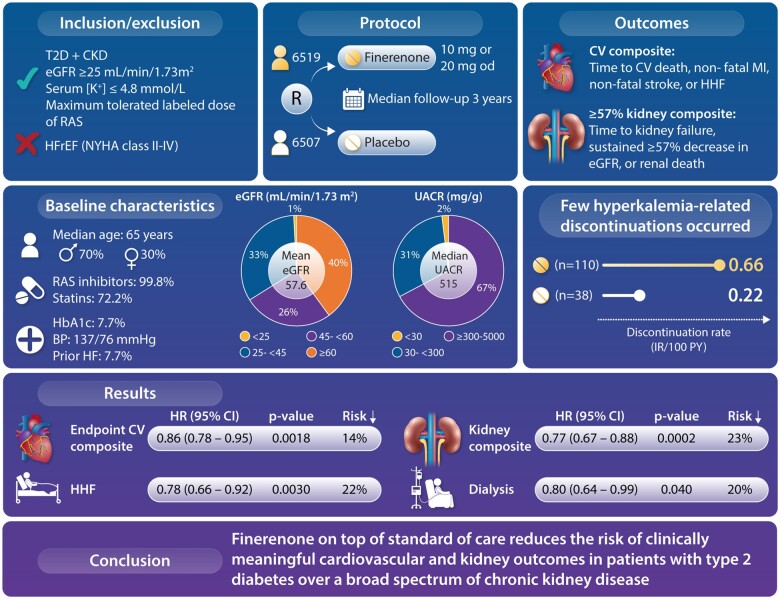
Aims: The complementary studies FIDELIO-DKD and FIGARO-DKD in patients with type 2 diabetes and chronic kidney disease (CKD) examined cardiovascular and kidney outcomes in different, overlapping stages of CKD. The purpose of the FIDELITY analysis was to perform an individual patient-level prespecified pooled efficacy and safety analysis across a broad spectrum of CKD to provide more robust estimates of safety and efficacy of finerenone compared with placebo. Methods and results: For this prespecified analysis, two phase III, multicentre, double-blind trials involving patients with CKD and type 2 diabetes, randomized 1:1 to finerenone or placebo, were combined. Main time-to-event efficacy outcomes were a composite of cardiovascular death, non-fatal myocardial infarction, non-fatal stroke, or hospitalization for heart failure, and a composite of kidney failure, a sustained ≥57% decrease in estimated glomerular filtration rate from baseline over ≥4 weeks, or renal death. Among 13 026 patients with a median follow-up of 3.0 years (interquartile range 2.3–3.8 years), the composite cardiovascular outcome occurred in 825 (12.7%) patients receiving finerenone and 939 (14.4%) receiving placebo [hazard ratio (HR), 0.86; 95% confidence interval (CI), 0.78–0.95; P = 0.0018]. The composite kidney outcome occurred in 360 (5.5%) patients receiving finerenone and 465 (7.1%) receiving placebo (HR, 0.77; 95% CI, 0.67–0.88; P = 0.0002). Overall safety outcomes were generally similar between treatment arms. Hyperkalaemia leading to permanent treatment discontinuation occurred more frequently in patients receiving finerenone (1.7%) than placebo (0.6%). Conclusion: Finerenone reduced the risk of clinically important cardiovascular and kidney outcomes vs. placebo across the spectrum of CKD in patients with type 2 diabetes. Key Question: Does finerenone, a novel selective, nonsteroidal mineralocorticoid receptor antagonist, added to maximum tolerated renin–angiotensin system inhibition reduce cardiovascular disease and kidney disease progression over a broad range of chronic kidney disease in patients with type 2 diabetes? Key Finding: In a prespecified, pooled individual-level analysis from two randomized trials, we found reductions both in cardiovascular events and kidney failure outcomes with finerenone. Because 40% of the patients had an estimated glomerular filtration rate of >60 mL/min/1.73m2 they were identified solely on the basis of albuminuria. Take Home Message: Finerenone reduces the risk of clinical cardiovascular outcomes and kidney disease progression in a broad range of patients with chronic kidney disease and type 2 diabetes. Screening for albuminuria to identify at-risk patients among patients with type 2 diabetes facilitates reduction of both cardiovascular and kidney disease burden.
Overview
CoChat Summary
TL;DR
In a prespecified pooled analysis of FIDELIO-DKD and FIGARO-DKD (13,026 patients with type 2 diabetes and CKD), finerenone reduced composite cardiovascular and kidney outcomes versus placebo. Hyperkalaemia was more frequent with finerenone but rarely led to permanent discontinuation, and no fatal hyperkalaemia occurred.
Key findings
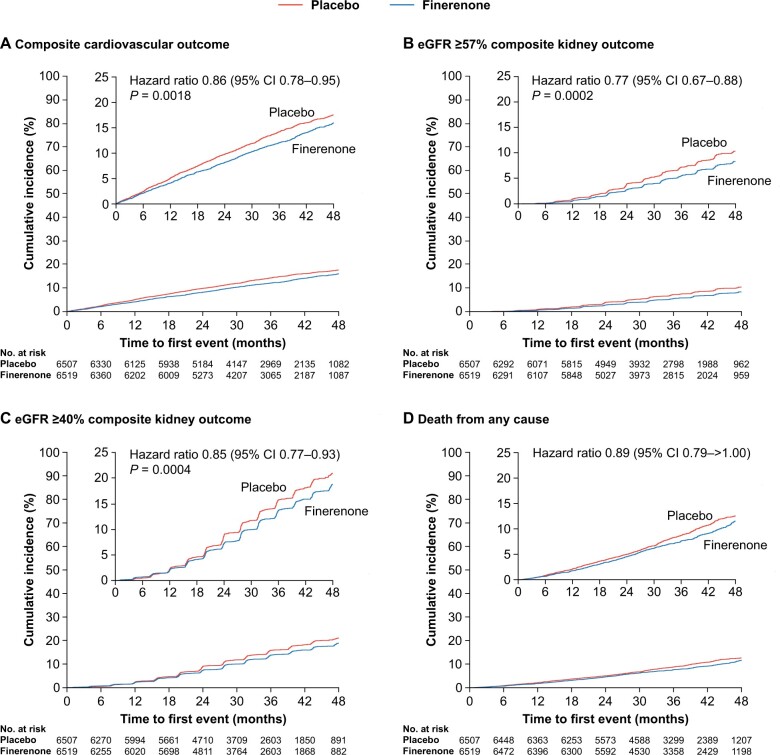
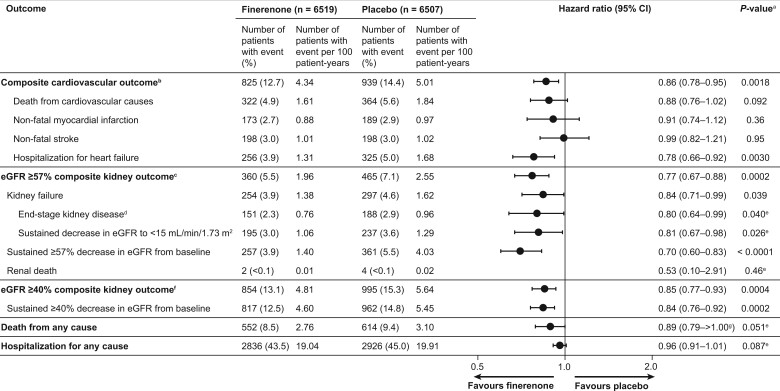
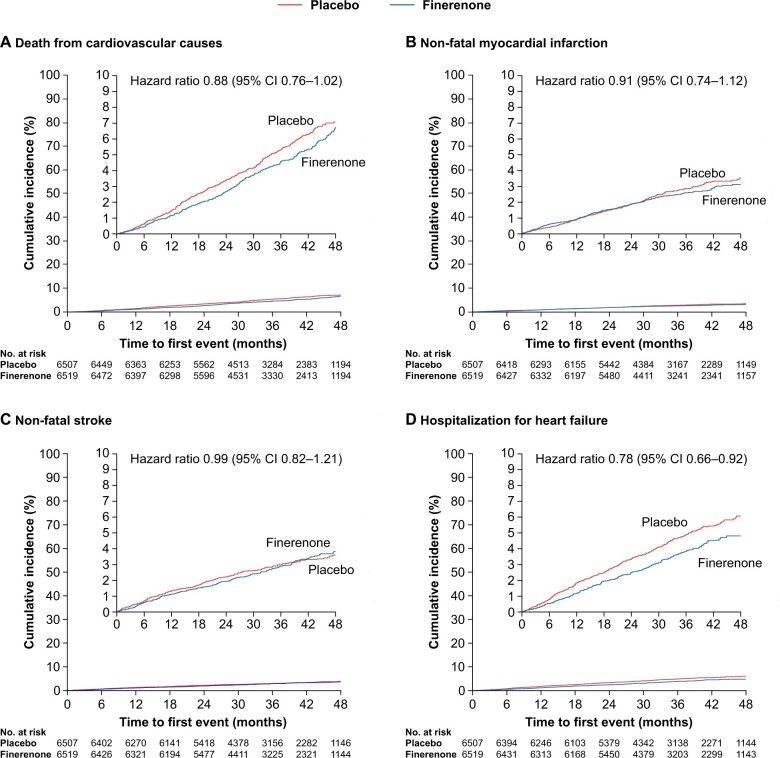
- The composite cardiovascular outcome (cardiovascular death, non-fatal MI, non-fatal stroke, or hospitalization for heart failure) occurred in 825 (12.7%) finerenone patients vs 939 (14.4%) placebo patients (HR 0.86; 95% CI 0.78–0.95; P=0.0018).
- The composite kidney outcome (kidney failure, sustained ≥57% eGFR decrease over ≥4 weeks, or renal death) occurred in 360 (5.5%) finerenone patients vs 465 (7.1%) placebo patients (HR 0.77; 95% CI 0.67–0.88; P=0.0002).
- Hospitalization for heart failure was lower with finerenone (HR 0.78; 95% CI 0.66–0.92; P=0.0030); sustained ≥57% eGFR decrease had HR 0.70 (95% CI 0.60–0.83; P<0.0001) and ESKD had HR 0.80 (95% CI 0.64–0.99; P=0.040).
- Hyperkalaemia leading to permanent treatment discontinuation occurred in 1.7% of finerenone patients vs 0.6% of placebo patients; hyperkalaemia-related adverse events occurred in 14.0% vs 6.9%, with no fatal hyperkalaemia.
Methods
- Prespecified pooled individual patient-level analysis of two phase III, multicentre, double-blind, placebo-controlled trials (FIDELIO-DKD and FIGARO-DKD) in adults with type 2 diabetes and CKD on maximum tolerated ACEi or ARB, randomized 1:1 to finerenone or placebo.
- The full analysis set included 13,026 patients after prospective exclusion of 145 patients with critical Good Clinical Practice violations; median follow-up was 3.0 years (IQR 2.3–3.8), mean eGFR was 57.6 mL/min/1.73 m², and median UACR was 515 mg/g.
- Outcomes were analyzed with stratified Cox proportional hazards models using stratification factors including study, region, eGFR category, albuminuria category, and history of cardiovascular disease; P-values came from stratified log-rank tests, and analyses were prespecified exploratory without multiplicity adjustment.
Limitations
- Stated in the paper: the analysis did not include patients with non-albuminuric CKD, and only a small proportion of Black patients were included.
- Stated in the paper: SGLT-2 inhibitors emerged as therapeutic options after the trials were designed; some patients received these agents at baseline, and combination efficacy/safety was not tested in a randomized combination trial.
- Evident from the text: statistical tests were exploratory rather than hypothesis-confirming and no multiplicity adjustment was performed; patients with chronic symptomatic heart failure with reduced ejection fraction were excluded, limiting generalizability to that population.
Model-written summary. Check it against the paper before relying on it.
Integrity signals
Registry
Cites
Statistics
Figures
Verification
Claims the paper makes
14 Valid · 2 Not valid · 2 Not checked · 76 Own results and interpretations
The cited sources that could be checked couldn’t confirm or dispute this claim.
In the paper
“Patient characteristics, medications, and demographics at baseline were balanced between patients randomized to finerenone and placebo (Table 2 and Supplementary material online, Table S1; published previously3).”
§ Cardiovascular and kidney outcomes with finerenone in patients with type 2 diabetes and chronic kidney disease: the FIDELITY pooled analysis > Results
What the sources say
- Could not verifycites [3] Agarwal R, Anker SD, Bakris G et al; FIDELIO-DKD and FIGARO-DKD Investigators. Investigating new treatment opportunities for patients with chronic kidney disease in type 2 diabetes: the role of finerenone. Nephrol Dial Transplant 2020. doi:10.1093/ndt/gfaa294. PMC9130026 33280027 sourceExperimental — accuracy not yet measured
Table 1 in the FINERENONE PHASE II PROGRAM section reports baseline demographics, clinical characteristics, and medications by trial and in combination, not by finerenone versus placebo assignment. The FINERENONE PHASE III PROGRAM section identifies the trials as randomized and placebo-controlled, but the passages found do not establish that baseline characteristics were balanced between treatment arms (searched for baseline balance and finerenone–placebo group comparisons). (LLM, conf=0.76)
plain- Asserted: passes — The authors put it forward as true.
- Checkable: passes — It can be checked against evidence.
- Load-bearing: passes — The paper’s conclusions depend on it.
- Based: passes — The paper gives a reason why it holds.
- Could not verify
The cited sources that could be checked couldn’t confirm or dispute this claim.
In the paper
“Compared with patients with advanced kidney disease, who are more likely to progress to dialysis, patients with better preserved estimated glomerular filtration rate (eGFR) have a greater lifetime risk of cardiovascular morbidity such as heart failure, myocardial infarction (MI), stroke, or dying from cardiovascular causes.7”
§ Cardiovascular and kidney outcomes with finerenone in patients with type 2 diabetes and chronic kidney disease: the FIDELITY pooled analysis > Introduction
What the sources say
- Could not verifycites [7] Bakris GL, Agarwal R, Anker SD et al; FIDELIO-DKD Investigators. Effect of finerenone on chronic kidney disease outcomes in type 2 diabetes. N Engl J Med 2020; 383: 2219– 2229. 33264825 sourceExperimental — accuracy not yet measured
The Outcomes section defines kidney failure to include long-term dialysis, and the Discussion describes cardiovascular events in a trial whose participants mostly had advanced CKD. Neither passage compares lifetime cardiovascular risk in patients with better-preserved eGFR against those with advanced kidney disease. Searches for that comparison and for preserved eGFR found no supporting passage in our copy; page numbers were not provided. (LLM, conf=0.76)
plainstates an association- Asserted: passes — The authors put it forward as true.
- Checkable: passes — It can be checked against evidence.
- Load-bearing: unclear — It is unclear whether the paper’s conclusions depend on it.
- Based: passes — The paper gives a reason why it holds.
- Could not verify
The cited sources support only part of this claim — read each source’s verdict below.
In the paper
“In FIGARO-DKD, finerenone significantly reduced the primary cardiovascular composite outcome risk in a broader patient population than studied in FIDELIO-DKD (patients with stage 2–4 CKD and moderately increased albuminuria, or stage 1–2 CKD with severely increased albuminuria).7 , 10”
§ Cardiovascular and kidney outcomes with finerenone in patients with type 2 diabetes and chronic kidney disease: the FIDELITY pooled analysis > Introduction
What the sources say
- Partly supportedcites [7] Bakris GL, Agarwal R, Anker SD et al; FIDELIO-DKD Investigators. Effect of finerenone on chronic kidney disease outcomes in type 2 diabetes. N Engl J Med 2020; 383: 2219– 2229. 33264825 sourceExperimental — accuracy not yet measured
Split into 2 atoms — 0 confirmed, 2 partially supported, 0 disputed, 0 misattributed, 0 unverifiable. Expand the claim to see per-atom verdicts.
- Supportedcites [10] Pitt B, Filippatos G, Agarwal R et al; FIGARO-DKD Investigators. Cardiovascular events with finerenone in kidney disease and type 2 diabetes. N Engl J Med 2021. doi:10.1056/NEJMoa2110956. 34449181 source
Split into 2 atoms — 2 confirmed, 0 partially supported, 0 disputed, 0 misattributed, 0 unverifiable. Expand the claim to see per-atom verdicts.
plainstates a cause- Asserted: passes — The authors put it forward as true.
- Checkable: passes — It can be checked against evidence.
- Load-bearing: passes — The paper’s conclusions depend on it.
- Based: passes — The paper gives a reason why it holds.
- Partly supported
The cited sources support only part of this claim — read each source’s verdict below.
In the paper
“Patients with chronic kidney disease (CKD) and type 2 diabetes have high residual cardiorenal morbidity and mortality, despite current therapies,1–5”
§ Cardiovascular and kidney outcomes with finerenone in patients with type 2 diabetes and chronic kidney disease: the FIDELITY pooled analysis > Introduction
What the sources say
- Supportedcites [1] Alicic RZ, Rooney MT, Tuttle KR. Diabetic kidney disease: challenges, progress, and possibilities. Clin J Am Soc Nephrol 2017; 12: 2032– 2045. 28522654 PMC5718284 source
The Abstract states that diabetic kidney disease carries substantial cardiovascular mortality and that a large risk of kidney disease onset and progression remains despite current therapies. The Treatment of DKD passage specifically discusses patients with type 2 diabetes and CKD, noting persistent cardiovascular and kidney risks under treatment. (LLM, conf=0.90)
- Supportedcites [2] Perkovic V, Jardine MJ, Neal B et al; CREDENCE Trial Investigators. Canagliflozin and renal outcomes in type 2 diabetes and nephropathy. N Engl J Med 2019; 380: 2295– 2306. 30990260 source
The Patients section states that participants with type 2 diabetes and chronic kidney disease were required to receive ACE-inhibitor or angiotensin-receptor-blocker therapy. The Secondary and Exploratory Outcomes table reports substantial kidney and cardiovascular event rates, including deaths, in the placebo group despite that background treatment. Page numbers were not supplied for these passages. (LLM, conf=0.88)
- Supportedcites [3] Agarwal R, Anker SD, Bakris G et al; FIDELIO-DKD and FIGARO-DKD Investigators. Investigating new treatment opportunities for patients with chronic kidney disease in type 2 diabetes: the role of finerenone. Nephrol Dial Transplant 2020. doi:10.1093/ndt/gfaa294. PMC9130026 33280027 source
The Introduction states that, despite ACE inhibitor or ARB treatment and concomitant SGLT2 inhibitor use, patients with CKD and type 2 diabetes retain a risk of progression to end-stage kidney disease and cardiovascular morbidity and mortality. The Conclusions also describe patients at high cardiorenal risk despite standard care. (LLM, conf=0.94)
- Partly supportedcites [4] Neuen BL, Young T, Heerspink HJL et al SGLT2 inhibitors for the prevention of kidney failure in patients with type 2 diabetes: a systematic review and meta-analysis. Lancet Diabetes Endocrinol 2019; 7: 845– 854. 31495651 sourceExperimental — accuracy not yet measured
The Introduction says that residual kidney risk remains high despite recommended ACE inhibitor or ARB treatment for people with type 2 diabetes who have, or are at risk of, kidney disease. The Results include cardiovascular or kidney death in a composite outcome, but the paper does not establish the claimed high residual cardiovascular morbidity and mortality in patients with both CKD and type 2 diabetes. (LLM, conf=0.83)
- Not checked — no full text of the sourcecites [5] Zelniker TA, Wiviott SD, Raz I et al Comparison of the effects of glucagon-like peptide receptor agonists and sodium-glucose cotransporter 2 inhibitors for prevention of major adverse cardiovascular and renal outcomes in type 2 diabetes mellitus. Circulation 2019; 139: 2022– 2031. 30786725 source
plain- Asserted: passes — The authors put it forward as true.
- Checkable: passes — It can be checked against evidence.
- Load-bearing: passes — The paper’s conclusions depend on it.
- Based: passes — The paper gives a reason why it holds.
- Supported
Every source the paper cites for this claim was checked and supports it.
In the paper
“They investigated the efficacy and safety of finerenone, on top of maximum tolerated renin–angiotensin system inhibition, on kidney and cardiovascular outcomes in patients with mild-to-severe CKD in type 2 diabetes (Supplementary material online, Figure S1).3”
§ Cardiovascular and kidney outcomes with finerenone in patients with type 2 diabetes and chronic kidney disease: the FIDELITY pooled analysis > Introduction
What the sources say
- Supportedcites [3] Agarwal R, Anker SD, Bakris G et al; FIDELIO-DKD and FIGARO-DKD Investigators. Investigating new treatment opportunities for patients with chronic kidney disease in type 2 diabetes: the role of finerenone. Nephrol Dial Transplant 2020. doi:10.1093/ndt/gfaa294. PMC9130026 33280027 source
The FINERENONE PHASE III PROGRAM section describes FIDELIO-DKD and FIGARO-DKD as trials of finerenone’s efficacy and safety for kidney and cardiovascular outcomes in patients with CKD and type 2 diabetes. Its comparison-of-populations subsection says participants received maximum tolerated labeled doses of an ACE inhibitor or ARB, and describes the trials’ inclusion of patients with preserved kidney function as well as those at high cardiorenal risk. Page numbers are not available in our copy. (LLM, conf=0.94)
plainstates a cause- Asserted: passes — The authors put it forward as true.
- Checkable: passes — It can be checked against evidence.
- Load-bearing: passes — The paper’s conclusions depend on it.
- Based: passes — The paper gives a reason why it holds.
- Supported
55 more claims · 5 with their cited sources checked
Create a free account to see all 94 claims and every source verdict.
- It may state two separate claims as one. 17
- Probably not a substantial claim. 23
Claims other papers make about this one
Each is checked against this paper’s own text: does it say what the citing paper says it does?
The source backs part of the claim, not all of it — or backs it for a different population, condition or comparison.
In the citing paper
“Sub-group analyses considering those co-prescribed MRA and SGLT2 inhibitors suggest their combined use does not modify safety findings from the key trials.150,189,[722][723][724][725][726]”
From 2023 ESC guidelines for the management of cardiovascular disease in patients with diabetes. (2023) · cites this paper as [722]
Experimental — accuracy not yet measuredThe source backs part of the claim, not all of it — or backs it for a different population, condition or comparison.
In the citing paper
“The pooled FIDELITY trial analysis confirms and strengthens the positive cardiovascular and kidney outcomes with finerenone across the spectrum of CKD, irrespective of baseline ASCVD history (with the exclusion of those with heart failure with reduced ejection fraction).”
From 11. Chronic Kidney Disease and Risk Management: Standards of Care in Diabetes—2025 (2025) · cites this paper as [127]
Experimental — accuracy not yet measuredThe source backs part of the claim, not all of it — or backs it for a different population, condition or comparison.
In the citing paper
“It also demonstrated a 23% reduction in the composite kidney outcome, consisting of sustained $57% decrease in eGFR from baseline over $4 weeks, or renal death, for finerenone vs. placebo (5.5% vs. 7.1%; HR 0.77 [95% CI 0.670.88];P = 0.0002).”
From 11. Chronic Kidney Disease and Risk Management: Standards of Care in Diabetes—2025 (2025) · cites this paper as [127]
Experimental — accuracy not yet measuredThe source backs part of the claim, not all of it — or backs it for a different population, condition or comparison.
In the citing paper
“and a lower incidence of kidney failure, de fi ned as initiation of chronic dialysis or kidney transplantation (HR: 0.80; 95% CI: 0.64 -0.99).”
From KDIGO 2022 Clinical Practice Guideline for Diabetes Management in Chronic Kidney Disease (2022) · cites this paper as [165]
Experimental — accuracy not yet measuredThe source backs part of the claim, not all of it — or backs it for a different population, condition or comparison.
In the citing paper
“HR: 0.79; 95% CI: 0.52 -1.11 among 944 participants using a GLP-1 RA”
From KDIGO 2022 Clinical Practice Guideline for Diabetes Management in Chronic Kidney Disease (2022) · cites this paper as [165]
Experimental — accuracy not yet measured
23 more claims about this paper
Create a free account to see every claim other papers make about this one.
Self-check
Percentages, sums and reported differences re-computed from the paper’s own numbers.
Rated minor: it would not touch a result — a value no result rests on, a p-value that stays on the same side of the significance level, or a conflict that is clerical, resolved elsewhere in the paper, or outside its own findings.
In the paper
“| Others | 385 (5.9) | 356 (5.4) | 741 (5.8) |”
§ Cardiovascular and kidney outcomes with finerenone in patients with type 2 diabetes and chronic kidney disease: the FIDELITY pooled analysis > Results
Reported 5.8 · recomputed 5.688623
Citations
Cites
McDonagh, T. A., Metra, M., Adamo, M., Gardner, R. S., Baumbach, A., Böhm, M., Burri, H., Butler, J., Čelutkienė, J., Chioncel, O., et al. (2021) · European Heart Journal · doi:10.1093/eurheartj/ehab670 · Cited by 19,442
2013 ACCF/AHA Guideline for the Management of Heart Failure
Yancy, C. W., Jessup, M., Bozkurt, B., Butler, J., Casey, D. E., Drazner, M. H., Fonarow, G. C., Geraci, S. A., Horwich, T., Januzzi, J. L., et al. (2013) · Journal of the American College of Cardiology · doi:10.1016/j.jacc.2013.05.019 · Cited by 12,536
Ahmed, A., Jorna, T., & Bhandari, S. (2016) · Nephron · doi:10.1159/000447068 · Cited by 11,717
2016 ESC Guidelines for the diagnosis and treatment of acute and chronic heart failure
Ponikowski, P., Voors, A. A., Anker, S. D., Bueno, H., Cleland, J. G. F., Coats, A. J. S., Falk, V., González-Juanatey, J. R., Harjola, V.-P., Jankowska, E. A., et al. (2016) · European Heart Journal · doi:10.1093/eurheartj/ehw128 · Cited by 11,429
Self-citationBrenner, B. M., Cooper, M. E., de Zeeuw, D., Keane, W. F., Mitch, W. E., Parving, H.-H., Remuzzi, G., Snapinn, S. M., Zhang, Z., & Shahinfar, S. (2001) · New England Journal of Medicine · doi:10.1056/nejmoa011161 · Cited by 7,493
Canagliflozin and Renal Outcomes in Type 2 Diabetes and Nephropathy
Perkovic, V., Jardine, M. J., Neal, B., Bompoint, S., Heerspink, H. J. L., Charytan, D. M., Edwards, R., Agarwal, R., Bakris, G., Bull, S., et al. (2019) · New England Journal of Medicine · doi:10.1056/nejmoa1811744 · Cited by 6,189
Self-citationLewis, E. J., Hunsicker, L. G., Clarke, W. R., Berl, T., Pohl, M. A., Lewis, J. B., Ritz, E., Atkins, R. C., Rohde, R., & Raz, I. (2001) · New England Journal of Medicine · doi:10.1056/nejmoa011303 · Cited by 5,987
Dapagliflozin in Patients with Chronic Kidney Disease
Heerspink, H. J. L., Stefánsson, B. V., Correa-Rotter, R., Chertow, G. M., Greene, T., Hou, F.-F., Mann, J. F. E., McMurray, J. J. V., Lindberg, M., Rossing, P., et al. (2020) · New England Journal of Medicine · doi:10.1056/nejmoa2024816 · Cited by 5,618
Self-citationEffect of finerenone on chronic kidney disease outcomes in type 2 diabetes
Bakris, G. L., Agarwal, R., Anker, S. D., Pitt, B., Ruilope, L. M., Rossing, P., Kolkhof, P., Nowack, C., Schloemer, P., Joseph, A., et al. (2020) · New England Journal of Medicine · doi:10.1056/nejmoa2025845 · Cited by 2,935 · cited 10×
“In FIDELIO-DKD, finerenone significantly reduced the risk of the primary kidney composite outcome and the key secondary cardiovascular composite outcome in patients with predominantly stage 3–4 CKD with severely increased albuminuria and type 2 diabetes.(7) In FIGARO-DKD, finerenone significantly reduced the primary c…”
BackgroundMethodInfluentialSelf-citationDiabetic Kidney Disease: Challenges, Progress, and Possibilities
Alicic, R. Z., Rooney, M. T., & Tuttle, K. R. (2017) · Clinical Journal of the American Society of Nephrology · doi:10.2215/cjn.11491116 · Cited by 2,898
Research works printed but not linked: 2
- United States Renal Data System. Cardiovascular disease in patients with CKD. In: USRDS Annual Data Report. Volume 1: Chronic Kidney Disease. Bethesda, MD: National Institutes of Health, National Institute of Diabetes and Digestive and Kidney Diseases; 2020, Chapter 4. https://adr.usrds.org/2020/chronic-kidney-disease/4-cardiovascular-disease-in-patients-with-ckd (1 June 2021).
- United States Renal Data System. Healthcare expenditures for persons with CKD. In: USRDS Annual Data Report. Volume 1: Chronic Kidney Disease. Bethesda, MD: National Institutes of Health, National Institute of Diabetes and Digestive and Kidney Diseases; 2020 (Chapter 6). https://adr.usrds.org/2020/chronic-kidney-disease/6-healthcare-expenditures-for-persons-with-ckd. (1 July 2021).
Cited by
Items 501–600 of 1,294
Carlino, I., Pirrotta, F., Gennari, L., & Palazzuoli, A. (2025) · Biomedicines · doi:10.3390/biomedicines13071693 · Cited by 6
Ramadan, M. M., Alajmi, S., Aldouseri, J., Alajmi, M., Tello, E., Mahdi, A.-M. O., Aladwani, A. J., AlAyyaf, A. E., Mahdi, O., & Elmahal, M. (2025) · Cureus · doi:10.7759/cureus.87706 · Cited by 8
Aldosterone in Chronic Kidney Disease
Polenus, P., Đuran, A., & Karanović, S. (2025) · Biomedicines · doi:10.3390/biomedicines13092081 · Cited by 11
Han, M., Wang, J., Guo, S., Zhu, H., Zhao, L., Wu, Z., Wu, Y., Guo, J., Liao, J., & Tang, Z. (2025) · Journal of Advanced Research · doi:10.1016/j.jare.2025.10.070 · Cited by 7
“Nonsteroidal mineralocorticoid receptor antagonists (NMRAs) exhibit dual antifibrotic/anti-inflammatory activity while posing hyperkalemia concerns [10,11].”
Mottl, A. K., Scott, C. A. B., Green, J. B., Heerspink, H. J. L., Mann, J. F. E., McGill, J. B., Nangaku, M., Rosenstock, J., Rossing, P. R., Li, L., et al. (2025) · Journal of the American Society of Nephrology · doi:10.1681/asn.0000000928 · Cited by 8
“Studies on fi nerenone and SGLT2i have explored how kidney outcomes are affected by baseline eGFR and UACR, and the data support treating people during early stages of CKD.”
InfluentialSelf-citationEffectiveness and safety of finerenone in IgA nephropathy patients
Yu, K., Li, D., Fan, X., Zhao, K., Wang, C., bai, F., Liu, L., & Yang, X. (2025) · Nephrology Dialysis Transplantation · doi:10.1093/ndt/gfaf240 · Cited by 8
Dong, H., Chang, L., Tian, T., Shi, R., Yu, K., Wang, C., Liu, Z., Jin, Q., Wang, J., He, T., et al. (2025) · Frontiers in Endocrinology · doi:10.3389/fendo.2025.1724965 · Cited by 10
Merolla, A., Valente, V., Basile, C., Benson, L., Cosentino, F., Dahlström, U., Guðbjörnsdóttir, S., Rovere, P. Q., Lund, L. H., Savarese, G., et al. (2025) · Cardiovascular Diabetology · doi:10.1186/s12933-025-02998-w · Cited by 5
“Recently, the non-steroidal mineralocorticoid receptor agonist finerenone, which had already been shown to reduce the risk of car-diorenal outcomes in patients with T2D, demonstrated a benefit on HF-related outcomes in patients with HFmrEF and HFpEF [11, 38].”
Wang, T.-Y., Zhang, L., Wang, H.-Y., & Jiang, F. (2025) · Frontiers in Pharmacology · doi:10.3389/fphar.2025.1725782 · Cited by 7
Li, P., Yang, F., Lou, Y., Zhang, Z., Du, Y., Zhang, J., Ren, Y., Tong, A., Xie, Z., Shi, B., et al. (2026) · Hypertension · doi:10.1161/hypertensionaha.125.26048 · Cited by 7
Cardio-Renal Syndrome: Review and New Perspectives
Martín, M., Fernández, M., Bacigalupe, L. P., & Rozado, J. (2026) · Journal of CardioRenal Medicine · doi:10.3390/jcrm2010004 · Cited by 7
Finerenone Utilization for Chronic Kidney Disease and Diabetes
Lin, W., Schweber, A. B., Xu, Y., Chang, A. R., Farag, Y. M. K., Mukhopadhyay, A., Blecker, S., Horwitz, L. I., Grams, M. E., & Shin, J. (2026) · JACC Advances · doi:10.1016/j.jacadv.2026.102642 · Cited by 5
Bansal, S., Puzantian, H. V., & Townsend, R. R. (2024) · Journal of General Internal Medicine · doi:10.1007/s11606-024-09081-2 · Cited by 8
Albuminuria Prevalence in Fontan Patients: A Systematic Review and Meta-Analysis
Belle, H. V., den Eynde, J. V., Ciepłucha, A., Ladouceur, M., Martinod, K., Piérard, S., Coats, L., Jansen, K., Opotowsky, A. R., Craenenbroeck, A. H. V., et al. (2024) · Pediatric Cardiology · doi:10.1007/s00246-024-03736-x · Cited by 5
Igarashi, A., Ohara, K., Matsuda, H., Morii, J., Jagannathan, S., & Filomeno, R. (2024) · Advances in Therapy · doi:10.1007/s12325-024-03084-5 · Cited by 6
Hsiao, C.-C., Chen, M., Liu, C. Y., Chan, C.-Y., Fang, Y.-W., Liou, H., & Tsai, M. (2025) · Clinical Kidney Journal · doi:10.1093/ckj/sfaf172 · Cited by 11
The role of blood pressure management in stroke prevention: current status and future prospects
Narita, K., Hoshide, S., & Kario, K. (2022) · Expert Review of Cardiovascular Therapy · doi:10.1080/14779072.2022.2137490 · Cited by 6
Rangaswami, J., & Mathew, R. O. (2023) · JAMA Cardiology · doi:10.1001/jamacardio.2023.1512 · Cited by 5
Finerenone in Hispanic Patients With CKD and Type 2 Diabetes: A Post Hoc FIDELITY Analysis
Rosas, S. E., Ruilope, L. M., Anker, S. D., Pitt, B., Rossing, P. R., Bonfanti, A. A. C., Correa‐Rotter, R., González, F., Munoz, C. F. J., Pérgola, P. E., et al. (2023) · Kidney Medicine · doi:10.1016/j.xkme.2023.100704 · Cited by 5
Self-citationShould we enlarge the indication for kidney biopsy in diabetics? The con part
Ortíz, A. (2023) · Clinical Kidney Journal · doi:10.1093/ckj/sfad267 · Cited by 6
“Kidney protection by SGLT2i and MRAs appears to be additive and clinical guidelines support using both in the presence of A2–A3 albuminuria [12 –14 ].”
Background2023 focused update of the 2021 ESC heart failure guidelines: Key messages for clinical practice
Tomasoni, D., Cannata, A. N., Adamo, M., & Metra, M. (2024) · European Journal of Clinical Investigation · doi:10.1111/eci.14163 · Cited by 5
Ткачева, О. Н., Kotovskaya, Y. V., Bobkova, I. N., Шутов, А. М., Вадимовна, В. С., Ефремова, Е. В., Рунихина, Н. К., Eruslanova, K. A., Arutyunov, G. P., Batyushin, М. М., et al. (2024) · Russian Journal of Geriatric Medicine · doi:10.37586/2686-8636-1-2024-6-20 · Cited by 11
Shared decision-making approach to type 2 diabetes management
MacDonald, B. J., McCormack, J. P., & Turgeon, R. D. (2024) · Canadian Family Physician · doi:10.46747/cfp.7005310 · Cited by 7
Liu, Z., Xie, B., Pang, S., Xie, Y., Jili, M., Mo, Z., Li, W., & Yang, R. (2024) · American Journal of Translational Research · doi:10.62347/nrgg6465 · Cited by 6
“The emergence of novel agents like finerenone offers hope for improved outcomes in patients with diabetes mellitus and CKD, emphasizing the ongoing evolution of treat - ment strategies for kidney damage [55].”
BackgroundMontero, N., Oliveras, L., Martínez‐Castelao, A., Górriz, J. L., Soler, M. J., Fernández‐Fernández, B., Quero, M., García-Carro, C., García-Sancho, P., Goicechea, M., et al. (2024) · Nefrología · doi:10.1016/j.nefro.2024.11.002 · Cited by 5
Belay, K. E., Feleke, Y., Alemneh, T. A., Haile, A. M., & Abebe, D. (2024) · Journal of the Endocrine Society · doi:10.1210/jendso/bvae208 · Cited by 6
A Saudi Heart Association Position Statement on Cardiovascular Diseases and Diabetes Mellitus
AlHabeeb, W., Elasfar, A., Kinsara, A. J., Aljizeeri, A. H., Jelaidan, I., Alghalayini, K. W., AlKheraiji., M. F., Akbar, M. A. J., Lawand, S., Alyousif, S. M., et al. (2024) · Journal of the Saudi Heart Association · doi:10.37616/2212-5043.1407 · Cited by 11
“The non-steroidal mineralocorticoid receptor antagonist fi nerenone is another therapeutic option for both CV and kidney failure risk reduction in patients with T2DM and CKD, as con fi rmed in clinical trials [245 e 247].”
Diabetes Mellitus in Kidney Transplant Recipients: New Horizons in Treatment
Sánchez-Baya, M., Bolufer, M., Vázquez, F., Alonso, N., Massó, E., Paúl, J., Coll-Brito, V., Taco, O., Antón-Pàmpols, P., Gelpi, R., et al. (2025) · Journal of Clinical Medicine · doi:10.3390/jcm14041048 · Cited by 7
Biglari, S., Mischak, H., Beige, J., Latosińska, A., Siwy, J., & Banasik, M. (2025) · Biomolecules · doi:10.3390/biom15060809 · Cited by 10
Agarwal, R., & Rifkin, B. S. (2022) · Kidney International Reports · doi:10.1016/j.ekir.2022.01.1049 · Cited by 5
Self-citationLee, C., Lui, D. T. W., Cheung, C. Y. Y., Fong, C. H.-Y., Yuen, M. M. A., Chow, W.-S., Xu, A., & Lam, K. S. L. (2023) · Nephrology Dialysis Transplantation · doi:10.1093/ndt/gfad034 · Cited by 5
“…of reno-protective medications such as sodium glucose co-transporter 2 inhibitors (SGLT2i) and non-steroidal mineralocorticoid receptor antagonist [7 , 8 ], those who are at the highest risk of developing adverse renal outcomes can be targeted for more timely initiation of these agents [5 ].”
Diabetes and vascular disease: New therapeutic avenues
Prato, S. D. (2023) · Vascular Pharmacology · doi:10.1016/j.vph.2023.107247 · Cited by 8
SEC Working Group for the 2023 update of the 2021 ESC guidelines for the diagnosis and treatment of acute and chronic heart failure and SEC Guidelines Committee (2023) · Revista Española de Cardiología (English Edition) · doi:10.1016/j.rec.2023.10.009 · Cited by 6
Drapkina, O. M., Boytsov, S. A., Ageev, F. T., Николаевна, Б. З., Dzhioeva, O. N., Drozdova, L. Y., Ipatov, P. V., Калинина, А. М., Martsevich, S. Y., Savchenko, E. D., et al. (2025) · Primary Health Care (Russian Federation) · doi:10.15829/3034-4123-2025-39 · Cited by 4
Wang, M., Wang, C., Zhao, M., Feng, Z., Li, Y., Li, L., Yao, S., Liu, H., & Xue, H. (2025) · Nutrition Metabolism and Cardiovascular Diseases · doi:10.1016/j.numecd.2025.104191 · Cited by 5
Chen, T., Ou, S., Lin, K.-H., Ho, Y., Tseng, W., Chu, Y.-C., & Tarng, D. (2025) · Clinical Kidney Journal · doi:10.1093/ckj/sfaf247 · Cited by 6
“Finerenone has demonstrated efficacy in reducing cardio-vascular and renal events in patients with CKD and type 2 diabetes, presenting a lower risk of hyperkalemia than steroidal MRAs such as spironolactone [16 –18 ].”
Comprehensive management of chronic kidney disease in the old population
Franco, M. E. P., Puente-García, A., Perez-Belmonte, L. M., Pérez, N., Ellingson, S., & Tornero, F. (2025) · Current Medical Research and Opinion · doi:10.1080/03007995.2025.2551217 · Cited by 5
2025 Update on resistant hypertension in CKD: where do we stand and where do we go?
Schmieder, R. E. (2025) · Clinical Kidney Journal · doi:10.1093/ckj/sfaf285 · Cited by 9
“The FIDELITY pooled analysis, combining data from FIDELIO-DKD and FIGARO-DKD trials, demonstrated a 23% relative risk reduction in kidney disease progression and a 14% reduction in cardiovascular morbidity and mortality compared to placebo [21 ].”
Nugroho, P., Lydia, A., Soewondo, P., Suhardjono, S. S., Timan, I. S., Harimurti, K., & Ali, Z. (2025) · Annals of Medicine · doi:10.1080/07853890.2025.2577271 · Cited by 6
Renal protection in heart failure with reduced ejection fraction: not all that glitters is gold
Russo, E., Venturelli, E., Leoncini, G., Viazzi, F. C., & Pontremoli, R. (2025) · European Journal of Internal Medicine · doi:10.1016/j.ejim.2025.106627 · Cited by 7
Schwartz, A. R., Sosnov, J. A., Brown, J., Delgado, C., Fried, L. F., Tamura, M. K., Morrison, J. W., Navaneethan, S. D., Palevsky, P. M., Rybacki, D. B., et al. (2025) · Annals of Internal Medicine · doi:10.7326/annals-25-03499 · Cited by 6
Advances in the Pharmacological Treatment of Heart Failure With Preserved Ejection Fraction
Valente, V., Beer, B. N., & Savarese, G. (2026) · International Journal of Heart Failure · doi:10.36628/ijhf.2025.0111 · Cited by 10
Current Landscape and Emerging Therapeutic Targets in Diabetic Kidney Disease
Hu, S., Lee, K., He, C., & Fan, Y. (2026) · Clinical Journal of the American Society of Nephrology · doi:10.2215/cjn.0000001053 · Cited by 5
Cardio‐Kidney‐Metabolic Therapy Use Among Adults With Type 1 Diabetes and Chronic Kidney Disease
Caramori, M. L., REPETTO, E., Perkins, C., Pandey, A., & Rossing, P. R. (2026) · Diabetes Obesity and Metabolism · doi:10.1111/dom.70640 · Cited by 6
Self-citationKubica, J., Kubica, A., Ratajczak, J. M., Gajda, R., Szarpak, Ł., & Navarese, E. P. (2026) · Journal of Clinical Medicine · doi:10.3390/jcm15093486 · Cited by 6
Nueva evidencia en el tratamiento de la enfermedad renal diabética: ¿qué aporta la finerenona?
Rico-Fontalvo, J. E., Daza-Arnedo, R., Salcedo, N. A., Alfaro, M., Torrejano, D. N., Cardona-Blanco, M., Uparella-Gulfo, I., Raad-Sarabia, M., Abuabara-Franco, E., & Cabrales, J. (2022) · Revista Colombiana de Nefrología · doi:10.22265/acnef.9.3.603 · Cited by 7
“Los pacientes elegibles en los estudios FIDELIO-DKD y FIGARO-DKD fueron adultos mayores de 18 años con DMT2 y enfermedad renal diabética en tratamiento con dosis máxima toleradas de IECA o ARA II y niveles de potasio menores de 4,8 mmol/L. La enfermedad renal diabética fue definida por cualquiera de los siguientes dos…”
BackgroundInfluentialFinerenone and diabetic renal disease: a narrative review
Venkatesan, K., Cheryeth, M. M. J., Verghese, A. T., Mathews, A. M., Ravisankar, N., Unnikrishnan, P., Prakash, V., Harimohan, H., Haroon, N. N., James, S., et al. (2024) · Endocrine · doi:10.1007/s12020-024-03945-7 · Cited by 7
Pliças, M. M. D., da Silva, B. M., & Almeida, E. (2025) · Nefrología (English Edition) · doi:10.1016/j.nefroe.2025.02.010 · Cited by 3
Benefits of aldosterone receptor antagonism in chronic kidney disease: the BARACK-D RCT
Hobbs, R. F., McManus, R. J., Taylor, C. J., Jones, N. R., Rahman, J. K., Wolstenholme, J. L., Jones, L., Hirst, J. A., Mort, S., & Yu, L. (2025) · Health Technology Assessment · doi:10.3310/pyft6977 · Cited by 4
Rossing, P. R., Birkenfeld, A. L., Fioretto, P., McGill, J. B., Anker, S. D., Pitt, B., Rohwedder, K., Scalise, A. V., Scott, C. A. B., Filippatos, G. S., et al. (2025) · Clinical Journal of the American Society of Nephrology · doi:10.2215/cjn.0000000700 · Cited by 7
Self-citationGe, S., Fu, M., Yang, Q., et al. (2025) · Crystal Growth & Design · doi:10.1021/acs.cgd.5c00241 · Cited by 4
Li, H.-L., Dong, L., Wei, H.-L., Li, H., Tian, M., & Dong, J.-W. (2025) · European journal of medical research · doi:10.1186/s40001-025-02671-8 · Cited by 6
Santamaría, R., Escobar, C., Aranda, U., Palacios, B., Capel, M., Hernández, I., Cebrián, A., Alcázar, R., & Gorostidi, M. (2025) · Nefrología · doi:10.1016/j.nefro.2025.501340 · Cited by 5
Song, Y., Yan, F., Yu, Y., et al. (2025) · Annals of Medicine · doi:10.1080/07853890.2025.2525393 · Cited by 4
Hyperkalemia in Heart Failure with Reduced Ejection Fraction: Implications and Management
Beavers, C. J., & Greene, S. J. (2025) · Heart Failure Reviews · doi:10.1007/s10741-025-10549-4 · Cited by 10
Jiang, W., Wang, M., Yang, W., Yao, X., & Li, N. (2025) · International Urology and Nephrology · doi:10.1007/s11255-025-04756-z · Cited by 4
“Influential authors such as Pitt Bertram, Zannad Faiez, and Rossignol Pat-rick have played pivotal roles in advancing the field, particularly in landmark studies on MRAs and cardiorenal syndromes [24, 27].”
Fernández‐Fernández, B., Górriz, J. L., Cuenca, A. M. C., Fácila, L., González-Moro, J. M. R., Maraver, M. P., & Ortíz, A. (2025) · Kidney International Reports · doi:10.1016/j.ekir.2025.09.027 · Cited by 6
BMDMs in metabolic memory impair fracture healing in diabetes
Zhang, D., Liu, C., Yuan, Y., Su, J., Wang, Z., Jian, C., & Yu, A. (2025) · Stem Cell Research & Therapy · doi:10.1186/s13287-025-04677-9 · Cited by 8
“Our findings align with previous studies that have demonstrated the role of metabolic memory in various diabetic complications, including atherosclerosis, nephropathy, and cardiomyopathy [6, 26– 28].”
The FLOW of Progress in Diabetic Kidney Disease: Semaglutide’s Role in Combination Therapy
Agarwal, R. (2025) · Diabetes Care · doi:10.2337/dci25-0088 · Cited by 6
Self-citationEndotrophin as a risk marker of mortality and kidney complications in a type 1 diabetes cohort
Møller, A. L., Tougaard, N. H., Rasmussen, D. G. K., Genovese, F., Rønn, P. F., Hansen, T. W., Karsdal, M. A., & Rossing, P. R. (2023) · Frontiers in Molecular Biosciences · doi:10.3389/fmolb.2023.1229579 · Cited by 4
Self-citationHow to optimize the use of diuretics in patients with heart failure?
Burnier, M., Narkiewicz, K., & Kjeldsen, S. E. (2023) · Kardiologia Polska · doi:10.33963/v.kp.97315 · Cited by 5
Karam, S., Cohen, D. L., Abou-Jaoudé, P., Dionne, J. M., Ding, F. L., Garg, A., Tannor, E. K., & Chanchlani, R. (2023) · Seminars in Nephrology · doi:10.1016/j.semnephrol.2023.151438 · Cited by 6
Tan, Y., Zhang, Z., Zhou, P., Zhang, Q., Li, N., Yan, Q., Huang, L., & Yu, J. (2024) · Frontiers in Pharmacology · doi:10.3389/fphar.2023.1288159 · Cited by 6
Mind the Gap in Kidney Care: Translating What We Know Into What We Do
Luyckx, V. A., Tuttle, K. R., Abdellatif, D. A., Correa‐Rotter, R., Fung, W. W., Haris, A., Hsiao, L., Khalife, M., Kumaraswami, L. A., Loud, F. C., et al. (2024) · American Journal of Hypertension · doi:10.1093/ajh/hpae056 · Cited by 7
“…inhibitors, nonsteroidal mineralocorticoid receptor antagonists have been demonstrated to reduce the risks of CKD progression, KF, cardiovascular events and deaths, on top of the standard of care with renin – angiotensin – aldosterone system inhibitors, in type 2 diabetes (Agarwal et al., 2022).”
Use of finerenone in patients with chronic kidney disease at high risk of heart failure
Hakim, J. P., Handelsman, Y., & Banerjee, T. (2025) · Metabolism · doi:10.1016/j.metabol.2025.156297 · Cited by 5
Finerenone’s Promise in Heart Failure and Kidney Disease
Shokri, K., Mohammadi, A., Karimian, A., Adeel, M. Y., Mozaffari, M. A., Frishman, W. H., & Aronow, W. S. (2025) · Cardiology in Review · doi:10.1097/crd.0000000000000958 · Cited by 6
MRAs, SGLT2 Inhibitors, and Kidney Outcomes in CKD and HF
Mendonça, L., Neves, J. S., Testani, J., Zannad, F. M., & Ferreira, J. P. (2025) · JACC Heart Failure · doi:10.1016/j.jchf.2025.102514 · Cited by 6
Cardiovascular Events with Finerenone in CKD and Diabetes
Gérard, A. O., Laurain, A., & Esnault, V. L. M. (2022) · New England Journal of Medicine · doi:10.1056/nejmc2200202 · Cited by 5
Romero-González, G. A., Bover, J., Arrieta, J., Salera, D., Troya, M. I., Graterol, F., Ureña, P., Cozzolino, M. G., Lullo, L. D., Cippà, P. E., et al. (2022) · Journal of Clinical Medicine · doi:10.3390/jcm11143970 · Cited by 4
Haller, H. G. (2022) · Herz · doi:10.1007/s00059-022-05138-2 · Cited by 6
Albuminuria and cardiorenal risk
Georgianos, P. I., Dounousi, E. C., & Liakopoulos, V. (2023) · Current Opinion in Cardiology · doi:10.1097/hco.0000000000001055 · Cited by 5
Салухов, В. В., Шамхалова, М. Ш., & Duganova, A. V. (2023) · Terapevticheskii arkhiv · doi:10.26442/00403660.2023.03.202152 · Cited by 6
Combination therapy with kidney protective therapies: optimizing the benefits?
Kotwal, S. S., Perkovic, E., & Perkovic, V. (2023) · Current Opinion in Nephrology & Hypertension · doi:10.1097/mnh.0000000000000929 · Cited by 4
Block, T. J., & Cooper, M. E. (2023) · La Presse Médicale · doi:10.1016/j.lpm.2023.104178 · Cited by 5
Renin Angiotensin Aldosterone System Blockers
Shibata, S., & Fujita, T. (2023) · Elsevier eBooks · doi:10.1016/b978-0-323-88369-6.00022-0 · Cited by 7
Shestakova, M. V., Dobronravov, V., As, A., Antsiferov, M. B., Batyushin, М. М., Bobkova, I. N., Galstyan, G. R., Demidova, T. Y., Klimontov, V. V., Mkrtumyan, A. M., et al. (2023) · Diabetes Mellitus · doi:10.14341/dm13020 · Cited by 5
Miyaoka, Y., Moriyama, T., Saito, S., Rinno, S., Kato, M., Tsujimoto, R., Suzuki, R., China, R., Nagai, M., & Kanno, Y. (2024) · The Nephron journals/Nephron journals · doi:10.1159/000538589 · Cited by 4
“MR activation is implicated in CKD progression, and a large amount of evidence has indicated that MR antagonist treatment results in favorable renal outcomes, particularly regarding diabetic nephropathy [24 – 26].”
Son, H. E. (2024) · Electrolytes & Blood Pressure · doi:10.5049/ebp.2024.22.2.29 · Cited by 4
“Three key trials — FIDELIO-DKD 14) , FIGARO-DKD 15) , and FIDELITY 16) — reported improved renal and cardiovascular outcomes in DKD patients with microalbuminuria.”
InfluentialCardiovascular-kidney-metabolic syndrome and treatment advances: a narrative review
Peña, C., Flores, J., & NUGENT, K. M. (2025) · Minerva Medica · doi:10.23736/s0026-4806.25.09607-7 · Cited by 6
Haq, N., Uppal, P., Abedin, T., & Lala, A. (2025) · Journal of Clinical Medicine · doi:10.3390/jcm14093213 · Cited by 7
Pecoits‐Filho, R., Wong, M., Moorthy, M., Banerjee, D., Behera, S., Cálice-Silva, V., Chothia, M., Colbert, G. B., Gulati, M., Herzog, C. A., et al. (2025) · American Journal of Preventive Cardiology · doi:10.1016/j.ajpc.2024.100663 · Cited by 3
Georgianos, P. I., Koufakis, T., Arampatzis, S., & Liakopoulos, V. (2025) · Diabetes Obesity and Metabolism · doi:10.1111/dom.70026 · Cited by 3
Song, J. T., Kang, Y., Wang, L., Guo, Y., Jia, X., Dong, S., Li, Y., Wang, D., Gao, J., & Yang, A. (2025) · PLoS ONE · doi:10.1371/journal.pone.0329965 · Cited by 5
Type 2 diabetes mediated heart failure: focus on early recognition and clinical strategies
Chen, X., Li, W. S., Zheng, J.-W., Huang, M., Wang, J., & Wu, M. (2025) · Frontiers in Endocrinology · doi:10.3389/fendo.2025.1630686 · Cited by 7
Narula, J., Butler, J., Chothia, M., Bannerjee, D., Jarraya, F., Ulasi, I., & Luyckx, V. A. (2025) · African Journal of Nephrology · doi:10.21804/28-1-7360 · Cited by 3
Cardiovascular-kidney-metabolic syndrome: the interdisciplinary approach. A review
Trushina, O. I. (2025) · Terapevticheskii arkhiv · doi:10.26442/00403660.2025.09.203346 · Cited by 5
Ostrominski, J. W., Neuen, B. L., Claggett, B. L., Filippatos, G. S., Desai, A. S., Jhund, P. S., Henderson, A. D., Lam, C. S. P., Senni, M., Shah, S. J., et al. (2025) · Journal of the American College of Cardiology · doi:10.1016/j.jacc.2025.10.060 · Cited by 3
Self-citationGu, C., Li, X., Guo, X., Zhou, J., Kang, L., & Fang, M. (2025) · Scientific Reports · doi:10.1038/s41598-025-27239-8 · Cited by 6
Zhou, X., Zhu, R., Liu, L., Liu, X., Lu, J., Chen, B., Wu, C. Y., Zhang, X., Yang, Y., Cui, J., et al. (2025) · Chinese Medical Journal · doi:10.1097/cm9.0000000000003914 · Cited by 9
Diabetic kidney disease, biomarkers, and finerenone
Verma, A., & Upadhyay, A. (2026) · Diabetes Obesity and Metabolism · doi:10.1111/dom.70464 · Cited by 5
Finerenone Improves Albuminuria via MR-TRPC Signaling in Diabetic Kidney Disease
Iwakura, T., Kidokoro, K., Tatsugawa, R., Hirano, A., Kajimoto, E., Takasu, M., Wada, M., Wada, Y., Kadoya, H., Kishi, S., et al. (2026) · Hypertension · doi:10.1161/hypertensionaha.125.25739 · Cited by 4
Registro Español de Diálisis y Trasplante (REDYT): informe del año 2023 y análisis evolutivo
Quiroga, B., Mahíllo, B., Mazuecos, A., Ortiz, A., Troya, M. I., Hernández-Marrero, D., Alemán, S. T., Santiuste, C., Arévalo, O. L. R., Marqués-Vidas, M., et al. (2026) · Nefrología · doi:10.1016/j.nefro.2026.501510 · Cited by 4
Yoshida, Y., & Shibata, H. (2026) · Hypertension Research · doi:10.1038/s41440-026-02561-4 · Cited by 3
Kramer, H. J., & Bakris, G. L. (2026) · Journal of Internal Medicine · doi:10.1111/joim.70066 · Cited by 4
“In an analysis of the FIDELITY data, finerenone treatment benefits in the composite cardiovascular outcomes were noted in the UACR 30 to 300 and ≥ 30 mg/g subgroups, although larger treat-ment effects were present in the higher baseline UACR subgroup ( ≥ 300 mg/g) ( p interaction 0.41) [98].”
InfluentialSelf-citationKidney Protection Options in 2025: Are Renin-Angiotensin System Inhibitors Still Needed?
Weir, M. R. (2026) · Seminars in Nephrology · doi:10.1016/j.semnephrol.2026.151688 · Cited by 4
Daza-Arnedo, R., Polo, V. S., Benavides, J., Gutiérrez, J. F., Clason, E. R., Domínguez, D., Rebutti, G. M., Mancia, C. M., López, R. T., Meza, M. R., et al. (2026) · World Journal of Nephrology · doi:10.5527/wjn.v15.i1.115933 · Cited by 3
Acute eGFR Changes and Their Mediation of Albuminuria Reduction with Empagliflozin and Finerenone
Agarwal, R., Correa‐Rotter, R., Navaneethan, S. D., Fukami, K., Heerspink, H. J. L., Mann, J. F. E., McGill, J. B., Mottl, A. K., Nangaku, M., Rosenstock, J., et al. (2026) · Journal of the American Society of Nephrology · doi:10.1681/asn.0000001071 · Cited by 4
Self-citationPre-heart failure in early chronic kidney disease: clinical epidemiology and treatment
Zoccali, C., Caterina, R. D., Tuttle, K. R., Burnier, M., Massy, Z. A., Mallamaci, F., Ferro, C. J., & Zannad, F. M. (2026) · European Heart Journal · doi:10.1093/eurheartj/ehag220 · Cited by 5
Cherney, D. Z. I., Alicic, R. Z., & Bonaca, M. P. (2026) · Mayo Clinic Proceedings · doi:10.1016/j.mayocp.2026.01.010 · Cited by 7
Geraci, G., Sinatra, N., Paternò, V., Calabrese, V., Cassataro, G., Cuttone, G., Geraci, C., Esposito, R., Mancusi, C., Pucci, G., et al. (2026) · Cardiovascular Drugs and Therapy · doi:10.1007/s10557-026-07890-7 · Cited by 3
Metadata
- Authors
- Agarwal, R., Filippatos, G., Pitt, B., Anker, S. D., Rossing, P., Joseph, A., Kolkhof, P., Nowack, C., Gebel, M., Ruilope, L. M., Bakris, G. L., & FIDELIO-DKD and FIGARO-DKD investigators
- Affiliations
- Richard L. Roudebush VA Medical Center (US)
- University General Hospital Attikon (GR)
- University of Michigan (US)
- German Centre for Cardiovascular Research (DE)
- University of Copenhagen (DK)
- Bayer (Germany) (DE)
- Research Institute Hospital 12 de Octubre (ES)
- University of Chicago (US)
- Corresponding author
- Agarwal, Rajiv
- Filippatos, Gerasimos
- ORCID
- Venue
- European Heart Journal
- Publisher
- Oxford University Press (OUP)
- Published
- 2021-11-22
- Volume
- 43
- Issue
- 6
- Pages
- 474-484
- ISSN
- 0195-668X (ISSN-L)
- 1522-9645
- PMC
- PMC8830527
- OpenAlex
- W4206077470
- Semantic Scholar
- 2dad20aa0edb43b1fed3b45b3b6ddda14f0e4b5f
- Cited by
- 1,317
- References
- 31
- Citations by year
- 2026: 340 · 2025: 348 · 2024: 265 · 2023: 243 · 2022: 115 · 2021: 4
- FWCI
- 107.33
- Type
- journal article
- Language
- en
- Open access
- hybrid
- doi.org
- Licence
- Locations
- European Heart Journal (publishedVersion, cc-by-nc)
- PubMed Central (publishedVersion, cc-by-nc)
- PubMed (publishedVersion)
- Research at the University of Copenhagen (University of Copenhagen) (publishedVersion, cc-by)
- Purdue University Indianapolis (Indiana University) (submittedVersion, cc-by-nc)
- ABACUS. Repositorio de Producción Científica (Universidad Europea) (submittedVersion, cc-by-nc)
- Adelaide Research & Scholarship (AR&S) (University of Adelaide) (submittedVersion, cc-by-nc)
- IUScholarWorks (Indiana University) (submittedVersion, cc-by-nc)
- Funders
- Bayer AG,
- Topics
- Health Sciences › Medicine › Nephrology › Chronic Kidney Disease and Diabetes
- Health Sciences › Medicine › Endocrinology, Diabetes and Metabolism › Diabetes Treatment and Management
- Health Sciences › Medicine › Nephrology › Acute Kidney Injury Research
- Keywords
- finerenone, type 2 diabetes, chronic kidney disease, mineralocorticoid receptor antagonists, cardiovascular outcomes, renal outcomes, hyperkalemia, renin-angiotensin system blockade, FIDELIO-DKD, FIGARO-DKD, heart failure hospitalization, renal failure, estimated glomerular filtration rate decline, renal safety
- MeSH terms
- Cardiovascular Diseases, Diabetes Mellitus, Type 2, Double-Blind Method, Humans, Kidney, Naphthyridines, Renal Insufficiency, Chronic
About these checks
Registry, retraction, Cites and statistics results are computed, not judged, with one exception: a printed reference that no index lists is read once by a model before it counts as a citation error. Claims are extracted by a model and kept only when their quote appears verbatim in the text; each cited source is then checked, with a model’s help, for whether it says what the claim relies on. Those verdicts can be wrong — read the claim’s quote and the cited source before relying on one.
The claim verdicts this report counts are experimental: their accuracy is not yet measured.
A language model drew the claims from the paper on 2026-10-16, under version 3 of the claim definition (model deepseek-v4.1-flash, prompt extract-v3).
A second model labelled each claim on 2026-10-16 (model jev-1.13-20260917, definition revision gold-guideline-v0.2).
Cited sources are checked with a language model’s help (gpt-6-sol).
Statistics and arithmetic are recomputed, not judged.
Confidence bands are shown only for fields calibrated on our annotated test set. None is calibrated yet, so no band is shown.
What counts as a claim ›How we measure confidence ›How we check this ›
Are you an author, or do you see a problem with this page? Request a review
Data sources
Bibliographic data: Semantic Scholar, OpenAlex, Crossref.
Contains information from the Semantic Scholar Academic Graph Datasets, made available under the ODC Attribution License (ODC-BY 1.0).
Semantic Scholar’s data is described in: Kinney, R., et al. (2023). The Semantic Scholar Open Data Platform. arXiv:2301.10140.
