

Prediction of fatal or near-fatal cardiac arrhythmia events in patients with depressed left ventricular function after an acute myocardial infarction
Open accessThe DOI matches its Crossref record; 35 of the 35 references it cites were found in a registry or an index.
Abstract
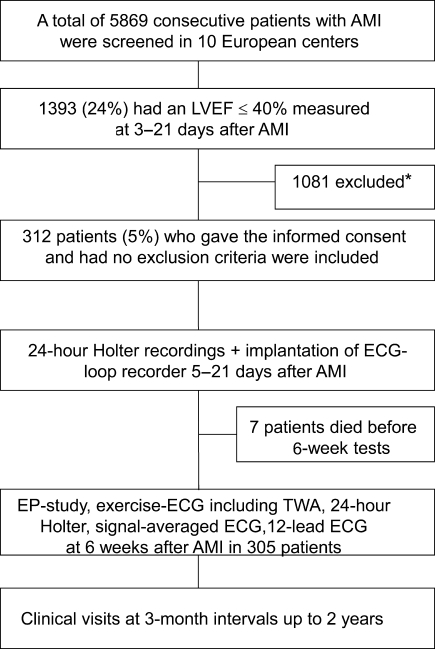
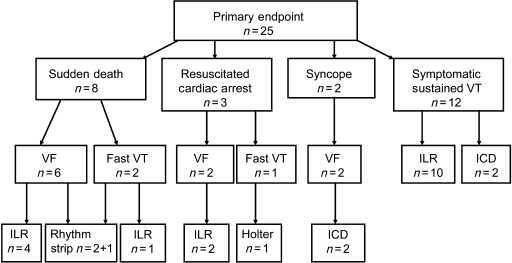
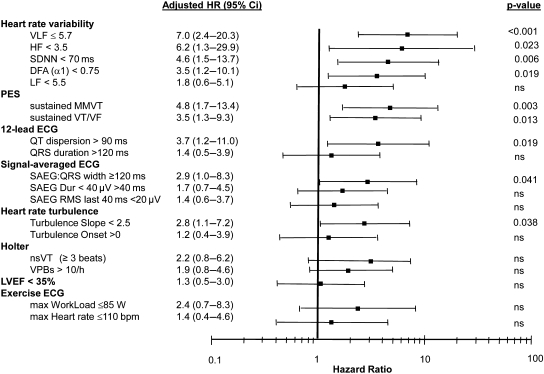
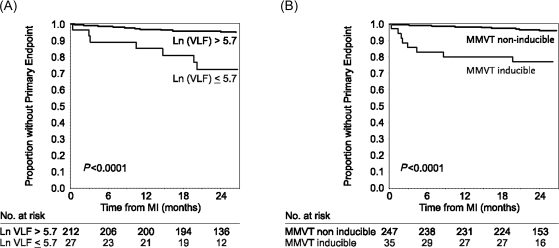
AIMS: To determine whether risk stratification tests can predict serious arrhythmic events after acute myocardial infarction (AMI) in patients with reduced left ventricular ejection fraction (LVEF < or = 0.40). METHODS AND RESULTS: A total of 5869 consecutive patients were screened in 10 European centres, and 312 patients (age 65 +/- 11 years) with a mean LVEF of 31 +/- 6% were included in the study. Heart rate variability/turbulence, ambient arrhythmias, signal-averaged electrocardiogram (SAECG), T-wave alternans, and programmed electrical stimulation (PES) were performed 6 weeks after AMI. The primary endpoint was ECG-documented ventricular fibrillation or symptomatic sustained ventricular tachycardia (VT). To document these arrhythmic events, the patients received an implantable ECG loop-recorder. There were 25 primary endpoints (8.0%) during the follow-up of 2 years. The strongest predictors of primary endpoint were measures of heart rate variability, e.g. hazard ratio (HR) for reduced very-low frequency component (<5.7 ln ms(2)) adjusted for clinical variables was 7.0 (95% CI: 2.4-20.3, P < 0.001). Induction of sustained monomorphic VT during PES (adjusted HR = 4.8, 95% CI, 1.7-13.4, P = 0.003) also predicted the primary endpoint. CONCLUSION: Fatal or near-fatal arrhythmias can be predicted by many risk stratification methods, especially by heart rate variability, in patients with reduced LVEF after AMI.
Overview
The claims and statistics of this paper haven’t been checked yet.
Free: it reads the open-access text and checks the first 5 claims that cite a source we can check. Create a free account to check every claim.
Integrity signals
Registry
Cites
Statistics
Figures
Verification
Claims the paper makes
The claims and statistics of this paper haven’t been checked yet.
Free: it reads the open-access text and checks the first 5 claims that cite a source we can check. Create a free account to check every claim.
Claims other papers make about this one
Each is checked against this paper’s own text: does it say what the citing paper says it does?
The source backs part of the claim, not all of it — or backs it for a different population, condition or comparison.
In the citing paper
“By contrast, the CARISMA trial investigators reported that in 312 patients evaluated at 6 weeks after an acute myocardial infarction, SDNN, very low frequency (VLF), high frequency (HF), and fractal scaling component independently predicted all-cause mortality and arrhythmic events documented by an ILR (Huikuri et al., 2009).”
From 2017 ISHNE-HRS expert consensus statement on ambulatory ECG and external cardiac monitoring/telemetry (2017) · cites this paper as Huikuri et al., 2009
Experimental — accuracy not yet measuredThe cited source says what the claim attributes to it.
In the citing paper
“Abnormal TS evaluated at 6 weeks after MI identified patients with LVEF ,40% who were at risk for arrhythmic events such as ventricular fibrillation or symptomatic VT during the 24-month follow-up (Huikuri et al., 2009).”
From 2017 ISHNE-HRS expert consensus statement on ambulatory ECG and external cardiac monitoring/telemetry (2017) · cites this paper as Huikuri et al., 2009
Self-check
Percentages, sums and reported differences re-computed from the paper’s own numbers.
The self-check needs the paper’s full text.
Citations
Cites
Moss, A. J., Zareba, W., Hall, W. J., Klein, H., Wilber, D. J., Cannom, D. S., Daubert, J. P., Higgins, S. L., Brown, M. W., & Andrews, M. L. (2002) · New England Journal of Medicine · doi:10.1056/nejmoa013474 · Cited by 6,902
Amiodarone or an Implantable Cardioverter–Defibrillator for Congestive Heart Failure
Bardy, G. H., Lee, K. L., Mark, D. B., Poole, J. E., Packer, D. L., Boineau, R., Domanski, M., Troutman, C., Anderson, J., Johnson, G., et al. (2005) · New England Journal of Medicine · doi:10.1056/nejmoa043399 · Cited by 6,552
Rovere, M. T. L., Bigger, J. T., Marcus, F. I., Mortara, A., & Schwartz, P. J. (1998) · The Lancet · doi:10.1016/s0140-6736(97)11144-8 · Cited by 3,120
Oss, J. M., Areba, W. O. Z., Ackson, W. J., Lein, H. E. K., Ilber, D. A. J. W., Annom, D. A. S. C., Ames, J. M., Aubert, P., Iggins, S. T. L. H., Rown, M. A. W. B., et al. (2002) · Cited by 2,028
Prophylactic use of an implantable cardioverter-defibrillator after acute myocardial infarction
Hohnloser, S. H., Kuck, K. H., Dorian, P., Roberts, R. S., Hampton, J. R., Hatala, R., Fain, E., Gent, M., & Connolly, S. J. (2004) · New England Journal of Medicine · doi:10.1056/nejmoa041489 · Cited by 1,519 · cited 4×
“The benefit is reportedly less marked in patients who received an ICD early after the acute event.(3,7) There is, therefore, a need to identify other risk markers beyond the LVEF for patients who are at risk of sudden arrhythmic deaths and who could also benefit from implantation of an ICD early after AMI, a time peri…”
BackgroundResultInfluentialSudden Death Due to Cardiac Arrhythmias
Huikuri, H. V., Castellanos, A., & Myerburg, R. J. (2001) · New England Journal of Medicine · doi:10.1056/nejmra000650 · Cited by 1,466
Self-citationBigger, J. T., Fleiss, J. L., Kleiger, R., Miller, J. P., & Rolnitzky, L. M. (1984) · Circulation · doi:10.1161/01.cir.69.2.250 · Cited by 1,286
Solomon, S. D., Zelenkofske, S., McMurray, J. J. V., Finn, P. V., Velazquez, E., Ertl, G., Harsanyi, A., Rouleau, J. L., Maggioni, A., Kober, L., et al. (2005) · New England Journal of Medicine · doi:10.1056/nejmoa043938 · Cited by 793
Wathen, M. S., DeGroot, P. J., Sweeney, M. O., Stark, A. J., Otterness, M. F., Adkisson, W. O., Canby, R. C., Khalighi, K., Machado, C., Rubenstein, D. S., et al. (2004) · Circulation · doi:10.1161/01.cir.0000145610.64014.e4 · Cited by 775
Schmidt, G., Malik, M., Barthel, P., Schneider, R., Ulm, K., Rolnitzky, L., Camm, A. J., Bigger, J. T., & Schömig, A. (1999) · The Lancet · doi:10.1016/s0140-6736(98)08428-1 · Cited by 716 · cited 2×
“Earlier studies have reported on all-cause mortality, alone or in combination with other serious events, such as cardiac death, sudden death, or resuscitation from cardiac arrest.(9) –14 Yet, it is now recognized that many sudden cardiac deaths are not due to arrhythmia as many other clinical conditions can evolve rap…”
Background
Research works printed but not linked: 3
- 2002, New England Journal of Medicine, 346, 877, 10.1056/nejmoa013474 · DOI · Paper page
- 2007, Journal of the American College of Cardiology, 50, 2275, 10.1016/j.jacc.2007.08.042 · DOI · Paper page
- 2005, European Heart Journal, 26, 762, 10.1093/eurheartj/ehi188 · DOI · Paper page
Cited by
Kemp, A. H., Quintana, D. S., Gray, M. A., Felmingham, K. L., Brown, K., & Gatt, J. M. (2010) · Biological Psychiatry · doi:10.1016/j.biopsych.2009.12.012 · Cited by 1,286
Verrier (2011) · doi:10.1016/j.jacc.2011.06.029 · Cited by 421
Indications for the use of diagnostic implantable and external ECG loop recorders
Task Force members, Brignole, M., Vardas, P., Hoffman, E., Huikuri, H., Moya, A., Ricci, R., Sulke, N., Wieling, W., EHRA Scientific Documents Committee, et al. (2009) · Europace · doi:10.1093/europace/eup097 · Cited by 362
Self-citation(2013) · Handbook of Clinical Neurology · doi:10.1016/b978-0-444-53491-0.00031-6 · Cited by 315
Steinberg, J. S., Varma, N., Cygankiewicz, I., Aziz, P., Balsam, P., Baranchuk, A., Cantillon, D. J., Dilaveris, P., Dubner, S. J., El-Sherif, N., et al. (2017) · Heart Rhythm · doi:10.1016/j.hrthm.2017.03.038 · Cited by 303
Fang, S.-C., Wu, Y.-L., & Tsai, P.-S. (2020) · Biological Research For Nursing · doi:10.1177/1099800419877442 · Cited by 302
“In related studies, HRV alone or in combination with risk factors positively predicted malignant arrhythmias and sudden death (Bigger, Fleiss, Rolnitzky, & Steinman, 1993; Huikuri et al., 2009).”
BackgroundBloch Thomsen, P. E., Jons, C., Raatikainen, M. J. P., Moerch Joergensen, R., Hartikainen, J., Virtanen, V., Boland, J., Anttonen, O., Gang, U. J., Hoest, N., et al. (2010) · Circulation · doi:10.1161/circulationaha.109.902148 · Cited by 285
Self-citationHeart Rate Variability in Risk Stratification of Cardiac Patients
Huikuri, H. V., & Stein, P. K. (2013) · Progress in Cardiovascular Diseases · doi:10.1016/j.pcad.2013.07.003 · Cited by 283
Self-citationINDO AMERICAN JOURNAL OF PHARMACEUTICAL SCIENCES
Baru, P. C. R. (2014) · ADVANCED SCIENCES INDEX · Cited by 236
Scirica, B. M. (2010) · Journal of the American College of Cardiology · doi:10.1016/j.jacc.2009.09.071 · Cited by 227
Dubner, S., Auricchio, A., Steinberg, J. S., Vardas, P., Stone, P., Brugada, J., Piotrowicz, R., Hayes, D. L., Kirchhof, P., Breithardt, G., et al. (2012) · Europace · doi:10.1093/europace/eur303 · Cited by 179
Mental Workload Alters Heart Rate Variability, Lowering Non-linear Dynamics
Delliaux, S., Delaforge, A., Deharo, J.-C., & Chaumet, G. (2019) · Frontiers in Physiology · doi:10.3389/fphys.2019.00565 · Cited by 169
Dagres, N., & Hindricks, G. (2013) · European Heart Journal · doi:10.1093/eurheartj/eht109 · Cited by 169
Risk Stratification for Sudden Cardiac Death: A Plan for the Future
Goldberger, J. J., Basu, A., Boineau, R., Buxton, A. E., CAIN, M. E., Canty, J. M., Chen, P., Chugh, S. S., Costantini, O., Exner, D. V., et al. (2014) · Circulation · doi:10.1161/circulationaha.113.007149 · Cited by 168
Risk Stratification for Arrhythmic Sudden Cardiac Death: Identifying the Roadblocks
Goldberger, J. J., Buxton, A. E., Cain, M., Costantini, O., Exner, D. V., Knight, B. P., Lloyd-Jones, D., Kadish, A. H., Lee, B., Moss, A., et al. (2011) · Circulation · doi:10.1161/circulationaha.110.959734 · Cited by 167
Haarmark, C., Hansen, P. R., Vedel-Larsen, E., Pedersen, S. H., Graff, C., Andersen, M. P., Toft, E. S., Wang, F., Struijk, J. J., & Kanters, J. K. (2009) · Journal of Electrocardiology · doi:10.1016/j.jelectrocard.2009.06.009 · Cited by 160
Zhao, X., Xie, Z., Chu, Y., Yang, L., Xu, W., Yang, X., Liu, X., & Tian, L. (2012) · Clinical Cardiology · doi:10.1002/clc.22022 · Cited by 159
Zaman, S. J., & Kovoor, P. (2014) · Circulation · doi:10.1161/circulationaha.113.007497 · Cited by 142
Holter Monitoring and Loop Recorders: From Research to Clinical Practice
Galli, A., Ambrosini, F., & Lombardi, F. (2016) · Arrhythmia & Electrophysiology Review · doi:10.15420/aer.2016.17.2 · Cited by 143
Sudden Cardiac Death Risk Stratification
Deyell, M. W., Krahn, A. D., & Goldberger, J. J. (2015) · Circulation Research · doi:10.1161/circresaha.116.304493 · Cited by 139
Steinberg, J. S., Varma, N., Cygankiewicz, I., Aziz, P. F., Balsam, P., Baranchuk, A. M., Cantillon, D. J., Dilaveris, P., Dubner, S., El‐Sherif, N., et al. (2017) · Annals of Noninvasive Electrocardiology · doi:10.1111/anec.12447 · Cited by 133
“Intermittent loop recorders can be either external devices (“external loop recorder” or ELR) or implantable devices (“implantable loop recorder” or ILR) (Brignole et al., 2009).”
BackgroundInfluentialImplantable loop recorder in clinical practice
Bisignani, A., Bonis, S. D., Mancuso, L., Ceravolo, G., & Bisignani, G. (2018) · Journal of Arrhythmia · doi:10.1002/joa3.12142 · Cited by 128
Clinical Application of Heart Rate Variability after Acute Myocardial Infarction
Huikuri, H. V., & Stein, P. K. (2012) · Frontiers in Physiology · doi:10.3389/fphys.2012.00041 · Cited by 119
“…(6 weeks after AMI) rather than early after AMI, especially the very-low frequency spectral component, was the most powerful index among many other non-invasive risk markers in predicting the fatal or near-fatal arrhythmic events diagnosed by implantable arrhythmia devices (Huikuri et al., 2009).”
Self-citationChange in Left Ventricular Ejection Fraction Following First Myocardial Infarction and Outcome
Chew, D. S., Heikki, H., Schmidt, G. P., Kavanagh, K. M., Dommasch, M., Thomsen, P. E. B., Sinnecker, D., Raatikainen, P. M. J., & Exner, D. V. (2018) · JACC. Clinical electrophysiology · doi:10.1016/j.jacep.2017.12.015 · Cited by 117
Association of Early Repolarization and Sudden Cardiac Death During an Acute Coronary Event
Tikkanen, J. T., Wichmann, V., Junttila, J. M., Rainio, M., Hookana, E., Lappi, O.-P., Kortelainen, M., Anttonen, O. M., & Huikuri, H. V. (2012) · Circulation Arrhythmia and Electrophysiology · doi:10.1161/circep.112.970863 · Cited by 112
Self-citationHeart rate variability alterations in late life depression: A meta-analysis
Brown, L., Karmakar, C., Gray, R., Jindal, R., Lim, T., & Bryant, C. (2018) · Journal of Affective Disorders · doi:10.1016/j.jad.2018.04.071 · Cited by 108
Lerma, C., Martinez, A., Ruiz, N., Vargas, A., Infante, O., & Martinez-Lavin, M. (2011) · Arthritis Research & Therapy · doi:10.1186/ar3513 · Cited by 84
“After myocardial infarction, diminished HRV is a strong predictor of sudden death [8].”
BackgroundMethodPsychotropic medications and the risk of sudden cardiac death during an acute coronary event
Honkola, J., Hookana, E., Malinen, S., Kaikkonen, K. S., Junttila, M. J., Isohanni, M., Kortelainen, M.-L., & Huikuri, H. V. (2012) · European Heart Journal · doi:10.1093/eurheartj/ehr368 · Cited by 86
Self-citationBrown, L., Rando, A. A., Eichel, K., Van Dam, N. T., Celano, C. M., Huffman, J. C., & Morris, M. E. (2021) · Psychosomatic Medicine · doi:10.1097/psy.0000000000000900 · Cited by 93
“health outcomes such as morbidity and risk of mortality in both medical (10, 11) and community settings (12-14).”
BackgroundHeart rate variability - current diagnosis of the cardiac autonomic neuropathy. A review
Metelka, R. (2014) · Biomedical Papers · doi:10.5507/bp.2014.025 · Cited by 85
Physical activity and heart rate variability measured simultaneously during waking hours
Hautala, A. J., Karjalainen, J., Kiviniemi, A. M., Kinnunen, H., Mäkikallio, T. H., Huikuri, H. V., & Tulppo, M. P. (2010) · American Journal of Physiology-Heart and Circulatory Physiology · doi:10.1152/ajpheart.00856.2009 · Cited by 71
“This observation is line with previous studies (6, 18) showing that long-term indexes are stronger predictors of mortality and arrhythmic events than short-term HRV indexes.”
Self-citationMajor depression is associated with cardiac autonomic dysregulation
Chang, H.-A., Chang, C.-C., Chen, C.-L., Kuo, T. B. J., Lu, R.-B., & Huang, S.-Y. (2012) · Acta Neuropsychiatrica · doi:10.1111/j.1601-5215.2011.00647.x · Cited by 70
“The relationship between depression and cardiac mortality is, in part, mediated by reduction of heart rate variability (HRV) (3), and HRV has been identified as providing the best measure for predicting fatal or near-fatal cardiac arrhythmia (4); however, research on HRV and depression has generally been conducted in…”
BackgroundRyan, M. L., Ogilvie, M. P., Pereira, B. M., Gómez-Rodríguez, J. C., Manning, R. J., Vargas, P. A., DUNCAN, R. C., & Proctor, K. G. (2011) · The Journal of Trauma: Injury, Infection, and Critical Care · doi:10.1097/ta.0b013e31821858e6 · Cited by 81
Smith, T., Jordaens, L., Theuns, D. A. M. J., van Dessel, P. F., Wilde, A. A., & Hunink, M. G. M. (2013) · European Heart Journal · doi:10.1093/eurheartj/ehs090 · Cited by 71
Huikuri, H. V., Exner, D. V., Kavanagh, K. M., Aggarwal, S. G., Mitchell, L. B., Messier, M. D., Becker, D., Sheldon, R. S., & Bloch Thomsen, P.-E. (2010) · Heart Rhythm · doi:10.1016/j.hrthm.2009.11.004 · Cited by 77
“BRS tended to increase over time in REFINE, alhough this was not statistically significant (P .1). utonomic and left ventricular remodeling as redictors of end-points he CARISMA primary end-point was predicted by a hange in HRT slope and by changes in the VLF and LF ower spectral components of HRV with relatively high…”
BackgroundMethodResultInfluentialSelf-citationCardiotoxicity screening: a review of rapid-throughput in vitro approaches
Li, X., Zhang, R., Zhao, B., Lossin, C., & Cao, Z. (2015) · Archives of Toxicology · doi:10.1007/s00204-015-1651-1 · Cited by 77
Marijon, É., Garcia, R., Narayanan, K., Karam, N., & Jouven, X. (2022) · European Heart Journal · doi:10.1093/eurheartj/ehab903 · Cited by 75
Respiratory–cardiovascular interactions
Fisher, J. P., Żera, T., & Paton, J. F. R. (2022) · Handbook of clinical neurology · doi:10.1016/b978-0-323-91534-2.00006-0 · Cited by 71
Heart Rate Variability and Non-Linear Dynamics in Risk Stratification
Perkiömäki, J. S. (2011) · Frontiers in Physiology · doi:10.3389/fphys.2011.00081 · Cited by 62
Cleland, J. G. F., Coletta, A. P., Buga, L., Ahmed, D., & Clark, A. L. (2010) · European Journal of Heart Failure · doi:10.1093/eurjhf/hfq083 · Cited by 62
Kapur, N. K., Kim, R. J., Moses, J. W., Stone, G. W., Udelson, J. E., Ben‐Yehuda, O., Redfors, B., Issever, M. O., Josephy, N., Polak, S. J., et al. (2022) · American Heart Journal · doi:10.1016/j.ahj.2022.08.011 · Cited by 68
Guan, L., Collet, J., Mazowita, G., & Claydon, V. E. (2018) · Frontiers in Neurology · doi:10.3389/fneur.2018.00090 · Cited by 67
The Evolution of Ambulatory ECG Monitoring
Kennedy, H. L. (2013) · Progress in Cardiovascular Diseases · doi:10.1016/j.pcad.2013.08.005 · Cited by 66
Jøns, C., Joergensen, R. M., Hassager, C., Gang, U. J. O., Dixen, U., Johannesen, A., Olsen, N. T., Hansen, T. F., Messier, M., Huikuri, H. V., et al. (2010) · European Journal of Echocardiography · doi:10.1093/ejechocard/jeq024 · Cited by 66
Self-citationPontone, G., Guaricci, A. I., Andreini, D., Ferro, G., Guglielmo, M., Baggiano, A., Fusini, L., Muscogiuri, G., Lorenzoni, V., Mushtaq, S., et al. (2017) · Circulation Cardiovascular Imaging · doi:10.1161/circimaging.117.006428 · Cited by 66
Jøns, C., Raatikainen, P. M. J., Gang, U. J. O., Huikuri, H. V., Joergensen, R. M., Johannesen, A., Dixen, U., Messier, M., McNitt, S. A., Thomsen, P. E. B., et al. (2010) · Journal of Cardiovascular Electrophysiology · doi:10.1111/j.1540-8167.2010.01795.x · Cited by 65
Self-citationZaman, S. J., Narayan, A., Thiagalingam, A., Sivagangabalan, G., Thomas, S. P., Ross, D. L., & Kovoor, P. (2013) · Circulation · doi:10.1161/circulationaha.113.005146 · Cited by 64
“8,9 Inducible ventricular tachycardia (VT) at electrophysiological study (EPS) demonstrates the presence of a substrate for re-entrant tachyarrhythmia and consistently predicts arrhythmia in observational and randomised studies.(10-16) The potential utility of EPS to guide early ICD implantation post-MI has been demon…”
BackgroundAnwer, S., Li, H., Umer, W., Antwi‐Afari, M. F., Mehmood, I., Yu, Y., Haas, C. T., & Wong, A. Y. L. (2023) · Journal of Construction Engineering and Management · doi:10.1061/jcemd4.coeng-13100 · Cited by 62
Tubaro, M., Danchin, N., Goldstein, P., Filippatos, G. S., Hasin, Y., Heras, M., Janský, P., Norekvål, T. M., Swahn, E., Thygesen, K. A., et al. (2011) · Acute Cardiac Care · doi:10.3109/17482941.2011.581292 · Cited by 64
Disertori, M., Masè, M., Rigoni, M., Nollo, G., & Ravelli, F. (2016) · Circulation Arrhythmia and Electrophysiology · doi:10.1161/circep.116.004610 · Cited by 62
Heart rhythm at the time of death documented by an implantable loop recorder
Gang, U. J. O., Jøns, C., Jørgensen, R. M., Abildstrom, S. Z., Haarbo, J., Messier, M., Huikuri, H. V., Thomsen, P. E. B., & on behalf of the CARISMA investigators (2009) · EP Europace · doi:10.1093/europace/eup383 · Cited by 60
“Briefly, the CARISMA study included 312 patients with an AMI and a subsequent left ventricular ejection fraction (LVEF) ,40% estimated by 2D echocardiography.(19) An ILR (Medtronic Reveal Plus) was implanted 5–21 days after the AMI in 297 of these patients for continuous arrhythmia monitoring.”
MethodResultSelf-citationCygankiewicz, I. (2013) · Progress in Cardiovascular Diseases · doi:10.1016/j.pcad.2013.08.002 · Cited by 59
Electrophysiology-guided defibrillator implantation early after ST-elevation myocardial infarction
Kumar, S., Sivagangabalan, G., Zaman, S. J., West, E. B., Narayan, A., Thiagalingam, A., & Kovoor, P. (2010) · Heart Rhythm · doi:10.1016/j.hrthm.2010.07.019 · Cited by 59
Prediction of sudden arrhythmic death following acute myocardial infarction
Liew, R. (2010) · Heart · doi:10.1136/hrt.2010.194407 · Cited by 55
“Thus, results from the early studies of EP testing among AMI survivors may still be valid today. However, one should also take into account that the routine use of β-blockers in most of the early studies was suboptimal. For example, the MUSTT investigators demonstrated that the induction of ventricular arrhythmias at…”
ResultChew, D. S., Wilton, S. B., Kavanagh, K. M., Southern, D. A., Tan-Mesiatowsky, L. E., & Exner, D. V. (2017) · American Heart Journal · doi:10.1016/j.ahj.2017.11.014 · Cited by 55
Buxton, A. E., Ellison, K., Lorvidhaya, P., & Ziv, O. (2010) · Journal of Cardiovascular Pharmacology · doi:10.1097/fjc.0b013e3181d9f49c · Cited by 51
Koivikko, M. L., Tulppo, M. P., Kiviniemi, A. M., Kallio, M. A., Perkiömäki, J. S., Salmela, P. I., Airaksinen, K. E. J., & Huikuri, H. V. (2012) · Diabetes Care · doi:10.2337/dc11-2120 · Cited by 43
Self-citationGoldenberg, I., Huang, D. T.-C., & Nielsen, J. C. (2019) · European Heart Journal · doi:10.1093/eurheartj/ehz788 · Cited by 49
Dubner, S., Auricchio, A., Steinberg, J. S., Vardas, P., Stone, P., Brugada, J., Piotrowicz, R., Hayes, D. L., Kirchhof, P., Breithardt, G., et al. (2012) · Annals of Noninvasive Electrocardiology · doi:10.1111/j.1542-474x.2011.00484.x · Cited by 47
Risk Stratification of Sudden Cardiac Death After Acute Myocardial Infarction
Bui, A. H., & Waks, J. W. (2018) · Journal of Innovations in Cardiac Rhythm Management · doi:10.19102/icrm.2018.090201 · Cited by 47
A randomized controlled trial of acupuncture in stable ischemic heart disease patients
Mehta, P. K., Polk, D. M., Zhang, X., Li, N., Painovich, J., Kothawade, K., Kirschner, J., Qiao, Y., Ma, X., Chen, Y.-D. I., et al. (2014) · International Journal of Cardiology · doi:10.1016/j.ijcard.2014.07.011 · Cited by 44
“SA may be clinically relevant, as prior work has shown that SDNN < 70 ms predicts arrhythmias in patients with low ejection fraction post-myocardial infarction [40].”
Resultde Lepper, A. G. W., Buck, C. M. A., Veer, M. V. ’., Huberts, W., van de Vosse, F. N., & Dekker, L. (2022) · Journal of The Royal Society Interface · doi:10.1098/rsif.2022.0317 · Cited by 44
Ruwald, A., Thomsen, P. E. B., Gang, U. J. O., Jørgensen, R. M., Huikuri, H. V., & Jøns, C. (2013) · American Heart Journal · doi:10.1016/j.ahj.2013.08.017 · Cited by 43
Self-citationAlkhodari, M., Rashid, M., Mukit, M. A., Ahmed, K. I. U., Mostafa, R., Parveen, S., & Khandoker, A. H. (2021) · IEEE Access · doi:10.1109/access.2021.3107687 · Cited by 41
“the use of HRV for the analysis of cardiovascular pathologies [15]–[18].”
MethodSudden Death Risk-Stratification in 2018–2019: The Old and the New
Zaman, S. J., Goldberger, J. J., & Kovoor, P. (2018) · Heart Lung and Circulation · doi:10.1016/j.hlc.2018.08.027 · Cited by 40
Antidepressants and heart-rate variability in older adults: a population-based study
Noordam, R., van den Berg, M. E., Niemeijer, M. N., Aarts, N., Hofman, A., Tiemeier, H., Kors, J. A., Stricker, B. H., Eijgelsheim, M., Visser, L. E., et al. (2016) · Psychological Medicine · doi:10.1017/s0033291715002779 · Cited by 37
Current and Emerging Indications for Implantable Cardiac Monitors
Giada, F., Bertaglia, E., Reimers, B., Noventa, D., & Raviele, A. (2012) · Pacing and Clinical Electrophysiology · doi:10.1111/j.1540-8159.2012.03411.x · Cited by 39
Current Evidence Base for Use of the Implantable Cardioverter–Defibrillator
Hohnloser, S. H., & Israel, C. W. (2013) · Circulation · doi:10.1161/circulationaha.112.000547 · Cited by 38
Αρσένος, Π., Gatzoulis, K. A., Dilaveris, P., Manis, G., Tsiachris, D., Archontakis, S., Vouliotis, A.-I., Vouliotis, A. H., Sideris, S. K., & Stefanadis, C. (2013) · PubMed · Cited by 39
Mugnai, G., Benfari, G., Fede, A., Rossi, A., Chierchia, G., Vassanelli, F., Menegatti, G., & Ribichini, F. L. (2015) · European Heart Journal Acute Cardiovascular Care · doi:10.1177/2048872615598616 · Cited by 37
“31 experienced arrhythmic death (negative predictive value of 100%); (2) all five patients who died from early ventricular fibrillation did present TpTe/QT values higher than 0.”
BackgroundMethodResultPredicting the risk of sudden cardiac death
Lerma, C., & Glass, L. (2016) · The Journal of Physiology · doi:10.1113/jp270535 · Cited by 38
“The Journal of Physiology C© 2015 The Physiological Society (Huikuri et al. 2009), it requires further development and confirmation before it can be incorporated in new methods for risk stratification.”
MethodInfluentialKarjalainen, J. J., Kiviniemi, A. M., Hautala, A. J., Piira, O.-P., Lepojärvi, E. S., Peltola, M. A., Ukkola, O. H., Hedberg, P. S. M., Huikuri, H. V., & Tulppo, M. P. (2013) · Diabetes Care · doi:10.2337/dc13-1072 · Cited by 36
Self-citationLerma, C., Gorelick, A. N., Ghanem, R. N., Glass, L., & Huikuri, H. V. (2013) · EP Europace · doi:10.1093/europace/eus415 · Cited by 35
“Previous work has proposed that the heartprint can help identify the mechanism of frequent PVCs resulting from parasystole.8 Further, a pattern of repetitive arrhythmias, especially bigeminy, with fixed CI and long QT, as might be expected in patients with early afterdepolarizations, was observed in a small sample of…”
BackgroundMethodInfluentialSelf-citationVuoti, A. O., Tulppo, M. P., Ukkola, O. H., Junttila, J. M., Huikuri, H. V., Kiviniemi, A. M., & Perkiömäki, J. S. (2021) · PLoS ONE · doi:10.1371/journal.pone.0254107 · Cited by 35
“HRV measurements have also been observed to predict ventricular fibrillation or symptomatic sustained ventricular tachycardia in postinfarction patients [41].”
MethodSelf-citationHeart rate variability after myocardial infarction: what we know and what we still need to find out
Brateanu, A. (2015) · Current Medical Research and Opinion · doi:10.1185/03007995.2015.1086992 · Cited by 38
Endoh, H., Kamimura, N., Honda, H., & Nitta, M. (2019) · Critical Care · doi:10.1186/s13054-019-2603-6 · Cited by 34
Pizzo, E., Berrettoni, S., Kaul, R., Cervantes, D. O., Stefano, V. D., Jain, S., Jacobson, J. T., & Rota, M. (2022) · Frontiers in Cardiovascular Medicine · doi:10.3389/fcvm.2022.843144 · Cited by 32
“Moreover, very low-frequency components are associated with fatal or near fatal arrhythmic events in individuals with MI and depressed left ventricular function (55).”
BackgroundMicrovolt T-wave Alternans: Where Are We Now?
Aro, A. L., Kenttä, T. V., & Huikuri, H. V. (2016) · Arrhythmia & Electrophysiology Review · doi:10.15420/aer.2015.28.1 · Cited by 32
Self-citationGang, U. J. O., Jøns, C., Jørgensen, R. M., Abildstrom, S. Z., Messier, M., Haarbo, J., Huikuri, H. V., Thomsen, P. E. B., on behalf of the CARISMA investigators, Raatikainen, M. J. P., et al. (2011) · EP Europace · doi:10.1093/europace/eur165 · Cited by 31
Self-citationHeart Rate Turbulence as Risk-Predictor after Myocardial Infarction
Zuern, C. S., Barthel, P., & Bauer, A. (2011) · Frontiers in Physiology · doi:10.3389/fphys.2011.00099 · Cited by 30
Yu, H., Fang, P., Wu, Y., Li, X., Jun, L., Li, Z., Sen, L., & Zhang, S. (2011) · Journal of Electrocardiology · doi:10.1016/j.jelectrocard.2011.07.015 · Cited by 30
Kumar, S., Sivagangabalan, G., Thiagalingam, A., West, E. B., Narayan, A., Sadick, N., Ong, A. T. L., & Kovoor, P. (2010) · Heart Rhythm · doi:10.1016/j.hrthm.2010.11.046 · Cited by 30
Cardiac autonomic imbalance by social stress in rodents: understanding putative biomarkers
Wood, S. K. (2014) · Frontiers in Psychology · doi:10.3389/fpsyg.2014.00950 · Cited by 29
“A shift in HRV of this manner predicts life-threatening cardiac arrhythmias (Huikuri et al., 2009) and in patients lacking preexisting CVD, stress-related disorders such as depression and anxiety are associated with significantly increased risk of adverse cardiac events (Barefoot et al., 1996;…”
BackgroundActualización en cardiopatía isquémica
Bardají, A., Barrabés, J. A., Sanchis, J. M., & Sanchez, P. L. (2010) · Revista Española de Cardiología · doi:10.1016/s0300-8932(10)70140-8 · Cited by 27
Kinoshita, T., Hashimoto, K., Yoshioka, K., Miwa, Y., Yodogawa, K., Watanabe, E., Nakamura, K., Nakagawa, M., Nakamura, K., Watanabe, T., et al. (2019) · Journal of Cardiology · doi:10.1016/j.jjcc.2019.07.012 · Cited by 27
Pannone, L., Falasconi, G., Cianfanelli, L., Baldetti, L., Moroni, F., Spoladore, R., & Vergara, P. (2021) · Journal of Clinical Medicine · doi:10.3390/jcm10091823 · Cited by 26
“Post-MI systolic function recovery was associated with SCD also in the CARISMA study [27], where patients with no LVEF recovery (∆LVEF ≤0%) showed a five-fold higher risk of cardiac mortality, compared to patients with any degree of LVEF recovery (9% vs.”
Yuan, L., Qiu, L., Ye, Y., Wu, J., Wang, S., Wang, X., Zhou, N., & Zou, Y. (2018) · Journal of Cellular and Molecular Medicine · doi:10.1111/jcmm.13713 · Cited by 26
“In particular, in the acute stage of the MI, the fatal arrhythmia ranks as one of the top cause of sudden death.(19,20) Therefore, it is very important to diminish the underlying pro-arrhythmic hypertrophy after acute MI.”
BackgroundArrhythmic risk stratification in heart failure: Time for the next step?
Gatzoulis, K. A., Sideris, A., KANOUPAKIS, E. M., Sideris, S. K., Nikolaou, N. I., Antoniou, C. K., & Kolettis, T. M. (2017) · Annals of Noninvasive Electrocardiology · doi:10.1111/anec.12430 · Cited by 26
Compostella, L., Lakušić, N., Compostella, C., Truong, L. V. S., Iliceto, S., & Bellotto, F. (2017) · World Journal of Cardiology · doi:10.4330/wjc.v9.i1.27 · Cited by 25
Prognostic value of heart rate variability in post-infarction patients
Bošković, A., Belada, N., & Knežević, B. (2014) · Vojnosanitetski pregled · doi:10.2298/vsp1410925b · Cited by 25
Sudden Cardiac Death in Ischemic Heart Disease
El‐Sherif, N., Boutjdir, M., & Turitto, G. (2017) · Cardiac Electrophysiology Clinics · doi:10.1016/j.ccep.2017.08.003 · Cited by 24
Exner, D. V. (2009) · Canadian Journal of Cardiology · doi:10.1016/s0828-282x(09)71050-5 · Cited by 24
“The CARISMA study found that a reduced, very low-frequency component of HRV predicted a sevenfold higher risk of serious arrhythmia, with reasonable sensitivity (41%) and positive accuracy (26%) (29).”
BackgroundWang, J., Liu, Y., Zhu, W., Zhang, F., & Zhou, Z. (2014) · Scientific Reports · doi:10.1038/srep07394 · Cited by 24
Heart rate variability regression and risk of sudden unexpected death in epilepsy
Galli, A., & Lombardi, F. (2016) · Medical Hypotheses · doi:10.1016/j.mehy.2016.11.016 · Cited by 23
Pezawas, T., Diedrich, A., Robertson, D., Winker, R., Richter, B., Wang, L. A., & Schmidinger, H. (2017) · European Journal of Clinical Investigation · doi:10.1111/eci.12729 · Cited by 23
Sudden cardiac death: The role of imaging
van der Bijl, P., Delgado, V., & Bax, J. J. (2017) · International Journal of Cardiology · doi:10.1016/j.ijcard.2017.03.010 · Cited by 23
“[8] 2009 312 30 ± 6 2 years 8 (VT/VF on loop recorder)”
Heart Rate Turbulence to Guide Treatment for Prevention of Sudden Death
Bauer, A., Zuern, C. S., & Schmidt, G. P. (2010) · Journal of Cardiovascular Pharmacology · doi:10.1097/fjc.0b013e3181d4c973 · Cited by 23
“The prospective studies include the Innovative Stratification of Arrhythmic Risk (ISAR)-HRT study,(6) the Risk Estimation Following Infarction Noninvasive Evaluation (REFINE) study,(35) the ISAR-Risk study,(36) and the Cardiac Arrhythmias and Risk Stratification after Acute Myocardial Infarction (CARISMA) study.(37) D…”
MethodResultInfluentialThe Dosage Effect of Laser Acupuncture at PC6 (Neiguan) on Heart Rate Variability: A Pilot Study
Chang, Y.-C., Chen, C., Lay, I., Lee, Y., & Tu, C. (2022) · Life · doi:10.3390/life12121951 · Cited by 22
“VLF power is regarded as an independent risk predictor in patients with congestive heart failure [44] and was the strongest predictor of the prognostic after acute myocardial infarction and mortality than HF or LF power [33,45].”
BackgroundAlkhodari, M., Khandoker, A. H., Jelinek, H. F., Karlas, A., Σουλαϊδόπουλος, Σ., Αρσένος, Π., Doundoulakis, I., Gatzoulis, K. A., Tsioufis, K. P., & Hadjileontiadis, L. J. (2024) · Computer Methods and Programs in Biomedicine · doi:10.1016/j.cmpb.2024.108107 · Cited by 22
Seegers, J., Bergau, L., Expósito, P. M., Bauer, A., Fischer, T. H., Lüthje, L., Hasenfuss, G. P., Friede, T., & Zabel, M. (2016) · The American Journal of Cardiology · doi:10.1016/j.amjcard.2016.04.016 · Cited by 22
Metadata
- Authors
- Huikuri, H. V., Raatikainen, M. J. P., Moerch-Joergensen, R., Hartikainen, J., Virtanen, V., Boland, J., Anttonen, O., Hoest, N., Boersma, L. V. A., Platou, E. S., Messier, M. D., Bloch-Thomsen, P.-E., & for the Cardiac Arrhythmias and Risk Stratification after Acute Myocardial Infarction (CARISMA) study group
- Affiliations
- University of Oulu (FI)
- University of Eastern Finland (FI)
- University of Tampere (FI)
- Centre hospitalier régional de la Citadelle (BE)
- Päijät-Hämeen Keskussairaala (FI)
- Glostrup Hospital (DK)
- St. Antonius Ziekenhuis (NL)
- Oslo University Hospital (NO)
- Medtronic (Netherlands) (NL)
- Gentofte Hospital (DK)
- Corresponding author
- Huikuri, H. V.
- Venue
- European Heart Journal
- Publisher
- Oxford University Press (OUP)
- Published
- 2008-08-18
- Volume
- 30
- Issue
- 6
- Pages
- 689-698
- ISSN
- 0195-668X (ISSN-L)
- 1522-9645
- PMC
- PMC2655314
- OpenAlex
- W2115479478
- Cited by
- 264
- References
- 35
- Citations by year
- 2026: 3 · 2025: 4 · 2024: 6 · 2023: 14 · 2022: 8 · 2021: 9 · 2020: 8 · 2019: 7 · 2018: 13 · 2017: 21 · 2016: 15 · 2015: 28 · 2014: 21 · 2013: 21 · 2012: 23
- FWCI
- 15.28
- Type
- journal article
- Language
- en
- Open access
- hybrid
- doi.org
- Licence
- other-oa
- Locations
- European Heart Journal (publishedVersion, other-oa)
- Europe PMC (PubMed Central) (publishedVersion)
- PubMed Central (publishedVersion)
- PubMed (publishedVersion)
- Data Archiving and Networked Services (DANS) (submittedVersion)
- Pure Amsterdam UMC (submittedVersion)
- Research at the University of Copenhagen (University of Copenhagen) (submittedVersion)
- Funders
- Heart Rhythm Society
- Karolinska Institutet
- Rigshospitalet
- Oulun Yliopisto
- Topics
- Health Sciences › Medicine › Cardiology and Cardiovascular Medicine › Cardiac electrophysiology and arrhythmias
- Health Sciences › Medicine › Cardiology and Cardiovascular Medicine › Acute Myocardial Infarction Research
- Health Sciences › Medicine › Cardiology and Cardiovascular Medicine › Heart Rate Variability and Autonomic Control
- Keywords
- cardiac arrhythmias, acute myocardial infarction, reduced left ventricular ejection fraction, risk stratification, ventricular fibrillation, ventricular tachycardia, heart rate variability, signal-averaged electrocardiogram, T-wave alternans, programmed electrical stimulation, implantable loop recorder, arrhythmia prediction
- MeSH terms
- Aged, Arrhythmias, Cardiac, Electrocardiography, Female, Heart Rate, Humans, Male, Myocardial Infarction, Predictive Value of Tests, Prospective Studies, Ventricular Fibrillation, Treatment Outcome, Defibrillators, Implantable, Tachycardia, Ventricular, Ventricular Dysfunction, Left, Risk Assessment
About these checks
Registry, retraction, Cites and statistics results are computed, not judged, with one exception: a printed reference that no index lists is read once by a model before it counts as a citation error. Claims are extracted by a model and kept only when their quote appears verbatim in the text; each cited source is then checked, with a model’s help, for whether it says what the claim relies on. Those verdicts can be wrong — read the claim’s quote and the cited source before relying on one.
Statistics and arithmetic are recomputed, not judged.
Confidence bands are shown only for fields calibrated on our annotated test set. None is calibrated yet, so no band is shown.
What counts as a claim ›How we measure confidence ›How we check this ›
Are you an author, or do you see a problem with this page? Request a review
Data sources
Bibliographic data: Semantic Scholar, OpenAlex, Crossref.
Contains information from the Semantic Scholar Academic Graph Datasets, made available under the ODC Attribution License (ODC-BY 1.0).
Semantic Scholar’s data is described in: Kinney, R., et al. (2023). The Semantic Scholar Open Data Platform. arXiv:2301.10140.
