

A randomized trial of long-term remote monitoring of pacemaker recipients (The COMPAS trial)
Open accessThe DOI matches its Crossref record; 19 of the 19 references it cites were found in a registry or an index.
Abstract
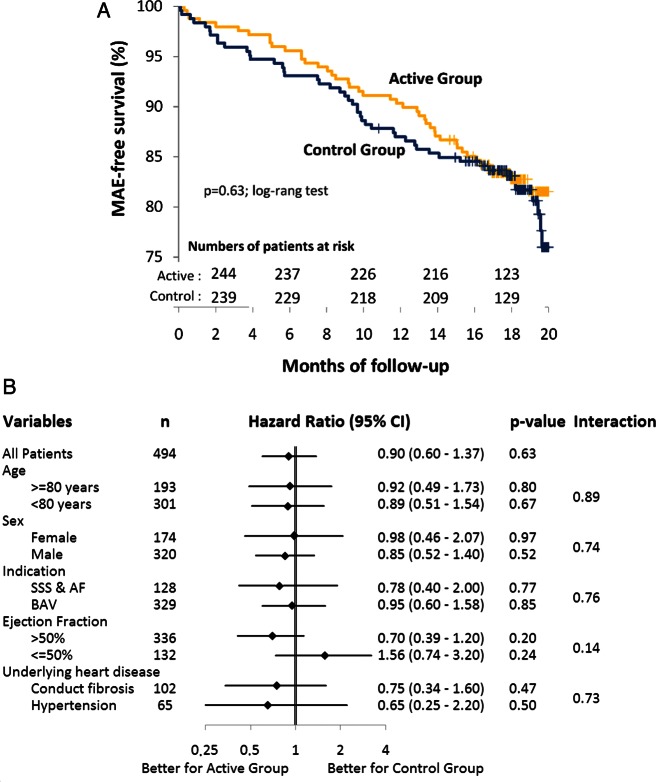
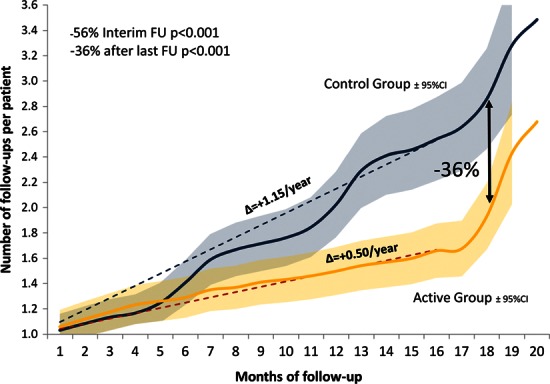
AIMS: Professional practice guidelines recommend that pacemaker recipients be followed regularly. However, the majority of scheduled ambulatory visits is unproductive and imposes a heavy burden on the health-care system. METHODS AND RESULTS: The COMPAS randomized, multicentre, non-inferiority trial examined the safety of long-term remote monitoring of pacemakers. Between December 2005 and January 2008, 538 patients were randomly assigned to remote monitoring follow-up (active group) vs. standard care (control group). The primary objective was to confirm that the proportion of patients who experienced at least one major adverse event (MAE), including all-cause death and hospitalizations for device-related or cardiovascular adverse events, was not >7% higher in the active than in the control group. MAE-free survivals and quality of life were compared in both groups. The characteristics of the study groups were similar. Over a follow-up of 18.3 months, 17.3% of patients in the active and 19.1% in the control group experienced at least one MAE (P < 0.01 for non-inferiority). Hospitalizations for atrial arrhythmias (6 vs. 18) and strokes (2 vs. 8) were fewer (P < 0.05), and the number of interim ambulatory visits was 56% lower (P < 0.001) in the active than the control group. Changes in pacemaker programming or drug regimens were made in 62% of visits in the active vs. 29% in the control group (P < 0.001). Quality of life remained unchanged in both groups. CONCLUSION: Remote monitoring was a safe alternative to conventional care and significantly lowered the number of ambulatory visits during long-term follow-up of permanently paced patients. ClinicalTrials.gov identifier: NCT00989326.
Overview
The claims and statistics of this paper haven’t been checked yet.
Free: it reads the open-access text and checks the first 5 claims that cite a source we can check. Create a free account to check every claim.
Integrity signals
Registry
Cites
Statistics
Figures
Verification
Claims the paper makes
The claims and statistics of this paper haven’t been checked yet.
Free: it reads the open-access text and checks the first 5 claims that cite a source we can check. Create a free account to check every claim.
Claims other papers make about this one
Each is checked against this paper’s own text: does it say what the citing paper says it does?
The source backs part of the claim, not all of it — or backs it for a different population, condition or comparison.
In the citing paper
“In the similar, more recent Chronicle Offers Management to Patients with Advanced Signs and Symptoms of Heart Failure (COMPAS) trial, both ambulatory visits and hospitalizations were fewer in those randomly assigned to remote follow-up.58”
From Managing with pacemakers and implantable cardioverter defibrillators (2013) · cites this paper as [58]
Experimental — accuracy not yet measured
Self-check
Percentages, sums and reported differences re-computed from the paper’s own numbers.
The self-check needs the paper’s full text.
Citations
Cites
(1992) · PubMed · Cited by 33,716
The MOS 36-ltem Short-Form Health Survey (SF-36): I. Conceptual Framework and Item Selection
Ware, J. E., & Sherbourne, C. D. (1992) · Medical Care · doi:10.1097/00005650-199206000-00002 · Cited by 30,033
ACC/AHA/HRS 2008 guidelines for device-based therapy of cardiac rhythm abnormalities
Epstein, A. E., DiMarco, J. P., Ellenbogen, K. A., Estes, N. A. M., Freedman, R. A., Gettes, L. S., Gillinov, A. M., Gregoratos, G., Hammill, S. C., Hayes, D. L., et al. (2008) · Journal of the American College of Cardiology · doi:10.1016/j.jacc.2008.02.032 · Cited by 2,546
Writing Committee Members, Epstein, A. E., DiMarco, J. P., Ellenbogen, K. A., Estes, N. A. M., Freedman, R. A., Gettes, L. S., Gillinov, A. M., Gregoratos, G., Hammill, S. C., et al. (2008) · Circulation · doi:10.1161/circualtionaha.108.189742 · Cited by 1,774
THE MOS 36- ITEM SHORT FORM HEALTH SURVEY (SF- 36) CONCEPTUAL FRAMEWORK AND ITEM SELECTION
J.E.Jr., W., & Sherburne, C. D. (1992) · Cited by 1,586
Authors/Task Force Members, Vardas, P. E., Auricchio, A., Blanc, J.-J., Daubert, J.-C., Drexler, H., Ector, H., Gasparini, M., Linde, C., Morgado, F. B., et al. (2007) · European Heart Journal · doi:10.1093/eurheartj/ehm305 · Cited by 902
Self-citationCleland, J. G. F., Louis, A. A., Rigby, A. S., Janssens, U., & Balk, A. H. M. M. (2005) · Journal of the American College of Cardiology · doi:10.1016/j.jacc.2005.01.050 · Cited by 700
Varma, N., Epstein, A. E., Irimpen, A., Schweikert, R., & Love, C. (2010) · Circulation · doi:10.1161/circulationaha.110.937409 · Cited by 594
The CONNECT (Clinical Evaluation of Remote Notification to Reduce Time to Clinical Decision) Trial
Crossley, G. H., Boyle, A., Vitense, H., Chang, Y., & Mead, R. H. (2011) · Journal of the American College of Cardiology · doi:10.1016/j.jacc.2010.12.012 · Cited by 526
Single-Chamber versus Dual-Chamber Pacing for High-Grade Atrioventricular Block
Toff, W. D., Camm, A. J., & Skehan, J. D. (2005) · New England Journal of Medicine · doi:10.1056/nejmoa042283 · Cited by 384
Cited by
Items 201–300 of 346
Burioka, N. (2020) · Yonago acta medica · doi:10.33160/yam.2020.11.001 · Cited by 8
Knowledge Update on the Economic Evaluation of Pacemaker Telemonitoring Systems
López-Villegas, A., Leal‐Costa, C., Pérez-Heredia, M., Villegas-Tripiana, I., & Catalán-Matamoros, D. (2021) · International Journal of Environmental Research and Public Health · doi:10.3390/ijerph182212120 · Cited by 8
“These results coincide with those found in the COMPAS [19] and ECOST [22] trials, which used the SF-36 questionnaire, and with the PONIENTE [20] study, which used the EQ-5D questionnaire.”
BackgroundResultInfluentialRaes, S., Prezzi, A., Willems, R., Heidbüchel, H., & Annemans, L. (2024) · Journal of Medical Internet Research · doi:10.2196/47616 · Cited by 8
Sane, M., Jäntti, T., Marjamaa, A., Pennanen, E., Aura, C., Torvinen, E., Karjalainen, L., Raatikainen, P. M. J., & Karvonen, J. (2025) · Circulation Arrhythmia and Electrophysiology · doi:10.1161/circep.124.013078 · Cited by 9
Sheahen, B., O’Hagan, E. T., Cho, K. K., Shaw, T. J., Lee, A., Lal, S., Sverdlov, A. L., & Chow, C. K. (2025) · JMIR Cardio · doi:10.2196/67758 · Cited by 8
“Furthermore, improvements in health care service utilization have been demonstrated with reduced emergency department presentations [19], hospital admissions [20,21], and hospitalization length-of-stay times [21].”
Technical and Clinical Overview: Spinal Cord Stimulation
Falowski, S. M., Ali, R., Sweet, J. A., Mackel, C. E., Kesarwani, R., Arle, J. E., Larkin, M. B., Pinckard-Dover, H. N., Stone, L. E., Nerison, C. S., et al. (2025) · Neuromodulation Technology at the Neural Interface · doi:10.1016/j.neurom.2025.07.012 · Cited by 6
Khetrapal, P., Stafford, R., Scanaill, P. Ó., Kocadag, H., Timinis, C., Chang, A., Hadjivasiliou, A., Liu, Y., Gibbs, O., Pickford, E., et al. (2022) · JMIR Research Protocols · doi:10.2196/30638 · Cited by 5
“For example, pacemaker checks can now be safely performed remotely, reducing additional hospital visits [15].”
Hidefjäll, P. (2017) · International Journal of Healthcare Management · doi:10.1080/20479700.2017.1397907 · Cited by 6
Remote Monitoring of Permanent Pacemakers and Implantable Cardioverter Defibrillators
Wilner, B. R., & Rickard, J. (2021) · Cardiac Electrophysiology Clinics · doi:10.1016/j.ccep.2021.04.005 · Cited by 6
Varma, N., Cygankiewicz, I., & Turakhia, M. P. (2021) · Russian Journal of Cardiology · doi:10.15829/1560-4071-2021-4420 · Cited by 7
Remote Monitoring of Atrial High Rate Episodes in Pacemaker Patients. The Rapid Study Design
Russo, V. (2018) · Journal of Atrial Fibrillation · doi:10.4022/jafib.2100 · Cited by 5
Remote Device Management in Patients with Cardiac Complaints
Burri, H., & Varma, N. (2013) · Cardiac Electrophysiology Clinics · doi:10.1016/j.ccep.2013.05.005 · Cited by 5
Remote monitoring of the cardiac rhythm: where do we stand today?
Deftereos, S., Papoutsidakis, N., Γιαννόπουλος, Γ., Kossyvakis, C., & Lekakis, J. P. (2016) · Continuing Cardiology Education · doi:10.1002/cce2.36 · Cited by 7
“Cost savings are probably driven by the fact that, in the majority of follow-up visits (78% in ICDs and 71% in PMs) there is no device reprogramming, medication changes, or other actions regarding patient management [14, 31], with an even higher percentage (93.”
BackgroundCardiac Resynchronization Therapy Follow-up
Linde, C. M., & Braunschweig, F. (2016) · Heart Failure Clinics · doi:10.1016/j.hfc.2016.07.020 · Cited by 5
Callum, K., Graune, C., Bowman, E., Molden, E., & Leslie, S. J. (2021) · World Journal of Cardiology · doi:10.4330/wjc.v13.i3.46 · Cited by 7
Menezes, A. D. S., Rivera, A., Miyawaki, I. A., Gewehr, D. M., & Nascimento, B. (2023) · Current Cardiology Reports · doi:10.1007/s11886-023-01963-x · Cited by 6
Kelly, S., Clifford, T., Coyle, D., Martin, J. E., Welch, V. A., Skidmore, B., BIRNIE, D. H., Parkash, R., TANG, A. S. L., & Wells, G. A. (2020) · Systematic Reviews · doi:10.1186/s13643-020-01406-6 · Cited by 5
Impact of Preprocedural Frailty Status in Elderly Transvenous Pacemaker Recipients
Ishii, R., Enomoto, Y., Nakamura, K., Noro, M., Hara, H., Sugi, K., Moroi, M., & Nakamura, M. (2023) · International Heart Journal · doi:10.1536/ihj.23-060 · Cited by 4
Artificial intelligence to detect noise events in remote monitoring data
Nishii, N., Baba, K., Morooka, K., Shirae, H., Mizuno, T., Masuda, T., Ueoka, A., Asada, S., Miyamoto, M., Ejiri, K., et al. (2024) · Journal of Arrhythmia · doi:10.1002/joa3.13037 · Cited by 4
Remote monitoring of ICDs and CRTs
Varma, N. (2013) · Journal of Arrhythmia · doi:10.1016/j.joa.2013.05.001 · Cited by 4
“Similar benefits were seen in pacemaker recipients in the COMPAS trial [16].”
ResultIntegrating remote follow-up into electronic health records workflow
Diederich, L., & Johnson, T. (2014) · Health Policy and Technology · doi:10.1016/j.hlpt.2014.01.002 · Cited by 5
Cardiac Pacing – Is Telemonitoring Now Essential?
Burri, H. (2013) · Arrhythmia & Electrophysiology Review · doi:10.15420/aer.2013.2.2.95 · Cited by 6
“The randomized trial of long-term remote monitoring of pacemaker recipients (COMPAS) trial in patients with dual-chamber PMs found that home monitoring allowed delaying scheduled in-office visits for as much as 18 months after device implantation, without any significant difference in major adverse events compared wit…”
BackgroundREMOTE MONITORING FOR EARLY DIAGNOSTICS OF PATIENT’S STATE CHANGES WITH HOME MONITORING TECHNOLOGY
Revishvili, A. S., Lomidze, N., Abdrakhmanov, A. S., Анатольевич, Н. А., Ivanitsky, E. A., Belyaev, O. V., Popov, S. V., Lebedev, D. S., Лебедева, В. К., Mikhailov, S. P., et al. (2019) · Journal of Arrhythmology · doi:10.35336/va-2019-2-5-13 · Cited by 4
Kumar, S. K., Davis, J. S., Thibault, B., Mangat, I., Coutu, B., Bennett, M. T., Philippon, F., Sandhu, R. K., Sterns, L. D., Essebag, V., et al. (2021) · EP Europace · doi:10.1093/europace/euab025 · Cited by 5
Parkkari, E., Vanhala, V., Lindberg, R., Tynkkynen, J., & Hernesniemi, J. A. (2023) · IJC Heart & Vasculature · doi:10.1016/j.ijcha.2023.101307 · Cited by 4
“Moreover, RM-ON group experienced less major adverse events such as deaths, hospitalizations for complications related to the pacing system, and hospitalization for an adverse cardiovascular event [9].”
BackgroundHayashi, H., Iwasaki, Y., Arai, T., Mimuro, R., Hachisuka, M., Maru, Y., Fujimoto, Y., Oka, E., Hagiwara, K. I., Imori, Y., et al. (2020) · Heart and Vessels · doi:10.1007/s00380-020-01728-4 · Cited by 4
Varma, N. (2013) · EP Europace · doi:10.1093/europace/eut065 · Cited by 4
“In support, continuous monitoring in the COMPAS (COMPArative follow-up Schedule with home monitoring) pacemaker trial suggested reduced morbidity.(5) This”
Aldaas, O. M., Lacharite‐Roberge, A., & Birgersdotter-Green, U. M. (2025) · NEJM Evidence · doi:10.1056/evidra2400323 · Cited by 4
Lazarus, A., Gentils, M., Klaes, S., Ibnouhsein, I., Rosier, A., Moubarak, G., Bonnet, J.-L., Singh, J. P., & Defaye, P. (2023) · Cardiovascular Digital Health Journal · doi:10.1016/j.cvdhj.2023.08.019 · Cited by 3
“RM of CIED recipients has enabled a 56% decrease in the number of ambulatory visits.(8) It is substantively costeffective by decreasing the time spent by health care professionals in outpatient care, decreasing the need for hospitalizations, and markedly decreasing the consumption of health care resources.”
BackgroundMiracapillo, G., Addonisio, L., Sensi, F. D., Orselli, P., Piccinetti, E., Aramini, C., & Limbruno, U. (2024) · Journal of Cardiovascular Electrophysiology · doi:10.1111/jce.16328 · Cited by 3
Remote monitoring in implantable cardiac devices: A care solution or alert pollution?
Chiu, C. S. L., & Meine, M. (2025) · Netherlands Heart Journal · doi:10.1007/s12471-025-01957-0 · Cited by 3
The Role of Implantable Devices to Treat Atrial Fibrillation
Santini, L., & Santini, M. (2015) · Future Cardiology · doi:10.2217/fca.15.61 · Cited by 3
Grabowski, M., Sadecka, S., Cacko, A., Michalak, M., Blicharz, L., Balsam, P., & Opolski, G. (2017) · Cardiology Journal · doi:10.5603/cj.a2017.0071 · Cited by 3
Cascini, F., Pantović, A., Al‐Ajlouni, Y. A., Ta’ani, O. A., Failla, G., Melnyk, A., Barach, P. R., & Ricciardi, W. (2023) · Telehealth and Medicine Today · doi:10.30953/thmt.v8.415 · Cited by 4
Fernandez, F., Calvo, S., Cano, Ó., Calvo, D., Jiménez, M. P., Lozano, I. F., Villagraz, L., Palacios, G. F., & González, J. M. (2023) · Revista Española de Cardiología (English Edition) · doi:10.1016/j.rec.2023.07.003 · Cited by 4
Adriaansen, F. W., Seelig, J., de Vries, T. A. C., Voorhout, L., Brouwers, F. P. J., Mánfai, B., Derksen, R., Aagenborg, C., Doggen, C. J. M., Pisters, R., et al. (2025) · Netherlands Heart Journal · doi:10.1007/s12471-025-01953-4 · Cited by 3
Remote monitoring of cardiovascular disease: great promise, but do not forget the patient!
Hong, P. S. G., Sulke, A. N., & Yousef, Z. R. (2014) · International Journal of Clinical Practice · doi:10.1111/ijcp.12366 · Cited by 4
Varma, N. (2016) · Continuing Cardiology Education · doi:10.1002/cce2.45 · Cited by 3
Chen, K., Dai, Y., Hua, W., Jie-Fu, Y. A. N. G., Li, K., Liang, Z., Shen, F., Chen, S., Su, Y., Ding, Y., et al. (2013) · Chinese Medical Journal · doi:10.3760/cma.j.issn.0366-6999.20130106 · Cited by 3
“This was in line with a computer model, tested through Monte Carlo simulations, predicting stroke reduction owing to Home Monitoring-guided management of anticoagulation.(19,30) While anticoagulation has been shown to significantly improve the outcome in patients with atrial fibrillation, it is associated with potenti…”
BackgroundMethodMichalik, J., Cacko, A., Poliński, J., Pawlik, K., Tataj, E., Gawalko, M. M., Opolski, G., & Grabowski, M. (2018) · Medicine · doi:10.1097/md.0000000000012556 · Cited by 3
Remote Monitoring of Atrial High Rate Episodes in Pacemaker Patients. The Rapid Study Design.
Russo, V., Rago, A., Tavoletta, V., Bianchi, V., Carella, C., Ammirati, G., Viggiano, A., Vivo, S. D., Rapacciuolo, A., Nigro, G., et al. (2018) · Europe PMC (PubMed Central) · doi:10.4022/jafib.2075 · Cited by 3
“RM has been shown to be a safe alternative to the conventional in-hospital visits, especially for low-risk patients, such as pacemaker recipients[7-8].”
BackgroundRemote Device Interrogation: When “nothing” really does matter
Gimbel, J. R. (2012) · Heart Rhythm · doi:10.1016/j.hrthm.2012.08.040 · Cited by 3
Long-term outcomes in contemporary bradycardia pacing: The FollowPace 2 study
Udo, E. O. (2013) · Utrecht University Repository (Utrecht University) · Cited by 4
Tan, V. H., Tow, H. X. S., Fong, K. Y., Koh, X. H., Wang, Y., Him, A. L., Hamid, S. B. S., Mok, X. R. J., Lee, L. L., Yeo, C., et al. (2025) · Journal of Arrhythmia · doi:10.1002/joa3.70203 · Cited by 3
“Patient acceptance of RM is variable, as some studies showed no difference in quality of life [26], while others have shown a high patient satisfaction rate with RM [27].”
Early event detection using a Home Monitoring system for patients with cardiac pacemakers
Tang, J., & Chen, S. (2013) · Aging Clinical and Experimental Research · doi:10.1007/s40520-013-0141-7 · Cited by 2
“We found up to 55 % of the transmitting events to be clinical cardiac events and got similar result to previous ones [14], while in the AWARE study HM could detect adverse events 154 days in advance [12].”
ResultVirtual clinics for follow-up of pacemakers and implantable cardioverter defibrillators in children
Spentzou, G., Mayne, K. J., Fulton, H., & McLEOD, K. A. (2019) · Cardiology in the Young · doi:10.1017/s1047951119001823 · Cited by 2
Remote monitoring of chronic noncommunicable diseases: potential in the COVID-19 pandemic
Kobyakova, О. S., Деев, И. А., Тюфилин, Д. С., Aleksandrov, G. O., & Kulikov, E. S. (2022) · Bulletin of Siberian Medicine · doi:10.20538/1682-0363-2022-1-109-120 · Cited by 2
Táborský, M., Kautzner, J., Fedorco, M., Čurila, K., Wünschová, H., Pyszko, J., Novák, M., Kozák, M., Válek, M., Polášek, R., et al. (2022) · Cor et Vasa · doi:10.33678/cor.2022.024 · Cited by 4
Boer, M. R.-D., Wolsink, I., Frenaij, I. M., Beukema, K. F., Brouns, B., van Dijk, V. F., Liebregts, M., WIJFFELS, M. C. E. F., Boersma, L. V. A., & Balt, J. C. (2025) · Netherlands Heart Journal · doi:10.1007/s12471-025-01935-6 · Cited by 3
Selección de lo mejor del año 2021 en estimulación cardiaca. Monitorización remota
Fernandez, F., Camós, I. A., García-Cuenca, E., García-Granja, P. E., González, J. M., Djadou, B. M., Jiménez, M. P., & André, I. V. (2021) · REC CardioClinics · doi:10.1016/j.rccl.2021.10.004 · Cited by 2
A Detailed View on Pacemaker Lead Parameters Remotely Transmitted after Magnetic Resonance
Wollmann, C. G., Steiner, E. H., Kleinjung, F., & Mayr, H. (2015) · Pacing and Clinical Electrophysiology · doi:10.1111/pace.12628 · Cited by 2
La télécardiologie en France, état des lieux en 2012 et perspectives de développement
Mabo, P., Guédon-Moreau, L., Clémenty, J., & Kacet, S. (2012) · European Research in Telemedicine / La Recherche Européenne en Télémédecine · doi:10.1016/j.eurtel.2012.02.008 · Cited by 2
Self-citationAdenosine test during confined pulmonary vein fibrillation: how to identify the dormant conduction?
Miyazaki, S., Kusa, S., & Iesaka, Y. (2013) · EP Europace · doi:10.1093/europace/eut035 · Cited by 2
When is Device-Detected Atrial Fibrillation Actionable?
Wasserlauf, J., & PASSMAN, R. S. (2018) · Cardiac Electrophysiology Clinics · doi:10.1016/j.ccep.2017.11.007 · Cited by 3
Beitrag von kardialen elektronischen Implantaten zur gesundheitsbezogenen Lebensqualität
HajKheder, S., Haase‐Fielitz, A., & Butter, C. (2019) · Herzschrittmachertherapie + Elektrophysiologie · doi:10.1007/s00399-019-0619-x · Cited by 2
Ollitrault, P., Jacon, P., Auquier, N., Champ‐Rigot, L., Kilani, M. B., Vandevelde, F., Pellissier, A., Ferchaud, V., Legallois, D., Defaye, P., et al. (2020) · EP Europace · doi:10.1093/europace/euaa184 · Cited by 3
Kamakura, S. (2013) · Circulation Journal · doi:10.1253/circj.cj-13-1110 · Cited by 2
Lewalter, T., & Brodherr, T. (2014) · European Heart Journal · doi:10.1093/eurheartj/ehu372 · Cited by 2
“inappropriate shocks and length of hospital stay, and helps to speed up the clinical decision-making process.(2) –4 While these studies are now available, it is very important to obtain additional information and ‘data power’ from prospective evaluation of benefits in such areas as reduced mortality (as a study’s prim…”
BackgroundTsao, S. S. L. (2019) · Pacing and Clinical Electrophysiology · doi:10.1111/pace.13706 · Cited by 1
Quinonero, C., Strik, M., Catalan, P.-A., Mondoly, P., Laborderie, J., Haïssaguerre, M., Eschalier, R., Bordachar, P., & Ploux, S. (2025) · Sensors · doi:10.3390/s25030656 · Cited by 4
Huovinen, J., Karvonen, J., Aro, A. L., & Sane, M. (2025) · Heart Rhythm O2 · doi:10.1016/j.hroo.2025.10.011 · Cited by 1
Oliveira, J., Oliveira, S., Martins, V., Reis, C., Branco, P., Pedrosa, H., Casalta, L., & Parreira, T. (2025) · Healthcare · doi:10.3390/healthcare13243257 · Cited by 1
“The benefits are well established in the literature, particularly in detecting arrhythmic events, managing device malfunctions, and optimizing battery life, reducing hospital visits, admissions, and costs for patients, and improving their quality of life [1–17].”
Fitzgerald, J. L., May, A. N., Baker, D., Sugito, S., Amardeep, A., Boyle, A., Sverdlov, A. L., Collins, N., Morris, G. M., Jackson, N., et al. (2026) · Journal of Interventional Cardiac Electrophysiology · doi:10.1007/s10840-026-02375-x · Cited by 1
Remote monitoring of cardiovascular implantable electronic devices in Japan
Okamura, H. (2014) · Journal of Arrhythmia · doi:10.1016/j.joa.2014.04.012 · Cited by 1
“The number of implantations of cardiovascular implantable electronic devices (CIEDs), including permanent pacemakers (PPMs), implantable cardioverter defibrillators (ICDs), and cardiac resynchronization therapy (CRT) defibrillators (CRT-D) is increasing annually in Japan as well as in Western countries (Fig.”
MethodInfluentialRemote Management of Pacemakers and Implantable Defibrillators – Role and Long-term Viability
Burri, H. (2012) · European Cardiology Review · doi:10.15420/ecr.2012.8.2.94 · Cited by 1
Telemonitoring chorych z niewydolnością serca
Wasiak, M., Ociessa, A., & Rozentryt, P. (2013) · Folia Cardiologica · Cited by 1
Home Screening for Detecting Subclinical Atrial Fibrillation.
Ricci, R. P., & Glotzer, T. V. (2015) · PubMed Central · doi:10.4022/jafib.1326 · Cited by 2
Case-Based Learning Cardiac Rehabilitation Pacemaker Implantation
Dendale, P., & Frederix, I. (2017) · Springer eBooks · doi:10.1007/978-3-319-47738-1_14 · Cited by 1
Cardiac rhythm devices of today and tomorrow
Sabbag, A., Witt, C. M., & Friedman, P. A. (2020) · Elsevier eBooks · doi:10.1016/b978-0-12-813704-8.00035-8 · Cited by 1
GER-e-TEC Study: An Innovative Geriatric Risk Remote Monitoring Project
Zulfiqar, A., Hajjam, M., Hassani, A. H. E., & Andrès, E. (2021) · Exon Publications eBooks · doi:10.36255/exon-publications-digital-health-remote-monitoring · Cited by 4
“The use of telemonitoring systems for elderly people is steadily increasing, but the majority of work in this age group concerns the telemonitoring of heart failure and rhythmology on the cardiovascular side, mainly at home (27-32).”
BackgroundCable, C. A., & Kusumoto, F. M. (2013) · Cardiac Electrophysiology Clinics · doi:10.1016/j.ccep.2013.05.004 · Cited by 1
Nachsorge und MRT-Untersuchungen bei Patienten mit implantierten kardialen Aggregaten
BOSCH, R. F. (2022) · Aktuelle Kardiologie · doi:10.1055/a-1738-0778 · Cited by 1
Kowal, D., Katarzyńska‐Szymańska, A., Prech, M., Rubiś, B., & Mitkowski, P. P. (2023) · Journal of Cardiovascular Development and Disease · doi:10.3390/jcdd10010030 · Cited by 2
Cascini, F., Pantović, A., Al‐Ajlouni, Y. A., Ta'ani, O. A., Failla, G., Melnyk, A., Barach, P. R., & Ricciardi, W. (2023) · Telehealth and Medicine Today · doi:10.30953/tmt.v8.415 · Cited by 1
Melissano, D., Gualtieri, M. R., Greco, A., Muscella, A., Marzo, A., & Perrone, C. (2023) · Indian Pacing and Electrophysiology Journal · doi:10.1016/j.ipej.2023.05.003 · Cited by 2
“Compas study [7] analyzed 538 patients randomly assigned to RM or standard care, revealing a lower number (56%) of ambulatory visits in RM group.”
Fernandez, F., Calvo, S., Pérez, Ó. C., Cuervo, D. C., Jiménez, M. P., Lozano, I. F., Villagraz, L., Palacios, G. F., & González, J. M. (2023) · Revista Española de Cardiología · doi:10.1016/j.recesp.2023.07.006 · Cited by 1
Remote Follow-Up/Monitoring of Cardiac Implantable Electronic Devices
Çay, S., Burunkaya, D. K., & Bozyel, S. (2025) · Turk Kardiyoloji Dernegi Arsivi-Archives of the Turkish Society of Cardiology · doi:10.5543/tkda.2024.34561 · Cited by 3
Singh, Y., Bhatt, S., Gupta, D., Verma, S., & Deep, P. (2025) · Journal of Drug Discovery and Health Sciences · doi:10.21590/jddhs.02.01.05
Telemonitoring von implantierten kardialen Devices: Klinische Notwendigkeit oder sinnloser Luxus?
Döring, M., Richter, S., Knopp, H., & Hindricks, G. (2018) · Herzschrittmachertherapie + Elektrophysiologie · doi:10.1007/s00399-018-0599-2 · Cited by 1
Remote Monitoring of Cardiac Implantable Electronic Devices
Zeitler, E. P., Greenfield, R. A., & Piccini, J. P. (2017) · Elsevier eBooks · doi:10.1016/b978-0-323-44733-1.00122-x · Cited by 1
Revishvili, A. S., Lomidze, N., Abdrakhmanov, A. S., Анатольевич, Н. А., Ivanitsky, E. A., Belyaev, O. V., Popov, S. V., Lebedev, D. S., Лебедева, В. К., Mikhailov, S. P., et al. (2020) · Journal of Arrhythmology · doi:10.35336/va-2020-e-3-9 · Cited by 1
VADiRSYRem: VANET-Based Diagnosis and Response System for Remote Locality
DasGupta, S., Choudhury, S., & Chaki, R. (2021) · SN Computer Science · doi:10.1007/s42979-020-00430-6 · Cited by 1
Efectos colaterales positivos de la pandemia (I)
(2020) · Revista Uruguaya de Cardiología · doi:10.29277/cardio.35.2.6 · Cited by 4
“rápida de eventuales problemas(5-8), sino que particularmente en portadores de DAI, ayuda a reducir la cantidad de choques apropiados e inapropiados (que comprometen el pronóstico además de la duración de la batería), aumentando la sobrevida de los pacientes(9,10).”
BackgroundTaieb, J., & Amara, W. (2021) · Annales de Cardiologie et d Angéiologie · doi:10.1016/j.ancard.2021.08.004 · Cited by 1
Bulková, V., Pindor, J., Plešinger, F., Viščora, I., & Fiala, M. (2022) · Vnitřní lékařství · doi:10.36290/vnl.2022.032 · Cited by 1
Sinha, S. K., Sharma, A. K., Razi, M. M., Shukla, P., Sachan, M., Pandey, U., Varma, C. M., Thakur, R., & Krishna, V. N. (2021) · PubMed Central · doi:10.22122/arya.v17i0.2354 · Cited by 1
Avances en investigación y buenas prácticas en comunicación y salud
Blanco, J. L. T., Peñafiel, C., & Catalán, D. (2017) · doi:10.4185/cac123 · Cited by 1
Oui à la téléconsultation préanesthésique !
Blanc, A., Morau, E., Blanié, A., Bordes, M., Bordes, J., Bourgain, J. L., Fletcher, D., Fuzier, R., Morau, E., Pélieu, I., et al. (2023) · Anesthésie & Réanimation · doi:10.1016/j.anrea.2022.11.004 · Cited by 1
Exploring the potential of virtual hospital care
Peters, G. (2024) · doi:10.3990/1.9789036560443 · Cited by 1
Chen, J. (2014) · Cardiac Electrophysiology Clinics · doi:10.1016/j.ccep.2014.03.001
The Impact of Early Detection of Atrial Fibrillation on Stroke Outcomes
Tomson, T. T., Greenland, P., & PASSMAN, R. S. (2014) · Cardiac Electrophysiology Clinics · doi:10.1016/j.ccep.2013.10.008 · Cited by 2
Remote Monitoring of Cardiac Implantable Electronic Devices
Park, S. W. (2015) · Arrhythmia · doi:10.18501/arrhythmia.2015.015
Quartieri, F., Giacopelli, D., Iori, M., & Bottoni, N. (2015) · Indian Pacing and Electrophysiology Journal · doi:10.1016/j.ipej.2015.10.001
“[4] Mabo P, Victor F, Bazin P, Ahres S, Babuty D, Da Costa A, et al.”
BackgroundVaksmann, A., Finat, L., Boulé, S., Kouakam, C., Marquié, C., Brigadeau, F., Klug, D., Lacroix, D., & Guédon-Moreau, L. (2016) · European Research in Telemedicine / La Recherche Européenne en Télémédecine · doi:10.1016/j.eurtel.2016.02.001
Cipolletta, L., & Ricciotti, J. (2015) · Springer eBooks · doi:10.1007/978-3-319-19926-9_28
The Role of Telemedicine in Paediatric Cardiology
McCrossan, B., & Casey, F. A. (2013) · IGI Global eBooks · doi:10.4018/978-1-4666-2979-0.ch004
Establishing and Managing a Device Clinic and Database
Boriani, G., & Wilkoff, B. L. (2016) · Elsevier eBooks · doi:10.1016/b978-0-323-37804-8.00043-2
Le patient connecté en rythmologie
MESSALI, A., Extramiana, F., Varlet, É., Denjoy, I., Dejode, P., Maison‐Blanche, P., & Leenhardt, A. (2016) · Archives des Maladies du Coeur et des Vaisseaux - Pratique · doi:10.1016/j.amcp.2016.01.006
Nouvelles techniques de stimulation dans le domaine des cardiopathies congénitales
Bloa, M. L., & Thambo, J. (2017) · La Presse Médicale · doi:10.1016/j.lpm.2017.05.015
“[57] Mabo P, Victor F, Bazin P, Ahres S, Babuty D, Costa AD, et al.”
BackgroundeHealth and mHealth to Manage Distress in Patients with an Implantable Cardioverter-Defibrillator
Castelnuovo, G., Pietrabissa, G., Manzoni, G. M., Borgia, F., Bertone, G., Montano, M., Nibbio, F., Titon, A. M., Gondoni, L. A., & Proietti, R. (2017) · Springer eBooks · doi:10.1007/978-3-319-55721-2_11 · Cited by 1
Metadata
- Authors
- Mabo, P., Victor, F., Bazin, P., Ahres, S., Babuty, D., Da Costa, A., Binet, D., & Daubert, J.-C.
- Affiliations
- Inserm (FR)
- Saint Laurent Polyclinique (FR)
- Centre Hospitalier de Redon (FR)
- Centre Hospitalier Universitaire de Tours (FR)
- Corresponding author
- Mabo, Philippe
- Venue
- European Heart Journal
- Publisher
- Oxford University Press (OUP)
- Published
- 2011-11-29
- Volume
- 33
- Issue
- 9
- Pages
- 1105-1111
- ISSN
- 0195-668X (ISSN-L)
- 1522-9645
- PMC
- PMC3341630
- OpenAlex
- W2112916640
- Semantic Scholar
- 7b0357a05a4d8882e3f039eb74ac19e6317c2e1c
- Cited by
- 347
- References
- 19
- Citations by year
- 2026: 7 · 2025: 18 · 2024: 12 · 2023: 28 · 2022: 16 · 2021: 30 · 2020: 36 · 2019: 27 · 2018: 20 · 2017: 28 · 2016: 17 · 2015: 29 · 2014: 22 · 2013: 38 · 2012: 19
- FWCI
- 17.31
- Type
- journal article
- Language
- en
- Open access
- hybrid
- doi.org
- Licence
- cc-by-nc
- Locations
- European Heart Journal (publishedVersion, cc-by-nc)
- PubMed Central (publishedVersion, cc-by-nc)
- PubMed (publishedVersion)
- HAL (submittedVersion)
- Funders
- Commercializations Promotion Agency for R and D Outcomes
- Topics
- Health Sciences › Medicine › Cardiology and Cardiovascular Medicine › Cardiac pacing and defibrillation studies
- Health Sciences › Medicine › Public Health, Environmental and Occupational Health › Telemedicine and Telehealth Implementation
- Health Sciences › Medicine › Cardiology and Cardiovascular Medicine › Cardiac Health and Mental Health
- Keywords
- remote monitoring, cardiac pacemaker, permanent cardiac pacing, major adverse events, non-inferiority, hospitalization, atrial arrhythmias, stroke, quality of life, pacemaker programming, device safety
- MeSH terms
- Aged, Aged, 80 and over, Arrhythmias, Cardiac, Cardiac Pacing, Artificial, Female, Follow-Up Studies, Humans, Male, Pacemaker, Artificial, Postoperative Care, Treatment Outcome, Remote Consultation, Kaplan-Meier Estimate
About these checks
Registry, retraction, Cites and statistics results are computed, not judged, with one exception: a printed reference that no index lists is read once by a model before it counts as a citation error. Claims are extracted by a model and kept only when their quote appears verbatim in the text; each cited source is then checked, with a model’s help, for whether it says what the claim relies on. Those verdicts can be wrong — read the claim’s quote and the cited source before relying on one.
Statistics and arithmetic are recomputed, not judged.
Confidence bands are shown only for fields calibrated on our annotated test set. None is calibrated yet, so no band is shown.
What counts as a claim ›How we measure confidence ›How we check this ›
Are you an author, or do you see a problem with this page? Request a review
Data sources
Bibliographic data: Semantic Scholar, OpenAlex, Crossref.
Contains information from the Semantic Scholar Academic Graph Datasets, made available under the ODC Attribution License (ODC-BY 1.0).
Semantic Scholar’s data is described in: Kinney, R., et al. (2023). The Semantic Scholar Open Data Platform. arXiv:2301.10140.
