

A randomized trial of long-term remote monitoring of pacemaker recipients (The COMPAS trial)
Open accessThe DOI matches its Crossref record; 19 of the 19 references it cites were found in a registry or an index.
Abstract
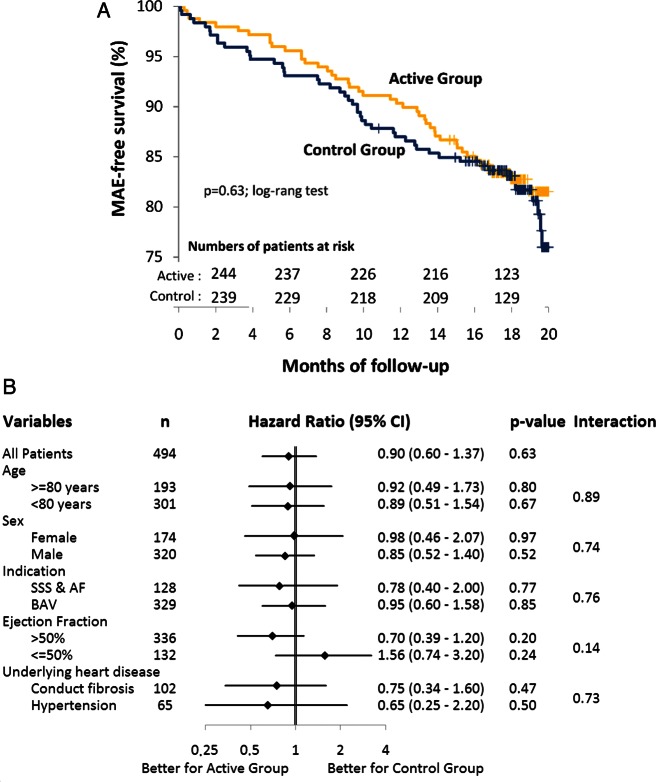
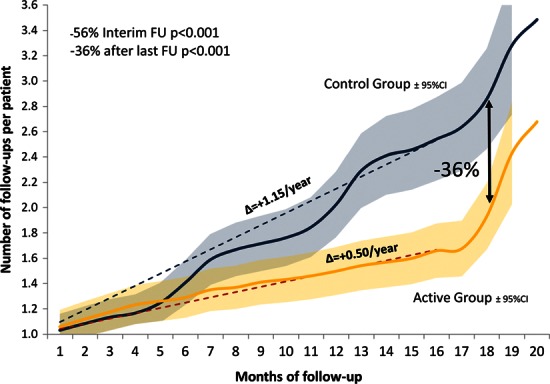
AIMS: Professional practice guidelines recommend that pacemaker recipients be followed regularly. However, the majority of scheduled ambulatory visits is unproductive and imposes a heavy burden on the health-care system. METHODS AND RESULTS: The COMPAS randomized, multicentre, non-inferiority trial examined the safety of long-term remote monitoring of pacemakers. Between December 2005 and January 2008, 538 patients were randomly assigned to remote monitoring follow-up (active group) vs. standard care (control group). The primary objective was to confirm that the proportion of patients who experienced at least one major adverse event (MAE), including all-cause death and hospitalizations for device-related or cardiovascular adverse events, was not >7% higher in the active than in the control group. MAE-free survivals and quality of life were compared in both groups. The characteristics of the study groups were similar. Over a follow-up of 18.3 months, 17.3% of patients in the active and 19.1% in the control group experienced at least one MAE (P < 0.01 for non-inferiority). Hospitalizations for atrial arrhythmias (6 vs. 18) and strokes (2 vs. 8) were fewer (P < 0.05), and the number of interim ambulatory visits was 56% lower (P < 0.001) in the active than the control group. Changes in pacemaker programming or drug regimens were made in 62% of visits in the active vs. 29% in the control group (P < 0.001). Quality of life remained unchanged in both groups. CONCLUSION: Remote monitoring was a safe alternative to conventional care and significantly lowered the number of ambulatory visits during long-term follow-up of permanently paced patients. ClinicalTrials.gov identifier: NCT00989326.
Overview
The claims and statistics of this paper haven’t been checked yet.
Free: it reads the open-access text and checks the first 5 claims that cite a source we can check. Create a free account to check every claim.
Integrity signals
Registry
Cites
Statistics
Figures
Verification
Claims the paper makes
The claims and statistics of this paper haven’t been checked yet.
Free: it reads the open-access text and checks the first 5 claims that cite a source we can check. Create a free account to check every claim.
Claims other papers make about this one
Each is checked against this paper’s own text: does it say what the citing paper says it does?
The source backs part of the claim, not all of it — or backs it for a different population, condition or comparison.
In the citing paper
“In the similar, more recent Chronicle Offers Management to Patients with Advanced Signs and Symptoms of Heart Failure (COMPAS) trial, both ambulatory visits and hospitalizations were fewer in those randomly assigned to remote follow-up.58”
From Managing with pacemakers and implantable cardioverter defibrillators (2013) · cites this paper as [58]
Experimental — accuracy not yet measured
Self-check
Percentages, sums and reported differences re-computed from the paper’s own numbers.
The self-check needs the paper’s full text.
Citations
Cites
(1992) · PubMed · Cited by 33,716
The MOS 36-ltem Short-Form Health Survey (SF-36): I. Conceptual Framework and Item Selection
Ware, J. E., & Sherbourne, C. D. (1992) · Medical Care · doi:10.1097/00005650-199206000-00002 · Cited by 30,033
ACC/AHA/HRS 2008 guidelines for device-based therapy of cardiac rhythm abnormalities
Epstein, A. E., DiMarco, J. P., Ellenbogen, K. A., Estes, N. A. M., Freedman, R. A., Gettes, L. S., Gillinov, A. M., Gregoratos, G., Hammill, S. C., Hayes, D. L., et al. (2008) · Journal of the American College of Cardiology · doi:10.1016/j.jacc.2008.02.032 · Cited by 2,546
Writing Committee Members, Epstein, A. E., DiMarco, J. P., Ellenbogen, K. A., Estes, N. A. M., Freedman, R. A., Gettes, L. S., Gillinov, A. M., Gregoratos, G., Hammill, S. C., et al. (2008) · Circulation · doi:10.1161/circualtionaha.108.189742 · Cited by 1,774
THE MOS 36- ITEM SHORT FORM HEALTH SURVEY (SF- 36) CONCEPTUAL FRAMEWORK AND ITEM SELECTION
J.E.Jr., W., & Sherburne, C. D. (1992) · Cited by 1,586
Authors/Task Force Members, Vardas, P. E., Auricchio, A., Blanc, J.-J., Daubert, J.-C., Drexler, H., Ector, H., Gasparini, M., Linde, C., Morgado, F. B., et al. (2007) · European Heart Journal · doi:10.1093/eurheartj/ehm305 · Cited by 902
Self-citationCleland, J. G. F., Louis, A. A., Rigby, A. S., Janssens, U., & Balk, A. H. M. M. (2005) · Journal of the American College of Cardiology · doi:10.1016/j.jacc.2005.01.050 · Cited by 700
Varma, N., Epstein, A. E., Irimpen, A., Schweikert, R., & Love, C. (2010) · Circulation · doi:10.1161/circulationaha.110.937409 · Cited by 594
The CONNECT (Clinical Evaluation of Remote Notification to Reduce Time to Clinical Decision) Trial
Crossley, G. H., Boyle, A., Vitense, H., Chang, Y., & Mead, R. H. (2011) · Journal of the American College of Cardiology · doi:10.1016/j.jacc.2010.12.012 · Cited by 526
Single-Chamber versus Dual-Chamber Pacing for High-Grade Atrioventricular Block
Toff, W. D., Camm, A. J., & Skehan, J. D. (2005) · New England Journal of Medicine · doi:10.1056/nejmoa042283 · Cited by 384
Authors/Task Force Members, Vardas, P. E., Auricchio, A., Blanc, J.-J., Daubert, J.-C., Drexler, H., Ector, H., Gasparini, M., Linde, C., Morgado, F. B., et al. (2007) · Europace · doi:10.1093/europace/eum189 · Cited by 291
Self-citationLAZARUS, A. (2007) · Pacing and Clinical Electrophysiology · doi:10.1111/j.1540-8159.2007.00595.x · Cited by 228
Ricci, R. P., Morichelli, L., & Santini, M. (2008) · Europace · doi:10.1093/europace/eum289 · Cited by 178
Ricci, R. P., Morichelli, L., & Santini, M. (2008) · Europace · doi:10.1093/europace/eun303 · Cited by 169 · cited 1×
“Several follow-ups prompted by remote monitoring, which enabled the early detection and management of atrial arrhythmias in the active group, may have prevented the development of more serious adverse events.(13)”
BackgroundHeidbuchel, H., Lioen, P., Foulon, S., Huybrechts, W., Ector, J., Willems, R., & Ector, H. (2008) · Europace · doi:10.1093/europace/eun010 · Cited by 133 · cited 1×
“The efficiency of this strategy is, however, questionable since, in the majority of scheduled visits, the device programming or drug regimen is left unchanged.(3) To optimize the follow-up of device recipients, systems have been developed, which allow the automatic teletransmission of data stored in the devices’ memor…”
BackgroundWhat evidence do we have to replace in-hospital implantable cardioverter defibrillator follow-up?
Brugada, P. (2006) · Clinical Research in Cardiology · doi:10.1007/s00392-006-1302-x · Cited by 104
Optimized post-operative surveillance of permanent pacemakers by home monitoring: the OEDIPE trial
Halimi, F., Clementy, J., Attuel, P., Dessenne, X., Amara, W., & on behalf of the OEDIPE trial Investigators (2008) · Europace · doi:10.1093/europace/eun250 · Cited by 88
Management of atrial fibrillation—
Ricci, R. P., Russo, M., & Santini, M. (2006) · Clinical Research in Cardiology · doi:10.1007/s00392-006-1303-9 · Cited by 36
THE VALUE OF PERMANENT FOLLOW-UP OF IMPLANTABLE PACEMAKERS - FIRST RESULTS OF AN EUROPEAN TRIAL
Wallbrück, K., Stellbrink, C., Santini, M., Gill, J., Hartmann, A., & Wunderlich, E. (2002) · Biomedizinische Technik/Biomedical Engineering · doi:10.1515/bmte.2002.47.s1b.950 · Cited by 36 · cited 1×
“only a few studies of permanently paced patients have been published.(4) –10”
Background
Cited by
2021 ESC Guidelines on cardiac pacing and cardiac resynchronization therapy
Glikson, M., Nielsen, J. C., Kronborg, M. B., Michowitz, Y., Auricchio, A., Barbash, I. M., Barrabés, J. A., Boriani, G., Braunschweig, F., Brignole, M., et al. (2021) · European Heart Journal · doi:10.1093/eurheartj/ehab364 · Cited by 2,019
Self-citationEpstein, A. E., DiMarco, J. P., Ellenbogen, K. A., Estes, N. A. M., Freedman, R. A., Gettes, L. S., Gillinov, A. M., Gregoratos, G., Hammill, S. C., Hayes, D. L., et al. (2013) · Circulation · doi:10.1161/cir.0b013e318276ce9b · Cited by 1,489
2021 ESC Guidelines on cardiac pacing and cardiac resynchronization therapy
Glikson, M., Nielsen, J. C., Kronborg, M. B., Michowitz, Y., Auricchio, A., Barbash, I. M., Barrabés, J. A., Boriani, G., Braunschweig, F., Brignole, M., et al. (2022) · EP Europace · doi:10.1093/europace/euab232 · Cited by 914
Self-citationInteractive telemedicine: effects on professional practice and health care outcomes
Flodgren, G., Rachas, A., Farmer, A. J., Inzitari, M., & Shepperd, S. (2015) · Cochrane Database of Systematic Reviews · doi:10.1002/14651858.cd002098.pub2 · Cited by 806
Tracy, C. M., Epstein, A. E., Darbar, D., DiMarco, J. P., Dunbar, S. B., Estes, N. A. M., Ferguson, T. B., Hammill, S. C., Karasik, P. E., Link, M. S., et al. (2013) · Journal of the American College of Cardiology · doi:10.1016/j.jacc.2012.11.007 · Cited by 732
Metadata
- Authors
- Mabo, P., Victor, F., Bazin, P., Ahres, S., Babuty, D., Da Costa, A., Binet, D., & Daubert, J.-C.
- Affiliations
- Inserm (FR)
- Saint Laurent Polyclinique (FR)
- Centre Hospitalier de Redon (FR)
- Centre Hospitalier Universitaire de Tours (FR)
- Corresponding author
- Mabo, Philippe
- Venue
- European Heart Journal
- Publisher
- Oxford University Press (OUP)
- Published
- 2011-11-29
- Volume
- 33
- Issue
- 9
- Pages
- 1105-1111
- ISSN
- 0195-668X (ISSN-L)
- 1522-9645
- PMC
- PMC3341630
- OpenAlex
- W2112916640
- Cited by
- 347
- References
- 19
- Citations by year
- 2026: 7 · 2025: 18 · 2024: 12 · 2023: 28 · 2022: 16 · 2021: 30 · 2020: 36 · 2019: 27 · 2018: 20 · 2017: 28 · 2016: 17 · 2015: 29 · 2014: 22 · 2013: 38 · 2012: 19
- FWCI
- 17.31
- Type
- journal article
- Language
- en
- Open access
- hybrid
- doi.org
- Licence
- cc-by-nc
- Locations
- European Heart Journal (publishedVersion, cc-by-nc)
- PubMed Central (publishedVersion, cc-by-nc)
- PubMed (publishedVersion)
- HAL (submittedVersion)
- Funders
- Commercializations Promotion Agency for R and D Outcomes
- Topics
- Health Sciences › Medicine › Cardiology and Cardiovascular Medicine › Cardiac pacing and defibrillation studies
- Health Sciences › Medicine › Public Health, Environmental and Occupational Health › Telemedicine and Telehealth Implementation
- Health Sciences › Medicine › Cardiology and Cardiovascular Medicine › Cardiac Health and Mental Health
- Keywords
- remote monitoring, cardiac pacemaker, permanent cardiac pacing, major adverse events, non-inferiority, hospitalization, atrial arrhythmias, stroke, quality of life, pacemaker programming, device safety
- MeSH terms
- Aged, Aged, 80 and over, Arrhythmias, Cardiac, Cardiac Pacing, Artificial, Female, Follow-Up Studies, Humans, Male, Pacemaker, Artificial, Postoperative Care, Treatment Outcome, Remote Consultation, Kaplan-Meier Estimate
About these checks
Registry, retraction, Cites and statistics results are computed, not judged, with one exception: a printed reference that no index lists is read once by a model before it counts as a citation error. Claims are extracted by a model and kept only when their quote appears verbatim in the text; each cited source is then checked, with a model’s help, for whether it says what the claim relies on. Those verdicts can be wrong — read the claim’s quote and the cited source before relying on one.
Statistics and arithmetic are recomputed, not judged.
Confidence bands are shown only for fields calibrated on our annotated test set. None is calibrated yet, so no band is shown.
What counts as a claim ›How we measure confidence ›How we check this ›
Are you an author, or do you see a problem with this page? Request a review
Data sources
Bibliographic data: Semantic Scholar, OpenAlex, Crossref.
Contains information from the Semantic Scholar Academic Graph Datasets, made available under the ODC Attribution License (ODC-BY 1.0).
Semantic Scholar’s data is described in: Kinney, R., et al. (2023). The Semantic Scholar Open Data Platform. arXiv:2301.10140.
