

The DOI matches its Crossref record; 64 of the 64 references it cites were found in a registry or an index.
Evolutionary genomics of yeast pathogens in the Saccharomycotina
Open accessAbstract
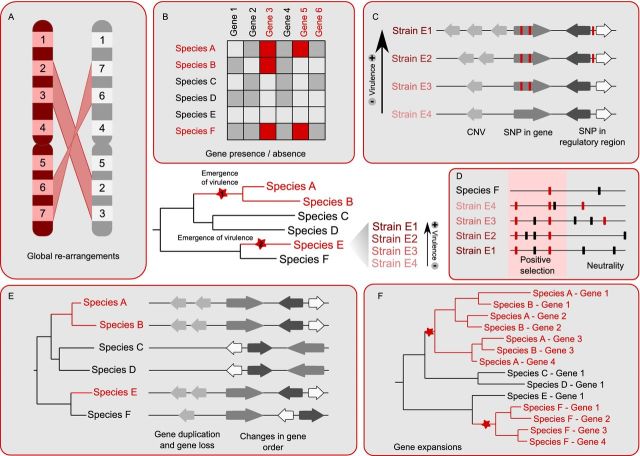
Saccharomycotina comprises a diverse group of yeasts that includes numerous species of industrial or clinical relevance. Opportunistic pathogens within this clade are often assigned to the genus Candida but belong to phylogenetically distant lineages that also comprise non-pathogenic species. This indicates that the ability to infect humans has evolved independently several times among Saccharomycotina. Although the mechanisms of infection of the main groups of Candida pathogens are starting to be unveiled, we still lack sufficient understanding of the evolutionary paths that led to a virulent phenotype in each of the pathogenic lineages. Deciphering what genomic changes underlie the evolutionary emergence of a virulence trait will not only aid the discovery of novel virulence mechanisms but it will also provide valuable information to understand how new pathogens emerge, and what clades may pose a future danger. Here we review recent comparative genomics efforts that have revealed possible evolutionary paths to pathogenesis in different lineages, focusing on the main three agents of candidiasis worldwide: Candida albicans, C. parapsilosis and C. glabrata We will discuss what genomic traits may facilitate the emergence of virulence, and focus on two different genome evolution mechanisms able to generate drastic phenotypic changes and which have been associated to the emergence of virulence: gene family expansion and interspecies hybridization.
Overview
The claims and statistics of this paper haven’t been checked yet.
Run the check — free, no account needed. It reads the open-access text and checks the sources it cites.
Integrity signals
Registry
Cites
Statistics
Figures
Verification
Claims the paper makes
The claims and statistics of this paper haven’t been checked yet.
Run the check — free, no account needed. It reads the open-access text and checks the sources it cites.
Claims other papers make about this one
Each is checked against this paper’s own text: does it say what the citing paper says it does?
In the citing paper
“although the four most common Candida (C. albicans, C. glabrata, C. parapsilosis, and C. tropicalis) can account for more than 80% of the cases, there is a long list with over 30 Candida that have been identified as candidemia agents [9]”
From Evolutionary Emergence of Drug Resistance in Candida Opportunistic Pathogens (2018) · cites this paper as [9]
In the citing paper
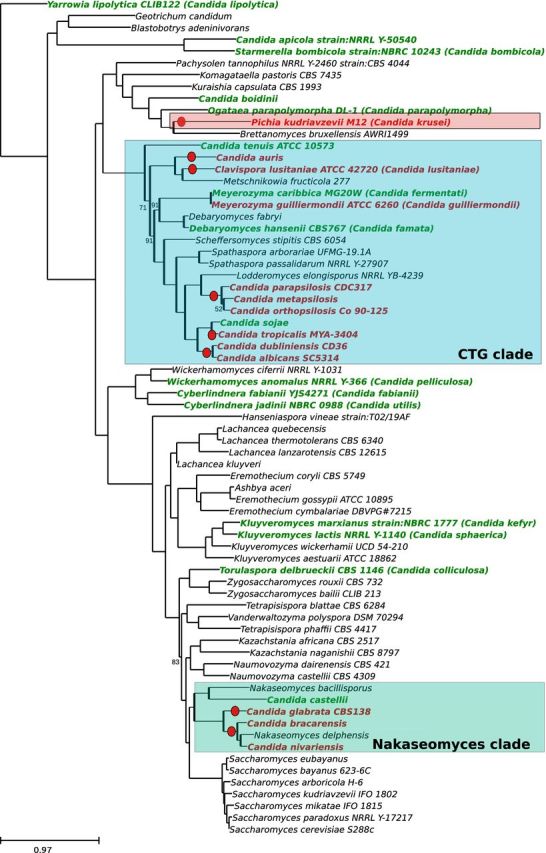
“When highlighted on a phylogenetic tree, Candida opportunistic pathogens belong to distinct lineages, which are interspersed with non-pathogenic relatives [9].”
From Evolutionary Emergence of Drug Resistance in Candida Opportunistic Pathogens (2018) · cites this paper as [9]
Self-check
Percentages, sums and reported differences re-computed from the paper’s own numbers.
The self-check needs the paper’s full text.
Citations
Cites
Epidemiology of Invasive Candidiasis: a Persistent Public Health Problem
Pfaller, M. A., & Diekema, D. J. (2007) · Clinical Microbiology Reviews · doi:10.1128/cmr.00029-06 · Cited by 4,174 · cited 5×
“Lastly, C. tropicalis infections are usually restricted to patients with neutropenia and other blood malignancies and usually respond to azole antifungals (Pfaller and Diekema 2007; Guinea et al. 2014).”
BackgroundResultInfluentialKurtzman, C. P., & Lodder, J. (1972) · Mycologia · doi:10.2307/3758036 · Cited by 3,441
Molecular evidence for an ancient duplication of the entire yeast genome
Wolfe, K. H., & Shields, D. C. (1997) · Nature · doi:10.1038/42711 · Cited by 1,785
Dujon, B., Sherman, D., Fischer, G., Durrens, P., Casaregola, S., Lafontaine, I., de Montigny, J., Marck, C., Neuvéglise, C., Talla, E., et al. (2004) · Nature · doi:10.1038/nature02579 · Cited by 1,623
Comparative Genomics of Listeria Species
Glaser, P., Frangeul, L., Buchrieser, C., Rusniok, C., Amend, A., Baquero, F., Berche, P., Blöcker, H., Brandt, P., Chakraborty, T., et al. (2001) · Science · doi:10.1126/science.1063447 · Cited by 1,505
RAxML-III: a fast program for maximum likelihood-based inference of large phylogenetic trees
Stamatakis, A., Ludwig, T. G., & Meier, H. (2004) · Bioinformatics · doi:10.1093/bioinformatics/bti191 · Cited by 1,429
Turning a hobby into a job: How duplicated genes find new functions
Conant, G. C., & Wolfe, K. H. (2008) · Nature Reviews Genetics · doi:10.1038/nrg2482 · Cited by 1,281
Growth of Candida albicans hyphae
Sudbery, P. E. (2011) · Nature Reviews Microbiology · doi:10.1038/nrmicro2636 · Cited by 1,110
Evolution of pathogenicity and sexual reproduction in eight Candida genomes
Butler, G., Rasmussen, M. D., Lin, M. F., Santos, M. A. S., Sakthikumar, S., Munro, C. A., Rheinbay, E., Grabherr, M., Forche, A., Reedy, J. L., et al. (2009) · Nature · doi:10.1038/nature08064 · Cited by 1,065
ESCMID† and ECMM‡ joint clinical guidelines for the diagnosis and management of mucormycosis 2013
Cornely, O. A., Arıkan-Akdağlı, S., Dannaoui, É., Groll, A. H., Lagrou, K., Chakrabarti, A., Lanternier, F., Pagano, L., Skiada, A., Akova, M., et al. (2014) · Clinical Microbiology and Infection · doi:10.1111/1469-0691.12371 · Cited by 864
Cited by
Sorted by citations
Muñoz, J. F., Gade, L., Chow, N. A., Loparev, V. N., Juieng, P., Berkow, E. L., Farrer, R. A., Litvintseva, A. P., & Cuomo, C. A. (2018) · Nature Communications · doi:10.1038/s41467-018-07779-6 · Cited by 458
Fungal evolution: major ecological adaptations and evolutionary transitions
Naranjo-Ortíz, M. A., & Gabaldón, T. (2019) · Biological reviews/Biological reviews of the Cambridge Philosophical Society · doi:10.1111/brv.12510 · Cited by 412
Self-citationEvolutionary Emergence of Drug Resistance in Candida Opportunistic Pathogens
Ksiezopolska, E., & Gabaldón, T. (2018) · Genes · doi:10.3390/genes9090461 · Cited by 230
Self-citationEvolution of the human pathogenic lifestyle in fungi
Rokas, A. (2022) · Nature Microbiology · doi:10.1038/s41564-022-01112-0 · Cited by 240
Molecular Mechanisms Associated with Antifungal Resistance in Pathogenic Candida Species
Czajka, K. M., Venkataraman, K., Brabant-Kirwan, D., Santi, S. A., Verschoor, C. P., Appanna, V. D., Singh, R. I., Saunders, D., & Tharmalingam, S. (2023) · Cells · doi:10.3390/cells12222655 · Cited by 207
Metadata
- Authors
- Gabaldón, T., Naranjo-Ortíz, M. A., & Marcet-Houben, M.
- Affiliations
- Institució Catalana de Recerca i Estudis Avançats (ES)
- Universitat Pompeu Fabra (ES)
- Corresponding author
- Gabaldón, Toni
- Venue
- FEMS Yeast Research
- Publisher
- Oxford University Press (OUP)
- Published
- 2016-08-03
- Volume
- 16
- Issue
- 6
- Pages
- fow064
- ISSN
- 1567-1356 (ISSN-L)
- 1567-1364
- PMC
- PMC5815160
- OpenAlex
- W2488745281
- Cited by
- 105
- References
- 64
- Citations by year
- 2026: 6 · 2025: 10 · 2024: 11 · 2023: 16 · 2022: 4 · 2021: 17 · 2020: 10 · 2019: 13 · 2018: 11 · 2017: 7
- FWCI
- 0.93
- Type
- journal article
- Language
- en
- Open access
- hybrid
- doi.org
- Licence
- cc-by-nc
- Locations
- FEMS Yeast Research (publishedVersion, cc-by-nc)
- PubMed Central (publishedVersion, cc-by-nc)
- PubMed (publishedVersion)
- RECERCAT (Consorci de Serveis Universitaris de Catalunya) (publishedVersion, other-oa)
- Repositori digital de la UPF (Universitat Pompeu Fabra) (publishedVersion, cc-by-nc)
- HighWire Press Open Archive (submittedVersion)
- Funders
- European Commission (H2020-MSCA-ITN, H2020-MSCA-ITN-2014, 2007–2013, FP7 2007-2013, 642095, FP7-PEOPLE-2013, FP7/2007, FP7‐PEOPLE‐ 2013‐ITN, 606786, H2020-MSCA)
- Ministerio de Economía y Competitividad (642095, SEV‐2012‐0208, BIO2012-37161)
- Horizon 2020 Framework Programme (MSCA-ITN-2014, FP7/2007-2013, H2020MSCA‐ITN‐2014, H2020-MSCA, H2020-MSCA-ITN-2014-642095, 642095, H2020-MSCA-ITN)
- Agència de Gestió d'Ajuts Universitaris i de Recerca (SGR857)
- European Regional Development Fund (H2020-MSCA-ITN-2014, FP7/2007‐2013, 2007 – 2013)
- FP7 People: Marie-Curie Actions (FP7-PEOPLE-2013-ITN-606786, 2007-2013, 2013‐ITN‐606786, FP7-PEOPLE-2013-ITN, FP7/2007‐2013/, FP7-PEOPLE-2013)
- Topics
- Life Sciences › Biochemistry, Genetics and Molecular Biology › Molecular Biology › Fungal and yeast genetics research
- Life Sciences › Immunology and Microbiology › Microbiology › Yeasts and Rust Fungi Studies
- Health Sciences › Medicine › Infectious Diseases › Antifungal resistance and susceptibility
- Keywords
- Saccharomycotina, pathogenic yeasts, Candida, candidiasis, virulence evolution, Candida albicans, Candida parapsilosis, Candida glabrata, comparative genomics, gene family expansion, interspecific hybridization, genome evolution, opportunistic pathogens
- MeSH terms
- Ascomycota, Evolution, Molecular, Genomics, Virulence Factors
About these checks
Registry, retraction, Cites and statistics results are computed, not judged, with one exception: a printed reference that no index lists is read once by a model before it counts as a citation error. Claims are extracted by a model and kept only when their quote appears verbatim in the text; each cited source is then checked, with a model’s help, for whether it says what the claim relies on. Those verdicts can be wrong — read the claim’s quote and the cited source before relying on one.
Statistics and arithmetic are recomputed, not judged.
Confidence bands are shown only for fields calibrated on our annotated test set. None is calibrated yet, so no band is shown.
What counts as a claim ›How we measure confidence ›How we check this ›
Are you an author, or do you see a problem with this page? Request a review
