

Horizontal Gene Transfer Contributes to the Evolution of Arthropod Herbivory
Open accessThe DOI matches its Crossref record; 152 of the 152 references it cites were found in a registry or an index.
Abstract
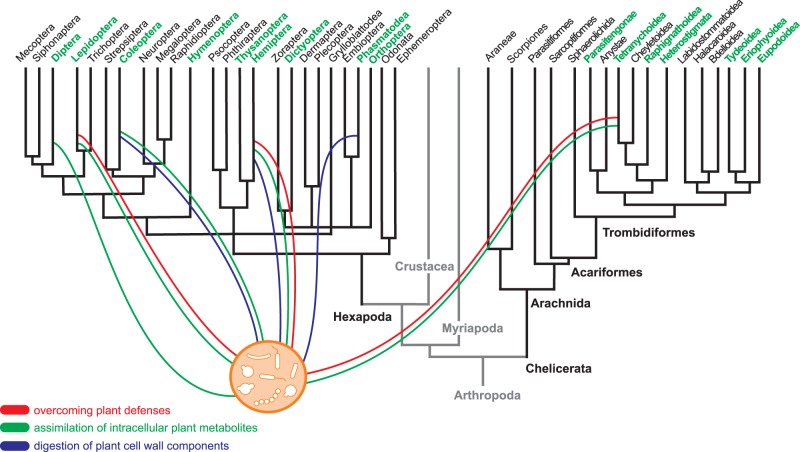
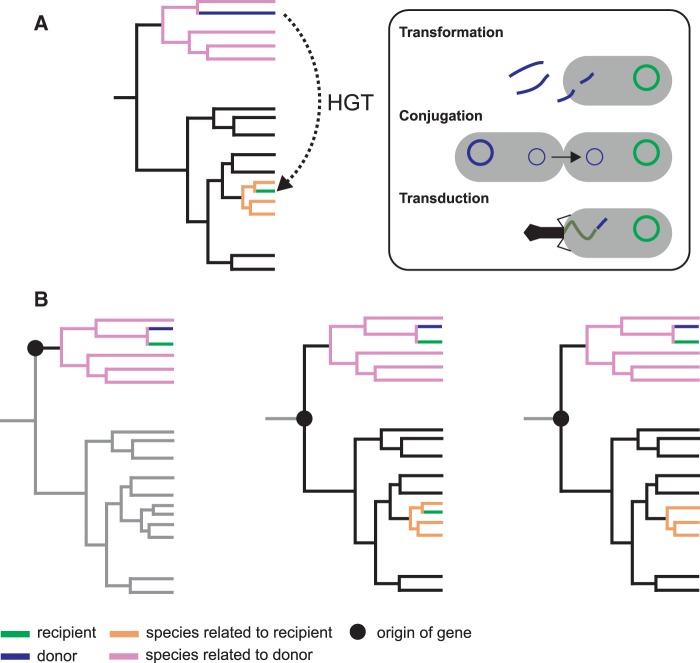
Within animals, evolutionary transition toward herbivory is severely limited by the hostile characteristics of plants. Arthropods have nonetheless counteracted many nutritional and defensive barriers imposed by plants and are currently considered as the most successful animal herbivores in terrestrial ecosystems. We gather a body of evidence showing that genomes of various plant feeding insects and mites possess genes whose presence can only be explained by horizontal gene transfer (HGT). HGT is the asexual transmission of genetic information between reproductively isolated species. Although HGT is known to have great adaptive significance in prokaryotes, its impact on eukaryotic evolution remains obscure. Here, we show that laterally transferred genes into arthropods underpin many adaptations to phytophagy, including efficient assimilation and detoxification of plant produced metabolites. Horizontally acquired genes and the traits they encode often functionally diversify within arthropod recipients, enabling the colonization of more host plant species and organs. We demonstrate that HGT can drive metazoan evolution by uncovering its prominent role in the adaptations of arthropods to exploit plants.
Overview
The claims and statistics of this paper haven’t been checked yet.
Free: it reads the open-access text and checks the first 5 claims that cite a source we can check. Create a free account to check every claim.
Integrity signals
Registry
Cites
Statistics
Figures
Verification
Claims the paper makes
The claims and statistics of this paper haven’t been checked yet.
Free: it reads the open-access text and checks the first 5 claims that cite a source we can check. Create a free account to check every claim.
Claims other papers make about this one
Each is checked against this paper’s own text: does it say what the citing paper says it does?
The source backs part of the claim, not all of it — or backs it for a different population, condition or comparison.
In the citing paper
“A notable example in animals is the presence of microbial genes in the genome of the coffee borer beetle Hypothenemus hampei, which facilitates the digestion of caffeine and reflects a functional adaptation through HGT [35].”
From Origin and Evolution of Genes in Eukaryotes: Mechanisms, Dynamics, and Functional Implications (2025) · cites this paper as [35]
Experimental — accuracy not yet measured
Self-check
Percentages, sums and reported differences re-computed from the paper’s own numbers.
The self-check needs the paper’s full text.
Citations
Cites
The Carbohydrate-Active EnZymes database (CAZy): an expert resource for Glycogenomics
Cantarel, B. L., Coutinho, P. M., Rancurel, C., Bernard, T., Lombard, V., & Henrissat, B. (2009) · Nucleic Acids Research · doi:10.1093/nar/gkn663 · Cited by 5,972 · cited 2×
“GHs are delineated into specific families and sub-families through the curated Carbohydrate-Active database of enzymes involved in carbohydrate metabolism (Cantarel et al. 2009).”
OrthoMCL: Identification of Ortholog Groups for Eukaryotic Genomes
Li, L., Stoeckert, C. J., & Roos, D. S. (2003) · Genome Research · doi:10.1101/gr.1224503 · Cited by 5,707 · cited 1×
“Using the plethora of sequenced genomes, families of orthologues can be systemically classified (Tatusov et al. 1997; Li et al. 2003).”
Carpita, N., & Gibeaut, D. (1993) · The Plant Journal · doi:10.1046/j.1365-313x.1993.00999.x · Cited by 3,651 · cited 1×
“In some plant species, these composite fibers form a thick rigid layer (for instance in woody plants), and pose a barrier for arthropods aiming to feed on plant nutrients (Carpita and Gibeaut 1993; Whetten and Sederoff 1995; Heredia 2003; Sorensen et al. 2010).”
A Genomic Perspective on Protein Families
Tatusov, R. L., Koonin, E. V., & Lipman, D. J. (1997) · Science · doi:10.1126/science.278.5338.631 · Cited by 3,590 · cited 1×
“Using the plethora of sequenced genomes, families of orthologues can be systemically classified (Tatusov et al. 1997; Li et al. 2003).”
Herbivory in Relation to Plant Nitrogen Content
Mattson, W. J. (1980) · Annual Review of Ecology and Systematics · doi:10.1146/annurev.es.11.110180.001003 · Cited by 3,425 · cited 2×
“As many plant species and tissues are characterized by a relatively high carbohydrate content, but low protein and vitamin levels (Mattson 1980; Strong et al. 1984; Awmack and Leather 2002), herbivorous animals need to optimize the assimilation of the limited supply of nutrients in plant tissues.”
Phylogenomics resolves the timing and pattern of insect evolution
Misof, B., Liu, S., Meusemann, K., Peters, R. S., Donath, A., Mayer, C., Frandsen, P. B., Ware, J., Flouri, T., Beutel, R. G., et al. (2014) · Science · doi:10.1126/science.1257570 · Cited by 2,694 · cited 1×
“For many arthropod studies, both requirements can be met as a significant part of the arthropod phylogenomic tree is well mapped and keeps improving due to the increasing number of sequenced arthropod genomes and transcriptomes (Regier et al. 2010; Wheat and Wahlberg 2013; Misof et al. 2014).”
Plant Immunity to Insect Herbivores
Howe, G. A., & Jander, G. (2008) · Annual Review of Plant Biology · doi:10.1146/annurev.arplant.59.032607.092825 · Cited by 2,427 · cited 2×
“Plant resistance to herbivory can be achieved by physical barriers such as trichomes and waxy cuticles and/or by the production of chemical defenses (Howe and Jander 2008).”
Host Plant Quality and Fecundity in Herbivorous Insects
Awmack, C. S., & Leather, S. R. (2002) · Annual Review of Entomology · doi:10.1146/annurev.ento.47.091201.145300 · Cited by 2,201 · cited 2×
“As many plant species and tissues are characterized by a relatively high carbohydrate content, but low protein and vitamin levels (Mattson 1980; Strong et al. 1984; Awmack and Leather 2002), herbivorous animals need to optimize the assimilation of the limited supply of nutrients in plant tissues.”
Schoonhoven, L. M., Jermy, T., & van Loon, J. J. A. (1998) · Springer eBooks · doi:10.1007/978-1-4899-3200-6 · Cited by 1,686 · cited 2×
“The arthropod phylum is now considered to harbor the most successful animal herbivores in terrestrial ecosystems, both in terms of biomass and species diversity (Strong et al. 1984; Labandeira 2002, 2006; Schoonhoven et al. 2006) (fig.”
Fundamentals of molecular evolution
(1991) · Journal of Human Evolution · doi:10.1016/0047-2484(91)90069-8 · Cited by 1,654
Cited by
The evolution and genomic basis of beetle diversity
McKenna, D. D., Shin, S., Ahrens, D., Balke, M., Beza-Beza, C., Clarke, D. J., Donath, A., Escalona, H. E., Friedrich, F., Letsch, H., et al. (2019) · Proceedings of the National Academy of Sciences · doi:10.1073/pnas.1909655116 · Cited by 606
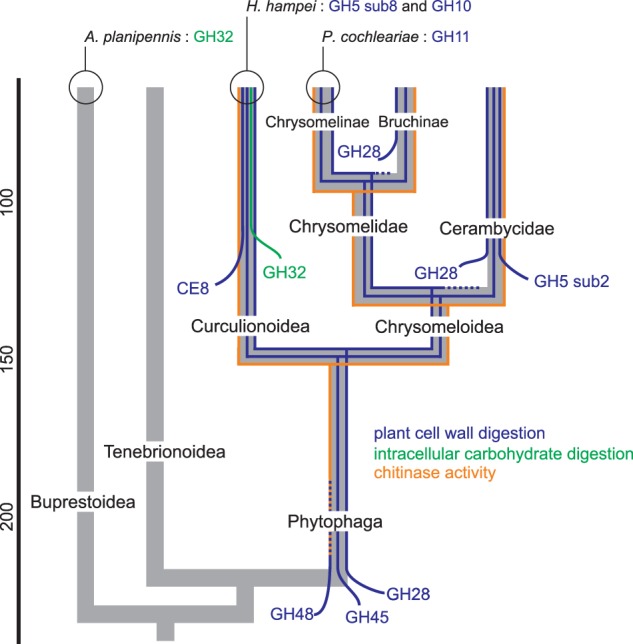
“For GH5-2, GH28, GH45, and GH32, a similar gene has been independently horizontally transferred to a plant-feeding organism outside of Insecta (16).”
InfluentialFunctional horizontal gene transfer from bacteria to eukaryotes
Husnik, F., & McCutcheon, J. P. (2018) · Nature Reviews Microbiology · doi:10.1038/nrmicro.2017.137 · Cited by 480
Division of labor in honey bee gut microbiota for plant polysaccharide digestion
Zheng, H., Perreau, J., Powell, J. E., Han, B., Zhang, Z., Kwong, W. K., Tringe, S. G., & Moran, N. A. (2019) · Proceedings of the National Academy of Sciences · doi:10.1073/pnas.1916224116 · Cited by 358
“P polysaccharides are abundant in many animal diets, but animals generally lack enzymes to digest these substrates (1).”
BackgroundWhitefly hijacks a plant detoxification gene that neutralizes plant toxins
Xia, J., Guo, Z., Yang, Z., Han, H., Wang, S., Xu, H., Yang, X., Yang, F., Wu, Q., Xie, W., et al. (2021) · Cell · doi:10.1016/j.cell.2021.02.014 · Cited by 298
Potential Effects of Horizontal Gene Exchange in the Human Gut
Lerner, A., Matthias, T., & Aminov, R. (2017) · Frontiers in Immunology · doi:10.3389/fimmu.2017.01630 · Cited by 198
Metadata
- Authors
- Wybouw, N., Pauchet, Y., Heckel, D. G., & Van Leeuwen, T.
- Affiliations
- University of Amsterdam (NL)
- Max Planck Institute for Chemical Ecology (DE)
- Corresponding author
- Wybouw, Nicky
- Venue
- Genome Biology and Evolution
- Publisher
- Oxford University Press (OUP)
- Published
- 2016-06
- Volume
- 8
- Issue
- 6
- Pages
- 1785-1801
- ISSN
- 1759-6653 (ISSN-L)
- PMC
- PMC4943190
- OpenAlex
- W2432572080
- Cited by
- 209
- References
- 152
- Citations by year
- 2026: 16 · 2025: 23 · 2024: 16 · 2023: 19 · 2022: 32 · 2021: 23 · 2020: 28 · 2019: 13 · 2018: 22 · 2017: 14 · 2016: 3
- FWCI
- 20.30
- Type
- journal article
- Language
- en
- Open access
- gold
- doi.org
- Licence
- cc-by-nc
- Locations
- Genome Biology and Evolution (publishedVersion, cc-by-nc)
- Europe PMC (PubMed Central) (publishedVersion, cc-by-nc)
- PubMed Central (publishedVersion, cc-by-nc)
- PubMed (publishedVersion)
- Ghent University Academic Bibliography (Ghent University) (submittedVersion, other-oa)
- UvA-DARE (University of Amsterdam) (submittedVersion, cc-by-nc)
- MPG.PuRe (Max Planck Society) (submittedVersion, other-oa)
- Data Archiving and Networked Services (DANS) (submittedVersion, other-oa)
- Max Planck Digital Library (submittedVersion, other-oa)
- HighWire Press Open Archive (submittedVersion)
- Funders
- European Commission (618105, HORIZON2020, 658795)
- Fonds Wetenschappelijk Onderzoek (G.0093.12N, G053815N)
- Max-Planck-Gesellschaft
- Vlaamse regering
- Topics
- Life Sciences › Biochemistry, Genetics and Molecular Biology › Genetics › Chromosomal and Genetic Variations
- Life Sciences › Agricultural and Biological Sciences › Insect Science › Insect symbiosis and bacterial influences
- Life Sciences › Biochemistry, Genetics and Molecular Biology › Molecular Biology › Genomics and Phylogenetic Studies
- Keywords
- horizontal gene transfer, arthropod herbivory, phytophagy, phytophagous insects, plant-feeding mites, plant defense metabolites, detoxification, host plant colonization, eukaryotic evolution, animal evolution
- MeSH terms
- Animals, Arthropods, Biological Evolution, Phylogeny, Plants, Ecosystem, Evolution, Molecular, Gene Transfer, Horizontal, Herbivory
About these checks
Registry, retraction, Cites and statistics results are computed, not judged, with one exception: a printed reference that no index lists is read once by a model before it counts as a citation error. Claims are extracted by a model and kept only when their quote appears verbatim in the text; each cited source is then checked, with a model’s help, for whether it says what the claim relies on. Those verdicts can be wrong — read the claim’s quote and the cited source before relying on one.
Statistics and arithmetic are recomputed, not judged.
Confidence bands are shown only for fields calibrated on our annotated test set. None is calibrated yet, so no band is shown.
What counts as a claim ›How we measure confidence ›How we check this ›
Are you an author, or do you see a problem with this page? Request a review
How to cite
Cite CoChat for the checks on this page, and the paper for its own findings.
- This page
- CoChat. (2026). Citation check: Horizontal Gene Transfer Contributes to the Evolution of Arthropod Herbivory. https://app.cochat.ai/papers/10.1093/gbe/evw119
- The paper
- Wybouw, N., Pauchet, Y., Heckel, D. G., & Van Leeuwen, T. (2016). Horizontal Gene Transfer Contributes to the Evolution of Arthropod Herbivory. Genome Biology and Evolution. https://doi.org/10.1093/gbe/evw119
Data sources
Bibliographic data: Semantic Scholar, OpenAlex, Crossref.
Contains information from the Semantic Scholar Academic Graph Datasets, made available under the ODC Attribution License (ODC-BY 1.0).
Semantic Scholar’s data is described in: Kinney, R., et al. (2023). The Semantic Scholar Open Data Platform. arXiv:2301.10140.
