

Epigenetics meets metabolomics: an epigenome-wide association study with blood serum metabolic traits
Open accessThe DOI matches its Crossref record; 34 of the 35 references it cites were found in a registry or an index.
Abstract
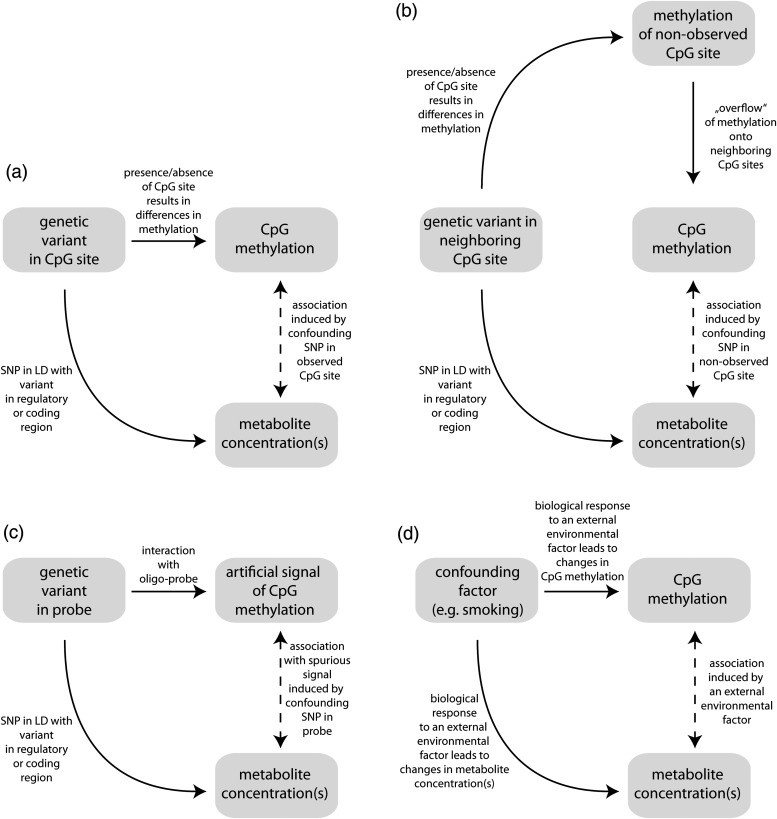
Previously, we reported strong influences of genetic variants on metabolic phenotypes, some of them with clinical relevance. Here, we hypothesize that DNA methylation may have an important and potentially independent effect on human metabolism. To test this hypothesis, we conducted what is to the best of our knowledge the first epigenome-wide association study (EWAS) between DNA methylation and metabolic traits (metabotypes) in human blood. We assess 649 blood metabolic traits from 1814 participants of the Kooperative Gesundheitsforschung in der Region Augsburg (KORA) population study for association with methylation of 457 004 CpG sites, determined on the Infinium HumanMethylation450 BeadChip platform. Using the EWAS approach, we identified two types of methylome-metabotype associations. One type is driven by an underlying genetic effect; the other type is independent of genetic variation and potentially driven by common environmental and life-style-dependent factors. We report eight CpG loci at genome-wide significance that have a genetic variant as confounder (P = 3.9 × 10(-20) to 2.0 × 10(-108), r(2) = 0.036 to 0.221). Seven loci display CpG site-specific associations to metabotypes, but do not exhibit any underlying genetic signals (P = 9.2 × 10(-14) to 2.7 × 10(-27), r(2) = 0.008 to 0.107). We further identify several groups of CpG loci that associate with a same metabotype, such as 4-vinylphenol sulfate and 4-androsten-3-beta,17-beta-diol disulfate. In these cases, the association between CpG-methylation and metabotype is likely the result of a common external environmental factor, including smoking. Our study shows that analysis of EWAS with large numbers of metabolic traits in large population cohorts are, in principle, feasible. Taken together, our data suggest that DNA methylation plays an important role in regulating human metabolism.
Overview
The claims and statistics of this paper haven’t been checked yet.
Free: it reads the open-access text and checks the first 5 claims that cite a source we can check. Create a free account to check every claim.
Integrity signals
Registry
Cites
Statistics
Figures
Verification
Claims the paper makes
The claims and statistics of this paper haven’t been checked yet.
Free: it reads the open-access text and checks the first 5 claims that cite a source we can check. Create a free account to check every claim.
Claims other papers make about this one
Each is checked against this paper’s own text: does it say what the citing paper says it does?
The cited source says what the claim attributes to it.
In the citing paper
“In a recent study, the associations between 649 metabolic traits and over 400,000 DNA methylation markers were examined using blood samples from 1,814 European participants. The epigenome-wide association approach revealed strong associations with metabolic traits driven by either genetic effects or possible environmental factors (Petersen et al., 2014).”
From Integrative Analysis of Multi-omics Data for Discovery and Functional Studies of Complex Human Diseases (2016) · cites this paper as Petersen et al., 2014
In the citing paper
“The group of correlated epigenetic and metabolic markers influenced by common environmental exposures suggest their potential utility in studying the environmental risk and gene-environmental interaction for human diseases.”
From Integrative Analysis of Multi-omics Data for Discovery and Functional Studies of Complex Human Diseases (2016) · cites this paper as Petersen et al., 2014
Self-check
Percentages, sums and reported differences re-computed from the paper’s own numbers.
The self-check needs the paper’s full text.
Citations
Cites
DNA methylation: roles in mammalian development
Smith, Z. D., & Meissner, A. (2013) · Nature Reviews Genetics · doi:10.1038/nrg3354 · Cited by 3,045 · cited 2×
“DNA methylation is an important gene-regulatory mechanism (4,5) and is therefore expected to also play a role in determining disease-relevant metabotypes (6).”
BackgroundEpigenetic modifications and human disease
Portela, A., & Esteller, M. (2010) · Nature Biotechnology · doi:10.1038/nbt.1685 · Cited by 2,836 · cited 1×
“DNA methylation is an important gene-regulatory mechanism (4,5) and is therefore expected to also play a role in determining disease-relevant metabotypes (6).”
BackgroundHigh density DNA methylation array with single CpG site resolution
Bibikova, M., Barnes, B., Tsan, C., Ho, V., Klotzle, B., Le, J. M., Delano, D., Zhang, L., Schroth, G. P., Gunderson, K. L., et al. (2011) · Genomics · doi:10.1016/j.ygeno.2011.07.007 · Cited by 1,727
Functional genomics reveal that the serine synthesis pathway is essential in breast cancer
Possemato, R., Marks, K. M., Shaul, Y. D., Pacold, M. E., Kim, D., Birsoy, K., Sethumadhavan, S., Woo, H.-K., Jang, H. G., Jha, A. K., et al. (2011) · Nature · doi:10.1038/nature10350 · Cited by 1,683
Teschendorff, A. E., Marabita, F., Lechner, M., Bartlett, T., Tegner, J., Gomez-Cabrero, D., & Beck, S. (2013) · Bioinformatics · doi:10.1093/bioinformatics/bts680 · Cited by 1,683
Epigenome-wide association studies for common human diseases
Rakyan, V. K., Down, T. A., Balding, D. J., & Beck, S. (2011) · Nature Reviews Genetics · doi:10.1038/nrg3000 · Cited by 1,267 · cited 2×
“DNA methylation is an important gene-regulatory mechanism (4,5) and is therefore expected to also play a role in determining disease-relevant metabotypes (6).”
BackgroundReinius, L. E., Acevedo, N., Joerink, M., Pershagen, G., Dahlén, S.-E., Greco, D., Söderhäll, C., Scheynius, A., & Kere, J. (2012) · PLoS ONE · doi:10.1371/journal.pone.0041361 · Cited by 1,035 · cited 1×
“The DNA methylation reported here is, therefore, a readout from a mixture of different types of blood cells (23).”
BackgroundHuman metabolic individuality in biomedical and pharmaceutical research
CARDIoGRAM, Suhre, K., Shin, S.-Y., Petersen, A.-K., Mohney, R. P., Meredith, D., Wägele, B., Altmaier, E., Deloukas, P., Erdmann, J., et al. (2011) · Nature · doi:10.1038/nature10354 · Cited by 1,017 · cited 4×
“(13) for known metabolites from the Metabolon platform, Petersen et al.”
BackgroundInfluentialSelf-citationLiu, Y., Aryee, M. J., Padyukov, L., Fallin, M. D., Hesselberg, E., Runarsson, A., Reinius, L., Acevedo, N., Taub, M., Ronninger, M., et al. (2013) · Nature Biotechnology · doi:10.1038/nbt.2487 · Cited by 969 · cited 2×
“(31) successfullyused thisapproachto adjust for cell-typeproportions inanEWASwithrheumatoidarthritis.”
SWAN: Subset-quantile Within Array Normalization for Illumina Infinium HumanMethylation450 BeadChips
Maksimovic, J., Gordon, L., & Oshlack, A. (2012) · Genome Biology · doi:10.1186/gb-2012-13-6-r44 · Cited by 826 · cited 1×
“There have been several efforts to develop new methodologies and pipelines to overcome the shift between Infinium I and II, such as subset-quantile within array normalization (20) and beta mixture quantile dilation (21).”
Method
Cited by
Connecting genetic risk to disease end points through the human blood plasma proteome
Suhre, K., Arnold, M., Bhagwat, A. M., Cotton, R. J., Engelke, R., Raffler, J., Sarwath, H., Thareja, G., Wahl, A., DeLisle, R. K., et al. (2017) · Nature Communications · doi:10.1038/ncomms14357 · Cited by 800
Self-citationAnalytical Methods in Untargeted Metabolomics: State of the Art in 2015
Alonso, A., Marsal, S., & JuliÃ, A. (2015) · Frontiers in Bioengineering and Biotechnology · doi:10.3389/fbioe.2015.00023 · Cited by 681
Sun, Y. V., & Hu, Y.-J. (2016) · Advances in Genetics · doi:10.1016/bs.adgen.2015.11.004 · Cited by 459
“…studies collecting multi-omic data but limited overview of the methodological framework for integrative analyses (Liu, Ding, et al., 2013; Petersen et al., 2014; Shah et al., 2015), we summarize the analytical methods for high-throughput multi-omic data, and provide an updated analytical…”
BackgroundMethodMcGarrah, R. W., Crown, S. B., Zhang, G.-F., Shah, S. H., & Newgard, C. B. (2018) · Circulation Research · doi:10.1161/circresaha.117.311002 · Cited by 423
Genetic and environmental influences interact with age and sex in shaping the human methylome
van Dongen, J., Nivard, M. G., Willemsen, G., Hottenga, J.-J., Helmer, Q., Dolan, C. V., Ehli, E. A., Davies, G. E., van Iterson, M., Breeze, C. E., et al. (2016) · Nature Communications · doi:10.1038/ncomms11115 · Cited by 402
van Dijk, S. J., Molloy, P. L., Varinli, H., Morrison, J. L., Muhlhausler, B. S., EpiSCOPE, M. O., Buckley, M., Clark, S. J., McMillen, I. C., Noakes, M., et al. (2015) · International Journal of Obesity · doi:10.1038/ijo.2014.34 · Cited by 359
Mendelson, M. M., Marioni, R. E., Joehanes, R., Liu, C., Hedman, Å. K., Aslibekyan, S., Demerath, E. W., Guan, W., Zhi, D., Yao, C., et al. (2017) · PLOS Medicine · doi:10.1371/journal.pmed.1002215 · Cited by 350
“Overlap between replicated BMI-related CpGs and metabolites as reported from the KORA cohort [86].”
BackgroundMulti-omics integration in biomedical research – A metabolomics-centric review
Wörheide, M. A., Krumsiek, J., Kastenmüller, G., & Arnold, M. (2021) · Analytica Chimica Acta · doi:10.1016/j.aca.2020.10.038 · Cited by 334
“Large-scale epidemiological studies have demonstrated the value of integrating metabolomics with other omics layers, such as genomics [14–17], transcriptomics [18] and epigenetics [19], providing insight into metabolic individuality and links to disease mechanisms [20,21].”
BackgroundSelf-citationMetabolomics for Plant Improvement: Status and Prospects
Kumar, R., Bohra, A., Pandey, A. K., Pandey, M. K., & Kumar, A. (2017) · Frontiers in Plant Science · doi:10.3389/fpls.2017.01302 · Cited by 328
“Similarly, modern techniques such as the epigenome wide association studies (EWAS) employed recently in human (Petersen et al., 2014) may also be extended to plants to better capitalize on the potential of trait-associations like “methylome-metabotype association” for accelerating plant improvement.”
BackgroundMethodTobi, E. W., Slieker, R. C., Luijk, R., Dekkers, K. F., Stein, A. D., Xu, K. M., Biobank-based Integrative Omics Studies Consortium, Slagboom, P. E., van Zwet, E. W., Lumey, L. H., et al. (2018) · Science Advances · doi:10.1126/sciadv.aao4364 · Cited by 284
Chen, Z., Miao, F., Paterson, A. D., Lachin, J. M., Zhang, L., Schones, D. E., Wu, X., Wang, J., Tompkins, J. D., Genuth, S., et al. (2016) · Proceedings of the National Academy of Sciences · doi:10.1073/pnas.1603712113 · Cited by 238
“Interestingly, association of TXNIP hypo-me at the same CpG3 with type 2 diabetes and related traits (including fasting glucose, HbA1C, and insulin resistance) (57–60), serum metabolites related to diabetes (61), and high blood triglycerides (62) in WB DNA from various cohorts was recently reported.”
BackgroundCharacterization of whole-genome autosomal differences of DNA methylation between men and women
Singmann, P., Shem-Tov, D., Wahl, S., Grallert, H., Fiorito, G., Shin, S.-Y., Schramm, K., Wolf, P., Kunze, S., Baran, Y., et al. (2015) · Epigenetics & Chromatin · doi:10.1186/s13072-015-0035-3 · Cited by 234
“Technical validation of the method has been reported elsewhere [63].”
MethodSelf-citationRecent developments on the role of epigenetics in obesity and metabolic disease
van Dijk, S. J., Tellam, R. L., Morrison, J. L., Muhlhausler, B. S., & Molloy, P. L. (2015) · Clinical Epigenetics · doi:10.1186/s13148-015-0101-5 · Cited by 233
Irvin, M. R., Zhi, D., Joehanes, R., Mendelson, M., Aslibekyan, S., Claas, S. A., Thibeault, K. S., Patel, N., Day, K., Jones, L. W., et al. (2014) · Circulation · doi:10.1161/circulationaha.114.009158 · Cited by 218
“Specifically, 649 blood metabolomic traits from 1814 participants of the Kooperative Gesundheitsforschung in der Region Augsburg (KORA) study were assessed for association with methylation at 457 004 CpG sites determined on the Infinium HumanMethylation450 BeadChip platform.(48)”
Tebani, A., Afonso, C., Marret, S., & Bekri, S. (2016) · International Journal of Molecular Sciences · doi:10.3390/ijms17091555 · Cited by 212
Aslibekyan, S., Demerath, E. W., Mendelson, M., Zhi, D., Guan, W., Liang, L., Sha, J., Pankow, J. S., Liu, C., Irvin, M. R., et al. (2015) · Obesity · doi:10.1002/oby.21111 · Cited by 210
“Previously, the methylation of the same locus has been linked to blood concentrations of 4-androsten-3beta,17beta-diol, a steroid hormone upregulated in obesity (33,34).”
BackgroundSoriano-Tárraga, C., Jiménez-Conde, J., Giralt-Steinhauer, E., Mola-Caminal, M., Vivanco-Hidalgo, R. M., Ois, A., Rodríguez-Campello, A., Cuadrado-Godia, E., Sayols-Baixeras, S., Elosua, R., et al. (2016) · Human Molecular Genetics · doi:10.1093/hmg/ddv493 · Cited by 191
“lomicrons (class A) and known metabolic markers of DM, such as hexose and alpha-hydrobutyrate (35).”
BackgroundMetabolic GWAS‐based dissection of genetic bases underlying the diversity of plant metabolism
Fang, C., & Luo, J. (2019) · The Plant Journal · doi:10.1111/tpj.14097 · Cited by 162
Florath, I., Butterbach, K., Heiss, J. A., Bewerunge‐Hudler, M., Zhang, Y., Schöttker, B., & Brenner, H. (2015) · Diabetologia · doi:10.1007/s00125-015-3773-7 · Cited by 166
“TXNIP was identified as one of seven loci at which methylome–metabotype associations independent of genetic variation and potentially driven by common environmental and lifestyle-dependent factors were observed [36].”
BackgroundEpigenetic associations of type 2 diabetes and BMI in an Arab population
Al‐Muftah, W., Al-Shafai, M. N., Zaghlool, S. B., Visconti, A., Tsai, P.-C., Kumar, P., Spector, T. D., Bell, J. T., Falchi, M., & Suhre, K. (2016) · Clinical Epigenetics · doi:10.1186/s13148-016-0177-6 · Cited by 158
“Other biomarkers of T2D and pre-diabetes have been previously associated with methylation at ABCG1, TXNIP, and CPT1A, including 3-methyl-2oxovalerate [33], glycine [19], several lipid traits, including phosphatidylcholines (PCs) [48], chylomicrons, and their remnants, very-low-density lipoprotein (VLDL) and IDL choles…”
BackgroundInfluentialSelf-citationPaving the Way to Precision Nutrition Through Metabolomics
Tebani, A., & Bekri, S. (2019) · Frontiers in Nutrition · doi:10.3389/fnut.2019.00041 · Cited by 143
Integration of ‘omics’ data in aging research: from biomarkers to systems biology
Zierer, J., Menni, C., Kastenmüller, G., & Spector, T. D. (2015) · Aging Cell · doi:10.1111/acel.12386 · Cited by 140
“Furthermore, metabolite concentrations are influenced by genetic variants (Shin et al., 2014) and epigenetic factors (Petersen et al., 2014) mediated through changes in gene expression or enzyme activity.”
BackgroundSelf-citationRodríguez, E., Baurecht, H., Wahn, A. F., Kretschmer, A., Hotze, M., Kunze, S., Klopp, N., Illig, T., Schramm, K., Prokisch, H., et al. (2014) · Journal of Investigative Dermatology · doi:10.1038/jid.2014.87 · Cited by 146
“did not observe any single-nucleotide polymorphism association with methylation levels at our top DMS within a distance of 500 kb (Petersen et al., 2013), we cannot fully exclude influences of low-prevalent genetic variations in the epidermis and the context of AD.”
BackgroundSelf-citationEpigenome-wide association study (EWAS) on lipids: the Rotterdam Study
Braun, K. V. E., Dhana, K., de Vries, P. S., Voortman, T., van Meurs, J. B. J., Uitterlinden, A. G., Hofman, A., Hu, F. B., Franco, O. H., & Dehghan, A. (2017) · Clinical Epigenetics · doi:10.1186/s13148-016-0304-4 · Cited by 174
“Although there are no previous studies that report an association between methylation of cg17901584 (DHCR24) and HDL-C, previous studies reported associations between methylation of this CpG site with waist circumference and phosphatidylcholine (PC ae C36:5) [14, 15].”
Genetics of human metabolism: an update
Kastenmüller, G., Raffler, J., Gieger, C., & Suhre, K. (2015) · Human Molecular Genetics · doi:10.1093/hmg/ddv263 · Cited by 133
“A number of GWAS with other disease-relevant -omics phenotypes have also been conducted, including genome-wide gene expression (58), proteomics (59) and protein glycosylation (60), and further epigenome-wide association studies between DNAmethylation andmetabolomics (61) and studies on transcriptome–metabolome associa…”
BackgroundSelf-citationZhang, Y., Schöttker, B., Florath, I., Stock, C., Butterbach, K., Holleczek, B., Mons, U., & Brenner, H. (2015) · Environmental Health Perspectives · doi:10.1289/ehp.1409020 · Cited by 133
Epigenetic scores for the circulating proteome as tools for disease prediction
Gadd, D. A., Hillary, R. F., McCartney, D. L., Zaghlool, S. B., Stevenson, A. J., Cheng, Y., Fawns‐Ritchie, C., Nangle, C., Campbell, A., Flaig, R., et al. (2022) · eLife · doi:10.7554/elife.71802 · Cited by 136
“Methylation data were generated for 1814 individuals ( Petersen et al., 2014 ); 944 also had protein and genotype measurements available.”
BackgroundSelf-citationAssociation of DNA methylation with age, gender, and smoking in an Arab population
Zaghlool, S. B., Al-Shafai, M., Al Muftah, W. A., Kumar, P., Falchi, M., & Suhre, K. (2015) · Clinical Epigenetics · doi:10.1186/s13148-014-0040-6 · Cited by 107
“EWAS with complex disorders, such as obesity [15-17], diabetes risk factors [18], rheumatoid arthritis [19], and metabolic traits [20] have already been reported.”
BackgroundSelf-citationThe Human Blood Metabolome-Transcriptome Interface
Bartel, J., Krumsiek, J., Schramm, K., Adamski, J., Gieger, C., Herder, C., Carstensen, M., Peters, A., Rathmann, W., Roden, M., et al. (2015) · PLOS Genetics · doi:10.1371/journal.pgen.1005274 · Cited by 105
“Comparing 1,350 reported methylationmetabolite associations from a recent epigenome-wide association study [31] with our results surprisingly revealed only a single overlapping hit: X-03094 and the MAN2A2 transcript correlated in our study and also displayed a comparable methylation-metabolite association in the Metab…”
BackgroundResultSelf-citationKamleh, M. A., Snowden, S. G., Grapov, D., Blackburn, G. J., Watson, D. G., Xu, N., Ståhle, M., & Wheelock, C. E. (2014) · Journal of Proteome Research · doi:10.1021/pr500782g · Cited by 116
F2RL3 methylation in blood DNA is a strong predictor of mortality
Zhang, Y., Yang, R., Burwinkel, B., Breitling, L. P., Holleczek, B., Schöttker, B., & Brenner, H. (2014) · International Journal of Epidemiology · doi:10.1093/ije/dyu006 · Cited by 101
“33 were all associated with 4-vinylphenol, a metabolic indicator of complex disorders.(37) Further research is warranted to address the individual and joint associations of smoking-related DNA methylation patterns with mortality and the underlying mechanisms.”
BackgroundResource, T. M. T. H. E., Busche, S., Shao, X., Caron, M., Kwan, T., Allum, F., Cheung, W., Ge, B., Westfall, S., Simon, M.-M., et al. (2015) · Genome biology · doi:10.1186/s13059-015-0856-1 · Cited by 103
“, Illumina HumanMethylation450 Beadchip, hereafter Illumina 450 K array) of large population-based cohorts, associating differential CpG methylation in blood with metabolic traits [11] and body mass index [12], and in CD4+ T-cells with fasting lipid levels [13].”
BackgroundWang, Z., Zhu, C., Nambi, V., Morrison, A. C., Folsom, A. R., Ballantyne, C. M., Boerwinkle, E., & Yu, B. (2019) · Arteriosclerosis Thrombosis and Vascular Biology · doi:10.1161/atvbaha.118.312236 · Cited by 102
Network Medicine in Pathobiology
Lee, L. Y.-H., & Loscalzo, J. (2019) · The American Journal of Pathology · doi:10.1016/j.ajpath.2019.03.009 · Cited by 95
Metabolic profiling in diabetes
Suhre, K. (2014) · Journal of Endocrinology · doi:10.1530/joe-14-0024 · Cited by 93
Self-citationDNA methylation and lipid metabolism: an EWAS of 226 metabolic measures
Gomez-Alonso, M. D. C., Kretschmer, A., Wilson, R., Pfeiffer, L., Karhunen, V., Seppälä, I., Zhang, W., Mittelstraß, K., Wahl, S., Matías‐García, P. R., et al. (2021) · Clinical Epigenetics · doi:10.1186/s13148-020-00957-8 · Cited by 93
“Up to now, three studies, including our previous investigation, have evaluated associations between serum metabolic measures and DNA methylation—with a limited sample size or a limited number of measures—identifying several loci linked to disease response mechanisms or environmental insults [29, 37, 38].”
ResultSelf-citationThe pathogenesis of gout: molecular insights from genetic, epigenomic and transcriptomic studies
Leask, M., Crișan, T. O., Ji, A., Matsuo, H., Köttgen, A., & Merriman, T. R. (2024) · Nature Reviews Rheumatology · doi:10.1038/s41584-024-01137-1 · Cited by 99
“These findings reinforce previous reports of an epigenome-mediated contribution of SLC2A9 to urate levels and risk of gout 95,96 .”
New advances in analytical methods for mass spectrometry-based large-scale metabolomics study
Liu, X., Zhou, L., Shi, X., & Xu, G. (2019) · TrAC Trends in Analytical Chemistry · doi:10.1016/j.trac.2019.115665 · Cited by 95
Juvinao-Quintero, D. L., Marioni, R. E., Ochoa‐Rosales, C., Russ, T. C., Deary, I. J., van Meurs, J. B. J., Voortman, T., Hivert, M., Sharp, G. C., Relton, C. L., et al. (2021) · Clinical Epigenetics · doi:10.1186/s13148-021-01027-3 · Cited by 95
Epigenetics in health and disease: heralding the EWAS era
Murphy, T. M., & Mill, J. S. (2014) · The Lancet · doi:10.1016/s0140-6736(14)60269-5 · Cited by 93
Zaghlool, S. B., Kühnel, B., Elhadad, M. A., Kader, S. A., Halama, A., Thareja, G., Engelke, R., Sarwath, H., Al‐Dous, E., Mohamoud, Y. A., et al. (2020) · Nature Communications · doi:10.1038/s41467-019-13831-w · Cited by 83
Self-citationBeynon, R. A., Richmond, R. C., Ferreira, D. L. S., Ness, A., May, M., Smith, G. D., Vincent, E. E., Adams, C. D., Ala‐Korpela, M., Würtz, P., et al. (2018) · International Journal of Cancer · doi:10.1002/ijc.31929 · Cited by 84
“Formal MR approaches have been used previously in this context, to capture causal relationships between metabolites and disease [19-22], facilitated by strong genotypic effects on metabolites [23-27].”
Obesity-Related Metabolomic Profiles and Discrimination of Metabolically Unhealthy Obesity
Bagheri, M., Farzadfar, F., Qi, L., Yekaninejad, M. S., Chamari, M., Zeleznik, O. A., Kalantar, Z., Ebrahimi, Z., Sheidaie, A., Koletzko, B. V., et al. (2018) · Journal of Proteome Research · doi:10.1021/acs.jproteome.7b00802 · Cited by 84
Yousri, N. A., Fakhro, K. A., Robay, A., Rodríguez-Flores, J. L., Mohney, R. P., Zeriri, H., Odeh, T., Kader, S. A., Al‐Dous, E., Thareja, G., et al. (2018) · Nature Communications · doi:10.1038/s41467-017-01972-9 · Cited by 82
Self-citationFisel, P., Schaeffeler, E., & Schwab, M. G. (2016) · Clinical Pharmacology & Therapeutics · doi:10.1002/cpt.343 · Cited by 78
Early Embryonic Androgen Exposure Induces Transgenerational Epigenetic and Metabolic Changes
Xu, N., Chua, A. K., Jiang, H., Liu, N.-A., & Goodarzi, M. O. (2014) · Molecular Endocrinology · doi:10.1210/me.2014-1042 · Cited by 69
“The first epigenome-wide association study between DNA methylation and metabolic traits in human blood suggested that DNA methylation may play an important role in metabolism (39).”
BackgroundNano, J., Ghanbari, M., Wang, W., de Vries, P. S., Dhana, K., Muka, T., Uitterlinden, A. G., van Meurs, J. B. J., Hofman, A., Franco, O. H., et al. (2017) · Gastroenterology · doi:10.1053/j.gastro.2017.06.003 · Cited by 92
Critical Role of the Human ATP-Binding Cassette G1 Transporter in Cardiometabolic Diseases
Hardy, L. M., Frisdal, É., & Goff, W. L. (2017) · International Journal of Molecular Sciences · doi:10.3390/ijms18091892 · Cited by 90
“Finally, beyond TG and HDL-C, EWAS between DNA methylation and lipidomic traits in human blood revealed an association between methylation at cg06500161 and SM, phosphatidylcholine, lysophosphatidylcholine and monoacylglycerol [79,83].”
BackgroundIntegrative Metabolomics to Identify Molecular Signatures of Responses to Vaccines and Infections
Diray‐Arce, J., Conti, M. G., Petrova, B., Kanarek, N., Angelidou, A., & Levy, O. (2020) · Metabolites · doi:10.3390/metabo10120492 · Cited by 72
“To provide a holistic understanding of a dynamic biological system, incorporating multi-omic variables addresses gaps in our current knowledge of disease pathogenesis and evolution and offers opportunities for early diagnosis, prevention and potentially treatment of disease [23].”
BackgroundDNA methylation in human lipid metabolism and related diseases
Mittelstraß, K., & Waldenberger, M. (2018) · Current Opinion in Lipidology · doi:10.1097/mol.0000000000000491 · Cited by 85
Self-citationMetaboTools: A Comprehensive Toolbox for Analysis of Genome-Scale Metabolic Models
Aurich, M. K., Fleming, R. M. T., & Thiele, I. (2016) · Frontiers in Physiology · doi:10.3389/fphys.2016.00327 · Cited by 62
“indispensable analytical method for many biological disciplines, including microbiology, plant sciences, biotechnology, and biomedicine [8-10].”
Computational approaches for systems metabolomics
Krumsiek, J., Bartel, J., & Theis, F. J. (2016) · Current Opinion in Biotechnology · doi:10.1016/j.copbio.2016.04.009 · Cited by 73
Lipidomes in health and disease: Analytical strategies and considerations
Wei, F., Lamichhane, S., Orešič, M., & Hyötyläinen, T. (2019) · TrAC Trends in Analytical Chemistry · doi:10.1016/j.trac.2019.115664 · Cited by 68
Fernández‐Sanlés, A., Sayols-Baixeras, S., Curcio, S., Subirana, I., Marrugat, J., & Elosúa, R. (2018) · Arteriosclerosis Thrombosis and Vascular Biology · doi:10.1161/atvbaha.117.310340 · Cited by 61
The Epigenomic Analysis of Human Obesity
Bell, C. G. (2017) · Obesity · doi:10.1002/oby.21909 · Cited by 66
“This clearly shows the power of EWAS to identify more precise biochemical phenotypes (38) and the benefit of closely examining the distinct biological changes associated with broad epidemiological measures, such as BMI.”
BackgroundInfluentialEpigenome-wide association meta-analysis of DNA methylation with coffee and tea consumption
Karabegović, I., Portilla-Fernández, E., Li, Y., Ma, J., Maas, S. C. E., Sun, D., Hu, E. A., Kühnel, B., Zhang, Y., Ambatipudi, S., et al. (2021) · Nature Communications · doi:10.1038/s41467-021-22752-6 · Cited by 60
“Another EWAS has also reported the association between this CpG and blood concentration of steroid hormones, which are upregulated in obesity 59 .”
Self-citationBioinformatics Tools for the Interpretation of Metabolomics Data
Gardinassi, L. G., Xia, J., Safo, S. E., & Li, S. (2017) · Current Pharmacology Reports · doi:10.1007/s40495-017-0107-0 · Cited by 57
“They have been successful in identifying genetic variants functionally related with metabolic traits and disease processes [98, 99].”
BackgroundUnrevealing metabolomics for abiotic stress adaptation and tolerance in plants
Choudhury, S. R., Sharma, P., Moulick, D., & Mazumder, M. K. (2021) · Journal of Crop Science and Biotechnology · doi:10.1007/s12892-021-00102-8 · Cited by 58
Metabolic profiling in human exposome studies
Athersuch, T. J., & Keun, H. C. (2015) · Mutagenesis · doi:10.1093/mutage/gev060 · Cited by 61
“Using 450K methylation array profiles, associated genomic data and metabolic profiles, the authors identified seven CpG site-specific epigenome–metabotype associations that were free from confounding by underlying genomic variation (65).”
BackgroundAn epigenome-wide association study of metabolic syndrome and its components
Nuotio, M.-L., Pervjakova, N., Joensuu, A., Karhunen, V., Hiekkalinna, T., Milani, L. A., Kettunen, J., Järvelin, M., Jousilahti, P., Metspalu, A., et al. (2020) · Scientific Reports · doi:10.1038/s41598-020-77506-z · Cited by 60
Metabolome analyses in exposome studies: Profiling methods for a vast chemical space
Athersuch, T. J. (2015) · Archives of Biochemistry and Biophysics · doi:10.1016/j.abb.2015.10.007 · Cited by 56
Early Diagnosis of Sepsis: Is an Integrated Omics Approach the Way Forward?
Langley, R. J., & Wong, H. R. (2017) · Molecular Diagnosis & Therapy · doi:10.1007/s40291-017-0282-z · Cited by 53
“However, integration linking metabolomic and transcriptomic changes with genetic and epigenetic changes may improve the identification of disease-causing mutations [122, 123].”
Backgroundvan Otterdijk, S. D., Binder, A. M., Szic, K. S. V., Schwald, J., & Michels, K. B. (2017) · PLoS ONE · doi:10.1371/journal.pone.0180955 · Cited by 49
“DNA methylation is thought to play a role in regulating human metabolism[10] and epigenetic changes have been suggested to participate in the development of T2D[11].”
BackgroundDeep molecular phenotypes link complex disorders and physiological insult to CpG methylation
Zaghlool, S. B., Mook‐Kanamori, D. O., Kader, S. A., Stephan, N., Halama, A., Engelke, R., Sarwath, H., Al‐Dous, E., Mohamoud, Y. A., Roemisch‐Margl, W., et al. (2018) · Human Molecular Genetics · doi:10.1093/hmg/ddy006 · Cited by 59
“As our study cohort is relatively small, but otherwise exceptionally deeply phenotyped at a multi-omics level, we focused on 20 CpG sites that we previously identified in our EWAS with metabolomics (25).”
BackgroundMethodResultSelf-citationGestational route to healthy birth (GaRBH): protocol for an Indian prospective cohort study
Gupta, V., Saxena, R., Walia, G. K., Agarwal, T., Vats, H., Dunn, W. B., Relton, C. L., Sovio, U., Papageorghiou, A. T., Smith, G. D., et al. (2019) · BMJ Open · doi:10.1136/bmjopen-2018-025395 · Cited by 45
Alfano, R., Chadeau‐Hyam, M., Ghantous, A., Keski‐Rahkonen, P., Chatzi, L., Espín-Pérez, A., Herceg, Z., Kogevinas, M., de Kok, T. M. C. M., Nawrot, T. S., et al. (2020) · Metabolism · doi:10.1016/j.metabol.2020.154292 · Cited by 45
Wang, Z., Peng, H., Gao, W., Cao, W., Lv, J., Yu, C., Huang, T., Sun, D., Wang, B., Liao, C., et al. (2021) · Genomics · doi:10.1016/j.ygeno.2021.11.005 · Cited by 55
DNA Methylation Changes and Inflammaging in Aging-Associated Diseases
Alimohammadi, M., Makaremi, S., Rahimi, A. A. R., Asghariazar, V., Taghadosi, M., & Safarzadeh, E. (2022) · Epigenomics · doi:10.2217/epi-2022-0143 · Cited by 47
Rapid Growth and Childhood Obesity Are Strongly Associated with LysoPC(14:0)
Rzehak, P., Hellmuth, C., Uhl, O., Kirchberg, F. F., Peißner, W., Harder, U., Grote, V., Weber, M., Xhonneux, A., Langhendries, J., et al. (2014) · Annals of Nutrition and Metabolism · doi:10.1159/000365037 · Cited by 43
Fitó, M., Melander, O., Martínez, J. A., Toledo, E., Carpéné, C., & Corella, D. (2016) · International Journal of Molecular Sciences · doi:10.3390/ijms17091469 · Cited by 45
“In addition to the high cost limitation of obtaining omics data from large sample sizes, there are also important computational limitations to integrating multidimensional omic data coming from GWAs, epigenome-wide methylation studies, genome-wide-transcriptomics, metabolomics, proteomics, and even metagenomics [133].”
BackgroundThe remodel of the “central dogma”: a metabolomics interaction perspective
dos Santos, G. C., Renovato‐Martins, M., & de Brito, N. M. (2021) · Metabolomics · doi:10.1007/s11306-021-01800-8 · Cited by 55
“Conventionally, epigenetic modifications comprise all aspects of the chromatin structure, histone posttranslational modifications, RNA, DNA methylation, or hydroxymethylation, and metabolites act as the substrates for these modifications (Carrer & Wellen, 2014; Gerhäuser, 2012; Janke et al., 2015; Johnson et al., 2015…”
BackgroundMetabolomics profiling reveals novel markers for leukocyte telomere length
Zierer, J., Kastenmüller, G., Suhre, K., Gieger, C., Codd, V., Tsai, P.-C., Bell, J., Peters, A., Strauch, K., Schulz, H., et al. (2016) · Aging · doi:10.18632/aging.100874 · Cited by 42
“The metabolite 4-vinylphenol sulfate is known to be associated with several DNA methylation probes, possibly driven by tobacco smoking [21,22].”
Self-citationKennedy, A. D., Ford, L. A., Wittmann, B. M., Conner, J., Wulff, J. E., Mitchell, M. W., Evans, A. M., & Toal, D. R. (2021) · PLoS ONE · doi:10.1371/journal.pone.0249797 · Cited by 43
Beuchel, C. F., Becker, S., Dittrich, J., Kirsten, H., Toenjes, A., Stümvoll, M., Loeffler, M., Thiele, H., Beutner, F., Thiery, J., et al. (2019) · Molecular Metabolism · doi:10.1016/j.molmet.2019.08.010 · Cited by 43
“The most frequently considered factors were age, sex, log-BMI, smoking status [6,12e16], and, to a lesser extent, type-2-diabetes (T2D) and application of sex hormones [6,7,15,17].”
BackgroundCirculating Metabolic Biomarkers of Screen-Detected Prostate Cancer in the ProtecT Study
Adams, C. D., Richmond, R. C., Ferreira, D. L. S., Spiller, W., Tan, V. Y., Zheng, J., Würtz, P., Donovan, J., Hamdy, F. C., Neal, D. E., et al. (2018) · Cancer Epidemiology Biomarkers & Prevention · doi:10.1158/1055-9965.epi-18-0079 · Cited by 39
Moler, E. R. V., Abakir, A., Eleftheriou, M., Johnson, J. S., Krutovsky, K. V., Lewis, L. C., Ruzov, A. S., Whipple, A. V., & Rajora, O. P. (2018) · Population genomics · doi:10.1007/13836_2018_59 · Cited by 40
From lipid locus to drug target through human genomics
van der Laan, S. W., Harshfield, E. L., Hemerich, D., Stacey, D., Wood, A., & Asselbergs, F. W. (2018) · Cardiovascular Research · doi:10.1093/cvr/cvy120 · Cited by 39
Ji, D. Y., Park, S. H., Park, S. J., Kim, K. H., Ku, C. R., Shin, D. Y., Yoon, J. S., Lee, D. Y., & Lee, E. J. (2018) · Scientific Reports · doi:10.1038/s41598-018-27600-0 · Cited by 36
Vellame, D. S., Castanho, I., Dahir, A., Mill, J. S., & Hannon, E. J. (2021) · BMC Genomics · doi:10.1186/s12864-021-07721-z · Cited by 48
Tin, A., Schlosser, P., Matías‐García, P. R., Thio, C. H. L., Joehanes, R., Liu, H., Yu, Z., Weihs, A., Hoppmann, A., Grundner-Culemann, F., et al. (2021) · Nature Communications · doi:10.1038/s41467-021-27198-4 · Cited by 35
Self-citationNutritional systems biology of type 2 diabetes
Zhao, Y., Barrere‐Cain, R., & Yang, X. (2015) · Genes & Nutrition · doi:10.1007/s12263-015-0481-3 · Cited by 33
“In fact, even the basic associations between DNA methylation, gene expression, and metabolite profiles throughout the human genome remain poorly described, and only modest correlations have been observed between proteins and their corresponding mRNAs (Olsson et al. 2014; Petersen et al. 2014).”
Measuring epigenetics as the mediator of gene/environment interactions in DOHaD
Ong, M., Lin, X., & Holbrook, J. D. (2014) · Journal of Developmental Origins of Health and Disease · doi:10.1017/s2040174414000506 · Cited by 31
“52,53 With multiple data sets, one can also explore the causal relationships between the different layers of biological control.”
BackgroundSun, Y. V. (2014) · Current Genetic Medicine Reports · doi:10.1007/s40142-014-0058-2 · Cited by 27
“A joint metabolome-DNA methylome study surveyed the epigenetic association with 649 blood metabolic traits [88].”
Demura, M., Demura, Y., Takeda, Y., & Saijoh, K. (2015) · Hypertension Research · doi:10.1038/hr.2015.42 · Cited by 27
Die Biobank der Nationalen Kohorte als Ressource der epidemiologischen Forschung
Wichmann, H. ‐., Hörlein, A., Ahrens, W., & Nauck, M. A. (2016) · Bundesgesundheitsblatt - Gesundheitsforschung - Gesundheitsschutz · doi:10.1007/s00103-015-2305-4 · Cited by 27
Lind, M. V., Savolainen, O. I., & Ross, A. B. (2016) · European Journal of Epidemiology · doi:10.1007/s10654-016-0166-2 · Cited by 29
Kao, W., Yang, S., Liu, W., Yeh, M., Lin, C., Liu, C., Huang, C., Lin, S., Lee, S., Chen, P., et al. (2016) · Molecular Carcinogenesis · doi:10.1002/mc.22505 · Cited by 29
Non-coding genome functions in diabetes
Cebola, I., & Pasquali, L. (2015) · Journal of Molecular Endocrinology · doi:10.1530/jme-15-0197 · Cited by 27
“Interestingly, the genetic component of T2D is also supported by studies showing that abnormal glucose homeostasis is also heritable (Poulsen et al. 1999).”
BackgroundNRF2 loss recapitulates heritable impacts of paternal cigarette smoke exposure
Murphy, P. J., Guo, J., Jenkins, T. G., James, E. R., Hoidal, J. R., Huecksteadt, T. P., Broberg, D. S., Hotaling, J. M., Alonso, D., Carrell, D. T., et al. (2020) · PLoS Genetics · doi:10.1371/journal.pgen.1008756 · Cited by 24
Kho, M., Zhao, W., Ratliff, S. M., Ammous, F., Mosley, T. H., Shang, L., Kardia, S. L. R., Zhou, X., & Smith, J. A. (2020) · BMC Medical Genomics · doi:10.1186/s12920-020-00791-0 · Cited by 23
Epigenetic Mechanisms Underlying the Pathogenesis of Neurogenetic Diseases
Qureshi, I., & Mehler, M. F. (2014) · Neurotherapeutics · doi:10.1007/s13311-014-0302-1 · Cited by 23
“One very interesting report employed epigenome-wide association studies coupled with metabolomic data to examine associations between DNA methylation and numerous metabolic traits in human blood [102].”
BackgroundAla‐Korpela, M., & Smith, G. D. (2016) · International Journal of Epidemiology · doi:10.1093/ije/dyw305 · Cited by 24
Untargeted Metabolomics Reveals Multiple Metabolites influencing Smoking-Related DNA Methylation
Huang, Y., Hui, Q., Walker, D. I., Uppal, K., Goldberg, J. H., Jones, D. P., Vaccarino, V., & Sun, Y. V. (2018) · Epigenomics · doi:10.2217/epi-2017-0101 · Cited by 21
On the potential of models for location and scale for genome-wide DNA methylation data
Wahl, S., Fenske, N., Kunze, S., Suhre, K., Gieger, C., Waldenberger, M., Grallert, H., & Schmid, M. C. (2014) · BMC Bioinformatics · doi:10.1186/1471-2105-15-232 · Cited by 21
“These data sets have been used in published EWAS before [3-5], and study design and data collection have been described in detail [29,30].”
BackgroundMethodInfluentialSelf-citationConnecting the epigenome, metabolome and proteome for a deeper understanding of disease
Suhre, K., & Zaghlool, S. B. (2021) · Journal of Internal Medicine · doi:10.1111/joim.13306 · Cited by 26
Self-citationOverview of Metabolomic Analysis and the Integration with Multi-Omics for Economic Traits in Cattle
Hao, D., Bai, J., Du, J., Wu, X., Thomsen, B., Gao, H., Su, G., & Wang, X. Q. (2021) · Metabolites · doi:10.3390/metabo11110753 · Cited by 23
“They found that the underlying genetic effects or environmental effects mainly drove the methylome–metabotype associations, and identified several CpG site-specific associations with metabolites; therefore, DNA methylation has an important role in regulating the metabolism [83].”
BackgroundXue, S., He, J., Zhang, X., Liu, Y., Xue, F., Wang, C., Ai, D., & Zhu, Y. (2015) · Biochimica et Biophysica Acta (BBA) - Molecular and Cell Biology of Lipids · doi:10.1016/j.bbalip.2015.07.001 · Cited by 20
Metabolic Phenotype of Obesity in a Saudi Population
Ahmad, M. S., Alsaleh, M., Kimhofer, T., Ahmad, S., Jamal, W. H., Wali, S., Nicholson, J. K., Damanhouri, Z. A., & Holmes, E. C. (2016) · Journal of Proteome Research · doi:10.1021/acs.jproteome.6b00710 · Cited by 24
Human White Adipose Tissue Metabolome: Current Perspective
Kučera, J., Spáčil, Z., Friedecký, D., Novák, J., Pekár, M., & Vašků, J. B. (2018) · Obesity · doi:10.1002/oby.22336 · Cited by 23
“Among others, these efforts should include attempts to (1) standardize the methods properly, (2) improve the stability and reproducibility of methods, (3) enforce quality and data control across different laboratories, (4) support effective data mining and evolve novel in silico methods, (5) improve the analysis of th…”
BackgroundWang, Z., Chen, S., Zhu, Q., Wu, Y., Xu, G., Guo, G., Lai, W., Chen, J., & Zhong, S. (2021) · Frontiers in Cardiovascular Medicine · doi:10.3389/fcvm.2021.695480 · Cited by 25
“(33) showed a significant correlation between 4-vinylphenol sulfate and methylation at a certain site of RARA, which is a transcription factor that regulates differentiation and apoptosis (34), and the evidence may be linked to the pathogenesis of HF.”
Background
Metadata
- Authors
- Petersen, A.-K., Zeilinger, S., Kastenmüller, G., Römisch-Margl, W., Brugger, M., Peters, A., Meisinger, C., Strauch, K., Hengstenberg, C., Pagel, P., Huber, F., Mohney, R. P., Grallert, H., Illig, T., Adamski, J., Waldenberger, M., Gieger, C., & Suhre, K.
- Affiliations
- Institute of Bioinformatics and Systems Biology (DE)
- Ludwig-Maximilians-Universität München (DE)
- University of Regensburg (DE)
- Metabolon (United States) (US)
- Medizinische Hochschule Hannover (DE)
- Helmholtz Munich (DE)
- Corresponding author
- Suhre, Karsten
- ORCID
- Venue
- Human Molecular Genetics
- Publisher
- Oxford University Press (OUP)
- Published
- 2013-09-06
- Volume
- 23
- Issue
- 2
- Pages
- 534-545
- ISSN
- 0964-6906 (ISSN-L)
- 1460-2083
- PMC
- PMC3869358
- OpenAlex
- W2132289378
- Cited by
- 183
- References
- 35
- Citations by year
- 2025: 3 · 2024: 6 · 2023: 8 · 2022: 6 · 2021: 24 · 2020: 13 · 2019: 19 · 2018: 19 · 2017: 15 · 2016: 23 · 2015: 27 · 2014: 18 · 2013: 1
- FWCI
- 10.29
- Type
- journal article
- Language
- en
- Open access
- hybrid
- doi.org
- Licence
- cc-by-nc
- Locations
- Human Molecular Genetics (publishedVersion, cc-by-nc)
- Europe PMC (PubMed Central) (publishedVersion, cc-by-nc)
- PubMed Central (publishedVersion, cc-by-nc)
- PubMed (publishedVersion)
- mediaTUM – the media and publications repository of the Technical University Munich (Technical University Munich) (submittedVersion)
- Site cant be reached (submittedVersion)
- OPUS (Augsburg University) (submittedVersion, cc-by-nc)
- Funders
- European Commission (2007–2013, FP7 2007-2013, 261433, 201413, FP7/2007)
- Deutsche Forschungsgemeinschaft (FP7/2007–2013)
- Bundesministerium für Bildung und Forschung (0315494A)
- Topics
- Life Sciences › Biochemistry, Genetics and Molecular Biology › Molecular Biology › Epigenetics and DNA Methylation
- Life Sciences › Biochemistry, Genetics and Molecular Biology › Genetics › Genetic Associations and Epidemiology
- Life Sciences › Biochemistry, Genetics and Molecular Biology › Genetics › Nutrition, Genetics, and Disease
- Keywords
- DNA methylation, epigenome-wide association study, metabolic phenotypes, CpG sites, genetic confounding, environmental factors, smoking, human metabolism
- MeSH terms
- Adult, Aged, Blood, Female, Gene Expression Regulation, Humans, Male, Middle Aged, Smoking, Genetic Variation, Genome, Human, CpG Islands, DNA Methylation, Quantitative Trait Loci, Epigenesis, Genetic, Genome-Wide Association Study, Metabolomics, Metabolome, Gene-Environment Interaction
About these checks
Registry, retraction, Cites and statistics results are computed, not judged, with one exception: a printed reference that no index lists is read once by a model before it counts as a citation error. Claims are extracted by a model and kept only when their quote appears verbatim in the text; each cited source is then checked, with a model’s help, for whether it says what the claim relies on. Those verdicts can be wrong — read the claim’s quote and the cited source before relying on one.
Statistics and arithmetic are recomputed, not judged.
Confidence bands are shown only for fields calibrated on our annotated test set. None is calibrated yet, so no band is shown.
What counts as a claim ›How we measure confidence ›How we check this ›
Are you an author, or do you see a problem with this page? Request a review
Data sources
Bibliographic data: Semantic Scholar, OpenAlex, Crossref.
Contains information from the Semantic Scholar Academic Graph Datasets, made available under the ODC Attribution License (ODC-BY 1.0).
Semantic Scholar’s data is described in: Kinney, R., et al. (2023). The Semantic Scholar Open Data Platform. arXiv:2301.10140.
