

HIV-1 Infection Accelerates Age According to the Epigenetic Clock
Open accessThe DOI matches its Crossref record; 100 of the 100 references it cites were found in a registry or an index.
Abstract
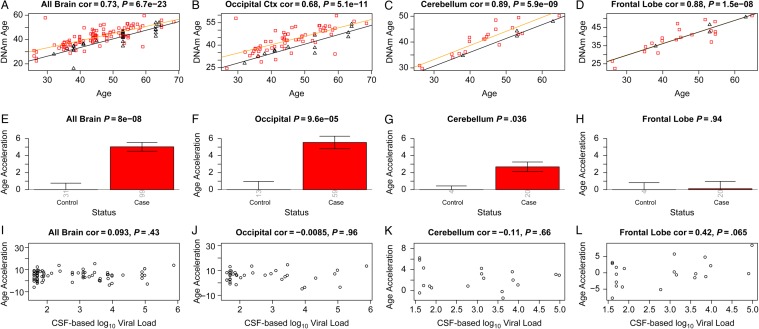
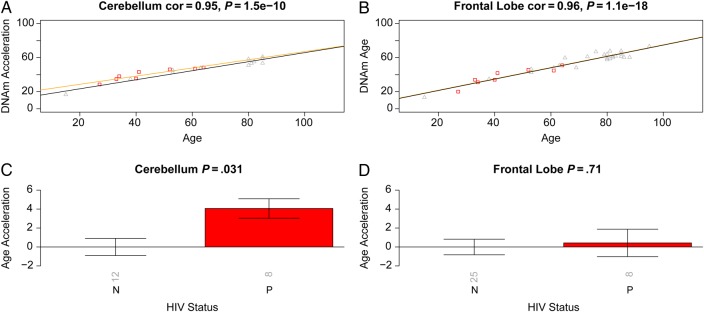
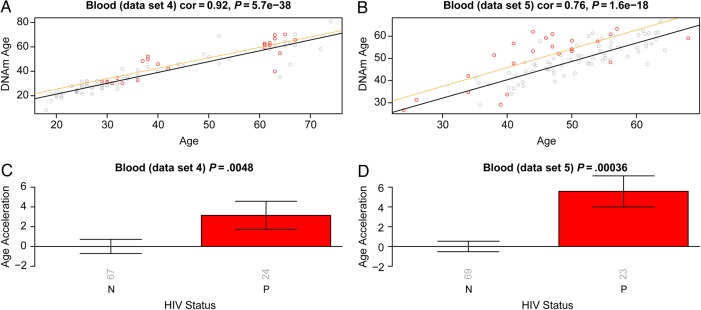
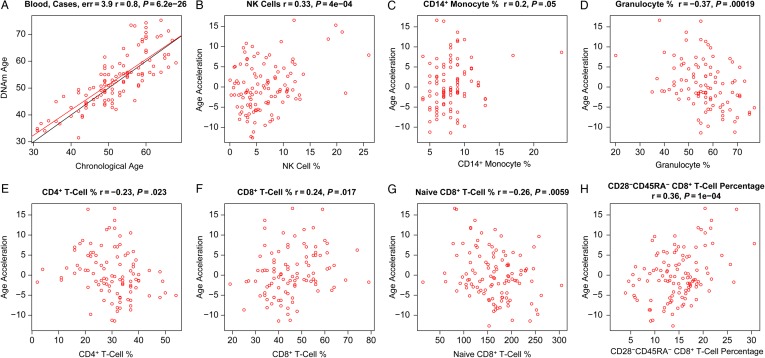
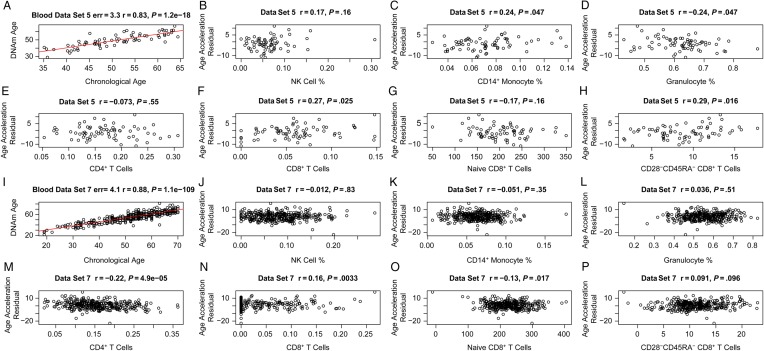
BACKGROUND: Infection with human immunodeficiency virus type 1 (HIV) is associated with clinical symptoms of accelerated aging, as evidenced by the increased incidence and diversity of age-related illnesses at relatively young ages and supporting findings of organ and cellular pathologic analyses. But it has been difficult to detect an accelerated aging effect at a molecular level. METHODS: Here, we used an epigenetic biomarker of aging based on host DNA methylation levels to study accelerated aging effects due to HIV infection. DNA from brain and blood tissue was assayed via the Illumina Infinium Methylation 450 K platform. RESULTS: Using 6 novel DNA methylation data sets, we show that HIV infection leads to an increase in epigenetic age both in brain tissue (7.4 years) and blood (5.2 years). While the observed accelerated aging effects in blood may reflect changes in blood cell composition (notably exhausted cytotoxic T cells), it is less clear what explains the observed accelerated aging effects in brain tissue. CONCLUSIONS: Overall, our results demonstrate that the epigenetic clock is a useful biomarker for detecting accelerated aging effects due to HIV infection. This tool can be used to accurately determine the extent of age acceleration in individual tissues and cells.
Overview
The claims and statistics of this paper haven’t been checked yet.
Free: it reads the open-access text and checks the first 5 claims that cite a source we can check. Create a free account to check every claim.
Integrity signals
Registry
Cites
Statistics
Figures
Verification
Claims the paper makes
The claims and statistics of this paper haven’t been checked yet.
Free: it reads the open-access text and checks the first 5 claims that cite a source we can check. Create a free account to check every claim.
Claims other papers make about this one
Each is checked against this paper’s own text: does it say what the citing paper says it does?
The source backs part of the claim, not all of it — or backs it for a different population, condition or comparison.
In the citing paper
“While it is incontrovertible that certain types of DNA damage mimic aging, including chemotherapy, radiation, smoking, and progeria”
From Loss of epigenetic information as a cause of mammalian aging (2023) · cites this paper as Horvath and Levine, 2015
Experimental — accuracy not yet measured
Self-check
Percentages, sums and reported differences re-computed from the paper’s own numbers.
The self-check needs the paper’s full text.
Citations
Cites
WGCNA: an R package for weighted correlation network analysis
Langfelder, P., & Horvath, S. (2008) · BMC Bioinformatics · doi:10.1186/1471-2105-9-559 · Cited by 27,252
Self-citationDNA methylation age of human tissues and cell types
Horvath, S. (2013) · Genome Biology · doi:10.1186/gb-2013-14-10-r115 · Cited by 7,075 · cited 11×
“eral recent studies support measuring accelerated aging effects by using DNA methylation levels [24, 25].”
BackgroundMethodInfluentialSelf-citationGenome-wide methylation profiles reveal quantitative views of human aging rates
Hannum, G., Guinney, J., Zhao, L., Zhang, L., Hughes, G., Sadda, S., Klotzle, B., Bibikova, M., Fan, J.-B., Gao, Y., et al. (2013) · Molecular Cell · doi:10.1016/j.molcel.2012.10.016 · Cited by 4,270
Clearance of p16Ink4a-positive senescent cells delays ageing-associated disorders
Baker, D. J., Wijshake, T., Tchkonia, T., LeBrasseur, N. K., Childs, B. G., van de Sluis, B., Kirkland, J. L., & van Deursen, J. M. (2011) · Nature · doi:10.1038/nature10600 · Cited by 3,670 · cited 1×
“[56] demonstrated that removal of senescent cells expressing p16 from a murine model of Progeria delayed the onset of aging-related diseases in several tissue and organ systems.”
BackgroundDNA methylation arrays as surrogate measures of cell mixture distribution
Houseman, E. A., Accomando, W. P., Koestler, D. C., Christensen, B. C., Marsit, C. J., Nelson, H. H., Wiencke, J. K., & Kelsey, K. T. (2012) · BMC Bioinformatics · doi:10.1186/1471-2105-13-86 · Cited by 3,175 · cited 2×
“Yun Liu [37], using the Houseman method [38].”
MethodUpdated research nosology for HIV-associated neurocognitive disorders
Antinori, A., Arendt, G., Becker, J. T., Brew, B. J., Byrd, D. A., Cherner, M., Clifford, D. B., Cinque, P., Epstein, L. G., Goodkin, K., et al. (2007) · Neurology · doi:10.1212/01.wnl.0000287431.88658.8b · Cited by 2,630 · cited 1×
“b HIV-related neurocognitive disorder was assessed as described elsewhere [33, 34].”
MethodDefining clusters from a hierarchical cluster tree: the Dynamic Tree Cut package for R
Langfelder, P., Zhang, B., & Horvath, S. (2008) · Bioinformatics · doi:10.1093/bioinformatics/btm563 · Cited by 1,892
Self-citationAn operational definition of epigenetics: Figure 1.
Berger, S. L., Kouzarides, T., Shiekhattar, R., & Shilatifard, A. (2009) · Genes & Development · doi:10.1101/gad.1787609 · Cited by 1,884
Teschendorff, A. E., Marabita, F., Lechner, M., Bartlett, T., Tegner, J., Gomez-Cabrero, D., & Beck, S. (2013) · Bioinformatics · doi:10.1093/bioinformatics/bts680 · Cited by 1,683
Triant, V. A., Lee, H., Hadigan, C., & Grinspoon, S. K. (2007) · The Journal of Clinical Endocrinology & Metabolism · doi:10.1210/jc.2006-2190 · Cited by 1,613 · cited 1×
“ease, osteoporosis, cancer, neurocognitive impairment, and frailty [1–11].”
Cited by
Items 601–612 of 612
Kożuch, A., Nowicka, W., Marcak, M., Dróżdż, M., & Rymarczyk, E. (2026) · Quality in Sport · doi:10.12775/qs.2026.76.76073
Interferome profiling in the blood links IFNα5-Mucin-1 axis to HIV-1 pathogenesis
Guo, K., Dillon, S. M., Meneses, E. C., Barrett, B. S., Norman, A., Mickens, K. L., Morrison, J. H., Dittmer, U., Sutter, K., Poeschla, E. M., et al. (2026) · Journal of Virology · doi:10.1128/jvi.01089-26
Correia, I. M., de Moraes, C. A. L. C., Brilhadori, J., dos Anjos, J. R. C., Gomide, E. B. G., Cordeiro, J. F. C., Borges, J. P., Machado, D. R. L., & dos Santos, A. P. (2026) · Journal of the Association of Nurses in AIDS Care · doi:10.1097/jnc.0000000000000700
Rodrigues, J. O., Silva, T. L., & de Souza, L. D. R. (2026) · Research Square · doi:10.21203/rs.3.rs-11107308/v1
The concept of biological age and prospects for its application in clinical practice
OSLOPOV, V. N., & GRISHINA, Y. D. (2026) · Kazan medical journal · doi:10.17816/kmj703616
Bello‐Chavolla, O. Y., & Fermín‐Martínez, C. A. (2026) · Advances in biogerontology · doi:10.1016/bs.abger.2026.08.002
蒋, 涵., Gao, F., Liu, P., Wu, Y., Jie, Y., Li, Y., & Jiang, Y. (2026) · bioRxiv (Cold Spring Harbor Laboratory) · doi:10.64898/2026.10.19.760015
Epigenetic aging in people with HIV across the life course: a systematic review and meta-analysis
Kinkade, C. W., Wimbish, A., Senthilkumar, A., Coker, M. O., Luo, L., Yin, M. T., Kuhn, L., Corley, M. J., & Shiau, S. (2026) · The Journals of Gerontology Series A · doi:10.1093/gerona/glag252
Profile of South African HIV/AIDS patients in a medical scheme environment
Erasmus, T. (2021) · Boloka Institutional Repository (North-west University)
Kuzub, N., Smialkovska, V., Momot, V., Moseiko, V., Lushchak, O., & Koliada, A. (2022) · doi:10.3389/fgene.2021.772298.s001
Sehl, M. E., Breen, E. C., Shih, R., Chen, L., Wang, R., Horvath, S., Bream, J. H., Duggal, P., Martinson, J., Wolinsky, S. M., et al. (2022) · doi:10.3389/fgene.2021.796547.s002
Self-citationPang, A. P. S., Higgins-Chen, A. T., Comite, F., Raica, I., Arboleda, C., Went, H., Mendez, T., Schotsaert, M., Dwaraka, V., Smith, R., et al. (2022) · doi:10.3389/fgene.2022.819749.s003
Metadata
- Authors
- Horvath, S., & Levine, A. J.
- Affiliations
- University of California, Los Angeles (US)
- Corresponding author
- Horvath, Steve
- Venue
- Journal of Infectious Diseases
- Publisher
- Oxford University Press (OUP)
- Published
- 2015-05-12
- Volume
- 212
- Issue
- 10
- Pages
- 1563-1573
- ISSN
- 0022-1899 (ISSN-L)
- 1537-6613
- PMC
- PMC4621253
- OpenAlex
- W2163887613
- Cited by
- 556
- References
- 100
- Citations by year
- 2026: 35 · 2025: 33 · 2024: 66 · 2023: 51 · 2022: 66 · 2021: 59 · 2020: 50 · 2019: 43 · 2018: 54 · 2017: 51 · 2016: 36 · 2015: 11
- FWCI
- 25.62
- Type
- journal article
- Language
- en
- Open access
- hybrid
- doi.org
- Licence
- cc-by-nc-nd
- Locations
- The Journal of Infectious Diseases (publishedVersion, cc-by-nc-nd)
- PubMed Central (publishedVersion, cc-by-nc-nd)
- PubMed (publishedVersion)
- Funders
- National Institute on Aging
- National Institutes of Health
- NIH (5R01AG042511-02, R01DA030913, U01-AI-35040)
- the University of California, Los Angeles (UCLA) AIDS Institute
- UCLA Center for AIDS Research (AI28697)
- the UCLA Clinical and Translational Science Institute
- National Center for Advancing Translational Sciences (UL1TR000124)
- the National Institute for Drug Abuse
- the National Institute of Allergy and Infectious Diseases
- the Los Angeles site of the Multicenter AIDS Cohort Study [
- the National NeuroAIDS Tissue Consortium
- National Neurological AIDS Bank (U01-MH08021 and R24-NS38841;)
- Texas NeuroAIDS Research Center (U01-MH083507 and R24-NS45491;)
- Manhattan HIV Brain Bank (U01-MH083501 and R24-MH59724)
- California NeuroAIDS Tissue Network (U01-MH083506 and R24-MH59745)
- Topics
- Life Sciences › Immunology and Microbiology › Virology › HIV Research and Treatment
- Life Sciences › Biochemistry, Genetics and Molecular Biology › Molecular Biology › Epigenetics and DNA Methylation
- Health Sciences › Medicine › Infectious Diseases › HIV-related health complications and treatments
- Keywords
- HIV-1 infection, accelerated aging, epigenetic clocks, DNA methylation, epigenetic age, brain tissue, blood, aging biomarkers
- MeSH terms
- Adolescent, Adult, Aged, Aging, Blood Cells, Brain, DNA, Humans, Male, Methylation, Middle Aged, HIV-1, HIV Infections, Epigenesis, Genetic, Young Adult
About these checks
Registry, retraction, Cites and statistics results are computed, not judged, with one exception: a printed reference that no index lists is read once by a model before it counts as a citation error. Claims are extracted by a model and kept only when their quote appears verbatim in the text; each cited source is then checked, with a model’s help, for whether it says what the claim relies on. Those verdicts can be wrong — read the claim’s quote and the cited source before relying on one.
Statistics and arithmetic are recomputed, not judged.
Confidence bands are shown only for fields calibrated on our annotated test set. None is calibrated yet, so no band is shown.
What counts as a claim ›How we measure confidence ›How we check this ›
Are you an author, or do you see a problem with this page? Request a review
Data sources
Bibliographic data: Semantic Scholar, OpenAlex, Crossref.
Contains information from the Semantic Scholar Academic Graph Datasets, made available under the ODC Attribution License (ODC-BY 1.0).
Semantic Scholar’s data is described in: Kinney, R., et al. (2023). The Semantic Scholar Open Data Platform. arXiv:2301.10140.
