

Modulation of murine breast tumor vascularity, hypoxia and chemotherapeutic response by exercise
Open accessThe DOI matches its Crossref record; 33 of the 35 references it cites were found in a registry or an index.
Abstract
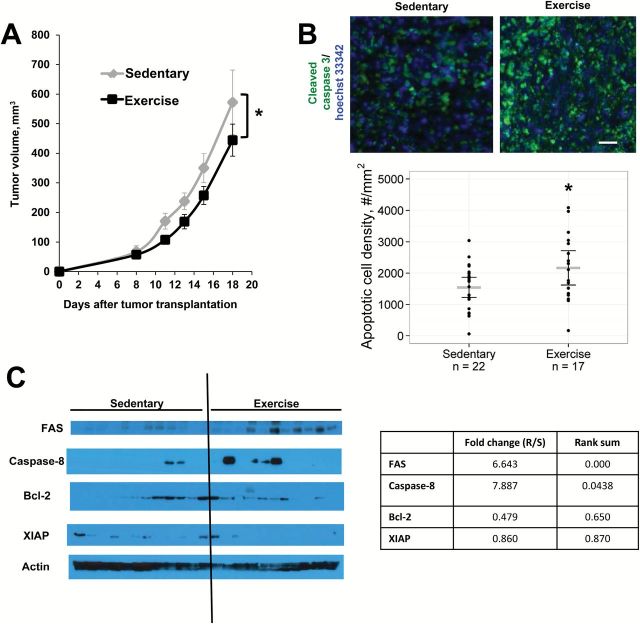
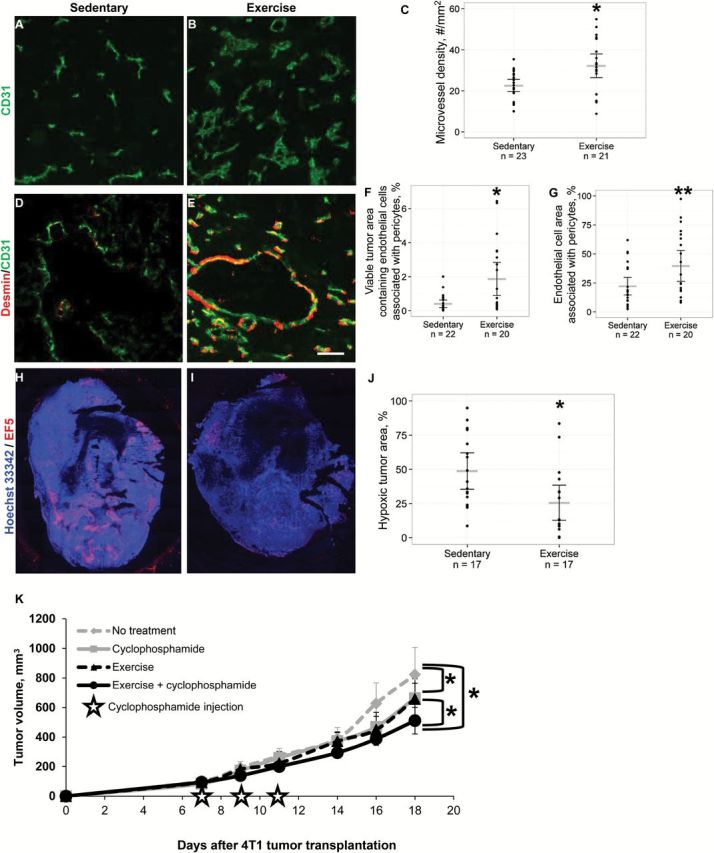
Exercise has been shown to improve postischemia perfusion of normal tissues; we investigated whether these effects extend to solid tumors. Estrogen receptor-negative (ER-, 4T1) and ER+ (E0771) tumor cells were implanted orthotopically into syngeneic mice (BALB/c, N = 11-12 per group) randomly assigned to exercise or sedentary control. Tumor growth, perfusion, hypoxia, and components of the angiogenic and apoptotic cascades were assessed by MRI, immunohistochemistry, western blotting, and quantitative polymerase chain reaction and analyzed with one-way and repeated measures analysis of variance and linear regression. All statistical tests were two-sided. Exercise statistically significantly reduced tumor growth and was associated with a 1.4-fold increase in apoptosis (sedentary vs exercise: 1544 cells/mm(2), 95% CI = 1223 to 1865 vs 2168 cells/mm(2), 95% CI = 1620 to 2717; P = .048), increased microvessel density (P = .004), vessel maturity (P = .006) and perfusion, and reduced intratumoral hypoxia (P = .012), compared with sedentary controls. We also tested whether exercise could improve chemotherapy (cyclophosphamide) efficacy. Exercise plus chemotherapy prolonged growth delay compared with chemotherapy alone (P < .001) in the orthotopic 4T1 model (n = 17 per group). Exercise is a potential novel adjuvant treatment of breast cancer.
Overview
The claims and statistics of this paper haven’t been checked yet.
Free: it reads the open-access text and checks the first 5 claims that cite a source we can check. Create a free account to check every claim.
Integrity signals
Registry
Cites
Statistics
Figures
Verification
Claims the paper makes
The claims and statistics of this paper haven’t been checked yet.
Free: it reads the open-access text and checks the first 5 claims that cite a source we can check. Create a free account to check every claim.
Claims other papers make about this one
Each is checked against this paper’s own text: does it say what the citing paper says it does?
The cited source says what the claim attributes to it.
In the citing paper
“Because exercise is a homeostatic physiological intervention, it also affects the tumor microenvironment (TME) (5-10).”
In the citing paper
“Beyond the acute increase in perfusion, exercise training (ExTr, accumulated bouts of exercise sessions) induces vessel normalization, thus enhancing tumor blood flow and oxygenation in subsequent resting conditions as well (6,7).”
In the citing paper
“Because most previous preclinical studies use ad libitum physical activity models (6,8,10), which do not properly capture human exercise behavior, we adapted a controlled exercise.”
In the citing paper
“Consistent with previous preclinical reports (6,7), we showed that ExTr induces vessel normalization, characterized by a larger number of vessels with higher pericyte coverage, resulting in less tumoral hypoxia.”
Self-check
Percentages, sums and reported differences re-computed from the paper’s own numbers.
The self-check needs the paper’s full text.
Citations
Cites
Bevacizumab plus Irinotecan, Fluorouracil, and Leucovorin for Metastatic Colorectal Cancer
Hurwitz, H., Fehrenbacher, L., Novotny, W., Cartwright, T., Hainsworth, J., Heim, W., Berlin, J., Baron, A., Griffing, S., Holmgren, E., et al. (2004) · New England Journal of Medicine · doi:10.1056/nejmoa032691 · Cited by 10,968
Paclitaxel–Carboplatin Alone or with Bevacizumab for Non–Small-Cell Lung Cancer
Sandler, A., Gray, R., Perry, M. C., Brahmer, J., Schiller, J. H., Dowlati, A., Lilenbaum, R., & Johnson, D. H. (2006) · New England Journal of Medicine · doi:10.1056/nejmoa061884 · Cited by 5,761
Hypoxia — a key regulatory factor in tumour growth
Harris, A. L. (2002) · Nature Reviews Cancer · doi:10.1038/nrc704 · Cited by 5,177
Paclitaxel plus Bevacizumab versus Paclitaxel Alone for Metastatic Breast Cancer
Miller, K., Wang, M., Gralow, J., Dickler, M., Cobleigh, M., Perez, E. A., Shenkier, T., Cella, D., & Davidson, N. E. (2007) · New England Journal of Medicine · doi:10.1056/nejmoa072113 · Cited by 3,081
Saltz, L. B., Clarke, S., Díaz-Rubio, E., Scheithauer, W., Figer, A., Wong, R., Koski, S., Lichinitser, M., Yang, T.-S., Rivera, F., et al. (2008) · Journal of Clinical Oncology · doi:10.1200/jco.2007.14.9930 · Cited by 2,955
Physical activity and survival after breast cancer diagnosis
Holmes, M. D. (2005) · JAMA · doi:10.1001/jama.293.20.2479 · Cited by 1,772
Principles and mechanisms of vessel normalization for cancer and other angiogenic diseases
Carmeliet, P., & Jain, R. K. (2011) · Nature Reviews Drug Discovery · doi:10.1038/nrd3455 · Cited by 1,675 · cited 1×
“Tumor blood vessels are structurally and functionally abnormal, resulting in heterogeneous intratumoral regions of hypoxia (1,2).”
BackgroundNormalization of the Vasculature for Treatment of Cancer and Other Diseases
Goel, S., Duda, D. G., Xu, L., Munn, L. L., Boucher, Y., Fukumura, D., & Jain, R. K. (2011) · Physiological Reviews · doi:10.1152/physrev.00038.2010 · Cited by 1,605 · cited 1×
“However, these effects are transient, lasting only days to weeks, which hinders long-term clinical use (16,17).”
BackgroundReck, M., von Pawel, J., Zatloukal, P., Ramlau, R., Gorbounova, V., Hirsh, V., Leighl, N., Mezger, J., Archer, V., Moore, N., et al. (2009) · Journal of Clinical Oncology · doi:10.1200/jco.2007.14.5466 · Cited by 1,505
Kinetics of vascular normalization by VEGFR2 blockade governs brain tumor response to radiation
Winkler, F., Kozin, S. V., Tong, R. T., Chae, S.-S., Booth, M. F., Garkavtsev, I., Xu, L., Hicklin, D. J., Fukumura, D., di Tomaso, E., et al. (2004) · Cancer Cell · doi:10.1016/j.ccr.2004.10.011 · Cited by 1,170 · cited 1×
“However, these effects are transient, lasting only days to weeks, which hinders long-term clinical use (16,17).”
Background
Research works printed but not linked: 1
- Jones LW Viglianti BL Tashjian JA Effect of aerobic exercise on tumor physiology in an animal model of human breast cancer. J Appl Physiol. 2010; 108(2): 343– 348. 19959769 PMC2822670 · DOI · Paper page
Cited by
Items 101–200 of 306
Mclaughlin, M., Florida-James, G. D., & Ross, M. (2021) · Vascular Biology · doi:10.1530/vb-21-0013 · Cited by 32
Li, W., Li, S., Chen, I. X., Liu, Y., Ramjiawan, R. R., Leung, S. C. H., Gerweck, L. E., Fukumura, D., Loeffler, J. S., Jain, R. K., et al. (2021) · Radiation Oncology · doi:10.1186/s13014-021-01775-9 · Cited by 32
Exercise and Physical Activity in Patients with Osteosarcoma and Survivors
Garcia, M. B., Ness, K. K., & Schadler, K. (2020) · Advances in experimental medicine and biology · doi:10.1007/978-3-030-43032-0_16 · Cited by 32
Aerobic Exercise Ameliorates Cancer Cachexia-Induced Muscle Wasting through Adiponectin Signaling
Morinaga, M., Sako, N., Isobe, M., Lee, S., Sugiura, H., & Kametaka, S. (2021) · International Journal of Molecular Sciences · doi:10.3390/ijms22063110 · Cited by 30
“As reported previously, aerobic exercise decreased tumor size to a greater extent in the exercised mice compared to that in the non-exercised mice treated with C26 [36] (Figure S2).”
BackgroundEffects of exercise and anti-PD-1 on the tumour microenvironment
Buss, L. A., Williams, T., Hock, B. D., Ang, A. D., Robinson, B. A., Currie, M. J., & Dachs, G. U. (2021) · Immunology Letters · doi:10.1016/j.imlet.2021.08.005 · Cited by 30
Blarigan, E. L. V., Gerstenberger, J. P., Kenfield, S. A., Giovannucci, E. L., Stampfer, M. J., Jones, L. W., Clinton, S. K., Chan, J. M., & Mucci, L. A. (2015) · Cancer Prevention Research · doi:10.1158/1940-6207.capr-15-0132 · Cited by 29
“In animal models, tumor blood flow increases two-fold during acute endurance exercise, and chronic physical activity modulates vasculature, increasing tumor perfusion and oxygenation and decreasing the propensity for distant metastasis (4, 5, 16, 17).”
InfluentialSelf-citationCannioto, R. A., Dighe, S. G., Mahoney, M. C., Moysich, K. B., Sen, A., Hulme, K., McCann, S. E., & Ambrosone, C. B. (2018) · Cancer Causes & Control · doi:10.1007/s10552-018-1101-5 · Cited by 31
The Effects of Physical Exercise on Tumor Vasculature: Systematic Review and Meta-analysis
Esteves, M., Monteiro, M. P., & Duarte, J. A. (2021) · International Journal of Sports Medicine · doi:10.1055/a-1533-1876 · Cited by 28
Wang, B., Jin, Y., Dong, J., Xiao, H., Zhang, S., Li, Y., Chen, Z.-Y., Yang, X., Fan, S., & Cui, M. (2021) · Frontiers in Cell and Developmental Biology · doi:10.3389/fcell.2021.706755 · Cited by 30
“, 2019), and even synergizing cancer treatment as an immune adjuvant or chemosensitizer (Betof et al., 2015; Febbraio, 2017; Duggal et al., 2019).”
BackgroundLiu, X., Zhu, X., Feng, L.-H., Li, X., Xu, B., Li, K., Xiao, N., Lei, M., Sun, H., & Tang, Z. (2022) · Experimental Hematology and Oncology · doi:10.1186/s40164-022-00275-0 · Cited by 27
The association of physical activity before and after lymphoma diagnosis with survival outcomes
Pophali, P. A., Ip, A., Larson, M. C., Rosenthal, A. C., Maurer, M. J., Flowers, C. R., Link, B. K., Farooq, U., Feldman, A. L., Allmer, C., et al. (2018) · American Journal of Hematology · doi:10.1002/ajh.25288 · Cited by 29
Can Exercise Enhance the Efficacy of Checkpoint Inhibition by Modulating Anti-Tumor Immunity?
Brummer, C., Pukrop, T., Wiskemann, J., Bruß, C., Ugele, I., & Renner, K. (2023) · Cancers · doi:10.3390/cancers15184668 · Cited by 26
Exercise to transform tumours from cold to hot and improve immunotherapy responsiveness
Hapuarachi, B. S., Danson, S. J., Wadsley, J., & Muthana, M. (2023) · Frontiers in Immunology · doi:10.3389/fimmu.2023.1335256 · Cited by 31
“Betof et al. demonstrated, using the 4T1 breast cancer murine model, a signi fi cant reduction in EF5 (marker of hypoxia) within the tumours of exercised mice compared to sedentary mice (40).”
MethodDose/Exposure Relationship of Exercise and Distant Recurrence in Primary Breast Cancer
Soldato, D., Michiels, S., Havas, J., Meglio, A. D., Pagliuca, M., Franzoi, M. A., Pistilli, B., Iyengar, N. M., Cottu, P. H., Lerebours, F., et al. (2024) · Journal of Clinical Oncology · doi:10.1200/jco.23.01959 · Cited by 30
Self-citationXu, Q., Gu, J., Lv, Y., Yuan, J., Yang, N., Chen, J., Wang, C., Hou, X., Jia, X., Feng, L., et al. (2018) · Oncology Letters · doi:10.3892/ol.2018.7734 · Cited by 27
“Excessive proliferation of tumor cells resulted in tumor tissue hypoxia, leading to angiogenesis, increased drug resistance, enhanced metastatic ability and other adaptive responses (41).”
Morielli, A. R., Usmani, N., Boulé, N. G., Severin, D. M., Tankel, K., Nijjar, T. S., Joseph, K. J., Fairchild, A. M., & Courneya, K. S. (2018) · Trials · doi:10.1186/s13063-017-2398-1 · Cited by 23
Tobias, G. C., Gomes, J. L. P., Fernandes, L. G., Voltarelli, V. A., de Almeida, N. R., Jannig, P. R., de Souza, R. W. A., Negrão, C. E., de Oliveira, E. M., Chammas, R. J., et al. (2023) · Scientific Reports · doi:10.1038/s41598-023-47217-2 · Cited by 37
“Interestingly, it has been shown that exercise training can improve tumor angiogenesis and that it can be associated with the presence of functional blood vessels irrigating the tumor, therefore decreasing the hypoxia-reperfusion cycle 10,78,79 .”
BackgroundResultUltrasound‐mediated mechanical forces activate selective tumor cell apoptosis
Tijore, A., Margadant, F., Dwivedi, N., Morgan, L., Yao, M., Hariharan, A., Chew, C. A. Z., Powell, S. N., Bonney, G. K., & Sheetz, M. P. (2024) · Bioengineering & Translational Medicine · doi:10.1002/btm2.10737 · Cited by 23
“1,2 Further, mechanically active muscle tissue has a low risk of tumor formation.”
Schmid, S., Minnella, E. M., Pilon, Y., Rokah, M., Rayes, R. F., Najmeh, S., Cools‐Lartigue, J., Ferri, L. E., Mulder, D. S., Sirois, C., et al. (2022) · Clinical Lung Cancer · doi:10.1016/j.cllc.2022.05.004 · Cited by 25
Djurhuus, S. S., Schauer, T., Simonsen, C., Toft, B. G., Jensen, A. R. D., Erler, J. T., Røder, M. A., Højman, P., Brasso, K., & Christensen, J. F. (2022) · Physiological Reports · doi:10.14814/phy2.15408 · Cited by 24
Effects of Exercise on the Tumour Microenvironment
Buss, L. A., & Dachs, G. U. (2020) · Advances in experimental medicine and biology · doi:10.1007/978-3-030-35727-6_3 · Cited by 24
Hart, N. H., Galvao, D. A., Saunders, C. M., Taaffe, D. R., Feeney, K., Spry, N. A., Tsoi, D. T. F., Martin, H. L., Chee, R., Clay, T. D., et al. (2018) · Trials · doi:10.1186/s13063-018-3091-8 · Cited by 25
Resistance Exercise Counteracts Tumor Growth in Two Carcinoma Rodent Models
Padilha, C. S., Testa, M. T. J., Marinello, P. C., Cella, P. S., Voltarelli, F. A., Frajácomo, F. T. T., Rubens, C., Duarte, J. A., Guarnier, F. A., & Deminice, R. (2019) · Medicine & Science in Sports & Exercise · doi:10.1249/mss.0000000000002009 · Cited by 22
Kirkham, A. A., Paterson, D. I., Prado, C. M. M., Mackey, J. R., Courneya, K. S., Pituskin, E., & Thompson, R. B. (2019) · BMC Cancer · doi:10.1186/s12885-019-5298-9 · Cited by 19
High‐intensity interval training slows down tumor progression in mice bearing Lewis lung carcinoma
Alves, C. R. R., das Neves, W., Tobias, G. C., de Almeida, N. R., Barreto, R. F. D. P., de Melo, C. M., Carneiro, C. D. G., Garcez, A. T., Faria, D. D. P., Chammas, R. J., et al. (2018) · JCSM Rapid Communications · doi:10.1002/j.2617-1619.2018.tb00008.x · Cited by 24
“5 fold increase in Vegfa mRNA levels in the exercised group when compared to the control [33].”
ResultXiao, C.-L., Zhong, Z.-P., Lü, C., Guo, B.-J., Chen, J., Zhao, T., Yin, Z.-F., & Li, B. (2023) · Journal of Chinese Integrative Medicine · doi:10.1016/j.joim.2023.01.002 · Cited by 21
Voltarelli, V. A., Amano, M. T., Tobias, G. C., Borges, G. S., da Paixão, A. O., Pereira, M. G., Câmara, N. O. S., Caldeira, W., Ribeiro, A. F., Le, O., et al. (2024) · iScience · doi:10.1016/j.isci.2024.110121 · Cited by 26
Thomas, V., Seet-Lee, C., Marthick, M., Cheema, B. S., Boyer, M. J., & Edwards, K. M. (2019) · Supportive Care in Cancer · doi:10.1007/s00520-019-04871-5 · Cited by 25
“Presently, there is preclinical data to support this [30, 31], but very limited evidence in human studies.”
BackgroundRamirez, G., Proctor, A. R., Jung, K. W., Wu, T. T., Han, S., Adams, R. R., Ren, J., Byun, D. K., Madden, K. S., Brown, E. B., et al. (2016) · Biomedical Optics Express · doi:10.1364/boe.7.003610 · Cited by 21
Ultrasound-mediated mechanical forces selectively kill tumor cellsPreprint
Tijore, A., Margadant, F., Yao, M., Hariharan, A., Chew, C. A. Z., Powell, S. N., Bonney, G. K., & Sheetz, M. P. (2020) · bioRxiv (Cold Spring Harbor Laboratory) · doi:10.1101/2020.10.09.332726 · Cited by 17
Exercise intensity governs tumor control in mice with breast cancer
Gomes-Santos, I. L., Kumar, A. S., Hauth, F., Meyer, M. N., Shiferaw, S. Z., Amoozgar, Z., Jain, R. K., & Fukumura, D. (2024) · Frontiers in Immunology · doi:10.3389/fimmu.2024.1339232 · Cited by 25
Cesano, A., Augustin, R. C., Barrea, L., Bedognetti, D., Bruno, T. C., Carturan, A., Hammer, C., Ho, W. S., Kather, J. N., Kirchhoff, T., et al. (2025) · Journal for ImmunoTherapy of Cancer · doi:10.1136/jitc-2024-008876 · Cited by 25
“132 133 Vascular normalization may enhance immune effector cell infiltration into the tumor, as dysfunctional tumor vessels downregulate endothelial adhesion molecules critical for translocation from the circulation to the tumor.”
The effect of multimodal prehabilitation on postoperative outcomes in lung cancer surgery
Cho, A.-R., Najafi, T., Ramanakumar, A. V., Ferri, L. E., Spicer, J. D., Najmeh, S., Cools‐Lartigue, J., Sirois, C., Soh, S., Kim, D. J., et al. (2025) · Journal of Thoracic and Cardiovascular Surgery · doi:10.1016/j.jtcvs.2025.02.013 · Cited by 28
Rayner, C. J., Bartlett, D. B., Allen, S. K., Wooldridge, T., Seymour, T., Sunshine, S., Hunt, J. E. A., King, D., Bagwan, I., Sultan, J., et al. (2025) · Journal of sport and health science/Journal of Sport and Health Science · doi:10.1016/j.jshs.2025.101063 · Cited by 21
Mechanisms Underlying Anti-Inflammatory and Anti-Cancer Properties of Stretching—A Review
Król, M., Kupnicka, P., Bosiacki, M., & Chlubek, D. (2022) · International Journal of Molecular Sciences · doi:10.3390/ijms231710127 · Cited by 23
Role and mechanisms of exercise therapy in enhancing drug treatment for glioma: a review
Guanghui, W., Chen, Y., Chen, C., Liu, J., Wu, Q., Zhang, Y., Chen, R., Xiao, J., Su, Y., Shi, H., et al. (2025) · Frontiers in Immunology · doi:10.3389/fimmu.2025.1576283 · Cited by 16
“In animal experiments, regular aerobic exercise (such as running and swimming) has been shown to signi fi cantly increase the permeability of antitumor drugs in the brain (131).”
Cancer cells can be killed mechanically or with combinations of cytoskeletal inhibitors
Tijore, A., Yang, B., & Sheetz, M. P. (2022) · Frontiers in Pharmacology · doi:10.3389/fphar.2022.955595 · Cited by 15
“Further, it was reported that exercise or mechanical stretching of tumors caused tumor regression in a mouse model (Betof et al., 2015; Berrueta et al., 2018).”
BackgroundMoulton, C., Murri, A., Benotti, G., Fantini, C., Duranti, G., Ceci, R., Grazioli, E., Cerulli, C., Sgrò, P., Rossi, C., et al. (2024) · Redox Biology · doi:10.1016/j.redox.2024.103033 · Cited by 18
“However, this view is changing with the accumulating evidence, which shows that PA not only reduces treatment toxicity [13, 15,79,80], but may also have the capacity to boost the efficacy and potency of traditional cancer therapies.”
BackgroundGouez, M., Rébillard, A., Thomas, A., Beaumel, S., Matera, E., Gouraud, É., Lefeuvre‐Orfila, L., Martin, B., Pérol, O., Chaveroux, C., et al. (2024) · Frontiers in Immunology · doi:10.3389/fimmu.2024.1368550 · Cited by 21
Case Report of Exercise to Attenuate Side Effects of Treatment for Pancreatic Cancer
Mclaughlin, M., Christie, A., & Campbell, A. (2019) · Case Reports in Oncology · doi:10.1159/000503815 · Cited by 16
Baker, J. L., Meglio, A. D., Gbenou, A. S., Mouhebb, M. E., Iyengar, N. M., Michiels, S., Cottu, P. H., Lerebours, F., Coutant, C., Lesur, A., et al. (2022) · British Journal of Cancer · doi:10.1038/s41416-022-01870-y · Cited by 14
“Given emergent preclinical data demonstrating that exercise regulates hypoxia, metabolism, and immune milieu landscapes of solid tumours including breast cancer [11, 24, 25], translational-driven studies are required to interrogate how exercise and patient physiology influence tumour response to conventional and novel…”
BackgroundSelf-citationHjorth, M., Egan, C. L., Telles, G. D., Pál, M., Gallego‐Ortega, D., Fuller, O. K., McLennan, E. D., Gillis, R. D., Oh, T. G., Muscat, G. E. O., et al. (2024) · Journal of sport and health science/Journal of Sport and Health Science · doi:10.1016/j.jshs.2024.100991 · Cited by 15
“77 The effects of exercise on metastatic spread in preclinical models are more unclear, with preclinical findings indicating that exercise does not significantly affect markers of cancer metastasis incidence or severity.”
Opoku‐Acheampong, A. B., Baumfalk, D. R., Horn, A. G., Kunkel, O. N., Ganta, C. K., McCullough, D. J., Siemann, D. W., Muller‐Delp, J. M., & Behnke, B. J. (2019) · PubMed Central · Cited by 22
Metabolism and cancer-select topics
Lonardo, F., & Ballouk, C. (2022) · Metabolism and Target Organ Damage · doi:10.20517/mtod.2022.05 · Cited by 14
Rehabilomics: A state-of-the-art review of framework, application, and future considerations
Cao, W., Zhang, X., & Qiu, H. (2023) · Frontiers in Neurology · doi:10.3389/fneur.2023.1103349 · Cited by 18
“These activities of NK cells correlate with reduced tumor growth (46, 47).”
BackgroundEsteves, M., Monteiro, M. P., & Duarte, J. A. (2021) · Critical Reviews in Oncology/Hematology · doi:10.1016/j.critrevonc.2021.103245 · Cited by 14
Echarri, A. A., Struszczak, L., Beresford, M. J., Campbell, J. P., Thompson, D., & Turner, J. E. (2023) · Frontiers in Sports and Active Living · doi:10.3389/fspor.2023.1163182 · Cited by 16
“Indeed, the delivery and accumulation of these immune cells within tissues could be influenced by an exercise-induced increase in pan-tissue vascularization (59, 60).”
BackgroundStiger, R. J., Williams, M. A., Gustafson, O. D., Woods, A., & Collett, J. (2024) · Disability and Rehabilitation · doi:10.1080/09638288.2024.2310765 · Cited by 15
“There is a growing body of evidence to support exercise interventions to improve neoadjuvant therapy tolerance and effectiveness [82,83].”
Iyengar, N. M., Scott, J. M., Lee, J., Lavery, J. A., Foug, K. L., Lee, C. P., Michalski, M., Chun, S. S., Harrison, J., Moskowitz, C. S., et al. (2024) · Cancer · doi:10.1002/cncr.35575 · Cited by 16
“…studies have demonstrated that combinatorial treatment with exercise therapy and single ‐ agent chemotherapy conferred additive tumor ‐ inhibitory effects compared with chemotherapy alone in several mouse models of triple ‐ negative breast cancer, 8,9 although not all studies found an effect.”
Self-citationAkdemir, E., Sweegers, M. G., Vrieling, A., Rundqvist, H., Meijer, R. P., Leliveld, A. M., van der Heijden, A. G., Rutten, V. C., Koldewijn, E. L., Bos, S. D., et al. (2023) · BMJ Open · doi:10.1136/bmjopen-2022-071304 · Cited by 19
Mitochondrial catalase suppresses naturally occurring lung cancer in old mice
Ge, X., Pettan-Brewer, C., Morton, J., Carter, K., Fatemi, S., Rabinovitch, P. S., & Ladiges, W. (2015) · Pathobiology of Aging & Age-related Diseases · doi:10.3402/pba.v5.28776 · Cited by 12
“However, it is possible that these are capable of decreasing tissue hypoxia, thus, shutting down HIF1 alpha-driven tumor growth (9).”
BackgroundSerotonin Shapes the Migratory Potential of NK Cells – An in vitro Approach
Zimmer, P., Bloch, W., Kieven, M., Lövenich, L., Lehmann, J. M., Holthaus, M., Theurich, S., & Schenk, A. (2017) · International Journal of Sports Medicine · doi:10.1055/s-0043-113042 · Cited by 12
“These findings support earlier research in animals indicating a tumor-preventive and progress-reducing effect of PE [1].”
ResultOutcomes of physical exercises on initiation, progression, and treatment of breast cancer
Xu, J., Jiao, X., & Bayat, R. (2024) · Cell Communication and Signaling · doi:10.1186/s12964-024-01634-6 · Cited by 16
“Previous experimental studies conducted in a murine model of breast cancer at a specific anatomical site have indicated that physical exercise promotes angiogenesis within the tumor and enhances the density of microvas-culature [41].”
BackgroundThe interplay of exercise and green tea: a new road in cancer therapy
Liu, B., Tian, H., & Momeni, M. R. (2025) · Cancer Cell International · doi:10.1186/s12935-024-03632-7 · Cited by 13
Nanoscale Ligand Spacing Regulates Mechanical Force-Induced Cancer Cell Killing
Veena, S., Chen, D., Kumar, A., Pratap, R., Young, J. L., & Tijore, A. (2025) · Nano Letters · doi:10.1021/acs.nanolett.4c05858 · Cited by 12
History informing the future of exercise oncology
Galvao, D. A., Courneya, K. S., Lucía, A., May, A. M., Mustian, K. M., Warner, A. B., Joachim, W., Wonders, K. Y., Schmitz, K. H., & Newton, R. U. (2025) · JNCI Monographs · doi:10.1093/jncimonographs/lgaf025 · Cited by 13
“34 In 2009, Exercise and Sports Science Australia (ESSA) produced the first national position statement on exercise and cancer: optimizing cancer outcomes through exercise.”
Echarri, A. A., Beresford, M. J., Campbell, J. P., Jones, R. H., Butler, R., Gollob, K. J., Brum, P. C., Thompson, D., & Turner, J. E. (2021) · Frontiers in Immunology · doi:10.3389/fimmu.2020.616188 · Cited by 11
Parke, S. C., Ng, A., Martone, P., Gerber, L. H., Zucker, D. S., Engle, J. P., Gupta, E., Power, K., Sokolof, J., Shahpar, S., et al. (2021) · PM&R · doi:10.1002/pmrj.12664 · Cited by 12
“In related work, murine models demonstrate a synergistic relationship between chemotherapy and exercise in delaying growth of malignancy as compared to chemotherapy alone in breast cancer and melanoma.(22) These findings are intriguing in light of the evidence noted above that exercise may increase cancer survival and…”
BackgroundThe effect of aerobic exercise on tumour blood delivery: a systematic review and meta-analysis
Seet-Lee, C., Yee, J., Morahan, H., Ross, L. S., & Edwards, K. M. (2022) · Supportive Care in Cancer · doi:10.1007/s00520-022-07132-0 · Cited by 21
“Blood flow Of the seven studies that evaluated blood flow, three reported an increase [18, 24, 28], one reported a decrease [27] and three reported no change [25, 26, 35] (Table 2).”
BackgroundResultInfluentialPhysical Exercise and Tumor Energy Metabolism
Vulczak, A., & Alberici, L. C. (2022) · Cancer Treatment and Research Communications · doi:10.1016/j.ctarc.2022.100600 · Cited by 21
Lactate Potentiates Differentiation and Expansion of Cytotoxic T CellsPreprint
Rundqvist, H., Veliça, P., Barbieri, L., Gameiro, P. A., Cunha, P. P., Gojković, M., Bargiela, D., Mijwel, S., Ahlstedt, E., Foskolou, I. P., et al. (2019) · SSRN Electronic Journal · doi:10.2139/ssrn.3411249 · Cited by 11
The Therapeutic Potential of Physical Exercise in Cancer: The Role of Chemokines
Buzaglo, G. B. B., Telles, G. D., Araújo, R. B., Dias, G., Ruberti, O. M., Ferreira, M. L. V., Derchain, S., VECHIN, F. C., & Conceição, M. S. (2024) · International Journal of Molecular Sciences · doi:10.3390/ijms252413740 · Cited by 15
“This is evidenced by increased coverage of pericytes in microvessels [105], associated with elevated body temperature during an exercise bout [95,106] The intratumoral vasculature dilation, modulated by body temperature, would also be able to increase the circulation of immune cells in the tumors…”
Exercise boost after surgery improves survival in model of metastatic breast cancer
Stagaard, R., Jensen, A. R. D., Schauer, T., Bay, M. L., Tavanez, A. R., Wielsøe, S., Peletier, M. C., Strøbech, J. E., Oria, V. O., Zornhagen, K. W., et al. (2025) · Frontiers in Immunology · doi:10.3389/fimmu.2025.1533798 · Cited by 9
Life Factors and Melanoma: From the Macroscopic State to the Molecular Mechanism
Wang, H., Zhang, H., Zhou, Y., Li, C., & Guo, W. (2025) · Advanced Science · doi:10.1002/advs.202501388 · Cited by 10
Advanced Exercise Prescription for Cancer Patients and its Application in Germany
Schumann, M., Freitag, N., & Bloch, W. (2020) · Journal of Science in Sport and Exercise · doi:10.1007/s42978-020-00074-1 · Cited by 10
Salamon, G., Dougherty, D., Whiting, L., Crawford, G. B., Stein, B. N., & Kotasek, D. (2021) · Internal Medicine Journal · doi:10.1111/imj.15170 · Cited by 11
“Changes in intra-tumoural hypoxia and/or host immunity may also be important (3, 26).”
BackgroundThe effect of single bout and prolonged aerobic exercise on tumor hypoxia in mice
Elming, P. B., Busk, M., Wittenborn, T. R., Bussink, J., Horsman, M. R., & Lønbro, S. (2023) · Journal of Applied Physiology · doi:10.1152/japplphysiol.00561.2022 · Cited by 9
Neurocognitive Impairment as One Facet of Cancer-Related Sickness Behavior Symptoms
Low, C. A., Kaliński, P., & Bovbjerg, D. H. (2015) · JNCI Journal of the National Cancer Institute · doi:10.1093/jnci/djv176 · Cited by 10
“Given emerging evidence that exercise may also increase the efficacy of chemotherapy by reducing tumor hypoxia (24), exercise in the context of active cancer treatment may be especially beneficial.”
BackgroundIncorporating Exercise Into the Cancer Treatment Paradigm
Haas, B. K., Hermanns, M., & Kimmel, G. T. (2016) · Clinical journal of oncology nursing · doi:10.1188/16.cjon.s2.17-24 · Cited by 14
“…microcirculation might be enhanced through increased vascular endothelial growth factor and changes in tumor endothelium, resulting in reduced tumor hypoxia by 50% and improved tumor blood flow by 200%, increasing delivery of chemotherapy to tumors (Betof et al., 2015; Vaccarezza & Vitale, 2015).”
BackgroundMechanical Stretch Kills Transformed Cancer CellsPreprint
Tijore, A., Yao, M., Wang, Y., Nematbakhsh, Y., Hariharan, A., Lim, C. T., & Sheetz, M. P. (2018) · bioRxiv (Cold Spring Harbor Laboratory) · doi:10.1101/491746 · Cited by 9
“Studies showing inhibition of tumor growth after stretching or exercise in mice model could be explained through a mechanical force-dependent growth inhibition (Berrueta et al., 2018; Betof et al., 2015).”
BackgroundRivera, J. N., Laemont, K. D., Tovmasyan, A. G., Stryker, S., Young, K., Charity, T., Palmer, G. M., & Chang, S. (2025) · Radiation · doi:10.3390/radiation5010003 · Cited by 10
Self-citationMichou, V., Zervoudis, S., Eskitzis, P., Tsamos, G., Vasdeki, D., Vouxinou, A., Markja, A., & Iatrakis, G. M. (2025) · Medicina · doi:10.3390/medicina61071167 · Cited by 15
“Furthermore, combining exercise with treatment [cyclophosphamide [132]; tamoxifen [172]] enhanced therapeutic efficacy [~500 mm 3 vs. ~600 mm 3 , p < 0.01 [133]; 0.25 cm 3 vs. ~1.0 cm 3 , p < 0.05 [172]], indicating an additive effect.”
InfluentialFasting and Exercise in Oncology: Potential Synergism of Combined Interventions
Wilson, R. L., Kang, D., Christopher, C. N., Crane, T. E., & Dieli-Conwright, C. M. (2021) · Nutrients · doi:10.3390/nu13103421 · Cited by 8
How to Modulate Tumor Hypoxia for Preclinical In Vivo Imaging Research
Bruycker, S. D., Vangestel, C., Staelens, S. G., WYNGAERT, T. V. D., & Stroobants, S. G. (2018) · Contrast Media & Molecular Imaging · doi:10.1155/2018/4608186 · Cited by 10
“Another major advantage is that low intensity exercise does not influence tumor growth [114, 115, 117].”
BackgroundMethodResultInfluentialBrown, M., Rébillard, A., Hart, N. H., O’Connor, D., Prue, G., O’Sullivan, J. M., & Jain, S. (2022) · Sports Medicine - Open · doi:10.1186/s40798-022-00436-9 · Cited by 10
Moderate exercise training since adolescence reduces Walker 256 tumour growth in adult rats
Moreira, V. M., Almeida, D. L., Franco, C. C. D. S., Gomes, R. M., Palma‐Rigo, K., Prates, K. V., Tófolo, L. P., Malta, A., Francisco, F. A., Pavanello, A., et al. (2019) · The Journal of Physiology · doi:10.1113/jp277645 · Cited by 10
“Despite cancer progression, studies have recommended a multifactorial interventions that include physical exercise apart from pharmacological interventions, both in human survivors and murine models (Betof et al. 2013; Vermaete et al. 2013; Betof et al. 2015; Rah et al. 2019).”
BackgroundLuo, H., Galvao, D. A., Newton, R. U., Tang, C., Dean, A. P., Jasas, K., Johansson, M., Yusoff, I. F., Spry, N. A., & Taaffe, D. R. (2021) · BMJ Open Gastroenterology · doi:10.1136/bmjgast-2021-000642 · Cited by 8
“Psychological distress will be measured using the Brief Symptom Inventory-18.”
Pérez-Regalado, S., León, J., & Feriche, B. (2022) · Journal of Cancer Research and Clinical Oncology · doi:10.1007/s00432-022-03918-1 · Cited by 9
“Thus, several studies conclude that chronic aerobic exercise promotes vessel maturity and perfusion in murine breast and prostate cancer, reducing tumor hypoxia and improving chemotherapy efficacy (Jones et al. 2012; Betof et al. 2015).”
BackgroundExercise therapy: an effective approach to mitigate the risk of cancer metastasis
Chen, X., Zhang, J., Gao, F., Liu, N., Du, H., Li, J., Li, Z., & Chen, R. (2025) · World Journal of Surgical Oncology · doi:10.1186/s12957-025-03846-7 · Cited by 11
“Betof et al. and Hojman et al. found that exercise-induced mobilization of T cells and NK cells dramatically diminished tumor growth and metastasis in preclinical breast cancer models [20, 106].”
Yang, G., Yang, W., & Kiarasi, F. (2025) · Food Science & Nutrition · doi:10.1002/fsn3.70758 · Cited by 9
Using Free-Range Laboratory Mice to Explore Foraging, Lifestyle, and Diet Issues in Cancer
Makin, D. F., Agra, E., Prasad, M., Brown, J. S., Elkabets, M., Menezes, J. F. S., Sargunaraj, F., & Kotler, B. P. (2021) · Frontiers in Ecology and Evolution · doi:10.3389/fevo.2021.741389 · Cited by 9
Reid, M. A., Sanderson, S. M., & Locasale, J. W. (2020) · Elsevier eBooks · doi:10.1016/b978-0-323-47674-4.00009-8 · Cited by 13
Li, J., Liu, L., Cheng, Y., Xie, Q., Wu, M., Chen, X., Li, Z., Chen, H., Peng, J., & Shen, A. (2022) · Open Life Sciences · doi:10.1515/biol-2022-0009 · Cited by 8
“In our current study, RNA-Seq did not find the change of HIF-1A mRNA expression, while the determination of HIF-1α protein expression indicated that swimming clearly attenuated HIF-1α expression, which suggests the improvement effect of swimming on hypoxic conditions, consistent with previous studies [6,34].”
BackgroundResultAssi, M. N., Derbré, F., Lefeuvre‐Orfila, L., Saligaut, D., Stock, N., ROPARS, M., & Rébillard, A. (2017) · Europe PMC (PubMed Central) · Cited by 11
Translating Preclinical Research for Exercise Oncology: Take It to the VO2max
Lamkin, D. M., & Garland, T. (2020) · Frontiers in Oncology · doi:10.3389/fonc.2020.575657 · Cited by 10
“However, the effect of bevacizumab is short-lived as drug resistance develops (38), whereas the effect of exercise may endure (33), at least if the exercise regimen is maintained.”
BackgroundSwartz, M. C., Teague, A. K., Wells, S. J., Honey, T. A., Fu, M., Mahadeo, K. M., Kabiri, L. S., Chandra, J., Moody, K. M., & Schadler, K. (2020) · Journal of Clinical Medicine · doi:10.3390/jcm9092879 · Cited by 9
Ngo‐Huang, A., Fricke, B. C., Schadler, K., & Parker, N. H. (2021) · Current Physical Medicine and Rehabilitation Reports · doi:10.1007/s40141-021-00316-5 · Cited by 8
Uurasmaa, T., Ricardo, C., Autio, A. K., HEINONEN, I. H. A., Rundqvist, H., & Anttila, K. (2024) · Frontiers in Physiology · doi:10.3389/fphys.2024.1347347 · Cited by 6
Effects of Exercise on Cancer Treatment Completion and Efficacy
Morielli, A. R., & Courneya, K. S. (2020) · Springer eBooks · doi:10.1007/978-3-030-42011-6_10 · Cited by 8
Is Exercise During Androgen Deprivation Therapy Effective and Safe? A Randomized Controlled Trial
Rantaniemi, L., Jussila, I., Siltari, A., Ahtiainen, J. P., Hakulinen, A., Harju, E., Sormunen, J., Nordstrom, T., Tammela, T. L. J., & Murtola, T. J. (2025) · Scandinavian Journal of Medicine and Science in Sports · doi:10.1111/sms.70084 · Cited by 7
“Preclinical studies have shown that exercise could reduce tumor growth [13], modulate metabolism [14], decrease hypoxia [15, 16], and activate immune cells [13] in rodent models.”
Dufresne, S., Richard, C., Dieumegard, A., Lefeuvre‐Orfila, L., Delpon, G., Chiavassa, S., Martin, B., Rouvìère, L., Escoffre, J., Oujagir, E., et al. (2021) · Cancers · doi:10.3390/cancers13215402 · Cited by 9
“Indeed, two preclinical studies reported that improved tumor vascularization in response to regular physical activity sensitized tumor cells to chemotherapeutic agents in models of breast cancer [7] and pancreatic ductal adenocarcinoma [8].”
BackgroundAldekwer, S., Desiderio, A., Farges, M., Rougé, S., Naour, A. L., Guennec, D. L., Gonçalves-Mendes, N., Mille-Hamard, L., Momken, I., Rossary, A., et al. (2020) · European Journal of Nutrition · doi:10.1007/s00394-020-02420-z · Cited by 7
Sauer, S. J., Beinart, D., Finn, S. M. B., Kumar, S. L., Cheng, Q., Hwang, S. E., Parker, W., & Devi, G. R. (2021) · Evolution Medicine and Public Health · doi:10.1093/emph/eoab007 · Cited by 5
Self-citationLoughney, L. A., & Grocott, M. P. W. (2016) · International Anesthesiology Clinics · doi:10.1097/aia.0000000000000122 · Cited by 6
“Moreover, aerobic exercise has been recently suggested to have a significant effect on tumor progression and the chemotherapy efficacy on solid tumors.(71) Exercise and Nutrition in Cancer Patients ’ e53”
BackgroundRegular Voluntary Running Inhibits Androgen-Independent Prostate Cancer Growth in Mice
Esteves, M., Silva, C., Pereira, S. S., Morais, T., Moreira, Â., Costa, M. M., Monteiro, M. P., & Duarte, J. A. (2021) · Journal of Physical Activity and Health · doi:10.1123/jpah.2020-0761 · Cited by 7
Exercise and CD8+ T cells: mechanisms of immune modulation in antitumor responses
Liu, L., Deng, Z., Fang, R., Zou, M., Ren, J., Gao, Y., Peng, J., & Hao, L. (2026) · Journal of Molecular Medicine · doi:10.1007/s00109-026-02659-9 · Cited by 5
Exercise and cancer outcomes: What do we know and where next?
Jones, L. W. (2025) · Journal of sport and health science/Journal of Sport and Health Science · doi:10.1016/j.jshs.2025.101068 · Cited by 5
“The rationale is supported by preclinical data demonstrating exercise plus chemotherapy was superior to chemotherapy alone 40 and secondary analyses of 2 RCTs showing exercise therapy either improved chemotherapy tolerability or enhanced pCR compared with chemotherapy alone.”
Self-citationAja, P. M., Agu, P. C., Musyoka, A. M., Ngwueche, W., Odo, J. U., Alum, E. U., Fasogbon, I. V., Herbert, M., & Eze, E. D. (2025) · American Journal of Men s Health · doi:10.1177/15579883251344571 · Cited by 9
Rickard, A. G., Sannareddy, D. S., Bennion, A., Patel, P., Sauer, S. J., Rouse, D. C., Bouchal, S. M., Liu, H., Dewhirst, M. W., Palmer, G. M., et al. (2023) · Cancers · doi:10.3390/cancers15082261 · Cited by 6
“Murine-derived mammary-gland carcinoma cells, 4T1 with RFP stable expression previously prepared and described [24], were cultured in DMEM supplemented with 10% v/v of fetal bovine serum.”
MethodSelf-citationFisher, S. A., Peddle‐McIntyre, C. J., Burton, K., Newton, R. U., Marcq, E., Lake, R., & Nowak, A. K. (2020) · BMC Research Notes · doi:10.1186/s13104-020-05284-y · Cited by 4
Metadata
- Authors
- Betof, A. S., Lascola, C. D., Weitzel, D., Landon, C., Scarbrough, P. M., Devi, G. R., Palmer, G., Jones, L. W., & Dewhirst, M. W.
- Affiliations
- Memorial Sloan Kettering Cancer Center (US)
- Corresponding author
- Jones, Lee W.
- Dewhirst, Mark W.
- ORCID
- Venue
- JNCI: Journal of the National Cancer Institute
- Publisher
- Oxford University Press (OUP)
- Published
- 2015-03-12
- Volume
- 107
- Issue
- 5
- ISSN
- 0027-8874 (ISSN-L)
- 1460-2105
- PMC
- PMC4822524
- OpenAlex
- W2147288982
- Cited by
- 309
- References
- 35
- Citations by year
- 2026: 20 · 2025: 29 · 2024: 26 · 2023: 36 · 2022: 32 · 2021: 39 · 2020: 38 · 2019: 28 · 2018: 21 · 2017: 20 · 2016: 13 · 2015: 7
- FWCI
- 8.82
- Type
- journal article
- Language
- en
- Open access
- hybrid
- doi.org
- Licence
- cc-by-nc
- Locations
- JNCI Journal of the National Cancer Institute (publishedVersion, cc-by-nc)
- Europe PMC (PubMed Central) (publishedVersion, cc-by-nc)
- PubMed Central (publishedVersion, cc-by-nc)
- PubMed (publishedVersion)
- DukeSpace (Duke University) (submittedVersion, cc-by-nc-nd)
- Funders
- National Cancer Institute (R01CA040355, T32CA078586, P30CA008748)
- Topics
- Life Sciences › Biochemistry, Genetics and Molecular Biology › Molecular Biology › Angiogenesis and VEGF in Cancer
- Life Sciences › Biochemistry, Genetics and Molecular Biology › Cancer Research › Cancer, Hypoxia, and Metabolism
- Health Sciences › Medicine › Physiology (medical) › Cardiovascular and exercise physiology
- Keywords
- physical activity, breast cancer, tumor vascularity, tumor hypoxia, chemotherapy response, cyclophosphamide, apoptosis, angiogenesis, microvessel density, 4T1 cells, E0771 cells, tumor perfusion, adjuvant therapy, orthotopic tumor model
- MeSH terms
- Analysis of Variance, Animals, Cyclophosphamide, Female, Humans, Mammary Neoplasms, Experimental, Mice, Inbred BALB C, Microcirculation, Neoplasm Transplantation, Neovascularization, Pathologic, Random Allocation, Receptors, Estrogen, Exercise, Cell Hypoxia, Linear Models, Treatment Outcome, Apoptosis, Antineoplastic Agents, Alkylating, Cell Line, Tumor, Cell Proliferation, Mice
About these checks
Registry, retraction, Cites and statistics results are computed, not judged, with one exception: a printed reference that no index lists is read once by a model before it counts as a citation error. Claims are extracted by a model and kept only when their quote appears verbatim in the text; each cited source is then checked, with a model’s help, for whether it says what the claim relies on. Those verdicts can be wrong — read the claim’s quote and the cited source before relying on one.
Statistics and arithmetic are recomputed, not judged.
Confidence bands are shown only for fields calibrated on our annotated test set. None is calibrated yet, so no band is shown.
What counts as a claim ›How we measure confidence ›How we check this ›
Are you an author, or do you see a problem with this page? Request a review
Data sources
Bibliographic data: Semantic Scholar, OpenAlex, Crossref.
Contains information from the Semantic Scholar Academic Graph Datasets, made available under the ODC Attribution License (ODC-BY 1.0).
Semantic Scholar’s data is described in: Kinney, R., et al. (2023). The Semantic Scholar Open Data Platform. arXiv:2301.10140.
