

Modulation of murine breast tumor vascularity, hypoxia and chemotherapeutic response by exercise
Open accessThe DOI matches its Crossref record; 33 of the 35 references it cites were found in a registry or an index.
Abstract
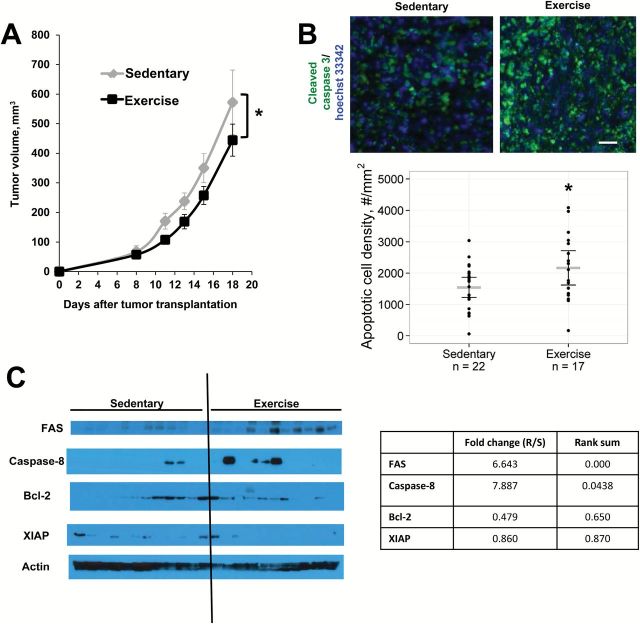
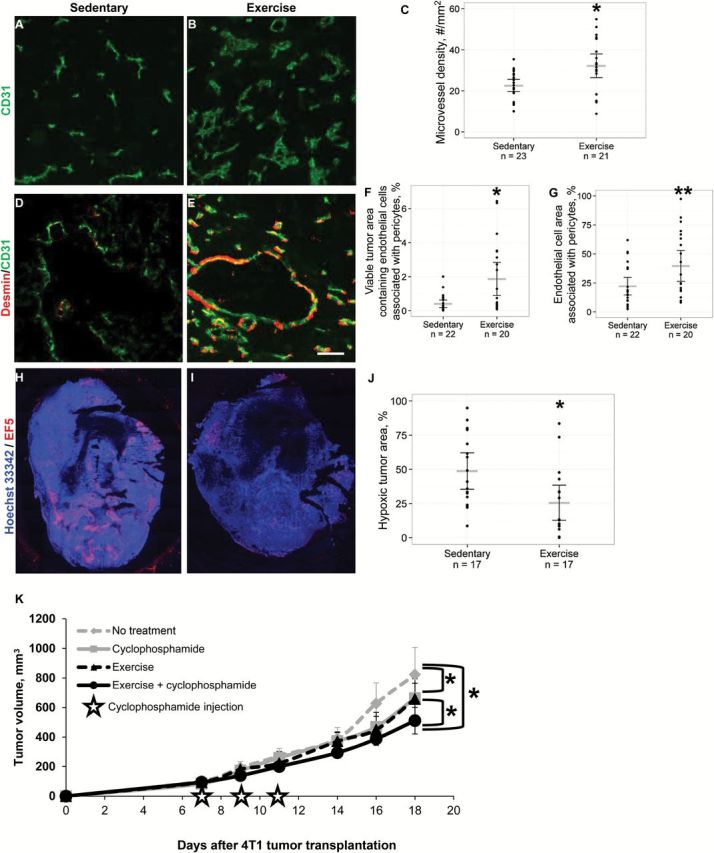
Exercise has been shown to improve postischemia perfusion of normal tissues; we investigated whether these effects extend to solid tumors. Estrogen receptor-negative (ER-, 4T1) and ER+ (E0771) tumor cells were implanted orthotopically into syngeneic mice (BALB/c, N = 11-12 per group) randomly assigned to exercise or sedentary control. Tumor growth, perfusion, hypoxia, and components of the angiogenic and apoptotic cascades were assessed by MRI, immunohistochemistry, western blotting, and quantitative polymerase chain reaction and analyzed with one-way and repeated measures analysis of variance and linear regression. All statistical tests were two-sided. Exercise statistically significantly reduced tumor growth and was associated with a 1.4-fold increase in apoptosis (sedentary vs exercise: 1544 cells/mm(2), 95% CI = 1223 to 1865 vs 2168 cells/mm(2), 95% CI = 1620 to 2717; P = .048), increased microvessel density (P = .004), vessel maturity (P = .006) and perfusion, and reduced intratumoral hypoxia (P = .012), compared with sedentary controls. We also tested whether exercise could improve chemotherapy (cyclophosphamide) efficacy. Exercise plus chemotherapy prolonged growth delay compared with chemotherapy alone (P < .001) in the orthotopic 4T1 model (n = 17 per group). Exercise is a potential novel adjuvant treatment of breast cancer.
Overview
The claims and statistics of this paper haven’t been checked yet.
Free: it reads the open-access text and checks the first 5 claims that cite a source we can check. Create a free account to check every claim.
Integrity signals
Registry
Cites
Statistics
Figures
Verification
Claims the paper makes
The claims and statistics of this paper haven’t been checked yet.
Free: it reads the open-access text and checks the first 5 claims that cite a source we can check. Create a free account to check every claim.
Claims other papers make about this one
Each is checked against this paper’s own text: does it say what the citing paper says it does?
The cited source says what the claim attributes to it.
In the citing paper
“Because exercise is a homeostatic physiological intervention, it also affects the tumor microenvironment (TME) (5-10).”
In the citing paper
“Beyond the acute increase in perfusion, exercise training (ExTr, accumulated bouts of exercise sessions) induces vessel normalization, thus enhancing tumor blood flow and oxygenation in subsequent resting conditions as well (6,7).”
In the citing paper
“Because most previous preclinical studies use ad libitum physical activity models (6,8,10), which do not properly capture human exercise behavior, we adapted a controlled exercise.”
In the citing paper
“Consistent with previous preclinical reports (6,7), we showed that ExTr induces vessel normalization, characterized by a larger number of vessels with higher pericyte coverage, resulting in less tumoral hypoxia.”
Self-check
Percentages, sums and reported differences re-computed from the paper’s own numbers.
The self-check needs the paper’s full text.
Citations
Cites
Bevacizumab plus Irinotecan, Fluorouracil, and Leucovorin for Metastatic Colorectal Cancer
Hurwitz, H., Fehrenbacher, L., Novotny, W., Cartwright, T., Hainsworth, J., Heim, W., Berlin, J., Baron, A., Griffing, S., Holmgren, E., et al. (2004) · New England Journal of Medicine · doi:10.1056/nejmoa032691 · Cited by 10,968
Paclitaxel–Carboplatin Alone or with Bevacizumab for Non–Small-Cell Lung Cancer
Sandler, A., Gray, R., Perry, M. C., Brahmer, J., Schiller, J. H., Dowlati, A., Lilenbaum, R., & Johnson, D. H. (2006) · New England Journal of Medicine · doi:10.1056/nejmoa061884 · Cited by 5,761
Hypoxia — a key regulatory factor in tumour growth
Harris, A. L. (2002) · Nature Reviews Cancer · doi:10.1038/nrc704 · Cited by 5,177
Paclitaxel plus Bevacizumab versus Paclitaxel Alone for Metastatic Breast Cancer
Miller, K., Wang, M., Gralow, J., Dickler, M., Cobleigh, M., Perez, E. A., Shenkier, T., Cella, D., & Davidson, N. E. (2007) · New England Journal of Medicine · doi:10.1056/nejmoa072113 · Cited by 3,081
Saltz, L. B., Clarke, S., Díaz-Rubio, E., Scheithauer, W., Figer, A., Wong, R., Koski, S., Lichinitser, M., Yang, T.-S., Rivera, F., et al. (2008) · Journal of Clinical Oncology · doi:10.1200/jco.2007.14.9930 · Cited by 2,955
Physical activity and survival after breast cancer diagnosis
Holmes, M. D. (2005) · JAMA · doi:10.1001/jama.293.20.2479 · Cited by 1,772
Principles and mechanisms of vessel normalization for cancer and other angiogenic diseases
Carmeliet, P., & Jain, R. K. (2011) · Nature Reviews Drug Discovery · doi:10.1038/nrd3455 · Cited by 1,675 · cited 1×
“Tumor blood vessels are structurally and functionally abnormal, resulting in heterogeneous intratumoral regions of hypoxia (1,2).”
BackgroundNormalization of the Vasculature for Treatment of Cancer and Other Diseases
Goel, S., Duda, D. G., Xu, L., Munn, L. L., Boucher, Y., Fukumura, D., & Jain, R. K. (2011) · Physiological Reviews · doi:10.1152/physrev.00038.2010 · Cited by 1,605 · cited 1×
“However, these effects are transient, lasting only days to weeks, which hinders long-term clinical use (16,17).”
BackgroundReck, M., von Pawel, J., Zatloukal, P., Ramlau, R., Gorbounova, V., Hirsh, V., Leighl, N., Mezger, J., Archer, V., Moore, N., et al. (2009) · Journal of Clinical Oncology · doi:10.1200/jco.2007.14.5466 · Cited by 1,505
Kinetics of vascular normalization by VEGFR2 blockade governs brain tumor response to radiation
Winkler, F., Kozin, S. V., Tong, R. T., Chae, S.-S., Booth, M. F., Garkavtsev, I., Xu, L., Hicklin, D. J., Fukumura, D., di Tomaso, E., et al. (2004) · Cancer Cell · doi:10.1016/j.ccr.2004.10.011 · Cited by 1,170 · cited 1×
“However, these effects are transient, lasting only days to weeks, which hinders long-term clinical use (16,17).”
Background
Research works printed but not linked: 1
- Jones LW Viglianti BL Tashjian JA Effect of aerobic exercise on tumor physiology in an animal model of human breast cancer. J Appl Physiol. 2010; 108(2): 343– 348. 19959769 PMC2822670 · DOI · Paper page
Cited by
PATEL, A. V., FRIEDENREICH, C. M., MOORE, S. C., HAYES, S. C., SILVER, J. K., CAMPBELL, K. L., WINTERS-STONE, K., GERBER, L. H., GEORGE, S. M., FULTON, J. E., et al. (2019) · Medicine & Science in Sports & Exercise · doi:10.1249/mss.0000000000002117 · Cited by 861
Transport of drugs from blood vessels to tumour tissue
Dewhirst, M. W., & Secomb, T. W. (2017) · Nature Reviews Cancer · doi:10.1038/nrc.2017.93 · Cited by 749
Self-citationMolecular mechanisms linking exercise to cancer prevention and treatment
Hojman, P., Gehl, J., Christensen, J. F., & Pedersen, B. K. (2018) · Cell Metabolism · doi:10.1016/j.cmet.2017.09.015 · Cited by 600
Normalizing Function of Tumor Vessels: Progress, Opportunities, and Challenges
Martin, J. D., Seano, G., & Jain, R. K. (2019) · Annual Review of Physiology · doi:10.1146/annurev-physiol-020518-114700 · Cited by 530
Exercise-dependent regulation of the tumour microenvironment
Koelwyn, G. J., Quail, D. F., Zhang, X., White, R. M., & Jones, L. W. (2017) · Nature Reviews Cancer · doi:10.1038/nrc.2017.78 · Cited by 296
Self-citationAshcraft, K. A., Peace, R. M., Betof, A. S., Dewhirst, M. W., & Jones, L. W. (2016) · Cancer Research · doi:10.1158/0008-5472.can-16-0887 · Cited by 217
Self-citationCytotoxic T-cells mediate exercise-induced reductions in tumor growth
Rundqvist, H., Veliça, P., Barbieri, L., Gameiro, P. A., Bargiela, D., Gojkovic, M., Mijwel, S., Reitzner, S. M., Wulliman, D., Ahlstedt, E., et al. (2020) · eLife · doi:10.7554/elife.59996 · Cited by 216
“Previously proposed underlying mechanisms for the anti-neoplastic effects of exercise include effects on weight control and endocrine hormone levels, as well as altered tumor vascularization (Betof et al., 2015) and immune function (Gleeson et al.”
BackgroundExercise-Dependent Regulation of NK Cells in Cancer Protection
Idorn, M., & Hojman, P. (2016) · Trends in Molecular Medicine · doi:10.1016/j.molmed.2016.05.007 · Cited by 211
Exercise training in cancer control and treatment
Christensen, J. F., Simonsen, C., & Hojman, P. (2018) · Comprehensive physiology · doi:10.1002/cphy.c180016 · Cited by 203
“As for radiotherapy, such enhanced drug delivery has not been investigated in human tumors, but preclinical studies convincingly show that combining chemotherapy with access to running wheels or treadmills improves the treatment response in mouse models (12, 81, 151).”
Tumor vessel normalization after aerobic exercise enhances chemotherapeutic efficacy
Schadler, K. L., Thomas, N. J., Galie, P. A., Bhang, D. H., Roby, K. C., Addai, P., Till, J. E., Sturgeon, K., Zaslavsky, A., Chen, C. S., et al. (2016) · Oncotarget · doi:10.18632/oncotarget.11748 · Cited by 199
“This is consistent with reports of tumor-specific effects of exercise on tumor growth, where exercise alone was sufficient to inhibit mammary carcinoma growth but had no effect on prostate tumor growth in mice [10, 16].”
BackgroundResultExercise and the Hallmarks of Cancer
Ruiz-Casado, A., Martín-Ruiz, A., Pérez, L. M., Provencio, M., Fiuza-Luces, C., & Lucia, A. (2017) · Trends in Cancer · doi:10.1016/j.trecan.2017.04.007 · Cited by 198
Roles and molecular mechanisms of physical exercise in cancer prevention and treatment
Wang, Q., & Zhou, W. (2021) · Journal of Sport and Health Science · doi:10.1016/j.jshs.2020.07.008 · Cited by 199
“In addition, exercise plus chemotherapy has prolonged the growth delay of breast cancer; exercise reduced hypoxia, increased microvascular density, increased blood perfusion, and normalized the vascular network in the cancer.(39) Increasingly, studies have demonstrated the beneficial effects of exercise in improving t…”
BackgroundCannioto, R. A., Hutson, A., Dighe, S., McCann, W., McCann, S. E., Zirpoli, G. R., Barlow, W., Kelly, K. M., DeNysschen, C. A., Hershman, D. L., et al. (2021) · JNCI: Journal of the National Cancer Institute · doi:10.1093/jnci/djaa046 · Cited by 188
“Data from mechanistic studies have also demonstrated that aerobic exercise in tumor-bearing mice enhances sensitivity to chemotherapy through decreased hypoxia, resulting in the direct suppression of tumor growth and recurrence across several mouse models including mammary cancer (55,56).”
BackgroundGomes-Santos, I. L., Amoozgar, Z., Kumar, A. S., Ho, W. W., Roh, K., Talele, N. P., Curtis, H., Kawaguchi, K., Jain, R. K., & Fukumura, D. (2021) · Cancer Immunology Research · doi:10.1158/2326-6066.cir-20-0499 · Cited by 181
“Consistent with previous preclinical reports (6, 7), we showed that ExTr induces vessel normalization, characterized by a larger number of vessels with higher pericyte coverage, resulting in less tumoral hypoxia.”
BackgroundMethodResultInfluentialModulation of the tumor vasculature and oxygenation to improve therapy
Siemann, D. W., & Horsman, M. R. (2015) · Pharmacology & Therapeutics · doi:10.1016/j.pharmthera.2015.06.006 · Cited by 169
“The ability to modulate tumor hypoxia by exploiting the systemic effects of exercise and the dysfunctional vasculature of solid tumors have recently been duplicated in rodent mammary tumor models grown in the mammary fat pads (Betof et al., 2015; Lee et al., 2015).”
Exercise protects from cancer through regulation of immune function and inflammation
Hojman, P. (2017) · Biochemical Society Transactions · doi:10.1042/bst20160466 · Cited by 164
Circadian rhythms and cancers: the intrinsic links and therapeutic potentials
Zhou, L., Zhang, Z., Nice, E. C., Huang, C., Zhang, W., & Tang, Y. C. (2022) · Journal of Hematology & Oncology · doi:10.1186/s13045-022-01238-y · Cited by 178
“Furthermore, during exercise, endothelial cell recruitment is mediated by platelet derived growth factor receptor-beta (PDGFRβ) derived from platelets for tumor angiogenesis, dramatically reducing tumor hypoxia by upregulation of microvessel density and perfusion [232, 234, 235].”
BackgroundExercise as adjunct therapy in cancer
Ashcraft, K. A., Warner, A. B., Jones, L. W., & Dewhirst, M. W. (2019) · Seminars in Radiation Oncology · doi:10.1016/j.semradonc.2018.10.001 · Cited by 148
Self-citationEco-evolutionary causes and consequences of temporal changes in intratumoural blood flow
Gillies, R. J., Brown, J. S., Anderson, A. R. A., & Gatenby, R. A. (2018) · Nature Reviews Cancer · doi:10.1038/s41568-018-0030-7 · Cited by 144
Vascular normalisation as the stepping stone into tumour microenvironment transformation
Magnussen, A. L., & Mills, I. G. (2021) · British Journal of Cancer · doi:10.1038/s41416-021-01330-z · Cited by 146
Exercise reduces immune suppression and breast cancer progression in a preclinical model
Wennerberg, E., Lhuillier, C., Rybstein, M. D., Dannenberg, K., Rudqvist, N.-P., Koelwyn, G. J., Jones, L. W., & Demaria, S. (2020) · Oncotarget · doi:10.18632/oncotarget.27464 · Cited by 127
“We have previously shown that “prescribed” exercise started at the time of tumor inoculation delayed tumor growth in mouse breast cancer models [15].”
BackgroundSelf-citationVadevoo, S. M. P., Gunassekaran, G. R., Lee, C., Lee, N., Lee, J., Chae, S., Park, J., Koo, J., & Lee, B.-H. (2021) · Proceedings of the National Academy of Sciences · doi:10.1073/pnas.2102434118 · Cited by 142
“The LLC tumor and EO771 breast tumor models used in this study are syngeneic, rather than xenograft, mouse tumor models, and are useful for studying tumor–immune cell interactions (46, 47).”
BackgroundExercise-induced myokines and their effect on prostate cancer
Kim, J., Galvao, D. A., Newton, R. U., Gray, E. S., & Taaffe, D. R. (2021) · Nature Reviews Urology · doi:10.1038/s41585-021-00476-y · Cited by 144
Exercise in Regulation of Inflammation-Immune Axis Function in Cancer Initiation and Progression.
Koelwyn, G. J., Wennerberg, E., Demaria, S., & Jones, L. W. (2015) · PubMed · Cited by 162
Self-citationVascular Normalization: A New Window Opened for Cancer Therapies
Yang, T., Xiao, H., Liu, X., Wang, Z., Zhang, Q., Wei, N., & Guo, X. (2021) · Frontiers in Oncology · doi:10.3389/fonc.2021.719836 · Cited by 141
Yang, L., Morielli, A. R., Heer, E., Kirkham, A. A., Cheung, W. Y., Usmani, N., Friedenreich, C. M., & Courneya, K. S. (2021) · Cancer Research · doi:10.1158/0008-5472.can-21-1258 · Cited by 118
Muscle-to-tumor crosstalk: The effect of exercise-induced myokine on cancer progression
Huang, Q., Wu, M., Wu, X., Zhang, Y., & Xia, Y. (2022) · Biochimica et Biophysica Acta (BBA) - Reviews on Cancer · doi:10.1016/j.bbcan.2022.188761 · Cited by 139
Kennedy, M. A., Bayes, S. J., Newton, R. U., Zissiadis, Y., Spry, N. A., Taaffe, D. R., Hart, N. H., & Galvao, D. A. (2021) · Journal of Cancer Survivorship · doi:10.1007/s11764-021-01080-0 · Cited by 128
“Researchers suggest that exercise has an important therapeutic role in preparing patients for surgery and treatment [5, 6], managing treatment-related side effects [7] and improving treatment tolerability [8], with emerging evidence of a potential role for exercise to enhance the effectiveness of treatment [9, 10, 11].”
BackgroundStrategies to Prevent or Remediate Cancer and Treatment-Related Aging
Guida, J. L., Agurs-Collins, T., Ahles, T. A., Campisi, J., Dale, W., Demark-Wahnefried, W., Dietrich, J., Fuldner, R., Gallicchio, L., Green, P. A., et al. (2021) · JNCI: Journal of the National Cancer Institute · doi:10.1093/jnci/djaa060 · Cited by 105
Sanft, T. B., Harrigan, M., McGowan, C. J., Cartmel, B., Zupa, M., Li, F., Ferrucci, L. M., Puklin, L. S., Cao, A., Nguyen, T. H., et al. (2023) · Journal of Clinical Oncology · doi:10.1200/jco.23.00871 · Cited by 119
Loughney, L. A., West, M. A., Kemp, G. J., Grocott, M. P. W., & Jack, S. (2015) · European Journal of Surgical Oncology · doi:10.1016/j.ejso.2015.09.027 · Cited by 119
Christensen, J. F., Simonsen, C., Banck-Petersen, A., Thorsen-Streit, S., Herrstedt, A., Djurhuus, S. S., Egeland, C., Mortensen, C. E., Kofoed, S., Kristensen, T. S., et al. (2018) · BJS Open · doi:10.1002/bjs5.50110 · Cited by 97
Zylstra, J., Whyte, G. P., Beckmann, K., Pate, J., Santaolalla, A., Gervais-Andre, L., Russell, B. A., Maisey, N. R., Waters, J. S., Tham, G., et al. (2022) · British Journal of Sports Medicine · doi:10.1136/bjsports-2021-104243 · Cited by 90
The future of biology in driving the field of hyperthermia
Dewhirst, M. W., Lee, C.-T., & Ashcraft, K. A. (2016) · International Journal of Hyperthermia · doi:10.3109/02656736.2015.1091093 · Cited by 89
“Interestingly, we observed that voluntary exercise exerts many of the same types of effects as those reported by the Repasky group [22,23].”
ResultSelf-citationExercise medicine for advanced prostate cancer
Hart, N. H., Galvao, D. A., & Newton, R. U. (2017) · Current Opinion in Supportive and Palliative Care · doi:10.1097/spc.0000000000000276 · Cited by 91
Zhang, X., Ashcraft, K. A., Warner, A. B., Nair, S. K., & Dewhirst, M. W. (2019) · Cancer Research · doi:10.1158/0008-5472.can-18-2468 · Cited by 98
“Chronic voluntary wheel running increased microvessel density by 50%, tripled the area of pericyte-covered vasculature, and halved hypoxic fraction (12) in mice bearing the 4T1 tumor.”
Self-citationWest, M. A., Astin, R., Moyses, H. E., Cave, J., White, D., Levett, D. Z. H., Bates, A. S., Brown, G., Grocott, M. P. W., & Jack, S. (2019) · Acta Oncologica · doi:10.1080/0284186x.2019.1566775 · Cited by 90
Zhu, C., Ma, H., He, A., Li, Y., He, C., & Xia, Y. (2022) · Cancer Letters · doi:10.1016/j.canlet.2022.215814 · Cited by 104
Exercise and cancer: a position statement from the Spanish Society of Medical Oncology
Pollán, M., Casla-Barrio, S., Alfaro, J., Esteban, C., Seguí, M. Á., Lucía, A., & Martín, M. (2020) · Clinical & Translational Oncology · doi:10.1007/s12094-020-02312-y · Cited by 105
Exercise during preoperative therapy increases tumor vascularity in pancreatic tumor patients
Bedoya, C. A. F., Cardoso, A. C. F., Parker, N. H., Ngo‐Huang, A., Petzel, M. Q. B., Kim, M. P., Fogelman, D. R., Romero, S. G., Wang, H., Park, M., et al. (2019) · Scientific Reports · doi:10.1038/s41598-019-49582-3 · Cited by 89
Exercise and immunometabolic regulation in cancer
Koelwyn, G. J., Zhuang, X., Tammela, T., Schietinger, A., & Jones, L. W. (2020) · Nature Metabolism · doi:10.1038/s42255-020-00277-4 · Cited by 91
Self-citationEO771, is it a well‐characterized cell line for mouse mammary cancer model? Limit and uncertainty
Naour, A. L., Rossary, A., & Vasson, M. (2020) · Cancer Medicine · doi:10.1002/cam4.3295 · Cited by 85
Reverse cardio-oncology: Exploring the effects of cardiovascular disease on cancer pathogenesis
Koelwyn, G. J., Aboumsallem, J. P., Moore, K. J., & de Boer, R. A. (2021) · Journal of Molecular and Cellular Cardiology · doi:10.1016/j.yjmcc.2021.09.008 · Cited by 74
Lieberman, D. E., Kistner, T. M., Richard, D., Lee, I.-M., & Baggish, A. L. (2021) · Proceedings of the National Academy of Sciences · doi:10.1073/pnas.2107621118 · Cited by 72
Sampsell, K., Hao, D., & Reimer, R. A. (2020) · International Journal of Molecular Sciences · doi:10.3390/ijms21239239 · Cited by 81
“In murine models of breast cancer, exercise increases sensitivity to chemotherapeutics through decreased hypoxia and regulation of vascularity, leading to improved outcomes via direct tumor suppression [158].”
BackgroundBolger, J. C., Loughney, L. A., Tully, R., Cunningham, M., Keogh, S., McCaffrey, N., Hickey, W., & Robb, W. B. (2019) · Diseases of the Esophagus · doi:10.1093/dote/doz058 · Cited by 76
Exercise and the Tumor Microenvironment: Potential Therapeutic Implications
Wiggins, J. M., Opoku‐Acheampong, A. B., Baumfalk, D. R., Siemann, D. W., & Behnke, B. J. (2017) · Exercise and Sport Sciences Reviews · doi:10.1249/jes.0000000000000137 · Cited by 74
A Tale of Two States: Normal and Transformed, With and Without Rigidity Sensing
Sheetz, M. P. (2019) · Annual Review of Cell and Developmental Biology · doi:10.1146/annurev-cellbio-100818-125227 · Cited by 67
Stretching Reduces Tumor Growth in a Mouse Breast Cancer Model
Berrueta, L., Bergholz, J. S., Muñoz‐Vergara, D., Muskaj, I., Badger, G. J., Shukla, A., Kim, H. J., Zhao, J. J., & Langevin, H. M. (2018) · Scientific Reports · doi:10.1038/s41598-018-26198-7 · Cited by 71
Eschke, R.-C. K.-R., Lampit, A., Schenk, A., Javelle, F., Steindorf, K., Diel, P. R., Bloch, W., & Zimmer, P. (2019) · Frontiers in Oncology · doi:10.3389/fonc.2019.00035 · Cited by 78
Turner, J. E., & Brum, P. C. (2017) · Oxidative Medicine and Cellular Longevity · doi:10.1155/2017/4234765 · Cited by 66
“For example, a murine model of breast cancer showed that regular wheel running improved the effectiveness of chemotherapy by promoting tumour vascularity, reducing tumour hypoxia, and subsequently enhancing tumour perfusion [203].”
BackgroundDufresne, S., Rébillard, A., Muti, P. C., Friedenreich, C. M., & Brenner, D. R. (2018) · Cancer Epidemiology Biomarkers & Prevention · doi:10.1158/1055-9965.epi-16-0969 · Cited by 70
Nanoparticle Delivery and Tumor Vascular Normalization: The Chicken or The Egg?
Mattheolabakis, G., & Mikelis, C. M. (2019) · Frontiers in Oncology · doi:10.3389/fonc.2019.01227 · Cited by 69
Schumacher, O., Galvao, D. A., Taaffe, D. R., Chee, R., Spry, N. A., & Newton, R. U. (2020) · Prostate Cancer and Prostatic Diseases · doi:10.1038/s41391-020-0245-z · Cited by 70
Selective killing of transformed cells by mechanical stretch
Tijore, A., Yao, M., Wang, Y., Hariharan, A., Nematbakhsh, Y., Doss, B. L., Lim, C. T., & Sheetz, M. P. (2021) · Biomaterials · doi:10.1016/j.biomaterials.2021.120866 · Cited by 68
Psychological distress and eustress in cancer and cancer treatment: Advances and perspectives
Wu, Y., Zhou, L., Zhang, X., Yang, X., Niedermann, G., & Xue, J. (2022) · Science Advances · doi:10.1126/sciadv.abq7982 · Cited by 74
Cell-stretching devices: advances and challenges in biomedical research and live-cell imaging
Constantinou, I., & Bastounis, E. E. (2023) · Trends in biotechnology · doi:10.1016/j.tibtech.2022.12.009 · Cited by 63
Tumor oxygenation and cancer therapy—then and now
Hughes, V. S., Wiggins, J. M., & Siemann, D. W. (2018) · British Journal of Radiology · doi:10.1259/bjr.20170955 · Cited by 76
Garcia, E., Becker, V. G. C., McCullough, D. J., Stabley, J. N., Gittemeier, E. M., Opoku-Acheampong, A. B., Sieman, D. W., & Behnke, B. J. (2016) · Journal of Applied Physiology · doi:10.1152/japplphysiol.00266.2016 · Cited by 57
Warner, A. B., & McQuade, J. L. (2019) · Current Oncology Reports · doi:10.1007/s11912-019-0814-2 · Cited by 63
Physical Activity as an Imperative Support in Breast Cancer Management
Ortega, M. A., Fraile‐Μartinez, O., Montero, C. G., Pekarek, L., Guijarro, L. G., Castellanos, A. J., Sánchez‐Trujillo, L., García‐Honduvilla, N., Álvarez‐Mon, M., Buján, J., et al. (2020) · Cancers · doi:10.3390/cancers13010055 · Cited by 73
“Modulation of tumor hypoxia may be a possible explanation for these facts, as the relationship between exercise and a reduction in tumor hypoxia has been shown, hence reducing tumor growth [97].”
BackgroundExercise and colorectal cancer: prevention and molecular mechanisms
Amirsasan, R., Akbarzadeh, M., & Akbarzadeh, S. (2022) · Cancer Cell International · doi:10.1186/s12935-022-02670-3 · Cited by 62
Impact of exercise on cancer: mechanistic perspectives and new insights
Ye, F., Feng, X., Wan, R., Luo, Z., Qu, L., & Wang, Q. (2024) · Frontiers in Immunology · doi:10.3389/fimmu.2024.1474770 · Cited by 74
Physical Exercise and the Hallmarks of Breast Cancer: A Narrative Review
García‐Chico, C., López‐Ortiz, S., Peñín‐Grandes, S., Pinto-Fraga, J., Valenzuela, P. L., Emanuele, E., Ceci, C., Graziani, G., Fiuza‐Luces, C., Lista, S., et al. (2023) · Cancers · doi:10.3390/cancers15010324 · Cited by 69
“Preclinical research in an orthotopic murine model of breast cancer shows that exercise promotes tumor vessel maturity and microvessel density [96], supported by reduction in intratumoral hypoxia and improvement in tissue perfusion, oxygen supply [97], and nitric oxide bioavailability [98], thus leading to an unfavora…”
BackgroundEnhanced tumor cell killing by ultrasound after microtubule depolymerization
Singh, A., Tijore, A., Margadant, F., Simpson, C., Chitkara, D., Low, B. C., & Sheetz, M. P. (2021) · Bioengineering & Translational Medicine · doi:10.1002/btm2.10233 · Cited by 47
“For instance, periodic exercise or stretching of tumors in an animal model leads to tumor regression.(6,7) Moreover, NIH National Cancer Institute lists seven different types of cancer that are inhibited by exercise and another eight tumor types where data are suggestive.”
BackgroundBody Composition in Pediatric Solid Tumors: State of the Science and Future Directions
Joffe, L., Schadler, K., Shen, W., & Ladas, E. J. (2019) · JNCI Monographs · doi:10.1093/jncimonographs/lgz018 · Cited by 51
Vascular modulation through exercise improves chemotherapy efficacy in Ewing sarcoma
Morrell, M. B. G., Alvarez‐Florez, C., Zhang, A., Kleinerman, E. S., Savage, H., Marmonti, E., Park, M., Shaw, A., & Schadler, K. (2019) · Pediatric Blood & Cancer · doi:10.1002/pbc.27835 · Cited by 54
Emery, A., Moore, S. E., Turner, J. E., & Campbell, J. P. (2022) · Frontiers in Oncology · doi:10.3389/fonc.2022.788113 · Cited by 54
Parry, T. L., & Hayward, R. (2015) · American Journal of Physiology-Regulatory, Integrative and Comparative Physiology · doi:10.1152/ajpregu.00185.2015 · Cited by 49
Oncology and Cardiac Rehabilitation: An Underrated Relationship
Venturini, E., Iannuzzo, G., D’Andrea, A., Pacileo, M., Tarantini, L., Canale, M. L., Gentile, M., Vitale, G., Sarullo, F. M., Vastarella, R., et al. (2020) · Journal of Clinical Medicine · doi:10.3390/jcm9061810 · Cited by 51
“Moreover, exercise increases vascular endothelial growth factor levels [78,79] and vascular density, while promoting better tumor perfusion [80].”
BackgroundExercise interventions for people undergoing multimodal cancer treatment that includes surgery
Loughney, L. A., West, M. A., Kemp, G. J., Grocott, M. P. W., & Jack, S. (2018) · Cochrane Database of Systematic Reviews · doi:10.1002/14651858.cd012280.pub2 · Cited by 48
“In combination with chemotherapy, exercise training has been shown to slow tumour progression in solid tumours compared with chemotherapy alone (Betof 2015).”
BackgroundLu, M., Sanderson, S. M., Zessin, A. S., Ashcraft, K. A., Jones, L. W., Dewhirst, M. W., Locasale, J. W., & Hsu, D. S. (2018) · Cancer & Metabolism · doi:10.1186/s40170-018-0190-7 · Cited by 45
“turity, and perfusion thereby decreasing intratumoral hypoxia [34].”
Self-citationSturgeon, K. M., Smith, A. M., Federici, E. H., Kodali, N., Kessler, R., Wyluda, E., Cream, L., Ky, B., & Schmitz, K. H. (2022) · BMC Sports Science Medicine and Rehabilitation · doi:10.1186/s13102-022-00420-6 · Cited by 50
“We and others have reported exercise-induced improvements in tumor perfusion leading to greater efficacy of chemotherapy in mice [7, 8].”
BackgroundMorielli, A. R., Usmani, N., Boulé, N. G., Severin, D. M., Tankel, K., Joseph, K. J., Nijjar, T. S., Fairchild, A. M., & Courneya, K. S. (2021) · Clinical Colorectal Cancer · doi:10.1016/j.clcc.2021.05.004 · Cited by 47
Therapeutic Modification of Hypoxia
Horsman, M. R., Sørensen, B. S., Busk, M., & Siemann, D. W. (2021) · Clinical Oncology · doi:10.1016/j.clon.2021.08.014 · Cited by 41
Torregrosa, C., Chorin, F., Beltran, E. E. M., Neuzillet, C., & Cardot‐Ruffino, V. (2022) · Cancers · doi:10.3390/cancers14215402 · Cited by 56
Do Cancer and Cancer Treatments Accelerate Aging?
Bhatia, R., Holtan, S. G., Jurdi, N. E., Prizment, A. E., & Blaes, A. H. (2022) · Current Oncology Reports · doi:10.1007/s11912-022-01311-2 · Cited by 42
Smęda, M., Przyborowski, K., Proniewski, B., Zakrzewska, A., Kaczor, D., Stojak, M., Buczek, E., Nieckarz, Z., Zoladz, J. A., Wietrzyk, J., et al. (2017) · Europe PMC (PubMed Central) · Cited by 39
Exercise training reverses cancer-induced oxidative stress and decrease in muscle COPS2/TRIP15/ALIEN
Alves, C. R. R., das Neves, W., de Almeida, N. R., Eichelberger, E. J., Jannig, P. R., Voltarelli, V. A., Tobias, G. C., Bechara, L. R. G., Faria, D. D. P., Alves, M. J. N. N., et al. (2020) · Molecular Metabolism · doi:10.1016/j.molmet.2020.101012 · Cited by 49
“Another exercise-induced effect is increased local vessel perfusion, which could facilitate the action of immune cells to suppress tumor growth [60].”
BackgroundThe antitumor mechanisms of aerobic exercise: A review of recent preclinical studies
Jia, N., Zhou, Y., Dong, X., & Ding, M. (2021) · Cancer Medicine · doi:10.1002/cam4.4169 · Cited by 41
Mechanotherapy in oncology: Targeting nuclear mechanics and mechanotransduction
Liu, S., Li, Y., Yuan, H., Wang, M., Zhang, H., Ma, J., Qu, K., Huang, G., & Lu, T. J. (2023) · Advanced Drug Delivery Reviews · doi:10.1016/j.addr.2023.114722 · Cited by 37
Effect of post-implant exercise on tumour growth rate, perfusion and hypoxia in mice
Buss, L. A., Ang, A. D., Hock, B. D., Robinson, B. A., Currie, M. J., & Dachs, G. U. (2020) · PLoS ONE · doi:10.1371/journal.pone.0229290 · Cited by 41
“tumours, have found that exercise can increase tumour perfusion [13–15], vascularity [15,16] and/or reduce hypoxia [15,17], thus ‘normalising’ the tumour microenvironment.”
BackgroundMethodResultInfluentialNewton, R. U., Taaffe, D. R., Chambers, S. K., Spry, N. A., & Galvao, D. A. (2018) · Journal of Clinical Oncology · doi:10.1200/jco.2017.76.7400 · Cited by 38
Exercise training improves radiotherapy efficiency in a murine model of prostate cancer
Dufresne, S., Guéritat, J., Chiavassa, S., Noblet, C., Assi, M. N., Rioux-Leclercq, N. C., Rannou‐Bekono, F., Lefeuvre‐Orfila, L., Paris, F., & Rébillard, A. (2020) · The FASEB Journal · doi:10.1096/fj.201901728r · Cited by 43
Physical activity delays accumulation of immunosuppressive myeloid-derived suppressor cells
Garritson, J. D., Krynski, L. M., Simon, L. H., Haughian, J. M., Pullen, N., & Hayward, R. (2020) · PLoS ONE · doi:10.1371/journal.pone.0234548 · Cited by 41
“Mixed results have been reported in the literature, with some studies in 4T1 tumor bearing mice showing that voluntary wheel running can slow the growth of 4T1 tumors [16,22,40], while other recent reports show that wheel running alone had no effect on tumor growth in 4T1 tumor-bearing mice [21,34].”
ResultRole of Regular Physical Exercise in Tumor Vasculature: Favorable Modulator of Tumor Milieu
Esteves, M., Monteiro, M. P., & Duarte, J. A. (2020) · International Journal of Sports Medicine · doi:10.1055/a-1308-3476 · Cited by 39
“[58] Betof AS, Lascola CD, Weitzel D et al.”
BackgroundInfluentialDifferential response to exercise in claudin-low breast cancer
Glass, O. K., Bowie, M., Fuller, J., Darr, D., Usary, J., Boss, K., Choudhury, K. R., Liu, X., Zhang, Z., Locasale, J. W., et al. (2017) · Oncotarget · doi:10.18632/oncotarget.21054 · Cited by 32
“[7, 8] Similar heterogeneity in response to exercise is observed in preclinical studies demonstrating that exercise inhibits primary breast tumor growth in some, but not all; both as a single modality [9, 10] and in combination with anticancer therapy [9, 11].”
BackgroundResultSelf-citationExercise Training in Elderly Cancer Patients: A Systematic Review
Giallauria, F., Testa, C., Cuomo, G., Lorenzo, A. D., Venturini, E., Lauretani, F., Maggio, M. G., Iannuzzo, G., & Vigorito, C. (2023) · Cancers · doi:10.3390/cancers15061671 · Cited by 37
“[56] Estrogen receptor–negative (ER-, 4T1) and ER+ (E0771) tumor cells were implanted orthotopically into syngeneic mice (BALB/c, N = 11–12 per group) randomly assigned to exercise or sedentary control Resisting cell death Effect of exercise on apoptosis Exercise plus chemotherapy prolonged growth delay compared with…”
MethodVoluntary exercise slows breast tumor establishment and reduces tumor hypoxia in ApoE−/− mice
Buss, L. A., & Dachs, G. U. (2018) · Journal of Applied Physiology · doi:10.1152/japplphysiol.00738.2017 · Cited by 38
“(7) using a similar experimental design, we found no change in intratumoral perfusion or microvessel density in exercising vs sedentary mice.”
BackgroundMethodInfluentialSchadler, K., Kleinerman, E. S., & Chandra, J. (2017) · Pediatric Research · doi:10.1038/pr.2017.225 · Cited by 33
“Wheel running significantly increased the antitumor effect of cyclophosphamide against mammary tumors and of celecoxib against prostate tumors in mice (65,71).”
Chemokine Receptors and Exercise to Tackle the Inadequacy of T Cell Homing to the Tumor Site
Idorn, M., & Straten, P. T. (2018) · Cells · doi:10.3390/cells7080108 · Cited by 36
Kirkham, A. A., Paterson, D. I., Prado, C. M. M., Mackey, J. R., Courneya, K. S., Pituskin, E., & Thompson, R. B. (2018) · BMC Cancer · doi:10.1186/s12885-018-4778-7 · Cited by 36
“Additionally, both caloric restriction and exercise have antineoplastic effects and can potentially sensitize the tumor to chemotherapy [22, 37], further reducing mortality risk in individuals diagnosed with cancer.”
BackgroundAerobic Exercise Alters the Melanoma Microenvironment and Modulates ERK5 S496 Phosphorylation
Savage, H., Pareek, S., Lee, J., Ballarò, R., Conterno Minussi, D., Hayek, K., Sadullozoda, M., Lochmann, B. S., McQuade, J. L., LaVoy, E. C., et al. (2023) · Cancer Immunology Research · doi:10.1158/2326-6066.cir-22-0465 · Cited by 30
Os Benefícios dos Exercícios Físicos no Câncer de Mama
Campos, M. D. S. B., Feitosa, R. H. F., Mizzaci, C. C., von Flach, M. D. R. T., Siqueira, B. J. M., & EduardoMastrocola, L. (2022) · Arquivos Brasileiros de Cardiologia · doi:10.36660/abc.20220086 · Cited by 80
“14-16 Tumor microenvironment acts in the cooption and deviation of the action of immunoinflammatory and stromal cells.”
BackgroundModerate Exercise Modulates Tumor Metabolism of Triple-Negative Breast Cancer
Vulczak, A., Souza, A. D. O., Ferrari, G. D., Azzolini, A. E. C. S., Pereira-da-Silva, G., & Alberici, L. C. (2020) · Cells · doi:10.3390/cells9030628 · Cited by 38
“In addition, voluntary physical exercise has been shown to reduce tumor growth rate after mice were inoculated with 5 × 10⁴ [22] or 1 × 10⁴ [23] 4T1 cells.”
BackgroundVoluntary wheel running can lead to modulation of immune checkpoint molecule expression
Bay, M. L., Unterrainer, N., Stagaard, R., Pedersen, K. S., Schauer, T., Staffeldt, M. M., Christensen, J. F., Højman, P., Pedersen, B. K., & Gehl, J. (2020) · Acta Oncologica · doi:10.1080/0284186x.2020.1817550 · Cited by 33
Sampsell, K., Wang, W., Ohland, C., Mager, L. F., Pett, N., Lowry, D. E., Sales, K. M., McNeely, M. L., McCoy, K. D., Culos-Reed, S. N., et al. (2022) · Cancers · doi:10.3390/cancers14112722 · Cited by 30
The Influence of Exercise on Cancer Risk, the Tumor Microenvironment and the Treatment of Cancer
He, A., Pu, Y., Jia, C., Wu, M., He, H., & Xia, Y. (2024) · Sports Medicine · doi:10.1007/s40279-024-02031-2 · Cited by 38
“These results illustrate that exercise may significantly improve tumor vascular structure, resulting in more uniform and concentrated tumor perfusion [21].”
InfluentialAdvances in Diet and Physical Activity in Breast Cancer Prevention and Treatment
Khalifa, A., Guijarro, A. I., & Nencioni, A. (2024) · Nutrients · doi:10.3390/nu16142262 · Cited by 42
Hart, N. H., Newton, R. U., Spry, N. A., Taaffe, D. R., Chambers, S. K., Feeney, K., Joseph, D. J., Redfern, A. D., Ferguson, T., & Galvao, D. A. (2017) · BMJ Open · doi:10.1136/bmjopen-2016-014458 · Cited by 33
Metadata
- Authors
- Betof, A. S., Lascola, C. D., Weitzel, D., Landon, C., Scarbrough, P. M., Devi, G. R., Palmer, G., Jones, L. W., & Dewhirst, M. W.
- Affiliations
- Memorial Sloan Kettering Cancer Center (US)
- Corresponding author
- Jones, Lee W.
- Dewhirst, Mark W.
- ORCID
- Venue
- JNCI: Journal of the National Cancer Institute
- Publisher
- Oxford University Press (OUP)
- Published
- 2015-03-12
- Volume
- 107
- Issue
- 5
- ISSN
- 0027-8874 (ISSN-L)
- 1460-2105
- PMC
- PMC4822524
- OpenAlex
- W2147288982
- Cited by
- 309
- References
- 35
- Citations by year
- 2026: 20 · 2025: 29 · 2024: 26 · 2023: 36 · 2022: 32 · 2021: 39 · 2020: 38 · 2019: 28 · 2018: 21 · 2017: 20 · 2016: 13 · 2015: 7
- FWCI
- 8.82
- Type
- journal article
- Language
- en
- Open access
- hybrid
- doi.org
- Licence
- cc-by-nc
- Locations
- JNCI Journal of the National Cancer Institute (publishedVersion, cc-by-nc)
- Europe PMC (PubMed Central) (publishedVersion, cc-by-nc)
- PubMed Central (publishedVersion, cc-by-nc)
- PubMed (publishedVersion)
- DukeSpace (Duke University) (submittedVersion, cc-by-nc-nd)
- Funders
- National Cancer Institute (R01CA040355, T32CA078586, P30CA008748)
- Topics
- Life Sciences › Biochemistry, Genetics and Molecular Biology › Molecular Biology › Angiogenesis and VEGF in Cancer
- Life Sciences › Biochemistry, Genetics and Molecular Biology › Cancer Research › Cancer, Hypoxia, and Metabolism
- Health Sciences › Medicine › Physiology (medical) › Cardiovascular and exercise physiology
- Keywords
- physical activity, breast cancer, tumor vascularity, tumor hypoxia, chemotherapy response, cyclophosphamide, apoptosis, angiogenesis, microvessel density, 4T1 cells, E0771 cells, tumor perfusion, adjuvant therapy, orthotopic tumor model
- MeSH terms
- Analysis of Variance, Animals, Cyclophosphamide, Female, Humans, Mammary Neoplasms, Experimental, Mice, Inbred BALB C, Microcirculation, Neoplasm Transplantation, Neovascularization, Pathologic, Random Allocation, Receptors, Estrogen, Exercise, Cell Hypoxia, Linear Models, Treatment Outcome, Apoptosis, Antineoplastic Agents, Alkylating, Cell Line, Tumor, Cell Proliferation, Mice
About these checks
Registry, retraction, Cites and statistics results are computed, not judged, with one exception: a printed reference that no index lists is read once by a model before it counts as a citation error. Claims are extracted by a model and kept only when their quote appears verbatim in the text; each cited source is then checked, with a model’s help, for whether it says what the claim relies on. Those verdicts can be wrong — read the claim’s quote and the cited source before relying on one.
Statistics and arithmetic are recomputed, not judged.
Confidence bands are shown only for fields calibrated on our annotated test set. None is calibrated yet, so no band is shown.
What counts as a claim ›How we measure confidence ›How we check this ›
Are you an author, or do you see a problem with this page? Request a review
Data sources
Bibliographic data: Semantic Scholar, OpenAlex, Crossref.
Contains information from the Semantic Scholar Academic Graph Datasets, made available under the ODC Attribution License (ODC-BY 1.0).
Semantic Scholar’s data is described in: Kinney, R., et al. (2023). The Semantic Scholar Open Data Platform. arXiv:2301.10140.
