

Modulation of murine breast tumor vascularity, hypoxia and chemotherapeutic response by exercise
Open accessThe DOI matches its Crossref record; 33 of the 35 references it cites were found in a registry or an index.
Abstract
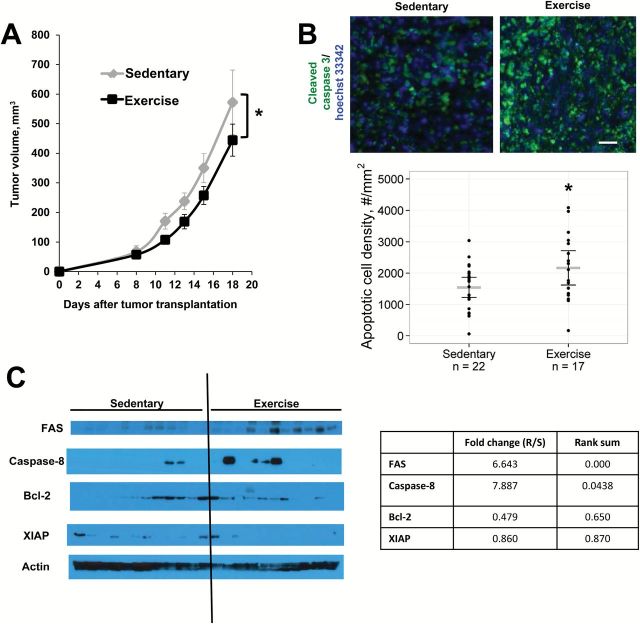
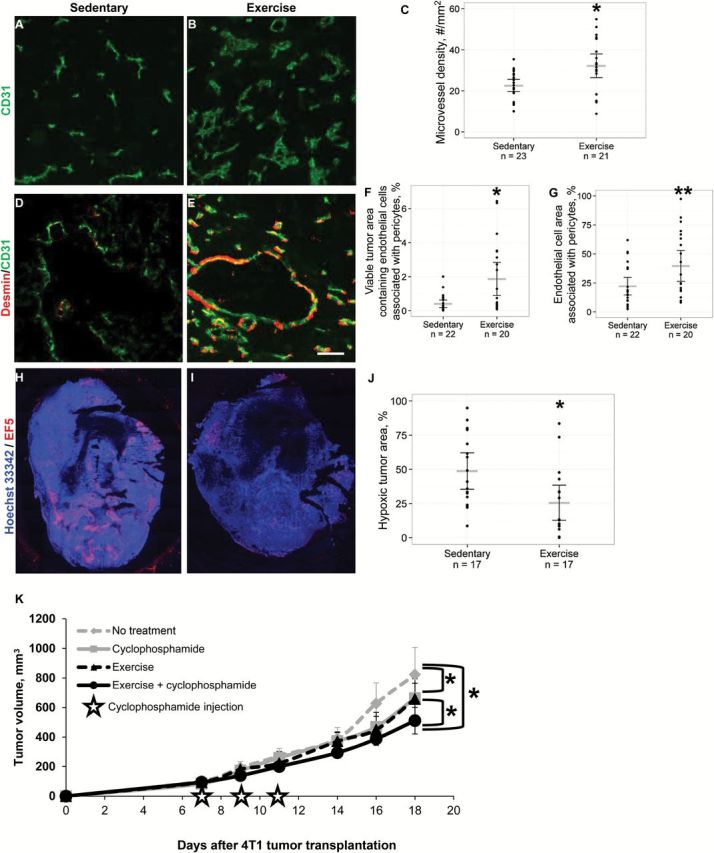
Exercise has been shown to improve postischemia perfusion of normal tissues; we investigated whether these effects extend to solid tumors. Estrogen receptor-negative (ER-, 4T1) and ER+ (E0771) tumor cells were implanted orthotopically into syngeneic mice (BALB/c, N = 11-12 per group) randomly assigned to exercise or sedentary control. Tumor growth, perfusion, hypoxia, and components of the angiogenic and apoptotic cascades were assessed by MRI, immunohistochemistry, western blotting, and quantitative polymerase chain reaction and analyzed with one-way and repeated measures analysis of variance and linear regression. All statistical tests were two-sided. Exercise statistically significantly reduced tumor growth and was associated with a 1.4-fold increase in apoptosis (sedentary vs exercise: 1544 cells/mm(2), 95% CI = 1223 to 1865 vs 2168 cells/mm(2), 95% CI = 1620 to 2717; P = .048), increased microvessel density (P = .004), vessel maturity (P = .006) and perfusion, and reduced intratumoral hypoxia (P = .012), compared with sedentary controls. We also tested whether exercise could improve chemotherapy (cyclophosphamide) efficacy. Exercise plus chemotherapy prolonged growth delay compared with chemotherapy alone (P < .001) in the orthotopic 4T1 model (n = 17 per group). Exercise is a potential novel adjuvant treatment of breast cancer.
Overview
The claims and statistics of this paper haven’t been checked yet.
Free: it reads the open-access text and checks the first 5 claims that cite a source we can check. Create a free account to check every claim.
Integrity signals
Registry
Cites
Statistics
Figures
Verification
Claims the paper makes
The claims and statistics of this paper haven’t been checked yet.
Free: it reads the open-access text and checks the first 5 claims that cite a source we can check. Create a free account to check every claim.
Claims other papers make about this one
Each is checked against this paper’s own text: does it say what the citing paper says it does?
The cited source says what the claim attributes to it.
In the citing paper
“Because exercise is a homeostatic physiological intervention, it also affects the tumor microenvironment (TME) (5-10).”
In the citing paper
“Beyond the acute increase in perfusion, exercise training (ExTr, accumulated bouts of exercise sessions) induces vessel normalization, thus enhancing tumor blood flow and oxygenation in subsequent resting conditions as well (6,7).”
In the citing paper
“Because most previous preclinical studies use ad libitum physical activity models (6,8,10), which do not properly capture human exercise behavior, we adapted a controlled exercise.”
In the citing paper
“Consistent with previous preclinical reports (6,7), we showed that ExTr induces vessel normalization, characterized by a larger number of vessels with higher pericyte coverage, resulting in less tumoral hypoxia.”
Self-check
Percentages, sums and reported differences re-computed from the paper’s own numbers.
The self-check needs the paper’s full text.
Citations
Cites
Bevacizumab plus Irinotecan, Fluorouracil, and Leucovorin for Metastatic Colorectal Cancer
Hurwitz, H., Fehrenbacher, L., Novotny, W., Cartwright, T., Hainsworth, J., Heim, W., Berlin, J., Baron, A., Griffing, S., Holmgren, E., et al. (2004) · New England Journal of Medicine · doi:10.1056/nejmoa032691 · Cited by 10,968
Paclitaxel–Carboplatin Alone or with Bevacizumab for Non–Small-Cell Lung Cancer
Sandler, A., Gray, R., Perry, M. C., Brahmer, J., Schiller, J. H., Dowlati, A., Lilenbaum, R., & Johnson, D. H. (2006) · New England Journal of Medicine · doi:10.1056/nejmoa061884 · Cited by 5,761
Hypoxia — a key regulatory factor in tumour growth
Harris, A. L. (2002) · Nature Reviews Cancer · doi:10.1038/nrc704 · Cited by 5,177
Paclitaxel plus Bevacizumab versus Paclitaxel Alone for Metastatic Breast Cancer
Miller, K., Wang, M., Gralow, J., Dickler, M., Cobleigh, M., Perez, E. A., Shenkier, T., Cella, D., & Davidson, N. E. (2007) · New England Journal of Medicine · doi:10.1056/nejmoa072113 · Cited by 3,081
Saltz, L. B., Clarke, S., Díaz-Rubio, E., Scheithauer, W., Figer, A., Wong, R., Koski, S., Lichinitser, M., Yang, T.-S., Rivera, F., et al. (2008) · Journal of Clinical Oncology · doi:10.1200/jco.2007.14.9930 · Cited by 2,955
Physical activity and survival after breast cancer diagnosis
Holmes, M. D. (2005) · JAMA · doi:10.1001/jama.293.20.2479 · Cited by 1,772
Principles and mechanisms of vessel normalization for cancer and other angiogenic diseases
Carmeliet, P., & Jain, R. K. (2011) · Nature Reviews Drug Discovery · doi:10.1038/nrd3455 · Cited by 1,675 · cited 1×
“Tumor blood vessels are structurally and functionally abnormal, resulting in heterogeneous intratumoral regions of hypoxia (1,2).”
BackgroundNormalization of the Vasculature for Treatment of Cancer and Other Diseases
Goel, S., Duda, D. G., Xu, L., Munn, L. L., Boucher, Y., Fukumura, D., & Jain, R. K. (2011) · Physiological Reviews · doi:10.1152/physrev.00038.2010 · Cited by 1,605 · cited 1×
“However, these effects are transient, lasting only days to weeks, which hinders long-term clinical use (16,17).”
BackgroundReck, M., von Pawel, J., Zatloukal, P., Ramlau, R., Gorbounova, V., Hirsh, V., Leighl, N., Mezger, J., Archer, V., Moore, N., et al. (2009) · Journal of Clinical Oncology · doi:10.1200/jco.2007.14.5466 · Cited by 1,505
Kinetics of vascular normalization by VEGFR2 blockade governs brain tumor response to radiation
Winkler, F., Kozin, S. V., Tong, R. T., Chae, S.-S., Booth, M. F., Garkavtsev, I., Xu, L., Hicklin, D. J., Fukumura, D., di Tomaso, E., et al. (2004) · Cancer Cell · doi:10.1016/j.ccr.2004.10.011 · Cited by 1,170 · cited 1×
“However, these effects are transient, lasting only days to weeks, which hinders long-term clinical use (16,17).”
Background
Research works printed but not linked: 1
- Jones LW Viglianti BL Tashjian JA Effect of aerobic exercise on tumor physiology in an animal model of human breast cancer. J Appl Physiol. 2010; 108(2): 343– 348. 19959769 PMC2822670 · DOI · Paper page
Cited by
Items 201–300 of 306
Exercise interventions for people undergoing multimodal cancer treatment that includes surgery
Loughney, L. A., West, M. A., Kemp, G. J., Grocott, M. P. W., & Jack, S. (2016) · Cochrane Database of Systematic Reviews · doi:10.1002/14651858.cd012280 · Cited by 4
Exercise Timing and Cancer Treatment: Avenues for Chronobiological Research
Yang, L., Lewis, P., & Park, Y. (2020) · Chronobiology in Medicine · doi:10.33069/cim.2020.0006 · Cited by 4
“Compared to mice treated with chemotherapy alone, mice treated with exercise plus chemotherapy presented with delayed tumor growth in models of breast [23], melanoma [24], and pancreatic [24] cancers.”
BackgroundPotential Roles of Exercise and Quercetin in Modulating Cancer Pathways and Cognitive Function
Lei, P. (2025) · Phytotherapy Research · doi:10.1002/ptr.70016 · Cited by 4
Esteves, M., Silva, C., Bovolini, A., Pereira, S. S., Morais, T., Moreira, Â., Costa, M. M., Monteiro, M. P., & Duarte, J. A. (2023) · International Journal of Sports Medicine · doi:10.1055/a-2008-7732 · Cited by 5
“Similar to our study, Betof and collaborators showed that 18 days of regular voluntary running increased the MVD and the percentage of pericyte covered vessels at breast tumors in BALB/c mice [36].”
ResultRETRACTED: Physical activity and glioblastoma: a paradigm shift in neuro-oncology therapy
Xie, L., & Wang, F. (2025) · Frontiers in Oncology · doi:10.3389/fonc.2025.1638060 · Cited by 5
RetractedEffects of exercise training on prostate cancer: Current evidence and potential molecular mechanisms
Webber, M., Li, M., Cai, C., & Zou, K. (2024) · Advanced Exercise and Health Science · doi:10.1016/j.aehs.2024.08.003 · Cited by 3
Aponte-Serrano, J. O., & Hagar, A. (2021) · Cancer Immunology Immunotherapy · doi:10.1007/s00262-020-02790-7 · Cited by 3
The Potential Role of Exercise on the Bioavailability of Cancer Treatments
Curnier, D. Y. (2019) · Academic Journal of Pediatrics & Neonatology · doi:10.19080/ajpn.2019.07.555775 · Cited by 3
“in the murine model [17-19], however, to our knowledge, it does not appear that there have been such studies in cancer patients.”
BackgroundIkeda, T., Noma, K., Konuma, M., Maeda, N., Tanabe, S., Kawabata, T., Kanai, M., Hamada, M., Fujiwara, T., & Ozaki, T. (2025) · Esophagus · doi:10.1007/s10388-025-01108-9 · Cited by 1
“First, LIPA may accelerate drug perfusion [30, 31].”
The lethal symbiont: exploring the pathophysiology of cancer
Nolan, E., Li, L., Giampazolias, E., Ombrato, L., & Malanchi, I. (2026) · Physiological Reviews · doi:10.1152/physrev.00019.2025 · Cited by 2
Koelwyn, G. J., Shahoei, S. H., Graham, C., Nonis, G. M., Vahedi, M., Sidhu, P., Brown, E. J., Khodadadi‐Jamayran, A., Liu, J., de Stanchina, E., et al. (2026) · Journal of sport and health science/Journal of Sport and Health Science · doi:10.1016/j.jshs.2026.101146 · Cited by 3
“6,7 Such effects occur in conjunction with enhanced CD8+ T cell infiltration and effector function, 7 together with lower innate immune cell content.”
Self-citationExercise therapy: Anti-tumor and improving chemotherapy efficacy
Wang, Z., Wang, Z., Chen, H., Siyuan, L., Yang, J., Ma, Y., Zhou, C., Jin, X., Liu, J., & Wang, X. (2024) · Journal of Holistic Integrative Pharmacy · doi:10.1016/j.jhip.2024.09.001 · Cited by 3
Chirino, T. Y. W., Joisten, N., Zimmer, P., & Proschinger, S. (2024) · Translational Exercise Biomedicine · doi:10.1515/teb-2024-0037 · Cited by 3
“…it is known that exercise, especially under hypoxic conditions and conducted as HIIT, increases activity of oxidative enzymes, mitochondrial density, and capillary-to-fi ber ratio within muscles [126], it also enhances perfusion of “ ectopic ” organs such as the brain or tumor tissue [127 – 130].”
Challenges and opportunities in thermal tissue modelling for electromagnetic applications
Paulides, M. M., Sümser, K., VilasBoas‐Ribeiro, I., Neufeld, E., & van Rhoon, G. C. (2019) · TU/e Research Portal · Cited by 4
Shahpar, S., Mhatre, P. V., & Oza, S. (2017) · Elsevier eBooks · doi:10.1016/b978-0-323-35955-9.00083-0 · Cited by 1
Choe, R., Ramirez, G., Proctor, A. R., Han, S., Durduran, T., & Brown, E. B. (2016) · Biomedical optics · doi:10.1364/cancer.2016.ctu4a.4 · Cited by 2
Suppressing breast cancer by exercise: consideration to animal models and exercise protocols
Lee, J. J., Beak, S., Ahn, S. H., Moon, B. S., Kim, J., & Lee, K. P. (2020) · Physical Activity and Nutrition · doi:10.20463/pan.2020.0011 · Cited by 2
Proceedings of the 5th annual symposium of the German Society for Paleo Nutrition held in 2017
Steger, K. (2017) · Journal of Evolution and Health An Ancestral Health Society Publication · doi:10.15310/2334-3591.1086 · Cited by 1
“Thirdly, it was speculated that exercise influences intratumoral angiogenesis [28].”
BackgroundTobias, G. C., Gomes, J. L. P., Soci, Ú. P. R., Fernandes, T., & de Oliveira, E. M. (2019) · IntechOpen eBooks · doi:10.5772/intechopen.84847 · Cited by 2
“[77] also demonstrated that previous aerobic physical activity is capable of attenuating tumor growth in the 4T1 breast cancer model.”
BackgroundMechanisms of Exercise in Cancer Prevention, Treatment, and Survivorship
Savage, H., & Schadler, K. (2020) · Springer eBooks · doi:10.1007/978-3-030-42011-6_4 · Cited by 2
Khair, L., Hayes, K. L., Tutto, A. A., Samant, A., Ferreira, L. M., Nguyen, T., Brehm, M. A., & Messina, L. M. (2023) · bioRxiv (Cold Spring Harbor Laboratory) · doi:10.1101/2023.09.30.560299 · Cited by 6
WITHDRAWN: Physical activity, dysfunctional metabolism, and antitumor immunity
Shaver, A. L., Nikita, N., Tran, B. V., & Kim, F. J. (2024) · Elsevier eBooks · doi:10.1016/b978-0-443-14064-8.00010-2 · Cited by 1
Exercise in patients with metastatic prostate cancer: A comprehensive review
Carrillo, F. J. M. I., de Herreros, M. G., Carrillo, D., Peralta, O., Aversa, C., Fernández-Mañas, L., Ferrer‐Mileo, L., Altamirano, M. F. A., Torras, Ò. R., Jiménez, N., et al. (2025) · Cancer Treatment Reviews · doi:10.1016/j.ctrv.2025.102996 · Cited by 3
Tumor Microcirculation: Abnormalities and Normalization
Fukumura, D. (2025) · Physiology in health and disease · doi:10.1007/978-3-031-99609-2_13 · Cited by 1
Crespo-Garcia, C., Bettariga, F., Taaffe, D. R., Peddle‐McIntyre, C. J., Campbell, J. P., Jeffery, E., Markarian, A. M., Borsati, A., Avancini, A., Pilotto, S., et al. (2025) · Current Nutrition Reports · doi:10.1007/s13668-025-00702-8 · Cited by 2
“Preclinical studies also support the role of exercise in enhancing chemotherapy efficacy [ 23, 25, 109, 110].”
InfluentialBreast Tumor Blood Flow, Disease Progression, and Treatment Response: The Role of Exercise
Ruberti, O. M., Telles, G. D., Derchain, S., Araújo, R. B., Lima, D., Bortolozo, H. I., Sarian, L. O., Zopf, E. M., Jales, R. M., & Conceição, M. S. (2026) · Sports Medicine · doi:10.1007/s40279-026-02392-w · Cited by 2
“This improved oxygenation promotes vascular normalization, marked by more organized, pericyte-covered vessels, similar to the effects of anti-angiogenic therapies, but through physiological pathways [32].”
InfluentialBrain-cancer interactions outside the CNS
Li, W., Huo, R., Liu, S., He, K., Wu, H., Wang, H., Jiang, S., & Xue, J. (2026) · Oncogene · doi:10.1038/s41388-026-03684-1 · Cited by 1
Hou, S., Sun, R., Hu, S., Zhang, Q., Sun, X., Wang, L., & Wu, J. (2026) · Frontiers in Sports and Active Living · doi:10.3389/fspor.2026.1774978 · Cited by 1
“Studies in mouse models have demonstrated that exercise training can increase vascular maturity and perfusion, in part by enhancing pericyte coverage and reducing intratumoral hypoxia (12).”
Liu, J., Qin, J., Zheng, W., Wang, X., Wei, Z., Xie, Z., Yan, T., Li, X. W., Ding, Z., Liu, H., et al. (2026) · Nature Communications · doi:10.1038/s41467-026-72847-1 · Cited by 5
An overview of current research on exercise interventions in aging and aging-related disease
Jain, A., Johnston, C., Zhang, Y., Oh, J., Tsung, C., Kent, E., & Zhang, H. (2026) · Frontiers in Aging · doi:10.3389/fragi.2026.1832962 · Cited by 2
Zhang, G., Hu, Q., & Zou, H. (2026) · Frontiers in Immunology · doi:10.3389/fimmu.2026.1888946 · Cited by 1
Exercise: Preventive and Therapeutic Benefits in Cancer
Agarwal, S. K. (2021) · Journal of cancer research updates · doi:10.30683/1929-2279.2021.10.02 · Cited by 1
“Exercise during treatment may increases treatment efficacy, be it chemotherapy, immunotherapy, or radiation therapy, by decreasing tumor hypoxia [29-31].”
BackgroundA review of the impact of energy balance on triple-negative breast cancer
Akingbesote, N. D., Owusu, D., Liu, R., Cartmel, B., Ferrucci, L. M., Zupa, M., Lustberg, M. B., Sanft, T. B., Blenman, K., Irwin, M. L., et al. (2023) · JNCI Monographs · doi:10.1093/jncimonographs/lgad011 · Cited by 2
Köppel, M. (2023) · B&G Bewegungstherapie und Gesundheitssport · doi:10.1055/a-2061-2647 · Cited by 1
Exercise’s impact on lung cancer molecular mechanisms: a current overview
Mancini, A., Orlandella, F. M., Vitucci, D., Luciano, N., Alfieri, A., Orrù, S., Salvatore, G., & Buono, P. (2024) · Frontiers in Oncology · doi:10.3389/fonc.2024.1479454 · Cited by 1
Clinically-based Exercise Oncology Programs: Development and Implementation
Wonders, K. Y. (2025) · ACSMʼs Health & Fitness Journal · doi:10.1249/fit.0000000000001071 · Cited by 1
لنگرودی, ف. ک., اسلامی, د. آ., پیری, م., اسلامی, د. آ., آذربایجانی, م. ع., اسلامی, د. آ., دلفان, م., & الزهرا, گ. ف. و. د. ع. و. د. (2020) · Iranian Journal of Breast Disease · doi:10.30699/ijbd.13.2.59 · Cited by 1
Predictive Lifestyle Markers for Efficacy of Cancer Immune Checkpoint Inhibitors: A Commentary
Sillah, A., Tykodi, S. S., Hall, E. T., Thompson, J. A., Watson, N. F., Lee, S. M., Bhatia, S., Veatch, J. R., Warner, J., Peters, U., et al. (2021) · Future Oncology · doi:10.2217/fon-2020-0730 · Cited by 1
The effect of prostate cancer on endurance exercise capacity in the rat
Esau, P. J. (2016) · K-State Research Exchange (Kansas State University) · Cited by 1
Seet-Lee, C., Morahan, H., Yee, J., & Edwards, K. (2022) · International Journal of Sports Medicine · doi:10.1055/a-1754-3323 · Cited by 1
Simpson, C., Sundararajan, V., Tan, T. Z., Huang, R. Y., & Sheetz, M. P. (2022) · bioRxiv (Cold Spring Harbor Laboratory) · doi:10.1101/2022.06.06.495045 · Cited by 1
Rayner, C. J., Bartlett, D. B., Allen, S. K., Wooldridge, T., Seymour, T., Sunshine, S., Hunt, J. E. A., King, D., Bagwan, I., Sultan, J., et al. (2024) · medRxiv · doi:10.1101/2024.07.09.24310044 · Cited by 1
The Influence of Exercise and Hyperlipidaemia on Breast Cancer
Buss, L. A. (2016) · Otago University Research Archive (University of Otago)
Stabilization versus Ablation of Tumor Vasculature: Implications in Radio and Chemo-sensitization
Ali, A. M. M. A. M. M. (2016) · The Journal of Cancer Research
Obesity and Endometrial Cancer: Mouse Models for Preclinical Prevention Studies
Schmandt, R. E., & Naff, K. A. (2017) · Energy balance and cancer · doi:10.1007/978-3-319-63483-8_8
Contribuição da atividade física aeróbia para a resposta imune antitumoral
Tobias, G. C. (2018) · Digital Library of Theses and Dissertations (Universidade de São Paulo) · doi:10.11606/d.39.2018.tde-08012018-102525 · Cited by 1
Gomes, J. L. P. (2017) · Digital Library of Theses and Dissertations (Universidade de São Paulo) · doi:10.11606/d.39.2017.tde-21112017-100349
Vulczak, A. (2019) · Digital Library of Theses and Dissertations (Universidade de São Paulo) · doi:10.11606/t.22.2019.tde-27032019-155119
Mororó, J. D. S. (2019) · Digital Library of Theses and Dissertations (Universidade de São Paulo) · doi:10.11606/t.5.2019.tde-16042019-105323
Molekulare und biologische Grundlage zum Einfluss von Sport auf die Krebsentstehung
Zimmer, P., Schenk, A., & Elter, T. (2019) · Der Gastroenterologe · doi:10.1007/s11377-019-0379-5
Exercise training and tumour progression: Younger, harder, better, faster and stronger
Tobias, G. C., Gomes, J. L. P., & Voltarelli, V. A. (2019) · The Journal of Physiology · doi:10.1113/jp279017
“Studies also demonstrate that aerobic physical activity is capable of attenuating tumour growth in different animal models of cancer (Betof et al. 2015; Pedersen et al. 2016). However, the molecular mechanisms involved in these responses are still poorly understood. Recently, Pedersen et al. (2016) demonstrated that 4…”
BackgroundInfluentialRe, G. L., Magnaldi, S., Doretto, P., Innocente, R., & Re, F. L. (2019) · Journal of Cancer Metastasis and Treatment · doi:10.20517/2394-4722.2019.30
“In healthy persons, exercise can positively influence the pro-inflammatory polarization of M1 macrophages following immune escape([21]), and neutrophil counts([22]), while, in a tumor animal model, exercise caused vascular normalization and hypoxia reduction with improvement of response to chemotherapy([23]) and reduc…”
BackgroundEfeito do treinamento físico na função cardíaca e no fenótipo muscular estriado em câncer de mama
da Costa, T. S. R. (2020) · Digital Library of Theses and Dissertations (Universidade de São Paulo) · doi:10.11606/t.5.2020.tde-09072020-141948
Buss, L. A. (2020) · Otago University Research Archive (University of Otago)
Community-based exercise rehabilitation in a diverse chronic disease population
Skelly, F. (2021) · Dublin City University Open Access Institutional Repository (Dublin City University) · Cited by 6
Efeitos do treinamento físico aeróbio sobre a regulação dos microRNAs no tumor do câncer de cólon
Tobias, G. C. (2021) · Digital Library of Theses and Dissertations (Universidade de São Paulo) · doi:10.11606/t.39.2021.tde-18052021-122244
Thermal tumor ablation therapy:Implications in Radio and Chemo-sensitization
Kumar, D. (2017) · Cancer Research and Cellular Therapeutics · doi:10.31579/2640-1053/002
“Intriguingly, emerging data indicate that aerobic exercise improves tumor perfusion and cancer therapy efficacy and reduces tumor metastasis in preclinical prostate and breast cancer models [43-45].”
BackgroundDudrick Research Symposium: Expanding the boundaries of cancer care through nutrition support
Pimiento, J. M., & Kraemer, W. J. (2021) · Journal of Parenteral and Enteral Nutrition · doi:10.1002/jpen.2275
Liu, X., Zhu, X., Feng, L.-H., Li, X., Xu, B., Li, K., Xiao, N., Lei, M., Sun, H., & Tang, Z. (2021) · Research Square · doi:10.21203/rs.3.rs-1078571/v1
Gomes, J. L. P. (2022) · Digital Library of Theses and Dissertations (Universidade de São Paulo) · doi:10.11606/t.39.2022.tde-16052022-111850
Exercise-induced modulation of the immune microenvironment in pre-clinical breast cancer models.Preprint
Wahlroos, S., Portman, N., Bonder, C. S., Hjorth, M., Wilkinson, A., Hastings, J. F., Croucher, D. R., Febbraio, M. A., Gallego‐Ortega, D., & Lim, E. (2022) · Research Square · doi:10.21203/rs.3.rs-1789675/v1
de Lima, E. A. (2020) · Digital Library of Theses and Dissertations (Universidade de São Paulo) · doi:10.11606/t.42.2020.tde-06052021-153019
Exercício físico como sincronizador do ritmo circadiano no câncer.
Teixeira, A. A. D. S. (2020) · Digital Library of Theses and Dissertations (Universidade de São Paulo) · doi:10.11606/t.42.2020.tde-05052021-134229
Gonçalves, R. D. C. (2022) · Digital Library of Theses and Dissertations (Universidade de São Paulo) · doi:10.11606/t.5.2022.tde-01022023-090414
Afonso, A. D. Q., SILVA, D. J. F. D., & Barreto, J. G. (2023) · doi:10.22533/at.ed.54123270611
OCLUSÃO VASCULAR: APTIDÃO E REABILITAÇÃO
Júnior, D. B. L., de MORAES, L. C. P., & SILVA, M. P. M. E. (2023) · doi:10.22533/at.ed.5412327069
Moraes, A. A. D. C., Almeida, G. C. D. S., Duarte, M. B., & Callegari, B. (2023) · doi:10.22533/at.ed.5412327068
Gaia, J. W. P., Ferreira, R. W., & Pires, D. A. (2023) · doi:10.22533/at.ed.54123270610 · Cited by 2
Tópicos em ciências do movimento humano
Penna, E. M., & Coswig, V. S. (2023) · doi:10.22533/at.ed.541232706
AVALIAÇÕES OBJETIVAS DO NÍVEL DE ATIVIDADE FÍSICA
de Sá, K. S. G., Santos, F. G. D., & SILVA, A. D. A. C. E. (2023) · doi:10.22533/at.ed.5412327062
COSTA, N. S. D., Costa, T. D. L., & Neto, J. S. D. M. (2023) · doi:10.22533/at.ed.54123270612
TRINDADE, F. P. P., SILVA, L. M. D., & NETO, J. B.-T. (2023) · doi:10.22533/at.ed.5412327066
VARIÁVEIS DE PRESCRIÇÃO DE EXERCÍCIO
Castanheira, L. F. D. S., Moda, T. E. D. R., FARACHE, W. L. P., & Coswig, V. S. (2023) · doi:10.22533/at.ed.5412327063
Penna, E. M., & Coswig, V. S. (2023) · doi:10.22533/at.ed.5412327061
Tomás, A. M., Moraes, P. M., & Bento-Torres, N. V. O. (2023) · doi:10.22533/at.ed.5412327067
MÉTODOS DE AVALIAÇÃO NEUROMUSCULAR
Noronha, Á. S. N., de Azevedo, A. B. C., Dias, R. K. N., & Coswig, V. S. (2023) · doi:10.22533/at.ed.5412327065
MÉTODOS DE AVALIAÇÃO CARDIORRESPIRATÓRIA
Cruz, S. D. J. V., Moraes, W. R. A., de Castro, V. L., Almeida, C. N. S., Ribeiro, B. C., & Neves, L. M. T. (2023) · doi:10.22533/at.ed.5412327064
Parent-Roberge, H., Fontvieille, A., Poirier, L., Tai, L., Pavic, M., Fülöp, T., & Riesco, É. (2023) · doi:10.31219/osf.io/sq5d3
Ballarò, R., Pareek, S., Lee, J., Patel, H., Tirumala, P., Liu, G., Hayek, K., Savage, H., Guerrouahen, B. S., Ngo‐Huang, A., et al. (2024) · bioRxiv (Cold Spring Harbor Laboratory) · doi:10.1101/2024.02.14.580332
“Aerobic exercise has been shown to improve anti-cancer therapy in different animal models 11,12,14,33,40 – 42 .”
BackgroundExercise and Energy Metabolism in Cancer Research
Vulczak, A., & Alberici, L. C. (2024) · Interdisciplinary cancer research · doi:10.1007/16833_2024_228
Muñoz-Lerma, A., Sánchez, R. S., Vozmediano, J. R., Cano, T. Y., Jiménez, A. D. G., & Jurado‐Fasoli, L. (2024) · Contemporary Clinical Trials · doi:10.1016/j.cct.2024.107598
Physiological Mechanisms of Exercise Related to Prevention and Treatment of Breast Cancer: A review
Jahromi, M. K., Dehghani, A., & Ghasemi, M. (2024) · Archives of Breast Cancer · doi:10.32768/abc.2024113222-235
Physical activity, dysfunctional metabolism, and antitumor immunity
Shaver, A. L., Nikita, N., Tran, B. V., & Kim, F. J. (2024) · Elsevier eBooks · doi:10.1016/b978-0-443-14064-8.90010-9 · Cited by 1
Prehabilitation and Immunonutrition in Pancreatic Cancer Therapy
Roorbach, M. D., Bleakley, W., & Russell, M. C. (2025) · Surgical Oncology Clinics of North America · doi:10.1016/j.soc.2025.03.004
Impact of Lifestyle Interventions to Inhibit AKT/mTOR Pathway in Breast Cancer
Soomro, S., Nayeem, N., Khaled, H. B., Ali, A. A., & Alshammari, A. M. (2025) · Asian Journal of Pharmaceutical Research and Health Care · doi:10.4103/ajprhc.ajprhc_34_25 · Cited by 1
Du, J., & Hou, J. (2025) · Sports Medicine and Health Science · doi:10.1016/j.smhs.2025.09.001
Translating Preclinical Studies into the Clinic: Assays and Endpoints Selected to Determine Efficacy
Horsman, M. R., & Siemann, D. W. (2025) · Molecular Cancer Therapeutics · doi:10.1158/1535-7163.mct-25-0739
Pilipenko, V. I., & Va, I. (2025) · Physical and rehabilitation medicine medical rehabilitation · doi:10.36425/rehab693961
Liu, X.-F., Zhu, X.-D., Feng, L.-H., Li, X.-L., Xu, B., Li, K.-S., Xiao, N., Lei, M., Sun, H.-C., & Tang, Z.-Y. (2022) · Figshare · doi:10.6084/m9.figshare.19518239
Liu, X.-F., Zhu, X.-D., Feng, L.-H., Li, X.-L., Xu, B., Li, K.-S., Xiao, N., Lei, M., Sun, H.-C., & Tang, Z.-Y. (2022) · Figshare · doi:10.6084/m9.figshare.19518242
Li, W., Li, S., Chen, I. X., Liu, Y., Ramjiawan, R. R., Leung, C.-H., Gerweck, L. E., Fukumura, D., Loeffler, J. S., Jain, R. K., et al. (2021) · Figshare · doi:10.6084/m9.figshare.14167780
Liu, X.-F., Zhu, X.-D., Feng, L.-H., Li, X.-L., Xu, B., Li, K.-S., Xiao, N., Lei, M., Sun, H.-C., & Tang, Z.-Y. (2022) · Figshare · doi:10.6084/m9.figshare.19518245
The Role of Lifetime Physical Activity in Active Cancer Treatment Outcomes
DiPietro, L., & Friedenreich, C. M. (2026) · Journal of Physical Activity and Health · doi:10.1123/jpah.2025-0844
Activité physique et cancer du sein
Duclos, M. (2025) · Les Dossiers de l obstétrique · doi:10.54695/dosf.554.0041
Murtola, T. J., Hakulinen, A., Penttinen, H., Jukkola‐Vuorinen, A., Raittinen, P. V. H., Jussila, I., Ilmonen, P., Ojala, H., Pietilä, I., Synnöve, S., et al. (2026) · Research Square · doi:10.21203/rs.3.rs-8501963/v1
Blinova, K. A., Мишина, И. Е., Ivanova, G. Е., Maleeva, A. M., Березина, Е. В., Николаевна, К. Е., & Александрович, Г. А. (2026) · Journal of clinical practice · doi:10.17816/clinpract699051
Walz, T., Baumann, F. T., Leuchte, K., Zubac, D., Matos, P. A. W., Koch, K. R., & Wefelnberg, M. M. (2026) · Cancers · doi:10.3390/cancers18152502
“Such adaptations could promote more stable vessel architecture, improved perfusion, and reduced hypoxia, thereby potentially creating a less favorable microenvironment for tumor recurrence or progression [16,33,45].”
The qualitative impact of the rural exercise for cancer patients and survivor programme (RECaPS)
Lavigne, D., Allen, L., Bijl, A., Chan, H. A. L., Dempster, H., Macmillan, L., Martin, C., Nairn, J., Partyka-Sitnik, M., Shearing, F., et al. (2026) · Canadian Journal of Rural Medicine · doi:10.4103/cjrm.cjrm_72_25
Metadata
- Authors
- Betof, A. S., Lascola, C. D., Weitzel, D., Landon, C., Scarbrough, P. M., Devi, G. R., Palmer, G., Jones, L. W., & Dewhirst, M. W.
- Affiliations
- Memorial Sloan Kettering Cancer Center (US)
- Corresponding author
- Jones, Lee W.
- Dewhirst, Mark W.
- ORCID
- Venue
- JNCI: Journal of the National Cancer Institute
- Publisher
- Oxford University Press (OUP)
- Published
- 2015-03-12
- Volume
- 107
- Issue
- 5
- ISSN
- 0027-8874 (ISSN-L)
- 1460-2105
- PMC
- PMC4822524
- OpenAlex
- W2147288982
- Cited by
- 309
- References
- 35
- Citations by year
- 2026: 20 · 2025: 29 · 2024: 26 · 2023: 36 · 2022: 32 · 2021: 39 · 2020: 38 · 2019: 28 · 2018: 21 · 2017: 20 · 2016: 13 · 2015: 7
- FWCI
- 8.82
- Type
- journal article
- Language
- en
- Open access
- hybrid
- doi.org
- Licence
- cc-by-nc
- Locations
- JNCI Journal of the National Cancer Institute (publishedVersion, cc-by-nc)
- Europe PMC (PubMed Central) (publishedVersion, cc-by-nc)
- PubMed Central (publishedVersion, cc-by-nc)
- PubMed (publishedVersion)
- DukeSpace (Duke University) (submittedVersion, cc-by-nc-nd)
- Funders
- National Cancer Institute (R01CA040355, T32CA078586, P30CA008748)
- Topics
- Life Sciences › Biochemistry, Genetics and Molecular Biology › Molecular Biology › Angiogenesis and VEGF in Cancer
- Life Sciences › Biochemistry, Genetics and Molecular Biology › Cancer Research › Cancer, Hypoxia, and Metabolism
- Health Sciences › Medicine › Physiology (medical) › Cardiovascular and exercise physiology
- Keywords
- physical activity, breast cancer, tumor vascularity, tumor hypoxia, chemotherapy response, cyclophosphamide, apoptosis, angiogenesis, microvessel density, 4T1 cells, E0771 cells, tumor perfusion, adjuvant therapy, orthotopic tumor model
- MeSH terms
- Analysis of Variance, Animals, Cyclophosphamide, Female, Humans, Mammary Neoplasms, Experimental, Mice, Inbred BALB C, Microcirculation, Neoplasm Transplantation, Neovascularization, Pathologic, Random Allocation, Receptors, Estrogen, Exercise, Cell Hypoxia, Linear Models, Treatment Outcome, Apoptosis, Antineoplastic Agents, Alkylating, Cell Line, Tumor, Cell Proliferation, Mice
About these checks
Registry, retraction, Cites and statistics results are computed, not judged, with one exception: a printed reference that no index lists is read once by a model before it counts as a citation error. Claims are extracted by a model and kept only when their quote appears verbatim in the text; each cited source is then checked, with a model’s help, for whether it says what the claim relies on. Those verdicts can be wrong — read the claim’s quote and the cited source before relying on one.
Statistics and arithmetic are recomputed, not judged.
Confidence bands are shown only for fields calibrated on our annotated test set. None is calibrated yet, so no band is shown.
What counts as a claim ›How we measure confidence ›How we check this ›
Are you an author, or do you see a problem with this page? Request a review
Data sources
Bibliographic data: Semantic Scholar, OpenAlex, Crossref.
Contains information from the Semantic Scholar Academic Graph Datasets, made available under the ODC Attribution License (ODC-BY 1.0).
Semantic Scholar’s data is described in: Kinney, R., et al. (2023). The Semantic Scholar Open Data Platform. arXiv:2301.10140.
