

Modulation of murine breast tumor vascularity, hypoxia and chemotherapeutic response by exercise
Open accessThe DOI matches its Crossref record; 33 of the 35 references it cites were found in a registry or an index.
Abstract
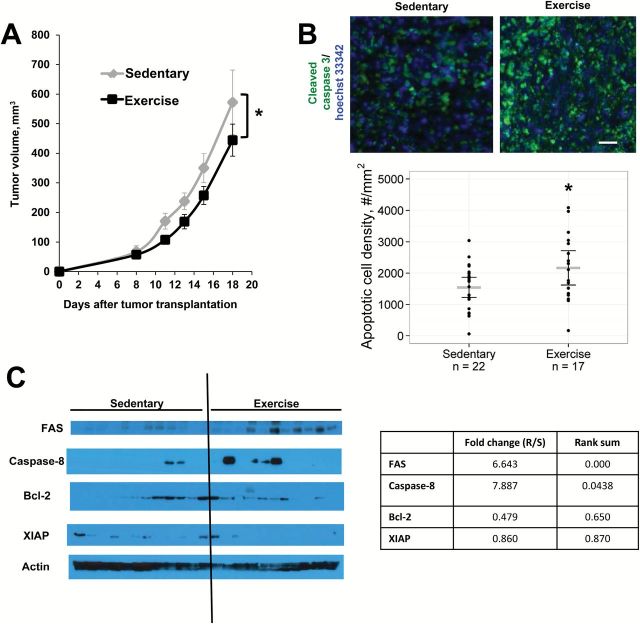
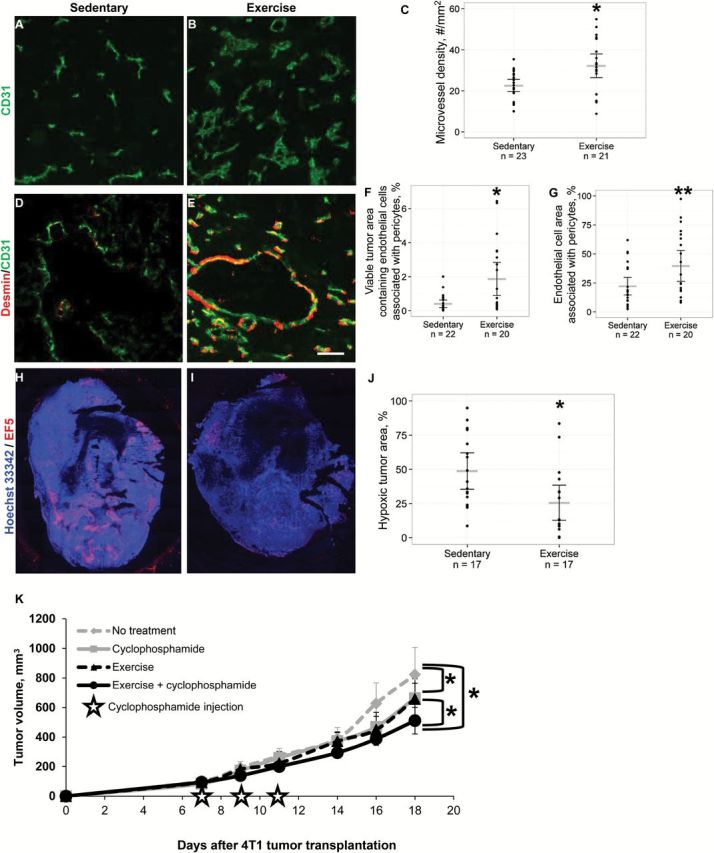
Exercise has been shown to improve postischemia perfusion of normal tissues; we investigated whether these effects extend to solid tumors. Estrogen receptor-negative (ER-, 4T1) and ER+ (E0771) tumor cells were implanted orthotopically into syngeneic mice (BALB/c, N = 11-12 per group) randomly assigned to exercise or sedentary control. Tumor growth, perfusion, hypoxia, and components of the angiogenic and apoptotic cascades were assessed by MRI, immunohistochemistry, western blotting, and quantitative polymerase chain reaction and analyzed with one-way and repeated measures analysis of variance and linear regression. All statistical tests were two-sided. Exercise statistically significantly reduced tumor growth and was associated with a 1.4-fold increase in apoptosis (sedentary vs exercise: 1544 cells/mm(2), 95% CI = 1223 to 1865 vs 2168 cells/mm(2), 95% CI = 1620 to 2717; P = .048), increased microvessel density (P = .004), vessel maturity (P = .006) and perfusion, and reduced intratumoral hypoxia (P = .012), compared with sedentary controls. We also tested whether exercise could improve chemotherapy (cyclophosphamide) efficacy. Exercise plus chemotherapy prolonged growth delay compared with chemotherapy alone (P < .001) in the orthotopic 4T1 model (n = 17 per group). Exercise is a potential novel adjuvant treatment of breast cancer.
Overview
The claims and statistics of this paper haven’t been checked yet.
Free: it reads the open-access text and checks the first 5 claims that cite a source we can check. Create a free account to check every claim.
Integrity signals
Registry
Cites
Statistics
Figures
Verification
Claims the paper makes
The claims and statistics of this paper haven’t been checked yet.
Free: it reads the open-access text and checks the first 5 claims that cite a source we can check. Create a free account to check every claim.
Claims other papers make about this one
Each is checked against this paper’s own text: does it say what the citing paper says it does?
The cited source says what the claim attributes to it.
In the citing paper
“Because exercise is a homeostatic physiological intervention, it also affects the tumor microenvironment (TME) (5-10).”
In the citing paper
“Beyond the acute increase in perfusion, exercise training (ExTr, accumulated bouts of exercise sessions) induces vessel normalization, thus enhancing tumor blood flow and oxygenation in subsequent resting conditions as well (6,7).”
In the citing paper
“Because most previous preclinical studies use ad libitum physical activity models (6,8,10), which do not properly capture human exercise behavior, we adapted a controlled exercise.”
In the citing paper
“Consistent with previous preclinical reports (6,7), we showed that ExTr induces vessel normalization, characterized by a larger number of vessels with higher pericyte coverage, resulting in less tumoral hypoxia.”
Self-check
Percentages, sums and reported differences re-computed from the paper’s own numbers.
The self-check needs the paper’s full text.
Citations
Cites
Bevacizumab plus Irinotecan, Fluorouracil, and Leucovorin for Metastatic Colorectal Cancer
Hurwitz, H., Fehrenbacher, L., Novotny, W., Cartwright, T., Hainsworth, J., Heim, W., Berlin, J., Baron, A., Griffing, S., Holmgren, E., et al. (2004) · New England Journal of Medicine · doi:10.1056/nejmoa032691 · Cited by 10,968
Paclitaxel–Carboplatin Alone or with Bevacizumab for Non–Small-Cell Lung Cancer
Sandler, A., Gray, R., Perry, M. C., Brahmer, J., Schiller, J. H., Dowlati, A., Lilenbaum, R., & Johnson, D. H. (2006) · New England Journal of Medicine · doi:10.1056/nejmoa061884 · Cited by 5,761
Hypoxia — a key regulatory factor in tumour growth
Harris, A. L. (2002) · Nature Reviews Cancer · doi:10.1038/nrc704 · Cited by 5,177
Paclitaxel plus Bevacizumab versus Paclitaxel Alone for Metastatic Breast Cancer
Miller, K., Wang, M., Gralow, J., Dickler, M., Cobleigh, M., Perez, E. A., Shenkier, T., Cella, D., & Davidson, N. E. (2007) · New England Journal of Medicine · doi:10.1056/nejmoa072113 · Cited by 3,081
Saltz, L. B., Clarke, S., Díaz-Rubio, E., Scheithauer, W., Figer, A., Wong, R., Koski, S., Lichinitser, M., Yang, T.-S., Rivera, F., et al. (2008) · Journal of Clinical Oncology · doi:10.1200/jco.2007.14.9930 · Cited by 2,955
Physical activity and survival after breast cancer diagnosis
Holmes, M. D. (2005) · JAMA · doi:10.1001/jama.293.20.2479 · Cited by 1,772
Principles and mechanisms of vessel normalization for cancer and other angiogenic diseases
Carmeliet, P., & Jain, R. K. (2011) · Nature Reviews Drug Discovery · doi:10.1038/nrd3455 · Cited by 1,675 · cited 1×
“Tumor blood vessels are structurally and functionally abnormal, resulting in heterogeneous intratumoral regions of hypoxia (1,2).”
BackgroundNormalization of the Vasculature for Treatment of Cancer and Other Diseases
Goel, S., Duda, D. G., Xu, L., Munn, L. L., Boucher, Y., Fukumura, D., & Jain, R. K. (2011) · Physiological Reviews · doi:10.1152/physrev.00038.2010 · Cited by 1,605 · cited 1×
“However, these effects are transient, lasting only days to weeks, which hinders long-term clinical use (16,17).”
BackgroundReck, M., von Pawel, J., Zatloukal, P., Ramlau, R., Gorbounova, V., Hirsh, V., Leighl, N., Mezger, J., Archer, V., Moore, N., et al. (2009) · Journal of Clinical Oncology · doi:10.1200/jco.2007.14.5466 · Cited by 1,505
Kinetics of vascular normalization by VEGFR2 blockade governs brain tumor response to radiation
Winkler, F., Kozin, S. V., Tong, R. T., Chae, S.-S., Booth, M. F., Garkavtsev, I., Xu, L., Hicklin, D. J., Fukumura, D., di Tomaso, E., et al. (2004) · Cancer Cell · doi:10.1016/j.ccr.2004.10.011 · Cited by 1,170 · cited 1×
“However, these effects are transient, lasting only days to weeks, which hinders long-term clinical use (16,17).”
Background
Research works printed but not linked: 1
- Jones LW Viglianti BL Tashjian JA Effect of aerobic exercise on tumor physiology in an animal model of human breast cancer. J Appl Physiol. 2010; 108(2): 343– 348. 19959769 PMC2822670 · DOI · Paper page
Cited by
Items 301–306 of 306
Parent-Roberge, H., Fontvieille, A., Poirier, L., Tai, L., Pavic, M., Fülöp, T., & Riesco, É. (2026) · Applied Physiology, Nutrition, and Metabolism · doi:10.1139/apnm-2025-0157
Shida, D. (2026) · Cancers · doi:10.3390/cancers18172883
“Furthermore, exercise promotes vascular normalization and hypoxia reduction within the tumor microenvironment [39], while creating an “exercise-induced metabolic shield” in organs like the liver by limiting nutrient availability for tumor growth [40].”
Grle, I., Grle, M., Prlić, J., Tirić, D., Tirić, B. G., Budimlić, J., Skender, N., Vukoja, M., Bazanov, B., Franjko, I., et al. (2026) · Physical Activity Exercise and Cancer · doi:10.55860/mwxe3541
“…through beta-adrenergic and Hippo-YAP signalling, voluntary running mobilising natural killer cells through epinephrine and interleukin-6, and aerobic exercise improving tumour perfusion and chemotherapy response in murine models (Betof et al., 2015; Dethlefsen et al., 2017; Pedersen et al., 2016).”
Exercise therapy in cancer prevention and treatment
Bliss, J. W., & Jones, L. W. (2026) · Nature Reviews Clinical Oncology · doi:10.1038/s41571-026-01201-7
“Preclinical studies to date have primarily focused on the former rationale, demonstrating that exercise-induced remodelling of TME physiology can alter intratumoural perfusion and oxygenation 114–117 .”
Self-citationPrehabilitation as a Strategy to Modulate the Tumor Microenvironment in Pancreatic Cancer
Sandeep, S., Schutt, J., Allenson, K., Stubbins, R., Zheng, J., Chen, S., & Dhala, A. F. (2026) · International Journal of Molecular Sciences · doi:10.3390/ijms27198900
“In pancreatic cancer, early translational work using patient-derived xenograft mouse models demonstrated that structured exercise during neoadjuvant therapy increased tumor vascularity and had more open microvessel lumens compared with non-exercising con-https trols [15].”
Castillo, H., Sebio-Garcia, R., Martínez‐Palli, G., Sisó, M., Gárriz, M., Sanfeliu, E., Brasó, F., Cebrecos, I., Torras, I., Quintas, L., et al. (2026) · PLoS ONE · doi:10.1371/journal.pone.0361188
Metadata
- Authors
- Betof, A. S., Lascola, C. D., Weitzel, D., Landon, C., Scarbrough, P. M., Devi, G. R., Palmer, G., Jones, L. W., & Dewhirst, M. W.
- Affiliations
- Memorial Sloan Kettering Cancer Center (US)
- Corresponding author
- Jones, Lee W.
- Dewhirst, Mark W.
- ORCID
- Venue
- JNCI: Journal of the National Cancer Institute
- Publisher
- Oxford University Press (OUP)
- Published
- 2015-03-12
- Volume
- 107
- Issue
- 5
- ISSN
- 0027-8874 (ISSN-L)
- 1460-2105
- PMC
- PMC4822524
- OpenAlex
- W2147288982
- Cited by
- 309
- References
- 35
- Citations by year
- 2026: 20 · 2025: 29 · 2024: 26 · 2023: 36 · 2022: 32 · 2021: 39 · 2020: 38 · 2019: 28 · 2018: 21 · 2017: 20 · 2016: 13 · 2015: 7
- FWCI
- 8.82
- Type
- journal article
- Language
- en
- Open access
- hybrid
- doi.org
- Licence
- cc-by-nc
- Locations
- JNCI Journal of the National Cancer Institute (publishedVersion, cc-by-nc)
- Europe PMC (PubMed Central) (publishedVersion, cc-by-nc)
- PubMed Central (publishedVersion, cc-by-nc)
- PubMed (publishedVersion)
- DukeSpace (Duke University) (submittedVersion, cc-by-nc-nd)
- Funders
- National Cancer Institute (R01CA040355, T32CA078586, P30CA008748)
- Topics
- Life Sciences › Biochemistry, Genetics and Molecular Biology › Molecular Biology › Angiogenesis and VEGF in Cancer
- Life Sciences › Biochemistry, Genetics and Molecular Biology › Cancer Research › Cancer, Hypoxia, and Metabolism
- Health Sciences › Medicine › Physiology (medical) › Cardiovascular and exercise physiology
- Keywords
- physical activity, breast cancer, tumor vascularity, tumor hypoxia, chemotherapy response, cyclophosphamide, apoptosis, angiogenesis, microvessel density, 4T1 cells, E0771 cells, tumor perfusion, adjuvant therapy, orthotopic tumor model
- MeSH terms
- Analysis of Variance, Animals, Cyclophosphamide, Female, Humans, Mammary Neoplasms, Experimental, Mice, Inbred BALB C, Microcirculation, Neoplasm Transplantation, Neovascularization, Pathologic, Random Allocation, Receptors, Estrogen, Exercise, Cell Hypoxia, Linear Models, Treatment Outcome, Apoptosis, Antineoplastic Agents, Alkylating, Cell Line, Tumor, Cell Proliferation, Mice
About these checks
Registry, retraction, Cites and statistics results are computed, not judged, with one exception: a printed reference that no index lists is read once by a model before it counts as a citation error. Claims are extracted by a model and kept only when their quote appears verbatim in the text; each cited source is then checked, with a model’s help, for whether it says what the claim relies on. Those verdicts can be wrong — read the claim’s quote and the cited source before relying on one.
Statistics and arithmetic are recomputed, not judged.
Confidence bands are shown only for fields calibrated on our annotated test set. None is calibrated yet, so no band is shown.
What counts as a claim ›How we measure confidence ›How we check this ›
Are you an author, or do you see a problem with this page? Request a review
Data sources
Bibliographic data: Semantic Scholar, OpenAlex, Crossref.
Contains information from the Semantic Scholar Academic Graph Datasets, made available under the ODC Attribution License (ODC-BY 1.0).
Semantic Scholar’s data is described in: Kinney, R., et al. (2023). The Semantic Scholar Open Data Platform. arXiv:2301.10140.
