

The DOI matches its Crossref record; 55 of the 58 references it cites were found in a registry or an index.
Gender Differences in Alzheimer Disease: Brain Atrophy, Histopathology Burden, and Cognition
Open accessAbstract
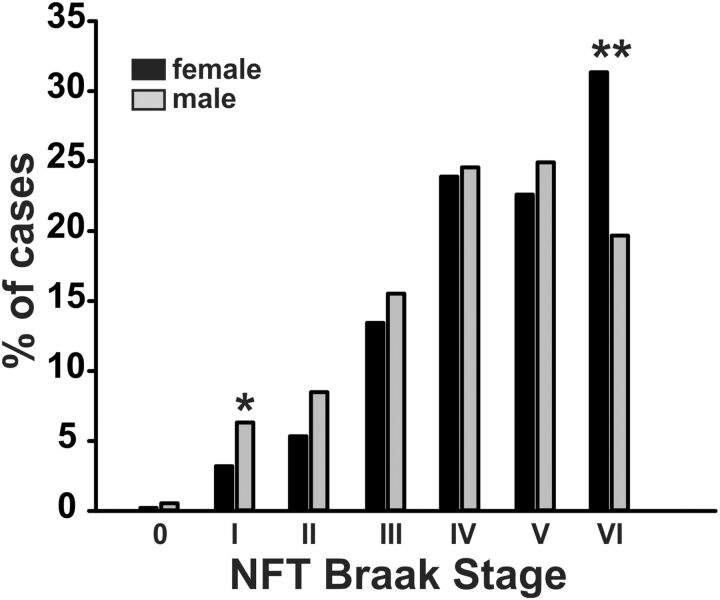
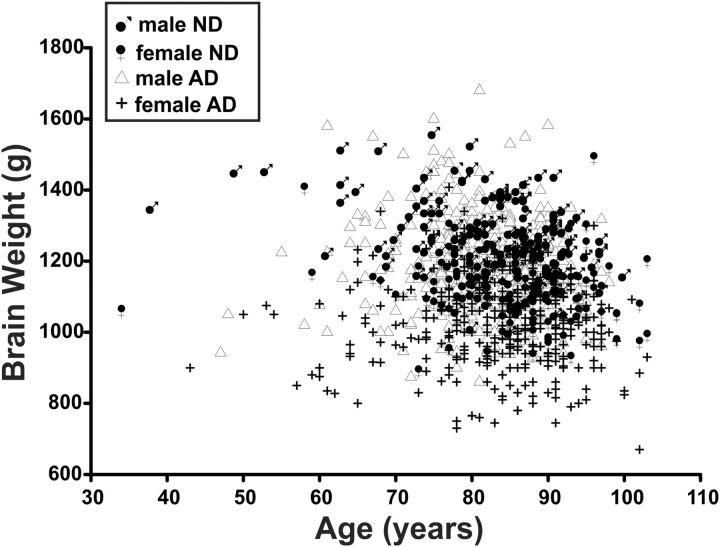
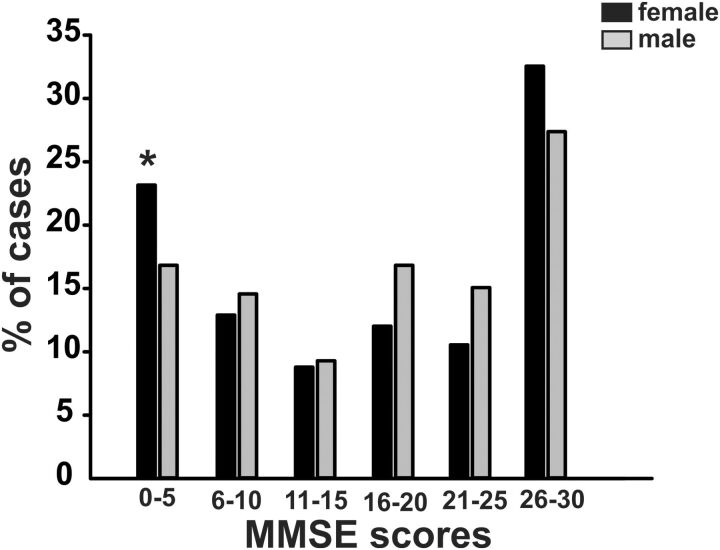
Multiple studies suggest that females are affected by Alzheimer disease (AD) more severely and more frequently than males. Other studies have failed to confirm this and the issue remains controversial. Difficulties include differences in study methods and male versus female life expectancy. Another element of uncertainty is that the majority of studies have lacked neuropathological confirmation of the AD diagnosis. We compared clinical and pathological AD severity in 1028 deceased subjects with full neuropathological examinations. The age of dementia onset did not differ by gender but females were more likely to proceed to very severe clinical and pathological disease, with significantly higher proportions having a Mini-Mental State Examination score of 5 or less and Braak stage VI neurofibrillary degeneration. Median neuritic plaque densities were similar in females and males with AD but females had significantly greater tangle density scores. In addition, we found that AD-control brain weight differences were significantly greater for females, even after adjustment for age, disease duration, and comorbid conditions. These findings suggest that when they are affected by AD, females progress more often to severe cognitive dysfunction, due to more severe neurofibrillary degeneration, and greater loss of brain parenchyma.
Overview
The claims and statistics of this paper haven’t been checked yet.
Run the check — free, no account needed. It reads the open-access text and checks the sources it cites.
Integrity signals
Registry
Cites
Statistics
Figures
Verification
Claims the paper makes
The claims and statistics of this paper haven’t been checked yet.
Run the check — free, no account needed. It reads the open-access text and checks the sources it cites.
Claims other papers make about this one
Each is checked against this paper’s own text: does it say what the citing paper says it does?
The cited source says what the claim attributes to it.
In the citing paper
“Recent studies suggest that women develop greater neurofibrillary degeneration, brain parenchymal loss, and cognitive decline.52,53,54”
From Sex differences in cognitive decline among US adults (2021) · cites this paper as [53]
Self-check
Percentages, sums and reported differences re-computed from the paper’s own numbers.
The self-check needs the paper’s full text.
Citations
Cites
McKhann, G. M., Knopman, D. S., Chertkow, H., Hyman, B. T., Jack, C. R., Kawas, C. H., Klunk, W. E., Koroshetz, W. J., Manly, J. J., Mayeux, R., et al. (2011) · Alzheimer's & Dementia · doi:10.1016/j.jalz.2011.03.005 · Cited by 18,657 · cited 1×
“Clinically defined measures used in this study included age at cognitive symptom onset and cognitive symptom duration, the latter defined as the number of years between cognitive symptom onset and death (14).”
MethodNeuropathological stageing of Alzheimer-related changes.
Braak, H., & Braak, E. (1991) · Acta Neuropathologica · doi:10.1007/bf00308809 · Cited by 16,123 · cited 13×
“Factors Affecting Alzheimer Disease-Control Brain Weight Difference, Multivariable Analysis Variable Complete Equation OR; 95% CI; Gender Values OR; 95% CI; p Value p Value Gender 1.3; 1.1–1.6; 0.01 0.6; 0.5–0.8; 0.001 Gender þ Braak stage 0.2; 0.4–0.4; <0.001 0.”
MethodInfluentialMirra, S. S., Heyman, A., McKeel, D., Sumi, S. M., Crain, B. J., Brownlee, L. M., Vogel, F. S., Hughes, J. P., Belle, G. V., Berg, L., et al. (1991) · Neurology · doi:10.1212/wnl.41.4.479 · Cited by 4,961 · cited 1×
“Neuritic plaque and neurofibrillary tangle densities were graded blindly as recommended by The Consortium to Establish a Registry for Alzheimer’s Disease (CERAD) with separate semiquantitative density estimates of none, sparse, moderate, or frequent (24).”
MethodMontine, T. J., Phelps, C. H., Beach, T. G., Bigio, E. H., Cairns, N. J., Dickson, D. W., Duyckaerts, C., Frosch, M. P., Masliah, E., Mirra, S. S., et al. (2012) · Acta Neuropathologica · doi:10.1007/s00401-011-0910-3 · Cited by 2,894
Self-citationα-Synuclein is phosphorylated in synucleinopathy lesions
Fujiwara, H., Hasegawa, M., Dohmae, N., Kawashima, A., Masliah, E., Goldberg, M. S., Shen, J., Takio, K., & Iwatsubo, T. (2002) · Nature Cell Biology · doi:10.1038/ncb748 · Cited by 2,174
Policy: NIH to balance sex in cell and animal studies
Clayton, J. A., & Collins, F. S. (2014) · Nature · doi:10.1038/509282a · Cited by 1,816 · cited 1×
“In response to this, the United States Congress approved the Revitalization Act in the early 1990s, requiring the inclusion of women in National Institutes of Health-funded clinical research (1).”
BackgroundBeach, T. G., Monsell, S. E., Phillips, L. E., & Kukull, W. (2012) · Journal of Neuropathology & Experimental Neurology · doi:10.1097/nen.0b013e31824b211b · Cited by 1,103 · cited 1×
“The accuracy of the clinical diagnosis of AD is low enough, with sensitivity ranging from 71% to 87% and specificity ranging from 44% to 71% (37), to increase the likelihood of false negative findings in studies lacking neuropathological diagnosis confirmation.”
BackgroundSelf-citationConsensus Recommendations for the Postmortem Diagnosis of Alzheimer’s Disease
(1997) · Neurobiology of Aging · doi:10.1016/s0197-4580(97)00057-2 · Cited by 981
Dementia and Alzheimer Disease Incidence: A Prospective Cohort Study
Kukull, W. A., Higdon, R., Bowen, J. D., McCormick, W. C., Teri, L., Schellenberg, G. D., van Belle, G., Jolley, L., & Larson, E. B. (2002) · Archives of Neurology · doi:10.1001/archneur.59.11.1737 · Cited by 806 · cited 1×
“Furthermore, Kukull et al (8), Rocca et al (9), and Knopman et al (33) did not find any incidence differences between males and females.”
BackgroundPhosphorylated TDP‐43 in frontotemporal lobar degeneration and amyotrophic lateral sclerosis
Hasegawa, M., Arai, T., Nonaka, T., Kametani, F., Yoshida, M., Hashizume, Y., Beach, T. G., Buratti, E., Baralle, F., Morita, M., et al. (2008) · Annals of Neurology · doi:10.1002/ana.21425 · Cited by 777
Self-citation
Research works printed but not linked: 2
- Gallyas, 1981, An argyrophil III method for the demonstration of fibrous neuroglia, Acta Morphol Acad Sci Hung, 29, 185
- Hyman, 1997, Consensus recommendations for the postmortem diagnosis of Alzheimer disease from the National Institute on Aging and the Reagan Institute Working Group on diagnostic criteria for the neuropathological assessment of Alzheimer disease, J Neuropathol Exp Neurol, 56, 1095, 10.1097/00005072-199710000-00002 · DOI · Paper page
Cited by
Sorted by citations
Items 101–135 of 135
Luo, W., Wen, H., Ge, S.-Q., Tang, C.-L., Liu, X.-F., & Lu, L.-M. (2022) · Frontiers in Aging Neuroscience · doi:10.3389/fnagi.2021.774804 · Cited by 3
“Sex hormone levels and sexual genetic differences determine nerve regeneration in the brain and facilitate axon guidance in two-way development of the vessels and nerves, and the differences between men and women include the most notable features of sex hormones based on body type and variable expression levels (Rosar…”
BackgroundFernández-Viadero, C., VerdugaVélez, R., & Crespo-Santiago, D. (2017) · Revista Española de Geriatría y Gerontología · doi:10.1016/s0211-139x(18)30073-8 · Cited by 3
Impact of sex differences on microglial function in Alzheimer’s disease
Figueiredo, E. V., Azevedo, C. V., Penitente, A. R., Pedrosa, V. R., da Silva, V. R. C., & Longo, B. M. (2026) · Alzheimer s Research & Therapy · doi:10.1186/s13195-026-02099-0 · Cited by 2
“Human studies suggest women may show greater NFT burden than men for a similar Aβ load in some cohorts and/or brain regions, which has been linked to greater brain atrophy and symptom in women [80–82].”
Tau-PET and CSF MTBR-tau243 comparisons validate increased tau aggregation in females
Robinson, C. G., Binette, A. P., Horie, K., Sato, C., Schindler, S. E., Bateman, R. J., Benzinger, T. L. S., Janelidze, S., Singleton, E. H., Stomrud, E., et al. (2026) · European Journal of Nuclear Medicine and Molecular Imaging · doi:10.1007/s00259-026-07934-y · Cited by 2
Treccarichi, S., Papa, C., Vinci, M., Cosentino, F., Scalia, G., Mostile, G., Zappia, M., Nicoletti, A., Pennisi, M., Musumeci, A., et al. (2026) · Scientific Reports · doi:10.1038/s41598-026-47948-y · Cited by 2
“In our cohort, among the 10 patients carrying pathogenic or likely pathogenic GBA variants (patients 10, 11, 15, 16, 17, 18, 19, 20, 21, and 35), only two individuals (patients 11 and 17) harboured GBA as the sole rare genetic finding identified by the targeted gene panel.”
Zeydan, B., & Kantarci, K. (2025) · Revue Neurologique · doi:10.1016/j.neurol.2025.06.015 · Cited by 2
Cheng, W., Zhang, D., Lei, L. L., & Li, K. (2024) · Journal of Gerontological Social Work · doi:10.1080/01634372.2024.2349603 · Cited by 2
“Overall, women have a higher prevalence of agitation behaviors and are more likely to exhibit verbally agitated and non-aggressive behaviors (Cohen-Mansfield et al., 1990, 2011), whereas men are more likely to exhibit physical aggression (Filon et al., 2016).”
Saati, H. (2024) · International Tinnitus Journal · doi:10.5935/0946-5448.20240014 · Cited by 2
Sex-specific regulation of angiogenin in Alzheimer’s disease
Jörg, M., Walz, L., Nathal, S., Kristen, M., Lietz, C., Müller, M., Nguyen, V. T. T., Ruffini, N., Winz, M., Gerber, S., et al. (2026) · Molecular Psychiatry · doi:10.1038/s41380-026-03656-7 · Cited by 1
Konishi, K., Spets, D. S., Fisher, P., Aroner, S. A., Sant, S. M., Prokopenko, D., Lokhande, H. A., Patel, R. P., Aizley, H. G., Smith, B., et al. (2025) · Journal of Alzheimer s Disease · doi:10.1177/13872877251366701 · Cited by 1
“68 Similarly, postmortem studies have found that women with AD had more severe tau pathology 24 and a stronger association between AD pathology and clinical symptoms compared to men.”
Han, Y., Huang, L., Zhou, Y., Zhu, Y., Huang, S., Huang, X., Li, D., Yan, J., & Su, W. (2025) · Aging Research · doi:10.26599/agr.2025.9340056 · Cited by 2
Étude descriptive de 32 cas de maladie d’Alzheimer au Sénégal
Djajhete, R., Sall, A., Bâ, D., Massamba, B. A., Faye, A., & Coumé, M. (2025) · NPG. Neurologie, psychiatrie, gériatrie/NPG · doi:10.1016/j.npg.2025.01.003 · Cited by 1
Serum β-secretase 1 (sBACE1) activity in subjective cognitive decline: an exploratory study
Cervellati, C., Trentini, A., Rosta, V., Passaro, A., Brombo, G., Renzini, C., Multhaup, G., & Zuliani, G. (2025) · GeroScience · doi:10.1007/s11357-025-01523-x · Cited by 1
“Intrigu-ingly, both animal and human studies showed an earlier and more severe AD pathology in females than in males [35–38].”
Kumar, G. M. (2022) · medRxiv · doi:10.1101/2022.11.26.22282736 · Cited by 1
MNI-FTD templates, unbiased average templates of frontotemporal dementia variants
Dadar, M., Manera, A., Fonov, V. S., Ducharme, S., & Collins, D. (2021) · Scientific Data · doi:10.1038/s41597-021-01007-5 · Cited by 1
Heterogeneity in Drug Recommendation Compliance: The case for Alzheimer’s disease in France
Chauvin, P., Sirven, N., Rapp, T., & Bellanger, M. M. (2020) · Journal de gestion et d économie médicales · doi:10.54695/jges.202.0093
Sex differences in CSF biomarkers of Alzheimer’s disease
Mielke, M. M. (2021) · Elsevier eBooks · doi:10.1016/b978-0-12-819344-0.00012-0 · Cited by 4
Rosende‐Roca, M., Ruiz, C. A., Esteban, E., Boada, M., Martínková, J., Mellino, S., & Chadha, A. S. (2021) · Elsevier eBooks · doi:10.1016/b978-0-12-819344-0.00017-x
Neuropathological Correlates of Apathy Progression in Alzheimer Disease and Related Dementias
Qi, Y. (., Goldberg, T. E., Kim, H., Devanand, D. P., & Lee, S. (2026) · Alzheimer Disease & Associated Disorders · doi:10.1101/2025.11.06.686966
Salvadó, G., Groot, C., Wisse, L. E. M., Vogel, J. W., Beach, T. G., Serrano, G. E., Reiman, E. M., Schneider, J. A., Bennett, D. A., Ossenkoppele, R., et al. (2026) · Acta Neuropathologica · doi:10.1007/s00401-026-03095-2
“Our observation that females exhibit higher tau levels is in line with several previous studies in humans [16, 30, 37, 54, 55] and animal models [44, 73].”
Self-citationAbdi, H., Sánchez‐Molina, D., Vilana, S. G., Azizi, S., Rahimi-Movaghar, V., & Haghighi, M. (2026) · Brain Research · doi:10.1016/j.brainres.2026.150580
Acosta-Martínez, M., Carter, V., Nessim, A., Murphy, S. R., Dhawan, J., Beach, T., Serrano, G., Sundermann, E., & Biegon, A. (2026) · International Journal of Molecular Sciences · doi:10.3390/ijms27198590
“The fact that MCI women and not MCI men are already showing a loss of NMDARs is consistent with studies demonstrating that compared to men, women experienced a greater pathological burden at earlier stages of the disease [45–49].”
Self-citationRanaldi, E. D. L. R. M. C., Johnson, N. H., Sawaya, A. P., Herrera, J. R., Kerr, N. A., Bramlett, H. M., Keane, R. W., Dietrich, W. D., & Vaccari, J. P. D. R. (2026) · Cells · doi:10.3390/cells15181658
“In addition, females are twice as likely to develop AD [45,46] and present neurofibrillary tangle pathology associated with clinical severity in post-mortem studies [47–49].”
Manjally, A. V., Fowler, A., Thanayangyuen, J., Cheval, M., Iordanov, M., Liljegren, D., Milord, Y., Park, J., Yamashita, E., Kieffer, A. C., et al. (2026) · bioRxiv (Cold Spring Harbor Laboratory) · doi:10.64898/2026.04.05.716600
“Women experience faster cognitive decline than men, reportedly with gender specific differences in cognitive profiles in the range of mild to moderate AD (Filon et al., 2016; Holland et al., 2013; Pusswald et al., 2015).”
Greater burden of Alzheimer's Co-pathology in women with Parkinson's disease dementia
Dunckley, N., Driver-Dunckley, E., Zhang, N., Serrano, G., Shill, H. A., Mehta, S., Belden, C. M., Tremblay, C., Atri, A., Adler, C. H., et al. (2026) · Journal of Parkinson's Disease · doi:10.1177/1877718x261470295
Self-citationA non-canonical androgen signaling pathway drives microglial activation and tau pathology in femalesPreprint
Chen, X., Muñoz-Mayorga, D., Lyu, X., Jati, S., Zhang, J. M., Rossitto, L.-A. M., Tao, Y., Zhao, S., Hui, E., Kauffman, A., et al. (2026) · Research Square · doi:10.21203/rs.3.rs-10286730/v1
“Pathologically, women on the AD continuum exhibit greater vulnerability to developing Tau pathology than men 3–6 , highlighting biological differences in disease progression that remain insufficiently characterized 7 .”
Xia, Y., Yuan, P., Fei, G., & Cheng, X. (2026) · Brain medicine : · doi:10.61373/bm026y.0051
Sex-dependent grey matter atrophy in Alzheimer’s disease progression
Mukherjee, C., Bajaj, S., Adhikari, B. M., & Dhamala, M. (2026) · Brain Communications · doi:10.1093/braincomms/fcag103
Salazar-Cea, M., Aros-Yáñez, C., & Álvarez-Villalobos, R. (2026) · ARS MEDICA Revista de Ciencias Médicas · doi:10.11565/arsmed.v51i2.2117
Sex Differences in Phenomenology of Behavioral and Psychological Symptoms of Dementia
Choudhury, S., Colman, S., Chu, L., Davies, S., Derkach, P., Elmi, S., Fischer, C., Gerretsen, P., Graff-Guerrero, A., Hussain, M., et al. (2025) · Neurodegenerative Diseases · doi:10.1159/000548713
“Females have greater vulnerability to AD risk factors and pathology [10–12], and have faster rates of cognitive decline in earlier stages of the disease and greater severity of cognitive deficits compared to their male counterparts with similar disease severity [12–14].”
Dumitrescu, L., Seto, M., Clifton, M. J., Gomez, M. L., Coughlan, G., Gifford, K., Jefferson, A., Jager, P. D. D., Bennett, D., Wang, Y.-L., et al. (2025) · Research Square · doi:10.21203/rs.3.rs-5938205/v1
“2, 4 However, the molecular factors that underlie these sex disparities remain poorly understood.”
Watermeyer, T. J., Atkinson, E., Howatson, G., McGill, G., Dodds, C., Ansdell, P., & Udeh-Momoh, C. T. (2024) · medRxiv · doi:10.1371/journal.pone.0306149
“A notable example is how hormones mediate the response to stress [10–12].”
Shaaban, C., Snitz, B., Tudorascu, D., Lopresti, B., Royse, S. K., Yu, Z., Aizenstein, H., Klunk, W., & Cohen, A. D. (2021) · Alzheimer's & Dementia · doi:10.1002/alz.056291
“Several postmortem 25-28 and neuroimaging 29-35 studies suggest that women have greater brain Aβ levels than men, while others have found no sex differences (postmortem, 36 neuroimaging, 29,37-41 and CSF 27,37,42 ).”
Brain Endothelial Cell Expression in Alzheimer’s Disease Showing Stage-Associated Changes
Zheng, Z. (2025) · Advances in Alzheimer s Disease · doi:10.4236/aad.2025.143003
Sex differences in neuroimaging biomarkers in healthy subjects and dementia
Massa, F., Arnaldi, D., Balma, M., Bauckneht, M., Chincarini, A., Ferraro, P. M., Grazzini, M., Lapucci, C., Meli, R., Morbelli, S. D., et al. (2021) · Elsevier eBooks · doi:10.1016/b978-0-12-819344-0.00009-0
Metadata
- Authors
- Filon, J. R., Intorcia, A. J., Sue, L. I., Vazquez Arreola, E., Wilson, J., Davis, K. J., Sabbagh, M. N., Belden, C. M., Caselli, R. J., Adler, C. H., Woodruff, B. K., Rapscak, S. Z., Ahern, G. L., Burke, A. D., Jacobson, S., Shill, H. A., Driver-Dunckley, E., Chen, K., Reiman, E. M., Beach, T. G., & Serrano, G. E.
- Affiliations
- University of Arizona (US)
- Corresponding author
- Serrano, Geidy E.
- ORCID
- Venue
- Journal of Neuropathology & Experimental Neurology
- Publisher
- Oxford University Press (OUP)
- Published
- 2016-06-11
- Volume
- 75
- Issue
- 8
- Pages
- 748-754
- ISSN
- 0022-3069 (ISSN-L)
- 1554-6578
- PMC
- PMC7299435
- OpenAlex
- W2418237732
- Cited by
- 143
- References
- 58
- Citations by year
- 2026: 20 · 2025: 26 · 2024: 13 · 2023: 20 · 2022: 21 · 2021: 19 · 2020: 6 · 2019: 9 · 2018: 6 · 2017: 2 · 2016: 1
- FWCI
- 5.33
- Type
- journal article
- Language
- en
- Open access
- hybrid
- doi.org
- Licence
- Locations
- Journal of Neuropathology & Experimental Neurology (publishedVersion, cc-by-nc)
- PubMed Central (publishedVersion, cc-by-nc)
- PubMed (publishedVersion)
- HighWire Press Open Archive (submittedVersion)
- Funders
- NIH
- National Institute of Neurological Disorders and Stroke (U24 NS072026)
- National Institute on Aging (P30 AG19610)
- Arizona Department of Health Services (211002)
- Arizona Biomedical Research Commission (4001, 0011, 05-901, 1001)
- Michael J. Fox Foundation for Parkinson's Research
- Topics
- Health Sciences › Medicine › Psychiatry and Mental health › Dementia and Cognitive Impairment Research
- Life Sciences › Neuroscience › Cellular and Molecular Neuroscience › Alzheimer's disease research and treatments
- Life Sciences › Neuroscience › Neurology › Neuroinflammation and Neurodegeneration Mechanisms
- Keywords
- Alzheimer's disease, sex differences, brain atrophy, neurofibrillary tangles, Braak stages, neuritic plaques, cognitive impairment, dementia severity, neuropathology, brain weight, Mini-Mental State Examination
About these checks
Registry, retraction, Cites and statistics results are computed, not judged, with one exception: a printed reference that no index lists is read once by a model before it counts as a citation error. Claims are extracted by a model and kept only when their quote appears verbatim in the text; each cited source is then checked, with a model’s help, for whether it says what the claim relies on. Those verdicts can be wrong — read the claim’s quote and the cited source before relying on one.
Statistics and arithmetic are recomputed, not judged.
Confidence bands are shown only for fields calibrated on our annotated test set. None is calibrated yet, so no band is shown.
What counts as a claim ›How we measure confidence ›How we check this ›
Are you an author, or do you see a problem with this page? Request a review
