

The identity and methylation status of the first transcribed nucleotide in eukaryotic mRNA 5’ cap modulates protein expression in living cells
Open accessPublished version of a preprint
The DOI matches its Crossref record; 68 of the 71 references it cites were found in a registry or an index.
Abstract
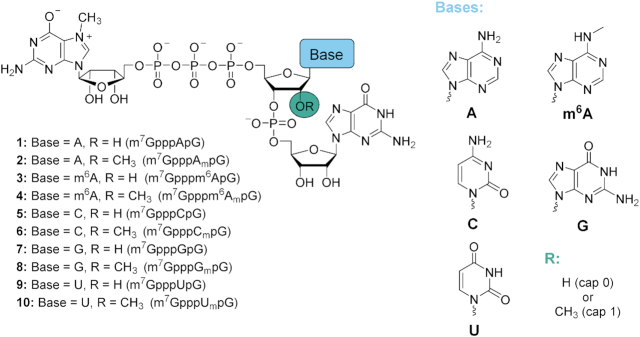
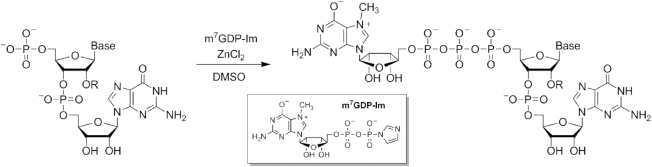
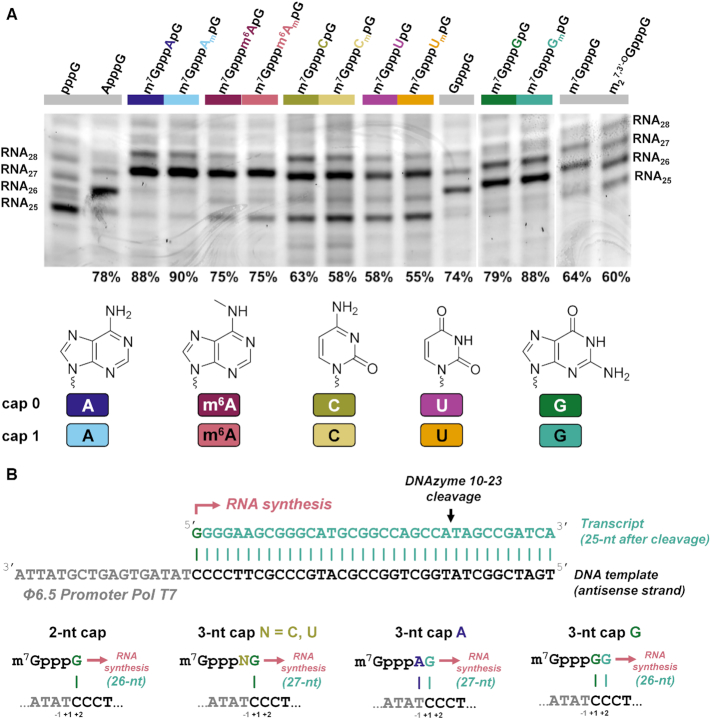
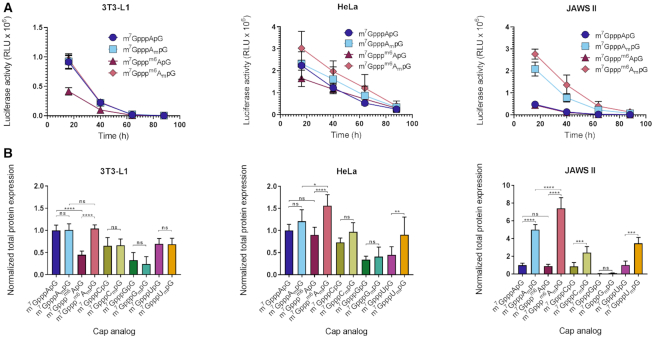
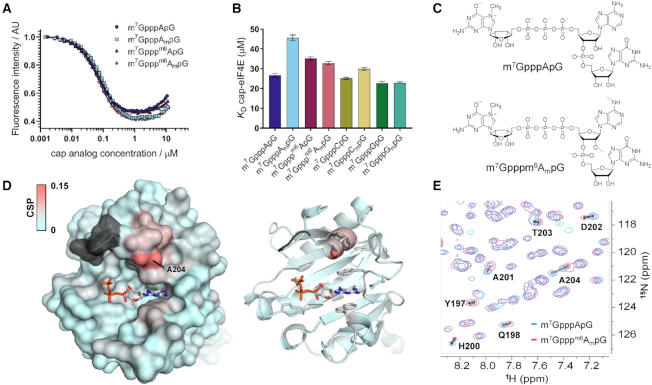
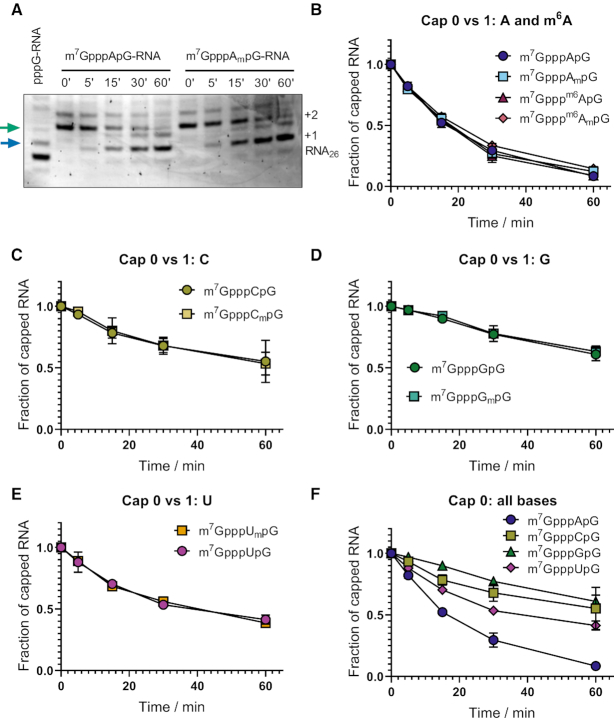
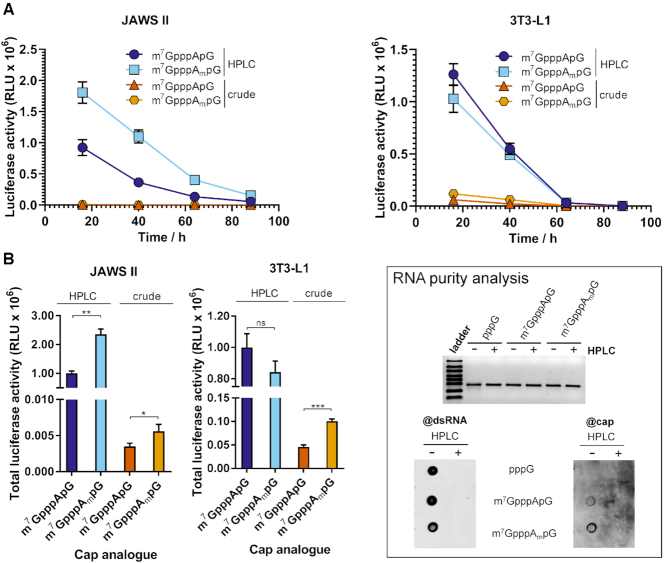
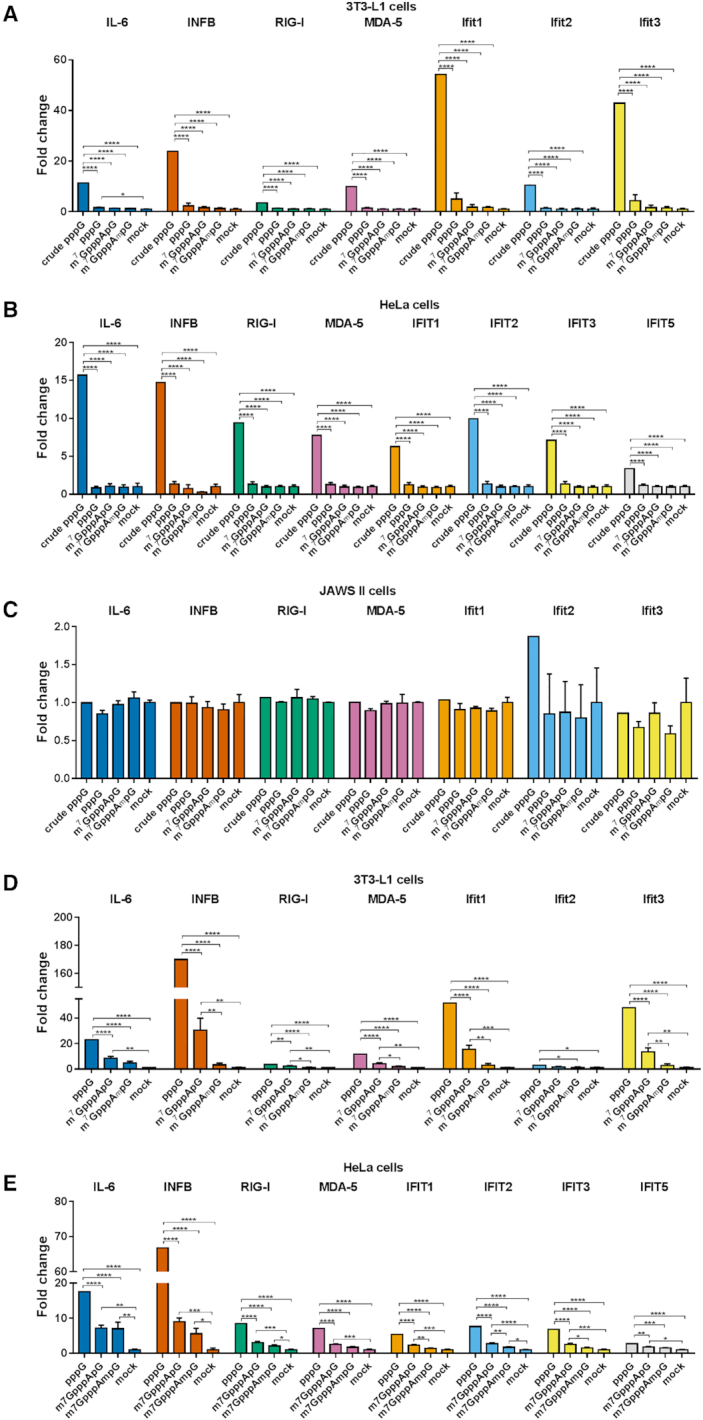
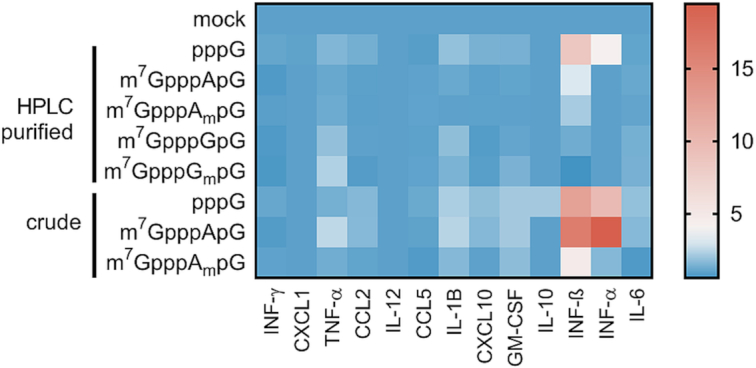
7-Methylguanosine 5' cap on mRNA is necessary for efficient protein expression in vitro and in vivo. Recent studies revealed structural diversity of endogenous mRNA caps, which carry different 5'-terminal nucleotides and additional methylations (2'-O-methylation and m6A). Currently available 5'-capping methods do not address this diversity. We report trinucleotide 5' cap analogs (m7GpppN(m)pG), which are utilized by RNA polymerase T7 to initiate transcription from templates carrying Φ6.5 promoter and enable production of mRNAs differing in the identity of the first transcribed nucleotide (N = A, m6A, G, C, U) and its methylation status (±2'-O-methylation). HPLC-purified mRNAs carrying these 5' caps were used to study protein expression in three mammalian cell lines (3T3-L1, HeLa and JAWS II). The highest expression was observed for mRNAs carrying 5'-terminal A/Am and m6Am, whereas the lowest was observed for G and Gm. The mRNAs carrying 2'-O-methyl at the first transcribed nucleotide (cap 1) had significantly higher expression than unmethylated counterparts (cap 0) only in JAWS II dendritic cells. Further experiments indicated that the mRNA expression characteristic does not correlate with affinity for translation initiation factor 4E or in vitro susceptibility to decapping, but instead depends on mRNA purity and the immune state of the cells.
Overview
The claims and statistics of this paper haven’t been checked yet.
Free: it reads the open-access text and checks the first 5 claims that cite a source we can check. Create a free account to check every claim.
Integrity signals
Registry
Cites
Statistics
Figures
Verification
Claims the paper makes
The claims and statistics of this paper haven’t been checked yet.
Free: it reads the open-access text and checks the first 5 claims that cite a source we can check. Create a free account to check every claim.
Claims other papers make about this one
Each is checked against this paper’s own text: does it say what the citing paper says it does?
The source backs part of the claim, not all of it — or backs it for a different population, condition or comparison.
In the citing paper
“However, for highly sensitive cells, such as primary immune cells, chemically modified mRNA with CleanCap AG is best for maximum expression and minimal intracellular nucleic acid recognition.52”
From Adenine base editor for knockout of proteins: A practical guide from design to analysis with updated MultiEditRbatch (2026) · cites this paper as [52]
Experimental — accuracy not yet measured
Self-check
Percentages, sums and reported differences re-computed from the paper’s own numbers.
The self-check needs the paper’s full text.
Citations
Cites
mRNA vaccines — a new era in vaccinology
Pardi, N., Hogan, M. J., Porter, F. W., & Weissman, D. (2018) · Nature Reviews Drug Discovery · doi:10.1038/nrd.2017.243 · Cited by 4,667 · cited 1×
“29 stability and translational potential of mRNA (55-58).”
BackgroundKarikó, K., Buckstein, M., Ni, H., & Weissman, D. (2005) · Immunity · doi:10.1016/j.immuni.2005.06.008 · Cited by 2,728
mRNA-based therapeutics--developing a new class of drugs
Sahin, U., Karikó, K., & Türeci, Ö. (2014) · Nature Reviews Drug Discovery · doi:10.1038/nrd4278 · Cited by 2,474 · cited 1×
“For clinical gene therapy applications it is beneficial to apply mRNAs with superior translational properties and improved stability (22).”
BackgroundA promoter-level mammalian expression atlas
The FANTOM Consortium and the RIKEN PMI and CLST (DGT) (2014) · Nature · doi:10.1038/nature13182 · Cited by 1,982
Karikó, K., Muramatsu, H., Welsh, F. A., Ludwig, J., Kato, H., Akira, S., & Weissman, D. (2008) · Molecular Therapy · doi:10.1038/mt.2008.200 · Cited by 1,930 · cited 1×
“29 stability and translational potential of mRNA (55-58).”
BackgroundImmune Signaling by RIG-I-like Receptors
Loo, Y.-M., & Gale, M. (2011) · Immunity · doi:10.1016/j.immuni.2011.05.003 · Cited by 1,875 · cited 1×
“Knowing that the presence of dsRNA impurities, which are commonly formed as a byproducts of IVT (52), stimulates intracellular nucleic acid receptors (44,53), we hypothesized that the methylation status of the first transcribed nucleotide may have differential effect in the case of purified and non-purified IVT mRNAs.”
BackgroundInnate Immune Pattern Recognition: A Cell Biological Perspective
Brubaker, S. W., Bonham, K. S., Zanoni, I., & Kagan, J. C. (2015) · Annual Review of Immunology · doi:10.1146/annurev-immunol-032414-112240 · Cited by 1,475
Genome-wide analysis of mammalian promoter architecture and evolution
Carninci, P., Sandelin, A., Lenhard, B., Katayama, S., Shimokawa, K., Ponjavic, J., Semple, C. A. M., Taylor, M. S., Engström, P. G., Frith, M. C., et al. (2006) · Nature Genetics · doi:10.1038/ng1789 · Cited by 1,350 · cited 1×
“For instance, in budding yeast a strong preference to start transcription of proteincoding genes with purines (A and G) was observed (16,17), whereas in human cells m(7)G-capped mRNAs frequently start with A,G, C, and m(6)A, but not U, which is used more than 100-times less frequently (18-20).”
BackgroundSchwartz, S., Mumbach, M. R., Jovanovic, M., Wang, T., Maciag, K., Bushkin, G. G., Mertins, P., Ter-Ovanesyan, D., Habib, N., Cacchiarelli, D., et al. (2014) · Cell Reports · doi:10.1016/j.celrep.2014.05.048 · Cited by 1,216
Reversible methylation of m6Am in the 5′ cap controls mRNA stability
Mauer, J., Luo, X., Blanjoie, A., Jiao, X., Grozhik, A. V., Patil, D. P., Linder, B., Pickering, B. F., Vasseur, J.-J., Chen, Q., et al. (2017) · Nature · doi:10.1038/nature21022 · Cited by 1,062
Cited by
Kim, J., Eygeris, Y., Gupta, M., & Sahay, G. (2021) · Advanced Drug Delivery Reviews · doi:10.1016/j.addr.2020.12.014 · Cited by 514
A Comprehensive Review of mRNA Vaccines
Gote, V., Bolla, P. K., Kommineni, N., Butreddy, A., Nukala, P. K., Palakurthi, S. S., & Khan, W. (2023) · International Journal of Molecular Sciences · doi:10.3390/ijms24032700 · Cited by 457
“These findings prove the importance of the 5′ capping structure for efficiently targeting DCs and generating a desired immune response [14].”
BackgroundCap 1 Messenger RNA Synthesis with Co‐transcriptional CleanCap ® Analog by In Vitro Transcription
Henderson, J. M., Ujita, A., Hill, E., Yousif‐Rosales, S., Smith, C., Ko, N., McReynolds, T., Cabral, C. R., Escamilla‐Powers, J. R., & Houston, M. E. (2021) · Current Protocols · doi:10.1002/cpz1.39 · Cited by 231
“Recent work from Sikorski et al. (2020) supports the concept of co-transcriptional trimeric cap analogs, with results showing increased gene expression by cap 1 versus cap 0 in certain cell types.”
BackgroundMethodWang, Y.-S., Kumari, M., Chen, G.-H., Hong, M.-H., Yuan, J. P.-Y., Tsai, J.-L., & Wu, H.-C. (2023) · Journal of Biomedical Science · doi:10.1186/s12929-023-00977-5 · Cited by 173
Roles of RNA Methylation on Tumor Immunity and Clinical Implications
Zhang, M., Song, J., Yuan, W., Zhang, W., & Sun, Z. (2021) · Frontiers in Immunology · doi:10.3389/fimmu.2021.641507 · Cited by 161
Metadata
- Authors
- Sikorski, P. J., Warminski, M., Kubacka, D., Ratajczak, T., Nowis, D., Kowalska, J., & Jemielity, J.
- Affiliations
- University of Warsaw (PL)
- Division of Biophysics, Institute of Experimental Physics, Faculty of Physics, University of Warsaw, Pasteura 5, 02-093 Warsaw, Poland
- Medical University of Warsaw (PL)
- Corresponding author
- Sikorski, Pawel J
- Kowalska, Joanna
- Jemielity, Jacek
- ORCID
- Venue
- Nucleic Acids Research
- Publisher
- Oxford University Press (OUP)
- Published
- 2020-01-27
- Volume
- 48
- Issue
- 4
- Pages
- 1607-1626
- ISSN
- 0305-1048 (ISSN-L)
- 1362-4962
- PMC
- PMC7038993
- OpenAlex
- W3004398293
- Cited by
- 142
- References
- 71
- Citations by year
- 2026: 18 · 2025: 20 · 2024: 29 · 2023: 27 · 2022: 23 · 2021: 17 · 2020: 8
- FWCI
- 6.08
- Type
- journal article
- Language
- en
- Open access
- gold
- doi.org
- Licence
- Locations
- Nucleic Acids Research (publishedVersion, cc-by-nc)
- bioRxiv (Cold Spring Harbor Laboratory) (acceptedVersion, cc-by-nc-nd)
- PubMed Central (publishedVersion, cc-by-nc)
- PubMed (publishedVersion)
- Funders
- National Science Centre, Poland (UMO-2016/21/B/ST5/02556, UMO-2018/31/D/NZ1/03526, UMO-2017/24/T/NZ1/00345, UMO-2016/20/S/ST5/00362)
- Topics
- Life Sciences › Biochemistry, Genetics and Molecular Biology › Molecular Biology › RNA modifications and cancer
- Life Sciences › Biochemistry, Genetics and Molecular Biology › Molecular Biology › RNA and protein synthesis mechanisms
- Life Sciences › Biochemistry, Genetics and Molecular Biology › Molecular Biology › RNA Research and Splicing
- Keywords
- mRNA 5' cap, 7-methylguanosine, 2'-O-methylation, N6-methyladenosine, T7 RNA polymerase, protein expression, dendritic cells, immune status, decapping
- MeSH terms
- Animals, Gene Expression Regulation, HeLa Cells, Humans, Methylation, Nucleotides, Protein Processing, Post-Translational, RNA Caps, RNA, Messenger, Transcription, Genetic, Protein Biosynthesis, Eukaryotic Initiation Factor-4E, Eukaryota
About these checks
Registry, retraction, Cites and statistics results are computed, not judged, with one exception: a printed reference that no index lists is read once by a model before it counts as a citation error. Claims are extracted by a model and kept only when their quote appears verbatim in the text; each cited source is then checked, with a model’s help, for whether it says what the claim relies on. Those verdicts can be wrong — read the claim’s quote and the cited source before relying on one.
Statistics and arithmetic are recomputed, not judged.
Confidence bands are shown only for fields calibrated on our annotated test set. None is calibrated yet, so no band is shown.
What counts as a claim ›How we measure confidence ›How we check this ›
Are you an author, or do you see a problem with this page? Request a review
Data sources
Bibliographic data: Semantic Scholar, OpenAlex, Crossref.
Contains information from the Semantic Scholar Academic Graph Datasets, made available under the ODC Attribution License (ODC-BY 1.0).
Semantic Scholar’s data is described in: Kinney, R., et al. (2023). The Semantic Scholar Open Data Platform. arXiv:2301.10140.
